Tuesday, April 08, 2014

SFIFF57—LATINBEAT

National cinemas and international film festivals go together like meat and salt, and I'm especially pleased that the 57th edition of the San Francisco International Film Festival (SFIFF) has gone elbows on the table with no less than nine films from the IberoAmerican and Latin American sectors. In alphabetical order:

All About the Feathers / Por Las Plumas, Neto Villalobos, Costa Rica (2013)—A security guard who wants to get into the cockfighting trade buys, befriends, and becomes inseparable from his rooster protégé Rocky, in this winsome feature debut from Costa Rican director Neto Villalobos. As Nicole Gluckstern has noted in her SFIFF program capsule, All About the Feathers is a "subtle, absurdist comedy" that hinges on the stellar performances of its mostly non-professional cast. "Sedately paced, yet quietly observational, the near-documentary feel of this quixotic fiction is enhanced by ... astute cinematography." Villalobos is expected to attend the festival. IMDb. Facebook.

All About the Feathers had its world premiere in the Discovery sidebar at the 2013 Toronto International Film Festival where Diana Sanchez characterized the film as "a bromance between a man and his rooster." She added: "Villalobos cultivates a dry comic style reminiscent of early Jim Jarmusch: cockeyed, minimalist, and affectionately attentive to behavioral quirks—both human and avian." The film followed up with its U.S. premiere last month at the Miami International, which awarded Villalobos its Encuentros Award the previous year, enabling the film to achieve completion. At Cultist, Hans Morgenstern praised the film's deadpan humor, warm wit, and resemblances to the films of Wes Anderson "without being too cute about it." He writes: "First-time director Neto Villalobos, who also wrote and edited the film, shows a keen eye for timing throughout the film, which runs a neat 85 minutes. He lets the camera linger on many scenes, building on a rhythm that seems to celebrate a love for the gradually unfolding moment and the Sisyphean myth of persistence. His original style never feels slow or dull, as it allows for the layers of ironic behavior to pile up for genuine laughs, well-earned by the charms of these characters." Univers/Ciné conducted a video interview in Spanish (with French subtitles) wherein Villalobos outlines the film's development over a persistent seven years. Another Spanish video interview can be found at LatAm Cinema.

The Amazing Catfish / Los insólitos peces gato, Claudia Sainte-Luce, Mexico (2013)—Set in Guadalajara, The Amazing Catfish follows the quiet transformation of a solitary young woman informally adopted and absorbed into a rambunctious matriarchy in a state of crisis. Filmed by Claire Denis' long-time cinematographer, Agnès Godard, Claudia Sainte-Luce's debut feature—based loosely on events from her own life—blends a wry and moving naturalism with moments of inspired comedy. IMDb. Wikipedia.

The film premiered at the Locarno International Film Festival, where it won two Junior Jury Awards and was a nominee for the Golden Leopard. It had its North American premiere in the Discovery sidebar at the 2013 Toronto International Film Festival, where programmer Diana Sanchez noted: "Some families we're born into; some we build. And some families simply come to us, unannounced, when we least expect it. The story of The Amazing Catfish falls into that last category." Amazing Catfish went on to win Toronto's FIPRESCI Discovery Prize. Eric Ortiz Garcia interviewed Claudia Sainte-Luce for Twitch at the 2013 Morelia International. He determined that the film's title came from the fact that catfish live together in families, which Sainte-Luce likened to the family in her film. "I think every member of the family is amazing," she told Garcia, "and their force is staying together."

Bad Hair / Pelo Malo, Mariana Rondón, Peru / Venezuela (2013)—A nine-year-old boy's preening obsession with straightening his hair elicits a tidal wave of homophobic panic in his hard-working mother in this tender but clear-eyed coming-of-age tale from Venezuelan writer-director Mariana Rondón. As Dennis Harvey amplifies in his SFIFF program capsule: "Without ever spelling anything out, Mariana Rondón's prize-winning feature addresses potent issues of economic pressure and homophobia within the family unit. She displays a fine understanding of the unspoken tensions that can create a divide—and the occasional words said in anger that can seal it. Bad Hair is a finely acted, deceptively small-scaled drama that subtly works its way toward a big impact." Mariana Rondón is expected to attend the festival. IMDb. Wikipedia. Facebook.

Winner of the Golden Seashell and the Sebastiane Award at the San Sebastián International Film Festival; Best Director and Screenplay at the Mar del Plata Film Festival; the Bronze Alexander and the FIPRESCI Prize at the Thessaloniki Film Festival; a Special Jury Prize at the Havana Film Festival; and awards for Best Female Performance by Samantha Castillo at the Montréal Festival of New Cinema and the Torino International Festival of Young Cinema, Bad Hair has likewise garnered unanimous critical acclaim. At the Toronto International, Diana Sanchez writes: "The slippery nature of identity—how it forms in us, the ways it tells us how we might want to look or who we desire—is at the heart of this third feature from Venezuelan writer-director Marina Rondón." At Variety, Jay Weissberg proclaims that "Mariana Rondón's impressively multilayered drama brings a powerful specificity to the story of a boy and his embittered single mother." Weissberg furthers: "Though Rondón had a script, she never showed it to the cast, preferring to work with them through improvisation. The results are a testament to the skills of all concerned, and performances are uniformly strong." At The Hollywood Reporter, David Rooney concurs with the film's strength as "a spare neorealist drama that holds attention and emotional involvement with its deft balance of toughness and sensitivity." He contextualizes: "In loose scenes drawn out of improvisation work with the naturalistic actors, the standoff between mother and son is etched with unflinching honesty. Rondón's detached observational approach and parsimoniousness with plot details may be frustrating for audiences wanting conventional storytelling. But a complex, compassionate picture emerges of the external forces that can cloud a mother's love, and of the lengths of abnegation to which a child will go to secure a parent's affection." At IndieWire, Vanessa Martinez finds Bad Hair "a bold, gripping drama." At Twitch, Pedro Ponte observes: "Caracas becomes a character in itself, a violent, hostile character, with its largely crowded, prison-like apartment blocks where families live cramped and hopeless."

Club Sándwich, Fernando Eimbcke, Mexico (2013)—While vacationing at a seaside resort, a single mother faces the inevitable when her 15-year-old son—and best friend—finds himself overwhelmingly drawn to a girl his own age. Mexican writer-director Fernando Eimbcke explores the awkwardness of both adolescence and parental separation anxiety with great sensitivity and a decidedly light comic touch. As stated by Gustavus Kundahl in his SFIFF program capsule: "In limning what may be the least verbal romance in cinema history, director Fernando Eimbcke employs a delightful restraint that brings forth an intimacy, acuity and comic release that few films can match." Fernando Eimbcke is expected to attend the festival. IMDb. Wikipedia.

Winner of the Silver Seashell for Best Director at the San Sebastián International Film Festival, Fernando Eimbcke proved as charming (and funny!) as his films when we met last Fall at the Morelia International Film Festival where Club Sándwich played to his enthusiastic fanbase. At Variety, Rob Nelson extols Club Sándwich as the "essence of evocative simplicity" and "a minimalist film with maximum pathos." At The Hollywood Reporter, David Rooney's bottom line is that Club Sándwich is "an intimate snapshot of separation anxiety" and concludes: "This is a modestly scaled film, but a refreshing one, laced with unforced humor. Eimbcke's observational style is dry and detached yet perceptive, channeled through the limpid gaze of Maria Secco's fixed camera. The Hockney-esque composed shots of the hotel swimming pool are used with particular effectiveness, and the lethargic rhythms of Mariana Rodriguez's editing are essential to the movie's general restraint. There's not a false note in the performances, from the internalized work of the two young leads to the more expressive countenance of [Maria Renee] Prudencio's Paloma, herself not so far removed from adolescence in her tender vulnerability." The Film Experience interviews Dánae Reynaud. At Keyframe Daily, David Hudson rounds up the reviews from the film's New York Film Festival screening.

Coast of Death / Costa da Morte, Lois Patiño, Spain (2013)—At any given film festival, there always seems to be a film that eludes me and, earlier this year at the Palm Springs International Film Festival (PSIFF), that film was Coast of Death, which sold out before I arrived, and had no screener for press review. Winner of the Best Emerging Director at the Locarno Film Festival, Lois Patiño directed, shot and edited this debut feature, an experimental documentary billed by PSIFF as a gorgeous and magical film about the people, land and sea that make up this special place in the far northwest region of Galicia, Spain. Lois Patiño is expected to attend SFIFF57. Official site. IMDb.

At Nonfics, Daniel Walber describes Coast of Death as "a starkly beautiful documentary about nature's troubled relationship with mankind, set on the rough coast of Northeastern Spain. Director Lois Patiño transcends the typical fare of this genre with an inspired device that splits the audience's perspective between the landscape and its people." Walber observes that the "governing style of the film, present[s] the inhabitants of Galicia as tiny figures surrounded by the towering beauty of their environment" but that Patiño allows the audience to hear what these Galicians are saying, no matter how distant. "With this device," Walber concludes, "Patiño can play with the relationship between Galicia and the Galicians. …The people are in the landscape and the landscape is in the people, and Costa da Morte is a beautifully crafted exploration of this simultaneity. And while it enmeshes itself in the particular topography of Galicia, it's hard to imagine a place that wouldn't have some relationship with this same natural dialog."

At Sound on Sight, Christopher Clemente has a more guarded perspective: "Characterized by the titled location, Costa Da Morte is an amorous tale like no other. A love affair between its maker, Lois Patiño, and its coastal surroundings, the film is a small, intimate display of compassion between cinematographer and landscape. Capturing beauty and immortalizing natural liveliness is indeed accomplished with great triumph by the young director, but unfortunately for the masses, that same director might be the film's biggest and possibly only fan." Also: "Yet this is so much more than a nature documentary; the film stimulates the senses. Close your eyes and you are transported to Galica, which isn't the worst of places to spend 80 minutes, but may feel like 70 minutes too long. Because the film doesn't use a structured script and character development, aside from the embodiment of the coast itself, the journey can seem a little too prolonged and a bit too personalized from the filmmaker's point of view." At The Film Experience, Glenn Dunks more fairly negotiates spectatorial expectation by accepting Coast of Death on its own terms: "Costa da Morte is the type of film I would expect more from the people that brought us Sweetgrass and Leviathan. Patiño’s film may have found itself under the banner of 'avant-garde' thanks to its lack of traditional documentary elements such as talking heads and overriding narrative, but it's far more standard than the term 'avant-garde' would suggest. It's a nature documentary first and foremost; an anthropological study into the way people integrate. For some I guess that's weird and strange, but for me it's just life."

History of Fear / Historia del miedo, Benjamín Naishtat, Argentina / France / Germany / Uruguay / Qatar (2014)—Paranoia runs rampant in this accomplished first feature, instilling a disorienting sense of dread in the viewer. Are the strange occurrences in an affluent Buenos Aires suburb evidence that the skittish residents are actually being targeted? Naishtat foregoes ready explanations or assurances in favor of foreboding suggestions in a film that is sprawling both in scope and implications but astonishingly exacting in its execution. Official site [Spanish]. IMDb. Wikipedia.

History of Fear had its premiere in the competition section of the 64th Berlin International Film Festival. At Variety, Peter Debruge notes that in Naishtat's hands, "the subtext intimidates even as what's happening on the surface sometimes seems inscrutable, the helmer aiming not to confuse so much as to allow audiences to project their own interpretations." The bottom line for Boyd von Hoeij at The Hollywood Reporter is that History of Fear is "an impressive debut feature that relies on visuals and the power of suggestion to talk about abstract notions such as angst." At IndieWire, Eric Kohn writes: "Buenos Aires is a haven for paranoia and confusion in Argentinian writer-director Benjamín Naishtat's mesmerizing debut History of Fear, though its title is something of a misnomer. Rather than chronicling the timeline of the listless quality that characterizes Argentina's suburban class—and, by extension, those around the world—History of Fear hypnotically sets its gaze on the present. Borrowing the beats of a disaster movie without ever giving the invisible threat a name, Naishtat explores the tenuous constructs that allow a subset of the population to deny the harsher ingredients of the world beyond their safety zone—until it's thrust right in front of them."

Manos Sucias, Josef Wladyka, USA / Colombia (2014)—A reluctant smuggler and his eager neophyte brother shepherd a dangerous narco-torpedo up the coast of Colombia, posing as fishermen. Paramilitary, guerrillas and hardscrabble desperation suffuse every inch of the jungle and waters that surround them, eager to separate the siblings from their only opportunity to escape the circumstances of their lives. Manos Sucias is the recipient of two 2013 San Francisco Film Society KRF Filmmaking grants. Director and co-writer Josef Kubota Wladyka, co-writer Alan Blanco, and producers Elena Julia Greenlee and Márcia Nunes are expected to attend the festival. IMDb.

The Militant / El Lugar del Hijo, Manolo Nieto, Argentina / Uruguay (2013)—As noted by Miguel Pendás in his SFIFF program capsule, a packinghouse workers strike forms the backdrop to this coming-of-age story set during the economic crisis in 2002 Uruguay. "This sensitive, multilayered film, brimming with metaphor and suggestion," Pendás writes, "was the most-awarded film at the Havana Film Festival, winning second place for best narrative feature, best cinematography and the film critics' FIPRESCI Prize." IMDb. Facebook.

Jonathan Holland's bottom line at The Hollywood Reporter is that The Militant is a "deceptively rambling, serious-minded coming-of-age drama with a sharp political point, built around a central performance that fascinatingly combines blankness and intensity." Comparing Nieto's effort with Santiago Mitre's El Estudiante, in its focus on "the political disenchantment of a disenfranchised generation", Holland synopsizes: "It's a comic, fish-out-of-water setup that generates some broad verbal and visual comedy, but far more urgent themes are bubbling under the surface, themes relating to a generation that has lost its way under the burden of a bad political and economic inheritance, consisting of people who are playing the roles of political activists without quite knowing what it is that political activists do."

The Reconstruction / La reconstrucción, Juan Taratuto, Argentina (2013)—"The Reconstruction's beauty," Judy Bloch writes in her SFIFF program capsule, "is in its challenge: to make an asocial character human. As in Bresson, empathy comes through the smallest revelations. Pay close attention to them, as the director Juan Taratuto and his star [Diego] Peretti have so skillfully done. Each character in this fine ensemble contributes to the others' redemption. In this way, love proves transmutable." Peretti won Best Actor at the Havana Film Festival and director Taratuto won the Critics Choice Award at the Valladolid International Film Festival. IMDb.

At The Hollywood Reporter, Jonathan Holland observes that one of the film's most unique accomplishments is "its directorial U-turn from comedy to tightly focused, character-based drama for both Argentinian director Juan Taratuto and star Diego Peretti." He continues: "Particularly strong in its atmospherics and performances, especially from Peretti, who reveals previously unsuspected depths, this miniature tale of a damaged heart is admirable."

SFIFF57—Michael Hawley Peruses the Line-up: Special Programs

The SF Film Society (SFFS) revealed the full line-up for the eagerly anticipated 57th San Francisco International Film Festival (SFIFF57) at a Fairmont Hotel press conference last Tuesday. In addition to the previously announced opening and closing night films, Founders Directing Award and live music events, the following special programs were unveiled by Executive Director Noah Cowan and SFFS's team of long-standing programmers.

Writer and film historian David Thomson will receive SFIFF57's Mel Novikoff Award, which "acknowledges an individual or institution whose work has enhanced the filmgoing public's knowledge and appreciation of world cinema." The sure-to-be engaging Thomson will be interviewed by author Geoff Dyer, followed by a screening of Preston Sturges' 1941 screwball comedy, The Lady Eve, with Barbara Stanwyck and Henry Fonda.

The festival's 2014 Kanbar Award for screenwriting will go to Stephen Gaghan (Traffic, Rules of Engagement), in a program that will feature a screening of 2005's Syriana.

The Persistence of Vision Award, which "honors the achievement of a filmmaker whose main body of work is outside the realm of narrative feature filmmaking," has been awarded to British filmmaker (Young Soul Rebels) and installation artist Isaac Julien. The on-stage interview will be conducted by none other than writer / critic B. Ruby Rich. A showing of Julien's 2010 installation piece, Ten Thousand Waves starring Maggie Cheung, will follow their conversation.

This year's Centerpiece Film is going to be Gia Coppola's teen drama Palo Alto, adapted from the short story collection written by James Franco (who also has a significant role in the film). Director Coppola, who happens to be Francis Ford's granddaughter, is expected to attend this Centerpiece presentation. (Palo Alto opens in theaters on May 16.)

A Conversation with K.K. Barrett, featuring the renowned production designer of such films as Her, Where the Wild Things Are and Being John Malkovich, has been added to the festival's Live & Onstage sidebar.

Amongst this year's Master Classes and Salons, I'm especially drawn to "The $11 Billion Dollar Year", a panel discussion about the film industry's future with reporter / critic Anne Thompson, Fandor co-founder Jonathan Marlow, Telluride's Gary Meyer and SFFS's brand new Executive Director Noah Cowan.

As of this writing, the Peter J. Owens Award for acting and the State of Cinema Address remain TBA.

In a sign of the times, I believe it's worth noting that with the exception of Tod Browing's 1927 The Unknown, and a handful of shorts, all SFIFF presentations this year will be digital, including the restorations and revivals.

Cross-published on film-415.

Sunday, April 06, 2014

SFIFF57—Michael Hawley Anticipates the Line-up

I've had the good fortune to attend every San Francisco International Film Festival (SFIFF) since 1976 and the privilege of covering it as accredited press for eight years running. The 57th SFIFF opens on Thursday, April 24 with a screening of The Two Faces of January, which marks the directorial debut of screenwriter Hossein Amini (Drive, The Wings of the Dove). The film premiered to positive reviews when it screened out of competition at this year's Berlin Film Festival, and the SFIFF Opening Night slot will be its North American premiere. Starring Kirsten Dunst, Viggo Mortensen and Oscar Isaac, the movie is based on a Patricia Highsmith (The Talented Mr. Ripley) novel and is set in a lushly photographed Greece and Turkey in the early '60s. Director Amini is scheduled to be in attendance. This year's opening night party will be at the SOMA nightclub Public Works.

The festival closes on May 8 with another directorial debut, this one from actor Chris Messina (who I had to IMDb because I obviously don't watch enough television). His film is called Alex of Venice and it stars Mary Elizabeth Winstead (had to look her up as well) as an attorney whose life changes when her stay-at-home husband (Messina) decides to take a break from it all. Both Messina and Winstead are expected to attend the screening. Alex of Venice arrives in San Francisco very soon after its world premiere at Tribeca. SFIFF57's closing night party takes place at The Chapel club, in the heart of the Mission District.

This year's Founder's Directing Award goes to none other than the fabulously eclectic and talented Richard Linklater, whose debut feature Slackers played the festival in 1991 and whose most recent film, Before Midnight, closed last year's fest with the director in attendance. Linklater's tribute takes place at the Castro Theatre on Friday, May 2, with an on-stage interview, career clips reel and a screening of his 18th and most recent feature, the wildly acclaimed Boyhood. This event is destined to be a huge highlight of SFIFF57—I arranged to take the night off from work the minute I heard about it.

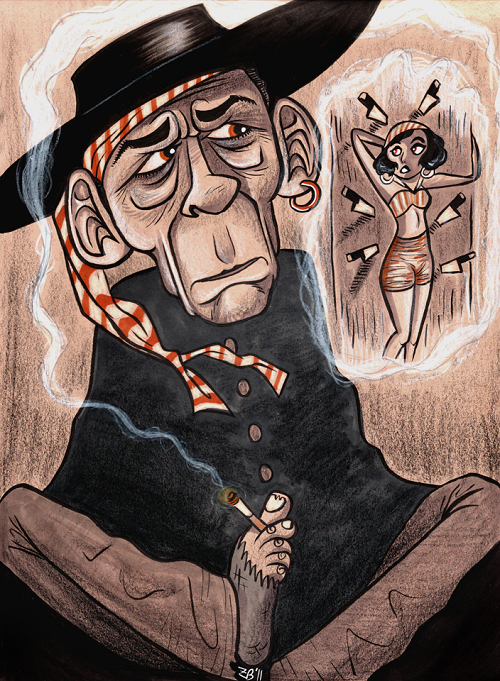
Artist: Zach Bellissimo
One of the festival's most popular events is the annual pairing of a silent film with a newly composed score, performed live by a contemporary music artist. Four years after his campy (and somewhat divisive) accompaniment to 20,000 Leagues Under the Sea, The Magnetic Fields' front man Stephin Merritt returns to SFIFF with his take on Tod Browning's 1927 creepy circus crime thriller The Unknown, starring Lon Chaney and Joan Crawford. (The film last played the Castro Theatre during the 2008 SF Silent Film Festival, with director Guy Maddin doing a live translation of its French inter-titles.) The second SFIFF57 live music event at the Castro will be Bay Area musician Thao Nguyen and her band, The Get Down Stay Down, performing alongside a diverse selection of short films that includes Chaplin's The Pawn Shop, animations by Harry Smith, vintage newsreels and some of Nguyen's own video work.

Eleven films will compete for 2014's SFIFF New Directors Prize. I'm especially excited they've programmed Salvation Army, Abdellah Taïa's adaptation of his autobiographical novel about a gay Moroccan boy who later immigrates to Europe. It's a critically acclaimed film I wasn't expecting to see until June's Frameline LGBT festival. The other New Directors Prize contender I'm hot to see is Benjamín Naishtat's History of Fear, a dystopian nightmare set in the Buenos Aires suburbs, which has drawn comparisons to the early works of Michael Haneke since its Berlin premiere. I've also heard terrific things about the Icelandic film, Of Horses and Men, and Mexico's The Amazing Catfish. Both the latter film, as well as Taïa's Salvation Army, boasts cinematography by renowned DP Agnès Godard.

Eight films are in the running for SFIFF57's Golden Gate Awards Documentary Feature Competition. The only one even remotely on my radar is Hubert Sauper's We Come as Friends, which examines the human cost of neo-colonialism in the newly formed nation of South Sudan. To this day, Sauper's 2004 Oscar®-nominated Darwin's Nightmare remains the most disturbing and dispiriting doc I've ever seen. Perhaps his latest will make me feel even worse.

Cross-published (in an expanded version) at film-415.

Tuesday, March 18, 2014

"THE BEST OF THE DISPOSABLE FILM FESTIVAL" AT TREEFORT

In March of 2011 I had the good fortune to be introduced by publicist Amber Kaplan to Carlton Evans, Eric Slatkin and Katie Gillum, the founding members of San Francisco's Disposable Film Festival (DFF), who had come to my attention through a series of staged "bike-ins". My first piece on DFF was an overview of their shift away from the Roxie Theater—audiences since their launch in 2007 had grown so large, necessitating a larger venue—to the 1400-seater Castro Theater, which each year since 2011 has sold out to capacity crowds. With so many community film festivals in San Francisco suffering low attendance, I was struck by DFF's popularity and wanted to see what the enthusiasm was all about so Carlton Evans agreed to an interview. Shortly after that conversation, we met again for beer at The Front Porch; a welcome diversion from the sale of my home on Bernal Heights before resituating assets to Boise, Idaho.

My first experience of DFF was revelatory. Not only did the Disposable Film Festival democratize the means of film production by celebrating the affordable cameras available to aspiring filmmakers, but they likewise democratized the joy of learning by providing informative panels and workshops free to their public. I had never seen educational outreach be so effectively egalitarian.

A little over a month later DFF co-presented a special screening of Oscar®-winning film director Kevin Macdonald's Life In A Day—a user-generated feature-length documentary shot on a single day (July 24, 2010)—that enlisted the global community to capture a moment of their lives on camera. Culled from over 80,000 videos to YouTube, the 90-minute feature pulled together deeply personal, powerful films from contributors from Australia to Zambia, from the heart of bustling major cities to the furthest and most remote reaches of the earth. Life In A Day director Kevin McDonald and editor Joe Walker were present for a Q&A following the screening. I was unable to attend but sent Evening Class intern Dominic Mercurio to cover the event.

Relocating to Idaho, it didn't take long to observe that Boise had a thriving bicycle culture and I began to think that DFF would be a perfect fit for the city, so I initiated discussions with the now-defunct Idaho Film Office to investigate bringing DFF to Boise, perhaps in conjunction with Boise Bike Week. We had multiple conversations about how we might effect that but nothing seemed to work. In the meantime, Carlton invited me to be a judge for the 2012 edition of DFF the following January, along with Ted Hope and Joshua "Peaches Christ" Grannell. He gave a rousing introductory speech to the opening night of that event:

"Thank you all for coming to the 5th annual Disposable Film Festival opening night! It's wonderful to be back at the Castro! In addition to the audience here tonight, we're broadcasting the program to Sony PlayStation's 26 million users in the Home virtual world.

"The program this year is absolutely stellar. We received some of the best films yet made on accessible equipment like mobile phones, webcams and other inexpensive devices. We also received an enormous number of films this year that were made without the use of cameras. Using screen capture software, several of the filmmakers in tonight's program turned to the massive archive that now exists at our fingertips and remixed and reframed existing footage to create some of the most compelling work we've seen.


"5 years is a milestone for us—an opportunity for reflection. 5 years ago, the fact that digital video technology had become so inexpensive that it was literally disposable was incredibly exciting. It seemed that soon everyone would have access to cameras and other tools needed for visual storytelling. But no one could have predicted what has happened since then. The change has been so complete and so quick that it seems impossible now to remember life before it. We can capture high def footage and then broadcast it all over the world, all with a swipe of our touchscreens. And the line between disposable and industry has become increasingly blurred as the DSLR is rapidly becoming the camera of choice for both camps. Making it more clear than ever that what makes a film isn't the equipment it's made on, but the concepts it's built around.

"What has come in the wake of this transformation is incredible. Not only the work we'll be showing tonight and throughout the weekend (which we hope will inspire you to make your own films), but video that has changed the world in the past year. It's hard to imagine the Arab Spring without the evocative medium of video. And Occupy Oakland taught us the power of mobile video to show perspectives omitted from official records. But in a broader sense, disposable video speaks to our shared reality. It's the way we've come to understand the world around us. It tells stories that speak to the moment."


In August 2012 Carlton visited me in Boise to get a sense of the place and to pursue discussion about bringing the Disposable Film Festival here. It's with heartfelt gratitude that Benjamin Morgan and the Treefort Film Festival have arranged to screen "The Best of Disposable Film Festival" at their inaugural event on Friday, March 21, 2:00-3:00PM, making my dream of bringing DFF to Boise come true! Please support this event to further the chance of DFF bringing an annual event to Boise, with attendant workshops and special events.

Monday, March 10, 2014

SEBASTOPOL DOCUMENTARY FILM FESTIVAL 2014—BENDING STEEL (2013)

Sure to eventually end up on a double-bill with Zachary Levy's Strongman (2009), Dave Carroll's Bending Steel (2013) [official site / Facebook] even includes Stanley "Stanless Steel" Pleskun—the subject of Levy's film—among its cast of characters. Pleskun's title as "The Strongest Man in the World at Bending Steel and Metal" comes up for grabs, however, when Chris "Wonder" Schoeck, an endearing and unassuming man, trains to become a professional "old-time" strongman, wooing audiences not only with his incredible feats of strength, but with his clean-cut looks, small stature, and evident vulnerability. That is perhaps what most winningly differentiates Bending Steel from Strongman: the attractiveness of Schoeck's confidence. Bending Steel is as much about the forging and burnishing of Schoeck's confidence, as Strongman suggests the creeping doubts and diminishing returns of an aging Pleskun.

There are obvious similarities between both films: masculinity and its discontents, uncompromising egoes at odds with the times they live in (Schoeck goes so far as to characterize himself as otherworldly and extraterrestrial), concerns over the monetary viability of a chosen career, and the effects of an individual's obsession on family. Though in Bending Steel it would be more accurate to point out an individual's obsession because of family. The heartache of this film lies in the lack of support that Chris Schoeck receives from his skeptical parents. Their absence at the film's final triumph is telling, yet accents Schoeck's own maturation towards self-acceptance. What emerges out of their absence is what Gabe Toro intuits in his IndieWire review: "the unspoken idea that Schoeck finds a family in those pushing him to improve." Namely, a small coterie of committed strong men who teach him craft, skill, and poise before the public as they gather together to revive the carnivalesque attraction of the strong man at Coney Island.

"You're not likely to see a more inspiring documentary this year than Bending Steel, " adds Toro at IndieWire. Through mastery of a piece of steel, Schoeck overcomes his social awkwardness, his inhibitions, and his fear of failure, and you can't help but cheer him on. Whatever resistance you might have toward's the film's eccentric subject matter, it warms and bends as the film "gains mileage out of its subject's modest tenacity" (John DeFore, The Hollywood Reporter). It's a no-brainer why this underdog tale won Audience Awards at the 2013 Camden International Film Festival and the 2013 Key West Film Festival, let alone Winner of the Best Documentary Feature at the 2014 Fargo Film Festival and the Jury Prize at the 2014 Oxford Film Festival, arriving to the Sebastopol Documentary Film Festival's juried section with a competitive edge.

Like its predecessor Strongman, and like a host of recent documentaries that focus on the lives of remarkable if eccentric individuals, it appears the documentary genre has set it sights on the allure of the real, which since 9/11 appears to have—as Mark Cousins phrases it—"out Hollywooded Hollywood, image-wise, and made the real world feel suspenseful and unfolding like a narrative, [making] fiction cinema look erstatz."

IN SEARCH OF EMAK BAKIA / EMAK BAKIA BAITA (2012)—OSKAR ALEGRIA ON....

Man Ray—known primarily in the art world for his avant-garde photography—produced major works in a variety of media, including film. In 1926, he directed the 19-minute short Emak-Bakia (Basque for "leave me alone"). Subtitled as a cinépoéme, it features many "experimental" filming techniques, including rayographs, double exposure, soft focus, stop-motion animation, and ambiguity, as well as incorporating sculptures by Pablo Picasso. Emak-Bakia can be viewed in its entirety here.

In 1998, the Pompidou Center in Paris, France, mounted an exhibition "Man Ray: Photography and Its Double" drawn from the Man Ray archives donated to the Center's collections in 1994. It was at this exhibition's London showing that Oskar Alegria was surprised to discover that Man Ray's talents included a filmography, albeit limited to four films. He entered a dark room where they were showing Man Ray's films and the first thing he noticed were the words "Emak Bakia", which he found mysterious. As his heritage was Basque, this film Emak-Bakia captured his imagination. He found himself watching the film like a detective or an investigator, trying to determine if Man Ray had made Emak-Bakia near his hometown, but there was no way of gaining a clear answer because the film was essentially visual. If anything, the mystery of the film's production provoked him to search for the inspiration behind Man Ray's film, which at first he thought was a graveyard epitaph, but which gradually revealed itself to be a house near Biarritz where a portion of the film had been made. Thus began The Search For Emak Bakia (2012), whereby Alegria sought to pay an homage to Man Ray by making a film in the same free spirit with which Man Ray endeavored his film, without interference, on foot, and eschewing a large production crew.

The Search For Emak Bakia honors Man Ray but departs from that artist's experimental short in significant ways. It retains its adventurous experimentation, but compresses it into shape through a hybrid documentary impulse, melding a meandering investigative journalism with reflective narrative intertitles more readily associated with an essay film. Alegria incorporates Man Ray's Emak-Bakia into his own film and—through an ingenious use of split-screen—creates a parallel structure between the 1926 original and his contemporary inflection. The result is a circumambulation around a central quest that respects chance to achieve its destination.

In one of the earliest sequences of The Search For Emak Bakia, Alegria ponders Federico Fellini's query: can a clown die? This association intrigued me because of Fellini's attraction to C.G. Jung's depth psychology, which came to characterize the maturation of Fellini's filmic style in the 1960s. C.G. Jung was fond of saying that—in order to bring up the creative contents of the unconscious—one needed to solicit the cooperation of the unconscious. I've never seen a film that has actively solicited the cooperation of the unconscious as much as Alegria's The Search For Emak Bakia. Recognizing creative opportunity in vision's peripheral margins, his film wanders and wonders—sometimes in seeming confusion—as he pursues tangential threads. Just when you're about to think all is lost on the quest, Alegria delivers a deep, resounding and satisfying resolution to his circuitous pursuits.

The Search For Emak Bakia was programmed into the 56th edition of the San Francisco International Film Festival where—quite by chance—I met Oskar in the press lounge. We started conversing about the value of retaining family recipes and our mutual backgrounds: his father was a sheepherder, mine a sheepshearing contractor, and—though I had not intended to watch his film—I ended up watching both screenings at the festival and a later screening at the Basque Cultural Center in South San Francisco. Oskar's following ruminations on his own film come from multiple personal conversations, and Q&A sessions with his various audiences.

On the "Knuckle Ball"

Introducing his film The Search For Emak Bakia at the San Francisco International Film Festival, Alegria admitted his difficulty in speaking about the film before audiences had a chance to see it. For that matter, he joked, it's equally difficult to speak about the film after audiences have seen it. "Maybe the best thing," he quipped, "would be to speak during?" He added that neither was it easy to speak about the film in English, let alone Spanish or Basque.

But he wanted to introduce the film to his San Francisco audience with a local metaphor. The day before, he had spent time with a local filmmaker who taught him the fundamentals of baseball, which previously he knew nothing about. Since he was in "the kingdom of the Giants", he decided a baseball metaphor would be the perfect parallel to his film. His afternoon companion had laid out for him all the different pitches in baseball and the one he appreciated the most was the one they called the knuckleball; a difficult pitch, he was advised, and a dying art for many pitchers. The Search For Emak Bakia likewise concerns itself with a dying art and a way of life that is vanishing. As described to him, the flight of the knuckleball is erratic and unpredictable, which Alegria asserted was what he loves about cinema. You will see, he offered, that The Search For Emak Bakia is also unpredicatable and erratic and that it flies like that ball without knowing where it is going.

On the Distinction Between Chemical and Spiritual Restorations

Regarding whether one of his original intentions was to reawaken an interest in Man Ray's filmic work, Alegria ventured that two kinds of restoration could be achieved with movies. There is the classic restoration, what one might call the chemical restoration, as was done by the Pompidou Centre in Paris with Man Ray's films. The original print of Man Ray's 1926 film was badly damaged with scratches and dust and this was the task the Center set out to rectify. But you can also make a second kind of restoration, Alegria distinguished, which is a spiritual restoration. Just as the physical nitrate print could fall into disrepair, so could interest in the film be likewise damaged by the passage of time. Man Ray's four films were made in a non-commercial free spirit. He worked with one assistant and not a production crew. That old way, that spirit, of making cinema also needs to be recovered as a way to work with cinema today, which is what Alegria tried to do with The Search For Emak Bakia.

On Doubting The Free Spirit

When he started this project, Alegria didn't know how to classify it. He thought of it as a commentary on Man Ray's earlier film, which others had characterized as an artifact, and he liked that term. Was he making a movie? Maybe. He didn't know. But he had faith and in the making of the film he kept encountering unforeseen treasures that inspired him to continue. He started the project by wandering in cemeteries searching for Emak Bakia as an epitaph, not as the name of a house. He thought that if he could find the tomb that bore this epitaph—"leave me alone" being an admittedly odd epitaph on a headstone—it would be the start of his movie. Yet even at the beginning of production the best part of the project was the mystery behind everything. The goal was an excuse. Finding the epitaph, and then the house, was an excuse. What was important was to enjoy the journey. For example, if he rented bicycles, then he wanted to enjoy the various bells on the bicycles, that sort of thing, and in the film there is a spirited jingling sequence of bicycle bells. He knew that sometimes when you find the object of a search, the search ends; but, in this case, whatever he found led to further treasures and a continued search. The events on the path itself were the main goal.

When he discovered Man Ray's film Emak-Bakia at a London gallery retrospective, he immediately tried to determine if the film had been shot near his hometown, but the film provided no ready answer. Instead of frustrating him, the mystery energized him. Man Ray could have made a film where he situated the house, showing an exterior, having the viewer enter through the front door, but—Alegria joked—that would have made for a short film. All Man Ray provided were three clues: a window, a doorway, and a shot of the coastline. There was an even more fleeting landscape shot of a car driving up the hill that showed some big white houses in the background. The form of the hills and the architecture identified the landscape as that of Iparralde, which is the north part of the Basque country in France.  The farms in the South have different architecture and the terrain is more mountainous.  That was all Alegria had to work with.

On the Battle Between Journalistic and Creative Instincts

Alegria felt the journalist within him was alive only in the first seven minutes of the film, after which he killed him, and then a more poetic persona emerged. For the first seven minutes he could state with confidence that his film was a documentary, but after that he didn't know what it was. He's still a journalist, and enjoys being a journalist, but considers it more of a chronicling activity than a creative one. He is fully aware of the battle between the journalistic viewpoint and a creative viewpoint. Sometimes they dance together. Sometimes one rules over the other. They strike a balance in which the journalist is always alive. The journalist is the rationalist who researches archives for the location of the house. The journalist is the one who interviews all the old people and elicits testimonials. But when Emak Bakia did not appear in the archives, he took it as a measure of success. In a sense, he defeated himself as a journalist, and that was when the search began to feel good. He believes in the battle and trusts the paradoxes.

He was a having a coffee in a park in Biarritz when he saw the plastic glove blowing around in the wind and thought to himself, "Okay. Let's follow that." That's not the way he would ordinarily pursue a story as a journalist. He certainly couldn't go to an editor and admit he found Emak Bakia by following a plastic glove blowing around on the street; but, in its own way it felt like he was celebrating his defeat as a journalist. An option opened up for him as a creative person. But, yes, these two impulses—journalistic and creative—dance together, much like the plastic glove and the napkin it woos.

On Coursing Rivers and Their Destinations

The first cut of The Search For Emak Bakia was two hours long. He was getting lost in his enjoyment of the search. He even wanted to go to Africa because one of the women who auditioned for the sleeping women sequence slept underneath a tapestry from the kingdom of Benin for protection. The film's thematic courses were like rivers confluencing into each other. Though many questions reside behind the film, his favorite question remained: why do rivers try to postpone their destination? Who knows?

On the Romanian Connection

Biarritz was a main tourist attraction during the Belle Epoque in the 1920s between the two world wars. Everybody vacationed there. There's a grand palace in Biarritz where—if you peruse the desk register—you will find the signatures of Bismarck, Stravinsky, Charlie Chaplin, everybody. There was a strong connection with Eastern European aristocracy. Even nowadays, if you go towards the Grand Palace in Biarritz, you'll find an orthodox church. Romanian people went there because of that connection. The Queen of Serbia also has a big palace there in Biarritz.

He used to think that this part of the Basque country, the French coastline, is magical. There's a special wind there. If you are exposed to that wind, something happens to you. In that part of the Basque country, every hill on the coast has a palace on it, and each palace is full of mysteries. You could make a lot of films there, palace by palace. Sometimes he feels that the hill on which the house of Emak Bakia rests—though a tiny hill with no more than 25 houses on it—could inspire a film. Biarritz rests on the border between Spain and France and, accordingly, there's a lot of surrounding history. Sometimes he thinks that—if he continues to be a filmmaker—he will base all his films on this tiny hill. It's called Parliamentia Hill. He could turn it into Parliamentiawood, like a Basque version of Hollywood.

On the Importance of the Hare

A festival programmer recently phoned Alegria to state that he had counted all the animals in the film and tallied 357 animals. You have 200 seabirds, you have 16 cows, you have one cat in a storm who looks dead, the programmer told him. Perhaps he likes animals so much, Alegria figured, because they're the only ones who look directly at the camera? It's like they know something. They can read human beings.

In The Search For Emak Bakia, Alegria likens his meandering quest to the habits of a hare, which most people mistake as a rabbit; but, there are important distinctions between a rabbit and a hare. They're from the same family, but totally different. Rabbits are born in underground burrows. Hares are born above ground. Rabbits are born with their eyes closed. Hares are born with their eyes open. These are essential differences. The hare raises its ears during Q&A sessions and inspires him to answer audience questions indirectly. Even SFIFF programmer Sean Uyehara joked that he was hesistant to ask Alegria questions because he was never quite sure what his answer would be. Hares are always escaping capture. Rabbits are more comfortable with being domesticated. They can feel safe in a cage. Hares are not as adaptable. One could say that Man Ray acted like a hare. He escaped mainstream art. People tried to trap him. He made four films and had a proposal to make a fifth by a big company with a lot of money but he declined. That's for rabbits. The meaning of Emak Bakia—"leave me alone"—ties into this. Hares can jump into the air, change direction, and land ready to move in a different direction. Like the knuckleball, the hare is unpredictable and erratic. You never quite know where it's going. Here or there? The straight line is for gregarious animals who follow each other. It's boring. It's not free.

The chronology of the story in his film was real. He was a man searching for a house that failed to readily appear so he tried to find other things named like the house. But as he was going along and the film kept growing, he realized that the house was not important; the substitutions for Emak Bakia were not important. The main thing was the path, the search, to be on the way. Thus, the house appears in the middle and not the end of the film and is, in effect, the true beginning of the film. That's when chance began to work hard.

On The Poetic Influence Of His Parents

Commenting on the poetic strength of his film, I asked him who he admired as poets? Alegria didn't miss a beat and said he admired his mother and his father. They were, as he stated earlier, from a tiny mountain village. They taught him how to make a film without knowing they were teaching him how to make a film and those are arguably the best teachers. If you want your child to become a pianist, you have lost your way as a parent because you will have to force them to learn how to be a pianist. The best lessons are involuntary.

His father was a shepherd since childhood. When his parents finally moved to the city in their old age, his father took a pencil in his hand and a piece of paper and for the first time began to write all the words that were disappearing in the Basque world. The names of the birds, for example. Kostalangorri, the bird with the red tail. Zumiriki, the island in the river. He was making a little dictionary. In years since, he has thought a lot about why his father was doing that. The lesson is that if the word for the bird with the red tail (kostalangorri) disappears, the bird itself will also vanish. Words in the Basque culture have tremendous strength and harbor a connection with nature. His father tried to fix things in time and Alegria feels he is doing something similar with his cinema. Perhaps that is the magic of cinema? Through his film, the name of the house was recovered and restored.

His mother always taught him, without knowing she was teaching him, to have a strong faith in magic, which references back to the conflict between his journalistic and creative instincts. Journalists are rationalists. Creative people pursue the magical side. By way of example, he remembers when he fell off his bicycle as a child and hurt his knee. His mother applied iodine to his scrapes and then blew on them. Iodine might be the science; but her breath was the magic. To this day, he doesn't know which made his injury recover more: the science or the magic; but, he's convinced that without the magic there would have been no recovery. And that's the lesson for making a film. You have to know how to fix words. You have to know how to disappear into the white paper or the blank screen. But also you have to use magic for that.

On the Use Of Intertitles Instead Of Voiceover

There's only one intertitle in Man Ray's Emak-Bakia. It's an interesting film, however, because it was made in that moment between Dadaism and Surrealism. You can see that half of the film is Dadaist and the other half is Surrealist. One is more visual and the other has some narrative, though a minor deference. He likes to think that his film is a realistic exercise of a surrealistic movie. He incorporated all the intertitles that Man Ray used in his films. There were 57 of them and he knew each one by heart. For him it was like a cinematic exercise. He used all the intertitles to tell the story of The Search For Emak Bakia. There's one intertitle that says, "Now we are in Paris." So that was easy to place when the project was in Paris. When he was filming the nightmare of the pigs, hidden away in the pig sty, he remembered that one of Man Ray's intertitles read "L'intrus", the intruder, and he thought, yes, that works here. Man Ray used his intertitles in an unconnected way but Alegria wanted to do the opposite: he wanted to use them to tell a specific story, which was in essence a classic story of a man searching for a treasure who finds a princess.

I understood why he decided to use intertitles to advance his narrative rather than a voiceover, but I was curious why he decided the intertitles should be in English? Per the transnational practice of using intertitles in traditional silent cinema, I wondered if he had plans to translate his intertitles into different languages to distribute in different countries? He confirmed he already has translated the intertitles of the film into five different languages; that there existed five versions of the film. The first was in Basque. Then Spanish. Then French. Then English. Now there's one in Italian and the most recent in Hebrew.

Interestingly, the film's title in Basque is Emak Bakia Baita; "baita" means house in Basque, but it also means house in Hebrew! It's a word both languages share. In Arab, "bait beit" is also a house. In Italy, there is a small shepherd's cottage built on the mountains and they call it "baita".  When the film screened in Poland, a Jewish member of his audience said that "emak bakia" in Hebrew sounds similar to the Biblical expression "a valley of tears", implying that Emak Bakia Baita might translate as "the house of the valley of tears."  After a screening in Tel Aviv, he was advised that the newspaper Haaretz had published an article about these linguistic coincidences.  Finally, "baita" is only used in the north part of the Basque country. You can find houses in a river basin that are referred to as "baita", but if they are built near to the river they are referred to as "etxea". It interests Alegria how the words travel with the water.

He explained that he used intertitles not just because Man Ray used them in his film, but because of a mistake. He loves mistakes. He loves accidents. Man Ray's film was full of accidents. Several of his photographs were born from accidents. Someone turned on the light when they shouldn't and it produced magic. For example, some of the best inventions of human beings—like champagne and Viagra and LSD—are accidents. The smokey cheese they have in the Basque country is an accident. The houses of the shepherds were so small that the smoke of the hearth flavored the cheese. Now they have to provoke it; but, originally it was an accident. His usage of intertitles had largely to do with the fact that when he started the film, he couldn't speak French. When it came to editing the first cut, he decided to write it out though intertitles since he couldn't speak French. He had to welcome the accident and believe in it.

Once he finished the film, he realized that what worked in the film was not his presence, but his absence. He's not on-screen. At most, you see his hands. At one point, you hear his voice briefly. He's felt in the film but never seen. He sent the film to a filmmaker in Belgium and he expected him to say something about not using voiceover in the film, but his friend wrote back qualifying that—as much as he preferred voiceover—it wouldn't have worked in this particular film. He said that Alegria had achieved something much more difficult with his film: he had captured the tempo of breathing by the pacing of the intertitles, and not through his voice.

On Richard Griffith

Oskar Alegria & Richard Griffith meet for the first time.
When he was in the cemetery at Man Ray's tomb, waiting for the rain, he found a CD of a musician from Minnesota, Richard Griffith. He didn't know Griffith but he decided to write him and tell him about the project. He thought Griffith had left his own CD, but it turned out he hadn't and he was surprised to hear about it. Once Alegria invited him to collaborate on the project, Griffith thought, "Why not?" Alegria recalled that his first letter to Griffith started with the sentence, "I am waiting here for a week for the rain to come." Griffith responded that he couldn't say no to someone who would write such an introductory sentence. Because he was asking him for professional services, to use his music, Griffith could have charged Alegria; but, he didn't. He told Alegria, "Your project is full of magic and I never say no to magic." That inspired Alegria to continue. Griffith and he have since become friends and exchanged much correspondence. Not only did Alegria use his music for the cemetery sequence, but Griffith offered to write more music for the rest of the film and sent Alegria two more pieces of music, which were used for the closing credits. "For you, Oskar," he wrote, "they're a gift." Although Griffith has seen The Search For Emak Bakia, he and Alegria have not yet met in person. When the film was screened at Telluride, someone from the Walker Art Center proposed a screening and Alegria told her that—since it was in Minnesota—he would agree to the screening if they would have Griffith play live music. They thought that was a great idea. For him that sounded like a magical way to finally meet Richard Griffith.

On Tonino Benacquista

Author Tonino Benacquista sports an Italian name but he's actually French. He's a well-known writer of crime novels. Alegria contacted him because one of his novels was entitled The Sleeping Woman. He had been investigating the dreams of the five women who slept for him in his film. He had asked them what they read before going to sleep and five of them were reading Benacquista. So he decided to pursue this thread of the story offered up by chance. He contacted Benacquista who said he knew what Alegria wanted—that he wanted to ask him about dreaming and sleeping—but he said he didn't know anything about that. Indeed, the characters in his novels suffer from insomnia. That's fine, Alegria responded affably, then that's what I'll put in the movie.

On the Mysterious Door Knocker

As to what became of the original "mysterious" door knocker, Alegria suspects it was taken by the Nazis, along with much else in Emak Bakia, including two pianos. He determined these thieveries from the photos shown him by the Romanian princess, which revealed exquisite furniture, jewels, all of which were stolen. But they couldn't remove the Medusa mantle to the chimney. He wasn't exactly sure, but he believes the door knocker was changed in the 1950s by the new owners. One woman who saw the film began to send him several photographs of door knockers from the island of Malta that were similar to the original. It's a strange door knocker: it shows a young Neptune astride two sea horses. In that sense, with the photos of door knockers that she is sending him, the film is continuing.

On Befriending A Hungarian Princess

When he first arrived at Emak Bakia, he didn't speak French and the first person he spoke to, the gardener, was trying to tell him that someone else had visited the week before but he couldn't understand her. He was so emotional at the time, thrilled to have even found the house, that he was flying, and not grounded enough to comprehend the importance of what the gardener was saying. When he finally gathered that she was telling him an old person had visited the house, he asked who it was and she showed him an envelope with the princess's address, which he wrote down. At first, he thought that maybe this mysterious visitor was a collector of Man Ray's work and was even a bit disgruntled that she had found the house first; but, then again, it was not like the search for Emak Bakia was an Olympics competition. He decided to write her to tell her he was investigating the history of the house and asked her about her visit. Someone helped him translate the letter into Hungarian because, after all, it was his first letter to a princess. She answered very kindly within the week.

She told him she wasn't there for Man Ray; she was there because Emak Bakia was the house of her childhood. She spent the first summers of her life there. For her, that house was very important. She had three major memories of the house. The first was the big Saint Bernard Biri who she used to ride like a horse around the grounds. She remembered the chimney. And she remembered the big lightning storm. That part of the Basque country is known for its hard weather. Since then, he and the Romanian princess have become good friends. Not only is cinema magical for recovering the name of a house, but for making a princess a friend. She is 95 years old.

On Editing and Finishing A Film

Was there a lot of footage left over from The Search For Emak Bakia that Alegria did not use? Yes. He recorded a lot of film that he wasn't able to use in this film, but he has other ideas in mind where he might be able to incorporate that footage. When you work with chance, you never really finish a film, he offered. In effect, The Search For Emak Bakia finished itself and discovered its own completion. When the Princess returned to the house of Emak Bakia for a visit, he thought that would be the appropriate end of the film. He edited it so that sequence returned to the image of the inverted horizon of sea and sky, which felt like a full cycle at first; but, then again, when you work with chance, sometimes cycles don't suffice. While he was in the process of editing the film, he discovered that the clown whose tombstone he examined at the beginning of the film was not really dead so he felt compelled to add that. It was a new cycle seeking completion.

Film is not as accomodating as books in that regard. In publishing, there is a faith in mistakes. In the second edition of a book, the publisher can add an errata which is an honest admission that the first edition was not complete. Alegria loves that books can be honest in that way, whereas films often are not.

After he completed his final edit, he received one of the best phone calls of his life. He had tried earlier to convince the owners to change the name of the house back to Emak Bakia but that proved difficult because French regulations required that the house be named after their corporate enterprises. But then the owners of Emak Bakia phoned him to say they were sitting with their lawyers and drafting new regulations for the house and were able, at that juncture, to rename the house. "What was that strange name you told us?" they asked. He spelled it out for them. This was his happiest moment in the three years of making the film. And yet again he felt compelled to include this development over the closing credits because it felt like an additional gift to the project. Even to this day, he doesn't believe the film is over; it continues.

On Future Projects

When asked what his next project might be, Alegria admitted this is a question he asks himself every day. Though preoccupied the past two years with accompanying The Search For Emak Bakia to festivals all around the world, he continues to have a passion for searching, and for anything on the cusp of extinction. By example, he related how his parents are from a tiny village in the mountains and from them he remembers the lesson that the people who cut the wood in the forest then cord the wood on the side of the house facing the sunset because they know that this wood will burn better.


We have to work with those people or those things that are on the cusp of being forgotten. One proposal that came to him after his screening in Buenos Aires was when a representative from their Culture of Ministry invited him out to lunch and said that they would be interested in supporting him if he would be willing to find the three houses where Marcel Duchamp lived in Buenos Aires. He said he would consider it, only for the purpose of having a business card that reads: "Oskar Alegria, Finder of Surrealist Houses."


Sunday, March 09, 2014

SEBASTOPOL DOCUMENTARY FILM FESTIVAL 2014—NOAH (2013)


Effective for underscoring the near-Pavlovian response to social media with all its concomitant bloops and jingles, Walter Woodman and Patrick Cederberg's 17-minute short Noah (2013)—not to be confused with the Aronofsky Biblical epic about to rain on muliplexes any day now—is a story that plays out entirely on a teenager's computer screen. Noah follows its eponymous protagonist as his relationship takes a rapid turn for the worse in this fascinating study of behavior (and romance) in the digital age. The film ingeniously creates itself out of screenshots of common practices of Internet browsing while our protagonist fidgets with his Macbook desktop, online gaming, Google search functions, Facebook messaging, SKYPE, Gmail, YouTube, Wikipedia, Chat Roulette, iTunes, and iPhone texting with all the momentum of an overheated mouse caught in its own trap. This makes it equally creepy, sad and disturbing for being—let's admit it—way too familiar and yet, amazingly, it's not at all judgmental, redeeming its commentary through an honest measure of compassion. Noah will be screening with Matt Wolf's Teenage at the 7th edition of the Sebastopol Documentary Film Festival later this month, as part of that festival's insightful Hybrid Documentary sidebar.

Noah was the winner of the YouTube Award for Best Canadian Short Film at the 2013 Toronto International Film Festival where the jurors of that festival's Short Cuts sidebar commented: "This film is a commentary on the ephemeral, disposable, A.D.D. culture that many of us are consumed by and living in. It tells us a story in a way we've never seen before and it tells it well. It's fresh, innovative, and had the remarkable ability to embody complex emotion through the simple gesture of a mouse." Noah likewise won the Audience Award and Grand Prix at the 2014 Clermont-Ferrand International Short Film Festival. As astutely noted by Ollie England at Crispy Sharp Film: "Noah uses a high-concept style to tell a story: How would a relationship breakdown look from the point-of-view of a computer user? ...If you can accept that the cinematography of the film is simply watching someone browse Facebook, then the narrative and the message of the film is pure zeitgeist."

Saturday, March 08, 2014

SFIFF 57—2014 NEW DIRECTORS PRIZE (NARRATIVE FEATURE) COMPETITION


The 57th San Francisco International Film Festival (SFIFF)—running April 24 through May 8—have announced the films in competition for the New Directors Prize. The New Directors Prize of $10,000 will be given to a narrative first feature that exhibits a unique artistic sensibility and deserves to be seen by as wide an audience as possible.

Los insólitos peces gato / The Amazing Catfish, Claudia Sainte-Luce, Mexico (2013)—Set in Guadalajara, The Amazing Catfish follows the quiet transformation of a solitary young woman informally adopted and absorbed into a rambunctious matriarchy in a state of crisis. Filmed by Claire Denis' long-time cinematographer, Agnès Godard, Claudia Sainte-Luce's debut feature—based loosely on events from her own life—blends a wry and moving naturalism with moments of inspired comedy. IMDb. Wikipedia.

The film premiered at the Locarno International Film Festival, where it won two Junior Jury Awards and was a nominee for the Golden Leopard. It had its North American premiere in the Discovery sidebar at the 2013 Toronto International Film Festival, where programmer Diana Sanchez noted: "Some families we're born into; some we build. And some families simply come to us, unannounced, when we least expect it. The story of The Amazing Catfish falls into that last category." It won Toronto's FIPRESCI Discovery Prize. Eric Ortiz Garcia interviewed Claudia Sainte-Luce for Twitch at the 2013 Morelia International. He determined that the film's title came from the fact that catfish live together in families, which Sainte-Luce likened to the family in her film. "I think every member of the family is amazing," she told Garcia, "and their force is staying together."

Mavi Dalga / The Blue Wave, Zeynep Dadak and Merve Kayan, Turkey / Germany / Netherlands / Greece (2013)—In this low-key, loosely plotted coming-of-age tale, a Turkish teenage girl wrestles with mood swings, unfocused restlessness, familial responsibilities, shifting friendships and romantic complications during a year of quiet tumult. IMDb. Facebook.

Winner of the Golden Orange for Best First Film, Best Screenplay and Best Editing at the 2013 Antalya Golden Orange Film Festival, The Blue Wave is Zeynep Dadak's personal inflection of growing up as a young woman in provincial Turkey. She explains, "As women who grew up in the provinces, we didn't experience time as slow-moving, or youth as depicted on TV, consisting of dualities, bad girls and so-and-so boys. Rather than dramatic conflicts, we were interested in small things—looks, gestures—exactly where cinema is at its most powerful."

Difret, Zeresenay Berhane Mehari, Ethiopia (2014)—In a contemporary Ethiopian village, a 14-year-old girl is abducted from school in an attempt at forced marriage, a tradition in her community. Her efforts to free herself from a preordained future set off a legal firestorm in this powerful drama inspired by a true story that pits the law against an entrenched cultural mindset. Official site. IMDb. Wikipedia.

Difret's popular appeal is demonstrated by Audience Award wins at both its 2014 Sundance Film Festival premiere and its appearance in the Panorama section of the 64th Berlin International Film Festival. The critical response has been slightly less enthused. At Variety, Dennis Harvey opines that Mehari's film presents an important message, albeit in clunky narrative terms. "More showing and less telling," he writes, "would have made this fact-inspired drama ... as artistically compelling as it is informative." At The Hollywood Reporter, Boyd von Hoeij qualifies that Difret is "quite powerful despite relying on familiar storytelling tropes."


La Dune / The Dune, Yossi Aviram, France / Israel (2013)—Delving into issues of identity and aging, this nuanced relationship drama portrays the personal crises faced by an aging gay cop in France and a younger Israeli man who is found on the beach, mute and without any identification. IMDb.

Historia del miedo / History of Fear, Benjamín Naishtat, Argentina / France / Germany / Uruguay / Qatar (2014)—Paranoia runs rampant in this accomplished first feature, instilling a disorienting sense of dread in the viewer. Are the strange occurrences in an affluent Buenos Aires suburb evidence that the skittish residents are actually being targeted? Naishtat foregoes ready explanations or assurances in favor of foreboding suggestions in a film that is sprawling both in scope and implications but astonishingly exacting in its execution. Official site [Spanish]. IMDb. Wikipedia.

History of Fear had its premiere in the competition section of the 64th Berlin International Film Festival. At Variety, Peter Debruge notes that in Naishtat's hands, "the subtext intimidates even as what's happening on the surface sometimes seems inscrutable, the helmer aiming not to confuse so much as to allow audiences to project their own interpretations." For Boyd von Hoeij at The Hollywood Reporter the bottom line is that History of Fear is "an impressive debut feature that relies on visuals and the power of suggestion to talk about abstract notions such as angst." At IndieWire, Eric Kohn writes: "Buenos Aires is a haven for paranoia and confusion in Argentinian writer-director Benjamín Naishtat's mesmerizing debut History of Fear, though its title is something of a misnomer. Rather than chronicling the timeline of the listless quality that characterizes Argentina's suburban class—and, by extension, those around the world—History of Fear hypnotically sets its gaze on the present. Borrowing the beats of a disaster movie without ever giving the invisible threat a name, Naishtat explores the tenuous constructs that allow a subset of the population to deny the harsher ingredients of the world beyond their safety zone—until it's thrust right in front of them."

Manos Sucias, Josef Wladyka, USA / Colombia (2014)—A reluctant smuggler and his eager neophyte brother shepherd a dangerous narco-torpedo up the coast of Colombia, posing as fishermen. Paramilitary, guerrillas and hardscrabble desperation suffuse every inch of the jungle and waters that surround them, eager to separate the siblings from their only opportunity to escape the circumstances of their lives. Manos Sucias is the recipient of two 2013 San Francisco Film Society KRF Filmmaking grants. IMDb.

Of Horses and Men, Benedikt Erlingsson, Iceland / Germany (2013)—The relationship between man and beast is explored in a series of dryly humorous, linked episodes set in a small Icelandic hamlet. With its idiosyncratic portrait of village life, this remarkable debut features several unforgettable visual tableaux. Official site. IMDb. Wikipedia. Facebook.

Winner of multiple awards on festival track including Best New Director at the San Sebastián International Film Festival, Best Director at the Tokyo International, and the FIPRESCI Prize and Tridens Award at the Tallinn Black Nights Film Festival, among others, Of Horses and Men has captivated critics. At Variety, Jay Weissberg extols: "Flabbergasting images and a delightfully dry sense of humor make Of Horses and Men a debut worthy of celebration. Stage and shorts helmer Benedikt Erlingsson reveals an astonishingly inventive eye and a sensitivity to the confluence of spirit between man and animal that's impossible to capture in words, balancing desire and jealousy with the cycles of life and repping a boldly distinctive vision set in a quirky horse-riding community in the stunning Icelandic countryside." At IndieWire, Carlos Aguilar adds: "Dryly comedic throughout, the film is also charged with evocative imagery that humanizes the horses presenting them as spectators to the barbaric behavior of men. Seen through the equines' eyes, the animalistic qualities in people are vividly present in all aspects of life. Fighting for turf, giving in to sexual urges, and stopping at nothing to stand out as the best of the pack, all are innate features of most living things. Without uttering a single word, their penetrating gaze can be interpreted as contempt, sympathy, disbelief, or perhaps a hint of condescension as they witness the chaos people bring upon themselves. Greatly compatible with each other, the ensemble cast—both human and equestrian—convincingly brings to life a very unusual universe."

L'armée du salut / Salvation Army, Abdellah Taïa, Morocco (2013)—Adapting his autobiographical novel, director Abdellah Taïa tells the story of a gay Moroccan boy finding self-realization and personal strength within a society that shuns him. Shot by the brilliant Agnès Godard, the film takes the form of a diptych, telling the protagonist's story in two different time periods and locales. Winner of the European Jury Award in the French Films competition. IMDb.

Il sud è niente / South Is Nothing, Fabio Mollo, Italy / France (2013)—Miriam Karlkvist took a well-deserved Shooting Star award at the Berlinale for her portrayal of an androgynous teenage girl negotiating life in a mafia-controlled town whose code of silence is destroying her family. Filmed in Reggio Calabria, this debut feature combines poetic realism with hard-edged cynicism. IMDb. Facebook.

Deborah Young's bottom line at The Hollywood Reporter is: "Magical realism, androgynous characters and a cruel wall of Southern silence forcibly mix in a curious coming of age tale."

Shuiyin jie / Trap Street, Vivian Qu, China (2013)—What's it like to be a 21st-century young adult-with access to gadgets, the Internet and other high-tech conveniences—within China's surveillance state? First-time writer-director Vivian Qu's taut, slow-building noir cleverly uses a simple boy-meets-girl tale to unearth a hidden world of government control lurking just under the surface. IMDb.

At Ioncinema, Nicholas Bell characterizes Trap Street as "a sinister slow boil." Patryk Czekaj contextulizes further at Twitch: "All those who've been closely watching the gradual evolution of Chinese cinema over the course of the last ten years must've realized by now that the country's directors are tackling all the more controversial topics with less fear and more confidence, mostly to stunningly spot-on results. The Chinese new wave is at the peak of popularity all over the world right now and Trap Street is a film that only confirms this trend in an utterly convincing way, even more when one realizes that it's a directorial debut of a woman who's previously worked only in production. Because it's a film that uncovers a ridiculously serious yet deeply concealed problem, it's been shown only in places outside China and even the producer during the Q&A said that he isn't sure whether the movie will have its Chinese premiere or not."

White Shadow, Noaz Deshe, Italy / Germany / Tanzania (2013)—Inspired by news reports of the ongoing perils faced by albinos in Tanzania, Noaz Deshe's film depicts a fractured and uneasy world, where superstition and the rule of law collide. An albino youth named Alias must learn to navigate through a culture not just unsympathetic to his condition, but actively violent towards it. Winner of the Luigi De Laurentiis Award at the 2013 Venice Film Festival. Official site. IMDb.

In addition to these 11 first features in competition, the New Directors section of SFIFF57 includes 14 out-of-competition films, which will be announced at the Festival's press conference Tuesday, April 1.