Thursday, October 22, 2015

MVFF38: TRUTH (2015)—Q&A with James Vanderbilt

"Truth will out," my mother used to say to me, "and your lies will find you." She wanted me to believe that honesty would somehow keep truth near, if accountable. She led me to believe that's what everyone wanted. But in the "truth is what we spin it to be" advent of the 21st century, honesty has as much valence as the TV channel you surf away from or the political party to who you believe you owe allegiance. In our increasingly polarized nation, Americans at odds seek out the truths that bolster their particular beliefs. James Vanderbilt doesn't believe that's necessarily good for a society.

Earlier this year, I had the opportunity to discuss with Robert Gordon the effect of the Buckley-Vidal debates on television punditry as the first indications of the devolution of news coverage into infotainment. With Vanderbilt's debut feature Truth (2015), we witness investigative journalism under attack during the Killian documents controversy, nicknamed "Rathergate", that resulted in American journalist and television news producer Mary Mapes being fired from CBS and the constructive resignation of CBS national news anchor Dan Rather.

With James Vanderbilt's permission, this transcript is cobbled together from the public discussion after the screening of Truth (2015) at the 38th edition of the Mill Valley Film Festival. I've rephrased the questions for conversational flow. I post this transcript in tandem with my one-on-one conversation with Vanderbilt regarding the craft of screenwriting, published at Fandor's Keyframe.

* * *

Q: Adapting Mary Mapes' memoir Truth and Duty: The Press, the President, and the Privilege of Power as the basis for your first feature film Truth, I'm aware your script took some significant departures. How did you decide to complicate Mary Mapes' back story by profiling her damaged relationship with her father?

James Vanderbilt: That developed through talking with Mary. It wasn't something that was actually in her book. I ended up spending a lot of time with Mary. She was reticent initially to option the book. She wrote it right after what had happened. I called her up and went down to Texas to spend time with her and to try to convince her that this would be a positive thing. In spending the time with her, she started to tell me about how she grew up, she told me about these experiences, and—as Lucy Scott (Elisabeth Moss) says in the film (but I also said it to Mary)—"You would get hit for asking questions and you grew up to do this as a profession." She looked at me and said, "I never thought of that. I never looked at it that way." For me, that was immediately the key to the lock to her character. This amazing woman had built this incredible life for herself where she had the perfect job, she was working with the best people, she was at the peak of her game. She had built all these layers upon layers to protect herself, as we all do, to not feel like the scared little kid that we all have inside ourselves. By virtue of the experience that she went through, all those layers got stripped away and she had to deal with it. Once I got that from her, and we talked about it, and we figured it out, I realized it was the structure of the story.

Q: Shortly after being fired from CBS for "Rathergate", Mary Mapes received the Peabody Award for her journalism exposing human rights violations at Abu Graib. The timing couldn't have been more haunting. What effect did that have on those involved with Rathergate? Where was Mapes when she received it?

Vanderbilt: She received it at home because she didn't have a job anymore. She was informed by phone, as she had been out of work for about three months: "Guess what? You've just won the most prestigious award you could win, but you're still fired." It's a fact I wanted to include in the film because it revolves around the idea that everything you've done before is wiped out because of an error in judgment. Mary had been to the Middle East many times. She even went to Afghanistan with Dan Rather. She said she was the first person to bring a curling iron to Afghanistan, and Rather made fun of her for it.

Q: Do you know what Mapes has done with her time since being fired?

Vanderbilt: For a long time, nothing. To hear her tell it, she drank a lot of glasses of chardonnay. Then she did a lot of work on death penalty cases. We didn't have time to put this in the film, but she had done a lot of journalism about the number of people executed in Texas compared to the rest of the country. That's a big passion for her. So she worked on several cases there. She worked on Maggie Davis's campaign doing opposition research. Her husband Mark Wrolstad worked with the Dallas Morning News for years and got a buyout in 2009.

Q: Was Cate Blanchett your first choice to portray Mapes? How did you approach her to get her involved?

Vanderbilt: When we tried to put the movie together in 2007, Cate was in a different place. But it was amazing and interesting watching her come to the fore over the following six years. When we finally put it together two years ago, she was absolutely our first choice but I never thought we would get her. Her agent read the script and liked it and said, "I would love to send it to her." She was doing the rounds with Blue Jasmine. It worked out that they sent the script to her the morning after she won the Academy Award® and I thought, "We're screwed." Who wins an Oscar® and then says, "You know what I would love to do next? Work with a first-time director on a politically-charged thing? That's a great career move!"

But, thank goodness, she responded to it and I got a phone call saying, "Cate would love to get on the phone with you. She's in Sydney now with her family." We talked for half an hour. She asked me what I thought my approach would be and other general stuff. She was lovely." I got off the phone and my agent called me and said, "How'd it go?" I said, "It went well." Then she called me back about 45 minutes later and said, "Oh, yes, she's going to do the movie."

As for working with her, she's such a gift. She and I often talked about that scene of Mary on the phone with her father as the lynchpin of the movie and the key to her character. On the day of shooting, she came out and did it a bunch of times and we did it all in one shot. Almost the entire movie is locked down from a camera perspective—it's very classical—but that was the one scene we wanted to film hand-held so that you felt off-kilter in it. She went out, parked it, and there were a lot of wet eyes on set.

Q: Is it a coincidence that so many people from Australia were involved in this film?

Vanderbilt: No, we shot the film in Australia, which was one of the conversations we had after Cate committed to the film. She said, "Listen, I told my family that I wasn't going to work this Fall." She has three boys of varying ages, 12 to 6. She said, "I don't know if I can do that to them. Can you make the movie in Australia?" So when you're talking to Cate Blanchett on the phone, you say, "Absolutely!" You hang up the phone and go, "How the Hell do we make this movie in Australia? It's supposed to be in New York and Texas." We started scouting down in Sydney, which is an amazing city that lends itself. We did the bulk of the movie in Australia, shot one day in New York, shot some stuff in Texas, and weirdly one day in Los Angeles, even though the movie doesn't take place there either. It was a double for New York. So there was a lot of Australian crew, a great Australian crew.

Q: As you developed the script, did you consult with Dan Rather?

Vanderbilt: I did. The first thing I did after I spoke to Mary and got the rights to the book, I called Dan up and went to New York with Mary to meet him. I wanted to see them together in a room and see what that relationship was. They could each say how much they liked each other but that was no substitute for being in a room with both of them. After the second hour they forgot they were being observed and started behaving naturally with each other, which was great for me. It was grist for the mill.

Then I spoke to him a lot on his own because I wanted to see what he would say about this situation when Mary wasn't around. He was incredibly open and honest about his career and cognizant that he was telling me his experience, but that I would have to then go away and make the film how I had to make it. For a public figure, he could have been very guarded and nervous; but, for some reason, he was the exact opposite. He was trusting. Both he and Mary knew that neither had editorial say over the film and that they had no control over how they would be portrayed; but, they were both welcoming and honest in talking about their experience.

Q: Had you met Robert Redford before casting him as Dan Rather?

Vanderbilt: I knew him a little bit. I had written a movie that he was going to direct and so—when I wrote this—I always had him in mind, but I knew I couldn't go to him until I knew who would be playing Mary. I wrote the script, we got Cate involved, and then I wrote Robert a nice note and said all the reasons why he should do this, going back all the way to All the President's Men, where journalism was then and where journalism is now, and how Truth in a way could be bookends in saying something about that; but, I always felt that the big buy of the movie would be Dan Rather. We all know Dan. He's been in our living rooms for 40 years. We know his face and his voice. I had a lot of conversations with producers about who to cast, and I always wanted Bob to do it. There was the concern that we know him so well, how would he meld into Dan Rather? My thinking was always that Bob has the same baggage Dan has. He occupies a place in Americana, as Dan does. I figured if we could get him to do it and be down for it, he would do an amazing job.

The conversation Bob and I had was, "I don't want to put you in prosthetics. I don't want to put you behind a bunch of make-up. I don't think this should be an impression. I'd like to grey your hair a little bit and play with a little vocal intonation and just play the character. Hopefully, that will be it." He came, did it, and couldn't have been more amazing.

Q: How did you develop the role of Mike Smith for Topher Grace?

Vanderbilt: Topher and I actually grew up together. We did drama camp together as kids, because clearly we were very popular, as most drama camp kids are. So we've known each other forever. Topher read the script independent of me. I hadn't spoken to him in several years. He auditioned and worked really hard to get into the movie, which is great. But I realized during the first week of production that he was actually dressed like me completely. I went to the costume designer and said, "He's dressed exactly like me in the movie." He had a thumb ring and I have a thumb ring. She said, "Yes, I know, I dressed him completely like you. I stole everything from what you wear.

Q: It's Topher's character Mike Smith who—in the scene where he is barred from returning to his desk—gives voice to the conspiracy theory that Karl Rove had something to do with discrediting the media's effort to expose Bush's National Guard service and switching the conversation away from the subject at hand.

Vanderbilt: Which is exactly what Mike Smith believed happened. I felt we had to honor that and be true to that in the film. Mike feels that way, but obviously other people feel differently about how that went. We wanted to be honest that everyone comes at it from a different place and a different point of view. When Dan filed his lawsuit and sued for breach of contract, in discovery it came out that people had talked to Republican strategists about who to put on the panel to make it look like it was a strong panel who was really going to dig in. But other than for that, no, there was no revolution. Dan lost his lawsuit. It was thrown out in Appeals Court.

Q: With regard to that panel, how did you reconstruct those proceedings when—as indicated in the film—there were no transcripts?

Vanderbilt: I spoke to Mary Mapes and Dick Hibey (Andrew McFarlane) who were both there. They verified each others' recollections. For probably obvious reasons, I did not talk to anyone who was on the panel. Certain lawyers told us not to make those phone calls and their recollections would have differed anyway.

I don't know anything more about the Rove conspiracy theory. I tried to put into the film as much as I could humanly verify. And I don't mean to denigrate Mike Smith's beliefs by calling them a conspiracy theory. With regard to these things, my mind always goes to a certain place where—for certain things to happen, so many people have to cooperate and so many people have to keep a secret and I find, time and time again, when you're talking about government, if three people know something, it leaks. I don't know how they could get away with certain things like that. What is interesting to me about it, though, is that we don't know, and we will never know. Maybe I shouldn't say that? Maybe tomorrow it'll come out one way or the other? It's tricky. I did this other movie Zodiac about the Zodiac killer where we never really find out who the Zodiac killer is. For some reason, I like movies about handwriting analysis.

Q: The Republicans really tore into John Kerry about his military past and it just wouldn't go away. But then when it came to this story about George Bush, Jr. not fulfilling his military responsibilities, the story took a total turn immediately to a different subject. Is there anything that the principals involved in this story could have done differently, anything at all, that would have changed the outcome on the subsequent calamity that happened?

Vanderbilt: I don't know. Hindsight is 20/20. You talk to Dan and Mary and certainly they wished that certain things had been different, they felt mistakes were made in vetting the story before putting it on the air and, looking back, they would have done things differently. But the thing that I don't think people realize is that they weren't the only ones on the story. They were rushing to beat The Boston Globe and NBC News at the time. They felt that they had the guy who got George W. Bush into the National Guard. They had him on camera saying, "Hey guys, guess what? I got this guy into the National Guard." They thought that was a great story. They also had these memos that they also felt were a great story. But when it all started to unravel, they were very surprised and were completely taken by shock—CBS was as well—with the speed with which this thing unraveled. No one had ever dealt with the internet working this quickly in this way. The first blog post about the memos being fake actually popped up online before the 60 Minutes episode was done airing. The episode aired from 8:00 to 9:00 on Wednesday night and around 8:42, the first entries saying these memos were fake were already on the internet. It was the speed of it that was so amazing. So, listen, you can never say whether they could have done this or they could have done that. It sadly is what it is.

Q: You're already getting swift boated for making this film (The New York Post calls your film "hogwash" and The Hollywood Reporter "a crackerjack journalism yarn"). You imply in the film what a lot of people think—that CBS was set up by Karl Rove or somebody like that—to undermine the story. Are you going to defend yourself adequately or is this film going to be destroyed by that?

Vanderbilt: I will defend myself inadequately.

Q: You implied in the film that they were set up by somebody on the inside, but you don't identify who it is. Who do you think set them up and are you prepared to say that in public?

Vanderbilt: I don't think that the film implies that one person or another inside set them up. That's not my read of the situation. There is the conspiracy theory that Karl Rove wrote the memos and put them out there in order to discredit anyone who reported this story and make it a non-story. I don't necessarily subscribe to that.

Q: Why not?

Vanderbilt: I don't necessarily think that it's true. I don't have any kind of evidence to point to them. One of the things that we tried to do with the movie was to nail down all the facts that we could as humanly possible and I don't want to necessarily imply something that I can't prove. In terms of reaction to the film, there's no version of making this movie that was going to make everyone happy. Of course, I'm absolutely aware that people are going to take issue with certain facts or portrayals. All I can do is say that—just because you're not going to make everybody happy—is not a good reason not to make a film.

Thursday, October 15, 2015

MVFF38—AMNESIA (2015)—An Evening Class Question for Barbet Schroeder

Not since Hal Ashby's Harold and Maude (1971) has an audience been asked to abandon expectations, suspend disbelief, and invest themselves in such an unusual May-September romance as Barbet Schroeder's Amnesia (2015), which had its U.S. premiere as the Centerpiece Screening for the 38th edition of the Mill Valley Film Festival, with Schroeder in attendance to dialogue with his audience.

Whereas Harold and Maude had a morbid quirkiness and the exploratory spirit of the early '70s (including a Cat Stevens score) to suffuse it with cultish cachet, Amnesia plays it straightforward and—despite a rich 6K sound design and Luciano Tavoli's stunning cinematography—suffers for stretching its believability thin.

Martha (Marthe Keller) and Jo (Max Riemelt) become neighbors sharing coastal views of Ibiza, Spain. Martha abandoned Germany in her late teens shortly after WWII, ashamed by the Nazi treatment of the Jews, refusing to speak her native tongue, let alone ride in "Hitler beetles" or drink Reisling wine. She wants nothing more to do with Germany. But then the handsome young German Jo arrives on the island with dreams of becoming a professional deejay. Despite Martha's thick German accent (which Schroeder admits was a stupid mistake that would now be too expensive to correct), Jo is oblivious to Martha's past and feels his affections grow. Keller has had an extensive career—though I'm sorry to say I'm unfamiliar with most of her credits—but I immediately recognized Max Riemelt as Wolfgang Bogdanow from the ensemble of the Netflix original series Sense8, particularly his welcome contribution to the provocative orgy scene in episode 6 of that series.

Respecting the challenges Schroeder set for himself with Amnesia, specifically making the May-September romance believable, his resistance to making theirs a sexual liaison to purposely confound expectations led to scriptural disagreement with his early screenwriting collaborator Peter F. Steinbach who wanted to "go there". I respected Schroeder's decision and expressed my interest.

* * *

Michael Guillén: I appreciate how you have made the May-September romance unique, by way of affection rather than sex. I do want to understand Jo's motivation or what it was that he loved so much in Martha? Could you unpack that just a little bit? It seemed he himself was confused about why he was attracted to her?

Barbet Schroeder: Well, he was attracted because she was a musician and he was attracted because she was a free spirit and somebody leading a philosophical life in the way of the Greeks, where you decide to survive on your own self-sufficiency. You fish what you eat. You grow what you eat. All those elements of a philosophical life in the way the old Greeks experienced it. That excites him because he's not used to it. Obviously, when you see his mother, there's a big difference between her and Martha.

The fact that Martha likes to provoke and have fun and to laugh, even to throw him in the water at the beginning just for fun, are traits of character that are light and humorous and that's what—in my mind—is what attracts him to her.


Monday, October 12, 2015

MVFF38—An Evening Class Question for Sir Ian McKellen

Without question, Sir Ian McKellen is one of the most beloved actors of many generations. When I mentioned to him at a recent San Francisco Film Critics Circle reception that I was amazed how my youthful friends in their late teens and early twenties were as excited as my 60-year-old friends that I was being offered the chance to meet him, it underscored how his appeal has attracted a fan base that stretches out in all directions. "That is something, isn't it?" he responded. I was especially heartened to be afforded an opportunity to express my gratitude for how much he has done for LBGTQ youth. For this, Sir Ian embraced me.

Fêted with a Lifetime Achievement Award at the 38th edition of the Mill Valley Film Festival, McKellen accepted his bronze award from his lifetime friend Armistead Maupin and regaled his audience with lively anecdotes regarding his career and willingly fielded questions from his audience. Never one to miss an opportunity, I swiftly raised my hand.

* * *

Michael Guillén: There seems to be a tendency in Hollywood right now to honor straight actors who play gay roles and yet—if queer actors try to portray themselves—they're not honored and, often, their careers are placed in jeopardy. You, however, are a tremendous exception to that practice. Can you speak to that?

Sir Ian McKellen: When I first came out, some long-time gay actors assumed that I would now turn myself into a queer artist and that I would stop playing the sort of parts I was playing and just concentrate on gay-related plays and films. I said, "No! I can't. I find heterosexuality is far too interesting a phenomenon to be ignored. [Audience laughter.] I couldn't stop playing King Lear. There's nothing queer about Lear! [More laughter.]

So, I don't get angry when Tom Hanks brilliantly plays a gay man in Philadelphia. I don't say all gay parts should be played by gay actors because, if so, I wouldn't be allowed to play straight parts. Ultimately, we're just actors.

What was wonderful about Gods and Monsters was that I think it was one of the first films to actually take a gay character and treat him with the same respect (and lack of respect) as might have been done had James Whale been straight. It just happened to be about the man, who happened to be gay and had particular problems, but the film took him honorably as himself. Thus, historically, that movie's very important and I hope the industry's moved on since then, but I'm afraid no one looks to Hollywood for social advancement, do they? Hollywood can be a little bit behind the times, which is odd in this state, which is so far ahead of the times than other states. It's an odd thing.

Also, there are young actors being advised by agents, etc., to stay in the closet and to not be themselves because it might damage their careers and yet on the other side of the continent in New York people are picking up Tony Awards and thanking their lovers of the same gender. So there is a bit of a cultural divide in this great nation.

Well, there's lots more to be said about it but I hope that the time has arisen when we can all be ourselves and declare ourselves and understand ourselves and respect each other. That's what I want. That's the way it should be, isn't it? Then us actors could get on with playing any other parts.

Saturday, October 10, 2015

MVFF38—SACRED BLOOD (2015)

The World Premiere of Christopher Coppola's Sacred Blood (2015) at the 38th edition of the Mill Valley Film Festival proves, yet again, that blood is thicker than water. The Coppola Clan as a filmmaking dynasty is now in its fourth generation and—though IMDb lists his role in Sofia Coppola's Palo Alto (2013)Bailey Coppola is only now being officially "introduced" in his father's SF-set vampire romance where he plays Luke, a sensitive street artist. A dead ringer for his uncle Nicolas, Bailey's lean good looks and natural presence in front of the camera promise future opportunity for the young actor who emerges as the main discovery of Sacred Blood, if not the main reason for watching this otherwise low-budget digital exercise that reworks its genre tropes dutifully, if lugubriously, making prudent use of San Francisco locations such as Yuet Lee's in Chinatown, The Condor and Caffe Trieste in North Beach, the steps of Mission Dolores, dark alleys in the Loin, and a Market Street BART station. It's always fun to recognize locations in films shot in San Francisco and Sacred Blood at least provides pleasure in that department.

The story, as it were, involves Natia (Anna Biani), a circus sharpshooter from Soviet Georgia who runs into troubles with an itinerant act that features the moodiest poodle ever filmed. The dog is able to leap through hoops at a ridiculous height due to what her master feeds her and the fact that this poodle won't eat any of the normal food fed to the other circus animals forecasts inevitable tragedy for Natia and her family. Natia ends up on the streets of San Francisco, a vampire having to adjust to the infrastructure set in place that governs bloodsuckers by the Bay. She's swiftly at odds with a freewheeling lesbian vampire who warns Natia that Chinatown is her turf and off limits, as well as a kind of godfather figure who, coincidentally enough, runs a winery and admits to spending his life seeking "the link between the vine and the vein." Really, there's no sense in going on with a narrative synopsis because it doesn't really matter. You'll be lucky to keep your neck up above the film's atmospherics.

Michael Madsen steps in to offer a welcome supporting performance as a police detective (Luke's alcoholic and emotionally crippled father). Madsen's always a treat to watch as he mumbles his way through bloody crime scenes. The best bit in the film, in my humble opinion, is his interrogation of an overweight bouncer who, quite effectively, whispers all of his lines. Along with the casting of Bailey Coppola, it's one of few highlights in an otherwise tepid film. This blood runs secular and lukewarm.

Thursday, October 08, 2015

MVFF38—MICHAEL HAWLEY PREVIEWS THE CANNES & BERLINALE CROSSOVERS

The Mill Valley Film Festival (MVFF) is perhaps best known as a showcase for indie-ish Telluride / Toronto movies making their autumnal trudge towards Awards Season glory. For its 38th edition running October 8 to 18, MVFF bookends itself with Tom Hooper's The Danish Girl (starring Eddie Redmayne, who trekked to Marin County last year hawking The Theory of Everything) and Sarah Gavron's Suffragette (whose lead actress Carey Mulligan will be fêted with a MVFF Spotlight tribute). Toronto's People's Choice Award winner Room will also be in the house, with star Brie Larson receiving a MVFF Award "in recognition of courageous work in a career-changing role."

MVFF's winning formula of mixing red carpet awards bait with indies, documentaries and discoveries from second-tier international fests has been enhanced in recent years by an uptick in big buzz, art-cinema breakouts from major festivals like Berlin and Cannes. This year's line-up boasts an inordinate number of works culled from those two events, including nearly all of the top prizewinners. It's a bonanza for Bay Area lovers of international art cinema and the focus of this subjective overview of the festival's 2015 roster.

Berlin Film Festival

This year's Berlinale bestowed the Golden Bear upon Jafar Panahi's Taxi, the director's third clandestine effort since being banned from filmmaking by the Iranian government in 2010. As with This is Not a Film and Closed Curtain, Panahi dares to place himself in front of the camera, this time posing as an inept Tehran taxi driver. The film skates a sketchy line between reality and fiction as his "chance" encounters with passengers are recorded by his vehicle's dash cam. Panahi's fares run the gamut from a bloodied accident victim imploring him to film a last will and testament, to two grumpy grannies transporting a goldfish to a sacred spring. He fetches a precocious niece from school (where she's studying filmmaking, natch). These meet-ups obliquely comment upon movie-making, censorship, Iranian social issues and Panahi's own quasi-celebrity. Iranian cinema devotees will also appreciate how he winks at his filmography (the goldfish from The White Balloon) and that of other Iranian directors (Abbas Kiarostami's similarly structured Ten). If you're unable to catch either of MFFF38's two Taxi screenings, it opens theatrically in the Bay Area on October 30.

Of the half-dozen MVFF selections I previewed, my favorite was Radu Jude's Aferim! which also copped Berlin's Silver Bear for Best Director. The Romanian filmmaker's two previous works, The Happiest Girl in the World and Everybody in Our Family seemed to make an impression on the international festival circuit but never reached the Bay Area. Jude's latest is a road movie cum neo-Western set in 1835 Wallachia, an area of modern-day Romania alternately controlled by Russians and Ottomans. In this entertaining and engrossing historical tale, a brusque constable and his teenage son are charged with capturing an escaped Roma slave and returning him to his evil boyar master. Featuring impressive period art direction and finely drawn characters, Aferim! is an arresting look at a long gone era's mores and customs, as well as an eye-opening portrait of slavery and anti-Jewish / Roma sentiment in 19th century Europe. It also boasts stunning B&W wide-screen cinematography shot on 35mm by DP Marius Panduru (12:08 East of Bucharest, Police, Adjective) and should therefore be experienced on as large a screen as possible.

Three additional MVFF38 selections garnered major prizes at Berlin. For their work in 45 Years by Andrew Haigh (Weekend, HBO's Looking), Charlotte Rampling and Tom Courtenay took home both acting awards for this character-driven drama about a long-married couple reevaluating their relationship. Berlin's 2015 Grand Jury Prize was awarded to Chilean director Pablo Larraín's The Club. In this follow-up chamber drama to 2012's Oscar®-nominated No, a Catholic crisis counselor is sent to a beach town retirement home for disgraced priests and nuns. Unfortunately, The Club is one of several enticing MVFF entries not screening at the Smith Rafael Film Center, the only venue readily accessible by public transportation. Finally, the fest will also present Jayro Bustamente's Ixcanul, winner of the prestigious Alfred Bauer Prize given each year to a movie that "opens new perspectives on cinematic arts" (past winners include Lucrecia Martel's La Ciénaga, Fernando Eimbcke's Lake Tahoe and Miguel Gomes' Tabu). Set in a community of coffee harvesters living at the foot of a Guatemalan volcano, Ixcanul has been named that country's first ever submission for Best Foreign Language Film Oscar® consideration.

Cannes Film Festival

As it did last year, MVFF will screen an impressive seven selections from Cannes' main competition, including several major prize winners. Starting at the top there's Jacques Audiard's Palme d'Or winning Dheepan, a searing drama about three Sri Lankan refugees struggling in a Paris housing project. The film was a controversial choice for Cannes' top prize, with many film writers and critics feeling the award more deservedly belonged to first-time Hungarian director Laszlo Nemes' Son of Saul. An intense holocaust drama set in Auschwitz during the final days of WWII, Son of Saul did win Cannes' Grand Prix (or second place) and will appear at MVFF38 as well. Cannes' Best Director prize went to Taiwanese master Hou Hsiou-hsien's The Assassin, a visually sumptuous 9th century martial arts epic. In addition to screening at Mill Valley, Hou's first film in eight years will play the San Francisco Film Society's Taiwan Film Days on October 12, with the director making an exclusive appearance (which is where I plan to see it). It also arrives in Bay Area theatres on October 23.

The remaining award recipient from Cannes' main competition is Todd Haynes' highly anticipated Carol, where it won a (shared) Best Actress prize for Rooney Mara and the festival's Queer Palm. Set during Christmastime in the early 1950's, Mara plays a department store clerk who becomes romantically involved with a well-to-do married woman (Cate Blanchett). Three additional competition films enjoying Bay Area premieres at MVFF38 include a new iteration of Macbeth starring Michael Fassbender and Marion Cotillard, and the latest from Italian auteurs Nanni Moretti (My Mother) and Paolo Sorrentino (Youth). The latter stars Michael Caine, Harvey Keitel and Jane Fonda and is the director's first feature since 2013's Oscar®-winning The Great Beauty.

It seemed the consensus of many who attended this year's Cannes that the true cinematic revelations were to be found outside the main competition. Happily for MVFF38 attendees, the festival has lined up a promising selection from Cannes' sidebars. From Un Certain Regard I can heartily recommend Grímur Hákonarson's Rams, an affecting tale from Iceland that won the sidebar's top award. The story focuses on two sheep-ranching brothers who haven't spoken in 40 years, despite living right next door in a desolate valley. When disease strikes and they're ordered to destroy prized livestock, the two begrudgingly unite to preserve a family legacy. An abrupt ending had me wondering if the final reel had gone missing. Rams unfolds at a measured pace, is not without humor, and features breathtaking cinematography from Sturla Brandth Grøvlen (who also filmed the bravura, shot-in-one-take Victoria, a big hit from Berlin which opens in the Bay Area on October 16).

Another rewarding Un Certain Regard selection I previewed was Radu Mutean's One Floor Below. While the director's The Paper Will Be Blue screened at MVFF in 2007, his two lauded follow-ups, Summer Holiday and Tuesday, After Christmas went unseen in the Bay Area (like so much of the New Romanian Cinema canon—hurrah for Netflix where I ultimately caught up with both). Muntean's latest is a wide-screen, slow-burner that places its protagonist at the center of a moral quandary. A middle-aged family man who works "expediting" motor vehicle registrations returns home one day and overhears what turns out to be the murder of his downstairs neighbor. He knows who the culprit is, and the culprit knows he knows—yet when the police investigate he says nothing. The film becomes unbearably discomforting as the culprit, who is also a neighbor, insinuates himself into the private life of our protagonist. Eventually, of course, it all has to explode. Be prepared for a head-scratcher of an ending and much screen time hanging out at a Romanian DMV.

Shifting over to Cannes' Director's Fortnight, MVFF38 has programmed that sidebar's top prize winner as well. Ciro Guerra's Embrace of the Serpent employs a bifurcated structure to deliver a meditative critique on the destruction of indigenous cultures (in this case, Amazonian) by colonialist forces. As an admirer of Guerra's The Wind Journeys, which screened at the 2010 SF International Film Festival, this is something I'm greatly anticipating. Another breakout hit from Director's Fortnight was Deniz Gamze Ergüven's Mustang, in which five Turkish sisters pay a severe price for an afternoon's innocent cavorting with teenage boys. The film won the sidebar's Europa Cinemas Label Award and curiously enough was just announced as France's submission for this year's Oscar® race (it's a French / German / Turkish co-production). Other Director's Fortnight selections include Colombian child soldier drama Alias Maria, and A Perfect Day, a black comedy set during the Bosnian War starring Tim Robbins and Benicio Del Toro. Finally, from Cannes' Critics Week sidebar I've read great things about Jonas Carpignano's Mediterranea, a verité-style docu-drama about Burkinabe immigrants working the orange groves of Italy.

Each year the Cannes Classics sidebar premieres restorations of iconic films, as well as recent documentaries about the personalities and craft of movie-making. MVFF38 presents three Cannes Classics docs from this year's edition, including Ingrid Berman: In Her Own Words and Sembene! The latter examines the life and career of revered Senegalese director Ousmane Sembene, laurelled as the Father of African Cinema. In conjunction with Sembene!, the fest will also show the filmmaker's groundbreaking debut feature, 1966's Black Girl. The third doc, which I previewed and immensely enjoyed is Kent Jones' Hitchcock / Truffaut. The film explores the ramifications of François Truffaut's legendary eight-day 1962 interview with Alfred Hitchcock that became the basis for one of cinema's indispensible guidebooks. Jones mingles dozens of movie clips with commentary from an eclectic group of contemporary directors ranging from Kiyoshi Kurosawa to Wes Anderson to Olivier Assayas. Best of all is getting to hear snippets from the actual tapes of Truffaut and Hitch conversing through a translator. If you can't see this at Mill Valley, hold on until December 11 when Hitchcock / Truffaut arrives in Bay Area theatres.

Although it didn't screen at Cannes, another movie-related doc worth seeing at MVFF is Women He's Undressed by Australian filmmaker Gillian Armstrong (My Brilliant Career). Her film explores the considerable highs and lows of Hollywood costume designer Orry-Kelly, a fellow Aussie who arrived in NYC in 1922 and worked on 285 films for Warner Brothers, Fox and MGM until his death in 1964. Remember Bette Davis' "red" dress in Jezebel? Barbara Stanwyck's costume changes as she slept her way to the top in Baby Face? Bergman and Bogie in Casablanca? Jack Lemmon and Tony Curtis' drag in Some Like It Hot? Roz Russell's outrageous frocks in Auntie Mame? They were all designed by three-time Oscar® winner Orry-Kelly. The film's title is misleading as the man was quite gay and Women He's Undressed has a lot to say about LGBT life in studio-era Hollywood (particularly regarding Cary Grant, an intimate "roommate" of Kelly's long before Randolph Scott came along). Armstrong's doc moves briskly, combining loads of clips and stills with contemporary interviews of Leonard Maltin, designer Colleen Atwood, Angela Lansbury and a particularly salient Jane Fonda (whom Kelly dressed in her early works like The Chapman Report and Sunday in New York). The film's only drawback is several ill-considered sequences in which an actor portraying Kelly floats around in a rowboat making pithy remarks about his own life. Otherwise Women He's Undressed is pure catnip for lovers of classic Hollywood movies.

Cross-published at film-415.

Friday, September 25, 2015

MVFF38—LATINBEAT

It's been several years since I've attended the Mill Valley Film Festival—a consequence of timing more than anything else—but, for their 38th edition, I'm making a concerted effort to participate and my timing couldn't be more fortuitous. This year's line-up includes a rich sidebar of Spanish, Portuguese and Latin American entries—which remain my favorite "national cinema(s)" to date—and several of these entries are award winners on the international film festival circuit. What follows are the festival's program capsules supplemented with critical overview, where available. My thanks to capsule authors Rod Armstrong, David Fear, Michael Fox, Carol Harada, Shari Kizirian, Lucy Laird, Margarita Landazuri, and Brendan Peterson for their enthused guidance.

Alias Maria (dir. José Luis Rugeles Gracia, Colombia / Argentina / France, 2014)—Child soldiers risk their lives to ferry their commander's newborn baby to safety in director José Luis Rugeles' tense drama. The children are part of a band of leftist guerrillas battling right-wing paramilitaries in the Colombian jungle. Thirteen-year-old Maria; her boyfriend, Mauricio; Afro-Colombian Byron; and Yuldor, a scrawny preteen, face constant danger in trying to protect an infant whose very cries could alert the enemy to their presence. The pressure on Maria is even greater as she tries to hide her own pregnancy from her comrades. In her screen debut, Karen Torres makes palpable Maria's terror, tenderness, and determination, while Rugeles' camera captures both the claustrophobia and lush beauty of the jungle. No mere war drama, Rugeles and writer Diego Vivanco made Alias Maria to draw attention to the plight of the thousands of children—according to Human Rights Watch—recruited to fight in Colombia's decades-long civil strife.—Margarita Landazuri. In Spanish with English subtitles. Official site. IMDb. Facebook.

Alias Maria screened in the Un Certain Regard section at the 2015 Cannes Film Festival where it was respected by the trades for its efforts to expose the plight of child soldiers in Colombia, but criticized for failing to do so in a way that could emotionally resonate with audiences. As Boyd von Hoeij states at The Hollywood Reporter, "[I]ts unusual angle on the ongoing war in Colombia is certainly worthy of attention. But the filmmaker's tendency to pare back his narrative to its barest essentials makes it very hard to identify with anyone, with all of the characters despondent archetypes rather than real people." He adds that Rugeles' approach "comes down to removing practically all references to not only personal lives—which these extremely young guerrillas don't really have anyway, the occasional bout of sex between fighters notwithstanding—but also private thoughts or emotions. The 'cause' does indeed seem to be their only raison d'etre, which might be lifelike but doesn't necessarily make for a good story." Peter Debruge concurs at Variety: "In contrast with numerous recent child-soldier stories, from the manipulative Salvadorian drama Innocent Voices to the entire mini-genre emerging in response to similar issues in Africa (like the Oscar®-nominated short That Wasn't Me), Rugeles opts for an austere art-film style, rather than the more conventionally accessible melodramatic approach that might help the film reach the widest possible international audience. Though informed by research, Diego Vivanco's script withholds much of the essential context viewers need to make sense of its long, wordless stretches, while Rugeles' execution fails to generate the tension that approach requires." In gist, Debruge complains, "this film drags when it should electrify."


Blue Blood / Sangre Azul (dir. Lírio Ferreira, Brazil, 2014)—Mythological themes are mined from petty human dramas when the circus travels to a volcanic archipelago two hundred miles off Brazil's northeast coast. Exiled as a child by his mother, the Cannon Man returns home to find the years have not diminished the taboo attraction between him and his sister. Natural opposites—the brother is shot into the air in nightly performances while the sister spends her days deep-sea diving—their reunion completes a cycle of fate. Director Lírio Ferreira hails from Pernambuco, the Brazilian state currently incubating a spare, compelling regional cinema, but his inspiration seems to come from elsewhere, borrowing the make-believe aesthetics of Fellini and the soap-operatic intensity of Cacá Diegues. Conscious of its theatricality, the film employs disorienting camera angles, direct address, and stock characters (including a ghost rider and a blind seer played by Cinema Novo's Paulo César Peréio and Ruy Guerra) to ensure the fulfillment of preordained destinies.—Shari Kizirian. In Portuguese with English subtitles. IMDb. Facebook.

Winner of Best Film, Best Director and Best Supporting Actor at the 2014 Rio de Janeiro International Film Festival, and best Cinematography and Costume Design at the 2014 Paulínia Film Festival, and featured in the Panorama section of the 65th Berlin International Film Festival, Blue Blood is deemed "gorgeous-looking yet narratively weak" by Variety's Jay Weissberg, who further qualifies that "the lack of script cohesion means that mood is better evoked than character." Jonathan Holland perceives the same at The Hollywood Reporter whose bottom line is that Blue Blood is "[v]isually stunning as film but largely unrelatable as drama." "High on style but low on substance," Holland continues, "The film is thus best enjoyed for its full creation of an isolated, remote and offbeat world, a world, however, in which it's hard to engage emotionally because of the broad brushstroke characterization." Lia Fietz interviews Lírio Ferreira for Indiewood Hollywoodn't.


The Club / El Club (dir. Pablo Larraín, Chile, 2014)—Wayward priests live their lives in shadow in Pablo Larrain's darkly comic allegory of long-delayed, fittingly carried out justice. The tension builds slowly in a drama where the clerics live among the dogs, gamblers, and beachcombers along the shore of a Chilean village. Shortly after a fifth reverend joins the household, their lives are thrown into turmoil first by a visit from a disturbed young man who levels shocking allegations against the newest arrival. Then when a church investigator appears after a shocking incident to "counsel" them, it's clear that the priests' isolated life of comfort and denial cannot continue. After examining the trauma of Chilean life under Pinochet in three recent films, including Best Foreign Language Film Oscar® nominee No (2012), Larraín turns his critical eye on the Catholic Church's cover-up of its most shocking scandal. The Club won the Silver Bear at the 2015 Berlin International Film Festival. Co-presented by Latino Council and Hispanic Chamber of Commerce.—Margarita Landazuri. In Spanish with English subtitles. IMDb. Wikipedia.

It's a shame that this Silver Bear winner has been booked exclusively at the festival's Mill Valley Sequoia Theatre venue. I don't drive and the venue is near-to-impossible to access by public transit. Why couldn't such an important title be shared among venues to increase availability? Cordoned off by restricted scheduling, it's further disappointing that the title is not available as a DVD screener or streaming link. I'll defer to Dave Hudson who has rounded up the reviews from Berlinale at Fandor's Keyframe Daily. The Club has been selected as the Chilean entry for the Best Foreign Language Film at the 88th Academy Awards®. For that alone, it would have been preferable for the programming team at MVFF to make the film more broadly available with at least one screening in Mill Valley and the other in San Rafael.


Dirty Wolves / Lobos sucios (dir. Simón Casal de Miguel, Spain, 2015)—Under ancient yew trees in the Nazi-controlled tungsten mines of northwest Spain, a single mother decides to fight someone else's war—and ends up risking everything. Known mockingly as "The Widow," Manuela was abandoned by her baby's father and now works processing the wolfram (aka tungsten) that the Germans will use to tear through Allied flesh. But it turns out there is more than just the wolf of poverty to keep from the door as Manuela comes to realize that—unlike her country—she cannot remain neutral in a time of war. In a thrilling first feature inspired by actual events, director Simón Casal de Miguel imbues the unrelenting grayness of the Galician countryside with a mysticism as old as the twisting yews and howling wolves that roam beneath them. And in Marian Álvarez's steely, nuanced Manuela, along with the terrific supporting cast, he has mined rich and subtle talent.—Lucy Laird. In Spanish and German with English subtitles. IMDb.


Embrace of the Serpent / El abrazo de la serpiente< (dir. Ciro Guerra, Colombia / Venezuela / Argentina, 2015)—This urgent tale startles in lush black and white. Karamakate, "the world mover," is a lone shaman, the last of the Cohiuano people living in harmony with the rainforest. On two separate occasions 40 years apart, he's summoned to help a white man heal his soul sickness, his lack of dreaming. Despite the incursion of missionaries and rubber robber barons, he attempts to reassert traditional ways. The winner of the 2015 top prize at Cannes' Directors' Fortnight, Embrace of the Serpent's crosscutting stories are based on the travel diaries of Theodor Koch-Grunberg and Richard Evans Schultes. In 1909, Karamakate attends to deathly ill German ethnographer Theo and accompanies him into the Amazonian heart of darkness in search of a fabled sacred medicine plant. Decades later, ethnobotanist Evan seeks the same plant with an older, less assured Karamakate. As colonialism cuts even deeper than before, will they be saved? Will we?—Carol Harada. In Amazonian Languages (Cuebo, Huitoto, Wanano, Tikuana), Spanish, German, Portugese, and Catalan with English Subtitles. IMDb. Wikipedia.

Along with its significant Cannes win, Embrace of the Serpent has likewise picked up honors at the 2015 Lima Latin American Film Festival (Best Film and a Critics Award) and the 2015 Odessa International Film Festival (Special Jury Mention in the International Competition). The film has been selected as the Colombian entry for the Best Foreign Language Film at the 88th Academy Awards®. David Hudson has rounded up the critical response from Cannes 2015 for Fandor's Keyframe Daily.


Havana Motor Club (dir. Bent-Jorgen Perlmutt, Cuba / U.S., 2015)—Declared an elitist pursuit after the revolution, auto racing in Cuba survives as a clandestine, cop-dodging activity on remote streets and highways. Drivers endlessly tweak the souped-up, tuned-up engines in their 1950s U.S. hotrods, dreaming of the day their underground sport is sanctioned again by the authorities. This vibrant, street-level documentary follows a handful of obsessed grease monkeys through the course of the Cuban Motor Federation's stop-and-go exertions to stage an organized drag-racing event. The top competitors setting engines—and hearts—racing are Reinaldo "Tito" Lopez Fernandez, the fierce gray-haired patriarch whose son drives their classic red-and-white 1955 Chevy Bel Air, and Carlos Alvarez Sanchez, blessed with Clooney-esque looks and a Cuban-American partner who flies in parts for their late-model red Porsche. To overcome the myriad bumps in the road, they and their fellow enthusiasts rely on a uniquely Cuban mix of determination, sacrifice, and macho swagger.—Michael Fox. In Spanish with English subtitles. Official site. IMDb. Facebook.

At Vice, Brandon Harris talks to Bent-Jorgen Perlmutt and driver Armando "Pity" Lorenzo Munnet at the film's Tribeca premiere. Most press on the film has been anticipatory from gearhead aficionados and racing publications.


Ixcanul Volcano / Ixcanul (dir. Jayro Bustamante, Guatemala / France, 2015)—With an indigenous cast and the power of a classic fable, Ixcanul tells the moving story of a Mayan family living in the shadow of a volcano in the Guatemalan highlands. In a rustic cabin, Maria and her parents eke out a living by harvesting coffee with hopes of improving their situation after the local overseer, Ignacio, proposes marriage. Pretty but naïve, young Maria has her eyes instead on a handsome itinerant worker who wants to travel to the States, and a rash decision imperils everyone's plans. In his beautifully shot debut film, writer-director Jayro Bustamante shows a world where nature is preeminent and rituals a part of daily life. An infestation of snakes that menaces their livelihood provides a rich metaphor for the various threats that face the family in a moving drama that was inspired by Bustamante's interviews with Mayan people about their daily lives.—Rod Armstrong. In Spanish with English subtitles. Official site. IMDb. Wikipedia. Facebook.

Winner of the Alfred Bauer Award at this year's Berlinale, David Hudson offers his review. Ixcanul has been selected as the Guatemalan entry for the Best Foreign Language Film at the 88th Academy Awards®.


La Tierra Roja (dir. Diego Martínez Vignatti, Belgium / Argentina, 2015)—A stunning ecological thriller and intense love story, director Diego Martinez Vignatti's third feature explores the effects of harmful farming techniques on a rainforest community in northern Argentina. Workers cut down trees and haul them to a paper company for processing, then they cover their faces with kerchiefs and spray poisonous weed killer to increase production. Pierre, a Belgian supervisor for the multinational company, is involved in a passionate relationship with local teacher Ana, and neither can ignore the growing evidence that people are being sickened by the chemicals they're using. As Ana helps mobilize protests and gather evidence that cancer, birth defects, and other illnesses are related to the agrotoxins, Pierre must make a choice. Vignatti, a former cinematographer, captures the region's beauty—and menace. With a cast that mixes seasoned actors and local indigenous people, the film culminates with a dramatic face-off that changes the community, and Pierre, forever.—Margarita Landazuri. In Spanish with English subtitles. IMDb. Facebook.


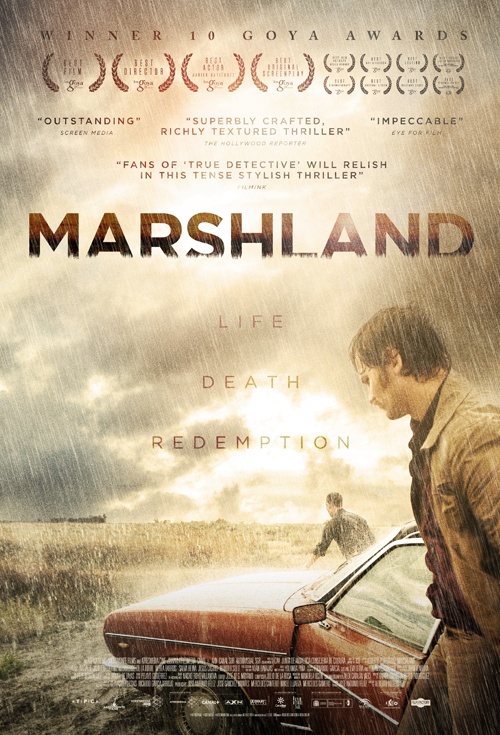
Marshland / La Isla Minima (dir. Alberto Rodriguez, Spain, 2014)—A mesmerizing and moody psychological journey into the underbelly of a small town in 1980, Marshland evokes the energy of True Detective and the tone of Twin Peaks to create a fascinating and haunting first-rate thriller. After teenage sisters disappear from a marshland town in southern Spain, two contrasting Madrid detectives are on the case. As their investigation unfolds, we take a twisty, turbulent ride filled with colorful characters, offbeat situations, and surprising moments of personal revelation. From the opening frames, featuring breathtaking aerial shots of the marshland, it's clear that filmmaker Alberto Rodriguez is in complete control. Each scene is perfectly crafted to capture the emotional and physical reality of that moment while an eerie, understated soundtrack seeps into our subconscious. This meticulous, multilayered cinematic puzzle rewards careful attention by doling out information on a need-to-know basis, assembling a suspenseful and magnetic experience that gives the best kind of movie thrill.—Brendan Peterson. In Spanish with English subtitles. Official site. IMDb. Wikipedia.

As reported by Alfonso Rivera to Cineuropa, Marshland swept this year's Goyas. At Variety, Jay Weissberg works with the film's plot failings to appreciate it as a "satisfyingly atmospheric neo-noir ... [s]teeped in a brooding transitional world of distrust, perversion, and disillusionment." Jonathan Holland's bottom line at The Hollywood Reporter: "This superbly crafted, richly textured thriller is one of the strongest Spanish films of the year." Holland adds: "Marshland merits international exposure as an example of ... how to fold significance into genre." At The Guardian, Jonathan Romney recommends this "slice of Ibero-noir" for those "weary of Scandi crime" and lays out the film's two distinctive elements: "One is the setting, the swamp regions of the Guadalquivir River in Andalucía: we could almost be watching a Spanish-language dub of a Hollywood thriller of the Louisiana bayous. The second is that the film is set in 1980, with the Franco legacy still a raw wound and causing divisions between the film's two homicide cops: younger, leftist Pedro (Raúl Arévalo) and his hard-boiled ancien regime colleague (Javier Gutiérrez)."


The Pawn / La Prenda (dir. Jean-Cosme Delaloye, Switzerland, 2015)—Guatemalan teen Astrid was kidnapped and held for ransom. Her family paid and she was released, but the family still gets phone calls from her abductors, calling her a pawn and threatening to snatch her again. Desperate, she enters the U.S. illegally and faces deportation. In Guatemala, one person is kidnapped every day. Targets are frequently children who have family in the United States. Ninety-eight percent of the kidnappers are never punished. Swiss journalist and documentarian Jean Cosme Delaloye examines the problem of abductions for ransom by focusing on Astrid's case, and two others. A father mourns the murder of his kidnapped wife and struggles to raise two young sons who witnessed their mother's death. Fifteen-year-old Kelly was snatched, brutally raped, and murdered. Most of Kelly's family has fled to the U.S., but her cousin Karin remains in Guatemala, working with the Survivors Network group to put Kelly's kidnappers in prison. The film follows court cases that will decide the fates of Astrid and some of the kidnappers.—Margarita Landazuri. In Spanish with English subtitles. Official site. IMDb. Facebook.

Eviator Bach and Jane Shi interview Delaloye and his subject Astrid Elías Macario for The Talon.

A Perfect Day (dir. Fernando Léon de Aranoa, Spain, 2015)—Humanitarian aid workers attempt to improve conditions despite facing bureaucracy, violence, cynicism, distrust, and a shortage of necessary materials in this tragicomedy, a kind of M*A*S*H comes to the Balkans, set during the waning days of the Bosnian War. The drama begins with Mambru (Benicio Del Toro) and Damir (Fedja Stukan) trying to fish a corpse out of a well. Lack of a proper rope complicates the situation—just one more absurdity for the two men and their co-workers, including wise-cracking B (Tim Robbins), as they go about the business of trying to survive while helping the region thrive once again. Spain stands in for Bosnia in Spaniard Fernando León de Aranoa’s gorgeously lensed, funny, and compassionate first English-language feature, a film as attuned to the comic potential of a booby-trapped cow in the road as it is to the challenge of doing the right thing in an impossible situation.—?. In English, Bosnian, Spanish, and French with English subtitles. IMDb. Wikipedia.

David Hudson has aggregated the Cannes reviews at Fandor's Keyframe Daily.


Viaje (dir. Paz Fárega, Costa Rica, 2015)—After 20-somethings Pedro (Fernando Bolaños) and Lucia (Kattia González) meet cute on the stairs of a costume party—he's in a bear suit; she's in schoolgirl overalls—the twosome spend the night together. The next morning, they impulsively decide to go on a camping trip; since he's heading out to work at a remote biological research facility and she's leaving the country, this may be the last chance they have to get to know each other. Filmmaker Paz Fábrega's romantic character study is like a Costa Rican Before Sunrise: The longer this couple muses about their dreams, desires, and how much this chance encounter has dinged their emotional defense systems, the downright sexier this film gets. Between its gorgeous black-and-white cinematography and the leads' breezy chemistry, this modest little gem of a movie packs more beauty, melancholy, and body heat into its 70-minute running time than most films twice its length.—David Fear. In Spanish with English subtitles. IMDb.

At The New York Times Stephen Holden anointed Viaje as the best entry in competition at the Tribeca Film Festival. At The Hollywood Reporter, John DeFore's bottom line: "An unpretentiously beautiful look at youth and how-casual-is-this? coupling." He adds: "Fabrega's script demonstrates the kind of feminist storytelling in which it goes without saying that men and women are equal participants in social life. ...The man and woman are peers in a way that's uncommon in romances directed by young men, working out in words and action the questions on both their minds: Is casual fun all there is? Is our youth ending if we make stronger bonds? What now?"