One of my favorite films from 2010 is the Argentine dark thriller Carancho (2010), for which I've already provided a critical overview, as well as an interview with the film's director Pablo Trapero. Strand Releasing has picked up Carancho for distribution and I'm happy to announce that the film opens in the Bay Area March 25, 2010 at Landmark's Lumiere Theatre in San Francisco and Landmark's Shattuck Cinemas in Berkeley. Carancho is also scheduled to open April 8, 2011 at Camera 3 in San Jose.
 Landmark's synopsis: "In Argentina, more than 8,000 people die every year in road accidents, with each victim representing millions of pesos in medical and legal expenses. Behind every tragedy, there is an industry. Set in Buenos Aires, the film noir thriller Carancho stars Ricardo Darín (The Secret in Their Eyes) as Sosa, an ambulance-chasing, disbarred attorney with questionable ethics. Luján (Martina Gusman, Lion's Den) is a young doctor from the provinces, trying to make a living out of many jobs. Alone, with a work rhythm that barely allows her to sleep, she tries to establish herself in a city unknown to her. After Luján and Sosa's paths repeatedly cross (she's trying to save a life; he's trying to add another client to his portfolio), the two form an unlikely romance that is threatened by Sosa’s turbulent past. With traffic accidents as the number one cause of deaths in Argentina, bodies are currency, and a black market strives to get rich from the personal tragedies that literally litter the streets."
Cross-published on Twitch.
 Pablo Trapero was born in San Justo, Buenos Aires, Argentina in 1971. He wrote, directed and edited the short films Mocoso Malcriado (1993) and Negocios (1995) before directing his feature debut, the award-winning Crane World (1999), a black and white 16mm film that proved to be a breaking point in Argentine cinema and that encouraged dozens of young directors into their first features. Crane World was released internationally at Venice, harvesting awards and critical acclaim at film festivals around the world.
 In 2002, his second feature El Bonaerense premiered at Un Certain Regard in the Cannes Film Festival, again to critical and audience acclaim. That same year he opened his own production company Matanza Cine in Buenos Aires, from which he has produced ever since not only his own features but also those of other Argentine and Latin American filmmakers, including Lisandro Alonso, Enrique Bellande and Raúl Perrone. "Matanza", Trapero informed me when we met at the 2010 Toronto International Film Festival (TIFF), is the name of the neighborhood where he was born and raised and literally means "the killing." El Bonoaerense was filmed there, as were several sequences for Carancho (2010), Trapero's sixth feature and Argentina's official submission to the Foreign Language category of the 2011 Academy Awards®. It's been picked up for North American distribution by Strand Releasing and has been programmed into the Awards Buzz: Best Foreign Language Film sidebar at the 2011 Palm Springs International Film Festival (PSIFF).
As a director, between shorts and TV films, Trapero's credits include Rolling Family (2004), Born and Bred (2006), and Lion's Den (2008). My thanks to Marcus Hu of Strand Releasing for setting me up to interview Pablo Trapero at TIFF and to Doug Cummings for initially publishing the transcript of our conversation at the AFI Fest website.
* * *
 Michael Guillén: Let's start with the title of your film. What does carancho mean?
Pablo Trapero: Carancho is a vulture; but—how do I say this?—it's handsome in a way; it's goodlooking. The feeling you have in front of this bird is not like the feeling you normally have in front of a vulture. Still, they eat roadkill.
Guillén: Is a carancho different than a zopilote?
Trapero: Yes. You only find a carancho in the countryside, in the pampa. It's a big bird. The idea is that it represents the character Sosa (Ricardo Darín). Interestingly enough, after the film showed in Argentina, people began using the term carancho to describe these types of lawyers. Recently in Argentina, in fact, the anti-carancho law was announced.
 Guillén: Carancho immediately reminded me of a comment made by Uruguayan author Eduardo Galeano that the term "accident" to describe a car wreck is inaccurate. Galeano argues that there is nothing accidental about car wrecks; that, in fact, from the moment cars were manufactured and set loose on the roadways car wrecks were inevitable. He said a better word to describe a car wreck would be "a consequence", rather than "an accident". In the case of Carancho, it might be said that it's also a consequence that cars would be rigged to crash. I'm intrigued that you've used a love story to reflect upon this corruption. Why did you move in that direction?
Trapero: The idea was to create a love story within a war zone; to show a love that comes from desperation or an extreme situation. Both ideas began at the same time: the love story and its environment. From the beginning I had the two characters of the lawyer and the emergency room doctor: they're two professions that one sees all over Argentina. I did a lot of research to learn about their worlds. Also at the beginning was the idea of creating a film noir.
 Guillén: I'm surprised that you reference film noir because—though others have referenced it as such—you've initially called Carancho "a classic black thriller", which I feel is more accurate. For me, Carancho is not a film noir; it's more a straightforward crime drama. So I want to make sure what you mean by using "noir" in this reference: are you referring to using a relationship to reflect a dark social situation? Social problems that could be considered dark?
Trapero: That's right. But not by talking about those problems. More by having them be present in the background. That's how I mean noir. Through this love story we can guess the bigger picture.
 Guillén: One of the pleasures of Carancho for me were its scenes of unexpected violence in situations where I wouldn't have anticipated them. For example, when the drunk man Luján (Martina Gusmán) is trying to help assaults her in the ambulance or—even more so—the gang war in the emergency room. The latter scene, especially, came off thrillingly comic. The audience I was in actually laughed at that scene.
Trapero: Ah, really? Great!
Guillén: Can you speak to your usages of violence, such that at times it's funny and other times not?
Trapero: In both of the scenes you mention, the violence serves as a way to let off steam. It's an escape valve for the intensity of the emotions. Of course, the violence serves a black humor in the film but not everyone understands that and some take it very seriously. But I meant it to be enjoyed, as you say you enjoyed it. And that enjoyment has to do with the contradictions in the situation; the contrast between what Luján is trying to do—she's trying to help others—and instead there's violence against others. In that is a black humor.
 Guillén: And no one is better at capturing these contradictions than Ricardo Darín. The carancho is a perfect metaphor for his character because on one level he's contemptible for being an ambulance chaser; but, he's also somehow charming about it. As you described the carancho, there's something seductive in Sosa's predatory nature. In fact, I'm frequently amused in Darín's performances in how he goes about seducing his female leads.
Trapero: Which is the same as saying how he seduces his audiences.
Guillén: Exactly. Though his characters—and particularly Sosa in Carancho—possess questionable ethics, he charms you into accepting his seedy ethics. He's what I would call an operator. What was it like working with him? It was your first time, no?
Trapero: Yes, it was my first time to work with him. Of course, I've known Ricardo since always. I met with him to discuss this project when he was shooting Juan José Campanella's The Secret In Their Eyes (2009). At a very early stage of developing the treatment, I contacted him to see what he thought, if he liked it, and if he would like to be in the movie? We kept in touch about all developments on the story.
 Both of them, Ricardo and Martina Gusmán made a good team. I could feel their chemistry from the very beginning. We knew from their first meeting that it could work; that it should work. I spent a lot of time with both of them reading the script in table rehearsals, talking about it, having lunch, having drinks, talking and talking, even more than true rehearsals with the scenes. We went straight from those discussions to filming the scenes rather than directly rehearsing them too much. This was the opposite of how Martina actually works. She spent six months researching her role, once a week doing a 24-hour shift in an actual hospital emergency ward. In effect, she became an assistant to the emergency doctor. Her approach to the role was very old-fashioned, you know? She became the character, little by little.
 Guillén: This is your third time to work with Martina Gusmán. What is it in her talent that you keep wanting to film in your movies?
Trapero: It's funny, because when we met a long time ago she was working in a production; that's how we met. But since she was four years old, she's been studying as an actress. When she was 17, she worked with a famous maestro named Carlos Gandolfo, which was unique for her being so young. Martina has deep formation as an actress. What I like about her work is how she goes through her characters. Her attention to detail—movement, her way of looking—this is more important than simply reciting the right words at the right moment. Both Martina and Ricardo are technical in their craft. If I tell them to move from here to there, they always hit their marks; but, at the same time, they can improvise as needed. I like to add new elements to a scene while we're shooting. Take by take, I'm always trying to improve the film, trying to make each take unique. Both of them are good at that. Of course, Martina knows me too well. But it's great to have that foundation and trust.
Guillén: I loved her performance, of course, in Lion's Den; but, have to say I loved her performance even more in Carancho. Let's shift to your sound design. You've used much ambient traffic noise, of course, which I'm presuming was fully conscious?
 Trapero: I mentioned earlier about the idea of a war zone, an environment that's really tough on the characters, but I didn't want to just film that on camera. I wanted to bring the mood of it to the scenes, to suggest that life is really tough out there. All the noises and sounds are a way of providing information to the audience, even if Sosa and Luján are just cooking or watching television or resting quietly on the sofa, the audience hears all the living city sounds drifting in from outside their window.
 Guillén: Can you speak to working with your cinematographer Julián Apezteguia to capture the feeling of confined vehicular spaces?
Trapero: It was strange to film in such tight spaces and we had a lot of long sequence takes, some as long as eight minutes. We didn't use a steadicam or anything like that. Julián always used a handheld RED camera, though with the assistance of a harness, and we shot in real cars. As for locations, we shot in real hospitals for the ambiance but we also built sets within the walls of the hospital to shoot the scenes in the emergency room. These sets had hidden access doors so that we could effect the long takes going through these small rooms.
Guillén: Lately I've been intrigued by what constitutes a "contemporary" film, especially from the directorial vantage. As your films frequently directly address social issues—such as the insurance fraud in Carancho—do you consider your films contemporary? What does that term mean for you?
 Trapero: I like the idea that my films have a dialogue with what is happening in the world off screen; but, I'm not sure if that could be called "contemporary." Maybe it is? My films are more a witness or a portrait of the moment. Even if you are shooting a science fiction film you are commenting upon the moment when you are shooting. It's not a matter of just being contemporary in terms of time, but in views of reality. That's what I like. When you make a film, you can feel the time when you were making the film; but, you can also feel it working on you now when you watch it. I like that a film can last for years and that it reflects the time when it was made; but, can still talk to audiences many years later. That for me is a contemporary film, even if it was shot 80 years ago. I like the idea of talking with movies over time.
Guillén: Can you talk a bit about your production company Matanza Cine? Do you have a signature style to the films you produce? A certain look? Or a certain message you're trying to get across in your films?
Trapero: No, no. What I enjoy doing with Matanza is to help directors throw it out there, to do it in the way that is proper to them, in the way they want to. I help them to have creative control. I give them the tools to help them go through the production of a film and to do it in such a way that the necessary production of a film does not hurt the soul of the film and a filmmaker's unique vision. I try to help them survive the process because sometimes making a movie fights against the spirit of their vision.
Cross-published on Twitch.
 Programmed within my favorite sidebar at the Palm Springs International Film Festival (PSIFF)—i.e., Awards Buzz: Best Foreign Language Film (which this year is featuring 40 of the 65 official submissions to the 2011 Academy Awards®)—Pablo Trapero's Carancho (2010) chases the shrill sound of ambulance sirens. I first caught this film at the 2010 Toronto International Film Festival (TIFF) and feel now is a good time to revisit those notes.
As synopsized by PSIFF: "Rooted in the reality of the corruption and violence of Buenos Aires, this gritty modern-day noir features Ricardo Darín (The Secret In Their Eyes and The Son Of The Bride) as Hector Sosa who, like the titular vulture-like bird, swoops down on unfortunate victims of Argentina's shockingly commonplace road accidents. Having lost his law license, he is relegated to the role of ambulance chaser for his thuggish employers who profit from a flourishing industry of false claims and insurance scams, fleecing victims of the bulk of any settlement received through their 'foundation.'
 "When he meets Luján [Martina Gusmán (Lion's Den)], an overworked medic who is wrestling with her own demons as she tries to save the lives of Sosa's 'clients,' he has a dramatic change of heart, but his plans to escape this life and change his ways go horribly awry. With crisp, tight editing, this lean and suspenseful thriller takes us through accident sites, hospital wards, and seedy interior settings that would be perfectly in place in a Hollywood noir. Carancho is the latest example of director Trapero's trademark socially realistic cinema."
Carancho explores the notion that "behind every tragedy, there is an industry." As Diana Sanchez detailed in her program notes for Carancho's North American premiere at TIFF 2010, Trapero's film is "a story drawn from the alarming violence on his country's streets" and "an engrossing love story set among people who trade in sudden tragedy and death." Tracking the film's press notes, Sanchez writes: "Each year, more than eight thousand people are killed on the road and over a hundred thousand are injured. As a result, a disturbingly large part of the Argentine economy revolves around traffic accidents, and a profit stands to be made from the ongoing flow of medical expenses and insurance claims. Trapero's sixth feature plunges into this murky world of opportunism, spotlighting the crooks that swoop in on emergency rooms and accident scenes."
 At Twitch, Todd Brown reported from the film's Cannes premiere: "A film that fuses stellar character work and intimate drama with larger thriller and heist moments with a few elements of shocking violence thrown in for good measure, Carancho is a masterful piece of work from writer / director / producer / editor Pablo Trapero. Trapero serves notice here that he is one of the very best film makers in the world today. Period. The complexity of his characters, the technical quality of the film work, his ability to balance intimate emotion with realistic and brutal action sequences, his obvious skill in working with actors—though that is made easier when you have actors the caliber of [Ricardo] Darín to work with—Trapero is at the highest level in all of these. Flawless? Carancho comes pretty damn close." As if to cinch the deal, Brown has included Carancho in his year-end top picks, emphasizing that "Ricardo Darín anchors Pablo Trapero's Carancho with a riveting, complex performance as a broken man slowly unraveling thanks to the tiny moré of conscience he retains. Classic noir in content if not in style, Trapero's film spins its amoral tale of insurance scams and ambulance chasing in as unaffected a style as possible, letting events play out in a cold, almost clinical fashion as his characters stumble inevitably to a bad end. The always stellar Darín has never been better and he's perfectly matched to both director and story."
 At MUBI, Daniel Kasman praises Trapero as a steady, sure-handed genre craftsman. Kasman reported from TIFF: "Carancho has the solidity of construction and reliance on conventional character types and story arcs to effectively normalize a highly specific and localized setting. The result, like an early '30s Hollywood entry, is a workman film, one made by a director prodigious enough to pick such a unglamorous setting and proceed to cast it in a reliably realistic and unappealing light—'cause that's the way it really is. ...The film is so solid that any room for ambiguity is left out of the digital masonry of the mise-en-scène, which builds a clear schema where, simply, anyone involved in the nocturnal world of deaths and near-deaths, accidents and 'incidents' is implicated in the gloom, no questions asked. Thus the modest ambitions of a genre film stay within its modest limits, rather than escaping into the unease of the shadows, blossoming within gray shades of morality, or aesthetically expanded in risky angles, lighting, and other stylistics."
Cross-published on Twitch.
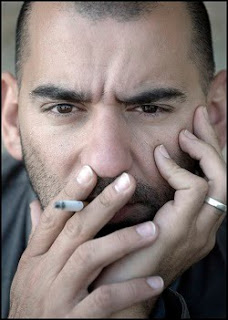 Pablo Trapero was born in San Justo, Buenos Aires, Argentina in 1971. He wrote, directed and edited the short films Mocoso Malcriado (1993) and Negocios (1995) before directing his feature debut, the award-winning Crane World (1999), a black and white 16mm film that proved to be a breaking point in Argentine cinema and that encouraged dozens of young directors into their first features. Crane World was released internationally at Venice, harvesting awards and critical acclaim at film festivals around the world.
In 2002, his second feature El Bonaerense premiered at Un Certain Regard in the Cannes Film Festival, again to critical and audience acclaim. That same year he opened his own production company Matanza Cine in Buenos Aires, from which he has produced ever since not only his own features but also those of other Argentine and Latin American filmmakers, including Lisandro Alonso, Enrique Bellande and Raúl Perrone. "Matanza", Trapero informed me, is the name of the neighborhood where he was born and raised and literally means "the killing." El Bonoaerense was filmed there, as were several sequences for Carancho (2010), Trapero's sixth feature and Argentina's official submission to the Foreign Language category of the 2011 Academy Awards®. It's been picked up for North American distribution by Strand Releasing.
 As a director, between shorts and TV films, his credits include Rolling Family (2004), Born and Bred (2006), and Lion's Den (2008). Carancho explores the notion that "behind every tragedy, there is an industry." As Diana Sanchez detailed in her program notes for Carancho's North American premiere at TIFF 2010, Trapero's film is "a story drawn from the alarming violence on his country's streets" and "an engrossing love story set among people who trade in sudden tragedy and death." Tracking the film's press notes, Sanchez writes: "Each year, more than eight thousand people are killed on the road and over a hundred thousand are injured. As a result, a disturbingly large part of the Argentine economy revolves around traffic accidents, and a profit stands to be made from the ongoing flow of medical expenses and insurance claims. Trapero's sixth feature plunges into this murky world of opportunism, spotlighting the crooks that swoop in on emergency rooms and accident scenes."
At Twitch, Todd Brown reported from the film's Cannes premiere: "A film that fuses stellar character work and intimate drama with larger thriller and heist moments with a few elements of shocking violence thrown in for good measure, Carancho is a masterful piece of work from writer / director / producer / editor Pablo Trapero. Trapero serves notice here that he is one of the very best film makers in the world today. Period. The complexity of his characters, the technical quality of the film work, his ability to balance intimate emotion with realistic and brutal action sequences, his obvious skill in working with actors—though that is made easier when you have actors the caliber of [Ricardo] Darín to work with—Trapero is at the highest level in all of these. Flawless? Carancho comes pretty damn close."
 At MUBI, Daniel Kasman praises Trapero as a steady, sure-handed genre craftsman. Kasman reports from the film's North American premiere at Toronto: "Carancho has the solidity of construction and reliance on conventional character types and story arcs to effectively normalize a highly specific and localized setting. The result, like an early 30s Hollywood entry, is a workman film, one made by a director prodigious enough to pick such a unglamorous setting and proceed to cast it in a reliably realistic and unappealing light—'cause that's the way it really is. ...The film is so solid that any room for ambiguity is left out of the digital masonry of the mise-en-scène, which builds a clear schema where, simply, anyone involved in the nocturnal world of deaths and near-deaths, accidents and 'incidents' is implicated in the gloom, no questions asked. Thus the modest ambitions of a genre film stay within its modest limits, rather than escaping into the unease of the shadows, blossoming within gray shades of morality, or aesthetically expanded in risky angles, lighting, and other stylistics."
 My thanks to Marcus Hu of Strand Releasing for setting me up to interview Pablo Trapero at the Toronto International and to Doug Cummings for publishing the transcript of our conversation on his AFI Fest website [here] in conjunction with the film's screening this evening at the Mann Chinese 6 Theatre in Hollywood.
Cross-published on Twitch.
 Landmark's synopsis: "In Argentina, more than 8,000 people die every year in road accidents, with each victim representing millions of pesos in medical and legal expenses. Behind every tragedy, there is an industry. Set in Buenos Aires, the film noir thriller Carancho stars Ricardo Darín (The Secret in Their Eyes) as Sosa, an ambulance-chasing, disbarred attorney with questionable ethics. Luján (Martina Gusman, Lion's Den) is a young doctor from the provinces, trying to make a living out of many jobs. Alone, with a work rhythm that barely allows her to sleep, she tries to establish herself in a city unknown to her. After Luján and Sosa's paths repeatedly cross (she's trying to save a life; he's trying to add another client to his portfolio), the two form an unlikely romance that is threatened by Sosa’s turbulent past. With traffic accidents as the number one cause of deaths in Argentina, bodies are currency, and a black market strives to get rich from the personal tragedies that literally litter the streets."


