 It is, perhaps, a belabored cliché to consider how films speak to each other across time and space; however, it's difficult not to observe when films speak to each other contemporaneously for being proximate in space by being programmed in the same film festival. Such was the case at the 2010 Toronto International Film Festival (TIFF) where three stylistically distinct films addressed the suffering source of poetry: South Korea's Poetry (Shi, 2010), the German / Austrian / Estonian co-production The Poll Diaries (2010), and the Russian film Silent Souls (Ovsyanki, 2010). In a word, Poetry was incandescent, Silent Souls elegiac, and The Poll Diaries morbid (though beautifully so). I'm quite pleased that all three will be speaking across to each other once again at the 2011 Palm Springs International Film Festival.
 The Poll Diaries (Germany / Austria / Estonia, 2010)—I've spoken with Chris Kraus regarding his fourth feature The Poll Diaries, a semi-fictional narrative set in turn-of-the-century Estonia depicting the effect of tumultuous historic events upon the tender sensibility of Oda Schaefer, a young girl whose destiny as a poet is influenced by her interaction with a wounded Estonian anarchist she nurses back to health. Reconciling her family's aristocratic indiscretions with a compassionate concern for the downtrodden, Oda's innate poetic sense is enflamed when she is forced to acknowledge scientific inhumanity, political injustice and social inequality.
Poetry / Shi (South Korea, 2010)—In their brief synopsis for Lee Chang-dong's most recent masterwork, TIFF quipped: "Rhyme and crime intertwine in Poetry, the moving portrait of an elegant old lady in the initial stages of Alzheimer's, as well as a lyrical take on creative discovery and an upsetting look at juvenile violence."
 Dispatching to MUBI from Poetry's premiere at the Cannes Film Festival, Danny Kasman observed: "Films about artists or someone creating art are incredibly difficult to pull off. It has something to do with audience verification—if we just hear that someone is a great painter or writer, we can take the film's word for it, but if we see them painting or writing, suddenly the viewer can cast instant judgment on that work and thereby the character and thereby the honesty of the film itself. Lee's film risks it all by including both artistic creation—we see our heroine thinking about and composing poetry—and the art too, since she eventually reads to us her composition. And the film wildly succeeds on both accounts, and at something even more challenging too, which is by painting Yun Jung-hee's character as an almost simple-minded or daft free spirit, which makes the believability of composition, creation, and exposition something requiring terrific subtlety and nuance. That her work is moving even before she finishes her poem, simply in her looking at the world around her and the way her new observations start to trickle through her conversations, is a resounding accomplishment for director and actress." Also at MUBI, David Hudson rounded up the subsequent Cannes reviews (where Poetry won Best Screenplay), as well as the resoundingly favorable reviews from the film's screening at the New York Film Festival (NYFF).
 Myself, I caught the film at its North American premiere at TIFF. Straight off, I was struck by how frequently cinematic narratives spring from the body of a dead girl; a thematic domain—if not a genre—unto itself. In Poetry, it is the corpse of teenage Agnes floating down the river. She's committed suicide after being raped by a gang of boys. Somehow it is her spirit that informs Mija's desperation to write one poem before she loses her mind to Alzheimer's. In the role of Mija, Yoon Jeong-hee—who came out of a 16-year retirement—permeates her performance with a wistful sweet sadness.
One of my favorite images from Poetry is when Mija—struggling for inspiration—sits beside the river staring at the bridge from which Agnes leapt to her death. With notepad in hand, Mija sits poised to write; but, a sudden rain arrives before inspiration. The white pages of Mija's empty notepad become startled by dark drops of rain; the cinematic image itself sheer poetry.
 Further, the fugacity of human experience is aligned with the natural cycle of growth and decay, which easily becomes one of the most fundamental templates of poetic expression; i.e., the fate of flowers and fruit becomes the fate of human beings or—as Mija herself says in a moment of senescent insight—"apricots are sweetest once they have fallen from the branch."
 Silent Souls / Ovsyanki (Russia, 2010)—Aleksei Fedorchenko's third feature film aligns thematically with Lee Chang-dong's riverside reveries in his mesmerizing focus on the obscure pagan practices of a small community of Finno-Ugric people, the Merya, who—as Dimitri Eipedes explains in his official description for TIFF—"never got over their infatuation with water, settling along riverbanks whenever and wherever they could" and all because "they believe death by drowning to be the ultimate release." Silent Souls becomes the filmic version of a novel written on a father's silted typewriter perched on the sides of dead fish: to drown, to drown, to drown....
Again at MUBI, David Hudson has rounded up the reviews from Venice and Toronto 2010, then again from NYFF. Likewise at MUBI, Danny Kasman weighs in independently from TIFF's North American premiere, observing that art cinema hazards blowing small filmic subjects out of proportion with distorting grandeur. He praises that Fedorchenko "keeps the sense of scale intact" and remains steadfast to his simple story about two men dispersing the ashes of a woman they both loved. "Compositions are in wide screen," Kasman describes, "but it is always roads, rivers, doors and paths that extend down the center and into the distance; the weight of solemn grey fixed camera shots lifted to a tranquil, almost nostalgic tone by this continual hint at journey and death."
Cross-published on Twitch.
 Chris Kraus was born in Goettingen, Germany and studied at the German Film and Television Academy (DFFB) in Berlin, where he now teaches. Already a noted scriptwriter before making his debut as a director, Kraus scored a notable success with his first feature, Scherbentanz (Shattered Glass, 2002), which was awarded two Bavarian Film Prizes, among other awards. His second film, Vier Minuten (Four Minutes, 2006), was one of the most successful German films of past years and won over 50 German and international awards, including the Audience Prize at San Francisco's 2007 Frameline Film Festival. In The Poll Diaries (2010) [official German site], Kraus continues his tradition of introducing sensational young talents to the movie-going public: after Hannah Herzsprung in Four Minutes, it is now Paula Beer's turn to shine as Oda von Siering, the adolescent protagonist of The Poll Diaries, which boasted its world premiere at the 2010 Toronto International Film Festival (TIFF) and is now poised for its U.S. premiere in the World Cinema Now sidebar at the 2011 Palm Springs International Film Festival (PSIFF).
 As synopsized by PSIFF: "On the eve of WWI, 14-year-old Oda Schaefer (Paula Beer, mesmerizing)—soon to grow into the real-life German poet—journeys by train to live with her estranged and discredited doctor father. She brings with her two 'gifts': her dead mother's body and a two-headed fetus. So begins Chris Krause's strange and deeply affecting drama that examines the chaotic home life of the poetess-to-be against the backdrop of civilization coming apart at the seams. Oda's father has little regard for human life—he is more concerned with furthering his disturbing studies on biology and destiny. Her stepmother is carrying on an affair. A wounded anarchist brings out Oda's maternal side, as she secretly nurses him back to life. Meanwhile Archduke Ferdinand has been shot and the world is sliding inexorably into war….
"Observant and profoundly humanist in belief and act, Oda serves as the audience surrogate, allowing us entry into a harsh and mysterious time, a time when the sacred sat alongside the profane, when the bizarre and gory were countered by the beautiful and the deeply felt. The Poll Diaries is a singular work, not easily forgotten."
I thought now would be a good time to revisit my interview with Kraus and I want to once again thank Stephen Lan for arranging time for Chris Kraus and I to sit down at the Toronto International to discuss his latest project. I likewise remain grateful to Sebastian Keismueller of Bavaria Film International for access to the film's production stills, including Jim Rakete's portrait of Kraus.
* * *
Michael Guillén: You have been working on The Poll Diaries (2010) for close to 14-15 years: from the original idea, through development and pre-production, to the actual filming. That's an unusually excessive amount of time to be working on a project and—since people change over time....
Chris Kraus: Yes, that's true.
Guillén: ...how was that for you? Did your approach to the project change over the years, as I assume you changed? Can you speak to the pros and cons of having such a length of time to develop a film?
 Kraus: I like this question, I must say. I never thought about it but it's true. In 1995, I wrote the script because in 1993—shortly after the freedom of Estonia—I traveled to Estonia and visited Poll. The story went through an interesting process because at the beginning I just wanted to give the script to another director. After a while, I became a director and—after all my efforts to bring the script to another director fell through—suddenly the possibility developed that I could work on it myself.
At that point the script itself went a little bit darker. Over time it became darker. That was the process. At the beginning, it was a story about a girl's adventure where at the end the anarchist escapes and she grows up; it was a coming-of-age story. Nothing really changed except the community in which the story was set. By the time I decided to direct the story myself, it had darkened, there was more tragedy, more pain. In retrospect, I'm glad that this film wasn't made when I was a young guy because now it's filled up with the ambivalency of being neither good nor bad, which is a theme of interest to me. Also, the idea of how luck can bring a person to the right decision and not the wrong. Allowing the script to mature to incorporate my personal interests was better for the project.
 Guillén: This tragic shadow that fell over the script over time, was it truer to the source memoirs of German-Baltic author Oda Schaefer (1900-1988)? Or were these tragic concerns more in league with your own personal development?
Kraus: Yes, absolutely, because when I began writing the script based on Oda Schaefer's memoirs, I felt that there was something wrong with this woman's story, like something was missing. I felt something had happened that she hadn't included in her memoirs. So I decided to create the world that she never talked about in her memoirs. Admittedly, my creation of Oda's world was incorrect—Poll was never destroyed and some of the information at the end of the film is incorrect—but, I wanted to play with this balance between fiction and non-fiction. Though the character of Oda Schaefer is real—she was a famous lyric writer in the 1950s—she is almost unknown today, though she remains real for my family. During her time at Poll, Oda Schaefer discovered her own identity. So perhaps it's safe to say that the way of her story and the way of my own story are not so far away from each other.
Guillén: That you both became writers surfaces as a common element? I'm aware you studied literature at the university, but what prompted the shift to scriptwriting? At what point did you choose film over literature?
 Kraus: There's not a direct link. Yes, I started at the university studying two years of literature; but, then I did a lot of other things, my life was mixed up, I stopped my studies, and only ten years later was lucky enough to study four years at a film school. To make a long story short, I decided to be a writer because I came from a background of writing. In those days at the film school everyone wanted to become a director. I never wanted to become a director. I had children I had to feed.
Guillén: Well, I'm glad to say you became a director, I'll put it that way.
Kraus: You're very charming.
Guillén: In your director's statement in the press notes, you state: "I wasn't interested in a world of the past, but in the onset of a period that we live in to this very day." Can you expand on that? What are the characteristics of this period we now live in that were introduced by the historical precedent of your story?
 Kraus: I'm not sure. Your questions are very complex and with my limited English I'm not sure I can be on the same level; but, I'll try. I don't believe the connections are details of time. It's more a feeling of insecurity that has been passed down to us from that time. Further, the changes in time from then to now are not as big as we think. On one hand, when we think of 1914 it seems almost the same as considering the ancient Romans—it seems so far away—but, on the other hand, all of the emblematic characteristics of the 20th century were already there in 1914: science, the cars, the beginning of psychology, all of those aspects of modernity were already in place. What I meant in my director's note was that 1914 was just the beginning of a modern age that we experience moreoreless today.
Guillén: To return to your earlier comment regarding your concern with the ambivalency of right and wrong and how seemingly straightforward events can lead to right or wrong decisions, what I found difficult to watch in The Poll Diaries was the characterization of Oda's father Ebbo von Siering (in a disturbing performance by Edgar Selge). Here is a man desperate to be acknowledged within a mainstream academic community who begins to scientifically experiment on human beings, which—historically, of course—we know led to the heinous practices that occurred during WWII. But it comments even further on the genetic splicing being explored today. That scientific impulse of experimenting with the human body, once started, has never stopped and I was wondering if this was the "onset of a period" that you were referencing? Or as Cameron Bailey phrased it in his program notes: "Posing a range of ethical questions, the film offers a compelling commentary on a morally bankrupt brand of reasoning that would come to underlie some of the greatest tragedies of the twentieth century."
 Kraus: I wanted to choose one part of the early turn of the century that would tell us about ourselves today. I chose science. I could have chosen other things as well. I could have chosen psychology, for example. The real existing Ebbo on whom my character was based was actually a journalist and—though he began his writing career with some interesting pieces—he was eventually unsuccessful as a writer. Filled with hate and resentment over his failed career, he became anti-Semitic. I gave that lack of success to my character Ebbo as well to show how he became more and more radical and extreme. When a man is not successful in life, he feels pressured and begins to resent and hate the times that work against him. I chose science as a way to articulate this theme of conflicted modernity. As a filmmaker, of course, you choose what will allow the most imagery and I felt I could do more with Ebbo as a scientist than I could if he were a journalist.
Guillén: One of the things I found most compelling about The Poll Diaries was precisely your directorial intent to create a historical drama that speaks to modern audiences. I'm continually intrigued by what makes such a historical drama contemporary. Do you feel The Poll Diaries is a contemporary film?
Kraus: It's hard for me to answer that; but, I think the characters are modern. Do you know what I mean? It's like trying to imagine what it would be like to live in the 16th Century or—in the specific case of The Poll Diaries—the transition from the 19th to the 20th Century. For me, as a German, with a family background in National Socialism, what I imagine as modern is what it would feel like for me to be this adolescent girl Oda? Although I never met her, I liked her a lot. It was forbidden to talk about her in my family.
 Guillén: Oda Schaefer was your great aunt?
Kraus: Yes, she was my great aunt and—because of that—that's the modern connection. The same family dynamics occurring during Oda's adolescence in 1914 are the same dynamics occurring in my family today. I'm pretty sure my family doesn't like my film.
Guillén: I was going to ask you how they felt about your championing the black sheep of your family.
Kraus: No, no, no, they are absolutely against this film.
Guillén: They didn't want anyone to know about her, right?
Kraus: No, that's not exactly right. They're not really interested in her; but, they're interested in the status of her own tradition and because I show a German-Baltic who is a bad guy doing bad things to people. Actually, I don't think of him as a bad guy. He's an ambivalent personality. Maybe he could have been a good guy?
Guillén: If he'd been academically successful?
 Kraus: Maybe? Or maybe Oda could have turned out to be a bad girl? Because I've staged that ambivalency, my family is totally against this film. I'm sure no one in my family could have imagined this, coming from an aristrocratic background with its tradition of pride. But to return to your question: this is the modern thing. This is what's contemporary about the film. The attitudes of my family. We even tried to work with German-Baltic organizations but it wasn't possible. They read a small treatment of the script and rejected participation. That reaction alone tells me that there is something in this story that is not just a fairy tale.
 Guillén: At a large international festival like TIFF where I'm watching so many different movies from different countries—which is such a compressed, almost artificial way to watch movies—one of the welcome delights is how certain movies begin to speak to each other. Your film The Poll Diaries speaks to two others I've seen at TIFF: Lee Changdong's Korean feature Poetry and Aleksei Fedorchenko's Russian feature Silent Souls. All three films concern individuals who—in their struggle against social constraints and personal tragedies—become poets. And though all three films are stylistically different, it's through the tragedies of their individual lives that their poetry emerges. In The Poll Diaries Oda is encouraged to become a poet through the influence of the Estonian anarchist "Schnaps" (handsomely played by Tambet Tuisk). Is this one of the fictional elements you added to the life of your great aunt Oda Schaefer?
Kraus: I thought about the character of my great aunt and wondered why she was not like the rest of the family? The answer is: because she became a writer. When you're a writer, you're never sure of the conditions of living and have to live with a certain insecurity. You have to be content to ask and perhaps not know the answers. When you begin to ask questions, when you begin to think about things, perhaps at the end of your questioning there will be no answer; but, because of all the questions you have asked, you maybe learn who you are. If you're a slave to family traditions, you will never find yourself. Speaking personally, that's the tragedy of my own family. So many members of my family have been so far away from themselves; but, my great aunt Oda tried to find herself. She spoke honestly of her feelings and that made a difference. That's also what interests me in other people.
 Guillén: The Poll Diaries is sumptuously filmed. It's visually beautiful. The entire production design is stunning. I was bemused reading the production notes that most of your production team is female.
Kraus: [Laughs loudly.]
Guillén: Your director of photography Daniela Knapp, your production designer Silke Buhr, your make up supervisor Susana Sánchez, your costume designer Gioia Raspé, your editor Uta Schmidt, your original music by Annette Focks, your casting director Nina Haun, even your producers Meike and Alexandra Kordes: all women. This is somewhat unusual and commendable. I respect this. What was this like for you to be surrounded by such an ensemble of feminine creative talent informing the film?
Kraus: I like to work with women! They add another sensitivity. The truth is that most of my team began with my career. We have grown together. It just happened.
 Guillén: I appreciate that you use the term "sensitivity" because the voice that comes out of this film, this young girl's voice, is a strong, feminist voice. The role you have given Paula Beer to play possesses admirable agency. It's a great debut performance for a young actress. I'm curious if the fact that you have such creative women working with you has helped develop and strengthen that feminine voice, not only here in The Poll Diaries but with your previous feature Four Minutes (2006)?
Kraus: It's just the way my life happened. When I began with my first film Scherbentanz (Shattered Glass, 2002), it wasn't that I said, "I only want to work with women." It just happened. I've planned a trilogy of films about my family. Scherbentanz was about my mother and The Poll Diaries about another female character. I think today that's very modern. Female characters now are more interesting because today they can do things; they're not victims anymore.
Guillén: Which reflects the central theme you're admittedly interested in of how an individual can find him or herself against all odds and despite opposition from the social environment.
Kraus: Yes. For men, of course, in our male world, it's normal; but, for women it's a challenge. Even for a woman to become a cinematographer is a challenge. Your question reveals to me that this is a theme in my work and I apologize for laughing so loudly. Why did you look at that? Why did you check that out?
Guillén: Because I personally relate to that feminine struggle for independent agency. I am one of those men who believe that the emancipation of women sets us all free. And I've met enough people in the film world to know how difficult it is for women to get a toehold in the industry; thus, I admired your production ensemble, which has served you well. Four Minutes was internationally successful.
Kraus: Yes. I see.
 Guillén: Returning to the production, this house that serves as the main location in your film, this incredible Palladine-style manor, is an incredible presence in your film. As Cameron Bailey described it in his program notes, it's "a character in its own right, a hulking, neoclassical manor that hovers on stilts above the sea." Can you speak to how you and your production team came up with this structure?
Kraus: The decision to build that house was mine. It was the only possibility to bring it alive. Even though at first we looked for an existing structure in Estonia. But the details of the house, its construction, was the work of Silke Buhr.
Guillén: Who, again, worked with you on Four Minutes, as well as on Florian Henckel von Donnersmarcks's The Lives Of Others. This house that Buhr designed, I'd never seen a house like this before.
Kraus: That's because it doesn't exist.
Guillén: So it was more an aesthetic concept rather than an architectural reconstruction of a historical structure?
Kraus: It has more to do with imagination. It's a house that could have existed. We thought about how we could bring it alive and it depended upon a character who could imagine such a house. A king in the 16th century, let's say, might say, "I want a mosque as a house" and he would have it built. Silke Buhr and I thought, "Okay, 100 years ago there might have been a grandfather in Alaska who wanted to bring a Palladine-style manor to Alaska." We decided that—though such a structure didn't exist—it could exist, especially if we had a character such as Ebbo von Siering who was crazy enough to build it. Thus, this somewhat fairy tale house came alive. I heard today, in fact, that some people found it admirable that we had found the house in Estonia!
Guillén: Speaking of Estonia, what was it like to film there? The Tallinn Black Nights Film Festival has become one of my dream destinations. I've heard their cities hold the old world charm of Prague. Was it a special experience for you to film there?
Kraus: Yes, it was a special experience; like filming here in the wilderness of Canada. We filmed in a nature reserve away from civilization. I haven't seen much of Estonia. I've mainly just seen its forests. When we filmed from the helicopter, it was amazing to see nothing but wilderness as far as the eye could see. This is uncommon for middle Europe so I was delighted to use this footage. For me, Estonia was archaic. That would be the word: archaic.
Unfortunately, with regard to the old world charm of Tallinn, they have polished it up. It's too new now. It's very nice; but, when I saw it in 1993, everything was wonderfully wrecked.
Guillén: It had character?
Kraus: Unbelievable character. It was like stepping back into the past 100 years. But it's not like that anymore.
Guillén: Can you speak to how you worked with your director of photography Daniela Kapp to create the pastoral atmosphere of The Poll Diaries? The look of the film is gorgeous, all that late afternoon low-angled amber light reflected off the surfaces of things. If I walk away from a movie with even just one image seared into my mind, I am happy and with The Poll Diaries it was that amber light glinting off of spider webs wavering in late afternoon breezes and those busy black ants trafficking over the coarse bark of trees. I'm sure you didn't place those spider webs or anything; but, I admire how your DoP had an eye for such pastoral detail.
Kraus: Though The Poll Diaries was my fourth film, I wasn't able to work with Judith Kaufmann who was my DoP on Four Minutes. Daniela arrived in Estonia five weeks before shooting began so it was just a process of bringing her into the project. And though, yes, you are right, we did not place the spider webs on the set, the ants were placed by four people who brought them in.
Guillén: [Laughs] Ant wranglers!
Kraus: Yeah, really. [Laughs.] Absolutely. I think it was wonderful that Daniela had the same vision. She contributed some very good ideas. But sometimes communication doesn't have to do with speaking. Of course you talk and all that, but you also communicate on another level and, perhaps, this is again that special thing of working with women. It's easier. With men, something else happens. You never have such problems working with women. You have other problems; but, not the ones you have with men.
Cross-published on Twitch.
 Programmed within my favorite sidebar at the Palm Springs International Film Festival (PSIFF)—i.e., Awards Buzz: Best Foreign Language Film (which this year is featuring 40 of the 65 official submissions to the 2011 Academy Awards®)—Pablo Trapero's Carancho (2010) chases the shrill sound of ambulance sirens. I first caught this film at the 2010 Toronto International Film Festival (TIFF) and feel now is a good time to revisit those notes.
As synopsized by PSIFF: "Rooted in the reality of the corruption and violence of Buenos Aires, this gritty modern-day noir features Ricardo Darín (The Secret In Their Eyes and The Son Of The Bride) as Hector Sosa who, like the titular vulture-like bird, swoops down on unfortunate victims of Argentina's shockingly commonplace road accidents. Having lost his law license, he is relegated to the role of ambulance chaser for his thuggish employers who profit from a flourishing industry of false claims and insurance scams, fleecing victims of the bulk of any settlement received through their 'foundation.'
 "When he meets Luján [Martina Gusmán (Lion's Den)], an overworked medic who is wrestling with her own demons as she tries to save the lives of Sosa's 'clients,' he has a dramatic change of heart, but his plans to escape this life and change his ways go horribly awry. With crisp, tight editing, this lean and suspenseful thriller takes us through accident sites, hospital wards, and seedy interior settings that would be perfectly in place in a Hollywood noir. Carancho is the latest example of director Trapero's trademark socially realistic cinema."
Carancho explores the notion that "behind every tragedy, there is an industry." As Diana Sanchez detailed in her program notes for Carancho's North American premiere at TIFF 2010, Trapero's film is "a story drawn from the alarming violence on his country's streets" and "an engrossing love story set among people who trade in sudden tragedy and death." Tracking the film's press notes, Sanchez writes: "Each year, more than eight thousand people are killed on the road and over a hundred thousand are injured. As a result, a disturbingly large part of the Argentine economy revolves around traffic accidents, and a profit stands to be made from the ongoing flow of medical expenses and insurance claims. Trapero's sixth feature plunges into this murky world of opportunism, spotlighting the crooks that swoop in on emergency rooms and accident scenes."
 At Twitch, Todd Brown reported from the film's Cannes premiere: "A film that fuses stellar character work and intimate drama with larger thriller and heist moments with a few elements of shocking violence thrown in for good measure, Carancho is a masterful piece of work from writer / director / producer / editor Pablo Trapero. Trapero serves notice here that he is one of the very best film makers in the world today. Period. The complexity of his characters, the technical quality of the film work, his ability to balance intimate emotion with realistic and brutal action sequences, his obvious skill in working with actors—though that is made easier when you have actors the caliber of [Ricardo] Darín to work with—Trapero is at the highest level in all of these. Flawless? Carancho comes pretty damn close." As if to cinch the deal, Brown has included Carancho in his year-end top picks, emphasizing that "Ricardo Darín anchors Pablo Trapero's Carancho with a riveting, complex performance as a broken man slowly unraveling thanks to the tiny moré of conscience he retains. Classic noir in content if not in style, Trapero's film spins its amoral tale of insurance scams and ambulance chasing in as unaffected a style as possible, letting events play out in a cold, almost clinical fashion as his characters stumble inevitably to a bad end. The always stellar Darín has never been better and he's perfectly matched to both director and story."
 At MUBI, Daniel Kasman praises Trapero as a steady, sure-handed genre craftsman. Kasman reported from TIFF: "Carancho has the solidity of construction and reliance on conventional character types and story arcs to effectively normalize a highly specific and localized setting. The result, like an early '30s Hollywood entry, is a workman film, one made by a director prodigious enough to pick such a unglamorous setting and proceed to cast it in a reliably realistic and unappealing light—'cause that's the way it really is. ...The film is so solid that any room for ambiguity is left out of the digital masonry of the mise-en-scène, which builds a clear schema where, simply, anyone involved in the nocturnal world of deaths and near-deaths, accidents and 'incidents' is implicated in the gloom, no questions asked. Thus the modest ambitions of a genre film stay within its modest limits, rather than escaping into the unease of the shadows, blossoming within gray shades of morality, or aesthetically expanded in risky angles, lighting, and other stylistics."
Cross-published on Twitch.
 Winner of the Palme d'Or at the 2010 Cannes Film Festival, I had the great pleasure of viewing Uncle Boonmee Who Can Recall His Past Lives at the 2010 Toronto International Film Festival, which was screened in conjunction with a Mavericks on-stage conversation between Apichatpong Weerasethakul and Dennis Lim from The Village Voice. That experience afforded the opportunity to ask "Joe" a question. [Not for the spoiler-wary!]
* * *
Michael Guillén: I was enchanted with the story of the Princess and the catfish embedded in Uncle Boonmee. It's a beautiful sequence. Is this a regional myth that you used for your film or a myth you've created to suit the region? I'm also curious about its particular placement within the narrative of the film?
Apichatpong Weerasethakul: That scene pops up in the movie without explanation. It comes halfway through the film like an odd chapter. We switched the reel. My concept was that each reel of film was a tribute and that this reel was a a tribute to the royal costume dramas that always have a prince, a princess and a talking animal; but, usually not to the point of intercourse. [Laughter.] That was my extra bonus!
 Uncle Boonmee as a film talks about reincarnation and transformation and the human relationship with nature. For example, the monkey ghost doesn't feel like he belongs so that's why he transforms himself to escape. It's the same with the Princess. She doesn't feel content with her own body, with her appearance, so she decides that one of the ways to overcome her discontent is to sacrifice herself to water and the catfish so that she can transform.
In fact, we cut the scene where she's about to deliver a baby and is very worried whether her baby will be a hybrid form of animal, a fish-human. That will be part two of Uncle Boonmee.
* * *
 Bay Area audiences will have their opportunity to view the West Coast Premiere of this award-winning fabulist tale Saturday, December 4, 7:30PM at the Rafael Film Center, where it is being screened as part of the International Buddhist Film Festival Showcase 2010. Uncle Boonmee will be introduced by Wes "Scoop" Nisker, a San Franciscan author, radio commentator (KFOG), comedian, and Buddhist meditation instructor well-known for the catchphrase, "If you don't like the news ... go out and make some of your own," which he used as the title for his 1994 book.
Cross-published on Twitch.
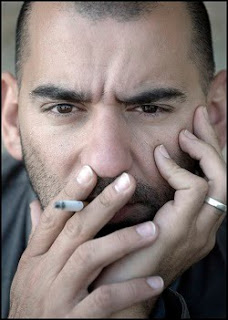 Pablo Trapero was born in San Justo, Buenos Aires, Argentina in 1971. He wrote, directed and edited the short films Mocoso Malcriado (1993) and Negocios (1995) before directing his feature debut, the award-winning Crane World (1999), a black and white 16mm film that proved to be a breaking point in Argentine cinema and that encouraged dozens of young directors into their first features. Crane World was released internationally at Venice, harvesting awards and critical acclaim at film festivals around the world.
In 2002, his second feature El Bonaerense premiered at Un Certain Regard in the Cannes Film Festival, again to critical and audience acclaim. That same year he opened his own production company Matanza Cine in Buenos Aires, from which he has produced ever since not only his own features but also those of other Argentine and Latin American filmmakers, including Lisandro Alonso, Enrique Bellande and Raúl Perrone. "Matanza", Trapero informed me, is the name of the neighborhood where he was born and raised and literally means "the killing." El Bonoaerense was filmed there, as were several sequences for Carancho (2010), Trapero's sixth feature and Argentina's official submission to the Foreign Language category of the 2011 Academy Awards®. It's been picked up for North American distribution by Strand Releasing.
 As a director, between shorts and TV films, his credits include Rolling Family (2004), Born and Bred (2006), and Lion's Den (2008). Carancho explores the notion that "behind every tragedy, there is an industry." As Diana Sanchez detailed in her program notes for Carancho's North American premiere at TIFF 2010, Trapero's film is "a story drawn from the alarming violence on his country's streets" and "an engrossing love story set among people who trade in sudden tragedy and death." Tracking the film's press notes, Sanchez writes: "Each year, more than eight thousand people are killed on the road and over a hundred thousand are injured. As a result, a disturbingly large part of the Argentine economy revolves around traffic accidents, and a profit stands to be made from the ongoing flow of medical expenses and insurance claims. Trapero's sixth feature plunges into this murky world of opportunism, spotlighting the crooks that swoop in on emergency rooms and accident scenes."
At Twitch, Todd Brown reported from the film's Cannes premiere: "A film that fuses stellar character work and intimate drama with larger thriller and heist moments with a few elements of shocking violence thrown in for good measure, Carancho is a masterful piece of work from writer / director / producer / editor Pablo Trapero. Trapero serves notice here that he is one of the very best film makers in the world today. Period. The complexity of his characters, the technical quality of the film work, his ability to balance intimate emotion with realistic and brutal action sequences, his obvious skill in working with actors—though that is made easier when you have actors the caliber of [Ricardo] Darín to work with—Trapero is at the highest level in all of these. Flawless? Carancho comes pretty damn close."
 At MUBI, Daniel Kasman praises Trapero as a steady, sure-handed genre craftsman. Kasman reports from the film's North American premiere at Toronto: "Carancho has the solidity of construction and reliance on conventional character types and story arcs to effectively normalize a highly specific and localized setting. The result, like an early 30s Hollywood entry, is a workman film, one made by a director prodigious enough to pick such a unglamorous setting and proceed to cast it in a reliably realistic and unappealing light—'cause that's the way it really is. ...The film is so solid that any room for ambiguity is left out of the digital masonry of the mise-en-scène, which builds a clear schema where, simply, anyone involved in the nocturnal world of deaths and near-deaths, accidents and 'incidents' is implicated in the gloom, no questions asked. Thus the modest ambitions of a genre film stay within its modest limits, rather than escaping into the unease of the shadows, blossoming within gray shades of morality, or aesthetically expanded in risky angles, lighting, and other stylistics."
 My thanks to Marcus Hu of Strand Releasing for setting me up to interview Pablo Trapero at the Toronto International and to Doug Cummings for publishing the transcript of our conversation on his AFI Fest website [here] in conjunction with the film's screening this evening at the Mann Chinese 6 Theatre in Hollywood.
Cross-published on Twitch.
 "In the year from September 2007 until September 2008, I challenged myself by accepting without any exclusions all of the film festivals and events inviting me as a guest [for my film En la ciudad de Sylvia (In the City of Sylvia, 2007)]. It made no difference whether I had any fondness for the place, nor the importance of the event: I would go to all of them; and I would try to see something at each one, leaving a trace of that fleeting visit like a quick sketch, captured in just a stroke. I arrive in an unknown city and wander about the streets, camera in hand, without any direction or preconceived idea in mind beyond the predisposition to be open to all encounters, to the latent revelation in the fortuitous. During this year of hotel rooms, I would frequently wake up to find a festival pass on the bedside table where the word GUEST could be read next to the passport-sized photo identifying me. I thought that this was my statute, my position, my pact with the world, while the film-journey lasted."—José Luis Guerín.
Perhaps one of the most pronounced examples of—as Variety's Jonathan Holland phrased it—"biting the festival hand that feeds you", José Luis Guerín eschewed the insularly spectacular dimension of the many international film festivals to which he and Sylvia were invited in exchange for actively chancing the discovery of his next film on the streets of various cities, predominantly from the Global South. His discoveries—often desultory, frequently provocative, and now and again incandescent—have been bookended between two editions of the Venice Film Festival, starting off in 2007 in a hotel room where he and Sylvia's lead actresses prepare for their premiere and rounding up the following year with cineaste Chantal Akerman denouncing the separation between documentary and fiction films; in effect, pounding the hybrid nail into the documentary coffin and confirming—perhaps not so indirectly—Guest's structural experiment.
 Guest (2010)—Guerín's evocation of global disenfranchisement—resounds with a heady balance of musicality and cacophony as life-affirming musicians compete against life-denying evangelists for audiences while poets rant, drunkards dance, and local political issues are chastened through populist debate in public squares. "Such a beautiful noise, rising up from the street," the lyric goes and it rings in the ear during the film's aerial silences which hyphenate Guerín's journey between destinations, providing a reprieve where all that has been said, sung and shouted at him (and us) can settle into cloud-induced contemplation.
Guest's critical reception at its North American premiere at the 2010 Toronto International Film Festival was affectionate but ambivalent. The film's length (133 minutes) and Guerín's preoccupation with giving voice to a broad swath of the world's dispossessed left some viewers weary and restless. Fernando Croce dispatched to Slant: "The trouble with Guerín's evocative two-hour diary is that, attempting to convey a feeling of life continuously swarming away from the confines of festivals, it reveals a dearth of concern for specific subjects that turns the faces and places into an amorphous mass." At MUBI, Daniel Kasman expressed concern that Guerín may have "confused the reality of these places and these people with the poetry of the project." By contrast, I found Guerín's editing assured and the poetic thrust of his experiment fully aligned with the social reality of his subjects. We met to talk about his effort. My thanks to Stephen Lan for setting me up with Guerín.
* * *
Michael Guillén: José Luis, I have read again and again your essay "Work In Progress" published at Rouge; the transcript of a talk you gave at a colloquium "Cinema and Thought: The Filmic Essay" held in Madrid in August 2003. Within that essay, especially in your appreciation of the early silent cinema comedians—namely, Charlie Chaplin—you stated: "All those comedians shot, of course, without a screenplay. However, their first screenplay was architecture." You quoted Chaplin as saying that all he needed to make a film was for some small construction to be built. "If I have a door and a window," Chaplin asserted, "I can do several things."
 This basic insight that directing arises from an architectural basis resonates with me. Especially since lately I have been fascinated with various practices of cinematic citation, wherein movies are quoted within movies, or—more exact to my point—whereby movies are constructed from the building blocks of other movies. You could say cinematic citation is itself a form of architecture and that movies are formed—informed—by the movies that have come before them. You've admitted your love for Chaplin. You've admitted your love for the Lumiere Brothers. How much have these films served to architect your own films by way of influence and homage?
José Luis Guerín: It might be pretentious to say my films have been influenced by the art of Charlie Chaplin, though I can honestly say he educated my imagination. Chaplin's films were my first contact with the cinema and this was within a familial context because I went to see his films with my father. I'm not conscious of being influenced by these great filmmakers but they have been my sentimental education; they showed me the world. They influenced me more as a human being than as a filmmaker.
 Guillén: I guess what I'm trying to ascertain is if one of the practices of cinematic citation is the relationship between an informing influence and a subsequent sense of homage, whether directly or indirectly? Perhaps that's too vague? In the more traditional sense of cinematic citation, your usage of the introductory monologue to A Portrait of Jennie (1948) to evoke your festival experience of Manhattan struck me as a rather brilliant use of cinematic citation.
Guerín: I had a problem seeing New York and its people: precisely because of the cinematic image of New York that I have from movies like A Portrait of Jennie. As a guest at their film festival for three or four days, I felt separated from knowing the real New York. There are times when I hope that cinema works towards a better understanding of the world, of life; but, sometimes cinema—in its crazy wisdom—suggests the opposite, suggests alienation. Sometimes cinema capsizes into cinephilic fetishism. When I was in New York, I couldn't see New York; I could only see these images from old movies.
Guillén: And it's that precedent that I'm calling cinematic citation and wondering how you use those precedents to construct your films?
 Guerín: Ah, now I understand what you're asking. I have made two films in the way you are suggesting. One was Innisfree (1990), which explored the filming of John Ford's The Quiet Man (1952). The other was Tren de Sombras (Train of Shadows, 1997), which explored the origins of cinema: both were dialogues with a precedent.
Guillén: In Guest, I was impressed with the running theme of the evangelists you filmed in many of the countries you visited. Can you speak to what you were thinking or feeling with regard to them?
Guerín: Guest is a film I made without preconceived notions. At the beginning I shot everything, absolutely everything. Little by little, the footage I shot started showing me its own limitations as well as its different possibilities until—by film's end—only certain single images were truly possible. When I started seeing recurrent elements occurring within different cities, it suggested a structure or composition for the film. Because there were themes or motifs in the film that kept occurring, this was what made me realize that I actually had a film and not just a catalogue of possible films.
I noticed transversal relationships that were provided within different scenes. I was surprised by these various Biblical stories that were occurring within the footage and how in a way they led me to the city of Jerusalem, the source of these stories. Images of the Biblical Flood, as well as ideas of portraiture, were elements that continued to appear and became increasingly relevant. Certain words, certain images, continued as leitmotifs throughout the film. For example, throughout the film religion is expressed through different readings, different levels, different layers. On one hand, the film's subjects are just storytellers and Guest features many street poets and storytellers. They're narrators who could be thought of as the alter-ego of myself as the filmmaker. But on the other hand, some are narrators who inspire fear in the heart of the people and at such times only drunk people talk back to them, such that the spectator begins to feel that reason is on the side of the drunks. Guest supports the idea that what is "right" is aligned with those who are fragile. In other cities, how my subjects speak about religion is more poetic or a description of something they grab onto in a desperate situation; but, they're all the same stories even though their meanings continually change as you start hearing them from different perspectives.
 Guillén: Guest exhibits a warm appreciation of the Global South and its essay approach stands in an intriguing contrast to films from the Global South programmed into an international festival like Toronto's, which—for better or worse—indulge Westernized narratives. I admired that your film allowed the everyday people of these countries to speak for themselves.
Returning to the idea of homage as one of the practices of cinematic citation, I felt that your love for the Lumiere Brothers was expressed through how you physically carried a small digital camera around with you at all times so you could more easily achieve an egalitarian approach to your subjects. Like the Lumiere Brothers, you evened the playing field between filmmaker and subject and—as you mentioned in last night's Q&A session—you became a character in your own film. In your opinion, is the role of the filmmaker not to separate from his subject?
Guerín: That is a question particularly suited for Guest. It's a question that concerns solidarity. For me it was the practice of solidarity to be with them and it was difficult for me because I am critical of myself and didn't want to put my own voice, let's say, into the film. It was more important for me to see and listen to what these people were telling me as a guest in their lives. I'm not a specialist in sociology, ethnology or politics; I'm just a guest. I listened with curiosity to the stories told me under the guise of looking for material for my next movie.
 Sometimes in some movies it's true that the mere act of speaking to others is equivalent to making cinema. You can see that very well, for example, in Pier Paolo Pasolini's documentary Comizi d'amore (1965) where the dialogue of the interviews between Pasolini and his subjects possess a certain tempo. A filmmaker provokes a situation with an "other" which possesses an itinerary and a sequential sense of dialogue. You can pose or insert a question to connect one moment with another moment in the movie. There are syntactical practices in making a movie where a filmmaker can reconsider the dialogue. This sense of conversing with subjects and creating a dialogue to make a movie is opposed to interruptive commentary or even silence on the part of the filmmaker; but, all these semantic considerations are cinema, really. As a filmmaker, it's not possible to delegate this to, let's say, a journalist because the filmmaker is making a movie with the words, he is looking for characters and imagining his movie.
Guillén: Speaking only for myself, the importance of your dialogue with the people of the Global South is its specific reminder to audiences in the North of the necessity of solidarity. Not that we ask them to speak in narratives that comfort us in our international film festivals; but that we allow ourselves perhaps a necessary discomfort in listening to their narratives. Even if we sometimes don't understand them. As in the scene with the Palestinian boys where you literally did not have a translator and were attempting communication through hand signals. Can you talk about filming that sequence?
 Guerín: Those boys are the children of people who have lost their lands. This situation was particularly unique in that, as you say, I did not have a translator to help me communicate with them. It was only later while I was editing the film that the scene was translated for me and I realized what they had actually been trying to say to me at the time. Though clearly with Spanish-speaking people I have a closer communication, I nonetheless enjoyed leaving these scenes of miscommunication within the film as part of the film's focus on communication.
Those Palestinian children have lost their homes, their classrooms, their space you might say, and this seemed to me to be a common theme throughout the film, throughout the many countries I visited, of people who have been displaced from their original homes and lands. One of the things that I found most interesting as the filmmaker of this film is that many of the subjects with whom I made contact came from rural backgrounds even though I was talking to them in the cities. This seemed to reflect a global cultural theme of the loss of the rural lifestyle, the provoked migration to the cities, and the creation of individuals who are neither city dwellers nor people from the country; they have become outsiders to both realms. This is something I came to after working on the film that the characters I felt closest to were those in this situation. Metaphorically speaking, this is also something interesting about the film because I too was in the role of an outsider, moving in and out of frame. Although from a comfortable bourgeois position, I was the same type of character as the subjects in my film.
Guillén: I found it particularly interesting that the Palestinian boys had collapsed their understanding of cinema into a television broadcast. Can you speak to that?
 Guerín: Of course. It's a paradox. These children have never had contact with cinema projected on a screen in a theater. Their entire experience of cinema has been to watch television. When the boys realized I was making a movie, they kept saying to me, "We are cinema"; not, "We go to the cinema." This is unfortunate. Because going to the cinema is as huge an emotion as going to church. The projected image is sacred and the collective experience of this sacred image in shared silence is an emotional experience. It's a sense of partaking in communion and becoming a community. That shared silence is wonderful.
Guillén: I wish you could attend San Francisco's Silent Film Festival where that emotional experience is brilliantly enunciated. In fact, the Castro Theatre in which the festival is venued is a historical landmark and is often affectionately called "The Church" by San Franciscan cinephiles.
What further amused me (in an uncomfortable way) about the Palestinian boys was their insistence on wanting to know when they could watch themselves as cinema. As a filmmaker keen to the realities of film production and distribution, you responded that they might be able to watch themselves in two years, whereas they were expecting a more immediate turnabout and thought you meant that the film would go "live" at two. They wanted to know if you meant two in the morning or two in the afternoon. That miscommunication about the very meaning of cinema was fascinating to me.
Guerín: And I didn't understand this until later when I was editing the movie. What I realized later was that what was important to those boys was access. With Guest, most of the characters of the movie came to the camera. It wasn't really me looking for characters. People saw me with a camera and they came to me. In that context, that's probably why mainly poor people approached me because they were the ones most hungry to be listened to. They were people without a voice.
 Guillén: Which is what I consider the most important lesson of your film: the need to listen. Another recent concern of mine is trying to understand exactly what constitutes a "contemporary" film. Can you speak to that?
Guerín: I don't know what constitutes a contemporary film. I have some ideas. I figure it has something to do with modernity; but, honestly, I don't know what makes a film contemporary. Usually it's about finding a story that reveals some modern signification; to better understand our world today.
Guillén: What made me think of it was just now when you said your subjects came to your camera. As if to say they came to share the space of the camera and its cinematic time. Lately, I've come to suspect that the contemporary is the time that a spectator takes to watch or—in your case the time a subject takes to be in—a film, and how it matches up with the time within the film.
Guerín: Ah. But that's the most ambitious idea of modernity and returns to that idea of access that the Palestinian boys were expressing. Perhaps to achieve the contemporary, the filmmaker must lose all control; must relinquish it. As a spectator, I love the films of the past where the director was a dictator. Stroheim, Murnau, Ozu, all my favorite filmmakers, they controlled every detail of their movies; but, one of the qualities of modernity is that such control cannot exist. Modern filmmakers have relinquished the power of control over their movies in order to be more in alliance with the world and life as it is. Their films are inscribed with chance. This is in sharp contrast to, let's say, Hitchcock's closed studio sets where he would not allow children or animals on the set, precisely because children and animals invite chance.
Then you have someone like Renoir whose philosophy as a director was to slightly open a window or a door to allow a few chances to enter his films—his was not the closed system of Hitchcock—and each time Renoir opened the window to chance in his films, he opened it wider and wider. Taken to its extreme, you have the documentary studies of Andy Warhol who was disposed to capturing chance. Every filmmaker enters into a pact with the real; but, for me what is most important about cinema is the pact a filmmaker enters into between chance and control. You can see this in the movies of the Lumiere Brothers: one part is chance; another part is control. In my film Jonas Mekas speaks of choice and chance. All my movies practice this dialectic.
Guillén: If we have entered, as you say, an age of modernity where the filmmaker must relinquish control in his filming, does he regain a semblance of control at the editing table? Is this when chance can be recognized and assembled into something meaningful?
Guerín: But not only. Those recognitions can be made while a filmmaker is shooting as well. What I encounter by chance converts or contests my inquiries towards controlling the real.
 Guillén: Can you speak more about Jonas Mekas and his appearance in Guest?
Guerín: Jonas Mekas has been an inspiration for Guest. You could say he was the film's oracle. Guest was constructed and thought about as it was being shot. My conversation with Mekas helped configure sequences for the film. As inspirational as Mekas might have been for the project of Guest, he transcends the framework of the film. He and I are currently collaborating on a film project for an art center and have been exchanging cinematic letters.
Guillén: Something to look forward to. As "colorful" as some of the countries are that you visited, you chose to film Guest in black and white. Why?
Guerín: Color is not a neutral element of cinema. You work with color or it goes against the film. Guest was such a natural type of film that it didn't allow me to control the color, therefore black and white provided a more homogenous tone and unified the film. At the same time, I wanted to pay homage to a certain history or memory of cinematography. The film was shot with a simple, humble camera; a fact which I didn't attempt to conceal. Still, in the end, it was important for me that Guest would be capable of being transferred to 35mm.
Using black and white situates my formal views of cinema. I work with a simple digital camera in deference to my cinematic heritage, which is associated with the direct cinema of the 1960s, but goes much further back to the Lumiere Brothers, to actuality films, to Italian neorealism. This conversation, this juxtaposition, between the obvious usage of digital material in Guest and its transfer to 35mm is not meant to camouflage the digital but more to translate and transmit my feelings about cinema. Guest is also a film concerned with portraits and black and white seems more suitable to capturing the human face. I could talk for hours on why I use black and white.
 Guillén: I wish we could. You've stated now and again that without memory cinema suffers. Can you expand on that?
Guerín: You know, for me it was frustrating to stay in Los Angeles. I've been exploring this idea of cinema and memory and when I was in Los Angeles I didn't see this association between cinema and memory. When I was at their film festival, I asked to see the studios of Max Sennett for example; but, I saw nothing about memory. The United Artists cinema is an evangelist temple but it's not conscious of memory. I asked myself if it was possible to make good cinema in Los Angeles if there's no sense of memory? They have no public space. Neighbors don't speak in the streets. They live in nice homes with nice gardens that are closed off to each other. They have an endogamic relation unrelated to public space with no connection to memory. I think it's very difficult to make good movies without these two things: a sense of memory and a sense of community as expressed through public space. I think American films now exclude the populist life and some critics have proposed that the popular is the same as the commercial; but, they're not the same, they're very different.
I felt an association with the Latin American countries I visited not only because of a common language but because of the strong populism of their streets and public squares; a strength which I feel has been lost in Europe. By contrast to the liveliness of Latin American public space, European public space has become practically mute. Latin America offers a more generous discourse to a documentarian filmmaker, its public spaces are filled with outspoken characters, and this is no longer the case in Europe. For example, the characters you might have seen and admired in films by Jean Renoir or the Italian neorealists no longer seem to exist in Europe today.
 Guillén: Here is a question on behalf of Chris Fujiwara: which is your favorite Allan Dwan film?
Guerín: What an odd question! I'm sorry to say I'm not that familiar with the films of Allan Dwan. I have only seen perhaps a total of four films of his over the years, including one of his westerns. So in order to answer Fujiwara's question and not be deceptive, I would need to see a complete retrospective of Dwan's films. Otherwise, I can't get a good sense of Dwan as a filmmaker. But I'm grateful for the question because it reminds me that familiarity with Dwan's films is something missing in my knowledge of cinema. His is a body of work I'm still needing to discover. But why would Fujiwara ask me such a question?
Guillén: I'm not exactly sure. Perhaps he presumed you were as familiar with Dwan's work as you are with other early cinema pioneers? Or perhaps because Dwan was born here in Toronto where we're having this conversation under the auspices of this festival? I don't really know.
Guerín: Dwan's compatriot William Wellman was important to me, as was King Vidor, but Allan Dwan less so. I'll propose to the cinematheque in Barcelona that they host a retrospective of Dwan's work and then I would be able to respond appropriately.
Guillén: To begin wrapping up here, I'd like to single out a few of my favorite images from Guest. Surely a chance encounter as you were specifying earlier, I loved that brief glimpse of the two battery-operated hands clasping each other.
Guerín: Ah yes, I chanced upon those in Brazil. Returning to what you were saying about cinematic citation, it's possible that my attraction to that image of the two hands came from Luis Buñuel's Un Chien Andalou (1929). In that film there is also a hand in the street.
Guillén: The other image I liked was of the animated figure in the shop window that was tapping on the window to attract consumers.
Guerín: Ah, you have a lovely memory for details.
Guillén: Well, Jose Luis, I wish we had more time to talk about cinema. It's been a great honor for me to speak with you.
Guerín: Thank you very much; but, what's most important—more than my words—are your impressions of my movie. Please. I want to read what you write about my movie more than what I say about it.
Cross-published on Twitch.
 It is, perhaps, a belabored cliché to consider how films speak to each other across time and space; however, it's difficult not to observe when films speak to each other contemporaneously for being proximate in space by being programmed in the same film festival. Such was the case at the 2010 Toronto International Film Festival (TIFF) where three stylistically distinct films addressed the suffering source of poetry: South Korea's Poetry (Shi, 2010), the German / Austrian / Estonian co-production The Poll Diaries (2010), and the Russian film Silent Souls (Ovsyanki, 2010). In a word, Poetry was incandescent, Silent Souls elegiac, and The Poll Diaries morbid (though beautifully so). I'm quite pleased that all three will be speaking across to each other once again at the 2011 Palm Springs International Film Festival.
 The Poll Diaries (Germany / Austria / Estonia, 2010)—I've spoken with Chris Kraus regarding his fourth feature The Poll Diaries, a semi-fictional narrative set in turn-of-the-century Estonia depicting the effect of tumultuous historic events upon the tender sensibility of Oda Schaefer, a young girl whose destiny as a poet is influenced by her interaction with a wounded Estonian anarchist she nurses back to health. Reconciling her family's aristocratic indiscretions with a compassionate concern for the downtrodden, Oda's innate poetic sense is enflamed when she is forced to acknowledge scientific inhumanity, political injustice and social inequality.
 Dispatching to MUBI from Poetry's premiere at the Cannes Film Festival, Danny Kasman observed: "Films about artists or someone creating art are incredibly difficult to pull off. It has something to do with audience verification—if we just hear that someone is a great painter or writer, we can take the film's word for it, but if we see them painting or writing, suddenly the viewer can cast instant judgment on that work and thereby the character and thereby the honesty of the film itself. Lee's film risks it all by including both artistic creation—we see our heroine thinking about and composing poetry—and the art too, since she eventually reads to us her composition. And the film wildly succeeds on both accounts, and at something even more challenging too, which is by painting Yun Jung-hee's character as an almost simple-minded or daft free spirit, which makes the believability of composition, creation, and exposition something requiring terrific subtlety and nuance. That her work is moving even before she finishes her poem, simply in her looking at the world around her and the way her new observations start to trickle through her conversations, is a resounding accomplishment for director and actress." Also at MUBI, David Hudson rounded up the subsequent Cannes reviews (where Poetry won Best Screenplay), as well as the resoundingly favorable reviews from the film's screening at the New York Film Festival (NYFF).
 Myself, I caught the film at its North American premiere at TIFF. Straight off, I was struck by how frequently cinematic narratives spring from the body of a dead girl; a thematic domain—if not a genre—unto itself. In Poetry, it is the corpse of teenage Agnes floating down the river. She's committed suicide after being raped by a gang of boys. Somehow it is her spirit that informs Mija's desperation to write one poem before she loses her mind to Alzheimer's. In the role of Mija, Yoon Jeong-hee—who came out of a 16-year retirement—permeates her performance with a wistful sweet sadness.
 Further, the fugacity of human experience is aligned with the natural cycle of growth and decay, which easily becomes one of the most fundamental templates of poetic expression; i.e., the fate of flowers and fruit becomes the fate of human beings or—as Mija herself says in a moment of senescent insight—"apricots are sweetest once they have fallen from the branch."
 Silent Souls / Ovsyanki (Russia, 2010)—Aleksei Fedorchenko's third feature film aligns thematically with Lee Chang-dong's riverside reveries in his mesmerizing focus on the obscure pagan practices of a small community of Finno-Ugric people, the Merya, who—as Dimitri Eipedes explains in his official description for TIFF—"never got over their infatuation with water, settling along riverbanks whenever and wherever they could" and all because "they believe death by drowning to be the ultimate release." Silent Souls becomes the filmic version of a novel written on a father's silted typewriter perched on the sides of dead fish: to drown, to drown, to drown....


