 The US premiere of Vortex (2009)—Lithuania's official submission to the Foreign Language category at the Academy Awards® and winner of three Sidabrinė gervė ("Silver Crane") awards for the outstanding performances of its talented trio of actors: Oksana Borbat (Best Actress); Vladimiras Jefremovas (Best Supporting Actor); and Jūratė Onaitytė (Best Supporting Actress)—was introduced by director Gytis Luksas, who wanted his Palm Springs audience to understand that Vortex was a film about his generation. He recounted that—despite his youth, falling in love, marrying, and raising a family—life in Lithuania at that time was "difficult and black." This played into his decision to film the narrative in black and white because he "didn't need the color" for his story.
 "Between the black and white," he offered, "there are numberless nuances of grey." He found it interesting to craft his film with his DP Viktoras Radzevicius using rules of vintage photography, such as its stern turn-of-the-century portraiture. The characters of his film speak both Lithuanian and Russian, which was normal for the time, and Luksas employed this bilingual practice as a temporal marker to situate the narrative in its historical context. At heart, however, the film can be easily understood as a love story free from the tethers of historical circumstance and a timeless study of the relationship between men and women; a theme important to Luksas, and one which he hoped would be of importance to his audience. It's not enough for him to make an interesting movie, he stated, it must reflect genuine emotions, whether love or hate.
An adaptation of the 2003 novel Duburys by Romualdas Granauskas—winner of the Lithuanian National Cultural and Art Prize—Vortex recounts the history of the generation that lived through Lithuania's gloomy Soviet period as inflected through the life story of its main character: good-hearted country boy Juzik (Giedrius Kiela). As synopsized by Dennis Harvey at Variety, though Juzik's father is killed returning from WWI, and his teenage best friend drowned in another accident, Juzik "nonetheless reaches adulthood with his country innocence and good faith intact. After military service, he works in a corrupt quarry where he becomes involved with two self-destructive women: boozing, promiscuous Klara (Jevgenija Varencia); and insecure, much-victimized Maska (Oksana Borbat). Periodically, Juzik returns home to visit his lonely, aging mother (Jūratė Onaitytė). Structured in chapters, the tale eventually plods a bit, but sports a gentle gravity that's winning, not least in Viktoras Radzevicius' luminous lensing."
 Harvey likewise suggests that—as much of a compliment as it is to say that Vortex "might be mistaken for a Soviet-bloc feature of 40-50 years ago—its austere black-and-white beauty, deliberate pace and tender solemnity are of a piece with works from a great period in world cinema"—the "difference is that during the 1960s, such exercises stood some chance of offshore theatrical exposure, while now they're strictly fest fare—and not even fashionably so." That demarcates a sad fate for an otherwise lustrous film.
After the PSIFF10 screening, Gytis Luksas and I talked briefly in the lobby of the Camelot Theatre.
* * *
Michael Guillén: Let's start with the film's title Vortex, which brought to my mind the whorling whirlpool in which Juzik's friend is drowned. Did you mean that deathly whirlpool to be equated with the idea of the vortex? [I later learned that Duburys means "waterhole".]
 Gytis Luksas: It's similar, yes. The whirlpool, yes, of course. The vortex, like the whirlpool, is something very dangerous; but, not only in the water—in life too.
Guillén: You're saying there's a vortex in life—a way of looking at life?—that a person can get sucked into?
Luksas: Yes, it's a metaphor.
 Guillén: I was intrigued by the film's false ending. You think that Juzik is going to die and that the film will end on that somber note; but, he doesn't die, and—as a consequence—the film expands out into hopefulness.
Luksas: You know, the novel by Romualdas Granauskas—on which my film is based—ends with Juzik drowning. I changed that especially because I felt that—to live for somebody, to do something for someone else—was thematically more important, even if more difficult. I didn't want the ending to be so simplistic. Suicide is the shortest way to end all problems; but, I felt it would be better to end the film with an image of hope: Maska, the two children, and the dog. For me they were a picture of happiness within a future life, something that could be.
 Guillén: I read it that—rather than succumb to the vortex of despair—Juzik for the first time became aware of the potential for happiness in life.
Luksas: Yes, it's an image that's about the fullness of life, the wholeness of life. Maybe, after all, Juzik will decide to adopt Klara's children from the orphanage? Maybe he'll return to Maska and begin life again?
 Guillén: Tell me about the novelist Romualdas Granauskas.
Luksas: He's a famous Lithuanian writer and this novel was written five years ago.
Guillén: Is he still alive?
Luksas: Yes.
Guillén: What did he think of your changing his ending?
Luksas: I was afraid when he came to see the movie; but, afterwards, we had a conversation and he told me, "You know, maybe you did better, because the film has more depth; it's more serious." I structured the film as a circle. At the beginning Juzik loses his friend to the whirlpool and—as the film's hero—he lives with a sense of sin; a sin that he has made in his own mind.
 Guillén: Is that the vortex that threatens to pull him under?
Luksas: Yes, it's like a vortex, and then he becomes involved with the two women, which leads to further problems, such that he decides to end his problems by committing suicide; but, he finally understands that perhaps it's more important to live. The writer Granauskas decided this was a better ending than his novel.
 Guillén: What can we expect from this film? Does it have a distributor in the US?
Luksas: As you know, it was considered the best film in Lithuania and submitted to the Academy Awards® for Best Foreign Language film; but, it remains difficult to know what will happen with the film. But the fact that Lithuania is represented at this festival with this film is good for Lithuania. We're such a small country.
Cross-published on Twitch.
 You can rest assured that—if it's a genre film—it's most likely been covered by the Twitch team from the moment a glimmer of malice appeared in the filmmaker's eye. Such is certainly the case with Joko Anwar's The Forbidden Door (2009) [site], the midnight screening offered in the International Showcase of this year's edition of the San Francisco International Asian American Film Festival (SFIAAFF).
 After exchanging email, Todd Brown finally met Joko Anwar (Kala, Janji Joni) at the 2008 Udine Far East Film Festival and hailed him as "the very best of the current crop of directors in Indonesia." He cited the film's official synopsis: "A successful sculptor whose life [is] run by [a] domineering wife and mother discovers a secret organization in which members can watch the lives of [the] most dysfunctional, depraved families in the town which are fed from hidden cameras. When he stumbles upon a channel showing a little boy who's being viciously abused by a crazy couple, he tries to find the kid to save him. But his quest leads him back to a secret door in his own house that could be the answer to many puzzles."
After that meeting, Todd pretty much kept up with every new production still, poster or available trailer for The Forbidden Door and offered them up to the Twitch readership (though, unfortunately, as is often the case with time and other thieves, some of those links are now broken).
 Equally an Anwar fan, Ard Vijn picked up the baton when The Forbidden Door had its international premiere at the 2009 Rotterdam International Film Festival, where he reviewed same. However qualified—Ard had difficulty feeling sympathy for the film's protagonist and mean-spirited narrative—he nonetheless found the film's shocking ending a satisfying achievement. Further praise went to the film's stylishness: "Deeming the real Jakarta to be too dirty looking, Joko Anwar ordered a fake, cleaner version to be built using several big sets. Like with Kala this makes it seem as if the story takes place in some alternate universe where everything is slightly more stylish, colorful or menacing. The sheer amount of gloss and polish totally defies the small budget: the film cost less than 600.000 USD to make but easily looks ten times as expensive." In fact, Ard considers the film's "sultry atmosphere" to be "the real star of the movie."
The Forbidden Door went on to make appearances at the 2009 New York Asian Film Festival (NYAFF) where it was described as "a 19th century gothic novel adapted by Alfred Hitchcock and directed by David Lynch" and "one of the sickest, kinkiest movies" NYAFF had ever screened: "Graceful, gliding and with a Bernard Herrmann-esque score we feel confident when we say you've never seen evil look quite so beguiling."
Canfield reviewed the film at NYAFF and cautioned: "This blood-soaked unpacking of what it means to sell-out should haunt anyone who has ever called themselves artist and asked to be paid for it." He concludes: "Incorporating elements of the Hostel series, film noir and psychological horror this begs to be seen on the big screen where the arterial spray can underline the Shakespearean sensibilities. Part tragedy, part drama, and hard to watch this is dangerous filmmaking made all the more dangerous by the line it walks between exploitation and truth telling."
 Guest reviewer Joshua Chaplinsky offered a second perspective, acknowledging The Forbidden Door's "tasty amalgamation of Lynch, Hitchcock, Hostel, Videodrome, Takashi Miike, The Usual Suspects and Shakespeare." Though considerably less impressed than Canfield, Joshua concludes that The Forbidden Door "digs below the surface in an attempt to raise larger questions. Is it an allegory about artistic integrity? A treatise on marital fidelity? A commentary on violence and the media?" Though mystery might be what gives the film its momentum, Joshua cautions: "Unfortunately, as is often the case, the answers cannot live up to the questions asked, and this is where the film falters."
 Guest reviewer Teresa Nieman offered a third take for Twitch when the film appeared in Vancouver: "In a nutshell, we get Dumplings meets Videodrome meets Hostel, by way of an Indonesian Tarantino." She summarizes: "The good news about Joko Anwar's follow up to the brilliant Dead Time (a.k.a. Kala, or The Secret) is that it's bigger, more ambitious, and seems to have had a much more lenient editing process. The bad news is that ... it's bigger, more ambitious, and seems to have had a much more lenient editing process. Yep, it's one of those."
Coming full circle, The Forbidden Door was announced on the line-up for the 2009 Udine Film Festival, screened at Toronto After Dark 2009, and won "Best Film" at the 2009 edition of PiFan.
 There's not much more to say other than that, clearly, The Forbidden Door continues to reveal Joko Anwar's promise checkered among his faults and it's certainly his promise that excites reviewers (who tend to be willing to overlook his faults). I felt the film couldn't decide what it wanted to be and—though certainly stylish in its look and tone—some of its cinematic waystations worked better than the film as a journey. For example, its resemblances to Videodrome were what impressed me the most—prurience and perversity are always a welcome cocktail—and I have to admit that I was genuinely creeped out by the story of the abused child, which seemed so real and exploitive that I was left no room to feel comfortable. I could probably say the same about protagonist Gambir's stringy haircut. Yeesh. And every time the red forbidden door loomed into view, I thought of that faux trailer Don't from Grindhouse. Don't open that red forbidden door. DON'T!
 Aside from Twitch, The Forbidden Door has received favorable critical praise. Richard Corliss at TIME—who caught the film at NYAFF—wrote: "As slick as it is sick, the movie could be Anwar's calling card for international employment, if only Hollywood moguls wanted something out of their own narrow range". Corliss appreciated the film's effort to be something that others "rarely dare to try." At The Hollywood Reporter—as quoted by Misa Oyama in her SFIAAFF program capsule—Maggie Lee opined: "A stylish and teasing chiller that unlocks a chamber of Freudian horrors, The Forbidden Door would make Hitchcock and Almodovar proud" and mentioned that "Joko Anwar accessorizes his creepy suspense-horror with a dazzling array of auteur-homage."
Disclaimer: Reviewed from screener.
Cross-published on Twitch.
 The San Francisco International Asian American Film Festival (SFIAAFF) unveiled the line-up for its 28th annual event last week, during a press conference at VIZ Cinema. The snazzy, state-of-the-art subterranean Japantown theater that opened last summer will serve as a supplemental venue for this year's fest. Festival Director Chi-hui Yang, Assistant Director Vicci Ho and Program Manager Christine Kwon took turns spotlighting the impressive roster of 109 films—44 of them narrative and documentary features—as well as some of the special events celebrating the 30th anniversary of CAAM (Center for Asian American Media). Sadly, this will be Yang's 10th and final year as director, but it's fun to see him go out with a starring role in this year's festival trailer.
 One of the strands running through 2010's festival is a Focus on Filipino and Filipino American Cinema, the highlight of which is a long overdue tribute to Lino Brocka. Openly gay and often at odds with Ferdinand Marcos' regime, Brocka directed 60-plus films between 1970 and his death in 1991, most of them melodramas with a social/political bent. To the best of my knowledge, with the exception of one-off screenings of 1988's Macho Dancer (for better or worse, his best known film in the U.S.), the Bay Area hasn't seen a Brocka film since the San Francisco International Film Festival (SFIFF) showed Dirty Affair in 1992. (And if memory serves, the screening I attended was cancelled after the film broke midway through). Even the venerable Pacific Film Archive lists only one Brocka screening in its entire online archive; again the 1992 SFIFF presentation of Dirty Affair.
 The SFIAAFF mini-retrospective consists of only four films, but they seem very well chosen. Yang explained that SFIAAFF wanted to program more, but prints were extremely hard to acquire. 1975's Manila in the Claws of Neon is a neo-noir about a country boy in the mean city, which I first saw at the 1980 SFIFF under the title Manila in the Claws of Darkness. (Oddly, the film is a.k.a. Manila in the Claws of Light). SFIFF also screened Brocka's mother-from-hell masterpiece Insiang in 1984, but I missed it. Bayan Ko is the film that got Brocka's Filipino citizenship revoked, and a print had to be smuggled out of the county for its competition screening at Cannes in 1984. The fourth selection is 1974's You Have Been Weighed and Found Wanting (what a title!). All four films will be screened in 16mm or 35mm prints.
 The rest of SFIAAFF's Focus on Filipino and Filipino American Cinema can be found scattered throughout the line-up. "Classic Filipino American Shorts" is, well, exactly that. From this year's Documentary Competition comes Ninoy Aquino & the Rise of People Power, about the revolutionary leader, political prisoner, exile and martyr to the cause of Philippine democracy. Manilatown is in the Heart—Time Travel with Al Robles is part of the CAAM@30 Documentary Showcase and the latest from director Curtis Choy (The Fall of the I-Hotel). From the Narrative Competition we have the world premiere of Gerry Balasta's The Mountain Thief, a docudrama about one family's struggle to live amidst a garbage dumpsite. And finally, the one I'm most looking forward to, Raya Martin's hyper-stylized allegory of early 20th century American colonialism, Independencia. Oh, and be sure to check out the fest's "Filipino or Not" mobile phone game app.
 Apart from the Brockas, there's one other revival in the fest—an Out of the Vaults screening of Kim Ki-young's 1960 shocker The Housemaid. Released the same year as Hitchcock's Psycho, it's been described as "making Fatal Attraction look like The Brady Bunch" and proves that transgression in Korean cinema didn't begin with Kim Ki-duk or Park Chan-wook. The 35mm print being screened at the Castro is a recent restoration done by Martin Scorsese's World Cinema Foundation and the Korean Film Archive. Folks into this type of thing might also want to check out the contempo Indonesian urban horror film, The Forbidden Door, being presented as a Midnight Show at Landmark's Clay Theater.
 Although Iran falls within SFIAAFF's definition of "Asian," films from that country are only intermittently represented in the festival—Bahman Ghobadi's Turtles Can Fly in 2005 is the last one I remember. This year they've programmed About Elly, for which Asghar Farhadi won the Best Director prize at last year's Berlin Film Festival. I caught this psychological thriller about a group of middle-class Tehranites on seaside holiday at last month's Palm Springs Film Festival, and recommend it highly. To my dismay, the Palm Springs screening was digital, so I look forward to seeing it again in 35mm. (This is as good a place as any to specially commend SFIAAF for always showing 35mm prints where possible and being totally upfront in their catalog about the format for each presentation. No other major festival I know bothers to do this!) Also from Iran this year is Tehran Without Permission, a documentary collage on life in Iran's capital city, shot entirely on a Nokia camera phone just before last summer's civil unrest.
 Of all the new narrative features in the fest, I'm most anticipating City of Life and Death from Chinese director Lu Chuan (Kekexili: Mountain Patrol), one of five films in the Special Presentations section. This dramatization of the Nanking Massacre got yanked from Palm Springs by the Chinese government because the fest refused to withdraw a pro-Dalai Lama documentary. The film's U.S. theatrical release was set to begin March 31, but it's been cancelled because distributor National Geographic Entertainment is "still in negotiations with the Chinese Film Board." So if you're interested in seeing this, you'd best do it at SFIAAFF. Be sure to check out some schedule changes that directly affect this particular film. On a related note, the festival is also showing a documentary about Japanese use of biological weapons and human experimentation during the occupation years (Lessons of the Blood).
 Apart from About Elly, Independencia and The Forbidden Door, I've got my eye on several other selections from the festival's International Showcase section. Although the drunken, infantile protagonists of Hong Sang-soo's films get on my nerves big-time, I wouldn't think of missing his latest, Like You Know It All, in which a Korean art-film director serves on a festival jury. The groundbreaking Thai film Mundane History just won a Tiger Award at the recent Rotterdam Film Festival, and concerns a male nurse and his invalid charge. For this year's Bollywood-at-the-Castro night, SFIAAFF has chosen Love Aaj Kal, starring Saif Ali Khan and Deepika Padulone in an Indian re-imagining of Hou Hsiao-hsien's Three Times. Talentime is the final film from beloved Malaysian filmmaker Yasmin Ahmad, who died prematurely at age 41 last summer, and The Message is a lavish, all-star Chinese historical drama set during WWII. Finally, I rarely attend shorts programs at film festivals, but when the directors involved represent the cream of Asian filmmaking, I'll be there. What We Talk About When We… is comprised of short films from Apitchatpong Weerasethakul, Tsai Ming-liang, Jia Zheng-ke and the aforementioned Hong Sang-soo.
 SFIAAFF is one my favorite festivals for documentaries, and there are many intriguing titles spread across its Documentary Showcase, CAAM 30th Anniversary Showcase and Documentary Competition. Oscar-winning director Ruby Yang (The Blood of Yingzhou District) returns to SFIAAFF with A Moment in Time, a look back at the golden era of Chinatown movie theaters. Agrarian Utopia is an acclaimed, lyrical portrait of rice farming in Thailand. As part of Spotlight: Frieda Lee Mock (Maya Lin: A Strong Clear Vision), we get to see her latest work, Lt. Watada, about the Japanese-American soldier who refused deployment to Iraq. Aoki tells the story of Richard Aoki, a Japanese-American who was a founding member and Field Marshall for the Black Panther Party. A Village Called Versailles focuses on New Orleans' Vietnamese community in the aftermath of Hurricane Katrina, while Hana, Dul, Sed… looks at North Korea's champion women's soccer team. There'll also be a work-in-progress screening of The Bonesetter's Daughter: Making of an Opera, about the creation of San Francisco Opera's recent lauded adaptation of Amy Tan's novel. The screening is free for CAAM members and the audience will be asked to provide feedback to director David Petersen.
 Finally, here are mentions of some remaining SFIAAFF presentations / events I've yet to touch upon. The festival opens with Today's Special and closes with Au Revoir Taipei. Actor Aasif Mandvi, star of the opening night movie and "Senior Foreign-Looking Correspondent" on Jon Stewart's The Daily Show, will be feted with a special "An Afternoon With". This year's Centerpiece Film is The People I've Slept With, an Asian-American sex comedy from director Quentin Lee (Shopping For Fangs, Ethan Mao). Seven narrative features "by or about Asian Americans or Asian Canadians" will be vying for the top prize in this year's Narrative Competition. "Directions in Sound" is the festival's annual underground music event, and "Festival Forum" is an all-day-and-evening happening with live performances, interactive storytelling and screenings in Japantown's Peace Plaza. Details for these two events are here.
* * *
 I always find it interesting to consider which films didn't get programmed for a particular festival, so in closing, here are some words on films I incorrectly assumed/hoped would be a part of SFIAAFF28. Because of this year's focus on Filipino Cinema, I was certain Brillante Mendoza's two new films would be programmed. Both Kinatay (a horrifying tale of a prostitute's kidnapping and dismemberment that won Mendoza a Best Director Award at Cannes) and Lola (about the ramifications of a crime on two elderly women), were on YBCA curator Joel Shepard's 2009 Best Of list, so maybe we'll see them there. While the fest included Raya Martin's Independencia, they passed on Manila, his collaboration with Adolfo Alix Jr. (Adela), which also screened at Cannes. I'd also hoped to see Filipino director Pepe Diokno's Clash, which won the Horizons Award last year at Venice.
Besides Kinatay, I'd anticipated two other 2009 Cannes Competition entries: Lou Ye's (Suzhou River, Summer Palace) gay-themed Spring Fever, which won a Best Screenplay award for its writer Feng Mei, and Johnnie To's Vengeance, starring veteran French rock n' roller Johnny Hallyday. Perhaps Spring Fever will show up at Frameline in June. And will Nymph—which screened in Cannes' Un Certain Regard—become the third consecutive Pen-ek Ratanaruang (Last Life in the Universe) film to bypass the Bay Area? Hirokazu Kore-eda's Air Doll, which also debuted in Un Certain Regard is a bit of a letdown after the masterful Still Walking (I saw it in Palm Springs), but is still very much worth a look. Another worthy film I caught at Palm Springs was the South Korean adoption drama A Brand New Life. Likewise Sawasdee Bangkok, a four-director Thai omnibus that's a decidedly mixed bag, but still of interest. Perhaps a few of these will appear when the SFIFF announces its 2010 line-up next month.
Cross-published on film-415 and Twitch.
 There's a lot of snarling, growling, snapping of teeth, ripping of flesh, dismemberment, beheading and very little bite in Joe Johnston's remount of The Wolfman (2010), or—as Rolling Stone's Peter Travers states it—"The Wolfman bites, but not—I think—in the way the filmmakers intended." The best part of my screening was the audience bah-rooing in protest during the film's closing credits. I got a kick out of that honest reaction.
Twitch teammates Jim Tudor and Canfield have already weighed in with fine reviews—Jim detailing the production problems that led to the film's belated release and Canfield culling out what works and doesn't work for him in this miserably flawed vehicle—so there's not much for me to add other than a few minor concurrences.
Jim considers The Wolfman as "maybe the best gothic horror film" he's seen in a while. "Maybe" is a careful qualifier and certainly apt in this technically proficient film that borrows the brooding bluish (if not overused) nocturnal palette now well-familiar to fans of Tim Burton. Jim credits screenwriter Andrew Kevin Walker for delivering "frequent werewolf group-carnage scenes" and—I have to admit—this does away with the somewhat silly trope of the Universal original where the Wolfman (Lon Chaney, Jr.) stalked victims through forests only to pounce on them and choke them to death. However, the remake's loud and thrashing scenes eschew nuance for startling audiences with amped sound and quick movement and—as proficient as set design, costuming and make-up lend to the film's purported atmosphere—contrary to Jim, I find it all easy to dismiss, admitting little interest in films that capsize narrative into atmosphere solely for atmosphere's sake. With multi-million misfires such as this I frequently consider what might have happened if all this money had been divvied up and parceled out among younger motivated filmmakers who could have possibly done more to deliver not only style, but maybe innovate some substance through sheer necessity of imagination?
Canfield's critiques strike me as honest and fair, especially in his "sense of a film frustrated by it's own hyperactive tendency to leap forward on all fours when it should be slowing down to develop its characters." That's the quintessential critique, isn't it? The Wolfman lacks character when it had one of the best characters in all of cinema history to work with. It will stimulate as special effects always stimulate; but, I'm hard pressed to call it entertainment. The Wolfman will go the way of most contemporary special effect films. It's the kind of film I recommend you watch on On Demand or Netflix Instant Play when there's not much else to catch.
As for the performances? The calibered reputations of Benecio del Toro, Anthony Hopkins, Emily Blunt and Hugo Weaving simply prove yet again how big-name actors become the mannequins on which a movie's look are dressed. As much as it breaks my heart to say so, del Toro's is a throwaway one-note performance of brow-furrowed agony. Hopkins plays his overly familiar villainous type (anymore the moment he enters a storyline, I suspect he's bad) and Weaving phrases his lines in a readily reconizable manner—"Mister Talbot"—all predictable with no surprises. And Geraldine Chaplin? Well, let's just say she's no Maria Ouspenskaya, lacking exactly—as Canfield has astutely observed—the moral and spiritual authority of Ouspenskaya's characterization. It's interesting to consider what lesser-known actors might have leant to these character types, which—played out by major actors—only emphasizes how much their skills have been tethered?
Cross-published on Twitch.
 I was frustrated when I arrived for my scheduled interview with Miguel Littin only to be advised that the interview had to be postponed due to a family emergency in Chile requiring Littin to leave for Palm Springs a day later. So with a two-hour time block at my disposal, I decided to take advantage of the press lounge. Chance morphed into opportunity when Liberation Entertainment's Director of Operations Zach Hunchar and filmmaker Caroline Bottaro sat down next to me. Eavesdropping (behind the ruse of reading Variety), I gathered that Bottaro's film Joueuse (Queen to Play, 2009) would be screening that evening and so I introduced myself and invited her—in effect—to convince me to change my schedule to catch her film instead.
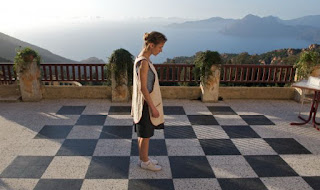
 Queen to Play's original title Joueuse is the feminine form of "player"—as in playing chess—which hotel maid Hélène (Sandrine Bonnaire) discovers by chance and with which she becomes sensually enthralled. Hélène's tutor in chess becomes widower Docteur Kröger (Kevin Kline, in his first French-speaking role). Jennifer Beals likewise has a cameo as a hotel guest who inspires Hélène to learn the game. Set on the island of Corsica, Queen to Play is Bottaro's adaptation of the novel La Joueuse d'échecs by Bertina Henrichs.
The film had its world premiere on April 25, 2009 in both New York City and Los Angeles, at the Tribeca Film Festival and the ColCoa Film Festival respectively. The film had a national release in France in August 2009 and was released in Germany in January 2010.
Though she lives in France, Caroline Bottaro considers herself "European more than French", born from a German mother and an Italian father, and fluent in several languages.
* * *
 Michael Guillén: For your first film, you've assembled an incredible cast. How did you negotiate securing such top-notch talent as Sandrine Bonnaire and Kevin Kline?
Caroline Bottaro: Sandrine was a special case because—before becoming a director, I was a screenwriter—and 10 years ago I co-wrote a film called C'est la vie (2001) with Jean-Pierre Améris in which Sandrine played the main character. I met her then. Bertina Henrichs—the novelist who wrote La Joueuse d'échecs (The Chessplayer), which I adapted for Queen to Play—was my neighbor in Paris, so I was the first one to read her manuscript and I immediately wanted to make a film about her story, and immediately shared the story with Sandrine, who—as I mentioned—I had gotten to know on the set of C'est la vie. Sandrine was very enthusiastic. That was six years ago. In the five years it took to make the film become real, Sandrine and I became very good friends. There were 18 different versions of the script and each new version was nourished by our friendship, our relationship. The movie, in a way, though it's the story of the character Hélène, was for me also a portrait of Sandrine Bonnaire. In my adaptation, there were many things that were especially written for her. She was with me from the beginning.
 With Kevin Kline it was a different matter because when you are a young French director with your first film, you cannot dream that you will have Kevin Kline. It's like Christmas for a child. I found the right producers in France [Dominique Besnehard and Michel Feller, Mon Voisin Productions] and—as I mentioned earlier to you—I'm happy to speak many languages and have different accents around me because of my family upbringing. I told this producer, "Why not an American actor for the male lead?" Because I love American cinema. It's difficult not to love American cinema when you love cinema. We had to find out which American actor could speak French. Someone in Paris mentioned, "Kevin Kline speaks French."
Guillén: He's a great comic talent.
 Bottaro: But in Queen To Play—though it's not a drama—it's also not the kind of comedy in which he usually acts. I thought, "Wow. Kevin Kline!" But it was a dream. Still I thought, "Why not?"
In fact, everything went like a miracle because Kline happened to have an agent in France. We sent the script to that agent. The next day the French agent phoned us and said, "I adore the script and I've sent it to Kline's American agent." The next day we received a phone call from the American agent who said, "I love the script and I'll send it to Kevin." Four days later, in the middle of the night I was sleeping and my cellular rang, I answered, and heard (in French), "Hello, this is Kevin Kline calling."
 We spoke an hour on the phone and he told me that he loved the script. He told me: "I haven't read a script as good as yours in 10 years." Further, he admired Sandrine Bonnaire's work. He knew her films. After that, I went to New York to meet him and we spent a whole day rehearsing at his home on Central Park in New York. It was like a dream for me to go to New York for one day. He went to his bedroom, changed his outfit, and said, "What do you think? These trousers?" He had just acted in Cyrano de Bergerac on Broadway and he had a beard. He asked, "Should I keep it or should I shave it?" I said, "Keep it." He tried on glasses to see what I thought. After a half hour he said, "Caroline, we are on the same page." Three months later he was on the set.
Guillén: How exciting for you! I'm intrigued when screenwriters shift into the directing role, and also that you took an existing book and adapted it into a screenplay. How approximate is your screenplay to the book and how approximate was your shooting script to your screenplay?
Bottaro: With regard to the book, it's a long story because—as I told you—the author was a friend and a neighbor…
Guillén: And you saw her book go through many stages and drafts?
 Bottaro: Yes. The story is the same but many things were changed in the different versions of the script. It was not always easy to be a friend and neighbor to the novelist. Bertina read the different scripts and at the beginning it was difficult for her to let her baby go. But by the end she became a great fan of the movie and told me, "It's strange because I am in the movie, you are in the movie [Bottaro has a brief cameo in a scene on the bus], Sandrine is in the movie." Bertina's very happy with the result. The grand situation remains the same with the most important difference being the connection between chess and sensuality, which for me was new and original. I've never seen that in any movie about chess, though there are several movies with chess in them. Queen to Play is a film where everyone speaks about chess all the time but chess is not really the subject of the film. The film premiered at the Tribeca Film Festival in New York and Variety wrote that the movie was a "clever feel-good movie" and I liked this.
Guillén: Cleverness works!
 Bottaro: The film is a journey of a character who at the beginning has an honest, simple, but boring life. Each day is like the other. She's a lower class character. The sudden passion she has for chess helps her become herself, even as a woman. Her relationship with Kevin Kline is more like friendship, it's not love, but it's a kind of love, very special, you have to see the movie. The way he looks at her, and through this passion, she become more feminine. Her life changes. That's the subject of this film: how a passion if you work at it and dedicate yourself to it can change your life. In this case, it's chess but it could have been something else.
Guillén: That's one of my favorite themes: that one can recreate their lives in their middle to late years.
 Bottaro: In fact, Hélène's not young and—at the moment she becomes interested in chess—there's nothing to tell her that her life is going to change. In a way, she's not the one who decides; her passion decides for her. She dedicates herself. She thinks only about chess. Her family and her whole life changes with her. So it's a positive message—though I don't like the word "message"—but….
Guillén: Notwithstanding, within the festival experience it's important to experience films that have positive messages, alongside all the equally-important somber films. It's important to walk out of a screening and feel, "Oh that was a good time." What's the film's theatrical trajectory? Have you opened in Europe?
Bottaro: It opened in France. It opened last week in Germany because it's a French-German co-production. In Belgium and Canada. And now it opens in April in New York.
 Guillén: What was the French reaction to Kline's first French-speaking role?
Bottaro: It was a good reaction. It's the first time he acted in a foreign movie. I was very proud of that.
Guillén: As well you should be. That's a major accomplishment!
Bottaro: Yes! We've remained friends. I just visited him in late December in New York. He stayed with us three weeks after his work was done on set and he said, "Wow, I haven't been as challenged on a film since Sophie's Choice." He had to speak French and he had to work a lot on that, even though he already spoke French, though not as fluently as necessary. He had to learn to play chess. Sandrine is not a chess player and I don't play chess either. By the end of the shoot, the whole crew had learned how to play chess. But we three did not have the same leisure time to learn how to play chess. In American movies Kline is a physical comedy actor. I love him for that too. He's graceful. He's like a dancer when you meet him in person. He's a physical man.
Guillén: If I recall correctly, he's one of the first actors to win an Oscar for a comic performance—the Academy doesn't usually award comic performances—which is a statement to his considerable talent. Myself, I associate him primarily with his serious roles.
 Bottaro: You can feel that he is a great theater actor too. He's a complete actor. Not just a film actor. I asked him to act less physically because at the rehearsals on the set he began to act out. He said, "Don't you think the audience will be bored if I do nothing?" I said, "Trust me." For me, it's part of his charm in my film. It's like a car. You can drive very fast but you don't have to push the pedal to the floor. You know the power of the car. His performance is charming. Those three things—improving his French, learning chess, and downplaying his performance—were challenging for him.
 Guillén: You're in a unique position because—having been a screenwriter, having worked with other directors, having known what they've done to your scripts—I imagine you've had to negotiate with directors to change your scripts to accommodate shooting? Can you speak to the advantages or disadvantages of working with your own script?
Bottaro: For me it would be a strange thing to direct a script I haven't written. You asked me earlier about the difference between the screenplay and the shooting script. It was a precisely written script so there's wasn't much difference between the screenplay and the shooting script, though there were surprises on the set involving the actors and so forth. As a writer, I visualize the movie and write it down. It took five years to make it happen so the script was very precise in my head. The surprises came from the actors. We didn't change the script much. Maybe it would be challenging for me to direct a script I haven't written; but, my point of view in this story was already in the script. I had visualized the mise en scène in detail. I had visualized if he was sitting in a chair and she was standing in front of him. I had visualized what was happening between the characters. After that in rehearsal when someone like Kevin would make a suggestion, sometimes it would be interesting and I would change my mind: "Yes, you are right. It's better like that." As a director you have to be very prepared or very strong—but even strong people are prepared—but when you are strong maybe you are more able to change things. But there's so much pressure on a director in terms of time and money, the schedule is so demanding that you have to know precisely what to do day after day.
 What was most important for me in this movie, and it was deliberate, was that the character and the actor—especially in the case of Sandrine—was the most important thing for me. I didn't think, "Yes, I'm a young director. I have to show the world how good I am and I have to do a special thing with the camera." I decided deliberately to be humble with the story I was telling and in my direction of the actors.
Guillén: You say it took you five years to make this film. Will it take you five years to make your next?
Bottaro: I hope not. No, no, I hope not. I'm writing the next one now. But it's funny because, in another way, those five years were important to the process of the film. Sometimes I'm a bit worried about the next film. I think, "Maybe it will be faster this time." But I hope that it's a good thing that it's faster. Every moment of those five years, even the bad ones—because you can imagine that in five years you have ups and downs, ups and downs, and you have people who tell you, "Give it up and write something else"—I was always saying, "I can't give this story up. I know I have to do this story." It had something to do with the main character in the movie. The question wasn't a question anymore, no way, I had to do this. Now what I worry most about the next one is to have that feeling again.
Guillén: That you're settled into the film? That you know it so well?
Bottaro: Yes.
 Guillén: I've recently been reviewing the films of Jacques Tati who was a filmmaker with considerable time between projects, such that he only accomplished six films in his whole career. I've given a lot of thought to his need to be settled into his films, to hold faithful to his vision, even if others could not recognize them as masterpieces.
Bottaro: But they were masterpieces!
Guillén: Clearly, but it took the critics and the public some time to recognize them as masterpieces.
Bottaro: No one begins to work on something saying, "I'm going to create a masterpiece." That would be crazy. And when that happens, the people become crazy. In fact, I just saw a documentary about Henri-Georges Clouzot….
Guillén: Ah, L'Enfer?
Bottaro: You saw the documentary on L'Enfer?
Guillén: Yes, I caught it at the Toronto International and enjoyed it very much.
Bottaro: Clouzot wanted to make a masterpiece. There were no limits, no producers, everything was possible and the film never came to the end and everyone became crazy on the set.
Guillén: I take it you don't want to experience that?
Bottaro: Oh no! I guess the most important thing for a film are the producers. If they're good, they're good; if bad….
 Guillén: Who are your influences in both European and American cinema?
Bottaro: I have to say that there are a lot of directors that I admire very much but for Queen to Play there were two American directors that were specific references. The first is Clint Eastwood. I love Clint Eastwood because he directs and acts in film that are very personal and have a Clint Eastwood "touch". But in another way his films are for the whole world. He's an auteur but with a commercial sense.
The other one is an older film The Ghost and Mrs. Muir. The set design for the house where Kevin Kline's character Docteur Kröger lives came about through working with the set designer Frédéric Jacq. I had him watch The Ghost and Mrs. Muir. I thought of Rex Harrison's role in that film as a guiding model for Kevin Kline's character.
* * *
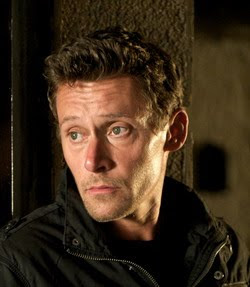 Needless to say, by this point Bottaro had convinced me to catch her film that evening, and made it easy to do so by offering a comp pass. The line to get into the Palm Springs High School screening was immense and everyone was buzzing in anticipation of seeing Kevin Kline in his first French-speaking role. It gave me pleasure to photograph Caroline and Zach in front of the auditorium with their excited audience queued behind them. Queen to Play proved delightful. Along with Bottaro's capacity audience, I was charmed by the film's intelligence and sensuality and the perfectly-pitched performances by Sandrine Bonnaire and Kevin Kline. Francis Renaud likewise delivers a heartfelt supporting turn as Bonnaire's salt-of-the-earth husband Ange struggling to respect and make sense of his wife's new passion. The film received a Special Jury Mention for PSIFF10's John Schlesinger Award for Outstanding First Feature (Narrative or Documentary).
08/14/10 UPDATE: indieWIRE reports that Zeitgeist Films has acquired all U.S. rights to Caroline Bottaro's Queen to Play. Zeitgeist plans an early 2011 release for the film.
Cross-published on Twitch.
 The US premiere of Vortex (2009)—Lithuania's official submission to the Foreign Language category at the Academy Awards® and winner of three Sidabrinė gervė ("Silver Crane") awards for the outstanding performances of its talented trio of actors: Oksana Borbat (Best Actress); Vladimiras Jefremovas (Best Supporting Actor); and Jūratė Onaitytė (Best Supporting Actress)—was introduced by director Gytis Luksas, who wanted his Palm Springs audience to understand that Vortex was a film about his generation. He recounted that—despite his youth, falling in love, marrying, and raising a family—life in Lithuania at that time was "difficult and black." This played into his decision to film the narrative in black and white because he "didn't need the color" for his story.
 "Between the black and white," he offered, "there are numberless nuances of grey." He found it interesting to craft his film with his DP Viktoras Radzevicius using rules of vintage photography, such as its stern turn-of-the-century portraiture. The characters of his film speak both Lithuanian and Russian, which was normal for the time, and Luksas employed this bilingual practice as a temporal marker to situate the narrative in its historical context. At heart, however, the film can be easily understood as a love story free from the tethers of historical circumstance and a timeless study of the relationship between men and women; a theme important to Luksas, and one which he hoped would be of importance to his audience. It's not enough for him to make an interesting movie, he stated, it must reflect genuine emotions, whether love or hate.
 Harvey likewise suggests that—as much of a compliment as it is to say that Vortex "might be mistaken for a Soviet-bloc feature of 40-50 years ago—its austere black-and-white beauty, deliberate pace and tender solemnity are of a piece with works from a great period in world cinema"—the "difference is that during the 1960s, such exercises stood some chance of offshore theatrical exposure, while now they're strictly fest fare—and not even fashionably so." That demarcates a sad fate for an otherwise lustrous film.
 Gytis Luksas: It's similar, yes. The whirlpool, yes, of course. The vortex, like the whirlpool, is something very dangerous; but, not only in the water—in life too.
 Guillén: I was intrigued by the film's false ending. You think that Juzik is going to die and that the film will end on that somber note; but, he doesn't die, and—as a consequence—the film expands out into hopefulness.
 Guillén: I read it that—rather than succumb to the vortex of despair—Juzik for the first time became aware of the potential for happiness in life.
 Guillén: Tell me about the novelist Romualdas Granauskas.
 Guillén: Is that the vortex that threatens to pull him under?
 Guillén: What can we expect from this film? Does it have a distributor in the US?


