 I've been recently fascinated with what would be considered "painterly" in cinema. It has, in fact, become one of my stock questions whenever I converse with a film historian or someone who has a deep embedded knowledge of film. Thomas Elsasesser distinguished between filmic projects where the director and art director collaborate to achieve either a historical drama (via the verisimilitude of historical paintings) and those films that express separate qualities about painting that are "more difficult to locate but [which] may actually have a deeper resonance."
"If we're talking about 'painterly', you really have to make a distinction," Elsaesser qualified. "Are you talking about 'painterly' in the 19th Century sense? Or are you talking about Modern art or painting? So I would make a big difference there. Both you can find in film."
When I posed the same question to Jonathan Rosenbaum for our published conversation in Film International (Vol. 9, No. 3), he responded: "It has an awful lot to do with the way certain people conceptualize and think about film. An obvious example of a painterly filmmaker is Chantal Akerman. She thinks in terms of painters. When I've talked to her before about her films, she'll talk about some of the Belgian Surrealists. Where I would say how much I liked Paul Delvaux, she would say, 'Yes, but his lighting is better than mine.' I remember she said that, which I thought was interesting. Of course, the painterly in film happens especially in experimental forms of cinema, such as the films of Michael Snow. In his own way, Snow is painterly though obviously he's also related to sculpture. Probably even more to sculpture than to painting."
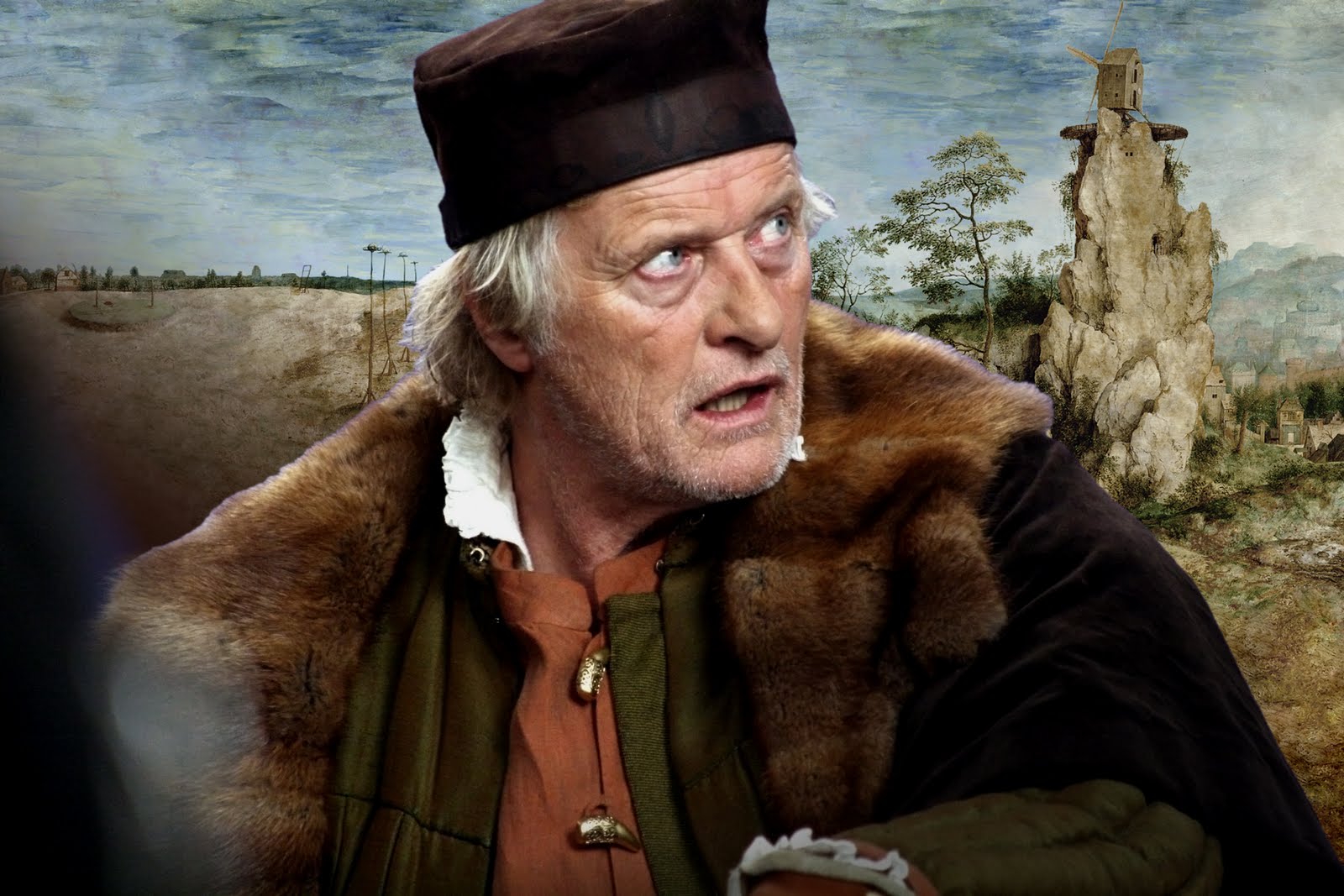
 Lech Majewski's sumptuous The Mill and the Cross probably falls within the historical grouping outlined by Elsaesser as it springs directly from Pieter Bruegel the Elder's 1564 painting "The Way to Calvary"; yet, in its cinematic devices, The Mill and the Cross achieves the quality of beauty delineated by Elsaesser that is effected by the dialogue a viewer establishes with a painting (or, in this case, a film). "The beauty is not something that your eye slides off after a couple of seconds because you think you recognize it," Elsaesser proposed, "but more the fact that the longer you look, the more the painting becomes something else. You know?" This quality of a painting "becoming something else" by way of cinema is undeniably evident in Majewski's The Mill and the Cross.
After a lauded tour on the festival circuit—including an appearance at the 54th edition of the San Francisco International Film Festival (SFIFF54) in their World Cinema Spotlight "Painting with Light" (which highlighted the cinematic contemplation of painting)—Majewski's The Mill and the Cross opens theatrically this weekend.
As Graham Leggat wrote in his SFIFF54 program notes for the film: "A miracle of technology in the service of the artistic imagination, Lech Majewski's brilliant film transports its viewers into the living, breathing world of Pieter Bruegel's dense frieze of Christ's passion, 'The Way to Calvary'. And live and breathe it does. Though carefully organized along symbolic axes, Bruegel's 1564 painting sets the drama of the crucifixion within a rustic Flanders scene teeming with everyday life. ('About suffering they were never wrong, the Old Masters,' wrote W.H. Auden. 'How well they understood / Its human position; how it takes place / While someone else is eating or opening a window or just walking dully along.') Likewise Majewski—using computer-generated blue-screen compositing, new 3-D technology, just-so location shooting in Poland, Austria and New Zealand and a massive backdrop he painted by hand—tells the story of the painting largely through closely observed secular rituals of 16th-century Flemish daily life, in all its earth-toned grubbiness, with occasional scenes revealing Bruegel's artistic choices and the politics of the day. Windmilling, calf-hauling, bread-peddling, villagers dancing and children horsing around take up the better part of the narrative, while cameos by Rutger Hauer (as Bruegel), Michael York (as his patron and friend) and Charlotte Rampling (as a limpid Virgin Mary) give historical context and symbolic depth. But the narrative is not the point—the extraordinary imagery is. The painting literally comes to life in this spellbinding film, its wondrous scenes entering the viewer like a dream enters a sleeping body."
 The Bay Area critical response during SFIFF54 was likewise affirming. At SF360, Max Goldberg noted that Majewski managed the problem of plotting a painting in time by organizing his scenes cyclically. Goldberg offered: "In regularly returning to the same actions—young children roughhousing, a man making heavy advances on a woman, a fool playing his flute—Majewski cleverly replicates the way our attention circulates looking at such a dense canvas. This enveloping aspect is further developed with the high-tech imagining systems that allow Majewski to situate his actors within Brueghel's own visual field. Meanwhile, the subversive aspects of the painting—the positioning of the mill grinder at a perch usually reserved for God; the placement of everyday bawdiness just next door to the Crucifixion, here imagined as taking place at the hands of Spanish inquisitors—come into focus through the narrative's slow build. By the time the camera tracks out from Brueghel's framed masterpiece, we're nearly surprised to find all that adventure emanating from a single canvas—only one of many in the gallery at the Kunsthistorisches Museum in Vienna."
At the San Francisco Bay Guardian, Matt Sussman observed: "Majeswki both re-stages Bruegel's painting—which draws parallels between its depiction of Christ en route to his crucifixion and the persecution of Flemish citizens by the Spanish inquisition's militia—in stunning tableaux vivant that combine bluescreen technology and stage backdrops, and gives back stories to a dozen or so of its 500 figures. Periodically, Bruegel himself (Rutger Hauer) addresses the camera mid-sketch to dolefully explain the allegorical nature of his work, but these pedantic asides speak less forcefully than Majeswki's beautifully lighted vignettes of the small joys and many hardships that comprised everyday life in the 16th century. Beguiling yet wholly absorbing, this portrait of a portrait is like nothing else at the festival."
At Vinyl Is Heavy, Ryland Walker Knight—though finding The Mill and The Cross "somewhat confounding, especially from the 2nd row"—nonetheless appreciated its wide and deep palette and noted that the film's "ideas, though rooted in the narrative structure of the painting, feel yet more modern in how arrayed (not inter-related) they are."
And at Variety, San Francisco's own Dennis Harvey raved: "Neither conventional costume drama nor abstract objet d'art, this visually ravishing, surprisingly beguiling gamble won't fit any standard arthouse niche. Still it could prove the Polish helmer's belated international breakthrough, especially if marketed as a unique, immersive museum-meets-cinema experience a la Alexander Sokurov's Russian Ark."
 At MUBI, Dave Hudson has gathered the critical commentary outside of the Bay Area.
Lech Majewski was born August 30, 1953 in Katowice, Poland, studied at the Academy of Fine Arts in Warsaw, and is a film and theater director, writer, poet, and painter. In the 1970s he studied at the National Film School in Łódź, notably as a student of Wojciech Has, who taught Majewski directing. In the early '80s, after completing The Knight and as martial law was declared in Poland, Majewski emigrated to England and then to the United States, where he lived for most of the late Communist era. Today, Majewski is a dual U.S. / Polish citizen. He is a member of the American and European film academies and the Polish International PEN. In 2006, the Museum of Modern Art in New York City hosted a complete retrospective of Majewski's work. This was their first ever full retrospective of a Polish filmmaker, and one of their only ever mid-career retrospectives. For that program, Majewski created the film eventually called Glass Lips, though initially it was known as Blood of a Poet.
The following comments are taken from his public introduction and subsequent Q&A to the film's SFIFF54 screening. Photos courtesy of Kino-Lorber.
Introduction
 A few words before the film. First of all, I would like to say that this is a work that took us three years to complete because we introduced some unbelievable and difficult tasks, technically speaking. I very much wanted to enter Pieter Bruegel's world. I respect him. I love his paintings. He was a great teacher for me in terms of his philosophy and the way he narrates his paintings.
Therefore, we did a lot of preparatory work. We started with costumes first of all. There are no textiles today like the textiles he painted in his paintings so basically we had to make these costumes, and then check the textures in front of the camera to determine which textiles would behave in a similar way as in the Bruegel painting. We had to hand-paint those costumes and hire seamstresses to hem them for us. The costumes alone took nine months of pre-production.
Then, obviously, when we started to look for the landscape that would be most appropriate to shoot the entire movie, we realized that there is no landscape like that; it doesn't exist at all. So we got a very good reproduction from the Kunsthistorisches Museum in Vienna that houses this painting "The Way to Calvary" by Pieter Bruegel. There are 500 figures in this painting. With the computer we started to analyze the perspective in the painting and found there were seven different perspectives in this singular painting. Obviously, Bruegel was foreseeing cubism 400 years before.
 We were completely lost as to how we were going to shoot the nature because in his paintings he uses at the same time a point of view that is coming from the left, from the right, above and from below. We realized we couldn't have a landscape like that, but what we could do was to cut these multiple perspective into single ones and look around for similarities in the real landscape. Then in post-production we could piece it together.
There were also various things that were helping us. For example, an article was published in a Polish newspaper about a little village whose citizens were ancestors of Flemish immigrants from the 16th century. They speak a fossilized Flemish. This language that they speak doesn't exist anymore. Linguists have recorded them and the majority of them are 80+. So when you hear the sing-songs and the voices, keep in mind it is a non-existent language, a medieval French.
I went to New Zealand at one point during post-production and discovered that over the southern island there was a fantastic cloud formation. In fact, the Maori call this southern island the "Island of the Long Clouds". I quickly hired a DP and we shot these clouds because they were so reminiscent of Bruegel's clouds.
The film was assembled by weaving a digital tapestry. We had a lot of young people sitting in front of their computers spending their whole lives, like abbots in a monastery painting illuminated manuscripts.
 The author of the original art essay that analyzes this film is the fantastic and brilliant writer Michael Francis Gibson, an American living in Paris and art historian who writes for the Herald Tribune. He wrote the original analysis of the painting in a 300-page essay entitled "The Mill and the Cross, Peter Bruegels 'Way to Calvary' ", [in French, Noêsis, 1996 and in English, Acatos, Lausanne, 2001], hence the title of my film. Michael Gibson researched vanished customs (for example, you see the treatment of the bread, how the people touch the bread to their forehead or the young woman who puts a loaf of bread on her naked belly. It has some symbolic meaning. Pregnancy = the bread, which is the flesh.
On the Hidden Language of Symbols
Michael Francis Gibson gave me his book because he thought I had a "Bruegelian soul", as he wrote in his review of my other movie Angelus (2000). The movie was showing in Paris and he saw it. He wrote a very good review and sent me his book.
I felt his book would make a great film because of his writing. The book was lucid and beautifully written. It's a brilliant guide through the labyrinth of allegories and symbols. The way he writes, it's a masterpiece. I'm a painter so the history of art is one of my favorite subjects. I read a lot of books about it. Also, I am a great lover of old masters, particularly the proto-Renaissance and the Renaissance. So I have read such subjects in other books and rarely have I encountered this kind of fantastic, beautiful and lucid analysis. It's very difficult to write about paintings. Michael Francis Gibson was born to do that.
 When we met for lunch in Paris, it surprised him when I suggested making a feature film from his analysis. He thought I was mad. He thought a documentary would be the most we could get out of it. He imagined standing in front of the painting and pointing to various symbols, explaining them. But then he scratched his head and said, "Well, the impossible is the realm of gentlemen. Let's do it."
We selected a few characters from the painting and proceeded to discuss these people, as if they were alive. Where were they going? What were they doing? There were various interesting idiosyncrasies about the behavior of people in those times because it was quite different to our's. Symbols were very important to these people. Today I think we are losing a lot of this hidden language of symbols. We have become inundated with shallow images gliding by. Maybe it's because we're moving too fast? Maybe it's because the images we look at are moving fast in front of our eyes? We rarely focus on anything. In those times they didn't have television and cars.
 I remind you that when you listen to music from the past, you will always discover the rhythm of a horse ride in the music. It's a rhythm given by the horse-drawn carriage. The screeching and banging of today's music is more like a train crashing or cars roaring by. It's natural that we digest the sounds and the images that are in our lives. In those times people spent a lot of time looking at paintings. They had the time and they could read the hidden language of symbols.
For example, if Titian is painting a woman dressed in blue and she leans against a tree and in front of her is a basket filled with grapes and an apple, for a contemporary viewer that's a sense that she's picnicking, reclining, and resting on a beautiful day; but, for the observer of those times, they realized that this image was the shortest metaphor for Christianity. The apple represents original sin and the grapes produce the wine—the blood of Christ—which washed away original sin. The tree she's leaning against becomes the tree of the knowledge of good and evil, as well as the tree upon which the fruit of her life will hang, crucified.
There is a painting in Washington D.C. by the Dutch painter Pieter de Hooch of a woman reading a letter. Her back is turned to the viewer who cannot see what is written on the letter. Only a corner of the letter is visible above her shoulder. There is a painting on the wall next to her. The painting is partially obscured because in those times people hung curtains over paintings so that they wouldn't become too familiar. When you become too familiar with something, you stop seeing it. So you would have to slide the curtain to take a look at the painting and, when done, you would close the curtain. In this painting the curtain is open a little bit and you can see a big storm, a huge wave. Thus, you imagine that the letter is very traumatic for the woman. You get the emotion from the image of the sea. There's a playing card on the ground and it's the ace of hearts.
 If in a painting you see a chandelier and it has a candle in it, people from that time knew that the chandelier represented the Virgin Mary and the candle Jesus Christ. Whether the candle is lit or not determines which period we're talking about. If it's lit, it expresses the transmutation of matter into spirit; the wax into the fire.
There are various meanings to the symbols. If the dog is next to his master's legs, it means he's faithful. If a subject is holding something in his left hand, it means he's higher up in the social hierarchy. Basically everything is a symbol. If there is an uneaten fruit on the windowsill, it means that the woman in the painting is not pregnant yet, despite the fact that her dress is bulging as if she is pregnant.
In The Mill and the Cross, for example, women of Flanders used to wash the threshold of the house. It was a common thing to do. Several times they washed the threshold and smeared it with different herbs for different seasons and for different times of the day. Oddly enough, those thresholds were worn out not by people stepping on them—that was forbidden—they were worn out from being washed.
On the Symbolism of the Mill
 There are various symbols of the mill. Number one, Bruegel's placement of the mill on a rock is completely surrealistic and unlike anything you would imagine from a painter who realistically paints his observations. For starters, this is Flanders and Flanders is flat. It doesn't have any rock outcroppings, not even hills. But Bruegel, like any respected painter of the time, traveled to Italy and he crossed the Alps. When he saw the Alps, he knelt down and his sketchbook filled up with hundreds of sketches. When he came back to Flanders, the rocks began popping up in his paintings. Apart from everything, the rocks and the nature at that time had an anthropomorphic character, which meant that nature served as a metaphor for the human body. So the rock on which the mill rests is the body, usually the body of Jesus Christ. The cracks in the rock represent the wounds of the crucified Christ. So if you have Leonardo's painting of the Madonna among the rocks, that's what it means. Putting the rock in the painting was Biblical. It's in the gospels. You have St. Peter, Pétros, "the rock", who builds the church upon the rock. Basically, that's what Bruegel is showing.
The shape of the mill and the fact that it has the cross in its blades or sails, the wings of the mill, obviously represents the Church. Therefore, the miller and his mill is completely surreal; it makes no financial sense. It's nonsense. How will he get the grain in there? How will he sell his flour? Perched on that rock, he will obviously get good wind; but, that's about it. Thus, the miller is not meant to be real; the miller is the Creator.
On Going Inside the World of the Painting,
Into the Mill
Into the Mill
The painting invites you into the terrain of the imagination. Once we received the fantastic reproduction from the Kunsthistorisches Museum—which was very accurate—we could show it on a big screen and zoom into the details. One of the things that I noticed were the two windows carved in the face of the rock. I instantly saw shafts of light penetrating these windows and illuminating this enormous kind of cathedral inside this mountain. For that reason, we needed machinery that was pre-modern. This miller is the Creator, right? He cranks up the mechanism that allows the sky to move.
 Obviously, we wanted to relay the size of the mill's interior; but, most of it was done through sound. Visually, there's a little bit of trickery. We managed to shoot several interiors of existing mills—one in the Czech Republic, the other in Poland, and one in Austria—as well as the big machinery in the salt mines in Poland close to Krakow. The salt mines are from the mid 1400s. Salt used to be more expensive than gold. Whoever had salt had money and power, unbelievably so. Now we can buy a kilo of salt for one buck and you cannot buy the same amount of gold for one buck. So the interior of the mill is a combination. Most of it exists in the reality of the salt mines and the rest of it—like the extension of the staircases—was engineered patiently in 3-D by the minute work of many young people. Throughout the film, 99% of what you see is a combination or reality, pieces of Bruegel and nature, and the construction through 3-D.
All of the images you see were built up by layers upon layers upon layers. People were shot separately against the blue screen. The landscape was shot separately. For example, when Rutger Hauer touches the spider web, it was a situation where at first we shot Rutger with a stick and he asked, "Where do I look?" I told him, "Well, look at the end of the stick." He said, "Then I'll be cross-eyed." I told him, "We'll fix it in post. Don't worry."
 Then we had three young gentlemen working on the spider web. One was working on the construction of the spider web. The computer had produced a perfect spider web and we looked at it and thought, "This is not a spider web. This is some German construction. Spiders don't behave like that." We Googled images of hundreds of spider webs and tried to get into the mind of the spider; but, we got nowhere because those spiders are high on drugs or something. They start to do a perfect web and soon thereafter they destroy it by going into various zigzagging ways as if they were thinking about something else, as if they were thinking, "I'm not going to do this spider web. I'm going to do its opposite." We had to figure out what would be the spider's algorithm of mistake; but, we couldn't find it. So we had to destroy the spider web by hand.
Then the other guy was doing the dew drops on the spider web, which was easy because the dew drops behaved politely with gravity. Gravity determined the size of the drop. Then we had the problem of the spider itself. The third young man was creating the spider. He asked me, "With which leg should the spider take its first step?" I couldn't figure that out. So he and I caught several spiders, filmed them, and in slow motion it turned out that spiders of the same species move differently. On one hand we had this top technology and on the other hand it felt like we were in the Middle Ages weirdly rediscovering the world and how it would translate into this 3-D creation. In order to create a tree moving, we had to go out and watch a tree and figure out how it moves. During this process, these young people grew to respect the Creator. That's a perfect animation, really.
On the Tension Between Stillness and Movement
Contrary to the popular idea about cinema, and life, I believe that the most important action is not that which moves but that which stands still. I think that people who are caught in the most important moments of their lives, in dramatic moments or moments of bliss, don't move. They stand still. Initially, I thought that throughout the entire movie I would have the people standing still for one hour and a half and just have the camera move around them. That was the initial idea. But then, you know, as with all good ideas, I had to give in and add movement. Sorry for that.
On the Business Side of the Production
Our Swedish co-producer hired an English production manager who measured what it would cost to make this film in England. It came to £33,000,000. But we did it in Poland for a fraction of that amount.
Initially, I thought that the movie would only be shown in five museums. The Louvre subscribed to this movie, the National Gallery in Washington, D.C., MoMA in New York (because I had a big retrospective there three years ago), the Prado in Madrid, Spain, and the Kunsthistorisches Museum in Vienna (because they house the painting); but, the film premiered at the Sundance Film Festival in January and there it was sold to 32 countries for theatrical distribution. I was totally surprised that people would want to see this film in theaters. Kino-Lorber is distributing the film in the United States and Canada.


