Thursday, November 10, 2022

THROWBACK THURSDAY: THE GOSPEL ACCORDING TO MATTHEW (IL VANGELO SECONDO MATTEO, 1964)—A Response To Casting & Narrative Elements

My response to the casting and narrative elements of Pier Paolo Pasolini’s The Gospel According to Matthew (Il Vangelo Secondo Matteo, 1964) ("Matthew") was originally published on Keyframe, Fandor’s digital magazine, on October 2013. A few years earlier over a meal at a Chinese restaurant I had been quite honored and excited when Jonathan Marlow and Kevin Lee invited me to write for Keyframe, and I was commensurately disappointed when in 2018 Fandor announced the layoff of its staff and the sale of its assets to an undisclosed investment firm. Along with many other contributors, most of my pieces for Keyframe disappeared into the ether. Along with the demise of Greencine and SF360, this became an ongoing cautionary tale in backing up my writing and not assuming that the sites to which I contributed would maintain archives. 

As transmogrifications go, however, at Deadline in early 2021 Dade Hayes announced that Fandor had been acquired by Cinedigm with “plans to update and expand its offerings”, including a relaunch of Keyframe. By October 2021 Fandor launched as a revamped independent streaming service, remaining available as an add-on channel on Amazon Prime (as it had been since its initial launch in 2016). Keyframe was likewise brought back, with admirable new content, and some archival offerings. A cursory review of their archival listings, however, didn’t include any of my work. In fact, it appeared that most of the “archival” listings were from articles written under the new management. 

And yet, a Google search brought up an archived version of my Matthew essay, written as it were by “Fandor Staff”, though it doesn’t seem to have been included in either Keyframe’s archives or articles holdings. As 5,667 archived pieces and 5,412 articles are listed as available, perhaps they intend to rotate these offerings? Your guess is as good as mine since it appears the courtesy of notification to the original authors, let alone attribution, doesn’t seem to have been considered. Notwithstanding, I was glad to find my essay on Matthew available online, even if in the same breath I recognized how unflattering broken links can render a piece. Addressing the wear and tear that time effects on an online article, and attaching my name to my work, I revisit my Keyframe article with ameliorative edits. 

* * * 

There are times after watching commercial theatrical releases when I struggle to muster enough enthusiasm to write even one appropriate sentence in response, obliged as I might be to some earnest publicist expecting a compensatory pound of flesh for a comped ticket or a festival badge. Such films—more often than not—fade swiftly from my memory like morning mist in direct sunlight. In recent years, rather than have my body decimated by obligation, I've elected to support the industry of filmmaking by preserving my silence and buying a ticket like every other moviegoer rather than feeling obliged to write a single word, which—as stated—frequently refuse to appear anyways. Nor am I motivated or entertained by ranting over how conspicuously mediocre most contemporary movies have become, like many front line reviewers who could readily be roaring extras in a Roman coliseum, gesticulating thumbs down, while innocents are being fed limb by limb to the lions. I quietly leave the theater and go home and splash cold water on my face. "They're only movies," I tell myself, staring vacantly at my reflection as the roar of the coliseum subsides. Enough said. 

But now and again I watch a movie that doesn't allow itself to be "just" a movie, and maybe it's a film that's nearly 50 years old, alluringly freed from market pressures, but still so incredibly current and relevant that it won't let go, demanding articulation and praise, insisting on being understood through language, and thereby undeniably elevating itself into the so-called seventh art by the sheer force of creative, competent will. Pier Paolo Pasolini's The Gospel According to Matthew (Il Vangelo Secondo Matteo, 1964) is one such film. I sometimes wonder if I am ever going to stop writing about this movie? Though, truthfully, I am delighted I even want to. 

During these last few weeks I have been asking myself why Pasolini's Matthew has taken such a hold on me? Perhaps its gravitational grip alludes to a painterly quality in which I have found a contemplative orbit? Even as its narrative urgency bespeaks politicized necessity? It abounds with conflicting energies: acknowledged as possibly the best film about the life of Christ, made by an affirmed Marxist atheist homosexual. Peter Bradshaw's description for The Guardian that Matthew "looks as if it has been hacked from some stark rockface" comports with Bosley Crowther's earlier comment in his New York Times review that the film's language is "flinty", suggesting Matthew's essential beauty is lapidary. There's a sculpted quality to Matthew, perhaps more rough-hewn than burnished, constructed as an homage to neorealism yet contaminated by stylized, purposeful anachronisms. Like the best pieces of Christian art, Matthew speaks to the history of Christian art, and situates itself along a vast continuum. In this historical layering it resembles something sedimentary. 

I'm not a Christian—I’m not going to pretend to be—but, I was raised in the Catholic faith and I cannot escape an imbedded sense of the cultural importance of the Bible as spiritual literature, specifically the narrative of The Passion. I know that having to believe is as important—if not existentially moreso—than believing. I believe faith and knowledge do not cancel themselves out but are symbiotic by design. I have to believe that. 

When I was researching Pasolini, I was struck by his devout atheism, his refusal to believe that Jesus Christ was the son of God, but also his awareness that the teachings of Christ—moreso today than ever—speak to revolutionary purpose. Pasolini may not have been a religious man, he may not have even been a spiritual man, but his sensibility was certainly mythopoeic, with a deep respect for the sacred, which he believed revealed itself through nature. He felt the sacred surfaced both in landscape and the human body. I have no difficulty understanding and appreciating how interwoven this is into his cinematic vision. It's not so much that The Gospel According to Matthew confirms a Christian viewpoint as it does a revolutionary and sacred one. 

In his review of the film, Roger Ebert understands that there is no single version of the story of the Passion. "It acts," he writes, "as a template into which we fit our ideas, and we see it as our lives have prepared us for it." For me, that's exact phrasing. As someone raised in the Catholic faith, I nonetheless always felt outside of it, partly because of the Church's stance on my sexual orientation. This caused me to engage in a debate with organized religion for many years and I educated myself on the early history of Christianity and its mythic antecedents in Assyrian-Babylonian narratives, as taught to me by comparative mythologists Joseph Campbell and Nanos Valaoritis. As a full scholar for San Francisco's C.G. Jung Institute over 20 years, I studied with Bible historians such as Elaine Pagels and Karen Armstrong and Gnostic scholars such as Gilles Quispel (who, in fact, helped smuggle The Gospel of Thomas ("Thomas") out of Egypt at Jung's bequest). Thomas, in fact, became my favorite of the gospels, even if excluded from the official canon. I studied with Marcus Borg and John Dominic Crossan who both advocated an appreciative perspective of the Historical Jesus

One could argue this is the same perspective applied by Pasolini in constructing The Gospel According to Matthew. During my theater years I was given the chance to play the apostle Peter in Magdalen, a production that incorporated the Gospel of Thomas verbatim within the script, and I can recall to this day how powerful it was to enact words written millennia ago. It felt as relevant as it felt ritualistic. Thus, I have a clear appreciation of Pasolini's similar experiment of incorporating the Gospel of Matthew verbatim into his filmic adaptation. These experiences—studying the history of Christianity, the Gnostic Gospels, and the Historical Jesus, along with enacting the Gospel of Thomas on stage—is what prepared me (in Ebert's sense) for viewing Pasolini's The Gospel According to Matthew. What follows are my responses to Pasolini's project, negotiated through a second, more informed, viewing after researching the film.  

The Iconic Countenance 

Margherita Caruso as the young Mary.
The face as icon reveals the sacred through countenance, where countenance is understood as an interaction between mind and heart. Pasolini's film starts out with close observances of the faces of a young woman and a slightly older man. Without either being identified, without a word being said, Pasolini defamiliarizes the standard Passion narrative by keeping the audience guessing as to their identities. Why is this young woman so troubled and tentative? Why is this man at turns near-angry and seemingly frustrated? As the camera pulls back, you see that she is pregnant and it's only then that you deduce she is Mary and he is Joseph. Clearly this is not Joseph's child and he's not sure how to handle the situation. He walks away from her to clear his thoughts, tires, stops to rest, and dreams. In his dream he is visited by an angel who tells him to rejoice that Mary has been impregnated by the Holy Spirit. Until the angel speaks, nothing has yet been said aloud, the narrative has followed Matthew's description in his gospel, and the story has been told purely, through images, through iconic countenances, staged in frontal compositions against backgrounds that suggest Byzantine art. Even after Joseph has received the good news, the ensuing scene returns the film to silence, relying on a relay of facial expressions that express Joseph's willingness to father the holy child, and Mary's relief in his willingness to do so. They both smile demurely, tentatively, as they accept parentage as their sacred fate. 

Margherita Caruso as the young Mary.
This visual device continues well into the film, both to introduce familiar characters to the narrative, but also to profile the social world within which the narrative rests. It did not go unnoticed by detractors at the time that many of the faces used by Pasolini were those of the disenfranchised people he knew from the borgata, the slums of Rome. Straight off, through visual countenance alone, Pasolini has rendered a class critique, casting his Passion narrative with members of a discriminated class, non-actors who by their very being, their countenance, reflected authenticity and—through the "authentic"—the sacred.  

Kenneth Turan considers Pasolini's "marvelous faces of local people, each one a book in itself." Russell Hittinger and Elizabeth Lev find their iconicity somewhat strange and grotesque, serving to disarm spectatorial imaginations that have been liturgically and textually informed. At Little White Lies, David Jenkins writes: "One thing that connects all of Pasolini's films is the unflinching way he photographs faces and bodies, finding a tremendous, grotesque beauty in the extras and supporting cast, displaying an almost Christ-like empathy towards all of God's creations." [Note: Unfortunately, both commentaries by Hittinger and Lev and David Jenkins are no longer available online.] 

Enrique Irazoqui as Jesus
At the London Review of Books, Michael Wood likewise extols the achievement of Matthew's opening sequence, and Pasolini's repeated usage of the iconic countenance to further the Passion narrative. "Again and again," Wood writes, "we see faces—of Peter, of Judas, of Jesus himself—before we see anything else. They stare out of the frame at us, often expressionless. We stare at them and wait to know what they are looking at (apart from us, that is), what they can see inside the frame of their own world. We can often guess what it is, since we know the story, but it's tempting to wait anyway, just to let the weird non-acting work on us. This is not a matter of the neo-realist trick of using amateurs, as if amateurs were somehow more real than professionals. 'You are working, aren't you?' Brecht used to say to his actors. It's a matter, as I have already suggested, of not acting at all, whether you are any good at it or not. It's a matter of being photographed. The faces talk, not the expressions on them, or the absence of expression. In their differences from each other, in their actuality, their sense of belonging to a particular place and time (Italy, 1964, not Palestine, 28), they enact not the story of Christ but the mystery of the story." 

In a slightly variant—though no less interesting take—Ara H. Merjian (author of Against the Avant-Garde: Pier Paolo Pasolini, Contemporary Art, and Neocapitalism, 2020) traces the affinities and contradictions between the unlikely pair of Pasolini and Andy Warhol in his think piece for Frieze magazine entitled "Mascots & Muses", which—in effect—eroticizes (i.e., queers) Pasolini's visual strategies. Merjian writes: "Notwithstanding the ideological chasm that separated them, Pasolini's and Warhol's eccentric orbits overlapped in a number of instances. Apropos of eccentricity, critics accused both men's work of unreconstructed narcissism—a thinly veiled euphemism for homosexuality and its bearing upon their art. Each, however, held at bay his identity (or identification) as a gay man, even as he helped to shape queer culture before Stonewall. Both enjoyed the company of mascots and muses, drawing upon them for artistic collaboration and personal frisson alike. The slow succession of apostles' faces in Pasolini's The Gospel According to St. Matthew (1964) recalls nothing if not Warhol's contemporaneous screen tests, a mix of eroticism and transcendence in their own right. Both Warhol and Pasolini availed themselves of delinquency (not to say criminality) as the stuff of aesthetic experiment." 
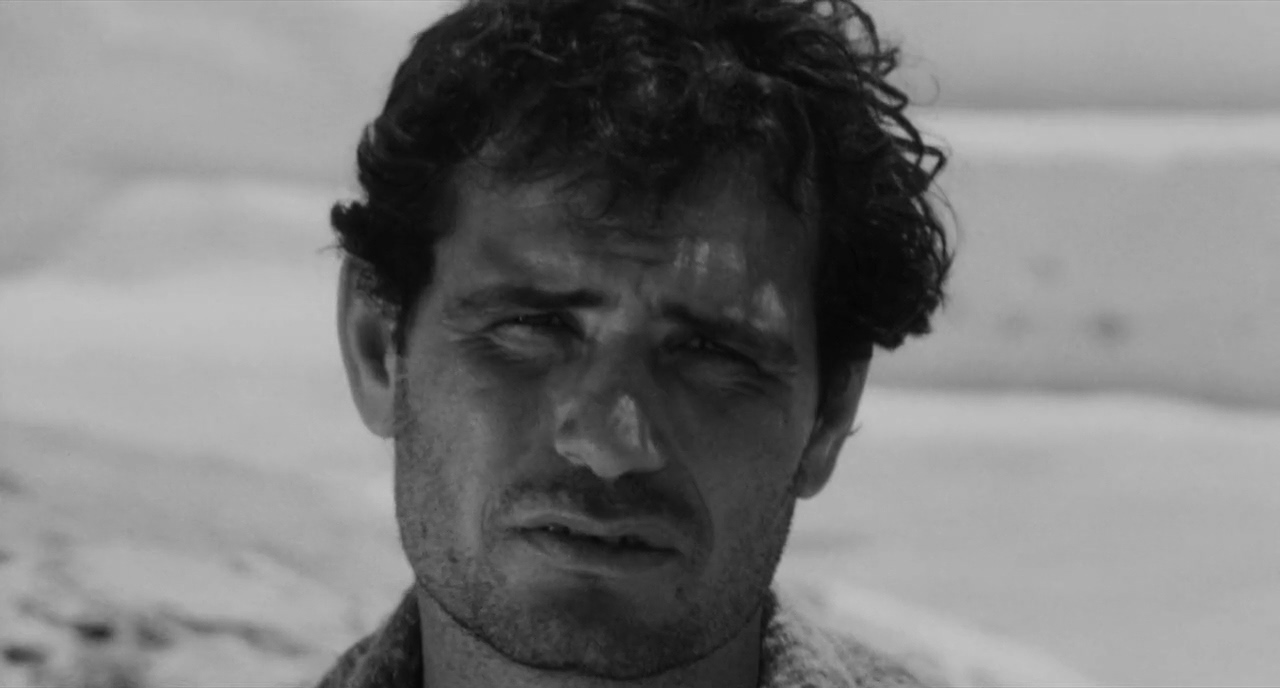
Otello Sestili as Judas.
As an aesthetic (if eroticized) experiment, the casting of the Apostles is equally noteworthy for reflecting Pasolini's literary acquaintances and suggesting Pasolini's sly projection of himself onto the figure of Christ (despite choosing someone else to portray Jesus). Otello Sestili, who played Judas Iscariot, may have been a ruggedly handsome truck-driver from Rome; but, Enzo Siciliano (Simon), became Pasolini's first biographer years later with his 1995 volume Who Killed Pasolini?; Alfonso Gatto (Andrew) was an author, poet, art critic and painter who later played a physician in Pasolini's Teorema; and Giorgio Agamben (Philip) was an eminent intellectual and philosopher. Of the other twelve, most were—as Merjian described them—"mascots" that Pasolini had discovered in the slums, and only the quite beautiful Luigi Barbini (James) joined Pasolini's ensemble after sidetracking momentarily into the sword and sandal feature Hercules the Avenger (1965). Barbini returned to work with Pasolini in Porcile and Medea, but most notably in Teorema where he wordlessly seduced Massimo Girotti in the train station with a proffered crotch.  

The Massacre of the Innocents & The Visitation of the Wisemen 

Raymond Durgnat.  Photo: Unknown.
Several narrative challenges were presented to Pasolini in adapting Matthew's gospel to the screen; a gospel known less for narrative continuity and cohesion than for episodic moments depicting Christ's life and ministry. As Raymond Durgnat indicated in his critique for Films & Filming, Pasolini always responded intelligently to the challenges built into each episode, "but with varying success." Durgnat was critical of Pasolini's robust enactment of Herod's massacre of the innocents—which he considered "historically dubious"—and felt there were more important narrative elements Pasolini could have pursued but didn't. As is, however, Kenneth Turan thought Pasolini's usage of the music Prokofiev wrote for the German slaughter of babies in Eisenstein's Alexander Nevsky fit perfectly for the scene, though Covey—having difficulty suspending disbelief—countered with a less appreciative take: "Herod's slaughter of the innocents provides some scenes that are both shocking and—at least, as I have always found them—unintentionally hilarious. The mothers running from the slaughtering soldiers with babes in arms are clearly carrying dolls in many cases, and when some of them are thrown in the air this becomes far too obvious, in a classic Saturday Night Live dummy-throwing sort of way." [Note: Covey’s film site Covey On Film no longer exists.]


Jesus As Non-Actor 

Enrique Irazoqui as Jesus.
Pasolini condenses the biography of Jesus into three swift temporal strokes. Jesus is born and visited by the Wisemen, he is next shown as an infant of three or four, and then as a young man of 33. As an infant, he obeys Joseph's call and comes running towards him with a toy sword in his hand. Straightaway through such a tender image, Pasolini signals the revolutionary Jesus. By the time Enrique Irazoqui appears on the screen, we are ready for a spirited Jesus zealous for rebellion. 

In her March 2004 piece "The Jesus Christ superstars; From DeMille to The Passion of The Christ, movies of the Gospels story have been charged with controversy" written for The Herald, Hannah McGill outlined Irazoqui's involvement in the project. McGill writes: "Arguably the most striking screen Jesus wasn't even an actor by trade. Enrique Irazoqui was a Catalan economics student and political activist, who, at the age of 19, visited Pier Paolo Pasolini to discuss the film-maker's work and to seek his support for the Spanish leftish movement. Pasolini, who had been searching for a lead for The Gospel According To St Matthew (1964), was struck by Irazoqui's resemblance to the long-faced, wide-eyed, sorrowful Christs of El Greco's paintings. 'Even before we had started talking,' the director later recalled, 'I said, "Excuse me, but would you act in one of my films?" ' Irazoqui's own response, as he later remembered it? 'I told him I had more important things to do, like the construction of the universal brotherhood.' Irazoqui was eventually persuaded to see the points of connection between Pasolini's mission and his own; but he provided only the physical presence required by the film. His lines were dubbed by the actor Enrico Maria Salerno [who likewise provided the voice of Clint Eastwood in the Italian version of Sergio Leone's Dollars Trilogy films]. 

Pasolini and Irazoqui during filming.  Photo: Unknown.
"Some were far from convinced. Pauline Kael referred to Irazoqui as 'a loathsome, prissy young man', whose crucifixion she positively welcomed. Certainly he's a frail, smooth-skinned boy; it's not easy to accept that he's 33 years of age, or butch enough to have ever earned a living as a carpenter. But Irazoqui's lack of narcissistic actorly affectations was suited to the film's austere style, while his unsettling combination of hauteur and vulnerability fitted Pasolini's volatile, unpredictable Jesus. Meek and mild one minute, stormy-browed and threatening the next, this is the difficult, contradictory Jesus who preaches forgiveness but also declares, 'I did not come to bring peace, but a sword.' He also appears insecure about his own effectiveness; Pasolini emphasizes his tendency to fret and complain when attendance is patchy at his sermons, and to promise chastisement for those who fail to follow him. Rather than emanating sleek self-containment, and issuing forth perfectly finished nuggets of wisdom, Pasolini's Christ is stroppy and troubled, only sporadically confident about his own duties and responsibilities. 

"Upon his return to Spain after shooting, Enrique Irazoqui had his passport confiscated by the Franco government for appearing in a film they considered to be Marxist propaganda. In later years, he became a noted economist and a professor of literature. Most intriguingly, he has earned an entirely separate fame, as a chess master and the creator and organizer of the world's largest chess computer tournament. A lifelong agnostic, Irazoqui now says: 'I have not returned to read the Gospel, and the relation that I have with Christ is through people who ask me.' " In a separate piece for The Scotsman, "A Story To Die For", Hannah McGill detailed that Enrique Irazoqui not only had his passport confiscated but was sentenced to 15 months' hard labor by the Spanish government. [Note: Hannah McGill’s Herald and Scotsman articles are no longer available online.] 

At The Guardian, Peter Bradshaw described Enrique Irazoqui's portrayal of Jesus as "eerily, almost disturbingly self-possessed, emerging from the landscape like Bergman's Death in The Seventh Seal. His rhetoric is ceaseless and fluent, and his sermonizing is persistently presented as a kind of dreamlike montage of inspired insights and mysterious aperçus, with Pasolini's camera jump-cutting from Jesus's face at different places and times. This really is raw film-making, in a political vernacular which speaks of Pasolini's high, theocratic Marxist belief in the sovereignty of the people, like the publicans and the harlots that Christ said understood him."  

Baptisms of Divine Silence 

Mario Socrate as John the Baptist.
One of Pasolini's strategies to work out the challenges of adapting scripture to screen was to create a parallel narrative between Jesus and John the Baptist (Mario Socrate), who Bosley Crowther described as "a subdued firebrand in a poet's angular frame." Philip French described Socrate as "scrawny, balding, undernourished, with a mouthful of bad teeth and the radiance of a true believer."  For me, however, the baptism of Jesus by John the Baptist at the River Jordan links The Gospel According to Matthew to a later version of the Passion: Martin Scorsese's The Last Temptation of Christ (1988)

Rossana Di Rocco as the Angel.
Countenances that express themselves through non-verbal communiques differ significantly (if slightly) from a related yet separate element in Pasolini's narrative that impressed me when I first watched the film; that of divine presence as silence. As synopsized earlier, in the film's opening sequence Joseph has wandered away to work out his thoughts and feelings. He wearies and stops to rest and—just before falling asleep—watches some children noisily playing. He is bolted awake by complete silence and—where the children had been playing—now stands a solitary figure, a beautiful and slightly androgynous angel (Rossana Di Rocco), who speaks the will of God. 

Perhaps this would not have caught my attention had I not already observed the same cinematic strategy in The Last Temptation of Christ when John baptizes Jesus at the River Jordan. As that scene is introduced in Scorsese's film, the River Jordan is flanked by penitents and zealots, several whipping themselves, emitting cries of pain. When John baptizes Jesus, suddenly there is complete and total silence. Scorsese's camera pans the riverbank—the self-flagellators are still jumping up and down and whipping themselves—but there are no cries, no sound at all. This was Scorsese's way of depicting the descent of the Holy Spirit who speaks the word of God, "This is my son in whom I am well pleased…." Scorsese, of course, doesn't require these words to be said aloud because those who know the story are familiar with what the Holy Spirit says. It's a potent ellipse: delivering a familiar line of dialogue in a well-known story through complete silence. At the time I saw The Last Temptation of Christ, I considered this downright brilliant; but, now that I've seen Matthew, I would be interested to determine whether Scorsese lifted his interpretation of divine presence as silence directly from Pasolini's Matthew

Paola Tedesco as Salome.
One final visual element that intrigued me within Pasolini's rendering of the parallel narrative of John the Baptist is how he shows Salome, quite a young girl, playing jacks before being called to dance before Herod. Her childish innocence makes her request all the more brutal. How chilling that such a lovely traipsing dance could result in a severed head on a plate.  

The Miracles 

To depict the miracles written about by Matthew in his gospel, Pasolini had to create his film as if he believed in these miracles—or, more accurately, as he knew others believed in them—but, such divinity is problematic for a revolutionary, historic Jesus and might not have necessarily even been Pasolini's point, which might account for why Pasolini presents the miracles so matter-of-factly—more as a discourse on how miracles have traditionally been depicted cinematically—and how cinematic tradition comports itself with a religious one, both to advance the narrative strategies of each other. Pasolini fulfills the tradition, but not without slyly winking and revealing this age-old collusion. 

As astutely observed, again by David Jenkins at Little White Lies: "Even though Pasolini's film offers traditional religious nourishment aplenty, there is still the sense that he's delicately manipulating the material to mine a more sophisticated seam. The manner in which he films the actual miracles is fascinating: they all occur very suddenly with a single cut. Not only is he happy to accept that Jesus was able to perform physical miracles, he also makes a point about cinema. For Pasolini, every cut is a potential miracle." 

At The New York Times, Bosley Crowther writes: "The cryptic performances of the miracles—the healing of a hideously grotesque leper, the feeding of the multitudes, the walking on water and others—are pictorially done so that they seem the simple, straight, quick-change recordings of inexplicable phenomena." At The Guardian, Peter Bradshaw describes the healing of the leper as bearing a "strangely unselfconscious innocence" and Philip French winnows out Pasolini's treatment of the Miracle of the Fishes: "The miracles are confronted head on, but when the loaves and fishes suddenly appear they're rapidly covered by flies. This is how this fringe of the Roman empire must have appeared to people at the time." 

As for Jesus walking on the water—a scene Pasolini later regretted as overly capitulative to the faithful—Enrique Irazoqui explained on the Arts & Faith bulletin board: "It was difficult not to fall in the water every other second. The scene was shot with a long tele lens and it was a matter of faking the walk lifting one leg at a time over a wooden board tied up to some empty big drums. Fun, but very wet a few times." [Note: The Arts & Faith bulletin board is no longer online.]  

The Sermon on the Mount 

Along with the pure imagery of Matthew's opening sequence, Pasolini is at his most inventive in depicting Christ's ministry, his teachings and sermons. Pasolini unpacks the text of the Sermon on the Mount by fracturing this familiar narrative into many moments of time differentiated by changing weather. Shifting angles, various combinations of light and shadow, instill a sense of a ministry repeated over time with different—perhaps increasing?—audiences. For me this sequence lends visual provocation to the controversial Q Source, an oral tradition from which many notable portions of the New Testament are said to have originated, including many of the parables delivered in this sequence. As the film's centerpiece, this montage distills Pasolini's perspective, which places prime importance on Christ's teachings delivered by way of an oral tradition. For Pasolini, the Historical Jesus and the Resurrected Christ capsize into the essential truth of these teachings. 

Covey emphasizes that Pasolini "cherry picks some of the most famous material from the Sermon of the Mount" but in no order that corresponds to Matthew's gospel or the others. Covey argues: "This apparent randomization amounts to a classic Marxist tactic—defamiliarization. By shuffling the deck he seems to be challenging the churched viewer to hear these texts, many of them quite radical, for the first time. And by presenting Jesus against various backdrops he makes it clear to possible objectors that he is anthologizing the material." [Note: Again, Covey’s review is no longer online.]


The Final Week 

Enrique Irazoqui as Jesus.
The events leading to Christ's crucifixion are handled quickly and somewhat dispassionately by Pasolini. Bosley Crowther noted Pasolini's simple staging of The Last Supper "as a gathering of a tired, disquieted group" and I love Crowther's line regarding Gethsemane where he says Jesus "looks upon his delinquent disciples in Gethsemane with deep and curling hurt." In his intelligent critique, Michael Wood asserts: "Christ returns from his agonized prayer in Gethsemane … to find the disciples sleeping. It's easy to see the fable here, and we all know it. The saviour keeps watch, his followers doze: this note of slackness and betrayal is everywhere in these pages of the gospel, and the sleep is just a minor, almost comic variant on Peter's tragic denial of his master. But here, with exemplary discretion, Pasolini shows us three men huddled at the foot of a tree, not symbolically inattentive, but literally asleep like actual people, and when they wake and are rebuked they are merely, humanly puzzled. They won't understand their defection till later, and Pasolini's image lets us understand this, catches the moment before it goes. It's an instance of what Godard called truth in the cinema, a piece of passing time seen passing." 

Settimio Di Porto as Peter.
Crowther describes Settimio Di Porto's Peter as "a fine, solid, foursquare man" and adds "the omission of the sound effect of a cock's crow after Peter's third denial—helps to achieve a fresh illusion of the unfolding of an ancient tragedy, or at least the illusion of the performance of a most reverent and sincere Passion Play." 

Finally, as Mary, Pasolini cast his own mother Susanna, which John Wrathall at The Independent opined had more to do with Pasolini's ego than with any desire to further his mother's acting ambitions. "And, if we're being ungenerous," Viv Wilby quips at Mostly Film, "casting your mother as Mary and dedicating your film to the memory of the recently deceased pope, John XXIII, seem like the acts of a sentimental altar boy." [Note: John Wrathall’s Independent piece is no longer online.] 

Having already surrounded himself with apostles cast from his "mascots" and literary associates, Pasolini had already impressed himself onto the figure of Jesus, and casting his mother as Mary may have been his way of amplifying his Christian moment.

Wednesday, November 09, 2022

AFF 2022—OPENING NIGHT: The Blue Caftan (2022)

Husband and wife Halim (Saleh Bakri) and Mina (Lubna Azabal) run a traditional caftan store in one of Morocco’s oldest medinas. In order to keep up with the commands of the demanding customers, they hire Youssef (Ayoub Missioui), who Halim takes on as an apprentice. Halim seeks to impart his experience as a maalem, a vanishing breed of Moroccan craftsman specializing in stitched embroidery on ceremonial caftans. In an early scene between the two men Halim instructs Youssef on the basic skill of cutting fabric, advising him to always give himself some leeway. “If you cut too much,” he cautions, “there’s no going back. And always leave yourself an extra centimeter. That’s your margin. The maalem’s centimeter.” Which approximates the measure of discretion that each man owes himself when dealing with hidden desires.  

Maryam Touzani’s sophomore feature film The Blue Caftan (2022) premiered at Cannes in the Un Certain Regard section, where it was awarded the FIPRESCI Prize. It has likewise been chosen as Morocco’s official submission for the “Best International Feature Film” category of the 95th Academy Awards (2023). The Blue Caftan’s controversial subject matter is compassionately finessed by Touzani and movingly enacted by seasoned performers Bakri (The Band’s Visit, 2007) and Azabal (Mary Magdalen, 2018) and newcomer Missioui. It’s a brave opening night choice for the 26th edition of San Francisco’s Arab Film Festival and bound to be a crowdpleaser when it raises the curtain at the Castro Theatre on Friday, November 11, 2022 with the director present to field questions. A second chance will be had to catch the film when it screens at the Roxie Theater on Saturday, November 19, 2022.


Tuesday, November 08, 2022

AFF 2022—Queer Lens Shorts (Diaspora & Displacement)


Like paper flowers in water, short films possess the capacity to expand small intimate stories into larger dimensions of meaning and relevance. “Short” and “small” convert into narrative snapshots of lives that open up to join a comprehensive, composite portrait of culture; in this instance Arab culture and the queer subculture struggling within it. For the 26th edition of San Francisco’s Arab Film Festival (“AFF”), their annual Queer Lens program admirably "celebrates the multi-dimensional formations of Arab queerness in stories that so urgently need to be told, especially in today’s polarized media climate that leaves issues of visibility lost in the haze, or, worse: cast in a one-size-fits-all “Western Queer Narrative” that ignores the many complexities and nuances faced by LGBTQ+ persons in the Arab World and beyond."

This year’s program focuses on the theme of "Diaspora & Displacement" by featuring an award-winning quintet of short films that highlight the experiences of Queer Arabs around the globe. As stated by AFF: “The characters in these stories all find themselves at the intersection of their identities. Some must reconcile the reality of their sexuality with a family who loves but does not understand, others work towards a life lived authentically in a society that does not accept them and a few explore leaving a place that is not safe even though it means letting go of those they care about. In this collection, audiences will find stories that may be unique in their details but are deeply relatable at their core and despite the difficulties, celebrate honesty and love.”  

Habib & The Thief (2022). Resilient optimism is the presiding theme of this competently-produced 15-minute short by Naures Sager. My first observation is how the gay subculture, as manifested in the United States, has swept into other countries and cultures with the swirling flourish of a glittering full-length cape and the carefree abandon of club music; the dreaded Westernization that Muslim countries conservatively abhor. 

In an unexpected moment of magical realism, two flamboyant gay men dressed in flashy party clothes disguise themselves in the head-to-toe black garb of heterosexual conformity. Though this narrative occurs in an unnamed Arab country (I’m presuming Iraq), cultural attitudes nonetheless underscore its fagbashing sequence, always difficult to witness, yet somehow redeemed here by the positive attitude that the true theft in this story is caped in desire. Robert Hannouch as Habib and Jonathan Kara as The Thief convincingly enact the lengths that two men forced to conceal their true identities to their condemning cultures will steal their joy and their dignity in the face of cultural oppression. 

Naures Sager is an Iraqi-Swedish Filmmaker. He is the founder of the platform The Uneven, which focuses on LGBTQ+ films and human rights. The invitations for the premiere of the film I Am Reva caused national attention in Sweden as they were designed as deportation letters and sent to a 109 well-known Swedes. Naures won the Pixel Talent Award 2020 and his short film 1-1 is touring around the world at different film festivals and screening on Swedish Television (SVT Play). Habib & the Thief is his most current project.  

The Window (2022). Two attractive Lebanese women, Basma (Sophia Moussa Fitch) and Mariam (Tamara Saade), reunite a year after Beirut's port explosion in a bedroom they once shared and whose large picture windows face what’s left of the port’s remains. “How can you sleep here?” Basma asks Mariam, stating that the window looks out on a “fucked up country”, which she has fled to lead a safer, more honest life, whereas Mariam has remained behind in a sheltered and compromised relationship with a man. The two women have, as they say, “history.” 

The conjoined image of Basma’s shadowed silhouette cast on the wall next to a cracked mirror in which she is also reflected signals how she remains a threat to Mariam, a traumatized lesbian trying to keep her desires “out of sight, out of mind.” The revelation of their attraction to each other is as explosive as their shared experience of the bomb that hit the port, though in this instance it implodes into an exhausted silence. Zeid Hamdan’s closing vocal “Balekeh” plaintively enunciates the sound of that implosion while the view through the window remains indifferent to their ruptured relationship.  

Sarah Kaskas deftly negotiates this intimate two-hander, poignant "against the chaos of Beirut." An award-winning Lebanese filmmaker, producer and co-founder of Karaaj Films, Kaskas focuses on the struggles and perseverance of marginalized communities. Her films have been touring world renowned festivals such as Tribeca, Aspen Shortsfest, Odense International and Hollyshorts. In 2016, Sarah released Bread and Tea which premiered and won Best Short Documentary at Cinéma Vérité. Her feature documentary Underdown premiered at IDFA in 2018 and picked up 5 awards including the Grand Prix at Mediteran Film Festival and the Jury Prize at Malmö Arab Film Festival. Her short documentary STRUCK and short fiction The Window were both completed in 2021 and are currently on tour. In 2022, Sarah joined the producing team of Beirut Dreams in Color, a documentary which was commissioned by The Guardian and is now streaming worldwide on its platforms. Sarah is developing her second feature film while working as a film educator with universities and NGOs.  

Faraway (2020). Filial duty and obligation is a haunt for gay men forced to hide their true natures from family members unable or unwilling to accept their orientation. I’ve long felt it’s a form of child abuse when parents refuse to embrace a gay son or shame them for defying expectation, yet Faraway does a good job of showing how one young man negotiates his absence and distance from his mother over the course of a year. Knowing that who you are causes someone you love so much anguish is always a painful insight, and knowing that where you have to be in order to become yourself might mean moving far away from family is a standard hurdle for young gay men leaving home, and no less heartfelt. Childhood can’t wait for the parent to grow up, that’s true, but young adulthood also can’t wait for a parent to come to terms.  

Aziz Zoromba is a Canadian-Egyptian director and producer. His work, documentary and fiction, mainly explore themes of cultural identity, family life, coming of age and the repercussions of being a second generation Canadian. His short films Leila (2017), Amal (2018) and Faraway (2020) have screened internationally at dozens of festivals. He is a recipient of the 2019 Sundance Ignite Fellowship from the Sundance Institute. Aziz also produced the short documentary No Crying at the Dinner Table (2019), selected at over 75 Festivals around the world and winner of over 15 awards, including the Grand Prize for Best Short Documentary at the SXSW Film Festival, qualifying the film for an Academy Award®.  

Dress Up (2022). Karina Dandashi pulls triple duty as screenwriter, director and lead actress in her short Dress Up where—on the eve of her sister’s wedding—Karina introduces her “best friend” to her family and then begins to feel anxious about not satisfying family expectations. Covertly, she puts on her sister’s wedding dress to feel for a moment what she might have felt playing the role expected of her, but (of course) it’s not who she’s meant to be. This sad realization is mollified by her sister’s loving empathy. This is a delicate tale of a sister supporting the difference of her lesbian sibling. 

Karina Dandashi is a queer Syrian-American Muslim writer, director, and actor born and raised in Pittsburgh, PA. Her films explore nuances in identity through the intersection of family, religion, and culture in Southwest Asian and North African (SWANA) and Muslim communities in America. Karina is a 2020 Creative Culture Fellow at The Jacob Burns Film Center and a 2021 Sundance Ignite Fellow. She was featured in Marie Claire’s inaugural Creators Issue as one of the “Top 21 Creators to Watch”. She is currently writing her first feature film.  

Warshaw (2022). The hypermasculine and homophobic construction site where gay Lebanese Mohammad (Khansa) works compels him to hazard a dangerous crane just so he can have enough private space removed from disapproving eyes to enact his secret passion high above the city: lipsynching Uum Kulthum. Cinematographer Shadi Chaaban’s stunning vertiginous overhead shots combined with evocative superimpositions capture Mohammad’s exhilarating victory.  

Dania Bdeir is a Lebanese award-winning writer and director. She’s a member of the Brooklyn Filmmakers Collective, has a BA in Graphic Design from the American University of Beirut and an MFA in directing from NYU’s Tisch School of the Arts where she received a full scholarship in her third year. In 2019, Dania was selected as a Berlinale Talent and participated in its Short Film Station with Warsha, a co-production between Inter Spinas Films (France), GoGoGo Films (France) and Né à Beyrouth Films (Lebanon). Dania is currently based in Dubai and is developing her first feature film Pigeon Wars which was selected for the 2018-2019 Torino Film Lab x DFI Hezaya Screenwriting lab, the 2021 Cine Qua Non Storylines lab and the 2021 Nostos Screenwriting Retreat. 

The in-person screenings for “Queer Lens: Diaspora & Displacement” will be on Saturday, November 12, 2022, 6:45PM, at the New Parkway Theater, 474 24th St, Oakland, CA 94612. Attentive to festival hybridity, the program will also be available for at-home streaming on November 12 through November 20, 2022 (purchase streaming passes here), admirably available throughout the United States.

Monday, November 07, 2022

BAM/PFA—Pier Paolo Pasolini Retrospective (2022)

Nine years ago the Bay Area celebrated a Pier Paolo Pasolini (2013) retrospective that provided the welcome opportunity to view most of his films. Enthused, at The Evening Class I assembled a listing of all the PFA Cine-Files available at the time. I also compiled Jonathan Rosenbaum’s writings on the director and assembled a critical overview of one of my favorite Pasolini vehicles The Gospel According to Matthew (1964). I also profiled Alfredo Jaar’s short documentary The Ashes of Pasolini (2009)

I was writing for Fandor at the time and likewise contributed an essay on The Gospel According to Matthew and an interview transcript of my conversation with one of Pasolini’s favored actors, Ninetto Davoli

How I wish I were still living in San Francisco to take advantage of the return of the Pasolini retrospective (2022), currently continuing at the Pacific Film Archive in Berkeley, California through November 27, 2022. Co-presented by BAMPFA and Cinecittà, Rome, the current Pasolini retrospective has been organized by Susan Oxtoby, BAMPFA, and Camilla Cormanni, Paola Ruggiero, Marco Cicala, Germana Rusico, Cinecittà and is presented in association with the Ministry of Culture of Italy, with welcome assistance from Annamaria Di Giorgio and the staff of the Italian Cultural Institute San Francisco and Amelia Antonucci, Cinema Italia. 

As Director of Film and Senior Curator Susan Oxtoby has so lucidly written: 

“A brilliant artist who was at the center of the intellectual life of postwar Europe, the influential Italian director Pier Paolo Pasolini (1922–1975) enjoyed a multidisciplinary career as a novelist, poet, playwright, actor, painter, polemicist, and filmmaker. No stranger to controversy, scandal, and censure (he was involved in some thirty-three trials during his lifetime), Pasolini represented and articulated many critical perspectives: as a defiant homosexual, a nonaligned leftist, a Catholic (who was arrested for insulting the Church), and a visionary artist. 

“Pasolini’s cinema takes its inspiration from many sources: Renaissance painting, Romanticism, Freudian psychology, Italian neorealism, ethnographic filmmaking, and music. His films share an affinity to musical structures and form. His aesthetic often rebuked traditional film grammar, opting instead for a spirit of experimentation. More often than not, he drew upon nonprofessional actors, casting peasants and urban youths who brought an authenticity and edginess to his narrative films. Behind the camera, Pasolini collaborated with top-notch filmmakers, including cinematographers Tonino Delli Colli and Giuseppe Ruzzolini, costume designer Danilo Donati, and composer Ennio Morricone, often working with the crew on location—be it the rugged terrain of the Holy Land or the impoverished outskirts of Rome. As a poet/filmmaker, he spoke of his 'tendency always to see something sacred and mythic and epic in everything, even the most humdrum, simple and banal objects and events.' " 

I encourage all Bay Area cinephiles to take advantage of the remaining screenings in the series, which include imported 35mm prints of Teorema (1968), The Decameron (1971), The Gospel According to Matthew (1964), The Canterbury Tales (1974), and Arabian Nights (1974), plus a new 4K digital restoration of Accattone (1961)

For those unable to attend this spectacular retrospective—and though, admittedly, nothing can replace the specular pleasure of watching 35mm films projected in communal darkness—some recompense can be achieved by accessing most of Pasolini’s films on the Criterion Channel.  

Viva il cinema!!

Thursday, November 03, 2022

AHITH 2022—LINE-UP ANNOUNCEMENT

The 19th edition of Another Hole In The Head Film Festival (“AHITH”) will take place December 1 to 18, 2022 at the Roxie Theater, 4 Star Theatre, Stage Werks, Eventive, and Zoom. Offering 18 days of films in the sci-fi, fantasy, horror, and other assorted (sordid?) genres, AHITH continues its practice of bringing the latest independent genre films from around the world to San Francisco audiences. This year's event will include dozens of feature films and hundreds of shorts. 

AHITH 2022 kicks off with their Roxie Theater Opening Night feature Satanic Hispanics (2022), an anthology of five short films from some of the leading Latin filmmakers in the horror genre, spotlighting Hispanic talent both in front and behind the camera. With segments directed by Mike Mendez (The Convent, Big Ass Spiders!), Demian Rugna (Terrified), Eduardo Sanchez (The Blair Witch Project, From Dusk Till Dawn: The Series), Gigi Saul Guerrero (Bingo Hell), and Alejandro Brugues (Juan of the Dead), Satanic Hispanics was hailed by Kate Sánchez as a “masterclass in anthologies” when it premiered at Austin’s Fantastic Fest, where it was awarded the Best Directors in the Fantastic Fest Horror Features category.


Sánchez lays out the anthology’s structure as four stories introduced by an unnamed mysterious man chained in a locked room. Identified only as “The Traveler”, Efren Ramirez (Napoleon Dynamite, Lightyear, Crank: High Voltage) recounts the tales within his own, where he is being questioned as the sole survivor of a massacre. “In the vein of classic Amicus and Hammer horror anthologies,” Joseph Perry notes at his site Horror Fuel, “he regales the detectives, sometimes to their dismay and often to their shock, with a series of tales.” A “thrilling ride that manages to show the depth of Latin takes on horror and on how much one genre can offer when combined with others”, Sánchez deems Satanic Hispanics a “near-perfect anthology” that “manages to tell an astounding wrap-around” that holds its different tones and themes together.

Horror Movies Uncut features a videotaped interview with the filmmakers.


George Romero's Night of the Living Dead (1968), the original zombie film that started it all and just won’t stay dead, is given fresh atmospherics with the world premiere performance of a new score by Sleepbomb whose “unique blend of doomy drones and electronics”, AHITH asserts, will insure that you will “never see the film the same way again.” Sleepbomb is a San Francisco ensemble focused primarily on film adjacent music. Stylistically ranging from drone and electronics to sludge and doom metal, Sleepbomb's unique scores provide a transformative take on classic genre films (such as Nosferatu, The Cabinet of Dr. Caligari, and Conan the Barbarian), recontextualizing them for contemporary audiences. 


For their “Live on Stage!” sidebar at the Stage Werx Theatre, AHITH offers “The Twilight Zone (Special Edition)” in a co-presentation with the Bay Area theater company Dreams On The Rocks. This special live event reimagines two classic episodes of The Twilight Zone: In "Eye of the Beholder" a woman wrapped in bandages awaits the results of her doctors' latest attempt to correct her facial deformities) and in "Nightmare as a Child" a school teacher is visited by a strange young girl. Completing the "TV" experience, a selection of commercial parodies will be performed during the break. Both episodes will be performed each night of the engagement. 

AHITH (2022) also boasts the U.S. premiere of The Curse (A Praga) by horror icon José Mojica Marins (aka "Coffin Joe"). The Curse was originally filmed in 1967 for Marins’ Brazilian TV show, but that version was lost in a fire. In 1980, Marins began filming a second version, but production was halted due to financial difficulties. The existing footage went missing until 2007, when producer Eugenio Puppo rediscovered it while preparing a retrospective of Mojica's work. After years of intensive restoration, including recovering the lost dialogue with the assistance of a lip-reader (!), the 52-minute film will make its U.S. debut at the 4 Star Theater. The Curse will double-bill with Mojica's Last Curse, a 17-minute documentary chronicling the restoration, which will screen immediately after the feature. 

Further offerings include Living With Chucky (2022), a documentary by Kyra Elise Gardner who grew up alongside Chucky the killer doll. She seeks out the other families surrounding the Child's Play films as they recount their experiences working on the ongoing franchise and what it means to be a part of the "Chucky" family. 

Also in the line-up is Shawn Burkett’s Don’t Fuck In The Woods 2 (2022), wherein the counselors of Pine Hills Summer Camp are getting the grounds ready for the season. While they set up, a mysterious girl enters the camp after a night of bloodshed. And there are things following her as well. 


Elevating their genre, AHITH includes Steve Balderson’s Alchemy of the Spirit (2022), a “gothic deconstruction of death, art, and mystery” that Film Threat describes as “haunting, beautiful, and extraordinary.” At The Arts Fuse, Eva Rosenfeld describes Alchemy as “a largely nonverbal story line about the complexities of mourning” and a “product of grief” conveyed as an “unreal vision through visual disruptions: veils, reflections, glaring light, a slippery sense of time. The colors—blues and yellows—are hypersaturated, as if Argento’s Suspiria were set in the daytime.”  

More titles to be announced.

THROWBACK THURSDAY—The SF360 Interview With Dennis Nyback

Photo: © S.W. Conser.
Dennis Nyback, respectfully remembered by S.W. Conser for his Oregon Artswatch profile, passed away at the age of 69 on October 2, 2022 following a long battle with cancer. I consider it cinephilic fortune to have attended several of his presentations and to have had the opportunity to converse with him on the occasion of his presentation of Bad Bugs Bunny at the 4th Annual Another Hole in the Head Film Festival. That conversation was originally published at SF360, and is now revisited here on The Evening Class

* * * 

As part of the program line-up for its newest animation showcase "SF IndieFest: Gets Animated"—piggybacking on the 4th Annual Another Hole in the Head Film Festival and co-presented by Oddball Films—film archivist Dennis Nyback's program Bad Bugs Bunny will afford an opportunity to assess racist and sexist stereotypes prevalent in Warner Brothers cartoons from the 1930's-40's. Nyback recently spoke to SF360 regarding the upcoming screening.  

Michael Guillén: Dennis, for my money you're a shining exemplar of an independent exhibitor, as distinguished from an independent filmmaker. 

Dennis Nyback: Yeah, but I'm also considered a found footage filmmaker and some things I do are more complicated than others, than mere compilations.  

Guillén: How did you begin collecting films? Where do you find them? 

Nyback: Specifically, I worked my way through college being a projectionist in an art theater in Seattle and from there I got into the Projectionists Union in Seattle and then I bought a little movie theater that was a revival theater. I wanted to show revival films the way they were presented originally so if I showed a film from 1937, I wanted to also show a newsreel from 1937 and a cartoon from 1937 and maybe a short subject because that was the motion picture experience. And I was young and didn't know any better. It was too expensive to actually rent all these things because it wasn't what people were coming to pay for. I was giving them a lot of stuff for free. Then a friend of mine told me that I could actually buy 16mm films cheaper than I could rent them from collectors and then I could keep them and I could show them more than once. So I started buying short subjects with that purpose. Then I found I could do complete programming of short films. Also, I love history and I thought it was great that I got to look at the past in this way. So now I have thousands of films.  

Guillén: Do you have a collection as large as Stephen Parr's at Oddball Cinema? 

Nyback: No. Mine is much more personal, meaning I have pretty much amassed my films one at a time with the exception of a couple of lots of films that I bought. Mainly I am buying very specific things. Steve's collection is pretty much amassed in huge groups, which is the main difference, not just the fact that he's got a lot more.  

Guillén: When you buy films like this and compile these programs, once you own them you have the rights to do whatever you want with them? 

Nyback: No, not in the least. Craig Baldwin made a film Sonic Outlaws about this group that got into trouble with U2. This group, which was called Negativland, put out a record called "U2" and used the Gary Powers U2 plane as the cover. They got sued by the rock group U2 and that pretty much destroyed them. Their motto was: "Copyright infraction is your great entertainment value." There are public domain films that I have; but, to answer your question, you don't get the rights just because you own the film.  

Guillén: So with the Bad Bugs Bunny program, which returns to San Francisco as part of this year's Another Hole in the Head Film Festival, and with which I know you've had some problems with Warner, you've been able to skirt litigation? 

Nyback: Specifically, in New York in 1997 I was stopped from showing Bad Bugs Bunny at the Cinema Village. That was because before I was showing Bad Bugs Bunny at my own theaters and I could just tell them, "Sue me." I'd say, "Actually, I think it would be good if this issue was brought to the greater public." Time-Warner, who I was dealing with, didn't want any publicity on the issue. They just wanted to stop me from showing the films without publicity. At Cinema Village I told them to sue me and then the owner of the theater told them that I wouldn't show the program. The owner of the theater said, "Dennis, maybe you don't care but we have tangible assets here." What I did there was I showed a completely different program of offensive animation to the crowd that showed up and told them that I'd done the show as a comment on corporate censorship and that they were getting a pretty cheap lesson in corporate censorship in that they didn't get to see the program that the press saw; that program was effectively stopped by the corporation. I showed them what I considered a very good program and hoped that they got their money's worth.  

Guillén: What is your interest in focusing on the "dark side" of animation? 

Nyback: I really like people to see the films I have. That's what separates me from the average collector. Most people who collect films are more hoarders than exhibitors. I guess I have better luck being provocative. It's not that I particularly want to be provocative. It's just a lot easier to get people to see Bad Bugs Bunny than, say, my program War Is For You.  

Guillén: So you find that audiences are receptive to the work? It's not a hard sell? 

Nyback: They've been very receptive to Bad Bugs Bunny. Bad Bugs Bunny is easily the most popular program I have ever created and I have created maybe 400 different film shows.  

Guillén: How many of those have you brought to San Francisco? 

Nyback: I've shown maybe eight programs at Oddball Cinema. I've probably shown that many at Yerba Buena Center for the Arts. Some films of mine have shown at the Roxie Film Center in the past.  

Guillén: Will you be attending the Roxie screening? Will there be a Q&A? 

Nyback: Heck, yeah! You might see me get arrested.  

Guillén: I hope not! Unless you want to be arrested? 

Nyback: Who knows? I told Jeff Ross that there can be problems with Bad Bugs Bunny and he seems fine with that.  

Guillén: Well not only is it courageous for you to skirt litigation and exhibit these rarely-seen cartoons, but you clearly recognize the importance of not allowing these works to be censured from the public record. They have historic value.

THROWBACK THURSDAY—The SF360 Fivepick for Another Hole In the Head (2007)

With early confirmation of the filmic slate being offered at the 19th edition of S.F. IndieFest’s genre sidebar Another Hole In the Head, I look back at my SF360 write-up for the festival’s fourth edition in 2007. 

* * * 

How do you like your horror? Do you prefer hideous aliens attempting to take over our planet let alone our human bodies? Do you prefer Japanese ghosts begrudgingly residing in the wallboards? Are you titillated by torture porn? Do you take your scares seriously or blended with lots of tongue-in-cheek comic relief? The SF Independent Film Festival's 4th Annual (Yet Another) Hole in the Head Film Festival ("Holehead") runs June 1-14, 2007 at the Roxie Film Center and is offering up a 10-day program catering to just about every preference. Along with the gore, ghouls, ghosts and gags San Franciscan audiences have grown accustomed to, this year's added attraction is an animation showcase: SF Indiefest Gets Animated! Owning up to my own idiosyncratic tastes, here are five I would recommend from this year's line-up:

Blood Car (2007)—For anyone who has ever chanted "Blood For Oil" at an anti-war rally, Alex Orr's Blood Car will confirm the equation once and for all. Though San Franciscans won't have the actual Blood Car out in front of the theater promoting the screening (as they did in Atlanta), we'll still have a clever send-up on gasoline prices, car sex and vegans placed in compromising situations. Mike Brune nails his nerdy but endearing characterization of Archie Andrews, a would-be inventor in a near future where gas prices have soared to $40 a gallon. Archie—as you've no doubt already guessed—accidentally stumbles upon a new fuel: human blood! Filling up the tank acquires new murderous connotations in this camp horror piece that deftly leverages gore with a classical music score. [2022 Update: Blood Car is available for rental through Amazon Prime. Gas prices may have gone up in Blood Car’s dystopian future, but the rental is only a buck.]


El Muerto (2006)Javier Hernandez was impaled by a radioactive pencil belonging to a comic book artist when he was a young boy and comic zinedom has never been the same since. His character El Muerto debuted in the Bay Area in 1998 and has been adapted by Brian Cox into a film that creatively tweaks muertos iconography and puts the Chicano back into chicanery. Death has never been more deceived than by Diego who—on his way to a Day of the Dead party—crashes into a tree, dies, but nonetheless sticks around. Wilmer Valderrama (known by many as Fez from That 70's Show but who recently did a fine turn in Richard Linklater's Fast Food Nation) plays Diego/El Muerto who traverses the death horizon to help the living.


Simon Says (2006)—Crispin Glover gleefully goes over the top in his dual role as maniacal brothers Simon and Stanley who enjoy playing deadly games out in the booby-trapped back country woods with unsuspecting sexy college kids. William Dear's film fondles the genre with loving wryness. Ever since Deliverance, hillbilly horror has been a staple for urbanites who fear running out of gas in some remote neck of the woods and who then have to save their own necks from dastardly sharp-edged contraptions. What Glover does with a yappy little poodle in this yarn must be seen to be believed.  

In The Living and The Dead (2006)—Simon Rumley's truly disturbing descent into madness eschews any kind of comic or ironic accents to thrust you into events so grueling and intense, you will frequently have to look away. As one of my [former] Twitch teammates has written, The Living and the Dead's achievement is its "volatile treatise on the emotional and physical burdens we place on loved ones throughout life." Part horror, part psychological decay, part tragedy, this genre hybrid unflinchingly examines the dark horror in the human heart. Leo Bill's performance as the troubled James Brocklebank is indelibly horrific.  

Murder Party (2007)—Winner of the Audience Award at Slamdance 2007, Murder Party arrives at Holehead bolstered by critical fanfare. Director Jeremy Saulnier describes his Halloween party gone awry as "The Breakfast Club—with chainsaws and hard drugs." A cautionary tale about accepting party invitations from hosts you don't know, Murder Party invites you into murderous pretenses to art. The deaths are creative and hilarious.  

And from the animation line-up: Bad Bugs Bunny—If you missed film archivist Dennis Nyback's recent Oddball Film presentations, here's your chance to catch up. Nyback developed the Bad Bugs Bunny program in 1993 for Seattle's Pike Street Cinema where it promptly sold out. He then traveled with the program throughout more than 20 cities in Europe. These Warner Brother cartoons have been pulled from distribution because they clearly evidence presiding racist, sexist and violent sentiments from America's not-too-distant past. Owned by Ted Turner's company who initially threatened to take action against Nyback for screening these "bad" cartoons, Bad Bugs Bunny is at this point skirting litigation and flirting with audiences. [2022 Update: Sadly, the film community lost Nyback about a month ago when he passed away on October 2, 2022.]