Film director and screenwriter Benjamin Heisenberg was born on June 9, 1974 in Tübingen, Germany. He grew up in a small village near Würzburg where his father was a professor of neurobiology at the local university. After finishing school in 1993, he studied at the academy of fine arts in Munich. In 1995 he became an assistant to Walther Grasskamp, professor for art history at the Art Academy. He finished at the academy in 1998, winning the "Debütantenpreis" awarded to the three best students of the year. During his studies, his interest moved away from classical sculpture to a filmic combination of picture and text. He had exhibited several art videos before he came to write, direct and shoot his first short film Terremoto in 1996. These first experiences with film convinced him to go into filmmaking. In 1997 Heisenberg followed through and became a student at the Munich Film School.
In 1998, together with Sebastian Kutzli and Christoph Hochhäusler, among others, Heisenberg founded the film magazine Revolver, where dogma 95 was published for the first time in Germany. They were motivated in part by their passion for thinking about making movies and in part by a frustration about the open disregard for theory, film history, and reflection at their film school. Hochhäusler and Heisenberg have since moved to Berlin and left a mark with their first films.
 Heisenberg has directed seven films since 1996. His first feature-length film Schläfer (Sleeper, 2005) was screened in the Un Certain Regard section at the 2005 Cannes Film Festival. His 2010 film Der Raüber (The Robber, 2010) was nominated for the Golden Bear at the 60th Berlin International Film Festival. Heisenberg is now writing on two screenplays for long feature films with Christoph Hochhäusler.
Schläfer (Sleeper) screened at the 2006 Berlin & Beyond film festival in San Francisco. Thus, Heisenberg was no stranger to the Castro Theatre stage, returning with his second feature Der Raüber (The Robber) for this year's edition of Berlin & Beyond. The Robber is based on the novel by Martin Prinz, which in turn was based on the true story of Johann Kastenberger, an Austrian endurance running champion turned bank robber, whose life on the run fascinated the whole country during the 1980s. My thanks to Emma Mascall of the Goethe Institut SF for providing a room to sit down with Heisenberg to discuss his latest. On the morning of our scheduled interview, Heisenberg received a phone call from his children back home, ready to be tucked into bed, and wanting to hear their father's voice wish them good night. He talked to them softly and gently. I felt our conversation annointed by a father's love.
[This conversation is not for the spoiler-wary!!]
* * *
 Michael Guillén: I have to start out with the obligatory question, which we might call my establishing shot. As you know, film writers / academics / critics have a bad habit of grouping individual filmmakers into cinematic schools. You have been associated with the second generation of the so-called Berlin School, as well as part of the New German Film Movement coming out of the Munich Film Academy. What are the pros and cons of such affiliations for you as a filmmaker?
Benjamin Heisenberg: There are a lot of pros and cons. I would say the pros are that—especially for people who are interested in current filmmaking in the world—these categories in which you're placed as a filmmaker work well because they identify a person with something that is bigger than just one filmmaker. For the filmmaker that's attractive because these films get shown in all sorts of places—universities and so on—that deal with filmmaking in general in the world and try to find out what the interesting new currents are. That's definitely great and—especially for the New Berlin School or the nouvelle vague alemande, or whatever you want to call it—it has worked out particularly well. There have been retrospectives of these films in Mexico, South American, China, Japan, everywhere in the world. In that respect, it's been great.
On the other hand, especially in Germany, these associations with the Berlin School can prove menacing for the individuals involved because there are some people in the German film industry who are afraid of the kind of filmmaking that took place in the '60s and '70s with Wenders and Fassbinder and so on. They have the feeling this wave of filmmaking was anti-commercial. These films didn't make money. They were too arthouse. So critics of the Berlin Film movement fear these filmmakers are trying to bring back those kinds of non-commercial films.
My first films have gained a certain audience and a certain amount of recognition within Germany, which has made it possible for me to work further. But for younger filmmakers who want to make arthouse films, or films that have certain similarities to what we've done, they run into problems with the financing. Those responsible in the industry for financing film are saying they don't want these kinds of arthouse films. They don't want cinema to go in that direction again, which I find sad.
 Guillén: When you discussed the topic with Julia Teichmann for the Berliner Zeitung [as translated by David Hudson at MUBI], you stated: "I like the people who have been subsumed by this term. I thought it was a good thing that there was such a term because I had the feeling that it describes a phenomenon: Young filmmakers who set out to deal with the reality of our country. They try to be precise with minimal means. As for the actual term, I'm not too wild about it. I have noticed that there are certain resentments associated with it." Are these non-commercial concerns the "resentments" you're speaking of here?
Heisenberg: Absolutely, yes.
 Guillén: That being said, your second full-length feature The Robber—made five years after your first film Sleeper—arrives somewhat juiced up with genre and appears to have sidestepped the critique of being non-commercial; it's actually been quite successful. It was nominated for the Golden Bear at this year's Berlinale, premiered in the U.S. at the New York Film Festival, and has just shown in Los Angeles at German Currents....
Heisenberg: And will be theatrically released in the U.S. in the Spring.
Guillén: So I'm wondering if the fact that the film feels juiced up with genre has something to do with its successful reception? Interestingly enough, elsewhere you've gone on record as saying that the genre the film most honors is that of the animal documentary....
 Heisenberg: [Laughs.] That's a little bit exaggerated. I would say that part of it could be seen as being near to an animal documentary; but, definitely, it's a bank heist movie, it's a love story, and a little bit of a biopic of this real-life bank robber Johann Kastenberger. But talking about the animal documentary, one main thing in this film is that you see this guy who has this unique energy, and the fascination with this energy, the fascination with the beauty of his movement, the beauty of how he robs these banks, how he runs away, how he runs his marathons, and how he escapes from the police in the end: in all of that there's something of the quality when we watch a beautiful animal. So with regard to this person, my film is not so much a psychological film but a film about the phenomenon of this person.
Guillén: So your film is more an observational narrative of this individual phenomenon?
Heisenberg: Yes. Whereas I must say that—talking about psychology and identification of the viewer—I have the feeling that in the beginning it starts as quite an intense observation of his character and then moves forward to a more complete audience identification with his character. That identification process is prolonged over the film's 96 minutes. It's not like a normal Hollywood movie where the audience identifies with the character within the first five minutes and then suffers anxiety over what the character will do next. With The Robber it's more like the audience is fascinated by him rather than identified with him because—to a certain extent—he's not letting the audience identify with him; but, gradually through the film, and more and more towards the end, the audience identifies with him and goes with him.
 Guillén: Is it the love story element that humanizes this otherwise inaccessible character and allows for that eventual identification?
Heisenberg: Yes, definitely, but not only I would say. He becomes more human and accessible throughout the film, whereas it's not like at the beginning where he's not so accessible but still fascinating. You're not feeling, "Okay, I don't care about this guy? Who is he? What's the story about?" I think the film works well; but, it's not really about identifying with the character as much as witnessing a unique phenomenon.
Guillén: What is it that makes this individual phenomenon so unique and fascinating, even if you can't quite identify with him?
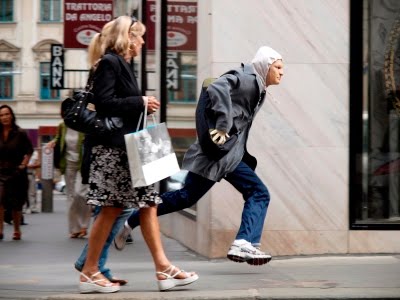 Heisenberg: If you talk about villains, we don't really identify with them; but, we find parts of their identity within us. I have the feeling it's the same with this guy Johann. He has this energy over which he has no choice; it's a unique energy within him that drives him forward and never stops. He knows it's far more intense than choice, especially psychological choice. All of us experience something of that in our lives. We have movements, currents and instincts within us that go against what we would like to do or like to be, which we feel a need to follow, even though we would sometimes prefer not to. For example, you see it all the time in the business world where people become mean or self-centered. It's not unconscious. They know they're acting this way; but, they can't stop it. There's something in them that drives them there.
Guillén: I have two thoughts with regard to this fascination with the individual phenomenon. I was a student of the mythologist Joseph Campbell and one of his favorite stories was that of watching an animal documentary where a cheetah captures and feeds on a gazelle. Campbell asked what a person can say to such an experience? Do you say no? Or do you say yes? This is the question at the heart of observation. I'm intrigued that with The Robber you are basically asking the same question but that you have posed the question while denying a facile psychological answer. You have denied the equation of psychology with choice in an effort to observe or examine something much more compulsive.
 Which leads me to my second observation that The Robber might fit within what Katie Lawrie Van de Ven terms "cinema of compulsion", as she has observed in urban cinema. If her thesis holds true, would you say the pressures of Johan's life in Vienna, or even his imprisonment, explain in any way his compulsive behavior?
Heisenberg: No, I don't think so. I don't think there is a real explanation for his behavior in the film.
Guillén: But people want one, don't they?!
Heisenberg: [Laughs.] People do, yes. But what works is that—in terms of feeling—people still understand this guy totally. Wanting an explanation is more of an involuntary reflex. People are used to getting an explanation in most narratives; but, The Robber doesn't give an explanation for why Johann does what he does, even as it provides other information: the love story, the killing in the film, they're all done in a way that explains why they happen; but, the unique energy that drives Johann and makes him become a runner and a robber, that's never explained and I don't think it can be explained. We actually tried in earlier versions of the script to shape an explanation by showing scenes of his parents; but, in reality, there wasn't enough in his middle class background to determine, "Okay, this was probably the problem" or if there was this or that trauma. No.
 I also don't think it was his surrounding environment. The prison was hard on him, you can definitely say that, but he already possessed his unique energy before he was sentenced to prison. It was an attempted bank robbery that got him sent to prison. But what you were saying earlier about Joseph Campbell asking whether you say yes or no to natural phenomenon is interesting to me. Morality is not an issue in the actions of an animal and the same holds true in my film: morals are not so much an issue when observing Johann, though they become an issue. But with Johann himself, there's nothing in him that has made him the person he is that is linked to moral choices; they're natural choices for him.
 Guillén: Which alludes to James Hillman's "acorn theory of the soul" which he borrowed from the pre-Socratics and expanded into his popular volume The Soul's Code: In Search of Character and Calling (1997). Hillman's premise is that the oak tree is already in the acorn. In other words, you are already who you are when you're born and life is the process (the opportunity, one might say) of discovering who you are predisposed to be, of coming into your own, or becoming yourself. In Johann's running, there is a passionate authenticity, whether he understands it himself, or certainly whether anyone else understands it. It is simply who he is, who he is meant to be.
Heisenberg: Absolutely.
 Guillén: The lack of explanation, however, the uncertainty, leads me to ask what might be an unfair question. I'm aware that your father Martin Heisenberg is a neurobiologist and your grandfather Werner Heisenberg came up with one of my favorite uncertainty principles....
Heisenberg: [Laughs.]
Guillén: ...did your father's interest in neurobiology have any bearing on how you approached Johann's narrative? You could almost say these impulses we're discussing in Johann are neurobiological?
Heisenberg: Yeah, you could say that. It might be that my love for observation and my love for action film making—parts of this film are definitely an action film—come from the same scientific background. Movies are simply observing and capturing movement in photography and then projecting that movement. That's what action films are about: capturing movement in photography. I observe a lot in my private life. We've talked about animal documentaries; I grew up around horses my whole life and nearly became a racing jockey. I've been observing these animals throughout my youth. So something of the scientific observations of my father and grandfather might have stuck on me.
 Guillén: Speaking of movement, then, and the action film, one of the things that critics have been praising again and again in The Robber is precisely its action sequences, specifically the running sequences, and—in contrast to the lack of psychological identification with Johann—the audience's nearly physical identification with him. You've filmed the running sequences in The Robber in such a way that the audience feels they are running alongside Johann. Kudos are due here to your DoP, Reinhold Vorschneider, who—I understand—likewise filmed Thomas Arslan's Im Schatten (In the Shadows, 2010)?
Heisenberg: Right.
Guillén: Can you speak to how you worked with your cinematographer Vorschneider to create these clean clear action sequences? I know you object to rapid editing. How did you work with him in such confined spaces to elicit the viscerality of these sequences?
Heisenberg: I'm not totally against fast cutting. I object more to when the cutting and the breaking up of a scene makes the action or what's happening no longer visible, thereby distracting and disorienting the viewer.
Guillén: It disrupts the clean line of the action?
 Heisenberg: Yes, and the missed line is something I don't like in modern action moviemaking. The beauty of the movement and why we're watching—because we want to know what's happening next—is to a far extent torn apart. But talking about Reinhold Vorschneider, Reinhold is someone uniquely talented in terms of capturing space. It's kind of funny but when we start breaking up a scene, I always think in cuts; how to break up the scene in different shots and cuts and so on. Reinhold, while we're on the set, walks around with his little photo camera. While I'm talking, he's walking away from me [laughs] and then he comes back with a picture of the room, which is just perfect. He has such good notions of how architecture functions and where to place the camera to secure a unique view of this architecture. That's something I find absolutely fascinating about him and where we come together well. Reinhold's way of looking through the lens and the frames he chooses are unique. What I look for and have always liked in my previous filmmaking is to have a clear view in the cutting of what's happening and of the beauty and elegance of the movement. We had to shoot very fast in this film. We were always shooting with two cameras, sometimes three cameras. The pace of production was high so it was hard to maintain this sense of elegance.
Guillén: Is that to say, then, that you don't storyboard?
Heisenberg: I do. I totally do.
Guillén: So how do you negotiate with him? Do you articulate your original vision through your storyboard? And then does his creative collaboration involve matching your original vision?
 Heisenberg: Absolutely. We talk precisely on what we're going to do. But moving the camera in the process of filmmaking when the movement in front of the camera takes place, the guy who's looking through the lens is the one who is deciding how the frame will be at that moment. So I absolutely rely on his genius. He's also committed to honoring my vision and bringing it into the picture.
Guillén: Technically, what cameras did the two of you use to capture such constant movement?
Heisenberg: We used super scope ARRI 35mm cameras, but very light ones. We had a good steadicam operator but—in order to run as fast as Johann runs through the cellar sequence—we needed to put together a lightweight camera. He's a great operator, I must say. I was astonished how well he did it. But Reinhold and I were always working with at least two cameras, one on steadicam and one on tripod, and what we came up with was a mixture between a normal big 35mm camera and a very small one, sometimes two, sometimes three cameras.
Guillén: I'm pleased to hear that you filmed on 35mm cameras. I would have thought with a project like this that you would have used digital equipment.
Heisenberg: I might for my next film. [Laughs.] Digital cameras have become so good that the distinction between digital and 35mm is no longer there, although I'll always love 35mm.
 Guillén: Another collaboration I'd like to highlight is your participation with Martin Prinz who authored the novel on which your film is based and—as I understand—worked with you closely on the film script? Is your film adaptation true to the novel? Is there a similar ambiguity to Johann's motivations in the novel?
Heisenberg: Is the film true to the novel? Yes and no. We have changed quite a lot of the original story, although I would say that what we're depicting is near to what really happened. In a way it depicts the heart of what has happened even though we've slightly altered some of the events. I started with Martin's novel and excerpted all the action out of it and tried to create a film treatment. That was the beginning of the script and then he and I worked from there to explore whether or not we should make the script more psychological, whether we should show his parents, her parents, so on and like that. The story changed a lot during the process of writing the script. It went from Europe to Alaska and back. [Laughs.] We worked closely together on the script. We initially met each other for about a week and then he went back to Vienna, I stayed in Berlin, and we collaborated by phone. We had nine-hour telephone calls where we shaped the script. One of them was funny because we were arguing about whether Johann's girlfriend Erika would ask him, "How was your day?" [Laughs.] Martin would say, "She can't do that. She's a smart girl. She knows that he would never cope with a question like that because he doesn't want anyone in his life who asks him, 'How was your day?' She's someone who knows that he doesn't want to be asked that." And I would say, "C'mon, it's a question like any other. 'How was your day?' You can just answer, 'Good' and that's it." After the fact, I have to admit Martin was right on that point but the whole process was great fun and we touched upon many of these questions.
 That reminds me of something I meant to say earlier about psychologizing the film. If you explain a character to an audience, even to just a certain extent, they will then want to know more about the character. That's something I experienced filming my first movie as well. If a filmmaker starts adding information about a character, the audience gets into a mode of wanting more information, and then you end up having to explain a lot about the character. It's not that the robber doesn't have a psychology. He's a person split between the animal phenomenon we discussed earlier and a person who just wants to be normal and have a girlfriend, etc. These two parts of himself work against each other and that's the drama of this person and of the woman who loves him. What I've noticed is that—once you start adding information—the audience wants to know more and then they begin feeling there has to be a reason for his actions and that I as the filmmaker am failing to explain those reasons. Whereas, if you don't explain anything, those expectations are minimized. So, just in terms of storytelling, that's why I made the decision not to explain where Johann's strange energy comes from. It can't be explained. As you were saying earlier, either you accept this is his nature or you don't and I think that's true to everyday life. The information we get about people is much less than we're used to in films.
 Guillén: The critical reception has been neatly divided on this very issue. Some critics are upset that you haven't offered the traction they expect in narrative features and others are delighted with this experiment you've undertaken to guide audiences towards finessing the narrative out of sheer observation. Another choice of yours I've found equally intriguing is that the setting of your drama can be perceived as neither specific to time or place, even though your story is based upon a specific historical personage. Did you intend to be open-ended in that manner?
Heisenberg: I wanted to place it in the present, in the here and now. Though the real life story of this robber occurred in Austria in the 1980s, we wanted to bring out the philosophical, unique, also spiritual story of this person without it being too fixed to historical time. But watching the film, it feels like today because of the cars and the cell phones. Vienna these days looks like any other European city so you have that sense of it being potentially anywhere.
Guillén: By placing your film in the here and now, does it make The Robber contemporary? What does that term mean for you? Do you have a sense of what constitutes a contemporary film and do you think that you have made a contemporary film?
 Heisenberg: The Robber addresses contemporary issues, yes, because it shows a bank robber—for example—who doesn't seem to care about the money he's stolen. He robs these banks not for the money but just for the act of robbing banks. He's almost Buddhist in the sense that the path is the thing, not the goal. He stores the stolen money under his bed and it's unimportant to him. That's something that I find contemporary. It lends a kind of funny insight into our current bank crisis. But it's hard to say if The Robber truly is a contemporary film. In filmmaking—as in some of the other arts—we have come to the place where all the different styles of filmmaking occur at the same time. It's not like there is any one main current any longer that says, "This is the new way of filmmaking." Even if you were making a film that looked like Eisenstein's Potemkin, it would be contemporary in some way because there are people who make films like that today. They have a certain style that is near to that. Then you have other styles that look like Transformers. For me, the contemporary is linked much more to content rather than style. It's linked to the feeling of having something to say to the important themes and questions that we ask ourselves today.
Guillén: By that, do you mean themes of modernity?
Heisenberg: They can be about modernity, but can also be about philosophical or spiritual questions relevant to our lives today. We probably feel different today about the afterlife than we felt 50 or 60 years ago. We feel different about communication than we felt 60 years ago. If you address these issues philosophically so that you notice as a viewer that the film is about these issues and not just one character and his actions, then it becomes a contemporary film. It's a film that says something about our society, our history, and how it's moving on.
 Guillén: Another important collaboration crucial to the success of your film has been your direction of Andreas Lust in the role of Johann. Can you speak to why you chose him? What you felt he had or possessed that appropriately inflected the energy of this character?
Heisenberg: I knew Andreas from his performances in other films, especially Revanche. He played a policeman in that film and was also a jogger, a runner, so I liked him in that role. We cast from a huge audition of hundreds of actors, which we reduced down to a pool of 70 with whom we auditioned acting scenes, and then we brought that down to 30 actors with whom we did both acting and running scenes. We took our final five actors and consulted with a professional trainer who told us whether or not these men could physically depict our character. We were looking for someone who was a good actor but at the same time could depict a marathon runner. That was the hard part.
 Guillén: Andreas actually trained for the running?
Heisenberg: Yes, he trained a few months for that. I mean, you can't be 100 pounds weight. Or a 100 kilos. [Laughs.] But our collaboration was really interesting because what I told him and what he brings to the character is being able to depict someone who the audience feels for even if he's not doing anything. That's what totally struck me about Andreas. When he was sitting in front of me during casting, he wasn't doing anything but I had a certain feeling for him. An emotion came up with me even though he wasn't doing anything to solicit that emotion. I loved that because I felt that was what we had to have in this character. Someone who was somewhat like a mask but who could still engender sympathy.
Another thing I wanted to mention earlier on when you were talking about becoming yourself was something I actually said to Andreas when we were working. I told him, "Andreas, imagine that you have two skins. One is your outer skin and the other skin is something that has crumpled inside, which the outer skin surrounds like a dark dome. The inner skin is not touching the outer skin; but, when you start running and when you start robbing, in that process when you become heated up and excited, the inner skin uncrumples and expands and—during the best part of your life when you are winning the marathon or the worst part when you are being chased by the police—these two skins become one and you can feel the outside." So that's what happens for me with the character and what is also—at some stage—touching about seeing him running and robbing.
 Guillén: Referencing your comment that Johann was somewhat like a mask, Twitch teammate Peter Gutierrez wrote: "Lust plays the deadpan ex-con with an intensity that's highly paradoxical: he does his utmost to remain a vacuum. Indeed, one of Heisenberg's best visual jokes involves Rettenberger removing his generic rubber hold-up mask and showing us that there's actually not much change in the character's expressiveness."
Heisenberg: Right. [Chuckles.] Absolutely.
 Guillén: On the subject of the mask, my understanding is that the real life robber used a Reagan mask; but, you elected not to do that and to have your character wear a more generic mask. Can you explain why?
Heisenberg: We thought about using many different masks. We thought of using Bush. The Pope. [Laughs.] We had all sorts of funny ideas about it; but, then we noticed that politicizing the mask took us away from the heart of this character. He became someone who was making a comment on society. That would mean having to create another sort of film. There's recent talk of an American remake of The Robber—we're negotiating selling the rights—in which case it might be interesting to politicize the mask, and to pull out these qualities of the real-life robber that were political and funny; but, for my film I had the feeling that Johann's spiritual side was what was unique about him. In my film the robber is quite different at the end than he was in real life.
Guillén: Johann Kastenberger committed suicide?
 Heisenberg: Yes, he killed himself. But here in my film he dies along the road. He dies like an animal, bleeding out on the side of the road without being noticed by anyone. I felt this was a more appropriate ending for the character we were depicting who—throughout his life—has had to go on running, go on robbing, doing what he's doing. In his instance, it can be a revelation to stop such behavior, to stop living. Death came to be synonymous with being still and quiet. Death for Johann means his unique energy has finally left him and it has all come to an end.
Guillén: Death has become equated with an absence of fever, an absence of compulsion?
 Heisenberg: Very good, yes, absolutely. That was something I found very touching in how we depicted this character. During the writing, Martin and I talked about how this was a story about reaching an end. For me, the film's ending is spiritual in that respect. It's different than the real story but it remains at the heart of this story and at the heart of this character and that's precisely why we changed it.
Guillén: A few critics have mentioned that it was in Johann's final moments that they could finally identify with him. Before I forget, I want to ask you about your percussive score. Could you speak to that and also to the operatic sequence when Johann appears to be experiencing an epiphany running the marathon race?
Heisenberg: We worked really hard on the score. I was assisted by Lorenz Dangel, a composer I've previously worked with and a very good friend of mine. I felt it would be good to have a big score accompany the film nearly all the way through and—in trying to do that—Lorenz composed 210 minutes worth of music, a big part of which was actually recorded. But when we tried it, it didn't work. Only about 10 minutes of that original score has remained in the film. The music fit for the first 10 to 20 seconds and then it divided from the picture. We had the feeling, "Something's wrong here. The music's not fitting with what's happening in the picture." So we knew we had to come up with a different concept.
Just a few weeks before we ended cutting, we realized we could enhance the film with a score that elevated the emotions. Most of the time the music we've used is not orchestral but, as you said, percussive. Then at the midpoint when he is running the marathon, just before he kills the parole officer, was where we added this emotional opera piece to create a theatrical approach.
 Guillén: So to wrap up here, I'll move away from the film and return to your beginnings. You trained in art history before you became a filmmaker, is that correct?
Heisenberg: I trained in arts and sculpture but I was an assistant to an art history professor, yes.
Guillén: What motivated or inspired you to shift from sculpture, let's say, to shaping with light?
Heisenberg: Actually, sculpture is shaping with light so your question leads in the right direction. The shift came because my work was becoming more and more narrational. I did sculptures that contained fables. I worked on animals that were stuffed. For example, I had this stuffed wild cat that was overrun by 200 stuffed mice, like in a horror dream. [Laughs.] I had several strange narrative sculptures. At the time I was thinking a lot about semiotics and Umberto Eco and such so I moved on to crafting a poem where every word you hear is linked to a certain pictogram. So it was a little video where these pictograms were shown in the rhythm of the words. I wanted to find out what the language of the pictures would do, if they would form a kind of sentence or if they would fall apart. It was an interesting project because the meanings changed and it was a different way of perceiving meaning. But that was actually the beginning of my filmmaking. I had gone to see a lot of arthouse films at the university in our town, but actually thinking about filmmaking came from making that video. I then started thinking about doing a fiction film with the poem and that became my first short film and with that I applied to film school. So I gradually moved over to filmmaking. I never thought of myself as becoming a filmmaker. It was something strange: suddenly I was in film school and I was thinking, "Filmmaking? Did I ever want to become a filmmaker? I don't know."
Guillén: And not only that but you've become quite a successful filmmaker.
Heisenberg: Knock on wood. [He knocks on the table.]
Guillén: The Robber has been getting favorable reviews and I predict it is the film that will grant you true exposure to North American audiences.
Heisenberg: I hope so.
Guillén: Thank you so much for your time today.
Heisenberg: Thank you! It was a great interview. You ask such smart questions. It's very seldom that I have an interview that has such insight and interest in all the right stuff.
Cross-published on Twitch.