June 2011 brought the fantastic news that—come September—the San Francisco Film Society (SFFS) would be transforming Japantown's New People Cinema into its very own year-round venue. Well summer's almost over and true to its promise, SFFS has revealed an auspicious line-up of September movies with which to inaugurate this new venture. This is exactly what I was hoping for: week-long runs of acclaimed films with limited distribution that were passed over by the likes of Landmark Theaters, the Roxie, YBCA and others. I'm doubly impressed by the commitment to daily matinee and evening showtimes.
 While the Official Grand Opening doesn't happen until later in the month, programming unofficially gets going on Friday, September 2 with the Bay Area premiere of Jean-Luc Godard's Film socialisme. This latest polemic from France's cranky, 80-year-old master provocateur is purportedly about the decline of Western civilization, vis-à-vis a Mediterranean cruise and portrait of a provincial French gas station-owning family—with purposefully oblique / misleading subtitles to boot. While the 1985 Hail Mary riots outside the Roxie Cinema are a lovely memory, I need to think back 40 years to come up with a Godard film I unequivocally "liked." Through the decades I've dutifully slogged my way through each new work that's come to the Bay Area (and not all of them have), so I'm feeling no less compelled to see this, the director's first new feature since 2004's Notre musique. My reticence is lessened just knowing Patti Smith is in it. Here's a Film socialisme trailer that appeared several months before the 2010 Cannes premiere. It appears to be the entire movie fast-forwarded in 4 1/2 minutes.
While Godard might be a hard pill for some, the following week brings a surefire crowd-pleaser to the SFFS / New People Cinema with the September 9 SF premiere of Natalia Smirnoff's Puzzle. I missed this Argentine film when it screened at last autumn's Mill Valley Film Festival, eventually catching up with it at January's Palm Springs fest. It was the most rapturously received of the three dozen movies I saw there. Puzzle is an accomplished, low-key charmer about a put-upon Buenos Aires housewife who finds personal validation and companionship in the world of competitive jigsaw puzzle tournaments. (Who knew?) It features a captivatingly understated performance by María Onetto, whom we last saw in Lucrecia Martel's The Headless Woman. Furthering the Martel connection is that director Smirnoff, making an assured directorial debut with Puzzle, served as Martel's assistant director on La ciénaga and The Holy Girl. My only complaint with Puzzle is a late-film plot development which rings so completely false, it might have derailed a lesser work. See the film and let me know if you agree.
 On Friday, September 16, the SFFS Cinema ping-pongs from crowd-pleaser back to hardcore art film with Cristi Puiu's Aurora. This three-hour, slow-burning Romanian character study cum crime thriller screened at this year's SF International Film Festival and is Puiu's follow-up to The Death of Mr. Lazarescu. It was my favorite narrative feature of the festival and has an assured place in my year-end Top 10. While I anticipate seeing it again, Aurora's SF return will be especially welcomed by those who attended a fateful screening late in the festival. The 35mm print broke just before the crucial event at the film's mid-point, resulting in a canceled screening and a room of traumatized cinephiles.
The less informed you are going into Aurora the better. Simply know that your patience for the mundane "events" which frontload the film will be amply rewarded and that the film's peevish protagonist, who appears in nearly every frame, is portrayed by the director himself. There's a note on the SFFS website advising that the September 20 and 21 showings of Aurora will be on Blu-ray, which I assume means the first four days will be 35mm. On Thursday, September 22, following Aurora's six-day run, the SFFS / New People Cinema will celebrate its Official Grand Opening with an open house reception. Festivities will include a ribbon-cutting ceremony, sake ceremony and a selection of short films.
 Beginning Friday, September 23 the cinema shifts gears with a week of special events, starting with SFFS' first ever three-day mini-festival of recent Hong Kong Cinema. As mentioned in the press release, "SFFS has played a pioneering role in introducing Hong Kong cinema to Bay Area audiences through the SF International Film Festival, which has shown over 70 Hong Kong films, beginning in 1959." The seven films in this series range from opening night indie Merry-Go-Round (partially set in San Francisco) to the latest from veteran Johnnie To (an atypical romantic dramedy, Don't Go Breaking My Heart). Other recognizable Hong Kong directors in the fest include Ann Hui (All About Love, in which pregnant, lesbian ex-partners re-connect) and Benny Chan (sci-fi actioner City Under Siege).
 Benny Chan's most recent film, martial arts epic Shaolin, screens later that week for two days (September 28 & 29), separate from the Hong Kong mini-fest. Set in early 20th century China, this tale of a warlord's spiritual redemption boasts a cast of HK superstars (Andy Lau, Nicholas Tse, Jackie Chan) and fight sequences performed by real Shaolin monks. In between Hong Kong Cinema and Shaolin, SFFS hosts a special screening of the documentary The Disappearance of McKinley Nolan on Monday, September 26. Directed by Henry Corra (who will attend the evening shows), this doc is about the mysterious 40-year-old disappearance of an African American G.I. in the jungles of Viet Nam and Cambodia.
And that takes us up to Friday, September 30 and a one-week run of Passione, John Turturro's valentine to the music and people of Naples which opened this year's Cinequest in San Jose. The month of October also finds SFFS into the full swing of its Fall Season, so save these dates: Taiwan Film Days (Oct. 14-16), NY/SF International Children's Film Festival (Oct. 21-23) and French Cinema Now (Oct. 27-Nov.2).
Cross-published on film-415 and Twitch.
 Continuing its commitment to contemporary Japanese fare, VIZ Cinema has been busy throughout the month of October with the San Francisco premiere of John H. Lee's Sayonara Itsuka: Goodbye, Someday (2010); encore screenings of Junichi Suzuki's documentary 442—Live with Honor, Die with Dignity (2010); the U.S. premiere of Takeshi Koike's anime Redline; while likewise hosting the San Francisco Film Society's Taiwan Film Days.
But VIZ Cinema has granted equal time to honor classic Japanese cinema, most recently with four Yasujirō Ozu films profiling the performances of Setsuko Hara—Late Spring (1949), Early Summer (1954), Late Autumn (1960) and Tokyo Twilight (1957)—and currently with four films by Kenji Mizoguchi: Women of the Night (1948), Miss Oyu (1951), Life of Oharu (1952), and Sansho the Bailiff (1952) (running through early November).
 As profiled at Wikipedia, "Setsuko Hara (原 節子, June 17, 1920) is a retired Japanese actress who appeared in many of Yasujirō Ozu's films, most notably as Noriko in the Noriko Trilogy (Late Spring, Early Summer, and Tokyo Story). She was born 会田 昌江 Masae Aida in Yokohama, Kanagawa prefecture. She also starred in films by Akira Kurosawa, Mikio Naruse and other prominent directors. She is called "the Eternal Virgin" in Japan and is a symbol of the golden era of Japanese cinema of the 1950s, although she is mostly unknown in the US. She suddenly quit acting in 1963 (the same year as Ozu's death), and has since led a secluded life in Kamakura, refusing all interviews and photographs. Her last major role was Riku, wife of Ōishi Yoshio, in the 1962 film, Chushingura. She was the inspiration for the protagonist of the 2001 movie Millennium Actress."
Ozu-san.com has attractively compiled her collaborations with Ozu, including the essay "Something About Setsuko" (taken from her fan page), an article by Donald Richie, and Peter Bradshaw's profile for The Guardian.
 I caught two of the Ozu films: Late Spring and Tokyo Twilight. Both have been released on Criterion with insightful essays by Michael Atkinson and Michael Koresky, respectively. Of equal interest is Dan Harper's profile on Setsuko Hara for Senses of Cinema and Jerome Delamater's for Film Reference (updated by Corey K. Creekmur).
Cross-published on Twitch.
 This weekend marks the one-year anniversary of VIZ Cinema. Admittedly, I've only begun attending screenings there in the last few months; but, it has rapidly become one of my favorite venues for its comfortable seating, its café serving vegan doughnuts and Blue Bottle coffee (hands down, the best coffee in San Francisco), and—most importantly—its eclectic programming that focuses on the latest and hottest films from Japan, as well as an incredible legacy of classics, favorites, documentaries and anime—making it the only venue of its kind in the United States. They've also just started distributing their own Blu-Ray DVD titles, kicking off with their Death Note Collection.
 Their August series "Winding Road to Peace" commemorates the 65th anniversary of the Hiroshima and Nagasaki bombings as chronicled through the Japanese American experience of WWII, and continues with two documentaries by local filmmaker Junichi Suzuki: Tôyô's Camera (2008) and 442—Live with honor, Die with dignity (2010), both screening in HD digital through August 19. Both films are key introductions to the internment of Japanese Americans at California's Manzanar Relocation Center during WWII and the celebrated heroics of the 442nd Regimental Combat Team, respectively.
 With Tôyô's Camera, filmmaker Suzuki crafts a documentary portrait of Tôyô Miyatake, a Japanese American photographer who smuggled his camera into Manzanar to capture black and white images that chronicled the plight of his people during this shameful episode of American history. Without question, Miyatake is a fascinating subject and his photographs are beautiful. The story of his internment and his lifelong friendships with Edward Weston and Ansel Adams are of significant interest and—had Suzuki kept his focus on Miyatake instead of mistakeningly attempting to chronicle the entire Japanese American experience of WWII—he would have achieved a poignant and elegant portrait of this important but relatively unknown photographer.
 In her review for the L.A. Times, Sheri Linden praised the selection of Miyatake photographs which makes up the heart of the documentary, but complained: "The film is far more static than any of those pictures. Their cumulative effect is, nonetheless, a sweeping introductory portrait of life in an internment camp." Linden concludes: "Director Junichi Suzuki's film offers compelling insights into a long-shrouded chapter of history, yet Tôyô's Camera lacks the subtlety of its subject's work." I'm afraid I must concur, even as I strongly admire the information I gleaned from Suzuki's flawed effort.
 The more I watch documentaries, the more I become convinced that they should rarely exceed 80 minutes. I imagine it's a considerable hardship for documentarians earnest to relay information to honor the adage that less is more. At 100 minutes, Tôyô's Camera becomes hazardously desultory. Eschewing any kind of narrative voiceover until late in the film when actor George Takei offers brief (and compelling) commentary, the visual enjoyment of the film is muddied by text in two languages slapped on top of the images. The images, which I felt should be predominant, were forced into the background.
 Suzuki remedied this problem in his subsequent documentary 442—Live with honor, Die with dignity, effectively employing narrative voiceover and resituating the Japanese subtitles vertically to the edge of the frame. This documentary profiles the Japanese American 442nd Regimental Combat Team of WWII and explores the regiment's intrinsic paradox. With many of the regiment's soldiers coming from the Japanese American internment camps, the 442 emancipated the Jewish prisoners of the Nazi concentration camps. The irony is painful. Though these soldiers were first looked at as a problem because of their race, they were later appreciated as problem solvers because of their splendid achievement in the battle field. They fought not only America's enemy but also America's prejudice. Suzuki has gathered remarkable oral histories from veterans of 442 still living today and insures that their courage against insurmountable odds will never be forgotten. Curiously, if Suzuki had held off on his desire to include information about the 442 in his earlier documentary Tôyô's Camera, it would have made that earlier effort a tighter one. One gets the sense that Suzuki was already distracted by 442—Live with honor, Die with dignity while filming Tôyô's Camera; an unfortunate enthusiasm.
Notwithstanding my reservations, I recommend both documentaries as valuable oral histories that provide significant information.
Cross-published on Twitch.
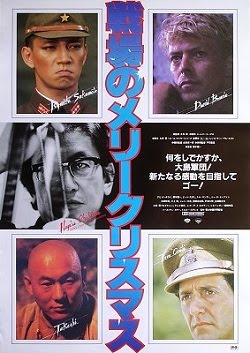
 Situated midway through VIZ Cinema's ongoing series "Winding Road to Peace"—their commemoration of the 65th anniversary of the Hiroshima and Nagasaki bombings in WWII as chronicled through the Japanese American experience of the war—comes a film made late in Nagisa Oshima's career: Merry Christmas, Mr. Lawrence (Senjo no meri Kurisumasu, 1983). As synopsized by VIZ: "In this captivating, exhilaratingly skewed World War II drama from Nagisa Oshima, David Bowie regally embodies the character Celliers, a high-ranking British officer interned by the Japanese as a POW. Music star Ryuichi Sakamoto (who also composed this film's hypnotic score) plays the camp commander, who becomes obsessed with the mysterious blond major, while Tom Conti is British lieutenant colonel Mr. Lawrence, who tries to bridge the emotional and language divides between his captors and fellow prisoners. Also featuring actor-director Takeshi Kitano in his first dramatic role, Merry Christmas Mr. Lawrence is a multilayered, brutal, at times erotic tale of culture clash that was one of Oshima's greatest successes."
 I missed Merry Christmas, Mr. Lawrence when it screened as part of the PFA "In the Realm of Oshima" retrospective that ran May-July, 2009 so I welcome the opportunity VIZ Cinema provides in programming a 35mm screening of Oshima's film. As Jason Sanders synopsized in his program notes for PFA: "After retreating from cinema during the 1970s (when he fashioned a new career as a talk-show host), Oshima returned in 1983 in typically idiosyncratic fashion, with an international coproduction starring David Bowie and Ryuichi Sakamoto of the Yellow Magic Orchestra, both plopped into a Jean Genet–like narrative of male lust and punishment in a World War II Japanese POW camp. Commander Yonai (Sakamoto) runs his camp with well-heeled precision, keeping his hands soft by letting the brutish Hara (Takeshi Kitano, in his film debut) knock everyone into shape. The arrival of the regal Celliers (Bowie), whose blond locks and chiseled cheekbones shine even when he's in chains, gives Yonai a simmering new challenge, not only to his rule but to his sense of superiority, his national pride, and possibly something more. 'A thinking man's Bridge on the River Kwai' (Cinematheque Ontario), this erotic tropical opera finds Oshima mellowed, but still questioning nationalism and contemplating the subversive power of sexuality." "Twitic" Brian Darr notes that Merry Christmas, Mr. Lawrence "merges Oshima's longstanding pop and intellectual impulses so that they feel (almost) harmonious."
At the time of the PFA retrospective, I had the great fortune to interview curator and Oshima scholar James Quandt to enquire after the homoerotic themes in Merry Christmas, Mr. Lawrence, which I replicate here for ready reference:
* * *
 Michael Guillén: I'm wondering if you would be willing to address Oshima's usage of homoerotics in such films as Merry Christmas, Mr. Lawrence and Gohatto?
Quandt: Something that's always fascinated me about Oshima's work is that—from very early on—he treats homosexuality openly. It's a motif all throughout his work and, of course, becomes explicit towards the end of his career with Merry Christmas, Mr. Lawrence and Gohatto especially. Part of my passion for Oshima came out of the retrospective I did of his work 20+ years ago at Toronto's Harbourfront when I was still programming there. There's a thing that happens when you invite a director. You get advice from your colleagues. In Oshima's case, it was unanimous: "Don't invite Oshima. Don't have him. Save yourself the grief. He's a bastard. He's incredibly difficult. He's not generous with the audience. There's no reason to have him." I won't name those colleagues—they're still around—but, because he was coming to North America to receive an award and had agreed to attend my retrospective, I felt I couldn't bypass the chance to have him in Toronto. As often happens in these cases, it turned out to be the opposite. Oshima was the funniest, sweetest, generous guest imaginable. Again, his generosity with his audiences inspired Q&As that went on and on and on. I remember that he loved his scotch. I worried at times about getting him from the fourth scotch across the parking lot into the cinema to do the Q&A; but, it always happened and he was always completely and wonderfully cogent.
 I asked him about his open treatment of homosexuality one night during one of our long discussions about art and cinema. At the time we both deified Theo Angelopoulos. Now when I look back on it, it's ironic because Oshima was holding up Angelopoulos as a god; but—when I look at Angelopoulos' work—I start to imagine that he probably took some things from Oshima? Of course, Angelopoulos denies any formative influences—he didn't take anything from Jancsó; he didn't take anything from Mizoguchi—and I'm not too sure he took anything from Oshima; but, boy, when you look at some of the early Oshimas and how he treats choral structuring, using groups of people as friezes (like in Night and Fog in Japan), it really does feel like Days of 36 and some of the Angelopoulos films. Anyway, I did ask Oshima about this motif of homosexuality because then—when he was at Harborfront—Merry Christmas, Mr. Lawrence was still relatively new. He hadn't made Gohatto yet—that was still a long way off—and all he said was, "It's very interesting, isn't it?" Then he passed on to some other topic.
Guillén: Oshima's usage of homosexuality strikes me as a purposeful representation of marginalized minorities as a romanticized outlaw position. I'm aware that Oshima was quite fond of Jean Genet's romantic criminals and that—as a television host—he had quite a flamboyant persona. Other than for that passing comment, he never offered anything more on the subject?
 Quandt: No, absolutely not. He just had this bewitching laugh. Then when he went to make Gohatto, again I thought it intriguing—aware that this might be his last project because of his debilitating stroke—that this is the story he chose. How do you explain that? He's been married for decades and has many children. I'm not saying there was anything there in his personal life; but, it fits with his fascination with all kinds of minorities, all kinds of rebellions, all kinds of refusals of the Japanese way. As much as it can be pointed out that the bishōnen, this figure of the beautiful youth—who you also get in Shiro Amakusa, The Christian Rebel from the '60s—has been very much a part of Japanese popular culture for a long time. Gay samurai, in fact, have been a part of popular culture for a long time. As much as you can make that argument, the expression of it in Oshima is something singular. It fits with all these various minorities that he's explored.
* * *
 Merry Christmas, Mr. Lawrence screens Wednesday, August 11, at 4:30PM and Thursday, August 12 at 7:00PM at the VIZ, 1746 Post Street, San Francisco. $10 general admission. Advance tickets available at the box office (415-525-8600) or at their website.
Cross-published on Twitch.
 While the Official Grand Opening doesn't happen until later in the month, programming unofficially gets going on Friday, September 2 with the Bay Area premiere of Jean-Luc Godard's Film socialisme. This latest polemic from France's cranky, 80-year-old master provocateur is purportedly about the decline of Western civilization, vis-à-vis a Mediterranean cruise and portrait of a provincial French gas station-owning family—with purposefully oblique / misleading subtitles to boot. While the 1985 Hail Mary riots outside the Roxie Cinema are a lovely memory, I need to think back 40 years to come up with a Godard film I unequivocally "liked." Through the decades I've dutifully slogged my way through each new work that's come to the Bay Area (and not all of them have), so I'm feeling no less compelled to see this, the director's first new feature since 2004's Notre musique. My reticence is lessened just knowing Patti Smith is in it. Here's a Film socialisme trailer that appeared several months before the 2010 Cannes premiere. It appears to be the entire movie fast-forwarded in 4 1/2 minutes.
 On Friday, September 16, the SFFS Cinema ping-pongs from crowd-pleaser back to hardcore art film with Cristi Puiu's Aurora. This three-hour, slow-burning Romanian character study cum crime thriller screened at this year's SF International Film Festival and is Puiu's follow-up to The Death of Mr. Lazarescu. It was my favorite narrative feature of the festival and has an assured place in my year-end Top 10. While I anticipate seeing it again, Aurora's SF return will be especially welcomed by those who attended a fateful screening late in the festival. The 35mm print broke just before the crucial event at the film's mid-point, resulting in a canceled screening and a room of traumatized cinephiles.
 Beginning Friday, September 23 the cinema shifts gears with a week of special events, starting with SFFS' first ever three-day mini-festival of recent Hong Kong Cinema. As mentioned in the press release, "SFFS has played a pioneering role in introducing Hong Kong cinema to Bay Area audiences through the SF International Film Festival, which has shown over 70 Hong Kong films, beginning in 1959." The seven films in this series range from opening night indie Merry-Go-Round (partially set in San Francisco) to the latest from veteran Johnnie To (an atypical romantic dramedy, Don't Go Breaking My Heart). Other recognizable Hong Kong directors in the fest include Ann Hui (All About Love, in which pregnant, lesbian ex-partners re-connect) and Benny Chan (sci-fi actioner City Under Siege).
 Benny Chan's most recent film, martial arts epic Shaolin, screens later that week for two days (September 28 & 29), separate from the Hong Kong mini-fest. Set in early 20th century China, this tale of a warlord's spiritual redemption boasts a cast of HK superstars (Andy Lau, Nicholas Tse, Jackie Chan) and fight sequences performed by real Shaolin monks. In between Hong Kong Cinema and Shaolin, SFFS hosts a special screening of the documentary The Disappearance of McKinley Nolan on Monday, September 26. Directed by Henry Corra (who will attend the evening shows), this doc is about the mysterious 40-year-old disappearance of an African American G.I. in the jungles of Viet Nam and Cambodia.