 As Jason Sanders has written—introducing the retrospective "The Library Lover: The Films of Raúl Ruiz", screening at the Pacific Film Archive (PFA) from March 2-April 15, 2012—"The Return of a Library Lover [Lettre d'un cinéaste ou Le retour d'un amateur de bibliothèques, 1983] is the title of an autobiographical short by Chilean director Raúl Ruiz, and looking over his remarkable filmography it's easy to see why: adaptations of Dante, Kafka, Proust, Calderón, Pierre Klossowski, Camilo Castelo Branco, and Sadegh Hedayat dot his career, while a list of citations could include Borges, Lacan, Le Petit Prince, and nineteenth-century Catholic thought—often in the same film. Intensely cerebral, his films are also highly entertaining, often hilarious, and always surprising."
Ruiz's literary pedigree is likewise celebrated by A.O. Scott in his consideration of Mysteries of Lisbon (Mistérios de Lisboa, 2010) for the New York Times: "The world of his movies—as experienced by the characters and the audience alike—is at once soothingly, elegantly familiar and booby-trapped with surprises. There are sudden disappearances, long-buried secrets coming to light, supernatural happenings and bizarre coincidences. In his universe, improbability is the rule."
 Born in Chile in 1941, Ruiz studied law and theology before attending film school in Argentina. Returning to Chile, he completed only a handful of works before the 1973 military coup forced him into exile in France, where he began a nearly 40-year career spanning several continents. Early successes funded by European television led to bigger budgets—by the mid-1990s Ruiz was able to work with such international stars as John Malkovich (Time Regained), Catherine Deneuve (Geneologies of a Crime), and Marcello Mastroianni (Three Lives and Only One Death).
Ruiz passed away in August of 2011, having completed one last film in his native Chile after the international success of Mysteries of Lisbon. His films embrace a "logic governed by miracles,"as he wrote, a "poetics of cinema" that remains unmatched in its freedom.
Series curated by Kathy Geritz. With thanks to Valeria Sarmentio; Marie Bonnel, Ministère des Affaires Etrangères, Paris; Denis Bisson, Cultural Attaché, Consulate General of France, San Francisco; Suzanne Fedak, Music Box Films; Gary Palmucci, Kino Lorber, Inc.; Jackie Raynal; Andrew Youdell, Annabelle Shaw, BFI Collections; Guillemette Laucoin, La Cinémathèque de Toulouse.
All film notes are by Jason Sanders (except where indicated). In the weeks to come, The Evening Class will expand on these entries through select primers.
 Friday / 3.2.12; 7:00pm
Mysteries of Lisbon (Mistérios de Lisboa)
Raúl Ruiz (Portugal / France , 2010)
"The most glorious achievement of Ruiz's prodigious career and one of the first cinematic masterpieces of this century."—Tony Pipolo, Film Comment
The noble and the damned are interchangeable in Raúl Ruiz's magisterial gambit on the art of storytelling, based on a nineteenth-century Portuguese novel yet more radical than any contemporary tale. A young Lisbon orphan wonders who he is, but soon every possible identity comes into question, especially as flashbacks, flash-forwards, and tales within tales spiral forth. What remains is the sumptuous setting: a decadent Old World Portugal of crumbling estates and extravagant ballrooms. A tale of tales, of orphans, counts, and duels, this costume metadrama is Dickens filtered through a Surrealist's gaze, and a fitting summation of Ruiz's artistry.
Written by Carlos Saboga, based on the book by Camilo Castelo Branco. Photographed by André Szankowski. With Adriano Luz, Maria Joäo Bastos, Ricardo Pereira, Clotilde Hesme. (272 mins, In Portuguese with English subtitles, Color, Blu-ray, From Music Box Films)
 Saturday / 3.3.12; 8:30pm
Three Lives and Only One Death (Trois vies et une seule mort)
Raúl Ruiz (France / Portugal, 1996)
"A brilliant comedy . . . sexy . . . elegantly surreal."—Stephen Holden, New York Times
In his second-to-last role, Marcello Mastroianni stars as a husband, a professor, a butler, and a businessman in Ruiz's light-hearted, Borgesian salute to fantasy life and the telling of tales, arguably the director's most accessible and commercially successful film involving the complete destruction of narrative. Four tales are united by a liberated-looking Mastroianni and the surrealist trickery (both visual and narrative) of Ruiz, at the top of his game—and now, thanks to Mastroianni's involvement, with a budget to match.
Written by Ruiz, Pascal Bonitzer. Photographed by Laurent Machuel. With Marcello Mastroianni, Anna Galiena, Marisa Paredes, Melvil Poupaud. (123 mins, In French with English subtitles, Color, 35mm, From Le Petit Bureau)
 Sunday / 3.18.12; 6:00pm
Time Regained (Le temps retrouvé)
Raúl Ruiz (France / Italy / Portugal, 1999)
Ruiz's adaptation of the final volume of In Search of Lost Time is a film "at once wholly faithful to Proust and to the distinctive vision of its director. Inventing a cinematic equivalent to the novelist's 'involuntary memory,' Ruiz creates a permeable fiction in which every image opens on another, and every level of the remembrance—from Marcel's cozy childhood memories to his struggles to recall the past—exists on the same plane. The film is a casting miracle, as the actors (leading figures of the contemporary French cinema, [plus John Malkovich]) are perfect physical and emotional matches for Proust's characters." (Dave Kehr, program note for the 2000 San Francisco International Film Festival.)
Time Regained will be introduced by Larry Bensky, executive producer of the website radioproust.org. Bensky teaches classes on Proust at the UC Berkeley Osher Lifetime Learning Center.
Written by Gilles Taurand, Ruiz, based on the book by Marcel Proust. Photographed by Ricardo Aronovich. With Catherine Deneuve, Emmanuelle Béart, Vincent Perez, John Malkovich. (162 mins, 35mm, From Kino Lorber, Inc.)
 Friday / 3.23.12; 6:45pm
The Hypothesis of the Stolen Painting (L'hypothèse du tableau volé)
Raúl Ruiz (France, 1979)
A satire on the urge to define and thus control art, The Hypothesis of the Stolen Painting follows a doddering art collector as he pontificates on several paintings by a great artist that he has recreated in human form in the rooms of his monstrous estate. Quizzed by a somewhat restless narrator, our collector turns his theories one way, then another, fishing for meanings in an increasingly emptying sea. On one level, Hypothesis parodies creaky intro-to-art public television shows; for Ruiz, it's also a detective story in which the pleasure "comes not from solving the mystery, but from moving from one level of interpretation to another."
Written by Ruiz, Pierre Klossowski. Photographed by Sacha Vierny. With Jean Rougeul, Gabriel Gascon, Chantal Paley, Jean Raynaud. (66 mins, In French with English subtitles, B&W, 35mm, From Jackie Raynall)
Preceded by: Dog's Dialogue (Le colloque de chiens, Raúl Ruiz, France, 1977). For this delightful film, Ruiz took a lurid tale found in a popular press crime magazine, cut out phrases and made a new story. Richard Peña (18 mins, In French with English subtitles, Color, 35mm, From BFI Collections, permission Valeria Sarmiento)
Total running time: 84 mins
 Wednesday / 4.4.12; 7:00pm
The Penal Colony (La colonia penal)
Raúl Ruiz (Chile, 1971)
Loosely adapting a Kafka story, Ruiz creates a satirical power allegory worthy of both Jonathan Swift and Eduardo Galeano. A small Latin American country, after "attempts to exploit its guano resources failed," has nothing left to export except the only thing the First World expects from it: atrocity. A willing journalist is given a tour of the country's torture mills, military repressions, and natural disasters, with a few traditional songs thrown in for good measure. ("I like you people because you're so like children!" she chirps.) Absurd, hilarious, and unsparing of Third and First Worlds alike, The Penal Colony is also—unfortunately—timeless.
Written by Ruiz, based on the story by Franz Kafka. Photographed by Hector Rios. With Monica Echeveria, Luis Alarcón, Anibal Reyna, Nelson Villagra. (67 mins, In Spanish with English subtitles, B&W, 16mm, From BFI Collections, permission Valeria Sarmiento)
Followed by:
A TV Dante: Cantos 9–14
Raúl Ruiz (U.K., 1991)
Raúl Ruiz has seen hell and come back to report on it. The filmmaker returns to Santiago, his home prior to Pinochet's coup, and stages a selection of Dante's cantos amidst the mundane goings-on of the city. Santiago as a metaphorical hell summons a bounty of past and present social inequities, foregrounding the allegorical aspects of the Inferno. But Ruiz is also the consummate visual stylist. His imagined city has an uncanny sense of the familiar made unrecognizable through grotesque imagery. A nightmarish state embraces the film, intimating the proximity of horror, of a near and waiting abyss.—Steve Seid.
Based on Dante's Inferno, translated by Tom Phillips. With Fernando Bordeau, Francisco Reyes, and the voices of John Gielgud, Bob Peck. (66 mins, Color, 3/4" video, PFA Collection)
Total running time: 133 mins
 Saturday / 4.14.12; 6:00pm
Tres Tristes Tigres (a.k.a. Three Sad Tigers)
Raúl Ruiz (Chile, 1968)
Ruiz's debut feature adapts a popular play involving a seedy older brother who prostitutes his younger sister. Positioned in opposition to then-popular Mexican melodramas, the film pointedly disregards their overly dramatic aesthetics and creates instead a hyper-realist, Cassavettes-like style more concerned with everyday realities. "I wanted the spectators to recognize themselves," Ruiz noted. Creating a Chilean New Wave from scratch—the mainly Argentine crew were culled from documentary projects, the actors from "the theater of Noel Coward"—Tres Tristes Tigres came from nowhere, and embodies the first break of a film movement that was soon dammed by the military coup.
Written by Ruiz, based on a play by Alejandro Sieveking. Photographed by Diego Bonacina. With Nelson Villagra, Shenda Román, Luis Alarcón, Delfina Guszmán. (100 mins, In Spanish with English subtitles, B&W, 35mm, From BFI Collections, permission Valeria Sarmiento)
 Sunday / 4.15.12; 4:00pm
The Suspended Vocation (La vocation suspendue)
Raúl Ruiz (France, 1977)
"There is a phrase ascribed to both St. Augustine and Stalin: in a besieged citadel, all dissidence is treason," notes Ruiz of this dizzying tale. "Thus my counter-argument: in order to survive, all institutions must behave as besieged citadels." In this adaptation of a Pierre Klossowski novel, there exist three unfinished films by the Catholic Church from different eras, all documenting rival factions debating truth and interpretation. Suspended Vocation is all three films as one; like the ideas of the characters in the films, the different actors, film stocks, and aesthetics also compete for supremacy. Here, it's not just the Church that's besieged, but cinema itself.
Written by Ruiz, based on the novel by Pierre Klossowski. Photographed by Sacha Vierny. With Gabriel Gascon, Didier Flamand, Pascal Bonitzer, Maurice Bénichou. (107 mins, In French with English subtitles, B&W, 16mm, From BFI Collections, permission Valeria Sarmiento)
 Situated midway through VIZ Cinema's ongoing series "Winding Road to Peace"—their commemoration of the 65th anniversary of the Hiroshima and Nagasaki bombings in WWII as chronicled through the Japanese American experience of the war—comes a film made late in Nagisa Oshima's career: Merry Christmas, Mr. Lawrence (Senjo no meri Kurisumasu, 1983). As synopsized by VIZ: "In this captivating, exhilaratingly skewed World War II drama from Nagisa Oshima, David Bowie regally embodies the character Celliers, a high-ranking British officer interned by the Japanese as a POW. Music star Ryuichi Sakamoto (who also composed this film's hypnotic score) plays the camp commander, who becomes obsessed with the mysterious blond major, while Tom Conti is British lieutenant colonel Mr. Lawrence, who tries to bridge the emotional and language divides between his captors and fellow prisoners. Also featuring actor-director Takeshi Kitano in his first dramatic role, Merry Christmas Mr. Lawrence is a multilayered, brutal, at times erotic tale of culture clash that was one of Oshima's greatest successes."
 I missed Merry Christmas, Mr. Lawrence when it screened as part of the PFA "In the Realm of Oshima" retrospective that ran May-July, 2009 so I welcome the opportunity VIZ Cinema provides in programming a 35mm screening of Oshima's film. As Jason Sanders synopsized in his program notes for PFA: "After retreating from cinema during the 1970s (when he fashioned a new career as a talk-show host), Oshima returned in 1983 in typically idiosyncratic fashion, with an international coproduction starring David Bowie and Ryuichi Sakamoto of the Yellow Magic Orchestra, both plopped into a Jean Genet–like narrative of male lust and punishment in a World War II Japanese POW camp. Commander Yonai (Sakamoto) runs his camp with well-heeled precision, keeping his hands soft by letting the brutish Hara (Takeshi Kitano, in his film debut) knock everyone into shape. The arrival of the regal Celliers (Bowie), whose blond locks and chiseled cheekbones shine even when he's in chains, gives Yonai a simmering new challenge, not only to his rule but to his sense of superiority, his national pride, and possibly something more. 'A thinking man's Bridge on the River Kwai' (Cinematheque Ontario), this erotic tropical opera finds Oshima mellowed, but still questioning nationalism and contemplating the subversive power of sexuality." "Twitic" Brian Darr notes that Merry Christmas, Mr. Lawrence "merges Oshima's longstanding pop and intellectual impulses so that they feel (almost) harmonious."
At the time of the PFA retrospective, I had the great fortune to interview curator and Oshima scholar James Quandt to enquire after the homoerotic themes in Merry Christmas, Mr. Lawrence, which I replicate here for ready reference:
* * *
 Michael Guillén: I'm wondering if you would be willing to address Oshima's usage of homoerotics in such films as Merry Christmas, Mr. Lawrence and Gohatto?
Quandt: Something that's always fascinated me about Oshima's work is that—from very early on—he treats homosexuality openly. It's a motif all throughout his work and, of course, becomes explicit towards the end of his career with Merry Christmas, Mr. Lawrence and Gohatto especially. Part of my passion for Oshima came out of the retrospective I did of his work 20+ years ago at Toronto's Harbourfront when I was still programming there. There's a thing that happens when you invite a director. You get advice from your colleagues. In Oshima's case, it was unanimous: "Don't invite Oshima. Don't have him. Save yourself the grief. He's a bastard. He's incredibly difficult. He's not generous with the audience. There's no reason to have him." I won't name those colleagues—they're still around—but, because he was coming to North America to receive an award and had agreed to attend my retrospective, I felt I couldn't bypass the chance to have him in Toronto. As often happens in these cases, it turned out to be the opposite. Oshima was the funniest, sweetest, generous guest imaginable. Again, his generosity with his audiences inspired Q&As that went on and on and on. I remember that he loved his scotch. I worried at times about getting him from the fourth scotch across the parking lot into the cinema to do the Q&A; but, it always happened and he was always completely and wonderfully cogent.
 I asked him about his open treatment of homosexuality one night during one of our long discussions about art and cinema. At the time we both deified Theo Angelopoulos. Now when I look back on it, it's ironic because Oshima was holding up Angelopoulos as a god; but—when I look at Angelopoulos' work—I start to imagine that he probably took some things from Oshima? Of course, Angelopoulos denies any formative influences—he didn't take anything from Jancsó; he didn't take anything from Mizoguchi—and I'm not too sure he took anything from Oshima; but, boy, when you look at some of the early Oshimas and how he treats choral structuring, using groups of people as friezes (like in Night and Fog in Japan), it really does feel like Days of 36 and some of the Angelopoulos films. Anyway, I did ask Oshima about this motif of homosexuality because then—when he was at Harborfront—Merry Christmas, Mr. Lawrence was still relatively new. He hadn't made Gohatto yet—that was still a long way off—and all he said was, "It's very interesting, isn't it?" Then he passed on to some other topic.
Guillén: Oshima's usage of homosexuality strikes me as a purposeful representation of marginalized minorities as a romanticized outlaw position. I'm aware that Oshima was quite fond of Jean Genet's romantic criminals and that—as a television host—he had quite a flamboyant persona. Other than for that passing comment, he never offered anything more on the subject?
 Quandt: No, absolutely not. He just had this bewitching laugh. Then when he went to make Gohatto, again I thought it intriguing—aware that this might be his last project because of his debilitating stroke—that this is the story he chose. How do you explain that? He's been married for decades and has many children. I'm not saying there was anything there in his personal life; but, it fits with his fascination with all kinds of minorities, all kinds of rebellions, all kinds of refusals of the Japanese way. As much as it can be pointed out that the bishōnen, this figure of the beautiful youth—who you also get in Shiro Amakusa, The Christian Rebel from the '60s—has been very much a part of Japanese popular culture for a long time. Gay samurai, in fact, have been a part of popular culture for a long time. As much as you can make that argument, the expression of it in Oshima is something singular. It fits with all these various minorities that he's explored.
* * *
 Merry Christmas, Mr. Lawrence screens Wednesday, August 11, at 4:30PM and Thursday, August 12 at 7:00PM at the VIZ, 1746 Post Street, San Francisco. $10 general admission. Advance tickets available at the box office (415-525-8600) or at their website.
Cross-published on Twitch.
 PFA Program Notes (by Jason Sanders)
 As Jason Sanders has written—introducing the retrospective "The Library Lover: The Films of Raúl Ruiz", screening at the Pacific Film Archive (PFA) from March 2-April 15, 2012—"The Return of a Library Lover [Lettre d'un cinéaste ou Le retour d'un amateur de bibliothèques, 1983] is the title of an autobiographical short by Chilean director Raúl Ruiz, and looking over his remarkable filmography it's easy to see why: adaptations of Dante, Kafka, Proust, Calderón, Pierre Klossowski, Camilo Castelo Branco, and Sadegh Hedayat dot his career, while a list of citations could include Borges, Lacan, Le Petit Prince, and nineteenth-century Catholic thought—often in the same film. Intensely cerebral, his films are also highly entertaining, often hilarious, and always surprising."
 Born in Chile in 1941, Ruiz studied law and theology before attending film school in Argentina. Returning to Chile, he completed only a handful of works before the 1973 military coup forced him into exile in France, where he began a nearly 40-year career spanning several continents. Early successes funded by European television led to bigger budgets—by the mid-1990s Ruiz was able to work with such international stars as John Malkovich (Time Regained), Catherine Deneuve (Geneologies of a Crime), and Marcello Mastroianni (Three Lives and Only One Death).
 Friday / 3.2.12; 7:00pm
 Saturday / 3.3.12; 8:30pm
 Sunday / 3.18.12; 6:00pm
 Friday / 3.23.12; 6:45pm
 Wednesday / 4.4.12; 7:00pm
 Saturday / 4.14.12; 6:00pm
 Sunday / 4.15.12; 4:00pm
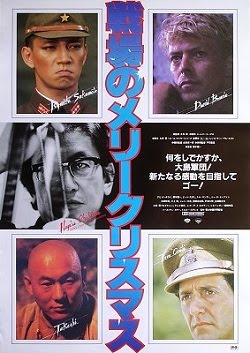 Situated midway through VIZ Cinema's ongoing series "Winding Road to Peace"—their commemoration of the 65th anniversary of the Hiroshima and Nagasaki bombings in WWII as chronicled through the Japanese American experience of the war—comes a film made late in Nagisa Oshima's career: Merry Christmas, Mr. Lawrence (Senjo no meri Kurisumasu, 1983). As synopsized by VIZ: "In this captivating, exhilaratingly skewed World War II drama from Nagisa Oshima, David Bowie regally embodies the character Celliers, a high-ranking British officer interned by the Japanese as a POW. Music star Ryuichi Sakamoto (who also composed this film's hypnotic score) plays the camp commander, who becomes obsessed with the mysterious blond major, while Tom Conti is British lieutenant colonel Mr. Lawrence, who tries to bridge the emotional and language divides between his captors and fellow prisoners. Also featuring actor-director Takeshi Kitano in his first dramatic role, Merry Christmas Mr. Lawrence is a multilayered, brutal, at times erotic tale of culture clash that was one of Oshima's greatest successes."
 I missed Merry Christmas, Mr. Lawrence when it screened as part of the PFA "In the Realm of Oshima" retrospective that ran May-July, 2009 so I welcome the opportunity VIZ Cinema provides in programming a 35mm screening of Oshima's film. As Jason Sanders synopsized in his program notes for PFA: "After retreating from cinema during the 1970s (when he fashioned a new career as a talk-show host), Oshima returned in 1983 in typically idiosyncratic fashion, with an international coproduction starring David Bowie and Ryuichi Sakamoto of the Yellow Magic Orchestra, both plopped into a Jean Genet–like narrative of male lust and punishment in a World War II Japanese POW camp. Commander Yonai (Sakamoto) runs his camp with well-heeled precision, keeping his hands soft by letting the brutish Hara (Takeshi Kitano, in his film debut) knock everyone into shape. The arrival of the regal Celliers (Bowie), whose blond locks and chiseled cheekbones shine even when he's in chains, gives Yonai a simmering new challenge, not only to his rule but to his sense of superiority, his national pride, and possibly something more. 'A thinking man's Bridge on the River Kwai' (Cinematheque Ontario), this erotic tropical opera finds Oshima mellowed, but still questioning nationalism and contemplating the subversive power of sexuality." "Twitic" Brian Darr notes that Merry Christmas, Mr. Lawrence "merges Oshima's longstanding pop and intellectual impulses so that they feel (almost) harmonious."
 Michael Guillén: I'm wondering if you would be willing to address Oshima's usage of homoerotics in such films as Merry Christmas, Mr. Lawrence and Gohatto?
 I asked him about his open treatment of homosexuality one night during one of our long discussions about art and cinema. At the time we both deified Theo Angelopoulos. Now when I look back on it, it's ironic because Oshima was holding up Angelopoulos as a god; but—when I look at Angelopoulos' work—I start to imagine that he probably took some things from Oshima? Of course, Angelopoulos denies any formative influences—he didn't take anything from Jancsó; he didn't take anything from Mizoguchi—and I'm not too sure he took anything from Oshima; but, boy, when you look at some of the early Oshimas and how he treats choral structuring, using groups of people as friezes (like in Night and Fog in Japan), it really does feel like Days of 36 and some of the Angelopoulos films. Anyway, I did ask Oshima about this motif of homosexuality because then—when he was at Harborfront—Merry Christmas, Mr. Lawrence was still relatively new. He hadn't made Gohatto yet—that was still a long way off—and all he said was, "It's very interesting, isn't it?" Then he passed on to some other topic.
 Quandt: No, absolutely not. He just had this bewitching laugh. Then when he went to make Gohatto, again I thought it intriguing—aware that this might be his last project because of his debilitating stroke—that this is the story he chose. How do you explain that? He's been married for decades and has many children. I'm not saying there was anything there in his personal life; but, it fits with his fascination with all kinds of minorities, all kinds of rebellions, all kinds of refusals of the Japanese way. As much as it can be pointed out that the bishōnen, this figure of the beautiful youth—who you also get in Shiro Amakusa, The Christian Rebel from the '60s—has been very much a part of Japanese popular culture for a long time. Gay samurai, in fact, have been a part of popular culture for a long time. As much as you can make that argument, the expression of it in Oshima is something singular. It fits with all these various minorities that he's explored.
 Merry Christmas, Mr. Lawrence screens Wednesday, August 11, at 4:30PM and Thursday, August 12 at 7:00PM at the VIZ, 1746 Post Street, San Francisco. $10 general admission. Advance tickets available at the box office (415-525-8600) or at their website.