Situated midway through VIZ Cinema's ongoing series "Winding Road to Peace"—their commemoration of the 65th anniversary of the Hiroshima and Nagasaki bombings in WWII as chronicled through the Japanese American experience of the war—comes a film made late in Nagisa Oshima's career: Merry Christmas, Mr. Lawrence (Senjo no meri Kurisumasu, 1983). As synopsized by VIZ: "In this captivating, exhilaratingly skewed World War II drama from Nagisa Oshima, David Bowie regally embodies the character Celliers, a high-ranking British officer interned by the Japanese as a POW. Music star Ryuichi Sakamoto (who also composed this film's hypnotic score) plays the camp commander, who becomes obsessed with the mysterious blond major, while Tom Conti is British lieutenant colonel Mr. Lawrence, who tries to bridge the emotional and language divides between his captors and fellow prisoners. Also featuring actor-director Takeshi Kitano in his first dramatic role, Merry Christmas Mr. Lawrence is a multilayered, brutal, at times erotic tale of culture clash that was one of Oshima's greatest successes."
 I missed Merry Christmas, Mr. Lawrence when it screened as part of the PFA "In the Realm of Oshima" retrospective that ran May-July, 2009 so I welcome the opportunity VIZ Cinema provides in programming a 35mm screening of Oshima's film. As Jason Sanders synopsized in his program notes for PFA: "After retreating from cinema during the 1970s (when he fashioned a new career as a talk-show host), Oshima returned in 1983 in typically idiosyncratic fashion, with an international coproduction starring David Bowie and Ryuichi Sakamoto of the Yellow Magic Orchestra, both plopped into a Jean Genet–like narrative of male lust and punishment in a World War II Japanese POW camp. Commander Yonai (Sakamoto) runs his camp with well-heeled precision, keeping his hands soft by letting the brutish Hara (Takeshi Kitano, in his film debut) knock everyone into shape. The arrival of the regal Celliers (Bowie), whose blond locks and chiseled cheekbones shine even when he's in chains, gives Yonai a simmering new challenge, not only to his rule but to his sense of superiority, his national pride, and possibly something more. 'A thinking man's Bridge on the River Kwai' (Cinematheque Ontario), this erotic tropical opera finds Oshima mellowed, but still questioning nationalism and contemplating the subversive power of sexuality." "Twitic" Brian Darr notes that Merry Christmas, Mr. Lawrence "merges Oshima's longstanding pop and intellectual impulses so that they feel (almost) harmonious."
At the time of the PFA retrospective, I had the great fortune to interview curator and Oshima scholar James Quandt to enquire after the homoerotic themes in Merry Christmas, Mr. Lawrence, which I replicate here for ready reference:
* * *
 Michael Guillén: I'm wondering if you would be willing to address Oshima's usage of homoerotics in such films as Merry Christmas, Mr. Lawrence and Gohatto?
Quandt: Something that's always fascinated me about Oshima's work is that—from very early on—he treats homosexuality openly. It's a motif all throughout his work and, of course, becomes explicit towards the end of his career with Merry Christmas, Mr. Lawrence and Gohatto especially. Part of my passion for Oshima came out of the retrospective I did of his work 20+ years ago at Toronto's Harbourfront when I was still programming there. There's a thing that happens when you invite a director. You get advice from your colleagues. In Oshima's case, it was unanimous: "Don't invite Oshima. Don't have him. Save yourself the grief. He's a bastard. He's incredibly difficult. He's not generous with the audience. There's no reason to have him." I won't name those colleagues—they're still around—but, because he was coming to North America to receive an award and had agreed to attend my retrospective, I felt I couldn't bypass the chance to have him in Toronto. As often happens in these cases, it turned out to be the opposite. Oshima was the funniest, sweetest, generous guest imaginable. Again, his generosity with his audiences inspired Q&As that went on and on and on. I remember that he loved his scotch. I worried at times about getting him from the fourth scotch across the parking lot into the cinema to do the Q&A; but, it always happened and he was always completely and wonderfully cogent.
 I asked him about his open treatment of homosexuality one night during one of our long discussions about art and cinema. At the time we both deified Theo Angelopoulos. Now when I look back on it, it's ironic because Oshima was holding up Angelopoulos as a god; but—when I look at Angelopoulos' work—I start to imagine that he probably took some things from Oshima? Of course, Angelopoulos denies any formative influences—he didn't take anything from Jancsó; he didn't take anything from Mizoguchi—and I'm not too sure he took anything from Oshima; but, boy, when you look at some of the early Oshimas and how he treats choral structuring, using groups of people as friezes (like in Night and Fog in Japan), it really does feel like Days of 36 and some of the Angelopoulos films. Anyway, I did ask Oshima about this motif of homosexuality because then—when he was at Harborfront—Merry Christmas, Mr. Lawrence was still relatively new. He hadn't made Gohatto yet—that was still a long way off—and all he said was, "It's very interesting, isn't it?" Then he passed on to some other topic.
Guillén: Oshima's usage of homosexuality strikes me as a purposeful representation of marginalized minorities as a romanticized outlaw position. I'm aware that Oshima was quite fond of Jean Genet's romantic criminals and that—as a television host—he had quite a flamboyant persona. Other than for that passing comment, he never offered anything more on the subject?
 Quandt: No, absolutely not. He just had this bewitching laugh. Then when he went to make Gohatto, again I thought it intriguing—aware that this might be his last project because of his debilitating stroke—that this is the story he chose. How do you explain that? He's been married for decades and has many children. I'm not saying there was anything there in his personal life; but, it fits with his fascination with all kinds of minorities, all kinds of rebellions, all kinds of refusals of the Japanese way. As much as it can be pointed out that the bishōnen, this figure of the beautiful youth—who you also get in Shiro Amakusa, The Christian Rebel from the '60s—has been very much a part of Japanese popular culture for a long time. Gay samurai, in fact, have been a part of popular culture for a long time. As much as you can make that argument, the expression of it in Oshima is something singular. It fits with all these various minorities that he's explored.
* * *
 Merry Christmas, Mr. Lawrence screens Wednesday, August 11, at 4:30PM and Thursday, August 12 at 7:00PM at the VIZ, 1746 Post Street, San Francisco. $10 general admission. Advance tickets available at the box office (415-525-8600) or at their website.
Cross-published on Twitch.
 Seattle-based journalist Jay Kuehner introduced the screening of Liverpool. "I was told to keep it to five words," he quipped, "so: distant, remote, vodka….?" Kuehner opined that Liverpool consolidates one of the most thematically strong trilogies seen from the cinema in quite some time, especially from such a fairly young director. Many claims have been made both for and against Alonso's cinema: that his are exercises in style and that his films reflect more on him than on his subjects and that—to his credit—he is pioneering a new film language (which, Kuehner suggested, might very well be true).
Earlier in the afternoon at the Masters Workshop, Kuehner wrote down Alonso's statement that he pays attention and thinks about everything: the way that a man eats, goes to the bathroom, and—in the case of Liverpool—the way that he drinks. By paying attention to small moments, Alonso has created a drama in the ongoing moment and, with that, the possibility that a lifetime of regrets can be uncovered in a single moment, or in a tiny object, as Liverpool bears out in its ending.
 With Liverpool, Alonso shifted his attention away from uneducated rural laborers to an educated and well-traveled sailor who, nonetheless, is unable to communicate with his family and others. Farrel (Juan Fernández) cannot change the way he is. Even though he is experienced, he cannot change his tendency to observe others at a distance or the way he feels towards his family. After reconnecting with them, he leaves them behind ("I'm off") even though they want him to stay, hoping he can help out. This basic drama was enough for Alonso to shape his film.
Admittedly inspired by Pedro Costa's Colossal Youth, Liverpool is purposely sad and isolated. Alonso wanted to balance aesthetic pleasures with the feelings of his characters. It was filmed in the southernmost part of Argentina in the snowy port town of Ushuaia (nicknamed "the southernmost city in the world"). The film is purposely short on dialogue, adhering to Alonso's mistrust of words. His goal was to tell his story through the images.
 In many ways films are like paintings for Alonso, in the sense that there's no way to explain why an artist chooses to use the color blue here and the color red there. He tries to make films for everybody but not everybody wants his films. It's not that he creates films just for film festivals, but it's the film festivals who show his films, not the local cinemas. What should he do? Compromise and make a film that will be played in the local cinema? Or what he wants to do?
 By contrast to the way that Alonso found Misael and Vargas and transformed them into the characters of his first two films, Alonso had already imagined the character of Liverpool's mariner Farrel before casting Juan Fernández in the role. True to technique, Alonso knew he wanted to make a film in this part of the world and that he wanted to film within a cargo ship. He had seen a magazine published by United Colors of Benetton that included some photographs of Ushuaia and the people who lived there and it intrigued his curiosity. The only place in Argentina where he could find a harbor that accommodated cargo ships in the snow—and he really wanted to shoot in snow—was Ushuaia. So the magazine sold him on the people and convinced him he could find a film in that place.
 The following week he drove 3,500 kilometers over a few days until he arrived in Ushuaia. He stayed there three to four days to organize his ideas, watching the people and how they lived. One of them—the cook who owns the restaurant and operates the short wave radio who appears in Liverpool—was staring out the window (just as he does in the film) and Alonso asked him what he was looking at? He had already walked around enough to know there was not much to look at. The cook answered that he was waiting to see if any brown rabbits would appear. Alonso didn't know how long the cook had entertained this habit of looking out the window for rabbits, but it awakened him to the possibility of creating a film that would show this community and how they lived. He didn't know if Ushuaia's inhabitants were running away from something or why they were a people who preferred not to have much contact with outsiders.
As Alonso detailed in my interview with him in Toronto, Alonso found Juan Fernández in Ushuaia. Fernández operated a snow plow caterpillar that kept the roads clear. In fact, the scene where Farrel waits with card-playing locals for a lift from a truck driving into the interior is the place where Fernández actually works.
 Kuehner asked Alonso to explore the theme of how location forms character and character forms location. Alonso specified that he works at the same level with space and character. In Liverpool he tried to use frozen nature to explain the character of Farrel. Others would ask what he was doing filming in such an empty place; but, for Alonso such empty places talk about many things that are happening inside Farrel. This intuitive trust in the articulative potential of empty spaces conforms to Alonso's penchant to leave his camera lingering in empty rooms after characters have left the scene, as if more is said by their absence than their presence. Alonso's camera is infatuated with the white shadow.
Before he started the film, Alonso created a history for the character of Farrel. Though he didn't know what it was that Farrel did in the first place to make him run away for so many years, Alonso suspected it must have been something wrong—maybe it had something to do with Analia?—but, whatever it was, Farrel took off on the cargo ship and didn't return. When the ship eventually returned to Ushuaia, after however many years, Farrel felt guilty about the fact that he had stayed away from "home" for so long. So he asked for shore leave to see if his mother was still alive. He finds her fragile with an addled memory. And though his remaining family members don't ask it outright, they want his help and hope he'll stay; but, he refuses and leaves. That's what Alonso felt from his film anyway, though he acknowledges others may not have the same reaction. The information has been organized in the film and it's up to the audience to decide how they want to take it, what they think it means, and create a narrative or non-narrative history for the character.
 Alonso likes to query his audiences about where they think Farrel is going when he walks off towards the woods in the film's longest shot. One person responded that Farrel was going to get the black bag he stashed away when he first got off the cargo ship. But Alonso is not so sure. If his intention was to return to the cargo ship, why did Farrel remove all his belongings from the cabin? Then why did he take only what he could carry in his red bag, leaving the rest in the black bag? Perhaps he never intended to return? Perhaps he intended to disappear? That's Alonso's interpretation; but, if the audience has a different interpretation and wants to believe that Farrel catches a truck that takes him back to his cargo ship in time to sail off, that's fine; but Alonso is not so sure.
 What will be the future of those Farrel has left behind? What will happen to the girl Analia? All she has to remind her of her father is a keychain that reads "Liverpool." Can she even read? Alonso doesn't know. Can she imagine what Liverpool means? To her it might just be a key chain that's red and blue. Developmentally disabled as she is, Alonso's not even sure she can distinguish between red and blue. Ironically, this keychain that has so much meaning for Farrel—that represents his life as a sailor traveling around the world, abstracted into a single memento—possibly means nothing to Analia, his daughter.
Alonso believes cinema needs smart critics to help keep his kind of independent filmmaking alive. In Argentina he recommends Quintin who he finds argumentative. Quintin is far from diplomatic in his writing, prefers to fight over films, something Alonso respects. As Alonso puts it, cinema needs "main critics who separate water from oil" and "publish in a main forum, not just one website."
Alonso refuses to shoot digitally because of the medium's destruction of 35mm culture. Part of digital filmmaking is the practice of shooting alone. By contrast, Alonso believes a true film requires a group of collaborators to help shape the film. It's an entirely different process than shooting alone, even though he knows it can be done. James Benning does it. Pedro Costa. But they are exceptional.
 Filming anywhere other than Argentina is problematic for Alonso. He is familiar with his Argentine subjects; he understands them fully—"what they eat, how they walk, their sex, etc."—but he wouldn't have the same familiarity with non-Argentine actors, nor the same connection with the land.
Alonso saw Quentin Tarantino's Inglorious Basterds and thought it was just fine; but, the real cinematic experience for him was watching the audience's reactions: how they talked, where they laughed, what excited them. Alonso realized the audience for Inglorious Basterds was simply not his audience and never would be. That's just the way it is.
As for what's coming up, every morning Alonso wakes up thinking about an idea he has for his next film but it is not strong enough to support a film and he's not ready to start the process again of writing, securing funding, shooting, editing, promoting. He feels lucky to have made the four films he's made. Alonso has decided to take a break from filmmaking for the next few years. Now that he's been out of the family business for the last 10 years, he wants to return to the ranch and see what his brothers are doing.
His decision has something to do as well with the fact that as a filmmaker he is trying to find new questions for his cinema language so that he doesn't keep repeating himself. He wants to do more than just make films about one man on a horse in the desert, "riding lonesome" as James Quandt puts it in his recently-republished Artforum essay.
In all frankness, Alonso admits that he is not very positive about the future of filmmaking in general and his own in particular, though he will keep trying to make films. He enjoys the entertainment of genre films but it troubles him that their popularity is diminishing the diversity of cinema language. He wants to see new faces, films from Africa for example, because there is so much he does not know about Africans.
Cross-published on Twitch.
 As Jay Kuehner assesses for Parallax View: "Fantasma, per its title, coyly and spectrally endeavors to bring together the principal 'non-actors' of his previous films to Buenos Aires, to the fabled Teatro San Martín, for—what else?—a retrospective of Alonso's films. The setup is an ingenious way to bring nature to the city, actors to their affect, and audiences to their subjective screens." The program capsule for the Harvard Film Archives notes the offbeat delight in watching Argentino Vargas wandering the labyrinthine corridors of the Teatro San Martín "in search of the film's premiere."
Fantasma was Alonso's way of saying thank you to the lead actors in his first two films: Misael Saavedra (La Libertad) and Argentino Vargas (Los Muertos). He wanted to thank them because they had both helped him change a certain portion of his life when he became his kind of filmmaker. Fantasma is an inbetween film in many respects. First of all, he was not able to secure the budget he needed to make the film he initially planned to make and, instead, elected to shoot a featurette.
 All of Fantasma's scenes were shot in the Teatro San Martín, the cinematheque where Alonso grew up watching films. Teatro San Martín is part of a five-theater cooperative (the Complejo Teatral de Buenos Aires) where the films of modern filmmakers such as Bresson, Fassbinder, and Kurosawa have been screened. For many years it was the only place he could see serious film, especially in his later student years when he spent much time there, often among audiences that numbered no more than three or four people, which was admittedly wonderful in a certain way. Sitting alone in a cinema, or sharing a film with only a few people, Alonso could enjoy a film undistracted by voices around him. He wonders if that solitude isn't what made him feel so strongly about film? Without question, Teatro San Martín's physicality left a lasting impression. Further, where tickets were $10 at other venues, at the Teatro San Martín they were only a few. Though he often focuses on people outside of Buenos Aires who don't even know what cinema is and often have never seen a movie themselves, even within Buenos Aires most people don't have the dispensible income to go to movies that are questionably marginal, and rarely discussed in the public sector. If they can't talk about a film with their friends, they tend not to go. Which is to say that choice as much as access determines what filmgoers in Buenos Aires support.
 Having visited Misrael in the Pampas and Vargas in Corrientes, Alonso felt it was time to invite them to Buenos Aires for the theatrical opening of Los Muertos. Admittedly, the film is limited and "a strange film, maybe." If you don't know who Misrael and Vargas are, Fantasma makes no sense. As an "inbetween film" requiring the first two, Fantasma continues to pursue Alonso's questions and critiques of Argentine filmic identity. "It seems there's two different kinds of Argentina," he mused. "One is Buenos Aires and one is outside Buenos Aires." When people talk about Argentina, they're usually referencing Buenos Aires, its main city. Similarly, when Argentines talk about culture and what there is to enjoy in Argentina, it's presumed this must be within the city. Alonso invited Misael and Vargas to Buenos Aires because he wanted to shoot how they fit into the cinematheque, which is a building that—though it means little to anyone else—means a lot to the people of Buenos Aires, and especially to him. As it was under reconstruction, the building was empty and Alonso took advantage of this opportunity to shoot his film. If they had said no to his request to film there, Fantasma would never have been made; the building was that important to the concept. As James Quandt specifies: "Fantasma is no less a film of landscape than the previous two. Like the pampas of La Libertad and the jungle of Los Muertos, the labyrinthine San Martín becomes Fantasma's second character: As much as the camera may linger on a now gaunter Vargas, in from the wild and uneasier than ever, Fantasma makes setting its preoccupation."
 Fantasma was also Alonso's attempt at comedy, though unfortunately no one laughed. Or more, it was that he "wanted to enjoy some jokes in the film" and to also comment on the kinds of film he wants to see; films which are vanishing and disappearing from distribution. Shortly before he made Fantasma, he had seen Tsai Ming-liang's Goodbye, Dragon Inn and—though Fantasma comes nowhere near Goodbye, Dragon Inn—it was evidently influenced by that film. Several critics have noted the resemblance. Quandt offers a separate comparison: "But, oddly, it is Tati who most comes to mind in surveying the San Martín's modernist horror of malfunctioning elevators, confounding staircases, and harshly lit hallways, rooms too ample or cramped, humanity subjugated to decor, architecture, mazes, and machinery. Like Tati, Alonso sees in this surrounding a kind of elegant inutility, a vast contraption in which people stumble, turn back, retrace their steps, push buttons that don't work, tentatively position themselves in spaces not designed for their being, much less comfort."
For Alonso, the pleasure of shooting Fantasma involved such things as realizing that Vargas had never in his life walked on a staircase, which Alonso could detect when Vargas walked down them. That told him a lot about Vargas in different spaces. You felt no awkward discomfort watching Vargas walk in his natural habitat the jungle. In fact, when they walked together in the jungle, Vargas laughed at how Alonso walked. "This was how I took my revenge," Alonso grinned, "though it wasn't easy." He had to work at convincing the reluctant Vargas to come to Buenos Aires. It wasn't about the money. But Alonso eventually convinced him to come enjoy the process and Vargas subsequently returned to Buenos Aires when Fantasma was released at the cinematheque, which was something like playing with mirrors because the film was made and shown in the same place. It was a multi-layered experience, especially after the film when the audience exited the auditorium into the spaces depicted in the film.
In some ways the film closed a cycle with Misael and Vargas. Perhaps in the future they will do another film together? Or maybe he can find new people to replace them? He cast his ex-girlfriend Rosa Martinez as the employee of the cinema. One of the other actors worked in the cinematheque itself. He tries to work with people who enjoy the particular experience of acting in one film.
 Before making Fantasma, Alonso was impressed with Gus van Sant's Last Days because it made him question what cinema is today. He realized he doesn't know what cinema is nowadays. Last Days reminded him that cinema is "simply" image and sound. So he tried to create a strange feeling about the cinematheque but with sounds from the cinematheque, like telephones and elevators. With his camera crew he captured environmental sounds such as street traffic.
Fantasma served as a bridge (or as Quandt describes it, "a pendant") between Los Muertos and Liverpool. Alonso already knew he would be shooting several interiors with artificial lighting in Liverpool. Fantasma gave him the chance to practice, since he had mainly done exterior shots until then. He made many mistakes and perhaps even repeated some of those mistakes in Liverpool.
Cross-published on Twitch.
 Introducing Los Muertos, Northwest Film Forum Program Director Adam Sekuler offered that Lisandro Alonso's characters are most often playing themselves and—while the trajectory of his films don't always follow a traditional plot—they do follow the trajectory of what all of us go through in any given day. In the selfsame way that Alonso's films might be unfamiliar cinematically, they are very familiar physically. Alonso followed with a brief, hurried introduction as he was desperate to secure a ticket to the Pixies concert at the Paramount. He said that—if he went back home and his friends found out he could have seen the Pixies and didn't—they would never forgive him. Fortunately, he was able to secure his Pixies ticket and returned after the film for a brief Q&A before rushing off again to attend the concert.
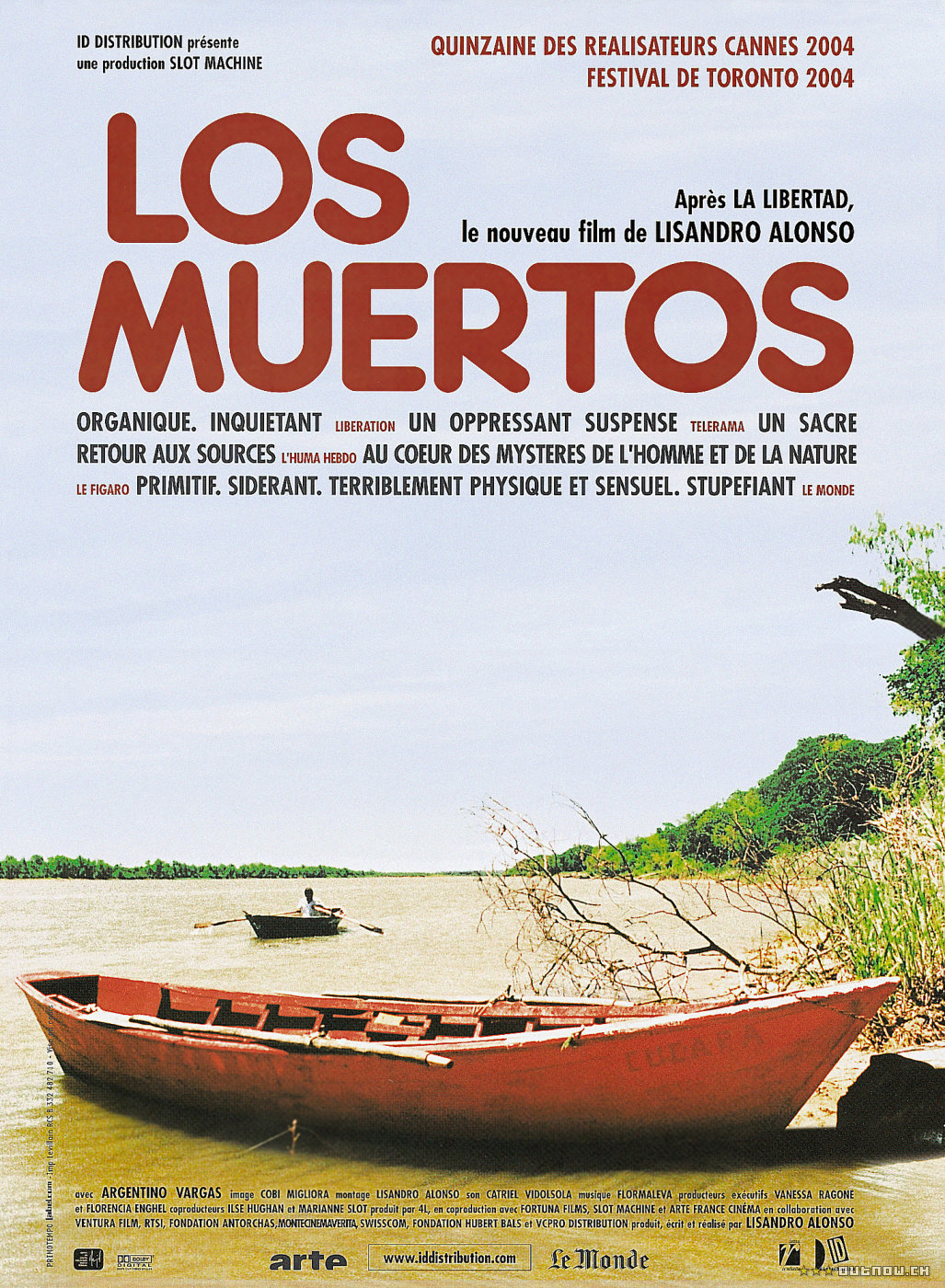
 Alonso shot Los Muertos three years after La Libertad. He wanted to make the film because in some ways he felt that La Libertad had happened by sheer luck. He wanted to prove to himself that he could make a second feature; but, this time around, he definitely wanted a producer. Los Muertos was shot in four weeks at a budget of $29,000 with the same crew from La Libertad. He shot the first scene as a one-off reel to secure financing to complete the film (that scene was later edited down but the original is offered as an extra on the DVD). It took nearly nine months before they could finally begin shooting in Corrientes. In Alonso's mind, Los Muertos was a commercial film. Thus, he has been disappointed that—as wonderful as it is that audiences want to see his films—it's not so wonderful that no one wants to buy and distribute them.
 Los Muertos won several awards on the festival circuit, including the FIPRESCI prize at the 2004 Viennale ("for its hypnotic fascination with the real"). In 2004, it likewise won the Critics Award at the Lima Latin American Film Festival. The following year it won an Independent Camera award at Karlovy Vary and a Special Jury Prize at Yerevan.
For Alonso, the opening sequence is about dreaming, nightmares and memory and—as James Quandt states it—"employs the tropes of revelation and occlusion in classic horror-film fashion." At that time, Alonso admits he was under the influence of Gaspar Noé's rape scene in Irreversible (2002). That scene made Alonso want to kill the rapist; a reaction he was not comfortable with. His impulse to kill expressed itself in Los Muertos. The opening sequence also conjured the title for the film, which replaced the film's original title Sangre.
Alonso asserts the film's protagonist Argentino Vargas is a wonderful man and the father of 24 children. "He is a good father to all of them." Alonso discovered Vargas through his usual manner of scouting for locations for his next film even before he'd written any form of script. He traveled around with a sleeping bag and tent, visiting locations, meeting locals. When he met Vargas and sensed he could be the actor in his film, he asked if he could hang around and camp out for a couple of days. Vargas wanted to know what for? Alonso answered he didn't know but that he liked the place. Vargas gave him permission and Alonso stayed there. They talked from time to time and got to know each other a little better. When he decided to return to Buenos Aires, he mentioned to Vargas that maybe he would return with a camera crew to make a movie; but, he didn't dwell on it much because he doesn't like to talk about these things with someone like Vargas who has no TV and lives in a poor house made of mud. His children drink water from the river. Vargas has never had the opportunity to understand the power of the cinematic image. Yet, unmediated experience is what draws Alonso to such people. It makes it easy for him in a way and is more interesting. When he returned with his camera crew, he told Vargas simply to not look into the camera and to just do what he always does, to be normal.
 When his son turned 18, Vargas gave him a gun. His son killed a man from Bolivia with the gun and was imprisoned in the selfsame jail Alonso filmed in Los Muertos. Vargas's son likewise appeared in the movie in the scene where Vargas arrives at the rancho of Maria and he and Maria's brother talk about fishing. The man who played Maria's brother was Vargas's son. Alonso appreciates working with "these people" who he describes as uneducated people that often don't know how to talk to themselves and understand their own experiences. They represent a sharp contrast to educated people in Buenos Aires who have increased options. When asked whether "these people" were happier than others and smiled more, Alonso responded that they could smile all they want but it would do little to reverse their lack of opportunity. It's not a question of a romantic notion of primitive mystique, as if they have access to some direct source of happiness. They lead difficult lives and—even if they are aware of how impoverished their lives are—there's little they can do to change it. That's why they keep to themselves and have little interest in traveling elsewhere. They defend themselves and the little they have. Because they are uneducated, wherever they go they are taken advantage of and exploited. Vargas has 24 children, with not even one aspirin to his name, so how could they be fantasized as "happy" people? Notwithstanding, whatever they have, they will offer to you because—despite their situation—they are wonderful human beings. Perhaps what audiences find mesmerizing about Alonso's characters is precisely their lack of self-consciousness? Even though they are allegedly "acting" for Alonso's camera, there is more authenticity and less encumberment by what Robert Beavers recently termed the "shadow of performance."
Asked if the woman who played the prostitute was a real prostitute, Alonso responded affirmatively. That seemed to agitate his audience a bit. That brusque sex scene, Quandt writes, "reminds one that Los Muertos appeared not long after Carlos Reygadas's Japón (2002), another Latin American movie in which a grizzled, existentially unmoored man travels into backcountry in search of decease. But the explicit sex of Japón, like the long takes of elemental landscape that film also shares with Los Muertos, strains for the transformative, even the transcendental, while Alonso aims for the opposite."
The killing of the goat is a visceral shock of recognition. What was important for Alonso to reveal—and thereby remember—was Vargas's skill with a machete, and the gutting of the goat proved it. Even after 25 years in prison, he could wield his blade masterfully. But there is something to be said about the fact that—after 25 years—Vargas has retained skills and remained very much the man he used to be. Returning to his home village further reveals that nothing has changed in his absence. As hungry as he and his brothers were before he was imprisoned, his grandchildren are still hungry and abandoned. These Argentines—unlike those in the cities—are uneducated and have little chance, little choice, and turn to alcohol, which makes it easy to use a knife. Quandt had mentioned in passing that Vargas murdered his brothers because they were starving. When I queried him on this, Alonso said that he came up with that answer because so many journalists were asking him about Vargas's motivations; but, he doesn't necessarily know why Vargas killed his brothers.
The goat, Alonso admitted, was bought and brought on location for that scene. Within the narrative, Vargas in essence "stole" the goat, though it could be argued that—since no one seemed to want it and it was wandering alone on the riverside—that it was a gift to him. What interested Alonso was how Vargas slaughtered the goat: that he leaned it over the edge of the boat to cut its throat so it would bleed into the boat. Alonso asked Vargas why he did that? If I am stealing a goat, Vargas said, I wouldn't want to leave blood on the ground because someone would suspect foul play. By spilling the blood in the boat, he covered his tracks and could clean up afterwards. This is a great example of the authenticity—and, to a certain extent, the particular self-consciousness—of Vargas's "acting"; a self-consciousness that insists upon authenticity. The scene was not in the original script. Again, the point was to demonstrate that he was still skillful with a knife, as well as handling a boat; that he retained a certain indigenous knowledge, one might even say a practical wisdom.
 Which made me recall something James Hillman wrote in The Soul's Code (1996:206): "Wisdom in Greek was sophia, as in our word 'philosophy,' love of wisdom. Sophia had a most practical meaning, referring originally to the crafts of handling things, especially to the helmsman who steers the boat. The wise one steers well; the wisdom of the helmsman shows in the art of making minor adjustments in accord with accidents of water, wind and weight. The daimon teaches this wisdom by constant appraisals of events that seems not to fit in. Sometimes this attention to the singular event is called by philosophers 'saving the phenomenon' from the metaphysical trajectories of theories." (Emphasis added.) For me, Hillman's statement applies to Alonso's cinema: his attention to singular events saves phenomenon from too much theory.
When asked about what happened to Vargas's daughter, the mother of the children at film's end, Alonso admitted he didn't know. He felt that Vargas returned to his home village only as an excuse to see the place again. Clearly, his daughter is gone but it's unsure for how long. It's not clear if she has fled from his arrival or abandoned her children. If they are abandoned, then it suggests that little has changed since his own abandonment as a child. Even though Vargas may have come to some kind of understanding within himself after his 25 years imprisonment, the possibility is that nothing has changed and may have even become worse. It's possible that life is no different for people in jail than for those outside of it. "I'm interested in the world of prisoners," Alonso has stated. When he was filming in the actual jail, which housed rapists and murderers, he asked them what the difference was between being in jail and outside. Some of them said that the only difference was that outside they could drink whatever they wanted to drink.
The characterization of Vargas as a serial killer to rationalize the film's abiding menace was a notion Quintin and Kent Jones initiated, and which has been explored by such writers as James Quandt; but, Alonso states adamantly this was never on his mind and that—as Quandt reports—"any violence portended in his ellipses is imagined, merely a sign … of Vargas's primitive existence." Quandt detects "an undercurrent of imminent violence" when Vargas sucks on a honeycomb and that, as "an obvious counterpart to the armadillo kill in La Libertad, the slaying and evisceration of the goat, the fierce shove and suck of its organs as Vargas rips them out and mops the gaping cavity, seem less like Misael's natural act of sustenance than an expression of bloodlust." At Parallax View, Jay Kuehner notes that these "small rituals of violence and survival" have now become signatures of Alonso's oeuvre.
 As for the film's cryptic ending and why Alonso chose to end the film where he did, Alonso said he always knew the film was going to end that way. He didn't shoot any further footage within the tent that was later taken out in editing. He took a long take of the toy in the dirt with the freckled shadows and held onto his intuition during the editing to create "this strange moment about living reality like normal movement." Alonso has often explained: "If you shoot a glass of water for two seconds, it's just a glass of water. But if you shoot it for a minute and a half, you—as an audience—start to think many things and it's no longer just a glass of water." Alonso extends what critics argue should be short films into long features precisely to explore this aesthetic. For Jay Kuehner at Parallax View the scene lasted just long enough for "the devastation of a life misspent" to sink in.
Cross-published on Twitch.
 "Film must provide audiences the opportunity to discover questions."—Lisandro Alonso.
La Libertad (Freedom, 2001) screened in the Un Certain Regard section at the 2001 Cannes Film Festival, and scored nominations and wins on the film festival circuit, including the FIPRESCI prize. The son of a cattle rancher and disinclined to carry on with the family business, Alonso was a 25-year-old recent graduate of the Universidad del Cine in Buenos Aires when he made La Libertad; "outside of Buenos Aires but within Argentina." Alonso met the film's protagonist Misael Saavedra on his father's ranch. Misael, logger by trade, epitomized non-urban youth for Alonso; his reaction to the then-popular trend in Argentine cinema to revel in urban narratives. Perhaps it was Alonso's rural background that granted him familiarity with Misael's incommunication?
 Alonso spent eight months in the Argentine Pampas with Misael. It was a difficult cohabitation because they had little in common to talk about; but, slowly, they developed a trust. Once he gained Misael's trust, Alonso proposed making the film. Fueled by his anger that his film proposals were not being considered by the Universidad del Cine in Buenos Aires, Alonso took on La Libertad independently. The shoot consisted of 10 days with a 12-person crew. The film remained "in the box" for eight months because neither friends nor family liked it. He was frustrated. But then—unexpectedly—La Libertad became a festival darling.
Alonso's method of filming consists of long takes (usually four minutes) which he restructures in the editing room, making minor manipulations to create—as he puts it—"strange expressions of natural everyday things." The result is—as the Harvard Film Archive program capsule describes—"a poetic meditation on labor and landscape."
James Quandt observed in his insightful essay "Ride Lonesome": "So matter-of-fact and uninflected is the film's recording of Misael's daily routines (faithfully re-created from weeks of Alonso's close observation of the man's actual life and edited so that several sequences seem to adhere as real-time) that La Libertad has been hailed as the apotheosis of Bazinian realism."
Quandt further tracked that at Cannes "the film elicited inevitable claims that the boundary between fiction and documentary had been blurred, collapsed, or straddled." Alonso, however, argues that La Libertad is not a documentary, though he grants audiences the sovereignty to think however they want about the film. He stresses his concern is more with the point of view of the audience than his own.
 The issue of labor chafes against the film's title. "La Libertad subtly questions the 'freedom' and identity alternately gained and lost by the daily burden of hard labor," the Harvard program capsule concludes. At Slant, Ed Gonzalez notes that "the film's long takes and the cyclical, labored nature of the man's daily grind force the spectator to question the nature of freedom." At Parallax View, Jay Kuehner comments: "Clearly, here was a director who had denuded his cinema down to its sheerest essentials, and what remained was a nominally minimal but ultimately voluptuous portrait of a beautifully forlorn landscape inhabited rather efficiently by a man and his work. Nature, and civilization. The banal, and the mythic. The story was not new—who hasn't worked an arduous day's labor at some time? But the grammar with which it was told was. Radically so." At Elusive Lucidity, Zach Campbell wonders whether the title is ironic: "Is the protagonist, Misael, free in the nature of his labor and solitude, or is he burdened by its necessity?" "The irony," Robert Koehler concludes at Film Journey, "is that there's nothing absolutely Argentine about La libertad. Its freedom is a freedom from nationality, time-space, narrative laws, camera laws and the expectations that audiences instinctively impose on themselves. But pay attention to the actual translation of the Spanish title: 'Liberty'—a harder, more profound word than 'freedom,' a word pointing to a greater leap, a commitment to an ideal, an identifier for an equation that even describes its opposition—oppression. Liberty is harder-won. Liberty is that thing that the films that really matter aspire to. This one just has the balls to take it as its own name."
In the film's final "quietly confrontational" sequence, Misael munches on roasted armadillo and then stares directly at the audience "as if"—Ed Gonzalez suggests at Slant—"daring us to question or challenge the integrity of his way of life", or what Sean Axmaker describes as "the integrity of the quotidian." "As if" becomes a convenient way to extrapolate Alonso's otherwise notoriously withheld motivations. Alonso admits that by encouraging Misael to look directly into the camera, he deconstructed documentary expectations and created a direct relationship with the audience. Alonso simply told Misael to "act" as if were looking at someone who was eating across a table from him.
The film's original ending had Misael laughing outloud while looking into the camera—achieved by Alonso unexpectedly dropping his pants; but—persuaded by the Cannes Festival to (as Quandt puts it) "remove this Brechtian breach"—Alonso settled for the somber, more atmospheric ending.
 Many critics of the film have suggested it would have sufficed better as a short; but, aware that no one recovers costs on a short film, Alonso chose to make a feature in hopes he might recover some of his family's investment. His father was the film's producer.
When La Libertad premiered at Cannes, one of the critics from Cahiers du Cinema complained that Alonso treated his non-actor Misael like he was a monkey. "I'm sorry to tell you, but he's wrong about how I direct my actors," Alonso asserted defensively. "I'm not trying to make any money from the films. I'm not trying to use them." He knows he's working with non-actors and has to develop specific approaches with them. He can't ask them to behave like professional actors. Nonetheless the question of Alonso's artistic sincerity clouded the film's Cannes reception. As Jay Kuehner summarized at Parallax View: "The question persisted whether Alonso's film was, to reduce the argument, an act of abstract humanism. Was it possible that esteemed auteurs held a kind of deep faith in their wounded protagonists yet had little regard in reality for their more immediate brethren?"
Cross-published on Twitch.
 I was so impressed with Lisandro Alonso’s Liverpool when it screened at the 2008 Toronto International Film Festival that—not only did I write it up right away for Twitch and The Evening Class—but I actively pursued and scored an interview. Since writing up Liverpool nearly a year ago, I’ve read commentary here and there that has deepened my appreciation of the film. Most noteworthy is James Quandt’s ArtForum essay “Ride Lonesome” (available at Highbeam Research Library). “Ride Lonesome” is an especially impressive piece of criticism, tackling all of Alonso’s films, while specifically noting: “Liverpool seems designed for auteurial legibility.” Praising Alonso’s “dilatory style”, Quandt adds that Liverpool “keeps to [Alonso’s] antidramatic ways, attenuating narrative through empty time and withheld information.” Of related interest: Violeta Kovacsics and Adam Nayman’s interview for Cinema Scope; Darren Hughes interview for Senses of Cinema; and R. Emmett Sweeney’s interview for The Rumpus.
 San Franciscan audiences will have a chance to experience the film themselves when Yerba Buena Center for the Arts mounts Liverpool’s Bay Area premiere on September 17, 19 and 20, 2009 as part of the film’s U.S. tour, organized by Adam Sekular of Seattle’s Northwest Film Forum who are likewise hosting “At The Edge Of The World: The Cinema of Lisandro Alonso” come November 11–19, 2009. Further, Alonso’s short film S/T will be featured in the fourth Wavelengths program for this year’s Toronto International. As Andréa Picard has written in her program notes: “Setting up an intense reciprocal gaze, Lisandro Alonso—whose work consistently explores the personal quests of men navigating natural settings—creates a face-to-face encounter with the wild in the beguiling and enigmatic S/T, a moment observed in a seemingly floating abyss.” This conversation is not for the spoiler-wary.
* * *
 Michael Guillén: I loved your movie!
Lisandro Alonso: Thank you very much.
Guillén: And—I’ll be honest—I was drawn to Liverpool by way of Kent Jones’ Film Comment essay, wherein he waxed eloquent appreciating your aesthetic. He wrote: “Alonso is a fascinating figure who probably thinks more about form than any other narrative filmmaker his age. His attempts at overall unity are impressive if not fearsome, even when he miscalculates. At his finest, Alonso settles on journeys that accumulate observation (of landscapes and ways of life) that expand along the way into collectively internalized visions of existence and their horizon lines.” Do you think it’s true you think more about form than any other narrative filmmaker your age?
Alonso: What can I say? I don’t know. Maybe. There are a lot of filmmakers who are better at form than I am.
Guillén: Let’s back up a bit. How did you come to filmmaking?
Alonso: I studied in the Film Institute for three years but, before that, my favorite movie was Dirty Harry. [Chuckles.] After I studied a little bit, I discovered older filmmakers. I understood that, maybe, if I was lucky, I could make a film and express myself to other people through the film.
 Guillén: Well, you’ve certainly caught critical attention. One of the critiques I’ve read most consistently is that your films achieve the non-dramatic by frustrating narrative expectation. For me, your films seem created by accretion, by the accumulation of many observed moments, that link together into a semblance of narrative.
Alonso: I think I understand what you’re trying to say. My films aren’t narratives. I observe people, different moments, and I put them all together in the film. The audience has to imagine or create something sitting in the chair.
Guillén: You give your audiences plenty of space to make associations. Spatiality, in fact, is a major aesthetic of your work. You use a lot of different kinds of space—not only inscapes, but landscapes—and specific locations like the lumber mill in southern Argentina’s Tierra del Fuego, that create multiple environments, different spatial scenarios, for your characters to journey through or temporarily repose. And they always seem to be longing in their movement, or longing to be moving, and that longing is often registered as their looking within themselves as they journey, or looking out at the landscape they’re journeying through: overwhelming snow-capped mountains and bright indifferent skies. I especially noticed your aesthetic of spatiality when you placed Farrel (Juan Fernandez) in the restaurant at a table next to an autumnal mural of a white birch grove. Inside and outdoors, domestic and wild spaces, the autumn and winter seasons, were intriguingly counterpointed.
 Alonso: I agree with what you say. I don’t know why, but using many spaces is interesting. I can’t explain why it seems interesting for me. I feel it and then I film it; but, I can’t tell you why. Maybe it’s intuition, probably. I didn’t think much about what I should be shooting or not, I just knew I wanted to shoot the film in nature. I really wanted to shoot a movie in the snow and on the cargo ship; but, whatever connection those two spaces have is just a coincidence.
Guillén: But surely you intend the contrast to be visceral? I mean, you feel the confined quarters of the ship cabin empty out into the relief of these immense landscapes. You feel it by way of contrast. In fact, one might say your earlier films looked out towards nature more while Liverpool explores confined domestic spaces: the ship cabin, Farrel’s mother’s home, the restaurant.
Alonso: For me it’s new to film in interiors. As you say, my previous films have a lot of nature, a lot of trees and land; but—during the process of making films—I discovered I wanted to film in interiors to see what would happen.
Guillén: Are you pleased with the result? Have you enjoyed yourself?
 Alonso: Yeah! I like it. Making a film in nature is easier for me. If I shoot something in a realistic way in nature, then with sound and editing I can make it not as realistic. For example, if I film this phone for two seconds, it’s just a phone; but, if I film it for a minute and a half, it’s more than a phone. Of course, it’s still a phone; but, the audience is thinking, “Why is this a minute-and-a-half phone?” I don’t know if I’m saying this right.
Guillén: I get it. It’s like Hitchcock with his glass of milk that the audience knows has a drop of poison in it. But where I felt it in your movie was the scene where Farrel is passed out drunk on a bottle of Stolishnaya and wakes up near the empty bottle stuck in the snow. That empty bottle is fraught with implications. It’s also just beautiful somehow and I don’t know why.
Alonso: Has that ever happened to you?
Guillén: Passing out drunk? Of course! [Laughs.]
Alonso: Ah! That’s why you like that scene and think it’s beautiful.
Guillén: Well, if you’re talking about images I relate to, there’s another in Liverpool that comes more to mind. My father abandoned me when I was two years old. I never knew him really; but, one of my few memories of him is when he came to visit when I was about four years old. We spent time together on the front porch of my grandparent’s home—no longer, in fact, than Farrel spent with Analía (Giselle Irrazabal), maybe 20 minutes max—but it was such an intense memory because he had come out of nowhere, unexpected, having won a lot of money gambling in Nevada. My dad was a gambler and a drinker and he had come “home” drunk to boast his spoils. He said, “Hijo, hold out your hands.” And so I did, cupping both small hands. He filled them overbrimming with shiny new pennies. To this day, whenever I see a penny on the street, I pick it up, thank Mystery, and remember my Father. When Farrel gave Analía the keychain—seemingly the only way he could express any kinship, any affection, any legacy—it moved me to the marrow.
Alonso: That’s a wonderful story.
 Guillén: With regard to that scene where the gift is exchanged, I have a question: why did she put it in her pocket to hide it from her grandmother?
Alonso: Maybe she just forgot about it? I don’t know. I wish I knew. She’s a little bit retarded and maybe—even though she has the keychain—she isn’t really aware of it? But I know what you’re saying, that little things like pennies or keychains can become meaningful treasures. Maybe. I’m not sure about that. It’s open. I’m asking. Maybe she’s just trying to understand it? What it is? Maybe she’s asking, “Why does it have ‘Liverpool’ on it? What does that word mean in this situation? It’s red. It’s a city. It’s a port. It’s a gift from my father. Is he my father? Who is he? What is this? I don’t know. It’s very cold out here. I’m going to go inside.”
Guillén: In other words, you prefer to keep these moments open-ended?
Alonso: Yes, for me. People think when you are a director that you know everything. I don’t. What I’m trying to say is that I prefer many questions to answers. I don’t have any answers.
Guillén: Since you admit you provide no answers to the questions Liverpool raises, and perhaps because its narrative doesn’t reach resolution, the film captures an emotional authenticity.
Alonso: What do you mean by “narrative”? How I’m telling the story?
Guillén: Usually when I refer to a narrative film, I think of a story that has a beginning, a middle and an end, like an O’Henry short story. A dramatic conflict that resolves itself. But filmmakers are free to tackle new kinds of narratives by subverting linearity, thwarting resolution, and telling the story in unexpected ways.
 Alonso: But I tell a story. I think I tell a very sad story about this sailor who’s a father, and this girl who’s his daughter. I didn’t tell the story in a commonplace way, but I think there’s a story there. [I start to protest.] I know what you’re going to say. If you say to me, it’s narrative in terms of making people go into the cinema, that’s another question.
Guillén: A popular narrative; popular probably because it’s accessible.
Alonso: In the beginning, you cry a little bit. Now you laugh a little bit. Now the music swells. No, that’s not my show.
Guillén: So when you’re filming….
Alonso: I don’t know what’s happening.
Guillén: You don’t know what’s happening? [Chuckles.] You just see things you want to shoot and aim your camera?
Alonso: I talk with the people. I talk with the crew. I talk with the actors. I tell them, “We want to shoot this”—I don’t write much; 15 pages is enough for me—but I tell them, “This is what I’ve written.” They say, “What is it? It’s bullshit.” I say, “Maybe it’s a little bit bullshit but, okay, do it.” And we do it like that.
Guillén: But there are images that are so strong in the movie that it’s hard for me to accept they’re accidental or made up on the spot. Maybe it’s just me? Maybe I’m reading too much into your films?
Alonso: No, no, no. For me, too, the images are strong.
Guillén: For example, I loved the image of the Jesus on the back of the door.
Alonso: I added that because the art director was sleeping off an all-nighter at the bar. [Laughs.]
 Guillén: And I love when Farrel is sitting at the battered red table against the green wall. The table’s length, the line it creates through the frame, abstracts the composition. There are many lines and angles in your compositions. Surely, you set up these compositions?
Alonso: I give that a little bit of thought, yes. [Grins.] I like to shoot night imagery and I have to look through the camera and make sure it’s in focus.
Guillén: And what I’m especially happy about is that you keep your camera still so your compositions can be appreciated. Your camera stays put and watches intensely. Your camera is composed as it’s composing. As in that final scene when Farrel is walking off towards the woods. The duration of that scene plunges the audience into a quizzical contemplation.
Alonso: Where do you think he’s going in that scene? Do you think he’s going back to the ship?
 Guillén: Yeah. He knew he had to be back by a certain time and had to start making his way there.
Alonso: Walking?
Guillén: He’ll find a way back. He’ll flag down a logging truck and hitch a ride or something.
Alonso: You’re positive? I’m more negative.
Guillén: You don’t think he’ll make it back to the ship?
Alonso: You know why I think that? There’s a little detail that I couldn’t get quite right when I filmed it. When Analía asks her father for money, I noticed—and not everybody noticed—that Farrel takes a moment, looks into his wallet and then hands over all the money in the wallet. Without money, he won’t be able to buy passage. I filmed that scene badly. If I had filmed it better, everyone would have known he wasn’t going to be able to make it back to the ship on time.
For me, he went back home to see his mother and she was already senile so now—having done all he could do—he could rest his mind and drink without conscience, drink better. Also his daughter didn’t recognize him so—after giving her all his money—he feels free. Until he returns to the ship. Maybe I’m just talking about me in 40 years? But I see him at a point where he can leave family behind and just go. He can go with the memory of having done something good. He thinks: “Now I can walk through the snow until something happens.”
Guillén: As someone who has travelled a lot, perhaps I am more hopeful about his returning to the ship because I’ve been in situations where I’ve been stranded with only a dollar in my pocket for days. I’ve learned from experience that if you really want to get from here to there, you can.
 Liverpool is a movie longing to move. First, Farrel petitions for shore leave so he can get his land legs back, and then—once he’s been traveling around on the land for a while—he wants to return to sea, or—as you’re insinuating—wherever he ends up wanting to be. There’s a restlessness that impels the film forward. It reminded me of Joni Mitchell’s lyric, “You want to keep moving and you want to stay still; but, lost in the moment some longing gets filled.”
 This kind of links back to what I was saying before. He’s a character who gauges his own movement by what he sees around him. He has to see the land. He has to see his mother. He has to see his daughter. And one of my favorite scenes was when he woke up hungover and was trying to see.
Alonso: [Laughs.] He sleeps everywhere.
Guillén: He slept outside and nearly froze to death! One curious omission in all of this is his mother Trujillo (Nieves Cabrera).
Alonso: What about her?
Guillén: That’s what I was going to ask: what about her?
Alonso: I don’t know. [Laughs.]
Guillén: Okay, I get my questions are annoying, but these are the kinds of things I wonder about watching a film.
Alonso: The only thing I can say is that when I “discovered” this grandmother, I asked her, “Nieves, can you act? Do you know that we are trying to make a movie? And that we want you to be in the movie? We’re going to pay this amount of money; do you want to be in the movie?” Then I asked her kids, “Does your mother want to be in this movie?” “Yes,” they said, “She wants to be in the movie.” I asked, “Can she work?” “Yeah,” they said, “she can work.” So I went to her and I said, “Ola, quieres caminar? [Are you ready to go?]” and she said no.
After about a month, I returned to the location, which was now covered in snow. When some of the people from the crew saw Nieves, they couldn’t believe their eyes and they thought bad of me because I wanted her to walk in the snow. Everyone on the crew was looking at me like, “You motherfucker, what are you doing?” I was so nervous, I started to laugh, and then I jumped out the window into the snow. I didn’t return for about two hours.
 Nieves was lying in her bed for two days. It’s funny but it’s not funny. She’d eat and go to the bathroom whenever she wanted. I would say, “Now we are shooting” and she would go, “What?” I realized you can’t do this with a professional actor because this little retarded girl and this old woman make an effect, but the fact that they’re real people and not actors has an affect on the crew also. When Farrel asks his mother, “Do you know who I am?”, the truth is Nieves didn’t really know anything about what we were doing there and so she reacted to Farrel’s questions quite naturally. What I’m trying is to say that—whatever the old woman was feeling—the whole crew was feeling, behind the camera as well.
Guillén: So you’re catching a real moment and placing it in your story?
Alonso: That scene was totally for real. I’m not the guy with a professional actor. It was the same with the girl Analía. She made the crew nervous when we were shooting but how else could I capture that? I can’t do it with a professional actor.
Guillén: Several directors whose work I favor refuse to work with professional actors for fear of losing a strived-for authenticity.
Alonso: When I was young, I took some acting lessons. But on the day I had to recite something, I was totally drunk. I decided that would be my last lesson and that—if I wanted to be drunk—I didn’t need to be in acting class; I needed a bar. What I’m trying to say is that I really respect actors; but, I don’t want an actor coming up to me and whispering, “Lisandro, what do you think of my performance? What’s my motivation?” I don’t care for that.
Guillén: Is your filmmaking an attempt to make the image complete in and of itself?
Alonso: There’s no Shakespeare in my movies. I just work from scene to scene, smoke cigarettes, say this, say that.
Guillén: Let me ask you this then: before you make your movie, I understand you explore where you think you might want to film, and then you just hang out there for a while? You watch and listen to the people who live there and you decide once and for all if that’s where you want to make your movie. In this case, you noticed the old grandmother and you noticed the mentally challenged girl and you decided you wanted to put them in your movie because they would have—as you’ve indicated—a particular effect. Despite all your efforts to make the filmmaking as naturalistic as possible, does the making of the movie influence the place and the people? Do they change because you have arrived with a camera to film them? Have they even seen the finished film?
Alonso: No, not this film. My other films, yes. I made a film called Fantasma, which is about the lead actor in Los Muertos going back to Buenos Aires to see the release of his own film. For me Fantasma is very special. But to answer your question, no, I don’t think the making of the movie influences the place or the people. We create an environment of happy moments between the people who live there and the people who have come to film them. We dance together. We eat. We drink. We enjoy the day together and that’s all I want to do.
Guillén: You’re reminding me of Carlos Reygadas and his film Japón where he cast an old woman named Magdalena Flores, for much the same reasons you cast Nieves Cabrera in Liverpool. Magdalena was perfectly wonderful in Japón. No professional actor could have delivered her performance. And then—because Reygadas enjoyed meeting her and working with her so much—he used her in his next movie, much to his regret. He told me that it was one of the biggest errors in casting he ever made when he sought to use her twice because—when she made her appearance in the second movie—everybody knew her, everyone had an association of her with the previous film. Reygadas didn’t realize that was going to happen, but it happened and it impacted the authenticity of her scene. Did you have any problems like that when you were reusing the actor in Fantasma?
Alonso: No, I don’t think so. Actually, I’m not working with some of the first actors in my films and am trying to discover some new people; but, I enjoy working again with people that I know.
Guillén: How did you find Juan Fernandez?
Alonso: I was looking for the location and he was working as a caterpillar operator removing snow off rooftops. I saw him and waved to him and he ran away.
Guillén: I would run away too. “Oh no! It’s Lisandro Alonso!!”
 Alonso: [Laughs.] But the good thing is that nobody knows me. So I would keep saying hello and he would keep looking at me like, “I don’t want anything to do with you people.” But after three or four hours of speaking with some of his co-workers, taking photos of the interiors, he finally was fucking freezing outside and came in to the restaurant. I asked him who he was and if I could take his picture? He finally said okay. After two or three coffees more, he had to go. The next day I called him and asked him if he would like to be in my movie? He said, “Okay, but I will have to ask permission from my family.”
Guillén: I hope this is not a stupid question or a disrespectful question, but are these people you meet in these remote locations even aware of movies?
Alonso: No. Absolutely not. Juan Fernandez, maybe.
Guillén: Because he was a natural, as they say and the camera loved him. He has a beautiful face and a noble nose. So what was it that you saw in him that you felt made him eligible to be the lead actor in your next movie?
Alonso: I don’t know. But once he agreed to be in the film, I told him he couldn’t back out or ask for more money or run away. He promised he wouldn’t. I told him he could drink whatever he wanted to drink but he had to wake up in the morning and come to work. He said, “Okay, I will do it.”
Guillén: That’s reminding me of a Malaysian filmmaker Deepak Kumaran Menon who brought his film The Gravel Road to the San Francisco International. Early in the film he had a little boy cast as a member of the family and I seemed to be the only one who noticed that halfway through the film the little boy disappeared without explanation and never showed up again, so I asked him during the Q&A what had happened to the boy. “I was hoping nobody would ask me that,” he answered. [Laughter.] Apparently, the boy decided he simply didn’t want to be in the movie anymore and the filmmaker didn’t have the means to reshoot his scenes. So it’s interesting how you lay down the law with your non-actors.
Alonso: From the moment we begin shooting the film, I know the people who I met from a month previously. I know all of them who live there and I know I can trust them.
Guillén: Do you know Pedro Costa?
Alonso: Yes.
Guillén: I’ve been much impressed with how he lives with the people he films in an effort to more accurately capture their situations, so much so that at this point he allows them to provide input into how the film shapes itself.
Alonso: He’s a good fellow, Pedro. I do understand why he changed his way of filmmaking and why he scaled down from 35mm to video. I understand why he wanted to film on his own and not with a crew of 100 people.
Guillén: Costa told me—and I was wondering if your experience is at all comparable—that he switched from the large moviemaking equipment and extensive crews to smaller cameras that he could handle himself or with one or two other people because coming into these people’s lives with all that equipment and commotion was, in essence, a death eye that killed what he was trying to record.
Alonso: I can understand that. Maybe he can’t raise the money to afford 35mm filmmaking so he has to change in order to survive as a filmmaker? I appreciate that. Maybe I’m wrong and I’m just a stupid kid, but my understanding is that for the movies he wanted to make, he couldn’t get the money so he had to use different equipment and shoot in a different way. I might be wrong but I think one of the main reasons he changed his style was because he couldn’t get the funding.
Guillén: He’s admitted to me that funding is an uphill battle. As for yourself within Argentina, as one of the key players in the so-called New Argentine Movement, do you consider yourself that way?
Alonso: The New Argentine Movement? I don’t know. New blood? Ten years ago there was new blood making films but now they’ve become old blood trying to make new films while new people keep making old films. What I do trust about this New Argentine Wave, or whatever you want to call it, is that they were basically people shooting on the weekends, sharing sandwiches, nobody was paid, and they were all just trying to make honest films. Nowadays, that spirit has disappeared because they now have families and production companies, they go to film festivals, they’ve met Viggo Mortensen…. [Laughs.]
Guillén: To wrap up, I simply want to say that I thoroughly enjoy the films you are making. I’ve come somewhat late to your work and am now looking forward to going back and appreciating your first three films, which people have been recommending to me for ages. I wish you the best of luck in the future in what you want to do and thank you so much for taking the time to talk with me today.
Alonso: Thank you for your time, man.
Cross-published on Twitch.
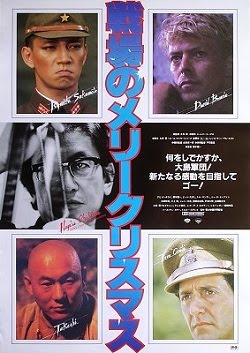 Situated midway through VIZ Cinema's ongoing series "Winding Road to Peace"—their commemoration of the 65th anniversary of the Hiroshima and Nagasaki bombings in WWII as chronicled through the Japanese American experience of the war—comes a film made late in Nagisa Oshima's career: Merry Christmas, Mr. Lawrence (Senjo no meri Kurisumasu, 1983). As synopsized by VIZ: "In this captivating, exhilaratingly skewed World War II drama from Nagisa Oshima, David Bowie regally embodies the character Celliers, a high-ranking British officer interned by the Japanese as a POW. Music star Ryuichi Sakamoto (who also composed this film's hypnotic score) plays the camp commander, who becomes obsessed with the mysterious blond major, while Tom Conti is British lieutenant colonel Mr. Lawrence, who tries to bridge the emotional and language divides between his captors and fellow prisoners. Also featuring actor-director Takeshi Kitano in his first dramatic role, Merry Christmas Mr. Lawrence is a multilayered, brutal, at times erotic tale of culture clash that was one of Oshima's greatest successes."
 I missed Merry Christmas, Mr. Lawrence when it screened as part of the PFA "In the Realm of Oshima" retrospective that ran May-July, 2009 so I welcome the opportunity VIZ Cinema provides in programming a 35mm screening of Oshima's film. As Jason Sanders synopsized in his program notes for PFA: "After retreating from cinema during the 1970s (when he fashioned a new career as a talk-show host), Oshima returned in 1983 in typically idiosyncratic fashion, with an international coproduction starring David Bowie and Ryuichi Sakamoto of the Yellow Magic Orchestra, both plopped into a Jean Genet–like narrative of male lust and punishment in a World War II Japanese POW camp. Commander Yonai (Sakamoto) runs his camp with well-heeled precision, keeping his hands soft by letting the brutish Hara (Takeshi Kitano, in his film debut) knock everyone into shape. The arrival of the regal Celliers (Bowie), whose blond locks and chiseled cheekbones shine even when he's in chains, gives Yonai a simmering new challenge, not only to his rule but to his sense of superiority, his national pride, and possibly something more. 'A thinking man's Bridge on the River Kwai' (Cinematheque Ontario), this erotic tropical opera finds Oshima mellowed, but still questioning nationalism and contemplating the subversive power of sexuality." "Twitic" Brian Darr notes that Merry Christmas, Mr. Lawrence "merges Oshima's longstanding pop and intellectual impulses so that they feel (almost) harmonious."
 Michael Guillén: I'm wondering if you would be willing to address Oshima's usage of homoerotics in such films as Merry Christmas, Mr. Lawrence and Gohatto?
 I asked him about his open treatment of homosexuality one night during one of our long discussions about art and cinema. At the time we both deified Theo Angelopoulos. Now when I look back on it, it's ironic because Oshima was holding up Angelopoulos as a god; but—when I look at Angelopoulos' work—I start to imagine that he probably took some things from Oshima? Of course, Angelopoulos denies any formative influences—he didn't take anything from Jancsó; he didn't take anything from Mizoguchi—and I'm not too sure he took anything from Oshima; but, boy, when you look at some of the early Oshimas and how he treats choral structuring, using groups of people as friezes (like in Night and Fog in Japan), it really does feel like Days of 36 and some of the Angelopoulos films. Anyway, I did ask Oshima about this motif of homosexuality because then—when he was at Harborfront—Merry Christmas, Mr. Lawrence was still relatively new. He hadn't made Gohatto yet—that was still a long way off—and all he said was, "It's very interesting, isn't it?" Then he passed on to some other topic.
 Quandt: No, absolutely not. He just had this bewitching laugh. Then when he went to make Gohatto, again I thought it intriguing—aware that this might be his last project because of his debilitating stroke—that this is the story he chose. How do you explain that? He's been married for decades and has many children. I'm not saying there was anything there in his personal life; but, it fits with his fascination with all kinds of minorities, all kinds of rebellions, all kinds of refusals of the Japanese way. As much as it can be pointed out that the bishōnen, this figure of the beautiful youth—who you also get in Shiro Amakusa, The Christian Rebel from the '60s—has been very much a part of Japanese popular culture for a long time. Gay samurai, in fact, have been a part of popular culture for a long time. As much as you can make that argument, the expression of it in Oshima is something singular. It fits with all these various minorities that he's explored.
 Merry Christmas, Mr. Lawrence screens Wednesday, August 11, at 4:30PM and Thursday, August 12 at 7:00PM at the VIZ, 1746 Post Street, San Francisco. $10 general admission. Advance tickets available at the box office (415-525-8600) or at their website.