The 53rd edition of the San Francisco International Film Festival (SFIFF) came to a close on May 6, having sold out 92 screenings during its successful 15-day run. While I'm still mulling over the three dozen films I saw during those two weeks—all of which I hope to write about—here's a look back at five of this year's special events.
I've been coming to the SFIFF for a few decades now, and 2010 was only the second time I've attended the opening night festivities. Someday I might grow to feel blasé about the event, but for now I still get caught up in the glamour of it all. My suit came out of the closet for the first time since last year's opening night, and despite a major MUNI snafu I was second in line and able to secure myself a choice, unreserved aisle seat in the Castro Theater. After perusing the contents of my goodie bag—which I placed under my seat and regrettably forgot at evening's end—I spent 90 minutes chatting with friends who were equally amped up for two weeks of movies, movies, movies.
The program started 20 minutes late, presumably to accommodate late arrivals from the aforementioned MUNI delay. Late that afternoon, a man either jumped or fell onto the Castro St. Station subway tracks and was killed, effectively terminating all train service until mid-evening. Finally at 7:20PM, SF Film Society Executive Director Graham Leggat took the stage and welcomed everyone, reminding us that this was his fifth year at the festival's helm—"the best five years of my life." The resounding applause and cheers hopefully told Leggat that the feeling is mutual.
This year's opening night film was Jean-Pierre Jeunet's Micmacs, which the director assured us had nothing to do with Big Macs, and everything to do with his new favorite English word, shenanigans. I've enjoyed all of Jeunet's films, except the one everybody adores (yes, Amelie, I'm talking about you). Reviews for Micmacs have been mixed, but it turned out to be a perfect opening night film—inventive, fast-paced, comical, crowd pleasing. I couldn't remember much about it the next day, but I did recall how much fun I had while watching it. After the screening, the festival's new Director of Programming Rachel Rosen interviewed Jeunet and conducted an audience Q&A. We learned that the director "wanted to put everything I love in this film," which ranged from animator Tex Avery to Mission Impossible, and that he's "not interested in realism." When asked if he might ever work again with Marc Caro (co-director of Delicatessen and The City of Lost Children), Jeunet diplomatically replied, "it's so good to work alone." With the final question, Jeunet got off the best line of the evening in regards to Micmacs poor reception on his home front: "In France they love to hate what they loved before." With that, the ebullient crowd adjourned to the Regency Center for a swinging after-party. The nibbly things I sampled there were delicious, and I washed them down with the beer everyone who frequents Landmark Theaters loves to hate.
I hadn't attended the festival's Founder's Directing Award program since it was given to Arturo Ripstein in 1999 (when it was still known as the Akira Kurosawa Award). In the interim years I've skipped honorees both deserving (Coppola, Leigh, Lee, Herzog, Forman, Altman, Kiarostami) and, imho, questionable (Eastwood, Beatty, Hackford). When I unexpectedly found myself with a free night on April 28, I high-tailed it over to the Sundance Kabuki Cinema for this year's tribute to Brazilian director Walter Salles (Central Station, The Motorcycle Diaries).
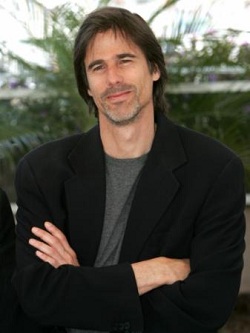
Firstly, I wish someone had clued me in on how handsome this guy is so I could have ogled him from the front row. But from my seat in the Kabuki's large House One it was easy to perceive the man's warmth and self-effacing intelligence. The evening began with introductory remarks by Leggat, followed by a clips reel of career highlights. Then came the on-stage conversation with Mexican director Alejandro González Iñárritu, who started things off by saying, "Let's put the guns down before we start, and talk about the sex life of Mr. Walter Salles." Hear, hear! I loved hearing about Salles' early life as a diplomat's son living atop a Parisian arthouse theater. Twelve-year-old Walter frequented that cinema so often, the ticket seller began letting him in for free. But he longed for Brazil: "I hated the drizzle, the cold, the croissants." During the talk it was also revealed that Salles spent a full year casting the boy in Central Station, that Latin Americans do not make good genre films (i.e., his own remake of Hideo Nakata's Dark Water), and that Argentina currently has the strongest cinema in Latin America (little to argue about there). He also acknowledged that "Antonioni is the director who brought me to cinema," specifically 1975's The Passenger.
Before getting to the evening's main event, Salles shared a short film that had been screened only once before—for the 60th anniversary of the Cannes Film Festival. In it, he addresses his six-month-old son, saying, "If I could choose just one film for you to see before any other, it would be this one." Then we saw an infant entranced by Chaplin dancing with the globe balloon in The Great Dictator. Salles remarked that they screened a DVD projection for the first take, and his son just wasn't interested. For the second take they projected it in 35mm and this time he became fully engaged by Chaplin's antics. What a smart, discerning kid!
As a special treat made exclusively for the SFIFF, Salles next showed us a one-hour work-in-progress documentary about his efforts to film Jack Kerouac's On the Road. It was edited in just one week from 100 hours of mini-DV and super-8 interview and location footage. Salles, who first read the book as a 15-year-old, feared that showing an incomplete film about The Beats in San Francisco might be a "suicidal act," but the festival audience ate it up. In its current state, the film gives an impressionistic overview of Kerouac's work and the times from which it sprang. An off-camera Matt Dillon intermittently reads passages from the book, and contemporary figures ranging from Laurie Anderson to Johnny Depp to David Byrne reflect on its influence. There are terrific interviews with key players who are still with us (Michael McClure, Carolyn Cassady), as well as vintage screen tests by Brendan Fraser, Ashley Judd, Mathew McConaughey and others made for a previous attempt at filming the book. Directors as diverse as D.A. Pennebaker and Jean-Luc Godard have been interested in the project, but based on the evidence presented that night, Salles is clearly the man for the job. Indeed just one week after this event, it was announced that shooting for Salles' On the Road (the narrative feature) will begin in August. The next day at the festival, Salles would conduct a master class, as well as introduce a screening of his 2008 film, Linha de Passe.
On Saturday, May 1st, I must have changed my mind a dozen times. Should I spend the early evening at the Kabuki watching a French orangutan documentary (Nenette) and a Brazilian movie (The Famous and the Dead) before heading over to the Castro for the late-night world premiere of All About Evil? Or should I catch Roger Ebert receiving this year's Mel Novikoff Award at the Castro? I chose the latter and it turned out to be a smart move. The combination of Roger Ebert and Peaches Christ made for one of the most fabulous evenings I've experienced in 35 years of attending this festival.
Ebert and his wife Chaz were brought onstage and seated while four directors delivered heartfelt and hilarious tributes to the man they call "The Thumb." Terry Zwigoff recalled Ebert being the first person in line for a 1985 Telluride screening of Louis Bluie, and later sold him a soundtrack LP in the theater lobby. He also told a great story about a Crumb test screening. The audience survey cards were overwhelming negative—they thought the storyline about brother Charles should be dropped—so Zwigoff "fixed" the cards with the help of Wite-Out and a late-night trip to Kinko's. Ebert would become a steadfast champion of the film, going so far as to record a commentary track for the DVD release (much of which would be used for the text-to-speech software that allows the now "speechless" Ebert to speak through a computer). Next, documentarian Errol Morris called Ebert, "not just a film critic, but a cultural icon." He was followed by Jason Reitman who, commenting upon Ebert's social networking prowess, declared "I know teenage girls who tweet less than Robert Ebert." Reitman would also add that, "It's hard to put Roger Ebert's work into context when it's him who puts us into context."
Last up was Philip Kaufman, who took a seat next to Ebert and Chaz and read a mayoral proclamation declaring May 1, 2010 "Roger Ebert Day" in San Francisco. Then the man himself fired up his laptop and brought the house down with his first sentence, "My little man is standing on his chair and applauding." The rest of Ebert's speech railed against Hollywood's current output of sequels and so-called blockbusters ("The studios are running like lemmings to 3-D") while films like Erick Zonka's Julia, featuring a tour de force performance by Tilda Swinton, gross a measly $65,000 in U.S. release. (Locally, the film ran for one week last summer on the SF Film Society's Kabuki Screen before moving over to the Roxie). The tribute audience then got to see and judge Julia for itself, having been specifically chosen by Ebert to accompany his appearance at the festival. A letter of regret from Swinton was read to the crowd—she had hoped to attend the screening but was stuck filming on the East coast. I was thrilled to watch it a second time, especially on the Castro's big screen. It's a tough little film and there were a few walkouts, but the applause at the end was booming.
I darted out of the Castro and was greeted by the sight of blood-splattered klieg lights clawing the night sky. Then I noticed a dead body flopped across the base of the lights and a ticketholders line already around the block a full two hours before showtime. This could only mean one thing—the world premiere of Peaches Christ's All About Evil! From my vantage point in the press line, I was able to watch the red carpet parade of outlandish costumes and mile-high hairdos, praying that none of those 'dos ended up sitting in front of me. (This was a movie theater, after all, and not a planetarium.) As Peaches would remark at some point in the evening ("Peaches" being the beloved late-night movie hostess alter-ego of one Joshua Grannell), a movie only gets one world premiere. And boy did he/she pull out the stops to ensure All About Evil's would be momentous.
The All About Evil preshow consisted of no less than four musical production numbers, the first one featuring Peaches and a dozen pom-pom shaking monstrosities performing, "I'm a Gore-Gore Girl." Afterwards, she threatened the audience with a three-hour preshow in which she would single-handedly act out the entire movie onstage. Next she brought out All About Evil cast member Mink Stole and the duo croaked out the theme song from John Water's film, Female Trouble. Peaches and Mink go way back, the latter having been the first "celebrity" to appear at Peaches' Midnight Mass film series at San Francisco's Bridge Theater. Waters was also in the house that night and stood for a round of applause. Teen heartthrob and All About Evil co-star Thomas Dekker was next on board, performing the movie's rocking theme song, "Welcome to the Horror Show." Then Natasha Lyonne, who stars as mousy theater-owner turned murderous film director Deborah Tennis (pronounced De-BOR-ah Ten-NIS) wrapped things up with a final number.
After all that hullabaloo, one almost expected the film itself to be anti-climactic. But no, All About Evil delivered the sicko thrills and chills. Two scenes in particular had all 1400 audience members screaming their collective heads off in disbelief, and neither was the film-within-the-film, A Tale of Two Severed Titties. By the time the Q&A wrapped up—with Peaches now out of drag and onstage as plain old Joshua Grannell—it was two in the morning. Everyone was handed a commemorative All About Evil world premiere poster upon exiting the theater, which I'll surely treasure for the rest of my days. It was Saturday night and the Castro Street bars were emptying out—a phenomenon I hadn't witnessed in many years. I was satisfied and spent and had no hope of making it to the next morning's surprise SF Film Society members screening.
If you weren't there that night, here's good news. Come October, Peaches will be presenting the film, complete with a preshow, at San Francisco's Victoria Theater (where All About Evil was actually filmed). She promises a full-on William Castle-like experience—I think her exact words were "we're gonna stab you and chainsaw you." Meanwhile, check out Dennis Harvey's recollection of the evening at SF360, and don't miss The Evening Class' Michael Guillén and his interviews with Grannell, special effects artist Aurora Bergere and five cast members. Now for a special treat, the evening's complete opening number.
I spent the next few days singing, "I'm a gore, I'm a whore, I'm a gore-gore girl" and desperately needed a new earworm. One came in the form of the rousing and repetitive chorus that greeted each new chapter of Stuart Paton's 1916 silent screen adaptation of Jules Verne's 20,000 Leagues Under the Sea. This May 4 Castro Theater screening was also the world premiere of a new score composed and performed by The Magnetic Fields' frontman Stephin Merritt, with help from Daniel Handler on accordion, David Hegarty on the Castro's Mighty Wurlitzer and a gentleman playing tuba and trumpet.
Merritt was clearly having a goof with it, blending his customary old-timey vibe with injections of electronic bleeping and screechy freakouts. Speaking and singing through megaphones, Handler gave voice to the female roles in an abrasive Olive Oyl-y falsetto while Merritt handled the male parts in a low register that was mostly inaudible. The film itself is kind of unremarkable—a flatly directed mash-up of Verne's 20,000 Leagues and The Mysterious Island, with underwater photography that was stunning for its time but is now merely quaint. Merritt exploited the film's campier aspects, such as a sarong-clad "child of nature" who sings a ditty about not wanting to wear pants and who turns out to be Captain Nemo's long lost daughter. I thought it was all good-natured fun and Merritt's legion of fans seemed satisfied, but I know some likened the performance to a bad episode of Mystery Science Theater 3000. I was glad I went, but it paled compared to last year when Dengue Fever blew the dome off the Castro with their score for the stop-motion dinosaur epic, The Lost World.
Cross-published on film-415 and Twitch. Photos by Pamela Gentile and Pat Mazzera courtesy of the San Francisco Film Society and SF360.
"Cinema is, first and foremost, the projection of a cultural identity which comes to life on the screen. It mirrors or should mirror this identity. But that is not all. It should also dream it. Or make it flesh and blood, with all its contradictions."—Walter Salles, The Cinema of Latin America (2003).
Walter Salles received the San Francisco Film Society's Founder's Directing Award at the 53rd San Francisco International Film Festival (SFIFF53). The Founder's Directing Award is presented each year to a master of world cinema and is given in memory of Irving M. Levin, founder of the San Francisco International Film Festival. The award was first bestowed in 1986 on iconic filmmaker Akira Kurosawa, and for many years carried his name. Highly recommended is Margarita Landazurri's tribute essay "Dreaming Identity" for the SFIFF53 catalogue, which provides an insightful overview of the filmmaker's creative shift from documentary work and its influence on his subsequent feature films. She likewise profiles his tireless promotion of Brazilian master works alongside the visions of younger South American filmmakers, many of whose films he has helped produce. Further, Landazurri finesses: "In dreaming and exploring his own cultural identity as a Brazilian, a Latin American and a citizen of the world, Salles has contributed his unique perspective and in so doing significantly enriched international cinema."
To celebrate the honor, SFIFF53 organized three separate programs with Salles in attendance at each. The first was an onstage tribute at the Sundance Kabuki Cinemas, which included a clip reel of career highlights, an onstage interview with Alejandro González Iñárritu, and a special screening of In Search of On the Road (a Work in Progress), an hour-long edit prepared specifically for the Festival of a documentary about Salles's effort to make a documentary about Jack Kerouac, his seminal novel On the Road, and the Beat Generation; the second was a Masters Class in which Salles spoke to young filmmakers; and the third was a screening of Linha de Passe, introduced by Salles before rushing off to accept his award at the benefit awards ceremony. I hope to write about all three events more fully when time warrants, but until then, I offer two brief exchanges with this year's strikingly articulate Walter Salles.
* * *
Michael Guillén: You've spoken of the movement within the visual language of your films, and you've touched upon the intriguing concept of the immersive quality of 3D technology as applied to films; but, I'd like to say that I find the 2D quality of your films to be quite immersive, quite sensual. I was wondering if you could speak to the tactile language of your films? And how it is that you structure your films such that your audiences experientially feel them?
Walter Salles: It's something that is hard to define—the word is not very good—but, even in a Cartesian manner. You achieve that quality when you are on the set and you forget that you are doing a film. Everybody forgets that they're doing a film. What blossoms is something that pertains to that movement, to that moment, and has an integrity of the moment. I don't know if I'm being clear about this; but, every time that you scheme everything that is the veils of acting and pretending, you're approaching something that is quite unique and sensorial. This is why I hate to have a "making of" [camera crew] in a shoot because you're constantly reminded that you are in a shoot, you see? I think that to film is to actually forget that you're doing a film. This is when the ballet of it starts, y'know? When the jazz of it starts. You can actually communicate with the DP just by looking at him and sensing where one should go. The actor feels that. It's something that cannot be expressed by words, but has to do with—I would say—the temperature that you create on the set and the way that you reach that.
So to give you an example: in the case of The Motorcycle Diaries, we arrived in Argentina where the production started and a long time before the shoot. And we collectively did—the word is a little bit grand, but—seminars. A lot of young professors from the University came to talk about the music of the period, about heroism, and about Inca history. At the beginning, Carlos Conti (the production designer) and a group of six or seven people came to listen to that, and at the end the whole crew came. We projected films from the fifties. We brought the period closer to us and we somehow decanted it.
Picasso used to say, "Painting as you should is at the time when you forget painting, as when you were a five-year-old." The process is really about knowing all the possibilities, then forgetting about what you've learned and being inventive on the moment. On the moment, you have to forget that you're doing a film. This is how it acquires a sensorial quality.
Guillén: I'm impressed with your quotesmanship, your knowledge of other filmmakers, and especially your knowledge of other art practices. I'm interested if you can address the value of acknowledging a sibling relationship with the other arts and the value such acknowledgment lends to filmmaking?
Salles: We are part of a generation that was mostly informed about the world through films; but, also through literature, through music. This morning I was writing, for instance, [an acceptance speech for tonight's award ceremony] and it wasn't working. I was feeling too much jet lag and I was thinking, "How can I solve this?" Neil Young helped me. The interconnection between different forms of narration, of art, is something irrefutable. It is what it is.
I tend to believe that you don't need to go to film school to become a filmmaker. I actually didn't go to film school. At one point I studied philosophy, history, economics, it just happened like this and for one reason: there was no film school in Brazil—in Rio at least—at that point. I couldn't study film, you see? So I had to drift a little to find a way to get there; but, above all, the film drifts out of curiosity. Because at the end of the day, it's about storytelling. Storytelling is in the streets, it's in the books that we read, it's in the music that we hear and all of these echoes. There's a general echo that comes from that interest.
Peering at the SFIFF53 films from non-French speaking Europe, I'm especially glad to see a pair of German entries. Maren Ade's Everyone Else won a Silver Bear at last year's Berlin Film Festival and follows the dissolution of a young couple on holiday in Sardinia. The film would have been a natural for our now-defunct Berlin & Beyond festival, and I'm assuming it didn't make the recent German Gems program because SFIFF already snagged it. If you've read the reviews and also caught Ade's debut The Forest for the Trees at SFIFF five years ago, you know this is going to be special. The other film is Turkish/German director Fatih Akin's Soul Kitchen, which is said to be quite different from his previous works like Head On and The Edge of Heaven. This one's a comic look at the efforts to save a failing family restaurant and stars my two favorite German actors, Moritz Bleibtreu and Birol Ünel.
I caught Portuguese director João Pedro Rodrigues hyper-stylized transsexual melodrama To Die Like a Man at the Palm Springs International Film Festival and loved it. Many loathed it. If you dug his previous works (O Fantasma, Two Drifters aka Odete) you sure don't want to miss this. In his review for the New York Film Festival, critic J. Hoberman called it "the kind of film Pedro Almodóvar should be making." Also Portuguese, at least in title and setting is Eugène Green's The Portuguese Nun. I'm totally unfamiliar with the work of this U.S.-born French director who seems to be known for his formalist approach to filmmaking. Ostensibly, the film is about a French actress making a film about a 17th century nun in Lisbon, with Green portraying the director. Variety gave it a scathing review, but I'm planning to give it a chance.
The big Italian film this year is Luca Guadagnino's I Am Love, starring Tilda Swinton as the unhappy wife of a Milanese industrialist. It's been compared to the works of Luchino Visconti. Uncoincidentally, the lone SFIFF screening of I Am Love takes place immediately after a restored print revival of Visconti's Senso at the Castro Theater on Sunday, May 2. If you're unable to make the showing, I Am Love opens at a Landmark Theater on July 2. The other Italian film I'm anticipating is Tizza Covi and Rainer Frimmel's La Pivellina, in which a group of circus performers find and keep an abandoned child. Also of interest from Italy is Giorgio Diritti's WWII massacre movie The Man Who Will Come, which won both Grand Jury and Audience Prizes at last year's Rome Film Festival
From elsewhere in Europe we have Serbian director Vladimir Perisic's Ordinary People, a multi-fest prizewinner and (Bruno) Dumont-ian parable of ethnic cleansing and the human potential for brutality. At an opposite extreme lies Nina Hedenius' Way of Nature, a near-silent meditation on life at a remote Swedish farm. According to some reports I've read, the ex-Soviet republic of Georgia might be the next international hotbed of inspired filmmaking. SFIFF53 has programmed one title that keeps popping up, Rusudan Pirveli's Susa, a neo-realist tale of a 12-year-old bootleg-vodka delivery boy. Also from Georgia is the documentary Russian Lessons, which examines the 2008 Georgia-Russia armed conflict.
2009 was a quiet year on the Latin American filmmaking front, with virtually none of the region's major directors releasing new films. I'd hoped to find the Mexican omnibus film Revolución in the line-up, but perhaps it's too soon after the film's January premiere at Berlin. That reasoning wouldn't apply, however, to the absence of Claudia Llosa's sublime The Milk of Sorrow, which won Berlin's top prize in 2009 and was one of the five Oscar nominees for Best Foreign Language Film. One wonders, did the programming team really deem this film unworthy of our fest or were other factors involved? Oh well, I'm darn glad I saw it at Palm Springs.
Headlining what Latin American cinema we do have at SFIFF53 is surely Brazilian director Walter Salles' receiving the Founders Directing Award, along with screenings of his 2008 Linha de Passe and also a new work-in-progress. Also from Brazil come the narrative feature The Famous and the Dead and the musical documentary Simonal: No One Knows How Tough It Was, about the "spectacular rise and infamous fall of the undisputed king of Brazilian popular music." From Colombia there's Ciro Guerra's The Wind Journeys, in which a man and teenage boy set off on a roadless road-trip to return a cursed accordion. I've watched this on screener and it's visually stunning. Usually we get a bunch of titles from Argentina in the festival, but this year there's only one. The Peddler documents the work of Daniel Burmeister, a traveling septuagenarian filmmaker who uses local amateur talent to create genre movies. Rounding out the South American roster is You Think You're the Prettiest, But You Are the Sluttiest, a Chilean comedy about the pitfalls of being young, horny and male.
While we may not have gotten Revolución, there are three other Mexican films in the SFIFF53 line-up, two of which I've previewed and heartily recommend. Roberto Hernandez and Geoffrey Smith's documentary Presumed Guilty is an exposé of the Mexican criminal justice systems that follows one young man's efforts to reverse a homicide conviction. In Rigoberto Perezcano's meditative feature Northless, a young man's determination to cross into El Norte gets waylaid by the female proprietor of a Tijuana grocery store. The film I haven't seen is Pedro González-Rubio's docu-fiction hybrid Alamar, in which a half-Mayan boy spends a final summer with his father and grandfather along the Caribbean coast. The film has won a slew of festival awards, most recently a Tiger at Rotterdam, and I'm saving it for a big-screen festival experience (the underwater cinematography is by Alexis Zabé, who also shot Carlos Reygadas' Silent Light and Fernando Eimbcke's Lake Tahoe).
OMFG! was the reaction I had to seeing two particular Asian titles in the line-up—and I'm using "Asian" here in its broadest geographical sense. In 2006 I was blown away by The Forsaken Land, a film by Sri Lankan director Vimukthi Jayasundara for which he won Cannes' Camera d'or for best first feature. I've had fingers and toes crossed that his new film Between Two Worlds would show up at our 3rd i South Asian Film Festival next fall, but I'm just as ecstatic to see it at the SF International. The other title that got a rise out of me is Iranian director Mohammad Rasoulof's The White Meadows. Rasoulof directed the phenomenal Iron Island, which the fest screened in 2006. I won't even attempt to synopsize what these two allegorical films are "about". Just read the program capsules and prepare yourself for an other-worldly cinematic experience. A million thanks to the programmers for securing these. (Mohammad Rasoulof, by the way, was arrested and imprisoned in Tehran along with director Jafar Panahi on March 1 and released 17 days later).
There are a handful of other Asian films I'm looking forward to. In 2006, Thai director Pen-Ek Ratanaruang made a big splash with Last Life in the Universe. His two follow-up films took a critical beating and never made it to our neck of the woods. Now he's made Nymph, which garnered mixed to favorable reviews, and I'm really pleased to have the chance to see it. One of the highlights of the 2005 SFIFF was a sidebar devoted to New Malaysian Cinema. One of the directors feted that year was Woo Ming-jin, and his new film called Woman on Fire Looks for Water has come our way. It's described as an "utterly gorgeous meditation on yearning and regret set amid a small fishing village." I caught Hirokazu Kore-eda's Air Doll, a wistful social comedy about a blow-up sex doll come to life, at Palm Springs. It's an inevitable disappointment coming on the heels of the director's undisputed masterpiece Still Walking, but is well worth seeing for the lead performance by bug-eyed South Korean star Bae Doo-Na (The Host, Linda Linda Linda). There are two more Iranian films I might catch if time allows. Nader Takmil Homayoun's Tehroun is a crime thriller set in Tehran's slums, while Babak Jalali's Frontier Blues is an absurdist portrait of life along Iran's northern frontier. Anyone with a penchant for star-studded Chinese historical epics probably won't want to miss Bodygyards and Assassins and Empire of Silver.
Finally, we have some films that don't fit in any of these geographic categories. The top prize winner at last year's Venice Film Festival was Samuel Maoz' Lebanon, a film set entirely inside an Israeli tank during the 1982 invasion of Lebanon. SFIFF53 also has this year's Grand Jury Prize winner from Sundance, Debra Granik's Winter's Bone. Set in a poor rural Ozark community, a 17-year-old girl must find her meth-cooking father to keep from losing the family home. Ted Kotcheff's 1971 once-considered-lost Australian exploitation shocker Wake in Fright (Outback) has been restored and revived with the hope of appalling a new generation of moviegoers. 2008's Baghead finally sold me on the talents of the directing Duplass Brothers and the festival will be screening their latest Cyrus, starring Marisa Tomei and John C. Reilly. Another (truly) American indie film that's sounds promising is Tanya Hamilton's Night Catches Us, the story of an ex-Black Panther returning home to Philadelphia in the year of the bicentennial. Finally, it you're as freaked out about Colony Collapse Disorder as I am, you won't want to miss Ross McDonnell and Carter Gunn's documentary Colony.
In a matter of days, the full line-up for the 53rd San Francisco International Film Festival (April 22 to May 8) will be revealed. If you're a San Francisco Film Society member, look for an e-mail this Friday with instructions for downloading a PDF of the fest’s mini-guide (and all tickets go on sale to members that same day). Non-members will be kept in the dark until after the official press conference next Tuesday, and can start buying tickets April 1. In the meantime, plenty of good stuff has already been announced. Here's a recap, followed by my personal 20-film wish list for the fest's 2010 edition.
For devotees of Midnight Mass hostess Peaches Christ (aka Joshua Grannell), the World Premiere of her/his feature directorial debut, All About Evil, will be the must-see event of this year's festival. Peaches seizes control of the Castro Theater on Saturday, May 1 at 10:45PM "with a fully realized stage-show spooktacular hosted by Peaches Christ, starring members of the cast including Mink Stole, Thomas Dekker, Martiny and more."
The SFIFF event I anticipate most each year is programmer Sean Uyehara's pairing of a silent film with a new live score written and performed by a contemporary music artist. You'd think last year's The Lost World/Dengue Fever combo would be an impossible act to follow, but I think Sean's done it again. On Tuesday, May 4, songwriter Stephin Merritt of the group The Magnetic Fields will premiere a new score to Stuart Paton's 1916 adaptation of Jules Verne's 20,000 Leagues Under the Sea. Joining Merritt will be Castro Theater organist David Hegarty, author Daniel Handler (aka Lemony Snicket) on accordion and others TBA.
Brazilian director Walter Salles (Central Station, The Motorcycle Diaries) will be the recipient of 2010's Founder’s Directing Award. His tribute takes place on Wednesday, April 28 and will feature a clip-reel of career highlights, an on-stage interview and "a special screening of In Search of On the Road (a Work in Progress), an hour-long edit prepared specifically for the Festival of a documentary about Salles's effort to make a documentary about Jack Kerouac." The following day Salles will offer a Master Class, plus attend a screening of his 2008 Cannes Competition film, Linha de Passe, which won a prize for its lead actress Sandra Corveloni. Hopefully, someone will ask the director why it has taken two years for this film to reach us (I believe this screening might even be the U.S. premiere?) Linha de Passe shows again at the Pacific Film Archive on Friday, April 30.
Receiving this year's Peter J. Owens Award for acting will be none other than legendary screen vet Robert Duvall. At the Friday, April 30 tribute, he'll be feted with a career clip reel, on-stage interview and a screening of his latest film Get Low, co-starring Bill Murray and Sissy Spacek.
Each year the festival gives its Mel Novikoff to "an individual or institution whose work has enhanced the filmgoing public's knowledge and appreciation of world cinema." Could anyone be more deserving of such an award than Roger Ebert? On Saturday, May 1, Ebert will appear on-stage in conversation (employing his extraordinary, new computerized text-to-speech speaking voice) with directors Terry Zwigoff, Jason Reitman and others TBA. Following the tribute, the festival will screen one of Ebert's favorite films of 2009, Erick Zonca's Julia, featuring a balls-to-the-wall performance by Tilda Swinton. If you missed this film when it screened at the SF Film Society's Kabuki Screen (R.I.P.?) last summer, or its subsequent run at the Roxie, you're lucky to have this additional opportunity.
The SFIFF's 2010 Kanbar Award for excellence in screenwriting will be given to writer/producer/Focus Features CEO James Shamus on Saturday, May 1. Shamus is best known for the films he's written and produced for Ang Lee, including Brokeback Mountain, Crouching Tiger, Hidden Dragon, The Ice Storm and Lust, Caution. Following an on-stage interview with critic B. Ruby Rich, the festival will host the West Coast premiere of a new director's cut of Ang Lee's underappreciated 1999 Civil War film, Ride With the Devil.
Every year the festival screens newly restored prints of some select cinema classics. For SFIFF53 we'll get to take another look at Satyajit Ray's 1958 The Music Room at the Castro on Saturday, May 1, as well as Luchino Visconti's 1954 film Senso (date TBA).
This year's State of Cinema Address will be delivered on Sunday, April 25 by film editor/sound designer extraordinaire Walter Murch (The Conversation, Apocalypse Now). Titled "Three Fathers of Cinema: Beethoven, Flaubert, Edison," the address will "contemplate what would have happened if motion pictures had been invented in 1789. He will present various theories on the evolution of filmmaking, investigating the cultural origins of cinema in the 19th century and the implications for the future of cinema in the 21st century."
The festival has also announced the 11 films that will be competing for Golden Gate Awards Documentary Competition. There are three I'm especially looking forward to. Lixin Fan's Last Train Home won the Sundance Grand Jury Prize for Best Documentary (World Cinema), and looks at the phenomenon of China's annual New Year's mass migration. Winning the documentary Jury Prize just last week at SXSW is Jeff Malmberg's Merwencol, in which a brain-damaged survivor of a bar attack copes by setting up a complete WWII-era town in his backyard. In Sebastian Junger and Tim Hetherington's Sundance Grand Jury Prize Documentary winner Restrepo, we follow a group of soldiers fighting the Taliban in the mountains of Afghanistan. The other eight titles are Colony, The Invention of Dr. Nakamats, Mugabe and the White African, The Peddler, PianoMania, Presumed Guilty, Russian Lessons and Simonal: No One Knows How Tough It Was.
Twelve filmmakers will compete for this year's New Directors Prize. I saw Ounie Lecomte's South Korean adoption drama A Brand New Life at the Palm Springs International Film Festival and would definitely recommend it. I've also heard very good things about Pedro González-Rubio's Alamar, which won a coveted Tiger Award at this year's Rotterdam Film Festival. The remaining 10 titles are Animal Heart, The Day God Walked Away, The Famous and the Dead, Night Catches Us, Northless, La Pivellina, Shirley Adams, Susa, Tehroun and—I've gotta see this one for the title alone—You Think You're the Prettiest, but You Are the Sluttiest.
This year's Persistence of Vision Award will go to Fremont-born, Oscar-nominated short-film animator Don Hertzfeldt on Friday, April 23 in a program titled "Life, Death and Very Large Utensils."
Finally, SFIFF53 will close on May 6 with a screening of Ricki Stern and Annie Sundberg's documentary Joan Rivers—A Piece of Work. It is anticipated that Rivers will attend the screening, along with director Stern. At the closing night party at 1015 Folsom, "partygoers will celebrate the culmination of SFIFF53 with festive drinks, hors d'oeuvres and music inspired by the legendary comedian Joan Rivers."
Every year I draw up a list of the 20 films I most hope to find in the SFIFF line-up. They're culled from a longer wish list of approximately 100 films, spanning from 2009's Berlin Film Festival up to the present. A few have received mixed-to awful-reviews, but they're from directors who interest me nonetheless. Last year I only got seven of my 20 films, but eventually caught up with all but three. We'll soon know how SFIFF53 shakes out.
Altiplano (Belgium dir. Peter Brosens, Jessica Hope Woodworth) The Army of Crime (France dir. Robert Guédiguian) Enter the Void (France, dir. Gaspar Noé) Everyone Else (Germany, dir. Maren Ade) Face (France/Taiwan dir. Tsai Ming-liang) Gainsbourg (vie héroïque) (France dir. Joann Sfar) Hadewijch (France dir. Bruno Dumont) Hiroshima (Uruguay dir. Pablo Stoll) I Am Love (Italy dir. Luca Guadagnino) Korkoro (France dir. Tony Gatlif) Life During Wartime (USA dir. Todd Solondz) Lola (Philippines dir. Brilliante Mendoza) Lourdes (France dir. Jessica Hausner) Min Ye (Mali dir. Souleymane Cissé) Rapt (France/Belgium dir. Lucas Belvaux) Revolución (Mexico dir. Mariana Chenillo, Fernando Eimbcke, Amat Escalante, Gael Garcia Bernal, Rodrigo Garcia, Diego Luna, Gerardo Naranjo, Rodrigo Plá, Carlos Reygadas, Patricia Riggen) Scheherazade Tell Me a Story (Egypt dir. Yousry Nasrallah) Skirt Day (France dir. Jean-Paul Lilienfeld) The Time That Remains (Palestine dir. Elia Suleiman) White Material (France, dir. Claire Denis)
And here are four terrific films I saw at January's Palm Springs International Film Festival—films I'd love for my Bay Area friends to see, too.
Dogtooth (Greece dir. Giorgos Lanthimos) I Killed My Mother (Canada dir. Xavier Dolan) The Milk of Sorrow (Peru dir. Claudia Lhosa) To Die Like a Man (Portugal dir. João Pedro Rodrigues)
 The 53rd edition of the San Francisco International Film Festival (SFIFF) came to a close on May 6, having sold out 92 screenings during its successful 15-day run. While I'm still mulling over the three dozen films I saw during those two weeks—all of which I hope to write about—here's a look back at five of this year's special events.
 This year's opening night film was Jean-Pierre Jeunet's Micmacs, which the director assured us had nothing to do with Big Macs, and everything to do with his new favorite English word, shenanigans. I've enjoyed all of Jeunet's films, except the one everybody adores (yes, Amelie, I'm talking about you). Reviews for Micmacs have been mixed, but it turned out to be a perfect opening night film—inventive, fast-paced, comical, crowd pleasing. I couldn't remember much about it the next day, but I did recall how much fun I had while watching it. After the screening, the festival's new Director of Programming Rachel Rosen interviewed Jeunet and conducted an audience Q&A. We learned that the director "wanted to put everything I love in this film," which ranged from animator Tex Avery to Mission Impossible, and that he's "not interested in realism." When asked if he might ever work again with Marc Caro (co-director of Delicatessen and The City of Lost Children), Jeunet diplomatically replied, "it's so good to work alone." With the final question, Jeunet got off the best line of the evening in regards to Micmacs poor reception on his home front: "In France they love to hate what they loved before." With that, the ebullient crowd adjourned to the Regency Center for a swinging after-party. The nibbly things I sampled there were delicious, and I washed them down with the beer everyone who frequents Landmark Theaters loves to hate.
 Firstly, I wish someone had clued me in on how handsome this guy is so I could have ogled him from the front row. But from my seat in the Kabuki's large House One it was easy to perceive the man's warmth and self-effacing intelligence. The evening began with introductory remarks by Leggat, followed by a clips reel of career highlights. Then came the on-stage conversation with Mexican director Alejandro González Iñárritu, who started things off by saying, "Let's put the guns down before we start, and talk about the sex life of Mr. Walter Salles." Hear, hear! I loved hearing about Salles' early life as a diplomat's son living atop a Parisian arthouse theater. Twelve-year-old Walter frequented that cinema so often, the ticket seller began letting him in for free. But he longed for Brazil: "I hated the drizzle, the cold, the croissants." During the talk it was also revealed that Salles spent a full year casting the boy in Central Station, that Latin Americans do not make good genre films (i.e., his own remake of Hideo Nakata's Dark Water), and that Argentina currently has the strongest cinema in Latin America (little to argue about there). He also acknowledged that "Antonioni is the director who brought me to cinema," specifically 1975's The Passenger.
 Ebert and his wife Chaz were brought onstage and seated while four directors delivered heartfelt and hilarious tributes to the man they call "The Thumb." Terry Zwigoff recalled Ebert being the first person in line for a 1985 Telluride screening of Louis Bluie, and later sold him a soundtrack LP in the theater lobby. He also told a great story about a Crumb test screening. The audience survey cards were overwhelming negative—they thought the storyline about brother Charles should be dropped—so Zwigoff "fixed" the cards with the help of Wite-Out and a late-night trip to Kinko's. Ebert would become a steadfast champion of the film, going so far as to record a commentary track for the DVD release (much of which would be used for the text-to-speech software that allows the now "speechless" Ebert to speak through a computer). Next, documentarian Errol Morris called Ebert, "not just a film critic, but a cultural icon." He was followed by Jason Reitman who, commenting upon Ebert's social networking prowess, declared "I know teenage girls who tweet less than Robert Ebert." Reitman would also add that, "It's hard to put Roger Ebert's work into context when it's him who puts us into context."
 The All About Evil preshow consisted of no less than four musical production numbers, the first one featuring Peaches and a dozen pom-pom shaking monstrosities performing, "I'm a Gore-Gore Girl." Afterwards, she threatened the audience with a three-hour preshow in which she would single-handedly act out the entire movie onstage. Next she brought out All About Evil cast member Mink Stole and the duo croaked out the theme song from John Water's film, Female Trouble. Peaches and Mink go way back, the latter having been the first "celebrity" to appear at Peaches' Midnight Mass film series at San Francisco's Bridge Theater. Waters was also in the house that night and stood for a round of applause. Teen heartthrob and All About Evil co-star Thomas Dekker was next on board, performing the movie's rocking theme song, "Welcome to the Horror Show." Then Natasha Lyonne, who stars as mousy theater-owner turned murderous film director Deborah Tennis (pronounced De-BOR-ah Ten-NIS) wrapped things up with a final number.
 Merritt was clearly having a goof with it, blending his customary old-timey vibe with injections of electronic bleeping and screechy freakouts. Speaking and singing through megaphones, Handler gave voice to the female roles in an abrasive Olive Oyl-y falsetto while Merritt handled the male parts in a low register that was mostly inaudible. The film itself is kind of unremarkable—a flatly directed mash-up of Verne's 20,000 Leagues and The Mysterious Island, with underwater photography that was stunning for its time but is now merely quaint. Merritt exploited the film's campier aspects, such as a sarong-clad "child of nature" who sings a ditty about not wanting to wear pants and who turns out to be Captain Nemo's long lost daughter. I thought it was all good-natured fun and Merritt's legion of fans seemed satisfied, but I know some likened the performance to a bad episode of Mystery Science Theater 3000. I was glad I went, but it paled compared to last year when Dengue Fever blew the dome off the Castro with their score for the stop-motion dinosaur epic, The Lost World.