 The San Francisco International South Asian International Film Festival (3rd i for short) is held each year in early November. As Vanessa Hua explained at the San Francisco Chronicle: "The name is a riff on the third eye, a symbol of internal reflection and perception, and Third World cinema, or movies from developing countries." This year's edition—continuing with their expansion into a four-day format—will venue at both The Castro Theatre and the Roxie Film Center. As a non-profit, national organization, 3rd i was founded by Ivan Jaigirdar, Shilpa Mankikar, and Camille Ramani in 2002 to represent filmmakers and audiences from Bangladesh, Bhutan, India, Nepal, The Maldives, Pakistan, Sri Lanka, Tibet, and the South Asian Diaspora. An early interview with Ramani and Jaigirdar for The Indian Express explored the early efforts of the organization, which has continued to support their mission by providing film screenings, filmmaking courses, networking resources, and a distribution channel for the South Asian-American film community and their audiences.
 I met with Artistic Director Ivan Jagirdar and Administrative Director Anuj Vaidya at ATA for this research interview for Diaspora By the Bay. Along with being Co-Founder and Executive Director of 3rd i South Asian Films, Ivan Jaigirdar is the Artistic director of San Francisco International South Asian Film Festival and the Bollyhood Cafe. Prior to founding 3rd i, Jaigirdar served as Creative Director and Programmer at Artist Television Access (he is still on the board), and has helped curate programs for numerous festivals including San Francisco International, Asian American Film Festival, Madcat International Women's Film Festival, the Black Film Festival, and NoisePop. Also an accomplished filmmaker, Jaigirdar's work has screened in festivals all over the world.
My thanks to Karen Larsen at Larsen Associates for setting up the meeting.
* * *
Michael Guillén: Ivan, how many years has 3rd i been in operation?
Ivan Jagirdar: Prior to becoming a festival we were a monthly screening house. We started about 2000-2001. For two years we did monthly screenings and gradually grew rapidly. In 2003 we decided to become a festival.
Guillén: Was there a focus to the monthly screenings?
 Jagirdar: There wasn't anything specific except that we wanted to get diverse images of South Asia; films about South Asia of South Asians by South Asians. They weren't commercial. They were underground alternative films. We started off with humor because we knew that attracted people so we showed depictions from British South Asian filmmakers, like Goodness Gracious Me and things like that. Then we went on to queer South Asian representation and then experimental South Asian representation. We try to get a variety of images.
Guillén: What prompted that? Did you not feel that the San Francisco International Asian American Film Festival was satisfying the needs of the South Asian community in the Bay Area?
Jagirdar: I was on the screening committee for the Asian American Festival, which was then NAATA, now it's CAAM, and really enjoyed that environment; but, yeah, we needed a South Asian festival. It was also at a time when there was a critical mass of South Asians that had appeared in England and I was a part of that. I grew up in England. We were getting a lot of the literature coming over from India and Bangladesh. There was some kind of shift going on in England where there was a cross-pollination going on between literature, music and film. Coming here, we didn't see that shift.
So part of what started the monthly screenings was to bring over that sense of that new identity in South Asia and the South Asian diaspora within San Francisco. We found it was so successful. We had chapters in New York, Chicago, L.A. and Washington, D.C. We spread quickly.
Guillén: 3rd i is operating in all these locations?
Jagirdar: We were. Two years in we realized that was just too much work. We decided to switch to the festival model and focus on San Francisco. It wasn't that CAAM wasn't enough. Our mission initiative was that there were other aspects of South Asian representation we wanted to explore, so—along with this critical mass occurring in England and what we saw happening here—we wanted to take advantage of it.
 Anuj Vaidya: Also, the idea of Asian or South Asian, they're constructions, right? And so I think in a way when Asian was considered or when that identity came to be, it was imagined as East Asian. That was what the community was at that time. It's only been in the last 10 years or so that this South Asian community has become a more visible presence.
Guillén: Do you have a sense of San Francisco's South Asian community?
Vaidya: More and more. Especially in the last two-three years, we're seeing a lot more younger South Asians.
Jagirdar: It's no longer that first generation. It's second and third generation South Asians. What's interesting is that—when we were here initially—you'd see South Asians but you'd know everyone on the street. Now I don't know anyone and I see so many younger South Asians. It's like they're no longer living in Fremont. They're in San Francisco.
Vaidya: I think it's the largest growing minority population in the city of San Francisco.
Guillén: But Fremont was the original nexus?
Vaidya: Silicon Valley. Fremont. Yeah, South Bay. [According to the 2000 census, there are some 167,000 people of South Asian descent live in the Bay Area, many who came to work in the tech industry.]
Guillén: Just to confirm, you've structured yourself on the nonprofit model and you receive funding from the San Francisco Arts Commission?
Jagirdar: That's a wonderful part of the city. It does support so many festivals and supports diversity within the community.
Guillén: Ivan, when you were talking about the critical mass occurring in England and the cross-pollination of the arts and film, can you give me some specific examples of how that occurrence was being represented in film?
 Jagirdar: I think we're used to seeing the traditional stereotypical Apu Trilogy based in India. I'm not critical of them; but, that's the kind of image that people have of India and of South Asia as a whole. In Britain there was more—at least from the diasporic perspective—a contemporary perspective that we were not just from India or Bangladesh or Pakistan or Sri Lanka; we're also from England. We're also from Australia and the U.S. So when I'm talking about the critical mass, I'm talking about the perspectives of South Asians in that context of England and using both the language of cinema in India as well as from Britain. Again, it was the cross-pollination of the two producing something new, a different expression. We'd see it in short films. Eventually, we got Bend It Like Beckham and, of course, now Slumdog Millionaire rooted, arguably, in British Asian roots. But there was also music and writers like Salman Rushdie so it was not just in film. There was The Buddha of Suburbia, a television miniseries made from the book. It was all of that and all of that working together,
Guillén: You're reminding me that—in her book Impossible Desires: Queer Diasporas and South Asian Public Cultures—Gayatri Gopinath offers a fantastic analysis of Surviving Sabu, which fits within these perspectives.
 Jagirdar: I love that film! It's one of my favorites. It's a critical look at early representations of South Asians in Hollywood: Sabu in Jungle Book. It shows Sabu as who he was, what he was, his real life and his constructed life in cinema and how he suicided at the end. Surviving Sabu is the narrative of a British Queer South Asian based in England telling that Hollywood story. It's very well-done.
Guillén: So I've heard. Please do a revival screening.
Jagirdar: It was in one of our early compilations that we showed years ago, within the initiative I was talking about of bringing over that different identity of South Asian.
Guillén: Talk to me about how you monitor and acquire diasporic content for your festival. Do you see films at other festivals? Are you part of a network?
Jagirdar: We learned as we progressed. For us, there wasn't a network; I didn't see a network. Gradually, step by step, using the Internet a lot, finding out other people we knew in festivals in England, things like that, we learned more each month as we gradually got deeper in the roots of distribution of films abroad, in England and other countries. Also, we worked with CAAM—then NAATA—a lot. I eventually put together the 3rd i International Shorts; but, I started seeing films like Surviving Sabu through being on their screening committee and realizing there was something there to put together, which eventually ended up as the compilation.
Vaidya: Now there are so many South Asian film festivals and a lot of Indian film festivals. Some places think that's interchangeable, which is problematic. We track that a lot now and see South Asian film festivals in other countries. There's one in Florence, Italy. One in France. Those places often showcase local talent and so you get to see what kind of South Asian content is coming out of different countries through tracking these different festivals. In the last five years there's been this proliferation of South Asian film festivals. In the U.S., we were the first; but, across the world I'm not sure.
 Guillén: With there being a proliferation of South Asian film festivals, has that meant that collaboration has been co-opted by competition? Or are you collaborating more with these other festivals? Is there the equivalent of a 3rd i Film Festival in Los Angeles that you can share programming with?
Vaidya: There's the Indian Film Festival of L.A., but they only show Indian content and not South Asian. Only about half of our films are from India and the rest are from other South Asian countries.
Jagirdar: Collaboration is one of the things we are exploring now more and more. We have started to speak with the people involved with the Indian Film Festival in L.A. and the Indo-American Arts Council in New York. Since we're not in the same region, there's no area of competition and collaboration is possible. There are competitive film festivals that you can see in different regions; but, what's wonderful about San Francisco is that it's so collaborative, such as our work with CAAM. We've worked with CAAM since we've started.
Vaidya: There's so much South Asian content now. Last year we felt our festival—which we were running for three days—had to go to four days because we just couldn't decide what to not show. This year, we programmed four days and there's still films left over that we wish we could go to five days. There's a burst of activity from South Asian filmmakers. There's definitely some kind of resurgence going on.
Also, in 1991-1992, India started satellite television. Until then, there were only two channels you could get on Indian television. All of a sudden in 1991 Indians had 50 channels to choose from and they were seeing a lot more media from across the world coming into India. We're seeing the effect of that in this gestation period that's then resulted in all these new ideas giving birth to new media.
Jagirdar: To add to which, India always had the biggest film industry in the world, bigger than Hollywood, so it stands to reason that there's already tons of films coming out of there in every way, from art movies to more commercial movies. The industry's expanded. I heard a comment once where Americans are raised on the three Rs—reading, 'riting and 'rithmetic—whereas, Indians and South Asians are raised on the three Cs—cricket, curry and cinema.
 Guillén: That's why Lagaan hit so well when it did; it had all three. I would argue Lagaan was the turning point in America's exposure to and acceptance of Bollywood film.
Just to be clear—because I suddenly realize we're operating off of certain presumptions here—when we're talking about South Asian representation in cinema, which countries are you talking about?
Vaidya: It varies. I don't think there's a definite answer. I mean, we're definitely talking India, Pakistan, Bangladesh, Nepal, Sri Lanka, Tibet, Bhutan, Maldives. There are all these countries on the edges that have had longstanding cultural continuity with South Asia but aren't necessarily considered South Asia.
Guillén: Would Malaysia be in that group?
Vaidya: No, that's Southeast Asia.
Guillén: Oh my gosh, is there a Southeast Asian Festival?!
Vaidya: No, there's not.
Jagirdar: But CAAM covers a lot of Southeast Asia.
Vaidya: They cover Vietnam and Thailand and the Philippines, that entire region.
Jagirdar: That's one of the differences we have with CAAM; we're more South Asia. They're all of Asia but we focus specifically on South Asia.
Guillén: In terms of South Asian diasporic representation, are there any South Asian American filmmakers that you're starting to profile?
Jagirdar: I would say that's the biggest change we've noticed. When we were first starting 3rd i, we would go after British films because they were so much more interesting and had depth into the social content and commentary of all sorts. The few South Asian American films that came out were, by contrast, superficial to tell you the truth, made by people who had made money during the dot.com boom and had millions to spare and said, "Let's make a film."
Vaidya: It's changed a lot in the last two or three years. There are a lot of younger filmmakers who have gone to film school or art school and are coming out and making films. But in the beginning, like 10 years ago, it was just a lot of people who had made a lot of money and decided to quit everything and go make films because that was what they dreamed about.
Guillén: Are you saying that—without much more incentive than that—their films were formulaic Hollywood rip-offs?
Vaidya: It was a lot of identity politics and cultural tensions but in a simplistic way. They weren't nuanced. They were like TV after school specials working out their own cultural conflicts. Though one film that came out early—and it speaks to this—by a filmmaker named Nagesh Kukonoor was called Hyderabad Blues (1998) and is about a guy who goes back to India after working in the Silicon Valley. It depicts the tensions of his going back to India after having lived here for a while and it's a brilliant film, low-budget. So Kukonoor is an example of a person who quit his Silicon Valley job to make films and he's one filmmaker who has actually continued to make films to this day. I think he's moved back to India for good.
Jagirdar: If we're using Surviving Sabu as an example of what we think is a layered film with social content and interesting well-done cinematography, acting, everything, then yeah, I think it's taken a long time for South Asian American filmmakers to get there; but, it's happening.
Guillén: Has the diasporic experience—as rendered through South Asian filmmakers in England and the U.S.—deepened South Asian film?
 Jagirdar: I don't know if it's deepened it. There's just a different conversation going on.
Vaidya: Right. I feel that it's less about fresh-off-the-boat issues. When you first come into a culture, there's the shock and dealing with that; but, in a way, it has deepened the filmmaking because it's more about conversations with the culture you're in, as opposed to being in conflict with it all the time.
Jagirdar: One of the aspects of being in Britain was that there was a genuine conflict, there was a lot of racism going on, and there was a reaction to that. Whereas I find in South Asian Americans, the issues weren't about racism as much as about the process of exotifying South Asians in America. It was a different form of racism, perhaps kinder and gentler, but it definitely switched post-9/11. Especially in the Sikh community, racism was felt heavily in terms of standing out with turbans. A lot of films got made out of that post-9/11 environment of South Asians and specifically of the Punjabi community.
Guillén: I imagine it became more pressing to be accurately represented?
Jagirdar: Right.
Guillén: By pooling resources and collaborating with other West Coast South Asian and Indian film festivals, do you feel you could accomplish more towards the spectacular dimension of a film festival? Attracting more talent, let's say?
Jagirdar: Your question is right on track. That's exactly what we're aiming at.
Vaidya: We've only had local guests, because that's easy, but otherwise we've had very few guests at our festival.
Jagirdar: Our focus was never the spectacular to begin with. We just wanted to bring the films. Plus we didn't have the budget for it. Now that we've developed the budget, we recognize the need to bring that spectacular dimension into the festival to create more attention but also to widen the festival.
 Guillén: But in all fairness, sometimes the film is spectacular enough. For example, your screening this last year of Om Shanti Om in the Castro Theatre was one of the most thrilling in-cinema experiences I've ever had. I've never seen an audience react like that. During that final musical sequence when all of Bollywood's best and brightest make an entrance, the audience screamed each time a new star appeared. I mean, I didn't even know who these people were and I was screaming, I was so excited!
Jagirdar: [Laughs.] That's the wonderful part about 3rd i. We go for underground alternative films but we also go for one great Bollywood film a year and we take our time to pick it. An audience at the Castro Theatre when it's packed is 1,500 and they laugh where they're supposed to laugh and then they laugh when they're not even supposed to laugh. It's a party in a sense and it's something we all celebrate.
Guillén: You usually sell out the Castro on Bollywood night during 3rd i. How is your outreach accomplished? Once you've lined up your films with diasporic content, how then do you find the audience to fit them? Again, do you have a community outreach network you utilize? Do you work through consulates? How do you spread the word?
Vaidya: Press obviously helps a lot. Until last year, we didn't have a publicist. Ivan basically did all the publicity, sending out press releases. Last year was the first year we worked with Karen Larsen.
Guillén: What do you think of Karen Larsen?
Vaidya: She's hooked in. That's a good thing but it has its down side because she's everybody's publicist and we're competing for her services. But she's really great. Last year we got so many little things that we didn't even know about. Working with her has opened up a lot of doors for us.
Jagirdar: Working with Larsen Associates took us to another level. Her network is amazing and she's always been so supportive of 3rd i.
Vaidya: But Larsen Associates is only one of our community outreach resources. We work with about 40 different social service organizations, cultural organizations, other film festivals, community-based organizations. We look at a film and make a list of its different content areas, who might be interested in coming to the film, and we try to find organizations that might fit that profile and ask them to co-present, which means they will send notice out on their mailing list and announce it on their website. It takes a lot of work.
Guillén: My understanding that—when the budget allows—community outreach is a job title for a specific person.
Vaidya: I used to be community outreach for Pacific Film Archive's curatorial programs for a year and a half.
 Jagirdar: We also try to get films for specific communities so that we represent as many communities as we can. For example, we'll try to get a Sri Lankan film each year if we can even though it's always hard to get one. Either that, or we'll try to get a Bengali film or a South Indian film. We really work on that. So then when we get the film, we'll ask the community to support the film as well. One of the approaches we had at the beginning when we first started was to have the monthly screenings so that we built up our name recognition and got people interested in us throughout the year. That's what we're bringing back—and Anuj is really working that at the moment—in terms of our monthly screenings becoming as vital and a part of our publicity towards the film festival.
Vaidya: Our mailing list has about 8,000 names on it, which is big. But in the last few years we haven't done as many monthly screenings so the vitality of that mailing list has lost a little bit. Even though we have 8,000 names, a lot of those people have probably moved away from the Bay Area or things like that. So what we're trying to do is make our mailing list a lot more current by having year round programming that can then feed into the festival.
Guillén: Speaking of your reliance on press to spread the word, can we speak about your festival's interaction with journalists? Do you tier press?
Jagirdar: We don't, no.
Guillén: Since you're just beginning to shape a spectacular dimension to your festival, you aren't yet concerned about red carpet privileges?
Jagirdar: No. But that's actually an interesting topic about how film festivals as a whole support that hierarchical perspective. That's specifically something we've stayed away from. We try to keep our festival as egalitarian as we can, which is precisely why we've shied away from the spectacular. We're trying to mediate those two.
Vaidya: The guests that we invite to our festival aren't superstars. They're emerging filmmakers who no one's heard of. So our invited guests are not so much about adding a spectacular dimension to the festival as having audiences engage with filmmakers. That's a very important part of a film festival: learning how a film is made and the artistic process, engaging with that.
Guillén: Your focus is more educational?
Jagirdar: The filmmakers have given us feedback. Last year, all the filmmakers were saying—and maybe they're just saying it to us or everybody else that they meet—but they were saying that ours was their favorite film festival to attend because our focus is on the filmmakers. We bring them over and give them special attention, whereas at other festivals it's all about the parties and who are the richest people at the parties.
Guillén: We won't name names. [Laughs.] Though I remain interested in what the potential value is in tiering press, I haven't heard a satisfactory answer yet.
Jagirdar: There is a culture of hierarchy in film festivals as a whole, not only with press and with who gets what pass.
Vaidya: A large part of it stems from sponsorship, right? Tiering might be a replication of something that works for those goals but doesn't necessarily work towards press goals. There's a need to give sponsors something that makes them feel special, so you have a VIP reception for them or something.
Jagirdar: We're a small festival in any case. We don't even cater to that.
Vaidya: In some ways we don't want to grow any bigger than we already are because we can manage it at this grass roots level. Growing any bigger would mean we'd have to sell our souls to a certain extent.
Guillén: In other words, you're telling me you are committed to being a community-based film festival?
Jagirdar: Right. We don't want to go into the hierarchical realm right now.
Guillén: Would participating in such a hierarchy draw away from what you're trying to accomplish in exhibiting diasporic content and address?
Jagirdar: That's actually been a complaint of people who want us to go for the spectacular, especially recently. We could go in that direction—we would get a lot of funding—but, it would come with a lot of compromise. I'm glad you bring up the topic of press tiering because I'm interested in that myself. It speaks to a class system.
Guillén: Do you work with any of the consulates to advance your festival?
Jagirdar: Yeah, we work with the Indian Consulate, the German Consulate, and the French Consulate, to name a few.
Guillén: What do they provide for you?
Jagirdar: Outreach. Sometimes they help in other ways but outreach is the main thing.
Vaidya: The Indian Consulate helps us by being a conduit into the Ministry of External Affairs in India, or the National Film Archive. If we need a print from there, we get it through the consulate who brings it over through diplomatic bags, in terms of shipping. The German Consulate has done that for us as well in the past. We get help in many different ways. It varies.
Guillén: Do you think audiences are becoming more literate about film and, thus, want more from their in-cinema experience? Has this necessitated the value added component of film festivals?
Jagirdar: Literate about popular films in certain ways—let's say by TV analysis….
Guillén: And yet they've been receptive to your bringing in local filmmakers to have a dialogue with the audience.
Jagirdar: Oh, you mean our audience?
Guillén: Yes, yes, yes.
Jagirdar: Not to differentiate, but I thought you meant North American audiences as a whole….
Guillén: No, North Americans as a whole are stupid. [Laughs.]
Jagirdar: The fact is we've been bringing in—not only local—but national and international filmmakers; but, we've started a discussion series. We also have classes like "Bollywood 101" and "Queer Eye for 3rd i." We had an "Experimental i" where we compared eastern and western perspectives on experimental cinema from India. Our classes are not seen as a way to educate as much as they are a way for all of us to learn about these cinemas together. We bring in academics and filmmakers to discuss their particular part of cinema.
Vaidya: For example, our silent film program—Snakes, Sirens and Vamps—is part of that. Anupama Kapse will be giving a lecture that leads you through the history with film clips. That's the format we like to use: a speaker who illustrates their talk with clips from these films.
Jagirdar: We also just had 3rd i's Green Eye on environmental film. That was a wonderful event. We showed a film about urban farms in people's back gardens and we had a screening of Dirt before that was even released. We had Raj Patel, author of Stuffed and Starved. He was fantastic. He was so funny.
Vaidya: He was a stand-up comic intellectual.
Jagirdar: Everyone was laughing and learning at the same time. It was the best thing because if you open up, you pick up. 3rd i Green Eye was a whole day event and packed all the way through.
Guillén: Speaking of added value to the festival experience, how about open air screenings? Is that anything you folks hope to do?
Vaidya: Yeah. Ivan told me Sita Sings the Blues was playing in the park and that might be the way to do it: to partner with the City. To free two birds with one stone by getting our name out and having a fun event.
Jagirdar: Your suggestion is right on target. We've been thinking about it but haven't taken the initiative.
Guillén: Can we talk a little bit about your upcoming 3rd i film festival in the fall? Anuj told me earlier that you pretty much have it locked down except for the revival screening? Will the festival once again be venued at the Castro Theatre?
Vaidya: Two days at the Roxie. Two days at the Castro.
Guillén: And you were saying the festival has expanded to four days?
Vaidya: Last year we went to four days. Two days at the Brava and two days at the Castro. That's what we'd like to do in the future. We'd like to do the Castro and the Brava.
Jagirdar: Just to add to that, we like to support the independent theaters in San Francisco and that's part of it. It's important to steer people towards those independent theaters like the Roxie, the Brava, and the Castro. That's where we like to screen our festival.
Guillén: Returning to the theme of collaboration with Bay Area film festivals, who are you working with?
Jagirdar: We love working with CAAM. In some ways we came out of CAAM, you know. We meet regularly to discuss ways to work with each other.
Vaidya: We've been talking to them about possibly joining in on distribution initiatives.
Guillén: Since some of the countries that border South Asia are technically Mideastern, have you collaborated at all with, let's say, the Arab Film Festival?
Jagirdar: We haven't explored that much. What's interesting is that the 3rd i in New York—because there's still a 3rd i New York and it's a pretty big film festival—they work with the Arab Film Festival and have created the joint South Asian Arab Film Festival. Here, we've discussed it. Actually, one of my closest friends was the director of the Arab Film Festival a couple of years ago. They're much bigger than us in some ways and they go over several days; but, we have done co-presentations with them.
Guillén: How about distributors? Do you work with them at all to create buzz for your festival?
 Jagirdar: We haven't really, though we have a little bit. Slumdog Millionaire was one of those collaborations. That was a good way to begin the spectacular. We've done others with co-presentations, like Bend It Like Beckham with CAAM. The year before we did Loins of Punjab, which for us was spectacular.
Guillén: So when you worked with the distributor for Slumdog Millionaire—and we need to at least mention Slumdog Millionaire because it proved to be such a benchmark film this year—did they send any talent? Did they provide a cost reduction in the print rental? Anything like that?
Jagirdar: No, they were just very generous and someone did come. It was good to work with them actually.
Guillén: [A long pause and then laughter.] I know you guys are keeping something from me. [Prolonged laughter.]
Vaidya: The collaboration that we're thinking of in terms of fundraising and things like that has less to do with other film festivals and more to do with other community-based organizations. Expanding the purview of who we collaborate with.
Jagirdar: We've collaborated with the Jewish Film Festival, maybe twice, and hopefully in the future.
Vaidya: Last year at their film festival, we co-presented In Search of the Bene Israel, which was about the Jewish community in India. Our collaborations have been mainly co-presentations.
Guillén: So 3rd i—by scheduling a Bollywood night and a revival screening—is providing a temporal spectrum to your programming?
Vaidya: Yes. Our opening night is usually a focus on a local filmmaker. We're trying to shape our closing night to be more of a big event.
Jagirdar: Our decision to focus on local talent for the opening night of our festival is unusual. We've been having local filmmakers for the last couple of years but now we're adding some performance within that.
Vaidya: It's going to be neo-Benshi this year.
Guillén: Ivan, talk to me about Bollyhood Café, which I understand you run.
Jagirdar: Bollyhood Café was an extension of 3rd i in some indirect way. It was a physical space to do more South Asian-related art, theater, film, dance and partying. I hadn't seen a community space for South Asians in San Francisco like other communities had community spaces. That's what it was meant for, though that's not what it became. Now it's just more of a club space. I'm less involved with it now.
Guillén: Finally, returning to your festival relationship with press, I wanted to shout out to one of your major champions, journalist Frako Loden. Each year she offers to write up 3rd i for The Evening Class / Twitch and I'm always like, "Okay, if you have to." [Laughs.]
Vaidya: She is one of our champions. We love Frako.
Jagirdar: I was on the screening committee at CAAM with Frako for something like eight years and—each time something would come out of Frako's mouth—I'd make a note.
Of related interest:
Film International Special Issue on Film Festivals (Vol. 6, Issue 4)
Film Festival Yearbook 1—A Response to Section One
Diaspora By the Bay: SFJFF—The Evening Class Interview With Program Director Nancy K. Fishman and Program Coordinator Joshua Moore
Cross-published on Twitch.
 I first stumbled on Mad Men channel surfing through On Demand one idle evening, watched the first episode, and was hooked by its sexiness and considerable style. I was pleased to see that the series featured January Jones—whose performance as a disillusioned young bride in The Three Burials of Melquiades Estrada moved me to melancholy—and it was sweet to see her once again distractedly smoking cigarettes to stave off ennui. Though I couldn't quite place him at first, it was equally intriguing to watch Vincent Kartheiser as the obsequious Pete Campbell; a far cry from his heartfelt performance in Larry Clark's Another Day In Paradise. But, of course, it was Jon Hamm as Don Draper who captivated my attention for being bracingly handsome; the kind of man American culture let get away; and the kind of man Mad Men has winningly resurrected with full intent to deconstruct.
 With Season Three ready to launch Sunday, August 16 on AMC, Vanity Fair's deputy editor Bruce Handy has written a fantastic three-part essay on Mad Men for the September 2009 issue, available at VF's online site. The feature article profiles Mad Men's creator (and former Sopranos writer) Matthew Weiner, the casting of Jon Hamm and January Jones as Don and Betty Draper, and the obsession that fuels each episode. Handy supplements this article with an interview with John Slattery—who plays "the droll and sybaritic" Roger Sterling—and an interview (and slideshow!) with costume designer Janie Bryant. Vanity Fair likewise offers a short video of Handy extolling the virtues of the series during Annie Leibovitz's photo shoot of the cast. Leibovitz's evocative gallery is likewise on line.
 Handy describes Mad Men's stylized title sequence: "which depicts Don Draper standing in a dissolving office and then plummeting into a glass-and-steel Manhattan canyon, taunted by glimpses of the good life as seen in old magazine ads."
Handy adds: "But while the show, like its subject, has many surface pleasures—period design, period bad behavior (if you like high modernism, narrow lapels, bullet bras, smoking, heavy drinking at lunch, good hotel sex, and bad office sex, this is the series for you)—at its core Mad Men is a moving and sometimes profound meditation on the deceptive allure of surface, and on the deeper mysteries of identity. The dialogue is almost invariably witty, but the silences, of which there are many, speak loudest."
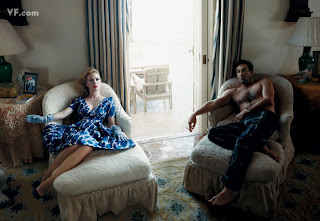 Eventually he summarizes: "Mad Men is too clear-eyed about its period to be called nostalgic—Weiner loves writing anti-Semitic wisecracks for his admen and showing pregnant women with cigarettes dangling from their lips—but at the same time there can be a yearning tug, even an ache, in the intensity of the show's backward gaze. Maybe it's a kind of wised-up, at times even loathing nostalgia—precisely the kind of contradiction that drives the show creatively."
Photos courtesy of Annie Leibovitz, Vanity Fair. Cross-published on Twitch.
 When it comes to consular promotion of Bay Area film culture, few do better than San Francisco's Italian Cultural Institute. Participating with local community organizations, cinematheques and movie theatres, the Institute helps put on a series of programs that bring the best of Italian cinema to Bay Area audiences.
 Currently running through August 29 at the Pacific Film Archive is Ecco l'uomo, a celebration of Italian actors in a series curated by Susan Oxtoby. As PFA boasts: "Behind every great Italian auteur stands a great Italian actor—or several. Where would Federico Fellini be without Marcello Mastroianni, or Mario Monicelli without Alberto Sordi or Totò? This series celebrates classic Italian cinema through its leading men."
I've caught two so far in the series—The Organizer (1963) and The Desert of the Tartars (1976)—and anticipate Elio Petri, Ettore Scola, Pier Paolo Pasolini, and Sergio Leone in the weeks to come.
 The Organizer (I compagni, 1963)—Mario Monicelli's depiction of the beginnings of the trade union movement in northern Italy at the end of the 19th century—features Marcello Mastroianni as Sinigaglia, a stubbornly idealistic schoolteacher sent by the Socialists to organize a much-needed strike in the textile-mill factories of Turin to improve the rights and lives of the workers. Judy Bloch writes that "Mastroianni's down-at-heels pedant turned agitator is played with shaggy restraint."
When the film opened at New York's Coronet in 1964, New York Times critic Bosley Crowther praised the drama as "engrossingly human, compassionate and humorous" largely due to Mastroianni's "delightful blend of ardor, ingenuousness and whimsicality." Crowther likewise extolled Giuseppe Rotunno's "superior" cinematography: "It has that wonderful lean quality, that strong, hard definition in subtly shaded black-and-white that you see in the classic still photographs of Jacob Riis, who did so much to depict the American urban scene at the turn of the century."
 At Ferdy on Films, etc., Marilyn Ferdinand provides a thorough plot summary and notes: "Monicelli, best known worldwide for his comic caper Big Deal on Madonna Street, has a deft hand for both the fine details and broad strokes of comedy and uses them to flesh out a story that in other hands has been told with tragic seriousness." She adds: "The community of workers is large, and Monicelli finds room to tell more than a few stories. While he highlights some families, the sense of shared fates is strong…." Ferdinand argues that The Organizer reveals many familiar patterns of labor films by utilizing Brechtian distanciation, allowing audiences to "project themselves into the masses of workers, deliberately emphasizing … a movement over individuality. It is the problem of a few individuals who want to keep the good life for themselves that creates the misery of the many, and labor films seek to put these facts in high relief."
 "In addition to the many wonderful comic/tragic performances of which Mastrioanni's is only one," Ferdinand concludes, "composer Carlo Rustichelli lends his considerable gifts to this film, punctuating the score with the types of comic moments for which he is known, particularly in his work with Pietro Germi. His tempos and Monicelli's lively mise-en-scène keep this somewhat complex film humming with energy. His Marcia della cinghia is superb—I'd be surprised if it weren't sung at labor rallies now as a legitimate populist march of solidarity."
 Valerio Zurlini's The Desert of the Tartars (Il deserto dei Tartari, 1976) sports a virile international ensemble—Jacques Perrin, Philippe Noiret, Max Von Sydow, Fernando Rey, Helmut Griem, Jean-Louis Trintignant, Francisco Rabal, Mohammad-Ali Keshavarz—with Vittorio Gassman and Giuliano Gemma doing the honors for Italy. As an allegory of how lives are subsumed in compulsive anticipation of and preparation for war, The Desert of the Tartars seems antecedent to Kathryn Bigelow's The Hurt Locker in its critique of the mindset that enforces military absurdity and the lives—primarily young men—lost to protocol and rank and file. But it's a minor association; the enemy in Iraq being all too real. The Desert of the Tartars emerges enduring for being compellingly surreal. "This allegory about the need for illusion," Judy Bloch writes, "takes on Kafkaesque qualities as the garrison becomes entrenched in its ritualized preparations for the enemy-that-never-comes. The enemy that triumphs will be the combined forces of illness and ennui."
 Based on Dinno Buzzati's 1940 novel The Tartar Steppe, The Desert of the Tartars is, as Bloch describes, "a discomfiting story about man's basic fear of the unknown. In the film this fear is symbolized by its location, a dreadful desert on the edge of some unknown country." Filmed at Arg-é Bam ("the Bam Citadel") in southeastern Iran, the film has accrued value for using this location as a character; a location since devastated by earthquake. At The Village Voice, Michael Atkinson finds Zurlini's film "fascinating both as a modernist flourish set in a primeval reality, and as a historical record" and explains it is "actually about the absence of event and consequence. It may be the grandest and most lavish existentialist parable ever made."
 PFA continues its focus on Italian cinema with Life's Work: The Cinema of Ermanno Olmi, also curated by Susan Oxtoby and presented in collaboration with the Italian Cultural Institute, running September 25 through October 30, 2009. Though PFA has not yet released the full calendar on this series, the Italian Cultural Institute's website announces: "Work—its rhythms, movements, pleasures, and pains—is at the heart of the cinema of Italian director Ermanno Olmi, who is best known for sly critiques of workplace drudgery like Il posto, and for later combinations of epic majesty and neorealist minutiae like the Palme d'Or–winning Tree of Wooden Clogs. In later years Olmi's deep love of the nature of work metamorphosed into a similar love for the work of nature; such films as Cammina Cammina, Secret of the Old Woods, and the new Slow Food documentary Terra Madre which will make its Bay Area premiere at the PFA."
 Overlapping in October will be the 33rd edition of Lido Cantarutti's Marin Italian Film Festival venued at the Marin Center Showcase Theater, San Rafael, CA, again in collaboration with the Institute. This year's program presents six new comedies and dramas from Italy over the course of six Saturday evenings from October 3 to November 14: Italians by Gianni Veronesi, The Right Distance by Carlo Mazzacurati, SMS/She Me She by Vincenzo Salemme, Lessons in Chocolate by Claudio Cupellini, Black Sea by Federico Bondi, and Giovanna's Father by Pupi Avati. The Marin Italian Film Festival affords Bay Area audiences a second chance to see Black Sea and Lessons in Chocolate, which premiered at last year's New Italian Cinema, put on by the San Francisco Film Society (SFFS). As for this year's edition of New Italian Cinema, SFFS hasn't announced the line-up yet, but, save your calendars for mid-November.
Cross-published on Twitch.
 Earlier, when I asked Program Director Nancy Fishman which program out of this year's edition of the San Francisco Jewish Film Festival (SFJFF) she was most anticipating, she didn't miss a beat in highlighting the salute to Gertrude Berg; a program consisting of four archival episodes from The Goldbergs television series, followed by Aviva Kempner's documentary Yoo Hoo, Mrs. Goldberg (2009). In tandem with SFJFF's presentation of the 2009 Freedom of Expression Award to Kempner, a Q&A session following The Goldbergs program, and a panel discussion following Yoo Hoo, Mrs. Goldberg, the program was leant considerable charm by the participation of Dr. Glenn D. "Pete" Smith, Jr., author of Something On My Own: Gertrude Berg and American Broadcasting, 1929-1956 (Syracuse: Syracuse University Press, 2007). Perhaps it was his Mississippian drawl, or his enthused (and contagious!) scholasticism, or the intriguing disconnect between his youthful interest in a subject matter mostly unknown by Americans under 60.
 Glenn D. Smith, Jr. is an assistant professor of communication at Mississippi State University located in Starkville, MS. Something On My Own was published by Syracuse University Press in 2007, and nominated for the 2008 Bancroft Prize, given for exceptional work in American history. The book has received notice in the Journal of American History, the Journal of Broadcasting and Electronic Media, Television Quarterly, and Shofar: An Interdisciplinary Journal of Jewish Studies, among other distinguished publications. It also has its detractors: Ben Birnbaum stages his complaints at Tablet Magazine. Professor Smith is currently researching the careers of union activist and blacklisted actor, Philip Loeb, and fellow Mississippian Carolyn Bennett Patterson, the first woman senior editor at National Geographic.
Dr. Smith's salute to Gertrude Berg (in PDF format) supplemented the SFJFF program and his comments during the afternoon tribute added—as mentioned—charming heft to the informational proceedings.
* * *
 Professor Smith's Intro to The Goldbergs:
Near the end of her life, Gertrude Berg asked herself, "Have I become the woman I always wanted to be or am I still trying?" If Gertrude was confused about her identity, she had good reason to be. After all, she spent more time as Molly Goldberg than she did as Gertrude Berg. The Goldbergs was produced, written and starred Gertrude but it was more than just a radio or television series; the first of its kind in either medium. It offered a glimpse inside the head of one of our more interesting, complex and prolific women in broadcasting history. If you wanted to know what Gertrude was thinking at any given moment in the day, look no further than that week's episode of The Goldbergs because—let's face it—she thought more about The Goldbergs than she did just about anything. I've often said in my writing that The Goldbergs was Gertrude's mouth piece for her political and social discontent. As you will see in the upcoming episode "Rent Strike", for example, Berg had something to say about the struggles of the common man and woman and she found the right person to say it in labor activist and actor Philip Loeb, who played Jake to her Molly.
So, The Goldbergs provides a glimpse into the world of Gertrude Berg. It offers, for example, bits and pieces of her own childhood in East Harlem, New York. It gives the viewer an idea of the life Gertrude may have lived—had she the inclination to do so—she had enough talent, drive and ambition to do something on her own. But yet The Goldbergs offers more than just a glimpse into the Gertrude Berg experience—as we celebrate her life today, let's look at it as just that experience—it also offers a microcosm of the Jewish American experience. All of this is to say that Gertrude—through The Goldbergs—created a venue through which the Jewish American was celebrated and people from all walks of life, including myself, were welcome.
* * *
 After screening the archival episodes of The Goldbergs—which included a heartfelt performance by a young Anne Bancroft in "Mother-in-Law"—Nancy Fishman asked Professor Smith to talk about the history of The Goldbergs on radio and television, bidding wars between studios for the show, and what caused it to eventually go off-air?
He responded: "Okay, some of you may not know that The Goldbergs was first a radio series in 1929, premiered at the start of the Great Depression, and Berg sold the series to NBC as a daily radio 15-minute serial with no sponsors. It took NBC two years to find a sponsor, Pepsodent Toothpaste (who also sponsored Amos n' Andy). She went from making about $75 a week in 1929—from which she had paid off the cast and crew—to $2,000 a week in the early 1930s. By the end of her first decade on radio—The Goldbergs, y'know, was a cottage industry—Berg was making the equivalent of about $7,500 a week and in 1937 she became the first woman in broadcasting to sign a million-dollar contract with a sponsor: Proctor and Gamble.
"So when I'm asked about Berg's legacy, just the fact that as a woman in a male-dominated business—and that's exactly what it was, make no mistake—she was able to write, produce, direct and star in her own radio series every single day for almost 10 years without interruption…! That being said, the show carried itself during the Second World War where Molly sold everything, including war bonds, and in 1945 the show was finally cancelled. In that 15-year period The Goldbergs bounced between CBS and NBC, whoever the highest bidder was at that time. If anything, that shows you how skillful Berg was at negotiations. If NBC, for example, didn't meet her demands, she would go to Paley's network. If Paley, by example, by the end of the next contract didn't meet her demands, she'd go back to NBC….
 "In 1949, the show did premiere on CBS—you saw three of the four episodes with Philip Loeb—and it lasted on CBS for 10 years and was ended, unfortunately, by the blacklist. Loeb was blacklisted for his union politics. He was a longtime member of Actors Equity, a champion for Actors Equity, he helped usher in things that I think most actors take for granted today, including rehearsal pay. …In his 20 years of union work, Phil would say that he loved Equity work first, his teaching at the American Academy of Dramatic Arts second, and acting third. It was, though, his union activities that got him blacklisted. Gertrude was asked by CBS and General Foods to fire him, but she refused. From there, she and Loeb were together in their 18-month stance in which they tried to find a new sponsor and a new network after CBS pulled the plug. The Goldbergs suffered from the blacklist itself, as did Berg. She spent the rest of her life piecing together what was left of her career and Loeb, of course, ended up committing suicide."
Asked whether Berg avoided being too Jewish on The Goldbergs, Professor Smith offered, "In the years I've researched Gertrude's career, one thing I've been struck by—in terms of The Goldbergs—is its universal appeal. She straddled that line between bringing the show that would celebrate—as we said earlier—the Jewish American experience, but not making it exclusive to one group of people. For years on radio some of her biggest fans were non-Jewish. Her favorite story, in fact, was when she got a letter from a group of Catholic nuns who had given up The Goldbergs for Lent. They had written to Berg to ask for copies of the scripts for episodes they had missed.
 "As the show progressed from 1949-1955, it did get more diluted (if that's a word I can use in this situation); it became more homogenized (I think is the word we use in academia when talking about ethnic shows). The ones in 1949 specifically address more Jewish themes than the ones in 1955, believe it or not. But I think it's just because she wanted to walk that fine line. She was also very aware that Mr. William Paley was watching closely. When you think about Paley and his politics, as much as he gave to Jewish causes, he was also timid about the fact of who he was and where he came from. That played into that as well. In fact, in the beginning of 1949, he didn't even want the series for television. As I've often said, it's one thing to hear an anti-Semitic line on a radio show, or a rock being thrown through a window (for example) during Passover; but, it's another to see it on television. That made William Paley nervous and Gertrude—if anything—was a business woman. She was very sensitive to what sponsors might or might not feel or want her to do, until it came to Philip Loeb when they went a step too far."
Protesting that something was lost when the venue from The Goldbergs was shifted from the city to the suburbs, one gentleman questioned why that decision had been made? Smith answered: "Yeah, The Goldbergs lost a lot in translation—you're absolutely correct about that—and it had lost a lot of air time too. The show had been almost 18 months off the air. Philip Loeb was blacklisted in September of 1950. Berg and Loeb fought the battle often with the studio that entire season with General Foods. CBS and General Foods cancelled the show in the Spring of 1951. And the show didn't reappear until later in 1952. By that point you had a different type of situation where shows like Father Knows Best and Leave It To Beaver and I Love Lucy—which, by the way, was the heir to Gertrude Berg's time slot—were on the air. By the time Gertrude came back to the air minus Philip Loeb, she was having to play catch-up. That's something Gertrude had never had to do in her life because she was the trendsetter for 20 years from radio, and now to play catch-up? Her son Charlie told me that she considered the Guild Film series sort of a step down. That was the last time the show was on the air in 1955. She had gone from CBS to NBC and then on to a syndicated film series, that was sort of her last gasp at a television career. She spent the rest of her life really trying to get back where she was in 1949 and that's, I think, the great tragedy of her career. The highlight was Molly Goldberg and—let's face it—that was the quintessential image that she created. She had a hard time, in many ways, letting go of that image. By 1955, things had simply changed and—you're right—the show as a result lost a lot in the translation."
 Asked about what I termed earlier as "the intriguing disconnect between his youthful interest in a subject matter mostly unknown by Americans under 60", Professor Smith chuckled and said, "That's the $64,000 question. That's always the first question I get. I enjoy that question because—as I tell my students—you know, a good television show and a good writer should transcend difference.
"I became interested when I was in graduate school. I was working on my masters at the university and—like most graduate students—I was looking for a good thesis topic. I ran across her name doing some research and I'm a journalist and a historian by trade—and I've told this story many times—but it was just a damn good story. I mean, point blank, a screenwriter could look for this kind of stuff and never find it. So I stayed with it. Believe it or not, I identify with Gertrude's story. Growing up in the South, we Southerners knew something about trials and tribulations ourselves, and her story speaks to the American Dream. Who doesn't want what Gertrude had in some way? Once I got to the blacklist, and started investigating Phil's life—for some reason I keep calling him Phil, like I knew him—but, once I started investigating that, I knew I had a big story. Then I knew I had a dissertation topic, which became my book. That's the long way around a short answer, I guess."
Fishman pursued this query in the panel discussion after the screening of Yoo Hoo, Mrs. Goldberg. Along with wanting to know what drew Professor Smith to Gertrude Berg, Fishman wanted to know when he knew he would end up writing about her? Which is unusual because Smith is from Mississippi, "Which," Fishman quipped, "was even farther away from Manhattan than the Bronx."
"Yeah," Smith grinned, "it's a long schlep. First of all, [her children] Cherney and Harriet were very hospitable to me. I was 27 or 28 when I sat down to interview Harriet and she said, 'Can I ask you a question before you start?' I said, 'Absolutely.' She said, 'Are you Jewish?' I said, 'No, ma'am.' She said, 'Do you mind if I ask your religious background?' I said, 'Well, I was raised Southern Baptist.' She said, 'Oh my God, you're a long way from home.'
 "To answer your question, I was doing some research for my masters thesis in Auburn back in 1994 and—as I was telling this story earlier—like most grad students I was struggling to find a good topic for my masters thesis and I ran across Gertrude's name in some obscure book on women in comedy, which I found funny later on because Gertrude never considered herself a comedienne; she considered herself a performer first and foremost. But anyway, that reference led to another reference and turned into a class I was doing on broadcasting history and women in the media corps. I took it all in and that parleyed itself into a partial masters thesis and then a dissertation topic at the University of Southern Mississippi. But like most journalists and/or historians, it was just a damn good story. That's the honest-to-God's truth. I do identify with Gertrude's story a little bit—I have a family member who has struggled with mental illness—those kind of little nuggets stick with you. She reminds me—Gertrude, not Molly—of my own mother, a woman who has called me three times in the last four hours. A strong, domineering, Southern woman who did not get to live out her own dreams so she transferred all of those to her two daughters and her son. Part of it's that; but, it's just a good old-fashioned story.
"As far as when I knew that I had something, it was when I got into Syracuse. I had many fits and starts with this project. I had actually fallen asleep one night and had a dream about Gertrude. She was playing in a stage play and my mother was out in the audience with me—I can't figure that one out, to save my life—and she invited me, Gertrude did, to come back stage after the play. I told my mother she needed to stay in the audience and I went back there and Gertrude sat me down and we chit chatted—because Gertrude loved to chit chat—and she said, 'Darling, you're doing a good job. Make sure they don't forget me.' I woke up the next morning and I said, 'You know what? This is my project.' The minute I got to Syracuse and stumbled upon her two children, as my dissertation director told me, 'Goddamn, you've hit the motherlode here.' That's when I knew."
Asked where Gertrude Berg's broadcasting career would have gone had she not defended Philip Loeb, and conceding that morally she really had no choice, Professor Smith added, "It bothered her anyway. Even the fact that she went to the ends of the earth—which most people would agree that she did—the fact that she couldn't do enough really sat next to her. Those are the kinds of things that kept Gertrude up at night. She wasn't worried about the next day's script—because she had those things down pat—but, it was this fundamental belief that her grandfather taught her that in America the principle of fair play should actually mean something. She practiced that to the best of her ability in her career. Was she always fair? I don't know. Did she always make the right decision? I'm not sure. But I do know one thing. She didn't bat an eyelash [deciding] to protect Phil Loeb. That was the great tragedy of her legacy. She always felt like she didn't do enough."
Aware that Berg successfully played NBC and CBS off each other in a bidding war during the height of the show's popularity, Fishman wondered if it was easier for Berg to do so because she was a woman? Did that soften her relationships with Paley and Sarnoff and their minions? "Absolutely not," Dr. Smith objected. "Being a woman just made it twice as hard for her, especially when they found out at the board meetings that she was nothing like Molly Goldberg. I have copies of memos going between one NBC vice president to another and they don't know what to do with her. She learned the business from the ground up and was literally the only woman in a roomful of men, who at first patronized her and considered her to be Molly Goldberg and—once they realized their mistake—she was laughing all the way to the bank, as they say."
As for whether she would have had the same success if her career had started after the advent of television, and if she had not already established herself as a major radio star, Professor Smith mentioned: "Let's give credit to Worthington 'Tony' Miner, who was a young producer from the World Theatre who Paley had hired and entrusted with three charges. He wanted Miner to bring a children's show to the network so Miner helped create Mr. I. Magination. Paley wanted a variety show on CBS so Miner found Ed Sullivan to create Toast of the Town. Paley was looking for a third element, a radio drama, and Gertrude did force the issue on Paley and Paley did give her an audition; but, Miner saw the audition. He probably helped convince Paley that this was the third element in the trifecta, so to speak. To give a more personal answer, Gertrude told Judith Abrams when Judith asked that very question in the early 1960s, 'Do you think you would be successful today knowing what you know?' and Gertrude said, 'No. It's all about timing.' She said, 'I just happened to be in the right place at the right time and in show business it is all about timing.' "
Noting that television shifted towards conformism for reasons having to do with a lot more than McCarthyism and the blacklist, one fellow wondered if popular culture could have been different without those factors? Professor Smith thought not. "I don't think so, simply because Paley and Sarnoff controlled so much of the industry early on and they couldn't help creating the characters as people who didn't resemble them. They helped homogenize these images. You have a gulf from the 1950s to the 1970s. It took someone like Norman Lear to step forward and recreate the narrative, so to speak. Between that there's this gulf, this void, and women like Gertrude were no longer around to help create the narrative. Everyone talks about the creativity in Hollywood but—with all due respect—they recycle the same thing over and over and play it safe. You have to remember it's a business and Paley and Sarnoff were in the business of making money—not that there's anything wrong with that—but, somehow they're afraid that they're going to offend some viewers out there in Kansas somewhere who will take offense to someone like Gertrude Berg. They continue to underestimate our ability to be sensible viewers."
Asked if Berg was familiar with the Bronx, where The Goldbergs was set, Professor Smith replied: "Gertrude was a meticulous researcher and she spent a long time in the lower east side back in her radio days where she became recognizable. She would join mothers clubs in the lower part of Manhattan just to pick up the accent and the conversations and that sort of thing. But when she went to television, she gave up directing to Walter Hart. CBS wanted to hire a writing staff and she liked that idea but—as Newsweek pointed out in 1949—she owned the whole kit and caboodle so she did go to the Bronx and according to at least one newspaper article I know, she did visit Treemont Avenue.
"She noticed there was a lot of commotion in one apartment—it was a child's birthday party—so she knocked on the door and asked if she could come in? One of the kids from that party ran out the door and ran to a nearby park and shouted, 'Molly's in our house!' A stream of kids came running back. As far as I know, she did visit the Bronx just to get the look and feel of what Molly's world was like. Even though she grew up in East Harlem, Gertrude loved Park Avenue. That's where her roots were as a modern woman.
Prefacing that several scripts on The Goldbergs were quite provocative and inclined towards the Left, another gentleman questioned whether there was ever any concern that they were pushing the envelope at a time when the tide was clearly moving in the other direction? "No," Dr. Smith answered, "because she was selling a buttload of Sanka coffee and that's all William Paley really was concerned with. I have made the stance before—let's make no mistake—Philip Loeb was the reason this show was blacklisted. It had little to do with the social issues in the show. I do grant you they are very progressive scripts; but, if you watched TV in 1949, I don't think Gertrude was the only one doing the unusual. The government had been chasing Philip for two decades. His politics in the union had divided many people within Equity. He'd been running from the Attorney General and later on the Senate Internal Security Committee off and on for years and it just finally caught up with him. But that is the reason the show came to a screeching halt, not because of the scripts. Because once again, as long as the show was selling the product, that's all the sponsor was concerned with. Loeb just got too much publicity and it got just a little too warm in the kitchen for the sponsor."
As for whether Gertrude Berg wrote scripts for others, Smith relayed, "She did other things in the 1930s. She actually had another radio series The House of Glass about a woman who runs a hotel in the Catskills (sound familiar?). She dabbled in that off and on. The integral years, the post-war years rather, between 1945 and 1949, were some dry years, so to speak. She was working on her play Me and Molly and the quote 'she was floundering around looking for something to do' that I used in the movie, that's from Harriet Berg who told me that. She said her mother was 'floundering around.' She said she was unbearable when she wasn't performing. Harriet did tell me this, she said, 'You can always tell when my mother got a new gig because we could stop taking the bus.' Not that Gertrude ever took the bus—she took maybe one trip—but she tried to cut back on the shopping, which she loved to do. It didn't last very long. She loved the work and that's what motivated her as a mother and a wife."
Cross-published on Twitch.
 Hello. My name is Michael and I am a film festival junkie, which means I cycle through addiction (should I watch four movies today or five?), recovery (I'm feeling oppressed with movies and I'm going to stop watching so many of them) and recidivism (the Toronto International's coming up!). Thus, you can imagine my unbridled delight in Film Festival Yearbook 1: The Festival Circuit, edited by Dina Iordanova with Ragan Rhyne, published by the Center for Film Studies at the University of St. Andrews and Wallflower Press.
As synopsized: "The first installment in an annual series, the Film Festival Yearbook features essays on the global proliferation of film festivals, focusing on the dynamics of the festival circuit. Contributions discuss the function of individual festivals within a larger and more complex network and the cultural policies that shape channels of film exhibition and distribution. The inaugural volume will include essays by Dina Iordanova, Charles-Clemens Rüling, Ragan Rhyne, Ruby Cheung, and Rahul Hamid. Forthcoming volumes cover gay and lesbian film festivals; festivals of Asia and the Asian diaspora; and the relationship between festivals and geopolitics."
Dina Iordanova is professor of film studies at the University of St. Andrews, where she directs the project Dynamics of World Cinema. She is the author of Cinema of the Balkans and Cinema of the Other Europe: The Industry and the Artistry of East Central European Film, both published by Wallflower Press. She guest-edited a recent Festivals issue for Film International, where I first became acquainted with her work and which I reviewed for The Evening Class. Highly-recommended reading.
As is Film Festival Yearbook 1: The Festival Circuit, which impressed me straight off for its staged parity between academics and critics-practitioners. Walking their talk even further, I was honored—as a non-academic and more practitioner than critic—to be invited to contribute to the next volume. Reviewing the worth of this first volume is almost impossible, if not implied—its necessity and timeliness are givens—so, instead, what I've decided to do is to respond to the essays themselves in a series of four entries that correspond to the sections of the book to set an (idiosyncratic?) example of how I've rendered the information relevant to my own festival experience(s).
As editors Iordanova and Rhyne lay out in their introduction to the volume: "By launching the series of the Film Festival Yearbook with this inaugural volume, we aim to: 1) explore festivals in a systematic manner that, while relying on individual case studies, will foreground theoretical concerns at the intersection of arts management, cultural policy and film studies and 2) chart the complex structure of the international film festival network, bringing along a better understanding of World Cinema. A level of abstraction is needed for the study of festivals to gain momentum and translate the currently scattered research environment of festival studies into a sufficiently structured context. Our hope is that the Film Festival Yearbook will serve this function.
 "In a programmatic essay, Thomas Elsaesser described the festival network as a specifically European industry response to Hollywood's distribution mechanisms and explored festivals in the context of actor-network theory. With respect to Europe, Elsaesser claimed, the festival circuit had become the key force and power grid in the film business, with wide-reaching consequences for the respective functioning of other elements of film culture, such as authorship, production, exhibition, cultural prestige and recognition." (2009:2) That "programmatic" essay—"Film Festival Networks: The New Topographies of Cinema in Europe"—was published in Elsaesser's European Cinema: Face to Face With Hollywood (Amsterdam: Amsterdam University Press, 2005). Although film festival scholarship had been ongoing for some time, Elsaesser's essay provided a fulcrum through which existing scholarship could be incorporated into the burgeoning field of film festival studies as well as a gameplan on how to proceed systematically. As important as his essay is to the field of film festival studies, I'm heartened that it has been made available in PDF format. Again, highly recommended reading.
"It is only through the continued development of both strands of festival studies—case studies and the theorization of their broader relevance to our understanding of the festival as a circuit—that this research will continue to progress," Iordanova and Rhyne argue in their introduction. "Just as the study of museums and galleries has become crucial to our understanding of the institutionalization of arts and heritage, so too must the study of festivals be central to understanding the socio-cultural dynamics of global cinema and international cultural exchanges at large." (2009:1)
As mentioned earlier, the volume has been divided into four sections. The first section on the film festival circuit begins with an analysis by Ragan Rhyne—"Film Festival Circuits and Stakeholders"—wherein she "deploys some of the case studies in this volume, arguing that the various interests of festival stakeholders are negotiated through the administrative and economic structures of a newly-globalized non-profit sector." (2009:3) Ragan Rhyne is a Research Associate at the Center for Film Studies at the University of St. Andrews on the Dynamics of World Cinema project. Her work has been published in GLQ, Velvet Light Trap, and the Journal of Homosexuality. It is perhaps of contextual import to note that the Dynamics of World Cinema project is a major research project undertaken by the Center for Film Studies at the University of St Andrews and sponsored by The Leverhulme Trust. This two-and-a-half-year-long study hopes to examine the patterns and cycles of various distinctly active circuits of contemporary film distribution and exhibition, and the dynamic patterns of complex interaction between them. Their attention will focus predominantly in four areas of the global circulation of non-Hollywood cinema: the international penetration of international blockbusters mainstream distribution, the film festival circuit, the film circulation via diasporic channels, as well as the various Internet-enabled forms of dissemination. The project's distinctiveness is in the endeavor to correlate these diverse strands and foreground their dynamic interactions.
Rhyne's essay poses the provocative consideration that the film festival "circuit" might be a misnomer. "The trouble," she writes, "is that materially, the film festival circuit is not nearly as connected as we have thought. In fact, we might abandon the structural idea of the festival circuit as a single entity altogether and instead understand it as an international cultural sector linked by a common economy of public and private subsidy." (2009:9) This economic understanding of the festival as a cultural industry managed through a global non-profit sector necessarily places a spotlight on who the stakeholders are in any given film festival. By "stakeholders", Rhyne references "filmmakers and studios, journalists and press agents, professionals and programmers, local cultural councils and supranational agencies, tourist boards, cinephiles, and others", all of whom she proposes "have particular interests in seeing the network proliferate." (2009:9) As both journalist and cinephile, I'm primed to question my own staked interests.
 Rhyne's historical purview of the role the non-profit mechanism has had in enabling film festivals to function—being funded by "some combination of earned income, government funding, corporate sponsorship and private donations" (2009:10)—likewise raises thorny issues about the hazardous reliance on such means of economic backing. Most recently, at the 29th edition of the San Francisco Jewish Film Festival, Executive Director Peter Stein and the festival's programming staff came under severe fire from conservative constituencies protesting the inclusion of Simone Bitton's Rachel, a documentary about Rachel Corrie and her controversial death. Conservative private donor Maurice Kanbar—who felt Rachel had no business being in the San Francisco Jewish Film Festival line-up—was overheard proclaiming that the Jewish Film Festival would not receive one more penny from him. The Koret Foundation and Taube Foundation likewise pulled their funding, protesting injuries to the Israeli state. They were deeply offended that the SFJFF invited Rachel Corrie's mother to the festival, and that the program was co-presented by the American Friends Service Committee and Jewish Voices For Peace; organizations which they claim are "virulently anti-Israel, anti-Semitic groups that support boycotts, divestment, and sanctions against Israel." At Tikun Olam, Richard Silverstein staged debate on the issue. Statements by both The Koret Foundation and the San Francisco Jewish Film Festival have been posted at JWeekly.com, where coverage on this "controversy" has continued.
I, in no way, want to deminimize the economic impact that withdrawal of funding from Kanbar and the Koret/Taube Foundations might have on the operations of the San Francisco Jewish Film Festival, albeit momentarily, and I consider this an unfortunate blow; however, this is a classic example of funders trying to manipulate a festival's programming, and thereby cultural policy. Perhaps Kanbar and the Koret/Taube Foundations should concert their conservative efforts to financing their own Zionist Film Festival—spelling it out clearly for all concerned—and leave the mission objectives of the San Francisco Jewish Film Festival alone?
In a less vitriolic but no less important example, the Los Angeles County Museum of Art recently jettisoned their 40-year-old film program. Doug Cummings has provided a masterful synopsis of the controversy at his site Film Journey; a controversy that, once again, underscores how withdrawn funding can strangle film culture. Critic Kenneth Turan lays out the hazards competently for the L.A. Times.
 Both examples confirm Rhyne's hypothesis: "From the outset, geopolitics and cultural politics have been co-articulated in the institutional structures and commercial affiliations of international film festivals." (2009:11) Rhyne cites Daniel Dayan's essay "Looking For Sundance: The Social Construction Of A Film Festival" (published in Moving Images, Culture and the Mind) wherein Dayan remarked that the film festival—referencing Sundance specifically—is often "an agonistic site of negotiation" dependent "upon a variety of conflicting interests" and "structured to not only contain them but also to deploy them toward institutional goals through what he calls the collective performance of the festival—a performance that actually requires the negotiation of these conflicting interests. Ironically, these conflicts, he argues, are fundamental to the cohesion of the festival as an event.
"…Dayan argues that the festival is constituted not only through the negotiation of these conflicts but also through journalistic chronicles of it—what he calls the 'written festival'. 'Like the physical event, but even more acutely so, the written festival turned out to be made of different versions, relaying different voices, relying on different sources of legitimacy. But it also provided its own common threads.' (Dayan 2000:52).
"Through his concept of 'the written festival', Dayan suggests that film festivals—or at least Sundance in particular—are constituted not only through the negotiation of various stakeholders, but through the articulation of these conflicting positions in journalistic coverage of the festival. This negotiation, in other words, is not incidental to the festival institution itself, but crucial to both its function as an event and to the way that the festival is understood as a cultural phenomenon. We might understand this as suggesting that the constant public discussion of the battle of festivals for aesthetic autonomy from the varying pressures of Hollywood, audiences, critics and corporate sponsors is theoretically misleading. The festival cannot solve these conflicts. Rather, it has an interest in playing them out in the cultural public sphere." (2009:18-19). San Francisco and Los Angeles have certainly had the opportunity to do so in recent weeks.
It's perhaps important to remember that the festival as a cultural industry managed through a global non-profit sector was an evolved response to the administration of the world's first film festival in Venice, founded by none other than Benito Mussolini and conceived as a tribute to fascism in Italy and Germany.
Moving on to Dina Iordanova's entry "The Film Festival Circuit", she "challenges the standard line in festival studies that film festivals constitute an alternative system of distribution. Instead, her suggestion that it is better understood as an exhibition network sheds light on how the economy of the festival circuit actually functions." (2009:3)
Cautioning that the art of cinema has been taken over by seemingly "secondary concerns like the rank of celebrities on the red carpet and the numbers of accredited journalists" (2009:23-24)—take heed San Francisco International!—Iordanova concludes: "The global film festival phenomenon is not inherently networked. Most festivals come about as singular ventures, independently from each other as temporary entities and discrete exhibition sites. They mushroom autonomously from each other, copying each other's model and replicating it in their own locality. It is only after a festival is established locally that the issue of its relationship with other festivals in what constitutes a loose network comes about. In that, individual festivals are discrete phenomena that spring up independently rather than as part of an orchestrated move." (2009:26).
The notion of film festivals as an alternate distribution model surfaced for me during my days on the board of the Global Film Initiative and was articulated by Jonathan Marlow in his fiercely opined Greencine editorial "They didn't build their sales model for you" (which remains a good read all these months later).
Film festivals as an alternative exhibition network, however, raises questions about the fees extracted by filmmakers and distributors from festivals to offset costs which will most likely never be achieved by a theatrical distribution (rendered incidental). Transparency on this subject is woefully inadequate. Any input encouraged.
 Finally, Janet Harbord's essay—"Film Festivals-Time-Event"—"takes a somewhat different approach to her conception of the festival circuit, calling for renewed attention to the temporality of the festival circuit, rather than a strict focus on festival geographies." (2009:3) Harbord is Reader of Film and Screen Media at Goldsmiths, University of London. She is the author of Film Cultures (Sage, 2002), The Evolution of Film (Polity, 2007) and Chris Marker: La Jettee (Afterall/MIT Press, 2009).
Harbord's essay thoroughly fascinated me, as much on a philosophic level as on a cinephilic one. "While attempting to think of a film festival, its meaning is inseparable from its particular location. And if it is not possible to make sense of a film festival without its emplacement, it is increasingly difficult to imagine certain cities apart from their film festivals." (2009:40). Hello, San Francisco! In my recent research project on the community-based festivals in the Bay Area, it's already becoming apparent how crucial the multiculturalism and ethnic diversity of San Francisco and environs plays out in its ongoing festival culture. In some respects when it comes to personal experience, some cities are their film festivals. Though I have been to Toronto several years in a row, I know nothing about the city itself except the infrastructure of TIFF. The same for the Palm Springs International. I do not extend myself past the festival experience to familiarize myself with what else the city might have to offer. But those are the admitted failings of an affirmed film festival junkie.
The spatial qualities of film festivals not only have to do with urban settings but the venues within those cities. For example, I have a vigilant eye on negotiations to move the San Francisco International out to the Presidio and away from the more-convenient Sundance Kabuki theaters. I hope to determine why this is considered a necessary choice; what—if any—connection it has to civic subsidies for development of tourism; and if this choice can escape a critique of classism, especially from a population committed to public transit? Has the San Francisco Film Society thought out a solution to access? Transit to the Presidio is highly problematic, let alone that the site itself is insular, with few amenities for the public. Will SFFS consider shuttles from convenient transit nodes (much like the Palm Springs International) or are they catering to an upper echelon of membership who can drive their fancy cars to the festival; lower minions be damned? I propose that one of the most winning aspects of the Toronto International Film Festival is how its public transit system efficiently connects its various venues, insuring egalitarian attendance.
As for time? Her essay could have just as aptly been entitled: "Does anybody really know what time it is?" Harbord defines a film as a recorded document of something past, which is then exhibited in the present. She argues that festivals gather together "the time of film and the time of viewing and recenters the time of projection as a live event. This choreography of a dance between the live event on one hand and the recorded, pre-fixed film on the other is the manufactured time of the festival. The alchemy resulting from these different temporalities, the now and the then, characterizes the potency of the film festival as event." (2009:44)
Further considerations of time involve when a festival is scheduled within a yearlong calendar. One of the specific challenges encountered by the San Francisco International, let's say, hinges on its being perhaps the very last festival of the calendar year, coming into play as Cannes announces its line-up of what is presumed to be the next year's bumper crop of films. Then there is the somewhat addictive intensity of film festivals produced by the compression of time anywhere within a few days to a few weeks. Then there's each person's selection of films, the choices made to best manage time spent at a festival; choices that include film length, film stock, conflicted screenings, and how much time one has to get from one venue to another, or to nourish the body with food, social networking or unapologetic down time.
If truth be told, my film writing was conceived by diary entries; my journalism from journal entries. Anaïs Nin encouraged me to consider that attending a film was a valid moment of life experience. She faithfully recorded cinematic events in Paris in her diaries, which inspired me to endeavor the same. This habit of writing in my diary about films I've seen has reached its seeming apotheosis in The Evening Class, which has become my running account of the sociality of Bay Area film culture. Harbord reflects on same: "A critical factor in the manufacture of live time is the role of reporting, the witness statements of journalists and bloggers sent out to the wider public to describe the event that has already happened. If the gate-keeping functions of film festivals are most evident in spatial terms, the barriers and ropes that demarcate internal worlds, the temporal also has a function in this practice of demarcating the event from everyday life, from the outside. Written reportage, which is the main form of festival journalism, is a delayed experience, a postcard as it were emitted from the place of happening. The newspaper report helps to seal the time of the event as a live happening that can only be recounted afterwards to those outside of its boundary.
"The task of the film festival is to make time matter," Harbord asserts, "to give urgency to the viewing of film in an historical context in which the public release of film is no longer a necessary compelling event of itself. The condensed structure of the festival makes the here and the now of viewing critically important. Contingency, which marks the festival as an unfolding event whose details are unknowable in advance, affords a singularity to the experience: to see a film here and now will be unlike any other time of viewing. This moment of viewing will attach itself to the film in many cases, bringing a film notoriety or award that then becomes part of its circulation, a moment 'carried over'." (2009:43-44).
These are fascinating concerns that ramify into considerations of what the difference is between the advance previewing of films on screener in contrast to the in-cinema reviewing of films in a festival, modes of distribution and exhibition, and how both anticipation and fulfillment are temporally and spatially structured.
Cross-published on Twitch.
 As part of its 50-year anniversary, The Center for Japanese Studies at the University of California, Berkeley recently awarded internationally acclaimed filmmaker Hayao Miyazaki with the 2009 Berkeley Japan Prize, which honors individuals from all disciplines and professions who have, over a lifetime, influenced the world's understanding of Japan. Hayao Miyazaki is the second recipient of the recently inaugurated Berkeley Japan Prize; the 2008 winner was novelist Haruki Murakami. In conjunction with his in-person acceptance of the award, Hayao Miyazaki was also honored with a series of events held on the UC Berkeley campus celebrating his timeless body of film work.
 One of those events was an onstage conversation in Berkeley's Zellerbach Auditorium between Hayao Miyazaki and Roland Kelts (Tokyo University lecturer and author of Japanamerica). My thanks to Peter van der Lugt for alerting me to the event and inviting me to transcribe the conversation for GhibliWorld.com. Further thanks to Duncan Williams, Chair of the Center for Japanese Studies, for arranging a last-minute pass to what had long been a sold-out event.
GhibliWorld.com has faithfully kept track of Miyazaki's West Coast promotional tour for Ponyo, which has included the trip to the UC Berkeley campus, UCLA, and San Diego's Comic-Con. Variety devoted their July 22 issue to contextualizing Miyazaki's career, via the American promotion of Ponyo, specifically at Comic-Con. In her report, Ellen Wolff quoted producer Kathleen Kennedy that one of her shared frustrations with Studio Ghibli is the "conundrum of how to distribute [Miyazaki's] movies in North America in a way that people realize these pictures can appeal to a wide range of audiences and not just be relegated to arthouses." I find this "conundrum"—that despite global acclaim Miyazaki's U.S. record is hit-and-miss—somewhat difficult to imagine. His capacity audiences seem to refute that. Further, as much as I wish Miyazaki the increased marketability he wishes for his films, I've poised concerns about how this is to be effected in the U.S.
The Variety coverage also included Erin Maxwell's dispatch from Comic-Con's Pixar/Disney panel, where Pixar's John Lasseter and Japanese animator Hayao Miyazaki were honored with Inkpot Awards for "great contributions to pop culture."
 Variety likewise gathered tribute testimonials from several industry professionals—Nick Park, Pete Doctor, Jean Giraud, among others—on how Miyazaki has inspired them. And Andrew Stewart reports on husband-and-wife team Don and Cindy Hewitt and the strategic care they have taken with dubbing Ponyo's English translations.
On behalf of Twitch, Doug Jones has compiled a condensed reaction to Miyazaki's various Southern California appearances and—as mentioned earlier—my transcript of Miyazaki's onstage conversation with Roland Kelts can be found here.
Illustration of Hayao Miyazaki courtesy of Marla Campbell, Variety. Cross-published on Twitch.
 The San Francisco International South Asian International Film Festival (3rd i for short) is held each year in early November. As Vanessa Hua explained at the San Francisco Chronicle: "The name is a riff on the third eye, a symbol of internal reflection and perception, and Third World cinema, or movies from developing countries." This year's edition—continuing with their expansion into a four-day format—will venue at both The Castro Theatre and the Roxie Film Center. As a non-profit, national organization, 3rd i was founded by Ivan Jaigirdar, Shilpa Mankikar, and Camille Ramani in 2002 to represent filmmakers and audiences from Bangladesh, Bhutan, India, Nepal, The Maldives, Pakistan, Sri Lanka, Tibet, and the South Asian Diaspora. An early interview with Ramani and Jaigirdar for The Indian Express explored the early efforts of the organization, which has continued to support their mission by providing film screenings, filmmaking courses, networking resources, and a distribution channel for the South Asian-American film community and their audiences.
 I met with Artistic Director Ivan Jagirdar and Administrative Director Anuj Vaidya at ATA for this research interview for Diaspora By the Bay. Along with being Co-Founder and Executive Director of 3rd i South Asian Films, Ivan Jaigirdar is the Artistic director of San Francisco International South Asian Film Festival and the Bollyhood Cafe. Prior to founding 3rd i, Jaigirdar served as Creative Director and Programmer at Artist Television Access (he is still on the board), and has helped curate programs for numerous festivals including San Francisco International, Asian American Film Festival, Madcat International Women's Film Festival, the Black Film Festival, and NoisePop. Also an accomplished filmmaker, Jaigirdar's work has screened in festivals all over the world.
 Jagirdar: There wasn't anything specific except that we wanted to get diverse images of South Asia; films about South Asia of South Asians by South Asians. They weren't commercial. They were underground alternative films. We started off with humor because we knew that attracted people so we showed depictions from British South Asian filmmakers, like Goodness Gracious Me and things like that. Then we went on to queer South Asian representation and then experimental South Asian representation. We try to get a variety of images.
 Anuj Vaidya: Also, the idea of Asian or South Asian, they're constructions, right? And so I think in a way when Asian was considered or when that identity came to be, it was imagined as East Asian. That was what the community was at that time. It's only been in the last 10 years or so that this South Asian community has become a more visible presence.
 Jagirdar: I think we're used to seeing the traditional stereotypical Apu Trilogy based in India. I'm not critical of them; but, that's the kind of image that people have of India and of South Asia as a whole. In Britain there was more—at least from the diasporic perspective—a contemporary perspective that we were not just from India or Bangladesh or Pakistan or Sri Lanka; we're also from England. We're also from Australia and the U.S. So when I'm talking about the critical mass, I'm talking about the perspectives of South Asians in that context of England and using both the language of cinema in India as well as from Britain. Again, it was the cross-pollination of the two producing something new, a different expression. We'd see it in short films. Eventually, we got Bend It Like Beckham and, of course, now Slumdog Millionaire rooted, arguably, in British Asian roots. But there was also music and writers like Salman Rushdie so it was not just in film. There was The Buddha of Suburbia, a television miniseries made from the book. It was all of that and all of that working together,
 Jagirdar: I love that film! It's one of my favorites. It's a critical look at early representations of South Asians in Hollywood: Sabu in Jungle Book. It shows Sabu as who he was, what he was, his real life and his constructed life in cinema and how he suicided at the end. Surviving Sabu is the narrative of a British Queer South Asian based in England telling that Hollywood story. It's very well-done.
 Guillén: With there being a proliferation of South Asian film festivals, has that meant that collaboration has been co-opted by competition? Or are you collaborating more with these other festivals? Is there the equivalent of a 3rd i Film Festival in Los Angeles that you can share programming with?
 Guillén: That's why Lagaan hit so well when it did; it had all three. I would argue Lagaan was the turning point in America's exposure to and acceptance of Bollywood film.
 Jagirdar: I don't know if it's deepened it. There's just a different conversation going on.
 Guillén: But in all fairness, sometimes the film is spectacular enough. For example, your screening this last year of Om Shanti Om in the Castro Theatre was one of the most thrilling in-cinema experiences I've ever had. I've never seen an audience react like that. During that final musical sequence when all of Bollywood's best and brightest make an entrance, the audience screamed each time a new star appeared. I mean, I didn't even know who these people were and I was screaming, I was so excited!
 Jagirdar: We also try to get films for specific communities so that we represent as many communities as we can. For example, we'll try to get a Sri Lankan film each year if we can even though it's always hard to get one. Either that, or we'll try to get a Bengali film or a South Indian film. We really work on that. So then when we get the film, we'll ask the community to support the film as well. One of the approaches we had at the beginning when we first started was to have the monthly screenings so that we built up our name recognition and got people interested in us throughout the year. That's what we're bringing back—and Anuj is really working that at the moment—in terms of our monthly screenings becoming as vital and a part of our publicity towards the film festival.
 Jagirdar: We haven't really, though we have a little bit. Slumdog Millionaire was one of those collaborations. That was a good way to begin the spectacular. We've done others with co-presentations, like Bend It Like Beckham with CAAM. The year before we did Loins of Punjab, which for us was spectacular.


