William Goyen, who died at the age of 68 in 1983, was born in Trinity, Texas, in 1915. He is the author of the acclaimed House of Breath (1950), The Collected Stories (1975, nominated for the Pulitzer Prize in 1977), and the novel Arcadio (1982), as well as numerous plays and short works. Mr. Goyen lived and worked primarily in New York and Los Angeles with his wife, the actress Doris Roberts.
Along with so many other visionary authors, I have the diarist Anaïs Nin to thank for exposing me to Goyen's poetic prose. While I was attending college in Emporia, Kansas, the fifth volume of Anaïs's already-infamous diaries had just been published and—though I lived on a student's meager income—I bought a hardbound first edition first printing. I took note of the following passage written in the winter of 1949-1950: "Possibly the only expression of American energy will be scientific, industrial, and the only vital art which can match up to it will be jazz. Possibly the American novel [will] never be written, certainly not by the new novelists who instead of maturity portray hysteria, brutality in place of feeling, clichés in place of revelation, obscenity in place of sensual vitality. But William Goyen writes House of Breath, a beautiful, sensitive novel, subtle and like a waking dream (1974:54)."
 That was cue enough for me to hunt out House of Breath, which—to paraphrase Goyen's fully-sympathetic gay character Folner—was my sensual revelation. No writer, not even Anaïs, has had such a profound influence upon my own writing. I even used one of Goyen's short stories "Ghost and Flesh, Water and Dirt" to satisfy a directing assignment in one of my theater classes.
Continuing in her sixth diary, Anaïs wrote in the Fall of 1956 that Goyen was "a master of atmosphere and suggestion" but characterized him as a wounded writer who—though critically acclaimed, especially in Europe—had been deeply hurt by his commercial failure at home (1976:63). All these years later, Goyen has nearly been forgotten; but, in my heart, he remains a writer's writer whose work will bear the critical scrutiny of time, no matter if the buying public has abandoned him.
 What struck me immediately about Goyen's writing was his access to spiritual insight through sensual experience. For me, this rang authentic, true and relevant. I discovered him before moving to San Francisco and so—as yet—had few positive gay role models. Thus, I derived much solace from House of Breath, particularly Goyen's character Folner who resonated with me to the marrow, all the more for knowing who he was. "Right away," Folner declared, "I learned what I was and went on like that, what I was and used myself for that, made no bones about—and can't say the same for most of the rest of Charity who don't know who they are. What matters if it got me death?" (Years later during the AIDS pandemic Folner's bold assertion reverberated with an eerie and disconcerting precision, but back then, when I first discovered him, he was inspirational for being a character way ahead of his time and for encouraging free self-expression.)
Goyen practiced a compassion for gender variance in 1950 that was practically unheard of at the time and his writing was equally as prescient regarding ecological concerns, which have sadly come to bear in recent years. When I headed out hitchhiking to San Francisco in 1975, it was very much in the spirit of Folner's rebellion against rural ennui. "I was wild for the world of a flashing eye and life castanetting round and stomping an insinuating foot. Sometimes in Charity I couldn't stand it any longer and would go out in the henhouse and make up dreams and play like I was something grand and royal and march up and down with a poker for a cane, with only the chickens to watch me. And then love myself and feel real again, a kind of tremor from the world ran through me." In Goyen's tale, Folner runs away from Charity, Texas with a trapeze acrobat from a traveling circus and leads a decadent but full life in the city. How could I not relate?
 Once I relocated to San Francisco, I continued to familiarize myself with Goyen's writing wherever I could find it. In the Fall of 1977 I read his short story "The Shape of Light" and was so moved that I boldly phoned information in New York to get his number, and left a series of enthusiastic messages on his answering machine. I followed up by writing a letter to him through his publisher Doubleday and received a response written on Christmas Day, 1977: "Dear Michael Guillén: I'm here in Boston over Christmas and I want to tell you how much it meant to me to hear, out of the blue, your message on my answering tape. I thank you, and I thank you for following your impulse to communicate your feelings then, as you were feeling them. Of course it was an affirmation. I wonder if you could know what it made me feel? ...Thanks again for your lovely gift."
* * *
 It seemed that whenever I read one of Goyen's short stories I felt compelled to write him a letter and I began to dream of staging The House of Breath as a theatrical production in San Francisco. I didn't hear from Goyen again, however, until September 1978 when he wrote me from Los Angeles: "Dear Michael: After a long time of physical troubles, I'm here resting and doing some writing until the end of October. My wife is working here in films and television and so I commute (now that I've finished my Princeton University tenure) between L.A. and N.Y. I'm just recovering from surgery and am lying close and low as I heal and regain my strength. I shall return to N.Y. at end of October and be there for the month of November at the N.Y. address you've used.
"Meantime, I haven't forgotten your beautiful letters to me and your hopes to do some work in the theater with The House of Breath. Of course you are welcome. Could you write to me here or call me if you're still interested? It's been many months of problems and please forgive my silence.
"Meantime, you might even write to my agent, Audrey Wood ... just to let her know what your feelings and wishes are. Only to inform her, nothing more.
"I do hope all is well with you and that your life is full and fruitful. I am a year into a long piece of work which I love. But mainly trying to recover right now.
"If I'm strong enough it may be possible for me to come to San Francisco late October before I go to New York, to visit my nephew, Don Gerrard, who co-published The House of Breath. ...Yours sincerely, William Goyen."
* * *
 It was only later that I realized Goyen was suffering from leukemia and, thus, not well enough to visit the Bay Area. But within a week or two of receiving his letter, a hardbound copy of the 25th anniversary reprint of The House of Breath arrived in my mailbox with the inscription: "For Michael Guillén, wishing him his own joy and fulfillment." Then in January 1979 I received a copy of "Precious Door" as a New Year's greeting. Again, it wasn't until just these past few years that I finally understood that "Precious Door" was the first story Goyen had published in 10 years! In retrospect, I can understand why "Precious Door" and his novel Arcadio—written as he was dying and published after his death in 1983—meant so much to him. If House of Breath was way ahead of its time in its sympathetic depiction of a gay male, Arcadio went even further in supporting the rights of the intersexed. In 1988 his final collection of short stories Had I A Hundred Mouths was published and then, amazingly, in 1994 his novel Half A Look Of Cain was finally published after being ignored by publishers for 40 years.
 Although then-resident New York Times film critic Bosley Crowther found Carol Reed's Trapeze (1956) "dismally obvious and monotonous" when it opened at the Capitol "to the tune of much ballyhoo", his review offers an entertaining observation that makes me keen to watch the film yet again (I've seen it several times): "The only thing that startled us in the whole show was due to a slip of the film-cutter. Signorina Lollobrigida's double is seen flying through the air in a green costume. The next shot of the actress in a medium close-up has her grabbing the hands of Mr. Lancaster and wearing a brown-and-white striped number. We would like to have seen that quick change."
 Such a prurient notation indicates to me that Crowther was not as thoroughly bored as he lets on. How could he be with such a bounty of classic beauty on the silver screen? Granted, the narrative's erotic triangulation is a familiar conceit, but rarely have I had to look up to watch such tempestuous melodramatics, in tights no less (glittering with sequins)! Burt Lancaster's background as a trapeze artist is a pleasure to behold; Gina Lollobrigida restores the definition of the hourglass figure while making her grand entrance into American films; Tony Curtis was and will always remain one of the most beautiful and androgynous faces in Hollywood; and Katy Jurado ain't too hard on the eyes either! Consider it a sensorial experience, if not an intellectual one, that Trapeze captures all four artists in the sensual prime of their youth. For me Trapeze spoke to a childhood dream of wanting to run away with the circus and reminded me of William Goyen's House of Breath whose character Folner runs away from Charity, Texas with a trapeze artist in tights after experiencing his "sensual revelation". The beauty of the actors in Trapeze fulfills the archetypal larger-than-life impulse of the circus.
 According to Ruth Waterbury's January 1956 Photoplay coverage: "Burt Lancaster came out from the stage entrance of the tawdry old Cirque d'Hiver, where Trapeze was shooting, into the exquisite orchid twilight of Paris in the early evening. The crowd, which had been filling up ever since the day's work had begun at noon, moved quietly forward until it saw the children hanging to Burt's big hands—two little boys on one side, two little girls on the other [his sons Billy and Jimmy and daughters Susan and Joanna]. Then the crowd and the couple of gendarmes cheered. This was a sight that appealed to the French love of family and drama, this very tall, slim-hipped man surrounded by four miniature duplicates of him. In response to the cheers, Burt stopped and grinned."

 Based on Max Catto's novel The Killing Frost, Trapeze fulfilled Lancaster's lifetime dream of making a film about the circus. He produced it through his own company Hecht-Hill-Lancaster and it proved a commercial success.
In his essay for TCM's website, Jeff Stafford quotes remembrances from both Tony Curtis and Janet Leigh's autobiographies regarding the making of Trapeze. Along with his personal admiration of Gina Lollobrigida's performance in her American debut ("she practically steals the film from her co-stars"), Stafford adds: "One thing everyone seemed to agree on ... was Gina Lollobrigida's immensely appealing performance as Lola."
Based on Max Catto's novel The Killing Frost, Trapeze fulfilled Lancaster's lifetime dream of making a film about the circus. He produced it through his own company Hecht-Hill-Lancaster and it proved a commercial success.
In his essay for TCM's website, Jeff Stafford quotes remembrances from both Tony Curtis and Janet Leigh's autobiographies regarding the making of Trapeze. Along with his personal admiration of Gina Lollobrigida's performance in her American debut ("she practically steals the film from her co-stars"), Stafford adds: "One thing everyone seemed to agree on ... was Gina Lollobrigida's immensely appealing performance as Lola."
 I was intrigued that—when the production was over and Tony Curtis and his wife Janet Leigh were heading back to Rome—Lollobrigida gave them a parting gift of an ancient stone carving of a ram's head. That recollection caught my attention because on my 2005 visit to Paris, I had the welcome opportunity to view Gina Lollobrigida's sculpture exhibition, which had recently toured to Moscow and was then gracing Paris. I was quite impressed to discover that—since giving up her acting career—Gina Lollobrigida had become an accomplished and successful sculptor. In the circular courtyard leading into the exhibition was her immense sculpture of Ganymede taking flight on the back of Zeus in the shape of an eagle. The movement of the sculpture swept up into the sky and so I took a photo trying to replicate the feeling it engendered in me.Trapeze screens with Jules Dassin's Brute Force (1947) tomorrow evening, November 27, 6:30PM and 8:40PM, respectively.
Cross-published on Twitch.
 Dedicated to Brian Darr whose tireless calendrics keep Bay Area film aficionados alert and excited. Thank you for hosting this blogathon.
I grew up a child of migrant laborers who traveled between the Imperial Valley of California and the Magic Valley of southern Idaho, weeding and thinning fields of beets, beans and onions as tenaciously as they sought out the American dream. That dream remains as elusive now—if not more so—than then. I want to think we have come a long ways since all those rows we had to hoe decades ago, that there have been significant breakthroughs for immigrant ethnicities striving to create new lives for themselves and their children, and sometimes I believe that, though more often I have to believe that. As novelist William Goyen has written, sometimes you have to hold ideals aloft like banners in the wind, hold them before you to inspire one foot in front of the other. But I grow disheartened with marching for ideals in my elder years, especially when I hear on the radio the reports of vigilante groups in Santa Rosa antagonizing day laborers; "Minute Men" who consider themselves patriotic for harassing those less fortunate than themselves. I'm forced to conclude that some issues are not meant to be resolved within any one lifetime, let alone successive generations, and we each bear the burden of our own biography in the ongoing sojourn of these social histories.
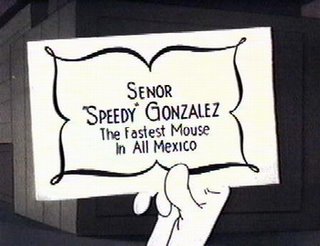
 In that baggage I tote on my back is a memory of a Summer afternoon with my mother in Twin Falls, Idaho, our walking into a store only to be sternly halted by a proprieter pointing to a sign: "No Mexicans or dogs allowed." I can still recall my mother's anger and her tearful shame that her young boy should have to grow up in such a world. Naturally, I took refuge in fantasy, in books and comics and my beloved movies, and—like all kids—in cartoons. I guess it's no surprise at all that children identify with mice and that the adult world looms over them like large menacing cats. How mice survive in a cat's world is a child's legacy. There was Mickey, of course, and Mighty Mouse on his way to save the day, and Tom constantly chasing his bemused Jerry, and Jinx hating meeses to pieces, and then there was the "fastest mouse in all Mexico"—Speedy Gonzales! As a little Chicano boy I loved Speedy Gonzales. Not so much because he was an accurate portrayal of my ethnicity—nothing of the sort—but because he was all I had in a world where my ethnicity was not allowed let alone visible and because he was quick and clever and made a fool of El Greengo Poosygato (aka Sylvester) time and time again, cartoon after cartoon, all the time joyfully and unabashedly shouting, "¡Arriba! ¡Arriba! ¡Ándale! ¡Ándale! YEEHAH!" (courtesy of Mel Blanc).
 Thus, I was among those who a few years back protested The Cartoon Network's refusal to air Speedy Gonzales's cartoons, alleging he was politically incorrect and an offensive ethnic stereotype of Mexicans and Mexican life. As reported by Michael Park for Fox News in late March 2002, Speedy Gonzales—the fastest mouse in Mexico who had easily bested Sylvester the Cat, Daffy Duck and other assorted banditos in his nearly 50-year career—couldn't seem to escape the clutches of the Cartoon Network. Matthew Hunter, who has written one of the finest on-line tribute histories of Speedy's career, spearheaded an online petition protesting The Cartoon Network's decision.
Hunter's backstory on this particular issue is of interest: "In the 1980's, Speedy was just as enduring as Bugs Bunny or Daffy Duck when it came to television and video. He proved himself as popular as the rest, and was shown just as often. Nickelodeon cable network, the station best known for their original Nicktoons series, has always been the best place to see Speedy Gonzales cartoons from all eras of WB animation, since they once had the rights to virtually all of them.
 "But in September of 1999, Nickelodeon dropped their showings of all Warner Brothers cartoons and sent them to Cartoon Network, and a year later ABC network did the same, making Cartoon Network the only television channel to show Warner Brothers classic cartoons on TV. Cartoon Network has been a fairly good place to see the Looney Tunes and Merrie Melodies. However, Cartoon Network's owner at the time, Ted Turner, supposedly asked the programmers to stop airing Speedy cartoons due to their content. This was evidently done at about the time Turner and Warner Brothers merged companies, and for the reason that with so many international venues, the content that in any way ridiculed foreigners might be offensive to some viewers."
In April 2002, Jim Burns reported to CSN News on the involvement of the nation's oldest Hispanic-American civil rights organization—The League of United Latin American Citizens (LULAC)—and Hispanic Online in refuting The Cartoon Network's categorizations. [Unfortunately, that link is now broken.] By June 2002, Michael Park followed up his original story for Fox News proclaiming that media exposure, Hunter's on-line petition and the outcry from fans had been effective; The Cartoon Network reconsidered their position.
 As one contributor ["Map Kernow"] to an online forum debating the issue angrily vented: "This shows what I've always maintained: 'political correctness' and 'sensitivity' etc. aren't about being 'sensitive' to minorities or people of color. It's a crutch for guilty liberal white people to feel good about themselves. It doesn't mean a damn thing that Mexicans themselves do like Speedy Gonzales—some white folks at Cartoon Network have decided they shouldn't oughta like Speedy, and that's that. The important thing, you see, is for those nice white liberals at Cartoon Network to feel good about themselves, with a nice big pat on the back for being so 'enlightened' and 'sensitive.' " I salute the righteousness of Kernow's rant. Rather that, than having the fastest—let alone the only—Mexican mouse I know censored from t.v. history by too-well-meaning thought police.
Anyways, in point, as Matthew Hunter synopsized, "Speedy showed cats, crows, banditos and greedy ducks what cartoons were all about—laughter." Which reminds me of something Susan Sontag wrote in her brilliant essay "Where the Stress Falls": "Comedy depends on certitude, the certitude about what is foolish and what is not, and on characters who are 'characters', that is, types." Take away the types and you take away the rich variance of laughter.
 So what does all this have to do with the Friz Freleng blogathon? Well … I'm glad you ask. Surely you know that Freleng directed the very best Speedy Gonzales cartoons (of which there are 42 in number)? He didn't create Speedy—that honor is reserved for Robert McKimson who debuted the character in 1953's Cat-Tails for Two—but, along with Hawley Pratt, Freleng redesigned Speedy Gonzales (changing the spelling of his name from González for starters) for the eponymous Oscar-winning best short subject of 1955, Speedy Gonzales.
 1955 was the year—you might remember and, if not, you might Google ("to remember" and "to Google" have become nearly synonymous)—when Marty swept the Oscars, winning Best Picture, Best Actor (Ernest Borgnine), Best Director (Delbert Mann), and Best Screenplay (Paddy Chayefsky). The monotony was alleviated by Anna Magnani winning Best Actress for Tennessee Williams' The Rose Tattoo, Jack Lemmon winning Best Supporting Actor for Mister Roberts, and Jo Van Fleet winning Best Supporting Actress for East of Eden. The music was good too: Oklahoma! shared the prize for best score with Love Is A Many-Splendored Thing, which won Best Song (buy me a martini and find me a piano to sit on and I'll croon it out of tune for you, splayed fingers and all). To Catch A Thief, Picnic, The Bridges of Toko-Ri and I'll Cry Tomorrow were also all at hand to grasp the golden nude, as was the Fastest Mouse in all of Mexico. No wonder I loved him.
I found it sweet and telling that—participating in Nancy de Los Santos and Alberto Domínguez's 2002 documentary The Bronze Screen: 100 Years of the Latino Image in American Cinema—Cheech Marin offered as his "contribution" to those 100 years the image of Speedy Gonzales cheerfully persevering against all manner of obstacles placed in his path. They're going to put tacks in your path, Cheech described, they're going to put bears, they're going to come up with all sorts of things that you're going to have to get around or die and—like Speedy Gonzales—you'll say, "Okay!"
 Though IMDb user Robert Reynolds is astonished that Speedy Gonzales won out over Legend of Rockabye Point and Good Will To Men (also competing that year), the formula of Speedy outwitting Sylvester proved popular and lasted for a decade. As a trivial aside, "Sylvester" is the Americanized version of the Mexican word silvestre, which means "wild". I always considered it hilarious that this lisping housecat would be named such. Anyways, back to the award-winning Speedy Gonzales, you recall the story: Starving Mexican mice want access to a cheese factory guarded by Sylvester Cat and send for Speedy Gonzales to breeze past Sylvester and obtain the cheese for them.
 Somehow, with all the immigration concerns all across the country but particularly in California, I can't stop thinking of that ad campaign: "California—it's the cheese." Which further reminds me of Guillermo Arriaga's heartfelt plea when he spoke at the Balboa Theater: "I think the United States has all the right to build whatever walls they need to protect its borders. They can send the whole U.S. Army to protect the border and I think it's all right. But it's a shame that my country doesn't have the capacity of building jobs for its citizens. That's [more] shameful than all the walls built by the Bush administration. But we have to realize something. The United States needs the labor force to keep running the economy. This is a reality. Mexico doesn't have the capacity to create jobs and the United States needs [laborers]. So instead of putting walls and putting these warm, great people in danger of death, why don't we make a profound dialogue between our countries and find the best way to resolve this?"
As Speedy reminds us, and Sylvester seems to forget, there is plenty of cheese to go around, and plenty of laughter too.
02/24/10 UPDATE: Eugene Hernandez reports at indieWIRE that Speedy Gonzales is in for a feature film treatment, with George Lopez providing the vocals, as detailed in a recent New York Times announcement by Dave Itzkoff.
 William Goyen, who died at the age of 68 in 1983, was born in Trinity, Texas, in 1915. He is the author of the acclaimed House of Breath (1950), The Collected Stories (1975, nominated for the Pulitzer Prize in 1977), and the novel Arcadio (1982), as well as numerous plays and short works. Mr. Goyen lived and worked primarily in New York and Los Angeles with his wife, the actress Doris Roberts.
 That was cue enough for me to hunt out House of Breath, which—to paraphrase Goyen's fully-sympathetic gay character Folner—was my sensual revelation. No writer, not even Anaïs, has had such a profound influence upon my own writing. I even used one of Goyen's short stories "Ghost and Flesh, Water and Dirt" to satisfy a directing assignment in one of my theater classes.
 What struck me immediately about Goyen's writing was his access to spiritual insight through sensual experience. For me, this rang authentic, true and relevant. I discovered him before moving to San Francisco and so—as yet—had few positive gay role models. Thus, I derived much solace from House of Breath, particularly Goyen's character Folner who resonated with me to the marrow, all the more for knowing who he was. "Right away," Folner declared, "I learned what I was and went on like that, what I was and used myself for that, made no bones about—and can't say the same for most of the rest of Charity who don't know who they are. What matters if it got me death?" (Years later during the AIDS pandemic Folner's bold assertion reverberated with an eerie and disconcerting precision, but back then, when I first discovered him, he was inspirational for being a character way ahead of his time and for encouraging free self-expression.)
 Once I relocated to San Francisco, I continued to familiarize myself with Goyen's writing wherever I could find it. In the Fall of 1977 I read his short story "The Shape of Light" and was so moved that I boldly phoned information in New York to get his number, and left a series of enthusiastic messages on his answering machine. I followed up by writing a letter to him through his publisher Doubleday and received a response written on Christmas Day, 1977: "Dear Michael Guillén: I'm here in Boston over Christmas and I want to tell you how much it meant to me to hear, out of the blue, your message on my answering tape. I thank you, and I thank you for following your impulse to communicate your feelings then, as you were feeling them. Of course it was an affirmation. I wonder if you could know what it made me feel? ...Thanks again for your lovely gift."
 It seemed that whenever I read one of Goyen's short stories I felt compelled to write him a letter and I began to dream of staging The House of Breath as a theatrical production in San Francisco. I didn't hear from Goyen again, however, until September 1978 when he wrote me from Los Angeles: "Dear Michael: After a long time of physical troubles, I'm here resting and doing some writing until the end of October. My wife is working here in films and television and so I commute (now that I've finished my Princeton University tenure) between L.A. and N.Y. I'm just recovering from surgery and am lying close and low as I heal and regain my strength. I shall return to N.Y. at end of October and be there for the month of November at the N.Y. address you've used.
 It was only later that I realized Goyen was suffering from leukemia and, thus, not well enough to visit the Bay Area. But within a week or two of receiving his letter, a hardbound copy of the 25th anniversary reprint of The House of Breath arrived in my mailbox with the inscription: "For Michael Guillén, wishing him his own joy and fulfillment." Then in January 1979 I received a copy of "Precious Door" as a New Year's greeting. Again, it wasn't until just these past few years that I finally understood that "Precious Door" was the first story Goyen had published in 10 years! In retrospect, I can understand why "Precious Door" and his novel Arcadio—written as he was dying and published after his death in 1983—meant so much to him. If House of Breath was way ahead of its time in its sympathetic depiction of a gay male, Arcadio went even further in supporting the rights of the intersexed. In 1988 his final collection of short stories Had I A Hundred Mouths was published and then, amazingly, in 1994 his novel Half A Look Of Cain was finally published after being ignored by publishers for 40 years.