 The Film on Film Foundation (FOFF)—partisans of movies screened on film and not digitally—is showing Otto Preminger's 1963 The Cardinal in the same month, and at the same venue, as Pacific Film Archive's Preminger mini-retrospective. Which Preminger idea came first? I haven't asked Steve Seid, PFA's video curator, or the FOFF principals yet—on the other hand, maybe I did and got no clear answer. (Many of the same films were shown at a January 2008 New York Film Forum series, and Cinémathèque Ontario in summer of this year.)
 Whosever idea it was has put me in Preminger perplex mode for the past month. It's given me a chance to recontextualize the Preminger films I already love (Laura, Angel Face, Daisy Kenyon, Carmen Jones) and explore the ones I've never seen or especially liked. Thanks to Turner Classic Movies I was also able recently to catch large chunks of Anatomy of a Murder, Bunny Lake is Missing and Exodus in what I believe was a tribute to title designer Saul Bass. Several screeners from PFA and offers from that remarkable cineaste (and FOFF member) Larry Chadbourne to show me the near-entirety of Preminger's work had to be declined in the interests of time. Finally, Chris Fujiwara's excellent 2008 critical biography The World and Its Double: The Life and Work of Otto Preminger (Faber & Faber, 2008) sustained me during two 10-hour plane flights. I look forward to reading Foster Hirsch's book Otto Preminger: The Man Who Would Be King (Knopf/Random House, 2007).
 I also haven't asked FOFF why of all the films they chose The Cardinal, the first '60s widescreen Technicolor "superproduction" on their schedule. It's one of Preminger's long (nearly three hours), large-scale explorations of institutional compromise and decision-making, up there with the broad canvases and huge casts of Anatomy of a Murder, Advise & Consent and Exodus. Of these four, however, it's the least commercially and critically successful—despite uncredited contributions to the script by the likes of Gore Vidal and Ring Lardner, Jr.
Anyway, that's for interested parties to decide for themselves after they see The Cardinal this Sunday at PFA, among the other Preminger films playing before and after it. Weekends in December will be Preminger paradise.
 Although I have enormous respect for his epics, I'm partial to Preminger's smaller-scale films, including the noirish works—and, by the way, Preminger disliked the term film noir being used to characterize them. I watched Whirlpool (1949) over a couple of days, a second time with Richard Shickel's casual commentary. One scene put me into a paralyzed stupor watching Gene Tierney as Ann, herself hypnotized, entering an unfamiliar house to hide evidence, seeing a portrait of the home's owner, and then coming upon a shocking sight without any discernible affect. Her zombie-like attitude in this particular scene is disturbing, yet we can still feel her mind working beneath the surface of Tierney's lovely complexion: Why am I here? What am I looking at? What am I doing? How am I supposed to react? I think it's that searching, wondering attitude that spellbinds me. Some of Preminger's most effective moments are of characters who, not hypnotized, sit alone and wonder.
In his book on Preminger, Fujiwara interprets the way the camera observes her: "The space around her, in the frame, figures the mental space of her own unconscious self-observation. The smoothness of the camera movements suggests this unconsciousness by emphasizing the mechanical quality of her actions, the regular, dance-like transitionality of all her movements."
 Then Ann's tremulous, round-eyed reactions to the men around her, who whether benevolent or malevolent are still trying to control her, are the index of a woman caught in a hopeless situation: she's damned if she's innocent and damned if she's guilty. She can't be a "serene and devoted wife" nor a brazen adulteress seeking treatment from a sadistic swindler, and there are no choices in between. All she wants is a good night's sleep! It's hard to tell who gives her a harder time: her distrustful psychiatrist husband (Richard Conte, perhaps not as miscast as others claim, since his tough-guy impatience bursts out of his rational/scientific veneer as you might expect of a husband who thought he had his beautiful wife and illustrious career under control); the detective who's recently lost his own wife and won't let suspect Ann out of his sight (Charles Bickford, very subdued here); or the smug and cynical quack/hypnotist David Korvo (a snakelike José Ferrer, even as he lies in bed sweating from the aftereffects of a gallbladder operation).
 Korvo knows all about women and expresses his cynicism freely. He rolls his eyes at Ann's attempts to keep their relationship aboveboard by not going to his hotel room: "Very well, I bow to your abysmal scruples." He's contemptuous of women and uses them to get what he wants, whether it's an inheritance or destroying the career of a more legitimate expert like Conte. His target before Ann, a woman who's trying to get her money back from Korvo, already looks destroyed before her ultimate fate—maybe it's the Bride of Frankenstein skein of white hair or the preternaturally pale makeup, but Barbara O'Neil looks almost as blood-drained as the greenish corpse of Scarlett O'Hara's mother.
 It's hard to tell how much Preminger intended me to feel so vividly Ann's predicament of a comfortable wife in postwar America, in a film that instead, like Laura, seems to emphasize the enigmatic quality of another woman played by Gene Tierney. Or one that uses a B-movie gimmick like hypnosis-induced crime. "You made me play-act," she accuses her husband, who trusts her only as long as she plays the perfect wife. She's like the mermaid pin she shoplifts from the department store, the witness to which secret proclivity is Korvo, the man who hatefully "knows" all women. Men seek her, hook her and land her, but she's flopping around on land wishing she were at sea—or at least unable to explain her feelings of deep discontent.
 Part of my perplexity with Preminger's films comes from wondering if I'm reading too much psychological depth into straight-faced entertainments, like I sometimes think Fujiwara does despite his often brilliant analyses. But I think his favorable opinion of The Cardinal, and especially Tom Tryon's often-criticized performance, is right on. Preminger, in his bullying and manipulation of his actors, usually got what he wanted out of them. Notoriously he terrorized Tryon, even firing him on the first day of shooting in front of his visiting parents and rehiring him an hour later. Tryon's performance has usually been condemned for its woodenness, but I love it for the same reason and think it's true to the character.
 Stephen Fermoyle, son of a Boston motorman, has ambitions to be cardinal and must fulfill several tests on his way up the ladder. He impresses the monsignor with his ability to comfort immigrant parishioners in their native Italian during a "miracle," and he secures a relationship with the influential and pragmatic Cardinal Glennon (John Huston in a marvelous performance). He is tested for humility by being sent to the Siberia of parishes. But his severest test comes from his sister Mona (Carol Lynley), whose Jewish boyfriend (John Saxon) has refused to convert to Catholicism to marry her and who in her own attempt to "convert" him has gotten herself pregnant, alone and in labor in a sleazy brothel. Stephen refuses to agree to a late-term abortion to save her life, and she dies while the child survives. This test makes him lose his religion, and he becomes an English teacher in Vienna. Resisting the love of a beautiful Viennese student (a radiant Romy Schneider), he realizes that he has passed another test and returns to the priesthood.
 From here he continues Fujiwara's characterization of him as a "superpriest who travels around the world," now going to Georgia to defend a poor black parish against the Ku Klux Klan and getting kidnapped and whipped for his trouble. Preminger apparently added the nonfictional character of Austrian Cardinal Theodor Innitzer (played phonetically by Josef Meinrad), whose belief in Adolf Hitler's promises to the Catholics is his undoing. Those still looking for scenes parodied in Inglourious Basterds will find a strudel scene as well as a Hitler snitfit (here offscreen).
Why is Tom Tryon effective? Because the actor's attitude of pained self-consciousness, his woodenness, is an accurate manifestation of the compromises the character has had to make along the way to attain cardinal. Fujiwara quotes Preminger in an interview saying that the character (whom he calls "Tom Tryon") is weak, that "he never does what I would think is right." In two powerful scenes, the confessional and the prison, Stephen fails the two women he loves. His ascension to cardinal marks his ultimate compromise with the world of power.
 More reasons to watch The Cardinal:
Murray Hamilton, whom I didn't fully appreciate having seen him in relatively one-dimensional roles in The Graduate and Jaws. In The Cardinal he plays a conscience-stricken white supremacist and in Anatomy of a Murder a bartender trial witness.
 Burgess Meredith in performances of abjection before he played cartoons like Batman's nemesis the Penguin or Rocky Balboa's trainer. In The Cardinal, he plays an unambitious parish priest dying of shame and multiple sclerosis. In a brief but unforgettably awkward scene in Advise & Consent, he appears before the Senate confirmation committee as a damaging witness to a period in cabinet hopeful Henry Fonda's past.
More information here.
12/06/09 UPDATE: Of related interest, Brian Darr confesses his admiration for The Cardinal at Hell on Fricso Bay.
Cross-published on Twitch.
 Currently screening at the Pacific Film Archive through December 20, 2009 is a 14-film tribute "Otto Preminger: Anatomy of a Movie", curated by Steve Seid. The first three entries in the series—Laura (1944), Fallen Angel (1945) and Daisy Kenyon (1947)—constitute the heft of Otto Preminger's collaboration with actor Dana Andrews, with the exception of Where the Sidewalk Ends (1950), which has not been included in the series (though—incidentally enough—it reunited the Laura duo: Andrews and Gene Tierney).
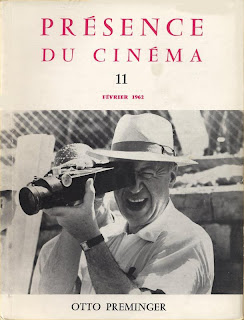 So much has been written about Otto Preminger that it seems foolish to reiterate what's already been stated many times over. Within immediate parameters, however, Steve Seid has synopsized: "As legend would have it, Otto Preminger was a bald-headed baddy scolding helpless actors about flaws in their performance—the tyrant on the set. But Preminger's films, some thirty-seven in all, bear no sign of this heated temperament, instead sharing a muted detachment that ironically excites our own engagement with his complex characters. …Preminger promoted a cool take on human nature that simultaneously savored cinema's expansive visual spaces; over time his eloquent way with the camera grew complex and sensuous. The willful director's insistence on artistic autonomy compelled him to become one of the first champions of independent film."
There are, of course, the career overviews offered by James Quandt, Thomas Gale, Jonathan Rosenbaum, Tag Gallagher and Chris Fujiwara. James Quandt cleverly finesses the alphabet to review Preminger's career from autocrat to Zanuck at the Cinémathèque Ontario website; Thomas Gale's entry on Preminger for The Encyclopedia of World Biography can be accessed at Highbeam Research Library; Jonathan Rosenbaum's essay "The Preminger Enigma" is at The Chicago Reader website; Tag Gallagher's Film International essay on Preminger's "heroic" films can also be accessed at Highbeam Research Library; and Chris Fujiwara's nuanced profile for the Great Directors database can be found at Senses of Cinema.
 Fujiwara, in fact, has provided the most recent biography on Preminger: The World and Its Double (Faber & Faber, 2008), published close on the heels of Foster Hirsch's own notable study Otto Preminger: The Man Who Would Be King (Knopf/Random House, 2007). Earlier, in his Film International DVD review "4 x Otto Preminger" (May 2004, Vol. 2, Issue 3), Fujiwara convincingly contested the oft-stated ascription of "film noir" to the suite of Preminger films that include Laura, Fallen Angel, Where The Sidewalk Ends, Whirlpool (1950), The Thirteenth Letter (1951), and Angel Face (1952). Fujiwara argued against this received wisdom: "It is pertinent to remember that Preminger repudiated this term, as far as his own work was concerned. Seeing these films as 'films noirs' is no more illuminating and no less destructive of any understanding of what the films are doing than seeing River of No Return (1954) as a Western; Carmen Jones (1954) as a musical; or In Harms Way (1965) as a war film. Preminger's films are absolutely heedless of genre, and Preminger never makes the slightest effort to adapt his style to generic norms."
Fujiwara further pointed out that films like Laura, Fallen Angel, and Whirlpool "depart radically from the 'film noir' pattern … characterized by scheming femmes fatales, trapped and desperate male protagonists, and unhappy endings."
Laura (1944)
 Dana Andrews—a popular leading man in the 1940s—has never been one of my favorite actors, though his brooding performance as the smitten detective Mark McPherson is unquestionably one of his best. In her profile of Andrews at Bright Lights Film Journal, Imogen Sarah Smith has written: "Dana Andrews, with his naturally tamped-down style and his gift for ambivalence, was an ideal leading man for Preminger. Apart from The Best Years of Our Lives, Andrews' four films with Preminger … were the peak of his career, and they gave him his most complex and compelling roles."
 In "Acting Like Children", his 1958 interview with the Columbia University Oral History Research Office, Andrews admitted: "People very often say to me that Laura was my first picture. Well, it's the first one they saw, which is why they think that." His recollections of the behind-the-scenes intrigues that shaped Laura—specifically his characterization of Detective McPherson—details how then-producer Preminger deviously wrested directorial control away from Rouben Mamoulian (the film's original director) by strategically aligning himself with studio head Darryl F. Zanuck. Andrews opines: "I think Mr. Preminger wanted to be a producer-director." Andrews also recounts how he and Preminger disagreed on a point of direction and stared each other down in stony silence for hours, "acting like children."
 Allegedly, Zanuck's dissatisfaction with Rouben Mamoulian's interpretation of Detective McPherson as an Ivy-league criminologist clashed with Zanuck's preference for a tough "right-down-the-alley type of detective" more familiar to audiences. Preminger's willingness to cater to Zanuck's vision on such a major issue distracted the studio head from his noted objection to the casting of Clifton Webb in the role of Waldo Lydecker. Andrews recollected that Laura was Webb's first motion picture. "He'd been under contract to MGM for 18 months and never done a foot of film—never had seen himself on the screen." According to David Boxwell at Bright Lights Film Journal, the homophobic Zanuck was initially displeased with Webb's portrayal of Lydecker as an effete and waspish socialite; however, Preminger convinced Zanuck that such effeminacy suited the character and provided comic contrast to the traditionally masculine Andrews.
 Originally, as Eddie Muller intimated in his Noir City introduction of Hangover Square (1945), Mamoulian had wanted Laird Cregar for the role of Lydecker; but, Preminger worried that Cregar—who had gained notoriety playing the sinister role of Jack the Ripper in The Lodger (1944)—would lead the audience to become suspicious of Lydecker earlier than necessary. When Cregar died of a heart attack after a drastic attempt to lose weight for the role, Preminger brought in Clifton Webb. It's now nearly inconceivable that anyone else could deliver Lydecker's vicious bon mots more stingingly, which to this day delight audiences with their unfettered bitchiness. "The voice alone would have carried the performance: the tone of a courtly buzz saw, the razor diction dining on consonants as if they were truffled squab," Richard Barrios has written in Screened Out: Playing Gay In Hollywood From Edison to Stonewall (Routledge, 2003:202).
Despite Lydecker's homosexuality having been removed from the script early on (though, as Barrios continues, "the rewritten character's bouts of hetero-jealousy [sit] oddly upon Webb's epicene deportment"), Clifton Webb's performance of Waldo Lydecker has gone down in cinema history as one of the great gay characters on film; the epitome of the "mannered, high-gloss style" that David Thomson pointedly identifies in his recent book The Moment of Psycho (Perseus Books 2009, p. 43) as a "code for homosexuality" in American films of the '30s, '40s and '50s.
 In retrospect, Preminger's direction of both Andrews and Webb—and the characterizations they finally settled upon—served to manifest a tension essential to Laura's suspense. As Imogen Sarah Smith has correctly perceived in her Bright Lights Film Journal profile: "Preminger was right about McPherson. Not playing him as hard-boiled not only destroys the comedy in his interactions with Laura's friends, it eliminates the tension within Mark's character as he begins to feel and behave in ways no one would expect of a standard-issue tough cop. Laura introduces the essential Dana Andrews character: the Average Joe with unexpected complications. It also demonstrates the Preminger Paradox: the director was a notorious tyrant, prone to tantrums and sadism often directed at the most vulnerable of his actors, yet the keynote of his films was tolerance for ambiguity. Ensembles in shades of gray, full of subtle, tamped-down performances, his films never turn on a simple axis of good and evil but listen to many voices and allow each some degree of persuasiveness."
 Smith evokes the "long, wordless sequence, followed by Preminger's fluidly tracking camera" wherein "McPherson prowls around Laura's apartment, ostensibly looking for clues but really indulging his insatiable desire for communion with the dead woman. Reading her letters and her private journal isn't enough; he opens her closets, fingers her silky handkerchiefs (obvious Hays Code stand-ins for her unmentionables), and sniffs her perfume. He doesn't linger over things sensually; he fidgets brusquely, irritated by his own romantic yearning. He heads for the liquor cabinet and gulps Scotch while gazing at Laura's portrait. He snarls at Waldo Lydecker, who hits the nail on the head when he sneers, 'I wonder you don't come here like a suitor with flowers and a box of candy.' Mark couldn't, or wouldn't, openly admit his own feelings: cops just don't find themselves in the grip of morbid, perfumed obsession with dames who have been bumped off. But he knows that Waldo is right, hence his seething, brooding restlessness. Alone again, he plants himself in front of the portrait and nurses a drink until he falls into a stupor."
 This pivotal scene—underscored by David Raskin's haunting theme (with belated lyrics by Johnny Mercer)—is seductive in its gravitational allure. It's one of my favorite scenes in Laura and one of my favorite scenes in film altogether. Rarely has desire for what is absent been so sensuously embodied in an imagined presence, save perhaps Portrait of Jennie (1948). It reminds me of what poet Mark Doty once wrote in his equally haunting study Still Life With Oysters and Lemon (Beacon Press 2001:3-4): "I have fallen in love with a painting. Though that phrase doesn't seem to suffice, not really—[rather, it's] that I have been drawn into the orbit of a painting, having allowed myself to be pulled into its sphere by casual attraction deepening to something more compelling. I have felt the energy and the life of the painting's will; I have been held there, instructed. And the overall effect, the result of looking and looking into its brimming surface as long as I could look, is love, by which I mean a sense of tenderness towards experience, of being held within an intimacy with the things of the world."
Cross-published on Twitch.
 The Film on Film Foundation (FOFF)—partisans of movies screened on film and not digitally—is showing Otto Preminger's 1963 The Cardinal in the same month, and at the same venue, as Pacific Film Archive's Preminger mini-retrospective. Which Preminger idea came first? I haven't asked Steve Seid, PFA's video curator, or the FOFF principals yet—on the other hand, maybe I did and got no clear answer. (Many of the same films were shown at a January 2008 New York Film Forum series, and Cinémathèque Ontario in summer of this year.)
 Whosever idea it was has put me in Preminger perplex mode for the past month. It's given me a chance to recontextualize the Preminger films I already love (Laura, Angel Face, Daisy Kenyon, Carmen Jones) and explore the ones I've never seen or especially liked. Thanks to Turner Classic Movies I was also able recently to catch large chunks of Anatomy of a Murder, Bunny Lake is Missing and Exodus in what I believe was a tribute to title designer Saul Bass. Several screeners from PFA and offers from that remarkable cineaste (and FOFF member) Larry Chadbourne to show me the near-entirety of Preminger's work had to be declined in the interests of time. Finally, Chris Fujiwara's excellent 2008 critical biography The World and Its Double: The Life and Work of Otto Preminger (Faber & Faber, 2008) sustained me during two 10-hour plane flights. I look forward to reading Foster Hirsch's book Otto Preminger: The Man Who Would Be King (Knopf/Random House, 2007).
 I also haven't asked FOFF why of all the films they chose The Cardinal, the first '60s widescreen Technicolor "superproduction" on their schedule. It's one of Preminger's long (nearly three hours), large-scale explorations of institutional compromise and decision-making, up there with the broad canvases and huge casts of Anatomy of a Murder, Advise & Consent and Exodus. Of these four, however, it's the least commercially and critically successful—despite uncredited contributions to the script by the likes of Gore Vidal and Ring Lardner, Jr.
 Although I have enormous respect for his epics, I'm partial to Preminger's smaller-scale films, including the noirish works—and, by the way, Preminger disliked the term film noir being used to characterize them. I watched Whirlpool (1949) over a couple of days, a second time with Richard Shickel's casual commentary. One scene put me into a paralyzed stupor watching Gene Tierney as Ann, herself hypnotized, entering an unfamiliar house to hide evidence, seeing a portrait of the home's owner, and then coming upon a shocking sight without any discernible affect. Her zombie-like attitude in this particular scene is disturbing, yet we can still feel her mind working beneath the surface of Tierney's lovely complexion: Why am I here? What am I looking at? What am I doing? How am I supposed to react? I think it's that searching, wondering attitude that spellbinds me. Some of Preminger's most effective moments are of characters who, not hypnotized, sit alone and wonder.
 Then Ann's tremulous, round-eyed reactions to the men around her, who whether benevolent or malevolent are still trying to control her, are the index of a woman caught in a hopeless situation: she's damned if she's innocent and damned if she's guilty. She can't be a "serene and devoted wife" nor a brazen adulteress seeking treatment from a sadistic swindler, and there are no choices in between. All she wants is a good night's sleep! It's hard to tell who gives her a harder time: her distrustful psychiatrist husband (Richard Conte, perhaps not as miscast as others claim, since his tough-guy impatience bursts out of his rational/scientific veneer as you might expect of a husband who thought he had his beautiful wife and illustrious career under control); the detective who's recently lost his own wife and won't let suspect Ann out of his sight (Charles Bickford, very subdued here); or the smug and cynical quack/hypnotist David Korvo (a snakelike José Ferrer, even as he lies in bed sweating from the aftereffects of a gallbladder operation).
 Korvo knows all about women and expresses his cynicism freely. He rolls his eyes at Ann's attempts to keep their relationship aboveboard by not going to his hotel room: "Very well, I bow to your abysmal scruples." He's contemptuous of women and uses them to get what he wants, whether it's an inheritance or destroying the career of a more legitimate expert like Conte. His target before Ann, a woman who's trying to get her money back from Korvo, already looks destroyed before her ultimate fate—maybe it's the Bride of Frankenstein skein of white hair or the preternaturally pale makeup, but Barbara O'Neil looks almost as blood-drained as the greenish corpse of Scarlett O'Hara's mother.
 It's hard to tell how much Preminger intended me to feel so vividly Ann's predicament of a comfortable wife in postwar America, in a film that instead, like Laura, seems to emphasize the enigmatic quality of another woman played by Gene Tierney. Or one that uses a B-movie gimmick like hypnosis-induced crime. "You made me play-act," she accuses her husband, who trusts her only as long as she plays the perfect wife. She's like the mermaid pin she shoplifts from the department store, the witness to which secret proclivity is Korvo, the man who hatefully "knows" all women. Men seek her, hook her and land her, but she's flopping around on land wishing she were at sea—or at least unable to explain her feelings of deep discontent.
 Part of my perplexity with Preminger's films comes from wondering if I'm reading too much psychological depth into straight-faced entertainments, like I sometimes think Fujiwara does despite his often brilliant analyses. But I think his favorable opinion of The Cardinal, and especially Tom Tryon's often-criticized performance, is right on. Preminger, in his bullying and manipulation of his actors, usually got what he wanted out of them. Notoriously he terrorized Tryon, even firing him on the first day of shooting in front of his visiting parents and rehiring him an hour later. Tryon's performance has usually been condemned for its woodenness, but I love it for the same reason and think it's true to the character.
 Stephen Fermoyle, son of a Boston motorman, has ambitions to be cardinal and must fulfill several tests on his way up the ladder. He impresses the monsignor with his ability to comfort immigrant parishioners in their native Italian during a "miracle," and he secures a relationship with the influential and pragmatic Cardinal Glennon (John Huston in a marvelous performance). He is tested for humility by being sent to the Siberia of parishes. But his severest test comes from his sister Mona (Carol Lynley), whose Jewish boyfriend (John Saxon) has refused to convert to Catholicism to marry her and who in her own attempt to "convert" him has gotten herself pregnant, alone and in labor in a sleazy brothel. Stephen refuses to agree to a late-term abortion to save her life, and she dies while the child survives. This test makes him lose his religion, and he becomes an English teacher in Vienna. Resisting the love of a beautiful Viennese student (a radiant Romy Schneider), he realizes that he has passed another test and returns to the priesthood.
 From here he continues Fujiwara's characterization of him as a "superpriest who travels around the world," now going to Georgia to defend a poor black parish against the Ku Klux Klan and getting kidnapped and whipped for his trouble. Preminger apparently added the nonfictional character of Austrian Cardinal Theodor Innitzer (played phonetically by Josef Meinrad), whose belief in Adolf Hitler's promises to the Catholics is his undoing. Those still looking for scenes parodied in Inglourious Basterds will find a strudel scene as well as a Hitler snitfit (here offscreen).
 More reasons to watch The Cardinal:
 Burgess Meredith in performances of abjection before he played cartoons like Batman's nemesis the Penguin or Rocky Balboa's trainer. In The Cardinal, he plays an unambitious parish priest dying of shame and multiple sclerosis. In a brief but unforgettably awkward scene in Advise & Consent, he appears before the Senate confirmation committee as a damaging witness to a period in cabinet hopeful Henry Fonda's past.


