The value of Alonso Duralde's Have Yourself A Movie Little Christmas is as a Yuletide resource to research (quite possibly) every known Christmas-themed movie on the face of the planet (or, at least, the ones worth watching). Structured in nine thematic chapters—1: Movies for Kids; 2: Movies for Grown-Ups; 3: Comedies; 4: Tearjerkers; 5: Crime & Action Extravaganzas; 6: Holiday Horror; 7: "Scrooge-a-Palooza"; 8: Lumps of Coal in Your Christmas Stocking; and 9: Christmas Classics—the beauty of Duralde's book is its utility: all you need is personal interest or seasonal necessity to easily access its festive bounty.
Myself, I dove right into Holiday Horror, partly because Gremlins (1984) and Black Christmas (1974) were the two entries Duralde brought to San Francisco's Castro Theatre on his national book tour; but, also because this chapter synopsized Christmas Evil (1980), Lewis Jackson's sole directorial effort, which—as Duralde quotes John Waters—is "the best seasonal film of all time … If I had kids, I'd make them watch it every year, and if they didn't like it they'd be punished." Also known as You Better Watch Out, Peaches Christ is giving the film and its director due idol worship at Midnight Mass this Saturday, December 11 at Landmark's Bridge Theatre. With each entry, Duralde offers "fun facts" and—regarding Christmas Evil—Duralde notes that the film's male lead Brandon Maggart is Fiona Apple's father and a Tony nominee for the Broadway musical Applause. Further, Jackson turned down Kathleen Turner when she auditioned for a role. Perhaps her voice hadn't yet become scary enough?
In his chapter on Christmas comedies, Duralde likewise mentions Remember the Night (1940), a Preston Sturges script directed by Mitchell Leisen starring Barbara Stanwyck and Fred MacMurray. "It's weird to see Stanwyck and MacMurray playing such a sweet and loving couple after their immortal turn as murderous grifters in the classic Double Indemnity (1944)," Duralde writes, "but this time around, they positively sparkle." Decide for yourself when Eddie Muller and the Film Noir Foundation screen Remember the Night on a double-bill with Mr. Soft Touch (1949) at their inaugural "Christmas Noir" program coming up next Wednesday, December 15, at the Castro Theatre.
Fun Facts for Remember the Night? Though the film is set at Christmastime, shooting took place in July so all the leaves had to be stripped from the trees for the winter farm sequence. MacMurray was so tall that he was forced to stand in a hole during the nightclub scene so that the camera could shoot over his shoulder when he introduces Stanwyck to the judge. Along with Easy Living (1937), Remember the Night is the only other film Sturges wrote but didn't direct at Paramount that he felt warranted purchasing a 16mm print for his own collection. Though billed as a "Christmas noir", Duralde wouldn't call Remember the Night a noir, though he could recommend Lady in the Lake (1947) as a true Christmas noir, or perhaps the relatively unknown Christmas Holiday (1944), based on a Somerset Maugham short story, directed by Robert Siodmak and featuring Deanna Durbin and Gene Kelly in uncharacteristic casting.
See how handy this Yuletide resource is? For Christmas films you've known—or films you've thought you've known—and all those holiday gems you've yet to discover, Have Yourself A Movie Little Christmas guides the way as surely as Rudolph's "nose-so-bright"!
At last night's on-stage presentation at the Castro Theatre, Jenni Olson—who has been friends with Alonso Duralde for 20+ years—revealed by her introduction that even she could barely keep pace with Alonso's broad and shifting credits. Duralde admitted he has had great fun going around the country flogging his book. He prefaced the Castro doublebill with a clip reel compiled by David Kittredge (Pornography: A Thriller, 2009).
Inbetween Gremlins and Black Christmas, Duralde and Olson returned to the Castro stage for a brief conversation. Duralde—who was working in a Georgia movie theater back in 1984 when Gremlins first ran—recalled firsthand little kids getting the crap scared out of them, their frightened tears, and their irate mothers. Under the aegis of "Steven Spielberg Presents", parents were misled into thinking Gremlins was suitable for their small children. Not so. The parental outcry against Gremlins and another Spielberg film that came out that summer—Indiana Jones and the Temple of Doom—led to the implementation of the PG-13 rating.
Asked how he became a film critic, Duralde answered that he had ruled out every other possibility of anything he could do with his life. He'd loved movies since he was a little kid and learned to read primarily so he could read the movie listings for any theater within 20 miles of his house. During the '70s when Hollywood nostalgia took hold, his older brother came home with volumes on Fred Astaire and Ginger Rogers, and the Marx Brothers, and nine-year-old Duralde was beside himself. He started out by writing movie reviews for his high school paper—"no one else wanted to write them"—and has never stopped since then.
As for coming up with the concept for a book about Christmas movies, Duralde admitted he has always been a Christmas fan—"Soap and candles smell best at this time of year"—so a book on Christmas movies seemed obvious. Plus, often invited to contribute lists to various media outlets, one of the most frequent requests has been for his top ten alternative Christmas movies. Eventually he did enough of those lists to recognize there was a book in there.
Asked for "tips" regarding which Christmas movies to take a look at this upcoming season, Duralde prefaced that people like different categories but his favorite are the dysfunctional family Christmas movies. That being the case, he would have to recommend The Ref (1994) with Judy Davis and Kevin Spacey, Arnaud Desplechin's A Christmas Tale (2008) with a French cast headed by Catherine Deneuve, and La Bûche (1999)—"a Christmas movie for people who hate Christmas." But he also likes ridiculous Christmas movies (nicknamed "lumps of coal in your cinema stocking") such as the Mexican film Santa Claus (1959), which—he reminded his San Francisco audience—won the Golden Gate Award for Best Family Film at the 1959 San Francisco International Film Festival. Santa Claus was directed by René Cardona—known for Wrestling Women vs. the Aztec Mummy (1964) "and other classics"—and involves Santa and his close friend Merlin the Magician battling Satan for the spirit of Christmas. It's currently available on Netflix Instant Watch and scheduled to air on TCM this evening at 11:00PM (PT) as part of an evening of Christmas classics (check out Richard Harland Smith's TCM essay). Duralde admitted Santa Claus stretches the "C" in TCM.
Though It's A Wonderful Life (1946) is considered the definitive Christmas movie, Duralde recommends Frank Capra's "other Christmas movie" Meet John Doe (1941), which serves to remind "that we are in a Depression again." Meet John Doe is about a corrupt business man taking over a newspaper ("very Rupert Murdock") and a grass roots political movement that gets taken over by corporate interests wanting to push their own agenda. As timely as ever, Meet John Doe has just turned 70. "Am I watching The Rachel Maddow Show?" Duralde quipped, "What the hell?"
As for Hanukkah favorites, Duralde recommended The Hebrew Hammer (2003) starring Adam Goldberg, which he characterized as "a kind of Shaft for Jews." Goldberg plays a Semitic superstud who saves Hunukkah from the evil machinations of Santa Claus, Jr. (Andy Dick). A hard "R" and not for kids.
As for GLBT Christmas fare, Duralde couldn't think of a lesbian entry and encouraged filmmakers to fill the niche. As far as gay guys, the Canadian feature Breakfast With Scot (2007) came to mind because the adopted nelly kid is super-obsessed with Christmas; a running theme throughout the film that leads to a big scene at the end of the film. It's not a great film, but it's nice and one he can recommend, in contrast to a handful of others which induce groans (and not the good kind). Again, he encouraged GLBT filmmakers to come up with a Christmas movie we can call our own.
As to how many times he watched these movies to research for his book, whether he watched them several times and/or all year round, Duralde stressed he couldn't imagine what his neighbors thought in mid-August when "God bless us, every one!" was coming out of his window every couple of hours. Some of these films he watched for the first time preparing for the book and others he watched again to refresh his memory; all were watched at least once, and others several times. He basically watched most of them over a period of nine months. He had written the first chapter as a sample to send to publishers but it wasn't until Limelight signed on to do the book that he was then given nine months to finish it up; but—being a terrible procrastinator—it was really the final two months wherein he applied himself.
Since writing Have Yourself A Movie Little Christmas, Duralde has been keeping a running list of additional entries, most recently the Finnish fantasy Rare Exports: A Christmas Tale (2010), which recently opened in New York. Rare Exports is about scientists digging for oil in Lapland who discover and disturb the grave of Santa Claus who then comes back to life and goes on a killing spree. "I really want to see that!" Duralde grinned. But he railed against The Nutcracker in 3D (2010) as "the worst fucking piece of shit ever made." He warned against going to see it even as a joke bad movie because "it will suck the life out of you." Duralde might mince pies for Christmas, but never words.
The upcoming issue of Veronica (#202, "Isn't It Bromantic?") hits the newstands mid-September and introduces the first openly gay character in the history of Archie comics. His name is Kevin Keller. As reported in the July 2010 issue of GQ magazine: "Right-wing bloggers—perhaps sensing that if the steadfastly bland and normal idea of America that Archie's Riverdale is meant to depict now includes homosexuality, it says something about which way the culture war is going—are up in arms. ...[T]here's already a Facebook group called 'Gay Archie comics can stay away from me, thanks,' presumably because 'Adult Male Homophobes Who Don't See Anything Weird About Reading Veronica' was already taken."
There are 56 definitions offered for the word “cover” in the Random House Unabridged Dictionary (2nd edition, 1993), with the 13th definition applied to journalism (where a journalist is assigned to “cover” a story) and the 51st definition applied to music (where a musician is said to “cover” another’s song). Immediately following the musical definition, is one for mathematics wherein a “cover” refers to “a collection of sets having the property that a given set is contained in the union of the sets in the collection.” That 52nd definition—along with its journalistic and musical variants—could equally apply to John Greyson’s experimental short Covered, which is at once intricately journalistic, musical and mathematic.
Originally slated in TIFF’s Short Cuts Canada program and billed as “an inspired experimental documentary on the violent closing of the first Queer Sarajevo Festival”, Greyson has pulled Covered from the official selection at TIFF in protest against their inaugural City-to-City Spotlight on Tel Aviv and in solidarity with the Palestinian call for a boycott against the Israeli government. Greyson has, instead, made Covered available online at Vimeo for the duration of the festival (until September 19th, 2009). Greyson likewise pulled his film Fig Trees from this year’s Tel Aviv GLBT Festival. Greyson’s principled protest has been laid out in his letter to festival heads Piers Handling, Noah Cowan and Cameron Bailey. His concern that TIFF’s cooperation with the Brand Israel campaign (launched in Toronto) ignores such socio-political realities as “the devastating Gaza massacre of eight months ago, resulting in over 1000 civilian deaths; the election of a Prime Minister accused of war crimes; the aggressive extension of illegal Israeli settlements on Palestinian lands; the accelerated destruction of Palestinian homes and orchards; the viral growth of the totalitarian security wall, and the further enshrining of the check-point system” leads to his criticism that “this isn't the right year to celebrate Brand Israel, or to demonstrate an ostrich-like indifference to the realities (cinematic and otherwise) of the region, or to pointedly ignore the international economic boycott campaign against Israel.” Greyson questions whether “such an uncritical celebration of Tel Aviv right now [isn’t] akin to celebrating Montgomery buses in 1963, California grapes in 1969, Chilean wines in 1973, Nestles infant formula in 1984, or South African fruit in 1991?”; boycott campaigns that “were specific and strategic to their historic moments, and certainly complex.”
Covered itself is a complex intertext that combines split screen imagery and multiple visual and aural registers to examine the brutal homophobic violence levied against the first Queer Sarajevo Festival. Greyson situates his examination through avian folklore, covers of popular songs that feature bird imagery, and his own “cover” of Susan Sontag’s cultural criticism. This last element—excerpts from an essay by Susan Sontag about cultural responses to war, entitled “Covered: the Sound of Solidarity”—is perhaps the film’s most intriguing critique and edges the film towards an alterity that nears sheer poetry. Greyson’s self-reflexive and appropriative homage to Sontag is encapsulated perfectly in his poised quote: “Covers must walk a line between tribute and treachery, paying heartfelt homage even as they betray the author with a musical kiss.”
Though it’s unfortunate that I’m not able to see Covered on a large screen, and though I appreciate being able to view the film on Vimeo, I respect Greyson’s commitment to use a cultural boycott to address his protest against cultural propaganda. If—as has been suggested in Raphaël Nadjari’s A History of Israeli Cinema—cinema anticipates (or should anticipate) awareness of the need for socio-political change, then current controversies such as Greyson’s withdrawl of Covered from TIFF09, and the recent uproar over Rachel at this year’s San Francisco Jewish Film Festival, belie changes anxious to unfold.
Michael Sicinski's review of Covered can be found here (scroll to the bottom). “Using split-screen and juxtaposing taxidermy exhibits with amateur YouTube performances of favorite songs, Greyson enacts a dialectic between official, institutional culture and the way actual individuals make things matter on a visceral level. ...Greyson demonstrates the awkward power of amateur cover-versions of these songs, since they both pay homage to fame and shadow it with rank normalcy.”
As Queers prepare to celebrate Stonewall's 40th anniversary next month, it's fitting that films spotlighting LGBT elders be at the center of this year's Frameline festival. That was the summational spin placed on this year's event by new Executive Director K.C. Price and longtime Festival Director Jennifer Morris, as they walked us through the 2009 line-up at last week's press conference. The festival turns 33 this year, and here's an acknowledged fact that always bears repeating—Frameline is the oldest and largest LGBT film exhibition event in the world. Appropriately, 2009's rousing theme—"The Power of Film"—is emblazoned upon a purple, fist-pumping Socialist-Realism inspired logo, and the festival's trailer features THE original Super-8 projector used at the very first festival in 1977.
At a time when many arts organizations are struggling to retain funding, Frameline has emerged relatively unscathed. Price explained that while many of the festival's corporate sponsors have slashed all arts bankrolling, when it came to Frameline, "they just couldn't do it." Happily, this enabled a hold on ticket prices which are already among the lowest of all Bay Area film festivals. There's more good news for the wallet. For those with weekday afternoons free (whether because of a job layoff or otherwise), the festival is introducing a $35.00 Weekday Matinee Pass good for all 15 Castro Theater screenings, Monday through Friday before 5:00PM. This breaks down to roughly $2.35 per show. Also new in 2009, audience members can eschew paper ballots in favor of voting for films by text-messaging. I'm mighty ambivalent about this one and hereby issue a warning: anyone seen texting their vote (and emitting that horribly distracting light) before a film is finished, will be smacked upside the head with a rolled-up Frameline catalogue by one very annoyed LGBT elder.
K.C. Price replaces 27-year vet Michael Lumpkin as Frameline's Executive Director, although he's hardly new to the organization. Price was Development Director from 1999 to 2003, at which point he became Managing Director of the Ninth Street Media Consortium (the SOMA edifice which houses Frameline and other film arts organizations). At the press conference he jokingly revealed his greatest fear—that his first year as director might also turn out to be an off-year in terms of quality programming. By the time Morris and Price finished running through the line-up, however, it was evident his fears were unfounded.
Ah yes, the line-up. The 2009 breakdown is as follows: 220 films (80 features and 140 shorts) from 32 countries presented in 96 separate programs spread over 11 days (June 18 to 28). As always, it's an almost mind-numbingly broad selection, representing every imaginable depiction of LGBT existence on Planet Earth. (To Price and Morris' great surprise, there were no films concerning Prop. 8 and the issue of marriage equality). What follows is a very subjective look at this year's roster, as filtered through the interests of a 55-year-old gay guy with a penchant for biographical documentaries and foreign narrative features.
US Features
This is where I tend to spend the least amount of time at Frameline. I've seen some great US features over the years here, but have found it can also be a minefield sprinkled with clunky issue-driven dramas, sappy romances and idiotic comedies. There is one American film I'm dying to see this year and it's Maggots and Men, Cary Cronenwett's homage to early Soviet cinema. This is a re-imagining of the historic 1921 Kronstadt Uprising of Russian sailors, and features a largely transgender cast. Maggots and Men[site] is a local production and is one of six films in the fest which received a grant from the Frameline Completion Fund.
The only film I've already seen (and one I heartily recommend) is Fruitfly, H.P. Mendoza's follow-up to Colma: The Musical, which got an uproarious reception when it world-premiered at this year's SF International Asian American Film Fest. After three decades I'm also anxious to have another look at Curt McDowell's 1975 screamingly outrageous, horror/porno hybrid Thundercrack! I took a boyfriend to see this in the late '70s and he fled the screening, vowing never to see me again. I think it was Marion Eaton yanking her vomit-covered wig out of the toilet and placing it back on her head that did him in. The Karen Black fetishist in me is curious about Watercolors, in which she plays art teacher to the high school nerd who's in love with the swim team champ (who's coached by Greg Louganis!). I might also have a look at Hollywood, je t'aime, where a young Frenchman comes to LA-LA-land to escape a failed romance back home.
US features also open and close this year's festival. In Opening Night-er An Englishman in New York, John Hurt reprises his role as queer icon Quentin Crisp, a part he first played in 1975's acclaimed The Naked Civil Servant (a film that's just been assigned one of the festival's TBA slots on Friday, June 19). As tradition dictates, the festival closes on Gay Pride Day—this year with Hannah Free, the tale of a decades-long love affair between a butch lesbian (Sharon Gless, who is expected to attend) and a married straight-laced housewife. This may be a perfectly fine film, but given that June 28 is also the exact 40th anniversary of Stonewall, I might have expected something more—I don't know—revolutionary to close the festival.
World Cinema
There are seven personal must-sees in this section, beginning with Argentine director Pablo Trapero's women's prison drama Lion's Den. I'm a big fan of the director (Crane World, Rolling Family, Born and Bred) and this one appeared in Cannes' main competition last year. (If you miss this, it'll pop up again in late July on the SF Film Society's Kabuki screen). I've heard great things about The Country Teacher, about a gay science teacher who moves to the country and befriends a single woman and her troubled 17-year-old son. The film is directed by Bohdan Sláma (Wild Bees, Something Like Happiness), considered by many to be the best Czech director working today. (The film opens at a Landmark Theater in early July). Admirers of Filipino director Aureus Solito's adorable The Blossoming of Maximo Oliveros surely won't want to miss his latest, Boy. This one follows a romance between a teenager and the rent boy he brings home on New Year's Eve (whose affections he's purchased by selling his collection of comic books and action figures). Longtime Frameline attendees will be very familiar with the challenging works of acclaimed Canadian director John Greyson (Lilies, Urinal, Zero Patience, Proteus). His latest film Fig Trees is an "experimental documentary" described in Steve Jenkins's catalog capsule as a "complex and moving rumination on AIDS activism, St. Teresa of Avila and Gertrude Stein, all plaited into an avant-garde opera featuring a singing albino squirrel." A single, middle-aged farmer in Spain's Basque country finds his life changed after hiring a Peruvian immigrant in Roberto Castón's Ander.
Rounding out my seven international must-sees are two French films, Born in '68 and Give Me Your Hand. The former comes from partners-in-life and partners-in-filmmaking Olivier Ducastel and Jacques Martineau, who are no strangers to Frameline (they were here three times previous with The Adventures of Felix, My Life on Ice and Côte d'Azur). Born in '68 is a social drama following two decades and two generations of gay men, from the student riots of '68 to AIDS activism of the '80s. In Pascal-Alex Vincent's road movie Give Me Your Hand, real-life twins Alexandre and Victor Carril play twin brothers en route to their mother's funeral in Spain. The film screened in this year's prestigious New Directors/New Films series in NYC, where Slant Magazine's Ed Gonzalez wrote this typically snarky review. Let's say I'm discouraged, but fully expect to enjoy the "scenery" anyway.
Should time and stamina permit, there are several other foreign features I might check out. Patrik, Age 1.5 is a Swedish comedy about a gay couple who mistakenly adopt a homophobic 15-year-old. The films of German frequent-Frameliner Monika Treut (The Virgin Machine, Gendernauts) are usually worth a look and her latest is Ghosted, an exploration of gender and cultural identity set in Taiwan. A young woman with a horribly disfigured face and a lesbian nurse who passionately tends to her is the stuff of Maria Beatty's Bandaged, a twisted-sounding German film executive-produced by Abel Ferrara. Fabiomassimo Lozzi's Anotherworld is an experimental narrative exploring Italian gay male identity, and is composed entirely of actors performing monologues scripted from real-life interviews. 21-year-old first-time director Simon Pearce spins a gritty tale of young British gang culture in Shank, a film which promises explicit sex and graphic violence.
Finally, I'd like to at least make mention of two films which, strangely enough, didn't make it into this year's festival. Frameline can always be depended upon to import all the important LGBT films from each year's Berlin Film Festival. So where, I'm wondering, is Raging Sun, Raging Sky, the latest from Mexican director Julián Hernández (A Thousand Clouds of Peace, Broken Sky) and The Fish Child, Argentine director Lucia Puenzo's follow-up to XXY (last year's Audience Award Winner for Best Feature Film)? Whatever the reason, I doubt it's from a lack of awareness or effort on Frameline's part.
Documentaries
Speaking of the Berlin Film Festival, the film I most hoped to find in this year's Frameline was Nicole Haeusser's Little Joe, which had its world premiere there in January. This is a bio-doc about Joe Dallesandro, the teenaged Athletic Guild model turned Warhol Superstar turned international sex icon, who is forever immortalized in the lyrics of Lou Reed's "Walk on the Wild Side." As a high-school senior in 1971, I snuck into Andy Warhol's X-rated Trash. To say it made a staggering impression would be the understatement of the millennium. I actually got to meet Joe at a San Francisco book signing in 1998, where he graciously autographed the one-sheet poster for Heat I'd been dragging around for over 25 years. And now, thanks to Frameline, I look forward to seeing him again when he appears in-person at the Castro Theater for the screening of Little Joe.
The NYC underground filmmaking scene of which Dallesandro was an integral part is at least tangentially connected to three other programs at Frameline33. Jennifer M. Kroot's It Came From Kuchar is a long overdue tribute to legendary filmmaking twins George and Mike Kuchar, who began making weird little 8mm films on the rooftop of their parent's Bronx apartment in the 1950s. In the documentary, filmmakers as diverse as John Waters, Atom Egoyan, Guy Maddin and Wayne Wang testify on camera as to the Kuchars' influence on their work. The brothers have (mostly) been residents of San Francisco for close to four decades now, and it will be an honor to see them receive this year's Frameline Award at the Castro Theater screening of It Came From Kuchar. George Kuchar's 1977 I, An Actress is one of eight short films included in Canyon Cinema's Queer Underground, a curated program of queer experimental shorts from the foremost guardian of America's avant-garde film heritage. Other filmmakers include Curt McDowell, Kenneth Anger and James Broughton. Finally, Crayton Robey's Making the Boys documents the whole zeitgeist surrounding William Friedkin's loved and loathed 1969 movie version of Mart Crowley's The Boys in the Band. Among the film's revelations is that Friedkin was filming blocks from where Stonewall drag queens were rioting. And according to Mark Freeman's program capsule, "Worth the price of admission alone is footage of a Malibu beach party showing Mart Crowley cavorting on the sand at Roddy McDowell's house with Natalie Wood, Sal Mineo, Judy Garland, Rock Hudson and a dozen more of Hollywood's gay glitterati and female admirers."
Each year at Frameline I like to check out those documentaries which examine the socio-political status of LGBT folks around the world. Yun Suh's City of Borders, which just screened at the SF International Film Festival, surveys the Arab and Jewish denizens of Shushan, the only gay bar in Jerusalem. I'm always shocked when I read news reports of Moscow gay rights marchers being beaten to a pulp and hauled off to jail. Jochen Hick's East/West—Sex & Politics examines why homosexuality, or at least its most visible variety, remains reviled in Russian society (hint: the Orthodox Church has a lot to do with it). For issues closer to home we have Pam Walton's Raging Grannies, which looks at the political street-theater antics of The Raging Grannies Action League of the San Francisco Bay Peninsula. These women aged 50 to 90 employ songs, skits and costumes to protest issues like gay rights and the environment—rejecting certain stereotypes of older women while playfully embodying them. A number of these Raging Grannies are expected at the screening, so watch out.
The remaining five documentaries I hope to see can be loosely filed under "people are not always what they seem." Yulene Olaizola reflects back on a former lodger at her grandmother's Mexico City boarding house—one who was an artistic genius and possibly a serial killer—in Shakespeare and Victor Hugo's Intimacies. In the festival Centerpiece Film Prodigal Sons, transgender filmmaker Kimberly Reed returns home to reconcile with an unstable adopted brother, only to discover that he's the only grandson of Orson Welles and Rita Hayworth. Two films are portraits of legendary drag artists. Michelle Lawler's Forever's Gonna Start Tonight profiles 74-year-old Vicki Marlene, who continues to perform regularly in San Francisco nightclubs. And Brazilian rock singer/activist/actress Claudia Wonder is the subject of Dacio Pinheiro's My Buddy Claudia. Last but not least, Andrew Haigh's Greek Pete follows a London rent-boy through one year on the job.
I've seen Ekachai Uekrongtham's Beautiful Boxer twice, first at the 47th San Francisco International Film Festival on April 18, 2004. At that time, I wrote:
Even Roger Garcia had trouble pronouncing Ekachai Uekrongtham's name when introducing him to his Castro Theater audience for last night's U.S. premiere screening of Beautiful Boxer. Uekrongtham admitted he had no idea when he made this film that it would travel as far as it has and originally worried that there would only be two people in his audience.
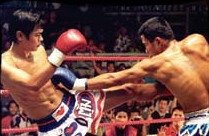
Uekrongtham's debut feature film is held aloft by the sincere, superb performance of Sanee Suwan in the role of Parinya Charoenphol (more generally known as Nong Toom). Suwan was named Best Boxer by the Association of Muay Thai (i.e., Thai kickboxing) for the northern region of Thailand in 2001 and this skill was beautifully evident in the film's boxing sequences, which really were quite exciting to watch.
The movie starts out with a kick. A journalist is trying to chase down Nong Toom to interview her, accidentally knocks over a woman whose hulky boyfriend rises to her defense, and before you know it the poor journalist is being used as a punching bag until, pow, here comes Nong-Toom kicking these thugs into submission and landing squarely on her high heel spikes. Such gynandrous exaggerations prove thrilling!!
It's hard not to like this movie. It's balanced so well between truth and prurience. It certainly seems to confirm Variety reviewer Russell Edwards' suspicion that Thailand is trying to "corner the market in gay-themed sports movies" and his projection that it "should K.O. predisposed auds, providing modest niche B.O." Without a doubt. But his further honesty in stating the film is "sweetly entertaining but bland" warns that, where it caters to a beautiful surface, it eschews the depths that could have made this a profound examination of cultural attitudes towards gender as well as internalized gender conflict. Everything is made so easy for Nong Toom to become the woman he wishes to be that the dramatic tension of his quest is weakened, much like the hormone pills that weakened his virility.
That weakened tension, however, is reinforced by the cameo appearance of Nong Toom herself in the final scenes of the movie, where she appears on a palanquin supported by several muscled men and offers sweet advice to a young kickboxer who has been forced to wear make-up to entertain her. She wipes off his lipstick and tells him to fight from his heart.
This, I would say, is the aspect of the movie that I found most powerful. When Nong Toom is a boy and sent away to the monastery, he sneaks out to work for a living to support a crippled father and an interred mother. When he can no longer find work to support his parents, he sits on some steps to cry. He is spotted by a transvestite who feeds him, finds him work, helps care for his parents, guides him to a wandering monk for further training, and shows him that his dream is accessible, that he can be like her if he wishes. That later in the film he then offers the same assistance to a young boy connotes the subcultural continuity that has helped so many gender-variant men and women to survive in a world where parents often forsake them, schools miseducate them, and governments punish them for aspiring towards the love and union given to other citizens.
Too often criticism is aimed at older men or women who take a youngster underwing. Sexual irresponsibility is more often than not projected upon them, when in truth what is more truthfully going on is a process of acculturation into a subculture whereby such a fragile spirit in such a young body can survive. This is one of the first foreign films where I have seen the continuity of this tradition so tenderly depicted.
It also deserves praise for joining ranks with cinematic depictions of gender variant individuals who fight for themselves—in this film literally—proving they are not victims, despite those who would wish to make them so in order to retain the comfort of their own narrow identities.
And it promises to each individual the wealth of their own sovereignty and their own self-expression, wherever it lies on the vast continuum of gender expression. In the final scenes where the real Nong Toom is shown at her vanity with actor Suwan stepping away into the background, we have a momentary sense of the internalized gender conflict that could have enrichened this movie even further. You no longer need me, the kickboxer smiles, you have become who you wanted to be, achieved what you wanted to achieve. But even so, she doesn't quite want to let go of this muscular young man who fought for himself. You don't have to, he reminds her, I will always be within you. The true and beautiful sygyzy.
Then I had a second opportunity to see Beautiful Boxer at an advance screening of its theatrical distribution in January 2005. I wrote then:
Attended a Film Society screening of Beautiful Boxer at the Lumiere with director Uekrongtham, actor Asanee Suwan and the film's subject Nong Toom, in attendance to promote the launch of the film's U.S. distribution. It was one of those singularly unique cinematic evenings in San Francisco that challenges my intellect even as it invigorates my soul.
Coincidentally, earlier in the afternoon while perusing the Intersections website, I came across an essay by Graeme Storer entitled "Performing Sexual Identity: Naming and Resisting 'Gayness' in Modern Thailand" in which Storer credited Parinya's appearance in the kickboxing arena as one of two critical events that has helped to shape Thai understanding of gender and sexuality. Storer's essay greatly enhanced my second viewing of Beautiful Boxer and provided a cultural context that underscored the film's themes with added resonance and depth. Further, I would suggest that, within the parameters of the contemporary Thai understanding of gender variance, the distribution of Beautiful Boxer in the United States and, more importantly, the appearance of Parinya at last night's screening was in and of itself its own critical event for Western queer-identified individuals.
Storer asserts that there is no indigenous Thai noun for a "homosexual" person other than kathoey and that like his Filipino or Indonesian counterpart (the bakla or waria respectively), the Thai kathoey "is feminised with unspoken but strict rules governing his behavior. Thus the male kathoey is expected to adopt traditional forms of address reserved for women . . . , dress in female clothing, and generally perform femininity. Kathoey are sometimes referred to in Thai as . . . the 'second type of women.' "
"The ubiquitous presence of the kathoey in Thailand," Storer continues, "might suggest, at first glance, a challenge to the traditional patriarchal gender system. But as Peter Jackson notes, the kathoey, in enacting femininity in feminine spaces, reinforces the gender system. Further, while the kathoey have access to the female domain, the naming of kathoey as 'second type of woman' firmly relegates them into an inferior position within that domain. Thus, even though kathoey are readily visible in Thai society, the term remains marked and problematised and nowadays, is often used in a derogatory way . . . ."
It is remarkable to consider that when Parinya became visible as a kickboxer, she was only 16 years old. Although it appears that it was financial concerns that drove her into the ring, such necessity engendered a form of protest that had never before been seen in Thailand. "[T]he appearance of Parinya in the boxing ring, performing kathoey (sporting external signs of femininity at least) but demanding room in a male space clearly troubled normative gender boundaries. Boxing is a game for men and real men do not wear lipstick."
So the true triumph of Parinya was to perform two gendered roles that until then had been considered intrinsic and essential. Not only was she a "real man" who could kickbox but she was a kathoey who eventually elected to surgically alter her sex to become a woman.
Viewing her in front of the screening audience, I was struck by how beautiful she truly was, but, after watching the film, had to recognize within myself that I preferred her as a young male. It is the first time that I, performing my own sexuality as a gay male, realized the tension I experience in the presence of transsexuals. The director himself admitted that he did not have a favorable impression of Parinya when he approached her about doing the film. Her choice to be a kathoey and to become a transsexual seems, as stated above, less transgressive than it sounds. To become a "second type of woman" within a system that denigrates women strikes me as a giant step backwards. But, of course, the truth is that we each choose (or at least many of us choose) the performance of gender and sexuality that feels right for each of us. And, obviously, just because some men think women are beneath them does not mean they are. We each in our own way fight against that monolithic misconception.
My concern is that, as good as the movie makes you feel for witnessing one individual's determination to become who s/he feels s/he must be, something everyone can salute and identify with, it is somehow culturally inappropriate to embrace it as "gay"; an issue I also have with how the relationship in Tropical Malady is being interpreted. These are not "gay" experiences; they are something culturally different and deserve the space to be so. For anyone interested in these issues, Beautiful Boxer will not disappoint. I believe it opens Friday here in the Bay Area and I hope the local queer community along with all those unfortunate to not be queer will embrace the film on its own terms and by its own definitions. The global expression of gender variance needs to go past American conceptions of "gayness" and I think this film has the potential to introduce that concept.
Graeme Storer's essay is much more insightful and articulate than I am. Please give it a read, if only to enhance your appreciation of Beautiful Boxer:
Now with the DVD release of Beautiful Boxer I am looking forward to whatever additional materials might be included on the disc.
08/21/06 UPDATE: Peter Nellhaus, anticipating his own sojourn to Thailand, reviews Beautiful Boxer for Coffee Coffee and More Coffee. He notes "the difference in a society where attitudes are informed by Buddhism, especially in the attitude towards transsexuals", harbors a minor (but valid) criticism against the film's "inappropriate use of graduated colored filters, as if no one trusted that the Thai countryside looks beautiful enough" and highlights the scene where Toom's father expresses concern prior to the sexual reassignment surgery as "one of the best moments in a movie to illustrate 'family values'."
 The value of Alonso Duralde's Have Yourself A Movie Little Christmas is as a Yuletide resource to research (quite possibly) every known Christmas-themed movie on the face of the planet (or, at least, the ones worth watching). Structured in nine thematic chapters—1: Movies for Kids; 2: Movies for Grown-Ups; 3: Comedies; 4: Tearjerkers; 5: Crime & Action Extravaganzas; 6: Holiday Horror; 7: "Scrooge-a-Palooza"; 8: Lumps of Coal in Your Christmas Stocking; and 9: Christmas Classics—the beauty of Duralde's book is its utility: all you need is personal interest or seasonal necessity to easily access its festive bounty.
 Myself, I dove right into Holiday Horror, partly because Gremlins (1984) and Black Christmas (1974) were the two entries Duralde brought to San Francisco's Castro Theatre on his national book tour; but, also because this chapter synopsized Christmas Evil (1980), Lewis Jackson's sole directorial effort, which—as Duralde quotes John Waters—is "the best seasonal film of all time … If I had kids, I'd make them watch it every year, and if they didn't like it they'd be punished." Also known as You Better Watch Out, Peaches Christ is giving the film and its director due idol worship at Midnight Mass this Saturday, December 11 at Landmark's Bridge Theatre. With each entry, Duralde offers "fun facts" and—regarding Christmas Evil—Duralde notes that the film's male lead Brandon Maggart is Fiona Apple's father and a Tony nominee for the Broadway musical Applause. Further, Jackson turned down Kathleen Turner when she auditioned for a role. Perhaps her voice hadn't yet become scary enough?
 In his chapter on Christmas comedies, Duralde likewise mentions Remember the Night (1940), a Preston Sturges script directed by Mitchell Leisen starring Barbara Stanwyck and Fred MacMurray. "It's weird to see Stanwyck and MacMurray playing such a sweet and loving couple after their immortal turn as murderous grifters in the classic Double Indemnity (1944)," Duralde writes, "but this time around, they positively sparkle." Decide for yourself when Eddie Muller and the Film Noir Foundation screen Remember the Night on a double-bill with Mr. Soft Touch (1949) at their inaugural "Christmas Noir" program coming up next Wednesday, December 15, at the Castro Theatre.
 Fun Facts for Remember the Night? Though the film is set at Christmastime, shooting took place in July so all the leaves had to be stripped from the trees for the winter farm sequence. MacMurray was so tall that he was forced to stand in a hole during the nightclub scene so that the camera could shoot over his shoulder when he introduces Stanwyck to the judge. Along with Easy Living (1937), Remember the Night is the only other film Sturges wrote but didn't direct at Paramount that he felt warranted purchasing a 16mm print for his own collection. Though billed as a "Christmas noir", Duralde wouldn't call Remember the Night a noir, though he could recommend Lady in the Lake (1947) as a true Christmas noir, or perhaps the relatively unknown Christmas Holiday (1944), based on a Somerset Maugham short story, directed by Robert Siodmak and featuring Deanna Durbin and Gene Kelly in uncharacteristic casting.
 Asked how he became a film critic, Duralde answered that he had ruled out every other possibility of anything he could do with his life. He'd loved movies since he was a little kid and learned to read primarily so he could read the movie listings for any theater within 20 miles of his house. During the '70s when Hollywood nostalgia took hold, his older brother came home with volumes on Fred Astaire and Ginger Rogers, and the Marx Brothers, and nine-year-old Duralde was beside himself. He started out by writing movie reviews for his high school paper—"no one else wanted to write them"—and has never stopped since then.
 Asked for "tips" regarding which Christmas movies to take a look at this upcoming season, Duralde prefaced that people like different categories but his favorite are the dysfunctional family Christmas movies. That being the case, he would have to recommend The Ref (1994) with Judy Davis and Kevin Spacey, Arnaud Desplechin's A Christmas Tale (2008) with a French cast headed by Catherine Deneuve, and La Bûche (1999)—"a Christmas movie for people who hate Christmas." But he also likes ridiculous Christmas movies (nicknamed "lumps of coal in your cinema stocking") such as the Mexican film Santa Claus (1959), which—he reminded his San Francisco audience—won the Golden Gate Award for Best Family Film at the 1959 San Francisco International Film Festival. Santa Claus was directed by René Cardona—known for Wrestling Women vs. the Aztec Mummy (1964) "and other classics"—and involves Santa and his close friend Merlin the Magician battling Satan for the spirit of Christmas. It's currently available on Netflix Instant Watch and scheduled to air on TCM this evening at 11:00PM (PT) as part of an evening of Christmas classics (check out Richard Harland Smith's TCM essay). Duralde admitted Santa Claus stretches the "C" in TCM.
 As for Hanukkah favorites, Duralde recommended The Hebrew Hammer (2003) starring Adam Goldberg, which he characterized as "a kind of Shaft for Jews." Goldberg plays a Semitic superstud who saves Hunukkah from the evil machinations of Santa Claus, Jr. (Andy Dick). A hard "R" and not for kids.
 Since writing Have Yourself A Movie Little Christmas, Duralde has been keeping a running list of additional entries, most recently the Finnish fantasy Rare Exports: A Christmas Tale (2010), which recently opened in New York. Rare Exports is about scientists digging for oil in Lapland who discover and disturb the grave of Santa Claus who then comes back to life and goes on a killing spree. "I really want to see that!" Duralde grinned. But he railed against The Nutcracker in 3D (2010) as "the worst fucking piece of shit ever made." He warned against going to see it even as a joke bad movie because "it will suck the life out of you." Duralde might mince pies for Christmas, but never words.