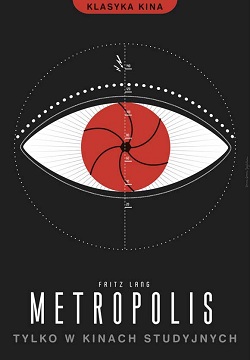
Eddie Muller is the consummate showman. Aware that his San Francisco Silent Film Festival (SFSFF) audience was restlessly grumbling because Metropolis (1927) was 40 minutes late getting started, he quipped, "When you've waited 83 years, what's another 40 minutes?"
"I don't need to tell you," Muller continued, "but what you are going to see tonight is almost unquestionably the most imaginative, innovative and ambitious silent film ever made and—at the time—the most ambitious, innovative, imaginative movie period that had been made up to that time."
Muller recalled that when he was a callow 15-year-old, he saw Metropolis for the very first time in a high school film literacy course. It was the film that opened his cinematic horizons and helped him appreciate silent film and film history; an experience he's confident he shares with a great many people because of the myth, the legend and the greatness of Metropolis. Admittedly, however, upon his first viewing of the film—despite being blown away by its visual spectacle—he didn't fully comprehend it, which he attributed to his callow youth without fully realizing that it wasn't just him. There were incomprehensible attributes to the film: characters appeared and disappeared without narrative reason, for example. It was only later on with subsequent viewings and study that he learned the reasons why. Metropolis was a film that had been severely edited after its initial release in 1927 and this long saga has been detailed in his essay for the SFSFF program (as well as in Bret Wood's TCM essay).
 Fritz Lang was hurt by this experience and frequently said he never wanted to watch Metropolis again; but, over the years, as every new version of the film appeared—and there have been a few within Muller's lifetime—they were touted as being the most complete version that would ever be seen. Every time he heard these boasts, Muller countered, it had the opposite effect than hoped. It made him feel that the original version of Metropolis—like von Stroheim's Greed—would never actually be found. "Folks," Muller grinned, "we found it!"
Muller then invited to the Castro stage the two individuals responsible for finding the complete Metropolis in a modest film vault in Buenos Aires: Argentine archivists Paula Félix-Didier and Fernando Martín Peña.
First off, Muller wanted to clarify that—when this happened in 2008 and it was reported in the international media—the way it was reported was that the discovery was pretty much "a delightful accident, a fantastic fluke, a feel-good story for the global media." But, apparently, those reports in the media weren't entirely true. "The actual story is something very different, right?" he posed to Peña.
 Yes, Peña confirmed, the discovery was no accident. He had been aware of the existence of the film for some time and had first been denied access to the print 20 years ago. In 1988, Peña was the teenage protégé of Argentine film critic Salvador Sammaritano who founded Argentina's most influential film society. Sammaritano had hired Peña to help him catalog the film collection of the late Manuel Peña-Rodriguez who, in turn, had been Sammaritano's mentor. On that list was Peña-Rodriguez's personal print of Metropolis, which recalled Sammaritano to a screening held in 1959 for a few members of his film society. Sammaritano told Peña that—at that screening—the shrinkage of the original nitrate print caused a gap between the film and the gate, leaving the image to flicker slightly out of focus. To fix the problem, Sammaritano went up to the projection booth and added pressure to the gate with his finger to steady the picture. Sammaritano told Peña that he held his finger in position for two hours and a half. Peña, of course, had studied film and seen the modern version of Metropolis, which didn't last nearly one hour and a half, so he doubted Sammaritano, "Are you sure? Two hours and a half?" Sammaritano responded that he would never forget those two hours and half; his finger was so numb.
 Peña began studying the story of the film in Argentina [read his fascinating Undercurrent account here] and discovered that the version of Metropolis that played in Buenos Aires came directly from Ufa, not Paramount, and that it was bought by an independent Argentine distributor Alolfo Z. Wilson in February 1927—six months before the recut American version replaced all international prints. Peña-Rodriguez—who had begun collecting film in the '30s—bought Wilson's distributor print. When he eventually sold his films to the Argentinean state, they destroyed the dangerous nitrate original and made the 16mm copy. Confirming this research against the 16mm print in the archives was hindered, however, by bureaucratic indifference. When the Peña-Rodriguez print was donated and transferred to the Fondo Nacional de las Artes in 1971, Peña petitioned for access to the print but Sammaritano's anecdote was reduced to interesting hearsay and his request was denied. Peña's repeated requests were denied for the next 20 years as he kept track of the film's transfer among national, state and municipal agencies.
 In April 2008, Peña's ex-wife Paula Félix-Didier was hired as the director of the Museo del Cine in Buenos Aires, the current home of the Peña-Rodriguez collection. Félix-Didier was fully aware of Peña's ongoing struggle to achieve access to the film and so—when they sat down to share a cup of coffee at a Buenos Aires film festival shortly after her appointment—she suggested they work together. Naturally, high on Peña's list was the long-awaited opportunity to go into the vaults to check on the Metropolis print. ("Funny how it works out," Muller quipped.) In May 2008 Peña and Félix-Didier located the print—it took all of 10 minutes; the can was clearly labeled—so the media reports that this was an "accidental" find were totally misleading. The truth was that no one in power had cared enough to confirm the facts. As Félix-Didier relayed to Muller in an earlier interview for the Noir City Sentinel, "Those 10 minutes were the culmination of a whole lifetime spent studying film history." The 16mm print, which had been struck from the 35mm print, was in poor condition and it was difficult for them to determine much holding the film up to the light; but, it didn't take long to confirm that they had indeed found the complete film.
 Muller asked how long it took after they had confirmed their discovery before the international film community believed that they had indeed discovered a full-length print of Metropolis? Peña said it took three to four months. Muller asked them to detail the process.
Félix-Didier explained that she contacted the copyright holders for Metropolis in Germany; Peña contacted Martin Koerber at the Murnau Foundation, who had administered the 2001 restoration. They received no response. They began to realize that, undoubtedly, these agencies had fielded numerous claims of discovered Metropolis footage, and receiving one more email from unknown archivists in Argentina didn't warrant immediate attention. "There's something about Germans and Argentina...." Muller offered by way of explanation.
Peña said it took Europeans to convince the other Europeans. It wasn't well understood that in the '30s and '40s Argentina was one of the first places to screen films from all over the world. They had many foreign expatriates who were collecting films from their home countries. This was somehow hard for Europeans to believe and they took an exclusive Eurocentric view that Argentines weren't aware of the many versions of Metropolis that existed. Peña was swift to assert that he was well aware of the many existing versions of Metropolis but that he was equally confident that he had located an original print.
 Muller asked the on-stage duo to explain some of the economic, political, and ethical issues involved in making such a monumental discovery, especially as the print was located during their employment with a public archive. Félix-Didier admitted that negotiating with the Murnau Foundation was difficult on both sides. She didn't want their discovery to become a repatriation issue—as was recently done with American films in the New Zealand archives—primarily because what Peña uncovered in the vault is a uniquely Argentinean version of Metropolis. Not only did it have Spanish subtitles and intertitles, but those titles had been translated by Leopoldo Torres Ríos who went on to become a well-known filmmaker. He took liberties with his translations and created a free-version "tango" unique to Argentine culture. He also made minor changes to the film. Though these designs might not hold much interest to international scholars of the film with regard to the authenticity of the film, they hold specific interest to Argentine scholars. This remains the version of Metropolis that Argentine audiences watched in 1928 and Félix-Didier wanted to keep that cultural product intact.
She sent the 16mm print to the Murnau Foundation in Germany. They scanned it, made a new print, and a DVD. The Germans only believed her when she physically went to Berlin to the Deutsche Kinemathek and showed them the DVD. Though this was all difficult to achieve, the upside is that the Germans are now helping her preserve a lot of the nitrate films in the Museo del Cine's vaults, currently in progress.
 There were other complications. Félix-Didier received several phone calls from collectors interested in buying their print. The importance of having such a film stored in a public archive is that Félix-Didier hardly needed to waste her breath in reminding interested collectors that the print was not hers to sell. Notwithstanding, one French "pirate" who owned a DVD distribution company, persisted in trying to secure same. At first he didn't even bother to contact her by phone, he sent an email without addressing her by name, and stated he was prepared to offer her a quarter of a million Euros to buy the print. He pleaded with her "not to give the film back to the Nazis"—("So much for forgive and forget," Muller joked)—and argued that he was aware that the Museo del Cine was poor and could use a quarter of a million Euros. Félix-Didier couldn't deny that—she could do a lot of things with so much money—but the point remained that the print was the property of a public archive and not hers to sell. Notwithstanding, he persisted and phoned her every day for two months and a half. Every day she refused his offer. He even phoned her 10 minutes before the premiere at the Berlinale, saying, "I know you are here. I am here too. Let's get together and have a cup of coffee. I want to talk to you because I know that the Murnau Foundation doesn't have the rights to Japan, China and India..." She hung up on him.
 As amazing an experience as this has assuredly been for both of them—particularly for Peña after trying to secure access to the print for 20 years—Muller wanted to know what they were taking away from the experience, what the experience has meant for them, and what this discovery has meant to Argentina? Peña wasn't sure if he could speak for Argentina; but, he hoped that the people in power in government would understand the importance of film preservation and provide funding so that archivists and preservationists can do their necessary work. Since there is no national cinematheque in Argentina, these public archives are dependent upon outside financial assistance and it would be great if some of that came from the government. As for himself, Peña joked: "I know it's going to be all downhill from now on."
Félix-Didier added that they were lucky to have found a complete print of a film that is so well-known because it has drawn a lot of attention—not only to the Museo del Cine, who really needs the attention—but also to film preservation in general everywhere. There's no denying that's a good thing. "I always say that this is our job," Félix-Didier concluded, "This is what we do. We take care of films. We take care of all kinds of films. Sometimes they are famous films and sometimes they are films that are not so famous but equally important."
Peña appended that when a person in a country like Argentina decides to dedicate themselves to film history, they need generosity and encouragement. In his case, he found generosity and encouragement in one man, whose work he has seen and read "since I could read and see." Those grateful for the Buenos Aires "find" of the complete print of Metropolis owe it, Peña suggested, to the work of Kevin Brownlow.
 Muller wrapped up by admitting that—though he knew the SFSFF screening of Metropolis was going to be a special event—he didn't know how special it was going to be until he learned that Fernando Peña had not yet seen the restored print and that he would be seeing it for the first time with the SFSFF audience. Muller was being modest. I feel it important to point out that Fernando Peña's opportunity to finally see the restored version of the film he has championed his entire adult life is directly attributable to Eddie Muller and the Film Noir Foundation, who paid for his airfare to attend SFSFF. Most festivals can only afford to fly one person in for such an event and Paula Félix-Didier, as the director of the Museo del Cine, is the obvious choice; but, realizing that Fernando Peña and his cinephilic passion was being swept aside in the rush of events, Muller wanted to fully credit him for his remarkable achievement. Kudos, Eddie!
07/26/10 UPDATE: At Parallax View, Sean Axmaker has compiled a useful aggregate of all coverage of the Metropolis restoration to date, including his conversation with Fernando Peña at SFSFF regarding the digital projection. As Carl Martin indicated earlier on his Film on Film Foundation blog, though a 35mm print of this recent restoration exists and was shown at the Hong Kong Film Archive in April, 2010, the digital print is seemingly screening everywhere else. Sean asked Peña how his experience of the SFSFF screening matched up to his hopes and expectations. "His response surprised me," Sean reported, "though it shouldn't have: he was disappointed that it was shown in projected digital edition, which he said flattens the image. Personally, I've always disliked the cold, harsh light of digital projection of black and white films, so unnatural compared to the warm light of film projection bulbs (or even better, the burn of old-fashioned carbon arcs, all but gone from projection houses). But Fernando brought another, even more distinctive difference to my attention when he reminded me that the screen image created by light passing through film gives you distinctive texture from light and shadow and gradations between them. It creates sense of space on the screen that video projection of black and white film does not and that texture was missing from the SFSFF screening."
Cross-published on Twitch.
 The San Francisco Silent Film Festival (SFSFF) is the biggest and most prestigious event of its kind in the Americas—and it's going to be even bigger for its 15th anniversary edition which begins Thursday. This year the fest expands from three days to four and will feature a massive 18 programs from seven countries. The line-up includes works by well known directors (Fritz Lang, Frank Capra, G.W. Pabst) and stars (Laurel and Hardy, Louise Brooks, Norma Talmadge), as well as rarities like The Flying Ace, a 1926 film that features an all African-American cast. And as a special treat, David Shepard and Serge Bromberg of Lobster Films have curated a selection of shorts by George Méliès (the French fantasist best known for 1902's A Trip to the Moon), which will play throughout the festival.
 If you've been to the SFSFF before, you don't need me to tell you what a fabulous, class act it is and why it's become a "destination festival" for silent film enthusiasts around the world. The programming is eclectic and fun, the best available 35mm prints are used, the cream of silent film accompanists are hired to do their thing and best of all, it all goes down in our beloved 1922 movie palace, the Castro Theater. As the SFSFF says in its mission statement, "Silent filmmakers produced masterpieces and crowd-thrilling entertainments. Remarkable for their artistry and their inestimable value as historical documents, silent films show us how our ancestors thought, spoke, dressed and lived. It is through these films that the world first came to love movies." And it's through the SFSFF that I've come to love silent movies. Here's a cursory walk through the 2010 line-up.
Thursday, July 15
 7:00 P.M. The Iron Horse (1924, USA, dir. John Ford)—In response to the success of Paramount's The Covered Wagon in 1923, Fox studios made this idealized epic about the building of America's trans-continental railroad. Filmed mostly in Arizona with a cast and crew of over 6,000 people, it was Hollywood's first big-scale western and is sometimes referred to as "the silent How the West Was Won." Cattle drives, Indian attacks, saloon brawls—things which later became clichés of the western genre—are said to have had their origins here. George O'Brien, now best known for F.W. Murnau's Sunrise, stars as a railroad surveyor whose childhood sweetheart marries the man who killed his father. The film culminates with the 1869 driving of the golden spike at Promontory Point, Utah, and Wild Bill Hickcok, Buffalo Bill and Abraham Lincoln all make fictionalized appearances. Dennis James, who owns the only existing 35mm print of the American version of The Iron Horse, will accompany it on the Mighty Wurlitzer.
Friday, July 16
11:30 A.M. Amazing Tales from the Archives: Lost & Found Films—One benefit of having an extra day in the festival is that we get two "Amazing Tales" programs. This first one features presentations by Joe Linder from the Academy of Motion Picture Arts and Sciences, plus Paula Félix-Didier and Fernando Peña of the Museo del Cine in Buenos Aires. The latter duo are now superheroes to silent film lovers everywhere, having discovered a 16mm dupe negative of Fritz Lang's Metropolis that was 25 minutes longer than any previously known version (the restoration of which will be shown at the festival later in the evening.) Donald Sosin accompanies. FREE ADMISSION!
 2:00 P.M. A Spray of Plum Blossoms (1931, China, dir. Bu Wancang)—This film is one of several collaborations between its prolific director and China's favorite on-screen couple of the silent era, Ruan Ling-yu and Jin Yan (tragically, Ruan would kill herself at age 24). Loosely based on Shakespeare's Two Gentlemen of Verona, this adaptation is set in the Chinese army circa 1930 and follows two old friends who become rivals for the same young woman. "Like any Shakespeare comedy, Plum Blossoms is replete with star-crossed lovers, mistaken identity and a satisfying happy ending." Donald Sosin accompanies.
6:00 P.M. Rotaie (1929, Italy, dir. Mario Camerini)—Virtually unknown to American audiences, this late-era Italian silent is noted for its German expressionist influence. Two down-on-their-luck young lovers plan suicide, until they find a lost wallet on a train. They're lured to a seaside resort by a high society sleazeball, who then tries to seduce the girl while her lover gambles away their money at the roulette wheel. A sound version of this film would be released two years later. There will be a live English translation of the original Italian intertitles. Stephen Horne accompanies.
 8:15 P.M. Metropolis (1927, Germany, dir. Fritz Lang)—If there's a "star" of this year's SFSFF, it's undoubtedly the new "complete" version of Lang's expressionist masterpiece of futuristic dystopianism. The last Metropolis restoration occurred in 2001 and it screened at the SF International Film Festival with the fest's former artistic director Peter Scarlett translating the German intertitles. At the time, it was believed the world would never see a more complete version. As I mentioned above, a 16mm print of Metropolis with 25 additional minutes was discovered in Buenos Aires in 2008—and those minutes are said to contain not just scene trims, but entire subplots. Just as importantly, the Argentine discovery reinstates Lang's original editing, which in previous restorations has been a matter of conjecture.
The digital restoration of the new material, still clearly identifiable due to the ravages of time, took one year and 600,000€ to complete. This will be the only film at the SFSFF to be screened digitally, which for better or worse is the only format that distributor Kino International is releasing. Argentine archivists Paula Félix-Didier and Fernando Peña will be on hand to do an introduction, and the incomparable Alloy Orchestra will perform their celebrated original score which has been expanded to accommodate the new material. And don't forget to check out the festival's Metropolis Photo Booth, courtesy of the San Francisco Film Museum. Metropolis is now on "rush" status, which means tickets are only obtainable by purchasing a Festival Pass, or by making a Patron or Grand Patron donation to the festival—or by waiting in the "rush" line and hoping for the best.
Saturday, July 17
 10:00 A.M. The Big Business of Short Funny Films—A few years back the SFSFF instituted a Director's Pick program and the pickers have included Terry Zwigoff and Guy Maddin. This year's selection is by Pete Docter, the Oscar-winning director of Pixar's Monsters, Inc. and Up, who has chosen to screen three comedy shorts. Roscoe "Fatty" Arbuckle directs himself and Buster Keaton as a cook and waiter respectively in 1918's The Cook. Inducted into the National Film Registry in 1998 is the Hal Roach-produced Pass the Gravy, a 1928 yarn about a prize rooster and feuding neighbors. Then in the 1929's Big Business, Laurel and Hardy play California Xmas tree salesmen whose argument with a customer escalates into all-out war. Pete Docter will be interviewed by Leonard Maltin and Dennis James will be this program's accompanist.
12:00 P.M. Variations on a Theme: Musicians on the Craft of Composing and Performing for Silent Film—The title says it all. The panelists in this special program comprise a who's who of silent film composers and accompanists, including pianists Donald Sosin and Stephen Horne, organist Dennis James, the Mont Alto Motion Picture Orchestra, the Alloy Orchestra, and Swedish musician and composer Matti Bye. Chloe Veltman, Bay Area culture correspondent for The New York Times and producer and host of NPR's VoiceBox, will moderate.
 2:00 P.M. The Flying Ace (1926, USA, dir. Richard E. Norman)—Between 1920 and 1928, white film producer/director Richard E. Norman made six feature films that sought an alternative to the demeaning portrayal of African-Americans found in silent cinema. His production company turned out everything from westerns to comedies to gangster flicks, but unfortunately, The Flying Ace is the only one that survives today. In this film, a WWI fighter pilot returns home a hero, only to become embroiled in a battle against railroad thieves. Introducing the film will be Rita Reagan from the Norman Studios Film Museum in Jacksonville, Florida. Donald Sosin provides accompaniment.
 4:00 P.M. The Strong Man (1926, USA, dir. Frank Capra)—This slapstick comedy was Capra's second feature, and it stars Harry Langdon as a Belgian soldier who comes to America in search of the female pen pal he corresponded with during the war. He's accompanied by German strongman performer Zandow the Great, whom 98 lb. weakling Langdon must replace when the great one becomes incapacitated. This will be my first Langdon film and from what I read, his wide-eyed, man-child persona is an acquired taste. Those who love him rank Langdon with the greats like Chaplin, Keaton and Lloyd, and many consider The Strong Man his best film. Prior to the screening, the 2010 Silent Film Festival Award will be presented to Kevin Brownlow and Patrick Stanbury. Their company Photoplay Productions specializes in restorations of silent era films, many of which have graced the SFSFF over the years. Stephen Horne accompanies this one.
 6:30 P.M. Diary of a Lost Girl (1929, Germany, dir. G.W. Pabst)—After obtaining incendiary results with Pandora's Box, Pabst and leading lady Louise Brooks collaborated once more on this story of a girl's ruination and a young woman's regeneration. After getting pregnant by her pharmacist father's lecherous assistant, Brooks' character is sent packing to a hellish girl's reform school. She manages to escape, then dabbles in prostitution en route to becoming a countess. The restoration being screened at the festival was made by the Cineteca di Bologna and includes seven minutes of previously censored footage. I only experienced Pandora's Box for the first time several nights ago, courtesy of Netflix' Watch Instantly, so now I'm really hot to catch this follow-up on the big screen. This SFSFF Centerpiece Film is also the Founders Pick, chosen by the festival's originators Stephen Salmons and Melissa Chittick. The film will be introduced by actor/writer/director and SFSFF board member Frank Buxton, and the fantastic Mont Alto Motion Picture Orchestra will provide the accompaniment.
 9:30 P.M. Häxan: Witchcraft Through the Ages (1922, Denmark/Sweden, dir Benjamin Christensen)—In the early 1980s, there was a Bay Area cable station that only screened public domain movies, and it screened the same ones repeatedly. That's where I first caught late-night bits and pieces of this seven-chapter, reverie-disturbing "documentary" exploring "the scientific hypothesis that the witches of the Middle Ages suffered the same hysteria as turn-of-the-century psychiatric patients." Reportedly the most expensive Scandinavian silent film ever made, it was banned in the US for depictions of torture, nudity, satanic worship, sacrilege and sexual perversion. Come for the comprehensive tour of medieval torture devices; stay for the flying witches kissing the ass of Satan (portrayed, as is a brief appearance by Jesus, by the director himself). Making their SFSFF debut accompanying Häxan is Sweden's Matti Bye Ensemble.
Sunday, July 18
 10:00 A.M. Amazing Tales from the Archives: First the Bad News…then the Good!—In this second set of Amazing Tales, clips and slides will be used to discuss various silent film preservation issues. First up is the Library of Congress' Mike Mashon, who will talk about the "fascinating and devastating reality of American silent film survival rates." He'll be followed by Annette Melville from the National Film Preservation Foundation, who will "present a way to bring back some of this history via a major international repatriation project." More good news—the presentation will include a newly preserved print of the 1920 Mutt and Jeff cartoon, On Strike! FREE ADMISSION!
12:00 P.M. The Shakedown (1929, USA, dir. William Wyler)—The great William Wyler directs James Murray (King Vidor's The Crowd) as a boxer who travels from town to town staging rigged fights, until he meets up with an orphan and a benevolent waitress who inspire him to mend his ways. Leonard Maltin will be on hand to interview the Wyler children about their father, and Donald Sosin will accompany the film.
 2:30 P.M. The Man with a Movie Camera (1929, USSR, dir. Dziga Vertov)—I recently watched this avant-garde masterpiece for the first time in 30-plus years on Netflix' Watch Instantly, accompanied by the Alloy Orchestra's rip-roaring, magisterial score. It unequivocally Blew. Me. Away.—and I can scarcely believe I'll be seeing it on the gigantic Castro screen with the awesome Alloys performing live! If you got shut out of seeing them perform with the sold-out Metropolis, this ought to make for one helluva consolation prize. Hell on Frisco Bay's Brian Darr has done the program notes for this, which I anxiously anticipate reading.
 4:30 P.M. The Woman Disputed (1928, USA, dir. Henry King, Sam Taylor)—Norma Talmadge makes her final silent film appearance in this tale of a prostitute who's unable to escape her past. Set in Austria during WWI, her character is coveted by an Austrian and a Russian officer, and she must spend "a night of passion" with the latter in order to save the townspeople who've scorned her. Based on a story by Guy de Maupassant, the film co-stars Talmadge's off-screen lover, Gilbert Roland. Stephen Horne provides accompaniment.
 7:30 P.M. L'heureuse mort (1924, France, dir. Serge Nadejdine)—The 2010 SFSFF closes with a French comedy that captivated the festival's staff at last year's Pordenone Silent Film Festival. Théodore is a failed Parisian playwright who falls off a boat while on holiday and is presumed drowned. When he returns home and learns that that his plays are now all the rage, he impersonates his own brother in order to perpetuate the posthumous acclaim that eluded him while "alive." Director Nadejdine was previously a ballet master in Russia, a job he'd take up again after moving to the US. The character of Théodore is played by Nicolas Rimsky, who also wrote the screenplay from a novel by Countess Baillehache. Leonard Maltin will introduce the film and the Matti Bye Ensemble will accompany it.
Cross-published on film-415 and Twitch.
 It's time to make noise about San Francisco's upcoming Silent Film Festival (SFSFF), launching at the Castro Theatre this Thursday July 15 with John Ford's The Iron Horse (1924) and continuing through the weekend with 11 classics, more shorts, more amazing tales from the archives, and an on-stage panel Variations on a Theme: Musicians on the Craft of Composing and Performing for Silent Film.
The heralds have been busy. At Hell on Frisco Bay, Brian Darr has enunciated summer's silence with a detailed entry that includes one-of-three posters designed by David O'Daniel specifically for SFSFF. Whereas at SIFFBlog, David Jeffers has posted anticipatory reviews of The Flying Ace (1926), The Shakedown (1929), L'Heureuse Mort (1924), Big Business (1929), The Cook (1918), Diary of a Lost Girl (1929), Rotaie (1929) and Metropolis (1927).
 Speaking of Metropolis, tickets for this highly-anticipated event have gone on rush. I had the great fortune to attend the North American premiere of Fritz Lang's recently-restored classic at the first-ever Turner Classic Movies Classic Film Festival in Grauman's Chinese Theatre, Hollywood, California. Introduced by TCM's Daytime Host Robert Osborne, my experience of the screening of Metropolis was enhanced by an erudite essay "Metropolis Resurrected" in the festival's souvenir program written by Bret Wood.
As indicated at his website, Bret Wood is the writer/director of the feature film Psychopathia Sexualis (2006). His first feature was the documentary Hell's Highway: The True Story of Highway Safety Films (2003), which was acclaimed as "unnerving and much fun" (The New York Times) and "endlessly fascinating" (Los Angeles Times). Filmmaker Magazine called it "A Lynchian view of the nightmarish underbelly of middle America." His previous documentaries include Kingdom of Shadows (1998, narrated by Rod Steiger). He has written several books on film, including Forbidden Fruit: The Golden Age of the Exploitation Film (co-written with his wife, art/film critic Felicia Feaster). Wood's film-related essays have appeared in Sight and Sound, Film Comment, Positif and other publications. He also works as an editor, graphic artist and producer of classic films on DVD. He is currently developing his award-winning screenplay The Seventh Daughter.
Bret Wood has generously granted permission to replicate his TCM souvenir catalog essay on Metropolis on The Evening Class as a gift to the San Franciscan audience about to share this thrilling experience. My thanks to him and Turner Classic Movies.
* * *
 Seldom has the rediscovery of a cache of lost footage ignited widespread curiosity as did the announcement, in July 2008, that an essentially complete copy of Fritz Lang's Metropolis had been found.
When it was first screened in Berlin on January 10, 1927, the sci-fi epic ran an estimated 153 minutes. After its premiere engagement, in an effort to maximize the film's commercial potential, the film's distributors (Ufa in Germany, Paramount in the U.S.) drastically shortened Metropolis. By the time it debuted in the States, the film ran approximately 90 minutes (exact running times are difficult to determine because silent films were not always projected at a standardized speed).
Even in its truncated form, Metropolis went on to become one of the cornerstones of fantastic cinema. Testament to its enduring popularity, the film has undergone numerous restorations in the intervening decades. In 1984, it was reissued with additional footage, color tints, and a pop rock score (but with many of its intertitles removed) by music producer Giorgio Moroder. A more archival restoration was completed in 1987, under the direction of Enno Patalas and the Munich Film Archive, in which missing scenes were represented with title cards and still photographs. More recently, the 2001 restoration—supervised by Martin Koerber, under the auspices of the Murnau Foundation—combined footage from four archives and ran a triumphant 124 minutes. It was widely believed that this would be the most complete version of Lang's film that contemporary audiences could ever hope to see.
 Then in the summer of 2008, the curator of the Buenos Aires Museo del Cine discovered a 16mm dupe negative that was considerably longer than any existing print. It included not merely a few additional snippets, but 25 minutes of "lost" footage, about a fifth of the film, that had not been seen since its Berlin debut.
The discovery of such a significant amount of material called for yet another restoration.
Spearheading the project was the Friedrich-Wilhelm-Murnau-Stiftung (hereafter referred to as the Murnau Foundation). Established in 1966, the Murnau Foundation's goal is the preservation and continued circulation of a large portion of Germany's film heritage. Ranging from early cinema to the 1960s, the collection of more than 6,000 films (silents, talkies, and shorts) includes works by Murnau, Lang, Ernst Lubitsch, and Douglas Sirk.
Film restorer for the Murnau Foundation, Anke Wilkening coordinated the endeavor.
 "We discussed the new approach with experts and German archive partners to establish a team for the 2010 restoration," Wilkening explains. "The project consisted of two main tasks: the reconstruction of the original cut and the digital restoration of the heavily-damaged images from the Argentinean source."
Returning to Metropolis was Koerber, Film Department Curator of the Deutsche Kinemathek, who had supervised the 2001 restoration. "Three people worked on what we call 'edition'—meaning sorting out the material and determining the order of shots, making aesthetic and technical decisions, etc.: Anke Wilkening, Frank Strobel, and myself," says Koerber.
As word spread of the discovery of the Buenos Aires negative, nervous aficianados worried that archival politics might hinder the integration of the rediscovered footage into Metropolis. Koerber explains this was never the case. "They were always willing to cooperate. In fact, they offered the material once they identified what it was."
 Once obtained by the Murnau Foundation, the 16mm negative was digitally scanned in 2K by the Arri Group in Munich.
The condition of the 16mm negative posed a major technical challenge to the team. The image was streaked with scratches and plagued by flickering brightness. "It had all been printed from the 35mm nitrate print, which means they have become part of the picture," says Wilkening. The source 35mm element was later destroyed (probably due to the flammability and chemical instability of the nitrocellulose film stock).
An unfortunate lesson was thus learned from the restoration. "Don't throw your originals away even if you think you preserved them, and even if they are in bad shape," Koerber says. "If we could have had access to the 35mm nitrate print that was destroyed after being reprinted for safety onto 16mm dupe negative some 30 years ago, we would have been able to make a much better copy today."
 Fortunately, advances in digital technology allowed the team to at least diminish some of the printed-in wear. "If we would have had the Argentinean material for the 2001 restoration, it would have hardly been possible to work on the severe damage," Wilkening says. In 2010, however, "it was possible to reduce the scratches prominent all over the image and almost eliminate the flicker that was caused by oil on the surface of the original print—without aggressively manipulating the image."
Under Wilkening and Koerber's supervision, the visual cleanup was performed by Alpha-Omega Digital GmbH, utilizing digital restoration software of their own development.
At one time, purists objected to the use of digital technology in the restoration of film. But it has become an indispensible tool for preservationists. "[Digital technology] has made things possible we could only dream of a decade or two ago," Koerber says. "Digital techniques allow more precise interventions than ever before. And it is still evolving—we are only at the beginning."
 "The work on the restoration teaches us once more that no restoration is ever definitive," says Wilkering. "Even if we are allowed for the first time to come as close to the first release as ever before, the new version will still remain an approach. The rediscovered sections, which change the film's composition, will at the same time always be recognizable through their damages as those parts that had been lost for 80 years."
Viewing Metropolis today, the Argentine footage is clearly identifiable because so much of the damage remains. The unintended benefit is that it provides convenient earmarks to the recently reintegrated scenes.
Other changes are not so noticeable. Because the Buenos Aires negative provided a definite blueprint to the cutting of Metropolis—which in the past had been a matter of conjecture—the order of some of the existing shots has been altered in the 2010 edition, bringing Metropolis several steps closer to its original form.
It is important to note that the "new" shots are not merely extensions of previously existing scenes. In some cases, they comprise whole subplots that were lopped off in their entirety.
 "It restores the original editing," Koerber says, "restoring the balance between the characters and subplots that remained and those that were excised."
"Thanks to the Argentine find, the film's structure changes thoroughly," explains Wilkening, "especially the three male supporting characters—Josaphat, Georgy, and "der Schmale" (the Thin One)—who had been diminished to mere extras due to the elimination of two large scenes."
"Parallel editing becomes now a major player in Metropolis," Wilkening says. "The new version represents a Fritz Lang film where we can observe the tension between the preferred subject, the male melodrama, and the bombastic dimensions of the Ufa production."
The 2010 restoration took about one year, from conception to completion, and was performed at the cost of 600,000€ (approx. $840,000). But Wilkening is quick to point out that it is but the latest chapter in an ongoing saga, and pays tribute to the other preservationists who have so vigorously championed the film. "Metropolis is the prototype of an archive film. Decades of research for the lost scenes and various attempts to reconstruct the first release version have produced a large pool of knowledge of this film."
 Asked how the Metropolis restoration compared to other projects in which the Deutsche Kinemathek participated, Koerber replies, "No comparison. Metropolis is more complex in many ways. On the other hand, it is also more rewarding, as the [availability of source material]—film material as well as secondary sources—is exceptionally good."
Currently, Wilkening is finishing a restoration of Lang's Die Nibelungen saga, and is optimistic about future projects. "Like everybody we would be keen to find the lost films of Murnau and Lang." But she adds, "I would be happy to turn from the holy grails to some films which are existing in the vaults of the archives, but are forgotten and hardly considered for restoration as they are not part of the canon."
On behalf of the Deutsche Kinemathek, Koerber says, "We were happy to be a partner with the Murnau-Stiftung and provide all the necessary expertise as well as the documents from our collection (script, music, etc.). I hope this successful cooperation will be a model for future projects."
 "The project was a very good experience regarding team work," Wilkening says. "The collaboration of the different individuals with different backgrounds—historians, musicians and technicians—was exceptionally fruitful."
Now that Metropolis is—at least for now—behind them, preservationists resume their watch for new opportunities, and forgotten cans of film that might offer other cinema treasures a second life.
07/14/10 UPDATE: At the Film on Film Foundation's blog, Carl Martin takes the digital restoration of Metropolis to task: "We have here the worst possible scenario from a purist preservationist perspective: a poorly duped 16mm copy of footage from a heavily scratched and oil-mottled print (since destroyed), worked over digitally and projected digitally to boot." Despite my assurance that my experience of the digital restoration and its Alloy Orchestra score was a memorable evening of cinema, Martin refuses to attend on principle. "Digital prints are like step children to you?" I queried. "Like step children with missing chromosomes," he responded wryly.
At SIFFblog, David Jeffers has put up his final two anticipatory reviews: Iron Horse (1924) and The Strong Man (1926).
Cross-published on Twitch.
 Eddie Muller is the consummate showman. Aware that his San Francisco Silent Film Festival (SFSFF) audience was restlessly grumbling because Metropolis (1927) was 40 minutes late getting started, he quipped, "When you've waited 83 years, what's another 40 minutes?"
 Fritz Lang was hurt by this experience and frequently said he never wanted to watch Metropolis again; but, over the years, as every new version of the film appeared—and there have been a few within Muller's lifetime—they were touted as being the most complete version that would ever be seen. Every time he heard these boasts, Muller countered, it had the opposite effect than hoped. It made him feel that the original version of Metropolis—like von Stroheim's Greed—would never actually be found. "Folks," Muller grinned, "we found it!"
 Yes, Peña confirmed, the discovery was no accident. He had been aware of the existence of the film for some time and had first been denied access to the print 20 years ago. In 1988, Peña was the teenage protégé of Argentine film critic Salvador Sammaritano who founded Argentina's most influential film society. Sammaritano had hired Peña to help him catalog the film collection of the late Manuel Peña-Rodriguez who, in turn, had been Sammaritano's mentor. On that list was Peña-Rodriguez's personal print of Metropolis, which recalled Sammaritano to a screening held in 1959 for a few members of his film society. Sammaritano told Peña that—at that screening—the shrinkage of the original nitrate print caused a gap between the film and the gate, leaving the image to flicker slightly out of focus. To fix the problem, Sammaritano went up to the projection booth and added pressure to the gate with his finger to steady the picture. Sammaritano told Peña that he held his finger in position for two hours and a half. Peña, of course, had studied film and seen the modern version of Metropolis, which didn't last nearly one hour and a half, so he doubted Sammaritano, "Are you sure? Two hours and a half?" Sammaritano responded that he would never forget those two hours and half; his finger was so numb.
 Peña began studying the story of the film in Argentina [read his fascinating Undercurrent account here] and discovered that the version of Metropolis that played in Buenos Aires came directly from Ufa, not Paramount, and that it was bought by an independent Argentine distributor Alolfo Z. Wilson in February 1927—six months before the recut American version replaced all international prints. Peña-Rodriguez—who had begun collecting film in the '30s—bought Wilson's distributor print. When he eventually sold his films to the Argentinean state, they destroyed the dangerous nitrate original and made the 16mm copy. Confirming this research against the 16mm print in the archives was hindered, however, by bureaucratic indifference. When the Peña-Rodriguez print was donated and transferred to the Fondo Nacional de las Artes in 1971, Peña petitioned for access to the print but Sammaritano's anecdote was reduced to interesting hearsay and his request was denied. Peña's repeated requests were denied for the next 20 years as he kept track of the film's transfer among national, state and municipal agencies.
 In April 2008, Peña's ex-wife Paula Félix-Didier was hired as the director of the Museo del Cine in Buenos Aires, the current home of the Peña-Rodriguez collection. Félix-Didier was fully aware of Peña's ongoing struggle to achieve access to the film and so—when they sat down to share a cup of coffee at a Buenos Aires film festival shortly after her appointment—she suggested they work together. Naturally, high on Peña's list was the long-awaited opportunity to go into the vaults to check on the Metropolis print. ("Funny how it works out," Muller quipped.) In May 2008 Peña and Félix-Didier located the print—it took all of 10 minutes; the can was clearly labeled—so the media reports that this was an "accidental" find were totally misleading. The truth was that no one in power had cared enough to confirm the facts. As Félix-Didier relayed to Muller in an earlier interview for the Noir City Sentinel, "Those 10 minutes were the culmination of a whole lifetime spent studying film history." The 16mm print, which had been struck from the 35mm print, was in poor condition and it was difficult for them to determine much holding the film up to the light; but, it didn't take long to confirm that they had indeed found the complete film.
 Muller asked how long it took after they had confirmed their discovery before the international film community believed that they had indeed discovered a full-length print of Metropolis? Peña said it took three to four months. Muller asked them to detail the process.
 Muller asked the on-stage duo to explain some of the economic, political, and ethical issues involved in making such a monumental discovery, especially as the print was located during their employment with a public archive. Félix-Didier admitted that negotiating with the Murnau Foundation was difficult on both sides. She didn't want their discovery to become a repatriation issue—as was recently done with American films in the New Zealand archives—primarily because what Peña uncovered in the vault is a uniquely Argentinean version of Metropolis. Not only did it have Spanish subtitles and intertitles, but those titles had been translated by Leopoldo Torres Ríos who went on to become a well-known filmmaker. He took liberties with his translations and created a free-version "tango" unique to Argentine culture. He also made minor changes to the film. Though these designs might not hold much interest to international scholars of the film with regard to the authenticity of the film, they hold specific interest to Argentine scholars. This remains the version of Metropolis that Argentine audiences watched in 1928 and Félix-Didier wanted to keep that cultural product intact.
 There were other complications. Félix-Didier received several phone calls from collectors interested in buying their print. The importance of having such a film stored in a public archive is that Félix-Didier hardly needed to waste her breath in reminding interested collectors that the print was not hers to sell. Notwithstanding, one French "pirate" who owned a DVD distribution company, persisted in trying to secure same. At first he didn't even bother to contact her by phone, he sent an email without addressing her by name, and stated he was prepared to offer her a quarter of a million Euros to buy the print. He pleaded with her "not to give the film back to the Nazis"—("So much for forgive and forget," Muller joked)—and argued that he was aware that the Museo del Cine was poor and could use a quarter of a million Euros. Félix-Didier couldn't deny that—she could do a lot of things with so much money—but the point remained that the print was the property of a public archive and not hers to sell. Notwithstanding, he persisted and phoned her every day for two months and a half. Every day she refused his offer. He even phoned her 10 minutes before the premiere at the Berlinale, saying, "I know you are here. I am here too. Let's get together and have a cup of coffee. I want to talk to you because I know that the Murnau Foundation doesn't have the rights to Japan, China and India..." She hung up on him.
 As amazing an experience as this has assuredly been for both of them—particularly for Peña after trying to secure access to the print for 20 years—Muller wanted to know what they were taking away from the experience, what the experience has meant for them, and what this discovery has meant to Argentina? Peña wasn't sure if he could speak for Argentina; but, he hoped that the people in power in government would understand the importance of film preservation and provide funding so that archivists and preservationists can do their necessary work. Since there is no national cinematheque in Argentina, these public archives are dependent upon outside financial assistance and it would be great if some of that came from the government. As for himself, Peña joked: "I know it's going to be all downhill from now on."
 Muller wrapped up by admitting that—though he knew the SFSFF screening of Metropolis was going to be a special event—he didn't know how special it was going to be until he learned that Fernando Peña had not yet seen the restored print and that he would be seeing it for the first time with the SFSFF audience. Muller was being modest. I feel it important to point out that Fernando Peña's opportunity to finally see the restored version of the film he has championed his entire adult life is directly attributable to Eddie Muller and the Film Noir Foundation, who paid for his airfare to attend SFSFF. Most festivals can only afford to fly one person in for such an event and Paula Félix-Didier, as the director of the Museo del Cine, is the obvious choice; but, realizing that Fernando Peña and his cinephilic passion was being swept aside in the rush of events, Muller wanted to fully credit him for his remarkable achievement. Kudos, Eddie!