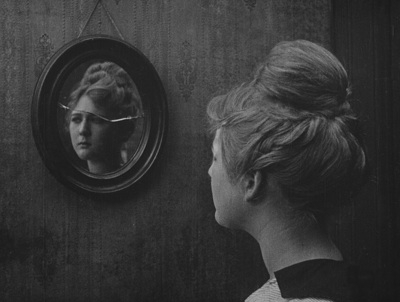
I first met Charles ("Charlie") Tabesh, the Senior Vice President of Programming for Turner Classic Movies (TCM), when Tabesh and Robert Osborne attended the 2007 summer edition of the San Francisco Silent Film Festival (SFSFF). Not only was Osborne on hand to introduce Camille (1921), but—on behalf of TCM—he accepted SFSFF's commendation to TCM for their continuing contributions to the silent film genre.
At that time I asked Charlie Tabesh to talk about TCM's commitment to the silent film genre and he replied: "As far as the silent film programming and why we do it and why it's important to us, there are three things I can think of off the top of my head that really explain it: One, we are not ad-supported. As a programmer, that's great because it gives us all sorts of flexibility and it allows us to not do things that advertisers would want to try to reach a mass audience, or whatever. Strategically, then, doing something niche like silent film, gives us really passionate advocates for the channel because we're the only place you can get it. There are a lot of people all over the country where the only way you're going to see a silent film is on Turner Classic Movies and that's really key because then you have those people going to their cable affiliates saying, 'I really want TCM. Give me TCM.' From a business perspective, that really helps us. It helps us and we're not hurt by the fact that it's very niche because we don't have to worry about advertisers. That's really good.
"The second thing on that is that our general programming strategy and philosophy is we're the history of movies. We're the history of the film and we're the place to go to learn about it. Of course, that means sometimes that includes newer films and people might complain when we play a newer film, but that also includes silent films. You can't be the history of movies and not include silent movies. [Third,] to narrow that further, we're also very much about context. We don't just put movies up on there; everything is themed and there is an idea or a reason behind it. So not only are we about film history, but in the way we look at film history by looking at actors, or directors, or various themes. No matter what theme you do—if you're doing romantic comedies—silent film is a part of that. They're actors and actresses that were both in silent films and sound films and—if we're going to do a tribute to Garbo—we're going to show both her silent and sound films. Silent films are a piece of film history and that's what TCM is all about."
When it was announced in January that TCM had signed on to be the media sponsor for SFSFF's upcoming international premiere of Abel Gance's Napoléon (1927), fully-restored by Kevin Brownlow with the original score by Carl Davis, I was delighted and contacted Charlie Tabesh to congratulate TCM. My thanks to Heather Sautter for facilitating our recent conversation.
* * *
 Michael Guillén: Charlie, thanks for taking a few minutes this morning to talk to me about the international premiere of Abel Gance's Napoléon. You are no stranger to interacting with the San Francisco Silent Film Festival. I first met you and Robert Osborne back in July of 2007 when you were brought out to San Francisco to be honored by SFSFF for Turner Classic Movies (TCM) silent film programming on Sunday nights.
Charlie Tabesh: That was great. It was really a fantastic experience.
Guillén: In January of this year SFSFF announced that TCM had signed on to be the official media sponsor for the Napoléon premiere. Can you talk to how that came about?
Tabesh: We are friendly and have a good relationship with the various people that are putting it on, both people from SFSFF and Patrick Stanbury and Kevin Brownlow, all of who are working on the project. They approached us about being partners and for TCM this Napoléon premiere is such an important event for film lovers and for film history that we really wanted to be affiliated and associated with it. We figured out a way to work with them and I'm really glad.
Guillén: What does TCM's involvement as an official media sponsor actually entail?
Tabesh: Well, that's not really my area. That gets into the marketing department and how they handle the sponsorship. I know we've done some programming on air in support of it. There was some Napoléon-themed programming in January around it to help talk about it and there will be Abel Gance films coming up in March to lead people into it.
Guillén: Will TCM in any way be filming the event? Or doing any interstitial footage of the event?
Tabesh: No, we won't be filming, partly because the legal rights—as you know—are what have kept this film out of circulation for so long. Filming around the event would be problematic and so we aren't planning on doing that.
Guillén: We've spoken before about TCM's silent film programming and discussed TCM's Young Composers initiative. Is that initiative still in effect?
Tabesh: No. We don't do that particular program any longer. It was a great experience and a great program for us but, to be honest, it was very expensive. But TCM is still funding the scoring of silent films.
Guillén: I'm aware that the third edition of the TCM Classic Film Festival in Hollywood is coming up soon. Do you screen silent films there?
Tabesh: We've programmed silent films the last two years and we will continue to do so this year. Every year we do silent films. Some are big name well-known films and others are more obscure; but, we do have a silent film program.
Guillén: One of the things we discussed when you were in San Francisco was after Robert Osborne commented that the appreciation of silent cinema appears to be a bit stronger on the West Coast due to an advantageous time zone. Your Sunday night programming hits us at prime time, whereas it's airing at midnight on the East Coast. Has that issue ever been addressed?
Tabesh: You're exactly right and that's still true. It's a challenge. Anything we do is a bit of a challenge because we have one feed. It's true that the silent films are smackdab in prime time for the West Coast. The one thing that has maybe changed since we last talked is the prevalence of DVRs so that our audience on the East Coast can now tape the silent films if midnight is too late for them. Again, that applies to all things that we do. We have an 8:00 franchise on Saturday nights that is perfect for the East Coast but it's maybe a little bit early for the West Coast. TCM has to try to balance that and make each coast as happy as we can.
Guillén: In recent years I've been intrigued to witness this resurgence of interest in silent cinema, of which TCM has clearly played a part. Do you have any thoughts on why there has been this rekindled interest in silent cinema?
Tabesh: I hope that's true that TCM has had something to do with that. The only thing I can think of is consistency. We've stayed with silent cinema and it's always been part of our mission so maybe just over time people have had the opportunity to catch some silent programming on air and discovered they're really good films. Initially, when you're not used to it, when it's not something you're familiar with, you might put up a little bit of a block and say, "I don't want to sit there and watch a silent movie. What do you mean no dialogue?" But once you give it a try, you're hooked, depending on the film and what your own tastes are. It's great that a movie like The Artist (2011) has helped to revive an interest in silent film.
Guillén: Can you speak to the amount and/or the quality of silent films TCM has in their library?
Tabesh: Within the Turner library itself we have the MGM and the Warner Brothers silents. Not all of them are in great shape so we've gone through a process of determining which materials are good and what we can save, preserve and score from that list. We also work with various studios whose films we license and we work with a lot of independent companies like Milestone Films, Kino and Jeff Mosino from Flicker Alley who has helped fund a lot of great restoration work. A lot of what we do is directly from the library that Ted Turner bought a few years ago, and a lot of what we do is working with these other companies that are as passionate about silent film who are putting them out on DVD. TCM is their television partner in a lot of cases. It just depends on the project. Sometimes Jeff will approach us and he's so passionate about a particular project and is persuasive enough that TCM goes, "Sold. Let's do it." A good example would be J'Accuse! (1919), the Abel Gance film that TCM will be screening [on Sunday, March 18, 9:00PM PT]. TCM funded that restoration some years ago. We can't do all of the restoration of silent films, but we can do quite a bit.
Guillén: I recall when the newly-restored print of J'Accuse! was screened at SFSFF in 2009. I wasn't aware that TCM was involved in that restoration; but, it's great to hear. I was actually going to ask if TCM has screened any Abel Gance films on the network?
Tabesh: We've screened J'Accuse! and La Roue (1923) and a version of Napoléon, but not the version that will be screening in the Bay Area.
Guillén: Will there be any chance of Brownlow's current restoration of Napoléon ever being screened on TCM?
Tabesh: It's so complicated. I hope we can someday; but, for right now, it's a long shot that it would be done anytime soon.
Guillén: All the more reason to catch the Paramount screening! Another wonderful feature of TCM's programming is your invitation to guest hosts to educate audiences about film. Will you have Brownlow or Carl Davis on TCM to speak about silent cinema?
Tabesh: It's funny you ask that. I was just thinking yesterday—not specifically about that idea—but, thinking about doing something with film historians and having them come on TCM. I don't know. Both Brownlow and Davis are in London, you know. We had Kevin Brownlow out last year at the TCM Classic Film Festival and I was really hoping that Carl Davis—when he was out in San Francisco—would stick around and come to our festival too; but, unfortunately, he's not going to be able to do that. I'm hoping we can invite him out next year or some time down the line. If we can get them here and set up a time for them to co-host movies on TCM, I would love to make that work, with them or other historians.
Guillén: Charlies, thanks again for taking the time today. I want to congratulate TCM on its continuing support of silent cinema. It was fantastic to hear that you signed on to be the media sponsor for the Napoléon screening and—if I don't see you at The Paramount—I will certainly see you in Hollywood at the Classic Film Festival.
Tabesh: Oh good! I'm really glad.
 As the San Francisco Silent Film Festival (SFSFF) prepares to launch its 16th edition this week, I find it impossible to say anything about this magnificent event I haven't already stated in previous SFSFF blog posts. So at the risk of sounding like a broken 78-rpm record, here again are the reasons why SFSFF is one of the biggest highlights of my movie-going year.
 First there's the venue. How do you top watching silent films in an authentic setting like the beloved 89-year-old Castro Theatre? Then there are the films themselves, always expertly curated and rich in variety. (And here it's worth noting that all 13 of this year's feature films will be screened in 35mm!) Next come the consummate musicians who are brought in to accompany each and every program—silent films were never meant to be experienced in silence! Then (don't tell anyone) but the SFSFF is also educational—with its on-screen slide shows, program guide of scholarly essays, informative panels and special guest intros. Finally, it's terrific fun: four convivial days of sharing long hours in the dark with like-minded enthusiasts. To the uninitiated who might ask "Why silent films?", I simply defer to the festival's mission statement:
"Silent filmmakers produced masterpieces and crowd-thrilling entertainments. Remarkable for their artistry and their inestimable value as historical documents, silent films show us how our ancestors thought, spoke, dressed and lived. It is through these films that the world first came to love movies, and learned to appreciate them as art."
Here's a ruminative stroll through this year's tantalizing 18-program line-up.
Thursday, July 14
 7:00 P.M. Upstream (1927, USA, dir. John Ford)—In 2009, nitrate prints of 75 American silent movies, many of them previously considered "lost," were discovered in a Wellington, New Zealand film archive. John Ford's Upstream—a lighthearted backstage drama about the struggling denizens of a showbiz boarding house—is the first feature-length of these treasures to be preserved for the public. Upstream is said to reflect the influence of visionary director F.W. Murnau upon Ford, a filmmaker best known for his epic Hollywood westerns. Interestingly, this is the second year in a row that SFSFF kicks off with a John Ford silent. Upstream will be accompanied by the Donald Sosin Ensemble (consisting of Sosin and members of the Mont Alto Motion Picture Orchestra) and afterwards an Opening Night party will take place at the top floor loft of the McRoskey Mattress Company.
 9:15 P.M. Sunrise (1927, USA, dir. F.W. Murnau)—For the first time this year, SFSFF will screen a film concurrent with its Opening Night party. Considered the zenith of silent film art by many—and named one of the greatest motion pictures of all time by others—F.W. Murnau's masterpiece has of course been shown at previous SFSFF editions, most recently at the 2009 Winter Event. The reason for this speedy return is the world premiere of Giovanni Spinelli's new rock score which is performed on a single electric guitar. The very notion will set some purists' teeth on edge. I admit I felt dubious until reading this piece on Anne Thompson's indieWire blog and watching this 6 ½-minute doc short at Vimeo. Now I can't wait.
Friday, July 15
11:00 A.M. Amazing Tales from the Archives (Archivist as Detective)—Celluloid sleuths from the George Eastman House, UCLA Film & Television Archive, and Academy Film Archive will illuminate the process of film identification. Last year's Silent Film Preservation Fellow Ken Fox will also speak on recreating intertitles for the recently rediscovered and restored Douglas Fairbanks film Mr. Fix-It (which screens Saturday night). Musician Stephen Horne will accompany these presentations of cinematic discovery. FREE ADMISSION.
 2:00 P.M. Huckleberry Finn (1920, USA, dir. William Desmond Taylor)—Filmed on location in Mississippi, this is the earliest film adaptation of Mark Twain's popular novel. William Desmond Taylor was the obvious choice for director, having already made the immensely popular Tom Sawyer (1917) and The Further Adventures of Tom Sawyer (1918). Two years after the release of Huckleberry Finn he would be shot dead in his living room in what remains one of Hollywood's great unsolved mysteries. Of the 64 films Taylor directed during his nine years in Hollywood, only 18 exist today. Huckleberry Finn is the 1000th film to be preserved by the National Film Preservation Foundation and NFPF director Annette Melville will be on hand to introduce it. Donald Sosin will accompany. For a detailed account of the film's preservation, check out this fascinating entry at the SFSFF blog.
 4:15 P.M. I Was Born, But… (1932, Japan, dir. Yasujiro Ozu)—Considered one of the great films about childhood, master Ozu's gentle satire about two young brothers and their disillusionment over social hierarchy occasionally plays UC Berkeley's Pacific Film Archive, most recently in 2009. Still, nothing will top seeing it on the Castro's big screen in a new 35mm print from Janus Films, with live accompaniment by the amazing Stephen Horne.
 7:00 P.M. The Great White Silence (1924, UK, dir. Herbert G. Ponting)—In 1910, British filmmaker Herbert Ponting accompanied Captain Robert Scott on a race to reach the South Pole. It wasn't until 1924, however, that he edited his footage of the ill-fated Antarctic expedition into a feature-length film, which has been recently restored by the British Film Institute (this screening will be its North American premiere). The documentary is one of three 2011 SFSFF programs that will be accompanied by Sweden's Matti Bye Ensemble. Their original score was developed during a recent residency at Marin's Headlands Center for the Arts, as part of a special collaboration with the SFSFF.
 9:00 P.M. Il Fuoco (1915, Italy, dir. Giovanni Pastrone)—Il Fuoco means "The Fire" in Italian, and diva Pina Menichelli is said to be incendiary as a femme fatale who seduces and discards an infatuated artist. With her feathered headdress, long capes and clenched teeth, Menichelli earned the nickname "Our Lady of Spasms" for her abrupt, vampish gestures in the film. Stephen Horne and composer/performer Jill Tracy will provide the accompaniment and rock musician / Italophile Jonathan Richman—fresh from translating the poetry of Pier Paolo Pasolini for City Lights Press—will do the introduction.
Saturday, July 16
 10:00 A.M. Disney's Laugh-O-Grams (1921-1923, USA)—One of my favorite things about SFSFF is hearing 21st century children shriek with delight at the antics of century-old silent comedies. There should be merriment galore when this year's fest screens a half-dozen fairy tale cartoons produced at Walt Disney's Kansas City, MO studio. Laugh-O-Gram Studio was Disney's pre-Hollywood enterprise, where he first employed ace animators like Ub Iwerks and Friz Freleng. Leonard Maltin and Disney author/historian J.B. Kaufman will introduce the program. Donald Sosin provides the accompaniment.
12:00 P.M. Variations on a Theme: Musicians on the Craft of Composing and Performing for Silent Film—Last year's musicians panel was such a success that SFSFF has brought it back for another go-round. With the aim of shining a light on the process of composing silent film scores, members of Matti Bye Ensemble, Mont Alto Motion Picture Orchestra, Alloy Orchestra, plus Dennis James, Giovanni Spinelli, Stephen Horne, and Donald Sosin will all be on hand to discuss and debate their craft. Composer/performer Jill Tracy will moderate.
 2:00 P.M. The Blizzard (1923, Sweden, dir. Mauritz Stiller)—From the acclaimed director of Sir Arne's Treasure and Erotikon comes this romantic melodrama about the consequences of a young man's rebellion against his family. Highlights are said to include a jaw-dropping reindeer drive across a wide river, an unsettling dream sequence and some weird hallucinations. Shortly after making The Blizzard, director Stiller came to Hollywood after accepting Louis B. Mayer's offer to make films for MGM. He brought along a young Swedish actress he had discovered and renamed "Greta Garbo." This film will be accompanied by the Matti Bye Ensemble.
 4:00 P.M. The Goose Woman (1925, USA, dir. Clarence Brown)—Speaking of Garbo, this next film is by a director who became best known for helming many of the star's early Hollywood vehicles, including Flesh and the Devil, A Woman of Affairs and Anna Christie. Here he directs a reportedly knockout lead performance by Louise Dresser as a former opera diva who lost her voice while giving birth to an illegitimate baby. Now a wretched tender of geese, she seeks to exploit a murder case in order to regain her lost fame. Inspired by real events. Musical accompaniment by Stephen Horne.
 6:30 P.M. Mr. Fix-It (1918, USA, dir. Allan Dwan)—Four years before directing Douglas Fairbanks in his celebrated role as Robin Hood, Allan Dwan made this romantic comedy-of-manners. Fairbanks stars here as a college boy who goes all out to save his best friend from an arranged marriage. It co-stars a certain Wanda Hawley (no relation) as the bride-to-be. This screening is the premiere of a recent restoration by the George Eastman House. Dennis James will do his thing on the Castro Theatre's Mighty Wurlitzer.
 8:30 P.M. The Woman Men Yearn For (1929, Germany, dir. Kurt Bernhardt)—Marlene Dietrich appeared or starred in more than a dozen silent movies, so it's surprising that this is her first appearance at the SFSFF. Released one year before her star-making turn in The Blue Angel, this is the film that proves the Dietrich persona was not entirely crafted by director / svengali Josef von Sternberg. In this potboiler that travels from the French Riviera to an Alpine resort, a woman who recently murdered her husband manipulates an unhappy newlywed into freeing her from the clutches of an accomplice. None other than San Francisco's Czar of Noir, Eddie Muller, will introduce the film and The Mont Alto Motion Picture Orchestra will accompany.
Sunday, July 17
10:00 A.M. Amazing Tales from the Archives II: Kevin Brownlow on 50 Years of Restoration—Esteemed film historian Kevin Brownlow, recipient of the 2010 SFSFF Award and recently honored by the Academy of Motion Picture Arts and Sciences, returns to the festival with this presentation. He'll talk about his love affair with silent film and his crusade to return it to the public. The program will include numerous film clips that will be accompanied by Stephen Horne on piano. FREE ADMISSION.
 12:00 P.M. Shoes (1916, USA, dir. Lois Weber)—Lois Weber was the most important woman director of the silent era. In 1914 she became the first to direct a feature length film (The Merchant of Venice) and in 1916—a year in which she made 19 films—she was simply the highest paid movie director in the world. (John Ford once served as her assistant director.) This former street corner evangelist made well over 130 films in all, and their controversial subject matter (abortion, birth control, prostitution, capital punishment, alcoholism, drug addiction) ensured their commercial success at the time. Shoes is a recent digital restoration by the EYE Film Institute Netherlands and tells the tale of a young working woman who sells her body for a pair of shoes. Dennis James will provide accompaniment.
 2:00 P.M. Wild and Weird: Short Film Favorites with New Music (1906–1928)—This is perhaps the program I'm most looking forward to. In these 10 short films from four countries (USA, France, Germany and Russia), we'll get to marvel in some fabulous silent-era special effects. Probably the best known are Wladyslaw Starewicz' 1912 stop-motion animated insect fantasy, Cameraman's Revenge and Edwin S. Porter's 1906 Dreams of a Rarebit Fiend. The films will be accompanied by the innovative and incomparable Alloy Orchestra, making their one and only appearance at this year's festival.
 4:30 P.M. The Nail in the Boot (1931, Georgian SSR, dir. Mikhail Kalatozov)—This bit of Soviet agitprop is a very early work by the director of 1957's Palme d-or winning The Cranes are Flying and 1964's acclaimed I Am Cuba. During wartime, a young soldier runs to secure help for his besieged comrades, but his efforts are thwarted by the titular poorly manufactured boot. The film was eventually banned by Stalin because Kalatazov "did not apply the revolutionary method of dialectical materialism to his theme, but proceeded from formalistic aestheticism." Whatever. Opening the program will be Chess Fever, a comic featurette directed by montage theorist Vsevolod Pudovkin, one year before the release of his masterwork, Mother. Stephen Horne accompanies.
 7:30 P.M. He Who Gets Slapped (1924, USA, dir. Victor Sjöström)—The 16th SFSFF closes with a twisted tale of betrayal and revenge starring Lon Chaney. He plays a humiliated scientist turned masochistic circus clown, a role that's considered one of his finest because of how he uncharacteristically underplayed it. The film was MGM's very first production, and Chaney shares the screen with two of the studio's biggest stars, John Gilbert and Norma Shearer. This was also the American debut of Swedish director Victor Sjöströn (The Phantom Carriage, The Scarlet Letter). Leonard Maltin will be on hand to present director Alexander Payne (Election, Sideways) who will introduce He Who Gets Slapped as this year's Director's Pick. Matti Bye Ensemble will do the accompaniment honors.
Cross-published on film-415 and Twitch.
 The world-renowned San Francisco Silent Film Festival (SFSFF) presents its annual Winter Event at the Castro Theater this Saturday, February 12. After the fabulously exhausting orgy of last summer's four-day, 18-program SFSFF, it's a relief to see Saturday's line-up tapered down to a modestly manageable threesome. On board is a program of classic Chaplin shorts, followed by a Frenchy doublet of Marcel L'Herbier's L'Argent and King Vidor's La Bohème.
 The fun begins at 1:00 P.M. with It's Mutual: Charlie Chaplin Shorts, a trio of comedies Chaplin made for the Mutual Film Corporation. In 1916, Mutual paid Chaplin $670,000 to produce 12 two-reel comedies, establishing him as the highest paid entertainer in the world. Given near complete artistic control, he turned out some of the most inspired comedic moments in cinema history during the course of 18 months. While at Mutual he also assembled an eminent stock company of supporting actors, which included Edna Purviance (with whom he was romantically involved), Harry Bergman, Albert Austin and the unmistakable, bushy-eyebrowed hulk that was Eric Campbell. All four appear in each of these three shorts.
 First up in the program is The Pawn Shop (1916), Chaplin's sixth Mutual film. He plays a shop assistant who battles a fellow employee, waits on customers (with expected disastrous results), flirts with the boss's daughter and captures a burglar. The Pawn Shop has also been noted as one of cinema's earliest renderings of Jewish identity. Also from 1916 comes The Rink, in which Chaplin wreaks havoc in the restaurant where he works and at a roller skating rink. This one does a swell job of demonstrating Chaplin's bewildering physical agility, particularly whilst on wheels. The program finishes up with Chaplin's final film for Mutual, 1917's The Adventurer. Here Charlie is an escaped convict who rescues a rich bathing beauty and her mother from drowning. All's well until the resulting notoriety attracts the attention of the cops, sending him off on the lam once more. This is my personal favorite of the three films, perhaps because it seems to harken back to Chaplin's rough-and-tumble roots at Keystone.
 At 3:30 on Saturday comes the Winter Event program I'm most anticipating, Marcel L'Herbier's 1928 L'Argent. This adaptation of Émile Zola's 1891 novel about financial speculation and the corrupting power of money cost a mind-blowing five million francs to make—an irony that wasn't lost upon critics of the time. They also chastised L'Herbier for transporting Zola's tale to "modern" times, which, ahem, occurred one year before the Great Crash. Reportedly, all of those francs are up on the screen in the form of massive, opulent sets and extreme, soaring camera movements that were unprecedented for 1928. (The camera operator was Jules Kruger, who performed the same duty for Abel Gance's Napoléon.)
The restored 35mm print we'll see on Saturday was struck from the original camera negative and comes from the Archives Françaises du Film, with special permission by Marie-Ange L'Herbier, the director's granddaughter. This is also the original edit, which clocks in at a butt-busting 168 minutes. Accompanying the film will be the incomparable Mont Alto Motion Picture Orchestra. The main theme of their score is the "Herod Overture" by American composer Henry Hadley, who was also the first conductor for the San Francisco Symphony. L'Argent's original French intertitles will be translated and read by Stephen Salmons, the festival's beloved founder and former artistic director.
 Following a two-hour dinner break—during which time patrons might consider attending the festival's Winter Event Celebration Party in the Castro mezzanine—we return to Paris, or at least a Hollywood version of it, with King Vidor's 1926 La Bohème. Based more upon Henri Murger's 1851 "Scènes de la vie de bohème" than Puccini's 1896 opera, the film stars Lillian Gish as Mimi (her first film at MGM) and John Gilbert as Rodolphe. It's said that Gilbert was so infatuated with Gish, he intentionally flubbed their loves scenes in order to necessitate retakes. Legend also claims that Gish did without water for three days before shooting Mimi's infamous death scene. Personally, I'm looking forward to seeing Edward Everett Horton in a supporting role as Rodolphe's roommate Colline, and the (uncredited) costumes designed by Érte. The new 35mm print that will be screened comes courtesy of the Stanford Theatre Foundation and UCLA Film and Television Archive. Dennis James will do that magnificent thing he does on the Castro Theater's Mighty Wurlitzer.
Cross-published at film-415 and Twitch.
 The Pacific Film Archive (PFA), Paramount Theatre, and the San Francisco Silent Film Festival are thrilled to announce a presentation of Voices of Light / The Passion of Joan of Arc: An Oratorio with Silent Film on Thursday, December 2 at 7:30PM at Oakland's Paramount Theatre. This event combines the performance of Richard Einhorn's choral and orchestral work Voices of Light with Carl Theodor Dreyer's 1928 silent film The Passion of Joan of Arc and is being presented in conjunction with the PFA's ongoing retrospective of Dreyer's films.
As detailed in their press release: "Dreyer's depiction of the trial and execution of Joan of Arc is rightfully canonized as one of cinema's masterpieces. The film combines the actual written records of the trial with a style that draws on French Impressionism, German Expressionism, and Soviet Montage to create a visually breathtaking and emotionally intimate portrayal of the young woman's interrogation and last moments....
 "The composition Voices of Light, scored by Richard Einhorn for soloists, chorus, and orchestra, 'sublimely matches one of the great films of all time' (Chicago Sun-Times). Voices of Light will be conducted on December 2 by Dr. Mark Sumner and performed by a chorus of 200 voices and a 22-piece orchestra. Dr. Sumner and the University of California Alumni Chorus will be joined by the women of UC Berkeley's Perfect Fifth; tenor soloist Daniel Ebbers and baritone soloist Martin Bell; and UC Men's and Women's Chorales."
In light of this upcoming event, I felt now would be a good time to revisit my interview with Dr. Mark Sumner, conducted when the oratorio was performed at the Castro Theatre mid-November, 2008.
* * *
 Carl Theodor Dreyer's 1928 silent film classic The Passion of Joan of Arc is a renowned masterpiece whose rescue from obscurity is the stuff of legend. Long thought to have been lost to fire, the original version was miraculously found in perfect condition in 1981—in a Norwegian mental institution. I first heard of The Passion of Joan of Arc through the diaries of Anaïs Nin in her compassionate writings on Antonin Artaud, who portrayed the monk Massieu in Dreyer's film. Long interested in Artaud, I welcomed the opportunity to view the film when it achieved a digital restoration for its Criterion DVD release, which includes Dreyer's notes on the "realized mysticism" of the production. At The Criterion Contraption, Matthew Dessem has written an excellent essay on the film (via Roger Ebert).
 The film details the last hours of Joan of Arc after she has been captured by the English. Her trial, imprisonment, torture and final execution are rendered similarly to a passion play, particularly through Dreyer's facial close-ups, effected through the use of recently-developed panchromatic film. Renée Jeanne Falconetti (aka "Maria" Falconetti) was commended for her multifaceted performance as Joan, which was her second and last movie role. New Yorker film critic Pauline Kael enthused Falconetti's turn as Joan of Arc "may be the finest performance ever recorded on film."
Lack of funds prevented Dreyer from employing the new technology of sound for his film so he elected to shoot it silent, intending it to be watched that way with no musical accompaniment. However, in 1994 composer Richard Einhorn wrote an oratorio based on the movie, entitled Voices of Light, which was offered as optional accompaniment on the Criterion DVD release. Einhorn's oratorio combined with screenings of Dreyer's The Passion of Joan of Arc proved to be a stunning evening of music theatre. The critically-acclaimed event brought sold-out houses to their feet at the Brooklyn Academy of Music Next Wave Festival; at Avery Fisher Hall in Lincoln Center; at the Kennedy Center and Wolf Trap with the National Symphony; at the Castro Theatre in San Francisco; and in dozens of major concert halls across the country.
My thanks to Katie Woodruff for facilitating an introduction to Dr. Mark Summer, who agreed to an interview.
* * *
Michael Guillén: Mark, could you provide some background on your position with the UC Alumni Chorus?
 Mark Sumner: I've been there for 12 years. It's an extracurricular wing associated with Cal Performances. Our particular department also contains the Cal Marching Band and the Jazz Ensembles, which are an instrumental group of students for those three components and I oversee the activities of nine different ensembles.
Guillén: This particular event will include two or three different ensembles, will it not? The University of California Alumni Chorus, the UC Men's and Women's Chorales, and Perfect Fifth? Let alone orchestra?
 Sumner: That's absolutely right, yes.
Guillén: I'm aware this is a concert that has been performed in various venues around the country since its initial debut, but how did it arrive to the Bay Area through you and your association with the Pacific Film Archive?
 Sumner: I performed in some of the original performances with the composer conducting back in the mid-'90s while I was still living in Los Angeles. I did a tour to the Midwest where we did several performances and I did several performances in Los Angeles at the Ford Ampitheatre and around. Anonymous 4 were used as the voice of Joan of Arc. The group that I sang in toured with them. I became familiar with both the movie and the oratorio some 13 years ago or so. It came to mind last year when the San Francisco Choral Society did a piece that was written not too long ago to accompany an anti-war documentary, which I felt was appropriate for the time. I noticed that they didn't perform it with the movie so I rented the movie, which I found to be insulting; I didn't care for it at all. I thought to myself, "Surely the Einhorn score to one of the greatest movies ever made would be something to do." I thought it would be a fun thing for my students to be involved in, the chorus that I've had for 12 years, I'm always interested in unique programming for them, so I phoned the composer and before I knew it we had a contract and we're doing it! I had done it with 12 voices but I thought it would be much more powerful with a large chorus, a "sea of humanity." You see that in the movie in the stark contrast between Joan's face, up close and personal, and the judge and various other people, but then there's the masses outside the church and the chaos and the protest, the people whose faces you see later in the movie who are just as emotional about what Joan represented.
Guillén: I'm aware that Dreyer didn't initially intend music to accompany the film and that Einhorn's oratorio—though inspired by the film—was only later combined with the film to great effect. Can you speak about Einhorn's oratorio?
 Sumner: It's rather unique in its design. There are several components to which I particularly responded. The musical language he uses is definitely inspired by medieval harmonic writing, yet it also seems to evoke 20th century elements. Einhorn studied with Philip Glass. I think he had a pretty good ear for emotion and drive and intensity. The music pairs up nicely as a commentary and as an enhancement of what you're seeing visually. The texts that he selects are quite remarkable.
Guillén: My understanding is that those texts come from the writings of medieval female mystics?
 Sumner: Exactly. There are some of Joan's own words; but, of course, she was illiterate. She didn't write them down herself. There were some surviving transcripts of things she had said. Just as Dreyer discarded his original screenplay and decided to go with actual transcripts of Joan's trial, Einhorn was strongly inspired by this appropriate selection of texts. Also, with a large chorus often using words from the traditional Catholic mass, juxtaposed with Christian writing inspired by Joan of Arc, or by other female mystics as you said who were likewise burned at the stake, it's remarkable how Einhorn's choice of texts interweave with the movie.
Guillén: I understand you will be using Perfect Fifth for the voice of Joan? Can you speak about them?
 Sumner: I have some very talented young singers so I decided to use the female singers in Perfect Fifth, similar to Anonymous 4 who specialize in medieval renaissance music. Perfect Fifth is a select madrigal group and the girls will be sharing solo duties and also singing together the voice of Joan in harmony and sometimes in unison. There are moments in the movie where Richard Einhorn has set places where the voice of Joan is sung in innocent-sounding series of simple melodies and beautiful open harmonies and so I specifically wanted a younger quality of voice and Perfect Fifth does that very well.
Guillén: How did the Pacific Film Archive become involved in the project?
 Sumner: I actually went to them. They had shown the movie recently a year or two ago in Berkeley so I approached Susan Oxtoby because we wanted to present it more than once and I was looking for appropriate venues. For the size of the choruses that I was wanting to engage, PFA had no venue themselves that they could offer me; but, Susan was so excited about this project that she agreed to help sponsor the presentation at [a venue] that would—of course—screen a 35mm print.
Guillén: Well, Mark, thank you for taking the time. I'm really looking forward to what I expect to be a remarkable event.
EVENT DETAILS: The Pacific Film Archive, Paramount Theatre, and Silent Film Festival present Voices of Light / The Passion of Joan of Arc: An Oratorio with Silent Film; 1928 film by Carl Theodor Dreyer with music by Richard Einhorn, conducted by Dr. Mark Sumner.
Thursday, December 2, 7:30PM
Paramount Theatre
2025 Broadway, Oakland
Cross-published on Twitch.
 Library of Congress film curator Mike Mashon (affiliated with the Motion Picture, Broadcasting and Recorded Sound Division, aka MBRS) has become a familiar and welcome face at the San Francisco Silent Film Festival (SFSFF).
Mashon explained that he has been working with the Norman Studios to strike a new print of The Flying Ace (1926) to bring to his "favorite film festival". The Library of Congress had been given a nitrate print by Capt. Richard Norman, Jr., the son of the founder of the studio. In 1980, they did a preservation of The Flying Ace and showed it occasionally during the '80s. He felt the SFSFF would be the perfect opportunity to strike a new print of the film and, since he had the power to do so, he picked up the phone and got the ball rolling only to discover that it was the "project from Hell", though well worth it.
The nitrate print in the Library of Congress dates back to the film's original release in 1926 by the Norman Studios, which was not a wealthy studio and thus the print was poorly exposed with lots of changes within the film between scenes. The exposure was all over the place. The folks in Mashon's lab—particularly their chief timer Ken Kuban—went back and retimed the film. There were more than 2000 timing changes! Mashon hopes the folks in his lab who deserve all the credit will still be speaking to him after their brilliant efforts striking a new print of The Flying Ace, which holds the record for the fastest turnaround in delivery to the SFSFF. The print was finished only a few days before its scheduled screening at the festival and for the last couple of days they have been blowing the chemicals dry up in the booth. Mashon asserted they will never try to beat this record in the future, even though the results are spectacular.
Mashon introduced Ann Burt and Carolyn Williams of the Norman Studios. Burt advised that in 1908 Jacksonville, Florida was invaded by fledgling filmmakers from New York. Along with a year-long temperate climate, Jacksonville offered a varied shooting locale, with the beautiful St. Johns River, coastal beaches, a modern cityscape (since they had just rebuilt from their great fire in 1901), and nearby farms which had been former plantations. Jacksonville was a perfect location for shooting Civil War films, jungle and tropical isle films, westerns and more. Several motion picture companies took advantage of these winning attributes, such that by 1916, Jacksonville telephone directories listed more than 30 motion picture companies. Jacksonville became known as the "Winter Film Capital of the World."
 But this was not to last. According to some, the industry had a scandalous nature and the antics of film crews (such as pulling fire alarms to draw crowds or inciting riots to film mob scenes) turned the burgeoning movie industry into a political issue. In the hotly contested mayoral race of 1917, the film opposition candidate emerged the victor. Jacksonville's welcome mat was pulled in and the fledgling film industry shifted to where they were welcome, which was Hollywood, California. The rest, as they say, is history. "And I can tell you," Burt quipped, "we're real sorry about that. We are spending a lot of money in trying to get them to come back."
 Not everyone made the exodus to California, Williams continued. The Norman Brothers appeared in Jacksonville just as the movie industry was decamping "to that other town, which we won't mention." They made history for the kinds of films they made. Though Oscar Micheaux's "race films" have achieved historical recognition, less well known were the efforts of white filmmaker Richard E. Norman, even though the Norman Studios were "at the top of the heap in terms of making the kind of films that would counteract the very negative impact on African Americans."
Williams mentioned that the Norman Studios helped introduce the practice of "colorism"—prevalent even today in such films as Precious—where light-skinned Blacks are advantaged over dark-skinned Blacks. A little of this can be seen in The Flying Ace and many of the race films supported colorism. Lighter complected Blacks were cast as more positive characters whereas darker complected Blacks were usually comic relief or, worse, villains.
 Of particular significance to Williams is the statement The Flying Ace makes regarding gender. The Flying Ace can be characterized as the typical damsel-in-distress film; however, the lead actress Kathryn Boyd was billed as "a female daredevil"; a reference to Bessie Coleman who basically inspired the film. As briefly mentioned in Megan Pugh's essay for the souvenir program, Richard Norman contacted Coleman hoping to include more daredevilry in the film. The Flying Ace, however, ended up not including any plane stunts.
The Norman Brothers, particularly Richard Norman, made a tremendous impact. His films were not just efforts to make money in terms of their relevance but made important contributions to African American representation in early film that reflected realities bypassed by the mainstream media.
The structures that housed the Norman Studios production company still exist in Jacksonville, largely due to the key efforts of Ann Burt who has spearheaded efforts to convert them into a museum that not only tells the story of the Norman Studios but of filmmaking in Jacksonville as a whole.
Cross-published on Twitch.
 I first met Charles ("Charlie") Tabesh, the Senior Vice President of Programming for Turner Classic Movies (TCM), when Tabesh and Robert Osborne attended the 2007 summer edition of the San Francisco Silent Film Festival (SFSFF). Not only was Osborne on hand to introduce Camille (1921), but—on behalf of TCM—he accepted SFSFF's commendation to TCM for their continuing contributions to the silent film genre.
 Michael Guillén: Charlie, thanks for taking a few minutes this morning to talk to me about the international premiere of Abel Gance's Napoléon. You are no stranger to interacting with the San Francisco Silent Film Festival. I first met you and Robert Osborne back in July of 2007 when you were brought out to San Francisco to be honored by SFSFF for Turner Classic Movies (TCM) silent film programming on Sunday nights.