"For to kill is the great law set by nature in the heart of existence! There is nothing more beautiful and honorable than killing!"—Guy de Maupassant.
At MUBI, Adrian Curry has curated a stunning gallery of posters for François Truffaut's The Bride Wore Black (La mariée était en noir, 1968) on the occasion of the film's re-release at New York's Film Forum. Also at MUBI, Daniel Kasman offers an object lesson in visual acuity by astutely comparing an Econolite train motion lamp (with "General" engine) as it appears in both The Bride Wore Black and Wim Wender's The American Friend (1977). Then, of course, David Hudson has rounded up a few key reviews from the Forum run, most notably my San Francisco Film Critics Circle colleague Fernando Croce's burnished piece for Slant.
Here on the West Coast, The Bride Wore Black showed up in the Pacific Film Archive's Enduring Allure retrospective of the films of Jeanne Moreau, which is where I caught up with Truffaut's adaptation of Cornell Woolrich's 1940 novel. PFA characterized The Bride Wore Black as Truffaut's alleged homage to Alfred Hitchcock "treated in the manner of Renoir." The San Francisco Film Society followed suit less than a week later with a brief run of a new 35mm print of The Bride Wore Black at New People Cinema, where I attended their first screening on Friday, December 16, 2011, specifically to hear Eddie Muller engage Laura Truffaut in an onstage conversation before her father's film.
Laura Truffaut, who has lived in the Bay Area for 30+ years, has now and again offered distinct insight into her father's films at various Bay Area presentations. I heard her introduce Les Quatre cents coups (The 400 Blows, 1959) at PFA in January 2008, and L'Enfant Sauvage (The Wild Child, 1970) at a Landmark screening in March 2009, and so I welcomed the opportunity to hear her a third time, which I knew would be a charm.
By way of introduction, Muller had mentioned earlier to Laura Truffaut that her father's book on Hitchcock was the very first film book he ever owned and read. As a kid, he had mentioned that he really liked Hitchcock's movies and a family friend gifted him the book, thereby changing his life. Shortly thereafter, he saw François Truffaut's La Nuit Américaine (Day For Night, 1973) and—smitten by the romance for moviemaking in that film—the die was cast. He said to himself, "That's the life for me. It has to somehow involve the movies."
Inviting Truffaut to the stage, Muller prefaced their conversation by confirming that he considers The Bride Wore Black to be a film noir, partly because it was based on a novel by Cornell Woolrich who, as a writer, was one of the key figures in the development of noir as literature in the United States. Woolrich's books translated very well to France, many of them appearing in the Série noire that was, in turn, influential on the French New Wave. Certain themes in Woolrich's work—i.e., the cruel indifference of fate—appealed to a French sensibility.
Not only that, Truffaut agreed, but Woolrich's themes of shifting personality, of one person turning out to be someone else, was an equally influential theme. Perhaps not as present in The Bride Wore Black as in La sirène du Mississipi (Mississippi Mermaid, 1969), another Woolrich adaptation of her father's made shortly after The Bride Wore Black.
Muller suggested that—by the time the film was made in 1968—a lot of people perceived it as a somewhat revisionist take on Woolrich's novel because it focused on the femme fatale figure as the protagonist. What Truffaut did with the character of Julie Kohler (Moreau) and his depiction of the men in the film who become her victims was markedly different than how Woolrich treated these characters in his novel. However, Truffaut stuck close to the structure of the book, replicating the novel's five episodes. Truffaut's adaptation was about the cruel indifference of fate, a protagonist bent on self-destruction, and encouraged the audience to empathize with a person who was doing something very wrong, who knew she was doing something wrong, but who went ahead and did it anyway. For Muller, those are three essentials for a film noir.
Though in the case of her father's film, Truffaut differentiated—unsure if this would apply generally to film noir—that there was also an attempt not to psychologize at all. There was something quite stylized about the story. Likening it a bit to a dark fairytale, Truffaut explained her father's challenge was indeed to gain the audience's empathy for Julie Kohler, but also to keep them involved and interested in the linear logic of the story, a creative challenge that was of considerable interest to her father. Later in his career in the late '70s he went on to film L'Histoire d'Adèle H (The Story of Adele H, 1975), L'Homme qui aimait les femmes (The Man Who Loved Women, 1977) and La chambre verte (The Green Room, 1978), wherein he focused on stories where the main characters follow an implacable logic. It remained a challenge for him to keep the audience interested in one character in a narrative limited by directions in which the story could go. He thought about it in musical terms: to follow a line, what he called an "ascending straight line." Not all of his movies were following that pattern, but The Bride Wore Black was probably the first film where he started doing that.
One way he addressed this challenge was to rely on strong acting. Her father had loved working with Jeanne Moreau on Jules et Jim (Jules and Jim, 1962) and he knew that having her as the central character in The Bride Wore Black would carry the movie; but, he also knew that the actors who played the men she encountered had to be equally good and compellingly hold their own. He found a number of them in the theater, which he attended frequently, often casting for actors for his films. A number of the actors in The Bride Wore Black subsequently appeared in his later movies.
The one character he was, perhaps, most attached to in The Bride Wore Black was Fergus, the artist, played by Charles Denner. She was seven when her father made this movie and it was the first film of his she was allowed to see in the theaters when it opened. She recalled her father sometimes liked to work on Sunday mornings going over dailies with his editor at a nearby screening room and he would let her and her sister come with him. There were scenes from the movie that she had easily seen 10 times over before the movie was finished, including a scene or two that were eventually cut, but which she recalled vividly; scenes that involved the character Fergus. Her father probably decided the scenes were too long and would throw off the balance of the film, so they were deleted; but, 10 years later, he revisited a similar character and used the same actor in The Man Who Loved Women. So The Bride Wore Black is both an adaptation of a novel but also something very personal for her father that he was able to return to later on in subsequent films.
It was Muller's understanding that François Truffaut was dissatisfied with the finished film and Laura confirmed her father had difficulty with the color. It was only his second time to use color in a film. His first films were all small budget black and white New Wave movies and then he went to England to make Farenheit 451 (1966), which was a British production with a lot more money that required color for many reasons. When he came back to France to do The Bride Wore Black, it became clear the film was also going to be in color. Later on as her father progressed in his career, he laid down rules for himself, including how to use color—how to use color in his period movies and how to use color in his more contemporary pieces—but, at the time of The Bride Wore Black, he hadn't quite figured it out. She suspects it was frustrating for him to figure out how to create atmosphere with color. If you think of what are considered to be the great adaptations of Cornell Woolrich, they're primarily in black and white. Femme fatales seem to be more fatale in black and white. That could have been an issue creating tension. For her, The Bride Wore Black is visually distinct from her father's other movies, probably because of those issues.
It was also Muller's understanding that her father had creative differences with his cinematographer Raoul Coutard who was working at the same time with Godard? In that regard, one of her father's challenges was that the protagonist was supposed to be traveling between one man and the other, as the story moves forward, but unfortunately for budgetary reasons most of the film had to be filmed in one geographic area. So her father and Coutard had to modify the storyline visually, made all the more trickier by the movie being in color, and create the illusion of different landscapes. There was definitely differences of opinion and approach between Coutard and her father.
Muller noted that The Bride Wore Black was the first Woolrich novel written in what is considered his "black period." Woolrich was a fascinating man. He was a closeted homosexual who lived at the Hotel Marseilles in New York with his mother virtually his whole life and he had absolutely no real experience of the outside world. He was the most socially inept human being imaginable. Despite Woolrich's extraordinary imagination, Muller couldn't imagine a person less like François Truffaut than Cornell Woolrich. Woolrich started writing his noir novels cooped up in his hotel room with The Bride Wore Black being the first of a series. Its structure was extraordinary innovative. Woolrich didn't reveal the motivations of the protagonist until the very end of the book so the reader was going through this whole story—as audiences did with the film—wondering why Julie Kohler was doing what she was doing.
Truffaut thinks her father decided to move it up a little bit, partly influenced by Hitchcock's understanding of how to manipulate audiences with suspense. When do you bring a flashback into a movie like The Bride Wore Black? A flashback or two was going to be necessary so her father gave much thought to when he would bring them in. Her father eventually agreed that Hitchcock's precept of letting the audience "in on it" early on actually created more suspense than a big revelation at the end. Another Hitchcock touch was that you never saw Jeanne Moreau's character knock on a door or enter a room. A couple of times in the movie she's suddenly just there, without explanation. Truffaut was fairly certain her father stole that from the character of Mrs. Danvers in Hitchcock's Rebecca (1940). Hitchcock made a point of not letting the audience hear Mrs. Danvers' footsteps so that they would be as startled as the protagonist Joan Fontaine when she lifted her glance and Mrs. Danvers was standing there observing her. Obviously, for the character of Mrs. Danvers, this was meant to be spooky. With Julie Kohler, it's meant to be more magical perhaps? She's suddenly in the middle of the scene and there isn't a whole lot of logic to it; the audience needs to accept it as a given.
Muller agreed that her father brought an element of magical realism to the film that compensated for a huge flaw in the original novel, which—not to spoil the plot—but you do wonder at one point how she knows who these men are? That's a crucial point in the story that's never explained. The way her father presented this as a given in the film eliminated the incongruency from the audience's mind. Julie just appears, almost like a supernatural force. There's no realism involved in it.
Muller asked Truffaut if she had ever met Hitchcock as a child? She hadn't. He wondered because—she may not have noticed as a young girl—but the relationship Hitchcock and her father shared was an intense bond between their two artistries. It fascinated Muller that—while her dad was making this film—his closest confidante was really Hitchcock, who was included in all the correspondence. Her dad was asking him questions all the time. She did attend Hitchcock's funeral under a peculiar set of circumstances.
Truffaut wanted to point out the unsung actor Serge Rousseau who plays David the groom (who the audience sees for only 10 seconds). He was one of her father's best friends. He was a casting agent, an actors' agent, and often played crucial small roles in her father's movies. Rousseau was actually an excellent actor who had given up on acting himself. He played the character at the end of Baisers volés (Stolen Kisses, 1968) who the audience has seen follow Claude Jade throughout the movie. At the very end he comes up to her sitting on the park bench and declares his love and proposes. He tells her, "Every other relationship is temporary but with me it will be forever." In The Green Room he plays the nemesis of the hero. We only see him in photographs but we hear his name mentioned constantly. So Rousseau played a big role in her father's life by pointing out to him interesting young actors who Truffaut would then watch perform in the theater and often hire for his films.
There was a story behind the name of the protagonist: Julie Kohler. Julie is a name that her father was fond of, though she never found out why. Kohler was a brand of chocolate that her father liked a lot as a child. He liked that name so much that he used it again in Tirez sur le pianiste (Shoot the Piano Player, 1960) where he named his protagonist Charlie Kohler. Of course, Kohler is also a homonym for colère, which means anger.
Everything Muller has read on this film indicates that it was made at a difficult time in her father's life, which undoubtedly colors his conflicted recollections of the film itself; but, Muller finds the film extraordinary. He's reached a point where he thinks of film noir in thematic terms and for him The Bride Wore Black is a classic thematic example of a film noir. He's impressed with her father's sensitivity to these types of stories, to the work of American writers like Cornell Woolrich and David Goodis (whose novel Down There Truffaut adapted into Shoot the Piano Player, "another classic noir"). The American narrative style tended to be tough, hard-edged and coldhearted; but, her father wasn't like that at all. No one would ever say that François Truffaut was a coldhearted filmmaker. Quite the opposite. He was probably the most humanistic filmmaker of his era. To see him adapt these kinds of stories made them doubly fascinating.
Laura Truffaut concluded by recalling that her father was keen on quoting Jean Renoir: every man has his reasons, which applies to any character in a movie. Muller identified the quote from La Règle du jeu (Rules of the Game, 1939) where, more to the point, the full quote specifies that "the most terrifying thing is that every man has his reasons."
Of related interest:John Goodman's interview with Laura Truffaut for the North Shore News.
I first caught Joann Sfar's feature debut Gainsbourg (Vie héroïque) (2010) at the 53rd edition of the San Francisco International Film Festival, where SFFCC colleague Pam Grady wrote in her program notes: "Best known in the United States for 'Je t'aime ... moi non plus,' his racy duet with then-lover Jane Birkin, singer / songwriter Serge Gainsbourg packed a lot of life into 62 years. As much provocateur as artist, he delighted in defying expectations, so it is only appropriate that this offbeat biopic should do the same. In keeping with a subject who rode the waves of the pop charts, comic book artist–turned-filmmaker Joann Sfar takes a greatest-hits approach to Gainsbourg's life, concentrating on his early years as a Jewish child in Nazi-occupied France, his transition from painter to jazz musician to pop superstar, his storied romances with the likes of Birkin and Brigitte Bardot, his many scandals and the behind-the-scenes stories of some of his most famous songs, including the Bardot hits 'Bonnie and Clyde' and 'Comic Strip.' In spot-on casting, Kacey Mottet Klein contributes a vivacious turn as Lucien, the precocious, irrepressible boy who would grow up to be Serge Gainsbourg, while Eric Elmosnino is a dead ringer in looks and mannerisms for the adult Serge. Sfar's own comic-book roots are evident in some of the drama's quirkier elements, particularly La Gueule (or 'ugly face'), a grotesque alter ego—part imaginary friend and all id—who accompanies Gainsbourg through life. This imaginative, exuberant and affectionate take on the man, his music and his times is a treasure trove for his fans and a witty introduction to anyone unfamiliar with his legend."
Joann Sfar was born in Nice to an Ashkenazi mother and a Sephardic father, a pencil in hand. He very quickly began collecting comic books and cultivating a bazaar full of quirky characters and funny monsters. After graduating from high school, he simultaneously pursued a degree in philosophy at the University of Nice (where he graduated with honors) while taking classes with Jean-François Debord at the School of Fine Arts in the Morphology department in Paris. These classes took him from autopsy rooms to the Museum of Natural History, where he found monster-like creatures floating in formaldehyde.
As a teenager, he knocked on the doors of famous comic book artists, who would later on become his guardian angels. He also knocked on the doors of publishers, who finally responded in 1994: during the same month, L'Association, Delcourt and Dargaud decided to publish his first comic books. In just a few years, the young man who had been criticized for his lack of talent became one of the leaders of the "new wave" of comic book art along with Christophe Blain, Lewis Trondheim and Emmanuel Guibert. He made less formal and less commercial drawings and made the storytelling a priority. Joann and these other leading artists manage to appeal to a much wider audience.
Sfar, either alone or in collaboration with other artists, has created over 150 comic books, some novels and animated films, amongst them a prize-winning video clip for the rock band Dionysos (Annecy International Animation Film Festival 2006). That same year, he received an Eisner Award for The Rabbi's Cat (and was previously nominated for Klezmer and Vampire Loves) as well as the Jury Prize at Angoulême International Comics Festival. He has been nominated for another Eisner Award this year in the Best Adaptation from Another Work category for his adaptation of The Little Prince, by Antoine de Saint-Exupéry.
He is best known in the United States for his children's books, Little Vampire Goes to School, which was on The New York Times best-seller list and Little Vampire does Kung Fu! (also nominated for an Eisner Award in 2004). Sfar is currently adapting Little Vampire Goes to School into an English-language 3D animation feature. He has already adapted his award-winning graphic novel Rabbi's Cat (co-directed with Antoine Delesvaux) into a feature length animated film which was released in France in early June and features the voice of actor Eric Elmosnino (star of Gainsbourg: A Heroic Life).
My thanks to Brandon Nichols and Music Box Films for facilitating an interview with the enthusiastic and charming Joann Sfar. Gainsbourg: A Heroic Life opens August 31 at New York's Film Forum, rolls out to the rest of the country shortly thereafter, arriving in Landmark Theatres in San Francisco and Berkeley in late October.
* * *
Michael Guillén: Joann, thank you for taking the time to speak with me today.
Joann Sfar: Thank you for helping me pretend I'm a filmmaker!
Guillén: [Laughs.] It's my hope to draw attention to your charming debut feature Gainsbourg (Vie héroïque) / Gainsbourg (A Heroic Life), which certainly qualifies you as a filmmaker. First and foremost, however, congratulations on your multiple nominations and triple win earlier this year at the César Awards where Gainsbourg won the César Award for Eric Elmosnino's lead performance, as well as Best Debut for you, and Best Sound.
Sfar: Thank you. I was the first one to be surprised. We were very happy with that and feel that the jury made a wonderful choice. [Laughs.]
Guillén: Not bad for a first film. Clearly, French audiences have embraced the film?
Sfar: Yes, definitely, and it's possible that the movie is not responsible. There has always been a huge French response to anything concerning Serge Gainsbourg. He is beloved by the French people.
Guillén: You have admitted your boyhood fascination with Serge Gainsbourg. Do you remember the first time you ever saw Gainsbourg on French television?
Sfar: I don't remember the first moment, no; but, I think most French kids reacted as I did. He was the only French singer with an attitude when I was a kid. He was the only French personality on TV who addressed subjects like sex, alcohol, and so on and—when you're a kid and watch someone so provocative—you feel it would be fun to be a grown-up.
Guillén: I can appreciate your youthful response to his being a provocateur. How about his music? When did his music first resonate with you?
Sfar: Well, the truth is that I had been listening to much of his music without knowing it was his. I didn't know that he was the composer of many of the songs I listened to. On one side he was a singer and on the other he was writing songs for a countless number of pop singers. When I was a kid, many French songs were filled with his lyrics and I wasn't even aware that he was the composer of so many titles.
Guillén: You came to making this film after an established career as a graphic novelist. What prompted the leap from creating a graphic novel to creating a film? Was the film your idea or was it brought to you?
Sfar: It was my idea and I had to fight for it because most of the studio executives told me that it was not a good time to make a biopic. Other biopics had done terribly in France. But I told them the film was not going to be a biopic; it was going to be a musical. They said that was even worse. [Laughs.] But after 20 years as a graphic novelist, I was conscious of the fact that a movie is about time. When you read a comic, you take your time; but, when you watch a movie, time is caused by the medium. The music was useful for me because the music was the root of my movie and I have to say I was more involved with making a musical, which was equally as important as storytelling for me, especially for this particular story.
Guillén: I'm fascinated when an artist works in multiple mediums. What is the connective tissue between graphic novels and filmic adaptations? How does the grammar of graphic novels become adapted to the grammar of film?
Sfar: You know, after 20 years people still tell me I don't know how to make a comic book. Maybe I don't know how to make a movie either? But I'm sure that one of the common elements is drawing. I make drawings all the time. I love the idea of performing and storytelling through pictures and putting the words afterwards. I love to be shocked by a picture, whether it's tender or violent or brutal and I love to leave a book or the theater with an image in my mind. So perhaps the connection is about drawing.
Guillén: Did you film your own hands making the watercolors within the film?
Sfar: Yes. It was quite difficult because we needed to pretend they were a child's hands so I had to hold the brush by the top and there was a camera weighing 200 kilos over my hand—the camera needed to be very close to the sheet of paper—and everyone kept reminding me film was expensive so we couldn't film a take that was longer than 40 seconds. I had to draw very quickly. But I'm a total megalomaniac so I wanted my drawings all over the place. Also, it's an interesting problem to see, "How do we shoot drawings?" It's as tricky as shooting music.
Guillén: The film excels at suggesting Gainsbourg's persona was a deeply rooted reaction to his childhood during WWII. And though I will be praising Eric Elmosnino's remarkable performance as Serge Gainsbourg in due course, I'd like to shout out first to Kacey Mottet Klein's equally brilliant performance as Lucien Ginsburg (Gainsbourg as a child). How did you find Kacey?
Sfar: This was tricky because I found him in Switzerland. He's a wonderful actor but we had a problem with his Swiss accent. He had to work a lot to lose the accent before making the movie. As I am a mad person, I always considered Kacey and Elmosnino to be the same actor. In my perception, I didn't differentiate between working with a child or a grown-up. I have to say that most of the lines from the movie come from real interviews with Serge Gainsbourg. Even the stories about his childhood are stories he told so we made the whole movie with the idea that everything was true, even if it was a fairytale or a story told by a drunk person. We pretended everything was true.
Guillén: When you have both a child actor and an adult actor portraying the same character, how do you maintain a through line in their characterizations? Did you ever have the two actors interact to coordinate the character?
Sfar: I guess from a psychological point of view you could say that Kacey and Elmosnino are clearly two separate people, yet both of them are extremely charming and fragile, and both of them are egotistical (as actors often can be) and they both possess the same temperament, which made it easy to develop that through line. The only true issue was legal. In France, you cannot shoot a child actor for longer than four hours a day so we had to divide every day of shooting between the first half of the day with Kacey and the second half of the day with Elmosnino. That was completely mad! We were shooting two separate moments of Gainsbourg's life every day.
Guillén: Which enforces what I would term the "longbody" aspect of your portraiture of Gainsbourg. I refer to longbody in its Amerindian sense, whereby the meaning of a life is contained within the span of a lifetime, specifically through the mutually-aware stages between childhood and old age. Psychologically, that's what the Jungians would probably term the puer / senex dyad. More simply put, you present the elder Gainsbourg as an eternal child, but I especially appreciated Kacey's performance as an adult child.
Sfar: That was exactly my point. I didn't want Kacey to be a true child. I wanted him to be the child you remember yourself as when you are old and drunk and referring back to your childhood. It was as if I had met a totally drunk Serge Gainsbourg in a nightclub where he began telling me about his boyhood. But it's possible he doesn't really even know who he truly was as a child—he says, "I did this and I did that"—and because the movie is not really a biopic, you're correct when you say these scenes are not really about his childhood. He is the same as a child as he is as an adult, in the sense that he is a boy mature beyond his years and an adult who is childish. It balances out to be the same.
Guillén: The film's subtitle is "A Heroic Life", yet you've mentioned elsewhere that French heroes never learn, in contrast to American heroes who redeem and heal themselves.
Sfar: The movie is more about the fact that Gainsbourg (as the hero) is unable to learn anything. He doesn't change. He doesn't have a character arc. There is no resolution. It's as if he is simply walking through life until he is old. From a psychological point of view, the meaning of the movie is that life has a meaning. The whole point about Serge Gainsbourg is that, I think, he was a happy person in a meaningless world. The fact that everything is meaningless and nothing is to be resolved is essentially Russian. In my perception, this is who Gainsbourg was. He had a way of being joyful and tragic at the same time.
Guillén: Would you say Gainsbourg was more Russian than Jewish?
Sfar: He pretended to be Russian and French, but Jewish first. He didn't come from a religious family. They didn't care about being Jewish; but, when he was nine years old, he was called in by the French police to register as a Jew. They gave him a yellow star. So his is a peculiar story of a guy who became Jewish because of the French police. [Chuckles.] In the way that he told that story, it turned all of his relationships with French women into a love story with France. I cannot forget that when he met Brigitte Bardot it was a symbol. When he wrote to his father, "I am dating Brigitte Bardot", he was in a sense saying, "We belong to this country now."
Guillén: That's fascinating and confirms Philip French's observation in the Observer that Gainsbourg's Jewish background was, in essence, his "Rosebud". Can you speak to pivoting your portrait around his negotiation with Jewishness and French anti-Semitism? And your creative decision to render racial caricaturing through full-body puppetry?
Sfar: There were two reasons. From a storytelling point of view, if I was going to refer to WWII I wanted it to be through the eyes of a selfish and solitary child who sees the tragedy of the war through the lens of what he can get. He assumed that he looked like the Jewish caricatures of the time. He presumed he was ugly. Maybe that propaganda had a part in that.
From a creative and somewhat egotistical point of view, I love puppets. While making my movie, I thought, "Maybe this will be my one and only movie. Maybe they will never let me make another one and I don't want to quit the movie business before I've had the chance to put puppets in a movie." So I decided to put puppets in the first movie I made. I also love monsters. My favorite movies would be the horror films from Universal or the Hammer Studios or Roger Corman's movies. I couldn't imagine making a movie without a puppet in it.
Guillén: How intriguing that you think of your puppets as monsters. La Gruele / "The Mug", Gainsbourg's Double, his Shadow, is played by one of my favorite character actors Doug Jones. As Peter Bradshaw writes in The Guardian: "This bizarre, long-nosed caricature expresses [Gainsbourg's] self-doubt, but also his exuberance and flamboyant flair, his bohemian sang-froid, his confrontational quality, which is bound up with Jewishness and differentness." Your casting of Doug Jones in this role is remarkable. Can you speak to why you chose him?
Sfar: Oh yes! Doug Jones is the most handsome monster I've ever met. [Laughs.] I was very lucky because I knew his face but most of my crew never saw his face until the end of the shoot. He came every day at 4:00 in the morning to get into his heavy make-up. Everyone on the set only saw him as a creature. Even when my children visited the set, they thought of him as a monster and I explained to them that—if they looked through the nostrils of his mask—they could see Doug's real face. One day when Doug was asleep during two shots, my kid wanted to feed him and brought him pancakes, which he shoved up through the nostrils.
Guillén: Oh no!
Sfar: [Laughs.] Doug Jones was so charming. I guess he was grateful that I allowed him to show that a monster can do something different, not only frighten people, but have a psychological moment where he can dance with a woman and play the piano. Both for Doug and all the makeup and prosthetic crew, it was a wonderful moment. We also had wonderful support from Guillermo del Toro during the shooting of the movie because most of his crew from Pan's Labyrinth was with us and he sent a memo and so on.
We also had the support of Jim Henson's company. The ugly face that steps out of the propaganda poster that you see early in the movie is the biggest animatronic face ever made. Usually when you make such a character, you make it at 20 centimeters and pretend that it's big; but—because we were totally mad—we made him two meters tall, which required a huge oven to bake the skin of this creature. The crew who made the prosthetics received help from Jim Henson's company and their friends at Industrial Light and Magic. A lot of nice people were involved in creating those moments for the movie.
Guillén: Well, even if you think of those creatures as monsters, they're quite beautiful and nuanced and you do genre fans a great service by incorporating them in your film. Another bit of whimsy that I appreciated in Gainsbourg was the talking black cat at the entrance to Juliette Gréco's apartment. Can you speak to that?
Sfar: Yes. That was my simple tribute to the Hammer films of my childhood. As with most movies about vampires, the hero arrives at a castle, accidentally cuts his hand on broken glass, and the reaction of his host to the sight of blood exposes (or announces) him as a vampire. I needed someone to announce the vampire—that is, Juliette Gréco—and the cat was perfect for that. I have to say that I don't like a movie where—through CGI—cats are made to look like they're talking. You know there's a computer involved. But in my movie I felt the cat really talks because you're seeing the cat and you hear a voice.
Guillén: It's a telepathic communication.
Sfar: And we were very lucky. The whole day was scheduled around that scene and the cat did everything we wanted in the first take. Not because he was in love with me but because we put food on a spoon and put the spoon on the top of my head. Animal handlers say cats are the most difficult animal to work with because you can't teach them anything; but, for us, for that scene, everything occurred within the hour. So that was one of the film's lucky moments.
Another lucky moment was when nobody died during the scene where we set fire to the painter's studio because, there again, that effect was not computerized. The wardrobe and the monster actually caught on fire. We were happy that no one was injured during the filming of that moment.
Guillén: So am I! Let's talk a bit more about your casting, which is key to this project and exquisitely executed. You've indicated that you never intended your film to be a biopic, and I'd agree that it's more a musical fantasy, but can you talk about the creative decision to cast actors who looked like their real-life counterparts, and who sang like them? How was that negotiated?
Sfar: It was not really negotiated. We wanted to pay a tribute and we wanted to pretend that all the characters came from my comic books. That may sound pretentious but it was a way of getting rid of the burden of reality. We didn't want to build a museum. We wanted to create a live performance and we wanted to have fun. People have asked me where I found such wonderful comedians for my film and the answer would be that I found them on the stage. I have to say that I am very close to stage actors and most of my actors come from live theater.
Sfar: Oui! It could have been no one else. She was happy with her makeup and it was tender during the wardrobe moments because I explained to her that Fréhel had to be always drunk. She comes through the door dressed in her nightgown and fur coat and, yes, she's like that but she also has to be elegant in a way. Of course, she is elegant. I told her, "She's big but she doesn't want people to know she's big" and that's how Moreau played the character. Also, during the WWII sequence, I needed one nice face from France.
Guillén: How did you score casting Claude Chabrol as Gainsbourg's music producer?
Sfar: That came about because Claude Chabrol was the person who made me enter moviemaking in the first place. He was the first director to invite me to visit a movie set. He wanted me to make comic book sketches during the making of one of his films. We met and became friends. When I asked him to be in my film, he was happy to come and perform. He refused money and asked only for champagne and good cigars. We were happy to provide them. We had a wonderful moment. Later he complained, "You tricked me. You obliged me to play with a dog, which is one of the worst things you can do to an actor." During filming, Chabrol was nice enough not to tell me how to make my film and I was grateful for that.
Guillén: Gainsbourg is the rare example of a beautiful film unexpectedly caught in the grip of the death horizon, with the tragic death of Lucy Gordon, who plays Jane Birkin in the film. I understand the film is dedicated to her and I commend you for eliciting such a charming performance out of her, all the more notable for being her last. What is it you want us to remember about Lucy Gordon?
Sfar: She was a wonderful archetype. We had seen 600 British comedians before we found her. My point at the beginning of the casting was that Jane Birkin should look like a British girl, but—when you go to London—you don't see a single British girl that looks or behaves like Jane Birkin. Lucy called me, told me she would be briefly in Paris, and asked to meet me. I saw this nice lady who behaved like a boy and talked like Cardinal Ratzinger. Her father was a teacher at Oxford (he told me that her name means "light"), she excelled at the modeling profession, and was just a wonderful person. We had so much fun during the making of the movie. She came to the set even when she was not scheduled to work and we were very upset when she died. The day before she died, I was at the Cannes Film Festival and we talked on the phone. She said, "I've just changed my hair color and I will join you tomorrow." But there never was a tomorrow. She was a strong person. Most of her girl friends, many of them models like her, often threatened suicide and she was the one who would argue, "Life is beautiful." We lost a friend when we lost Lucy and I'm sure that the movie industry lost a wonderful actress.
Guillén: And then there's Laetitia Casta as Brigitte Bardot. I understand that you sold this film less as a biopic about Serge Gainsbourg and more as a love story with Bardot as the love interest? Particularly with Laetitia as Bardot, the relationship between the camera and the female bodies in your film are markedly sensuous. Her entrance into the film as she walks down the hallway to Gainsbourg's apartment is one of the most voluptuous entrances in film I've ever seen.
Sfar: Maybe because that's what I love? [Laughs.] And maybe because I love the temper of this actress? Laetitia has a very bad temper, and so do I, so our relationship has been wonderful. Before making a movie, I make a comic book and that comic book is filled with heavy sexual content, extremely pornographic, you name it; but, I never want to have my actors doing the same things. I want my actors to keep something to themselves, to create something evocative and abstract, and I feel there's a true tension between the sexual content of my drawings and the naïve and childish way in which I make movies. Maybe the tension between the beautiful pictures in my movies and the dirty drawings brings out something sensual?
I have one story about a moment with Laetitia that says everything about working with her. She is aware of her unearthly power over men. The way men react whenever she enters a room. The way when she wants to take power, men give it up. We were discussing about hiring a dance teacher for the scene where Bardot dances in a bedsheet around Gainsbourg at the piano. Shortly before the scene, she told me, "Okay. You want me to give the audience a hard-on, right? So fire the dance teacher and let's get to work." In that moment I knew what it was going to be like to work with her.
She's very smart as an actress. It's all about what do you want to get? As Bardot, she's the most famous woman in the world but with her man she is just a girlfriend who wants to give him a dance. It doesn't have to be a perfect dance, but it should be a charming dance, and that's how she and I built the choreography for that scene. I love that my actors know I'm willing to let them try something on set. My only job as a director is to give them the space to try something. The way I look at Laetitia is not just male desire; it's more admiration and fascination. In one way, I feel extremely gay because I want to be her in that moment. In this way, Gainsbourg relates more to a movie like American In Paris or those kinds of movies, which had a way of depicting women as poisonous and harmless at the same time.
Agnès Varda could read to me out of the phone book and I would be enthralled with the cadence and expressiveness of her voice. In this wonderful interview with Ciné-Fils, Varda speaks on how mental images become film scenes, where film and poetry meet, and her surrealist influences. Ciné-Fils—named after a quote by Serge Daney: "I had to be a cinephile, ciné-fils, a child of the cinema, mythologically born in such and such a film"—is worth a lengthy perusal, especially for its essays (original language) and video interviews (graciously subtitled in English).
Of related interest: My transcript of Varda's Q&A session following the 2008 Toronto International Film Festival screening of Les Plages d'Agnès (The Beaches of Agnès), which—I might add—is now available on Netflix Instant Play. A must-see!
Since first writing up Jacques Audiard's Un Prophète (A Prophet) at this year's Toronto International—where it arrived fresh from its Grand Prix win at the 62nd Cannes Film Festival—the film has secured numerous nominations and awards, including (most recently) the Best Actor and Best Sound Design nods at the European Film Awards; the Louis Delluc prize for best French film of the year; the National Board of Review's award for Best Foreign Language Film; Oscar® and Independent Spirit nominations in that category; and the Star of London prize for Best Film at the 53rd London Film Festival where Sight & Sound hailed the film as "the crime drama of the year."
Of course, it didn't take a gift of prophecy to see all this coming. I anticipated as much when I sat down to talk all-too-briefly with the film's enthusiastic director Audiard, co-writer Thomas Bidegain and the irrepressibly charming (though surprisingly quiet) lead actor Tahar Rahim.
* * *
Michael Guillén: Let's begin with the film's title. I'm aware, Jacques, that you have already stated that the title harbors no religious implication?
Jacques Audiard: Yes and no.
Guillén: Notwithstanding, I was reminded of the Biblical adage that a prophet has no honor in his own country and interpreted the prison as a country in which Malik must earn respect. So if Malik is a prophet earning respect in this prison, what is the prophecy?
Audiard: There is no prophecy whatsoever. As Thomas and I were writing the script, we detected there would be this irony with regard to the film's title; but, Malik is a prophet in that he is a "new" man, the one who is exploring ahead of the others, and announcing what's coming. As we were writing the script, we weren't sure and hesitated about the film's title. It looked and sounded good and—though now it seems obvious—it wasn't always so obvious.
Thomas Bidegain: At first we wanted to call it To Serve Somebody.
Guillén: A Prophet operates on different tonal registers. The film shifts between an almost documentary-like naturalism, a stylized realism, and the phantasmagoric. Can you speak to your decision to shift between these registers?
Audiard: A Prophet was proposed as strictly a genre film at the beginning; but, this was not enough for me and Thomas. We were not satisfied. Tahar's character had no depth. So that's what Thomas and I focused on: to develop the character of Malik and to give him more depth. This necessitated changing the type of genre of the film.
Bidegain: The moment Jacques and I decided the main character Malik would be haunted by the ghost of the first man he killed, then the form of the film changed. Imagine if Tony Montana would be haunted one by one by all the people he had killed? Maybe that would have made him a different person? Maybe he would have killed less?
Guillén: Well, since you bring up the ghost, let's talk about him. Why is he on fire?
Audiard: Because he is angry. It's like in cartoons when a character gets angry and steam comes out of his ears.
Guillén: [Laughs.] That's a funny image! I hadn't quite associated Malik with Yosemite Sam! What intrigued me about the ghost was—though you say he was angry—he didn't seem to be a vengeful ghost. He didn't seem to even judge Malik for having killed him. In fact, by all appearances, he seemed to be helping Malik adjust to prison life?
Audiard: He's a well-meaning ghost.
Guillén: A Prophet is strengthened for being alloyed with genre. Why do you love genre and why does it work for you?
Audiard: There are many things I love about genre: the entire imaginary; the whole universe that comes with it; the acting styles in specific scenes. Genre allows me to reach spectators more quickly. As a director, genre allows me to work faster. One of the things that comes with genre is a clear definition of good and evil. That's useful. Another aspect that comes with genre is the definition of the hierarchy. Though the character of Malik in A Prophet comes off as something of a hero, this is not so common in French cinema. His characterization is not the usual way that men are depicted in French cinema.
Guillén: One might even argue that there's a certain amount of improbability to Malik's character. I'm not the only reviewer who—as much as I love the movie—finds the premise somewhat improbable. The speed with which Malik achieves power and rank in the prison suits the genre but doesn't seem wholly believable. Even you, Jacques, have mentioned elsewhere that the character of the Corsican boss César (Niels Arestrup) is improbable in the role of the prison king. I like how you described him: "He's an ogre in charge of a kingdom of spiders." How does that improbability further the truth of your film?
Bidegain: May I answer this? The film is a fiction so, of course, it is improbable that an uneducated young man who can't even read or write would learn Corsican from the prison boss in six years. He probably wouldn't be able to accomplish that even in 20 years, that's for sure. But that's why the prison as a setting is so interesting: it's a microcosm. It's like a magnifying glass on society. All the conflicts are tougher, faster, as well as simpler. All the problems that would complicate progress in the outside world—problems of integration, racism, the sociological problems—within the genre become justified for territory, power, or money. The improbabilities within the genre make the action simpler.
Guillén: One aspect I enjoy about the "heroes" in your movies, Jacques, is that I can identify with them. They're not too glamorous… [I turn to Rahim] Please don't take that the wrong way. What I mean is that they're not overly macho. They're smarter than that. I'm aware you look for certain masculine qualities that differ from the usual cinematic portrayals of male heroes, especially within French cinema. What was it that you saw in Tahar that you felt suited the man you wanted in your film?
Audiard: It was, indeed, my intention from the start that the spectator should be able to identify with the character of Malik and to the universe of the jail around him. It would have been an easy choice to cast muscular hunks in the roles of the convicts; but, I decided not to. Admittedly, when I started shooting, I became nervous because it seemed all the actors were skinny and tiny. [Laughs.] For a moment I thought I had made a mistake. But I have a taste for short, skinny men and women on which my camera concentrates.
Guillén: [To Rahim] So you're a skinny, short person, eh? [Rahim laughs.] Let me ask you a question, Tahar. As an actor, what did you give Jacques that he did not expect?
Tahar Rahim: I can't answer that because I don't know. All I can tell you is that I gave him all my trust. I gave him everything I had.
Audiard: When you work with an actor, it's a relationship comparable to taking a lover. You learn to open up, to surrender, you're not quite sure when it's going to happen that you'll be able to trust each other, but when it happens you can bet he will hit you under the belt.
Introductory photo of Audiard, Bidegain and Rahim courtesy of Brian Brooks at indieWIRE. Cross-published on Twitch.
 "For to kill is the great law set by nature in the heart of existence! There is nothing more beautiful and honorable than killing!"—Guy de Maupassant.
 Here on the West Coast, The Bride Wore Black showed up in the Pacific Film Archive's Enduring Allure retrospective of the films of Jeanne Moreau, which is where I caught up with Truffaut's adaptation of Cornell Woolrich's 1940 novel. PFA characterized The Bride Wore Black as Truffaut's alleged homage to Alfred Hitchcock "treated in the manner of Renoir." The San Francisco Film Society followed suit less than a week later with a brief run of a new 35mm print of The Bride Wore Black at New People Cinema, where I attended their first screening on Friday, December 16, 2011, specifically to hear Eddie Muller engage Laura Truffaut in an onstage conversation before her father's film.
 By way of introduction, Muller had mentioned earlier to Laura Truffaut that her father's book on Hitchcock was the very first film book he ever owned and read. As a kid, he had mentioned that he really liked Hitchcock's movies and a family friend gifted him the book, thereby changing his life. Shortly thereafter, he saw François Truffaut's La Nuit Américaine (Day For Night, 1973) and—smitten by the romance for moviemaking in that film—the die was cast. He said to himself, "That's the life for me. It has to somehow involve the movies."
 Not only that, Truffaut agreed, but Woolrich's themes of shifting personality, of one person turning out to be someone else, was an equally influential theme. Perhaps not as present in The Bride Wore Black as in La sirène du Mississipi (Mississippi Mermaid, 1969), another Woolrich adaptation of her father's made shortly after The Bride Wore Black.
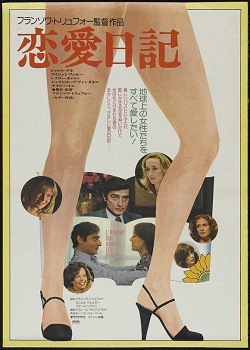 Though in the case of her father's film, Truffaut differentiated—unsure if this would apply generally to film noir—that there was also an attempt not to psychologize at all. There was something quite stylized about the story. Likening it a bit to a dark fairytale, Truffaut explained her father's challenge was indeed to gain the audience's empathy for Julie Kohler, but also to keep them involved and interested in the linear logic of the story, a creative challenge that was of considerable interest to her father. Later in his career in the late '70s he went on to film L'Histoire d'Adèle H (The Story of Adele H, 1975), L'Homme qui aimait les femmes (The Man Who Loved Women, 1977) and La chambre verte (The Green Room, 1978), wherein he focused on stories where the main characters follow an implacable logic. It remained a challenge for him to keep the audience interested in one character in a narrative limited by directions in which the story could go. He thought about it in musical terms: to follow a line, what he called an "ascending straight line." Not all of his movies were following that pattern, but The Bride Wore Black was probably the first film where he started doing that.
 The one character he was, perhaps, most attached to in The Bride Wore Black was Fergus, the artist, played by Charles Denner. She was seven when her father made this movie and it was the first film of his she was allowed to see in the theaters when it opened. She recalled her father sometimes liked to work on Sunday mornings going over dailies with his editor at a nearby screening room and he would let her and her sister come with him. There were scenes from the movie that she had easily seen 10 times over before the movie was finished, including a scene or two that were eventually cut, but which she recalled vividly; scenes that involved the character Fergus. Her father probably decided the scenes were too long and would throw off the balance of the film, so they were deleted; but, 10 years later, he revisited a similar character and used the same actor in The Man Who Loved Women. So The Bride Wore Black is both an adaptation of a novel but also something very personal for her father that he was able to return to later on in subsequent films.
 It was Muller's understanding that François Truffaut was dissatisfied with the finished film and Laura confirmed her father had difficulty with the color. It was only his second time to use color in a film. His first films were all small budget black and white New Wave movies and then he went to England to make Farenheit 451 (1966), which was a British production with a lot more money that required color for many reasons. When he came back to France to do The Bride Wore Black, it became clear the film was also going to be in color. Later on as her father progressed in his career, he laid down rules for himself, including how to use color—how to use color in his period movies and how to use color in his more contemporary pieces—but, at the time of The Bride Wore Black, he hadn't quite figured it out. She suspects it was frustrating for him to figure out how to create atmosphere with color. If you think of what are considered to be the great adaptations of Cornell Woolrich, they're primarily in black and white. Femme fatales seem to be more fatale in black and white. That could have been an issue creating tension. For her, The Bride Wore Black is visually distinct from her father's other movies, probably because of those issues.
 It was also Muller's understanding that her father had creative differences with his cinematographer Raoul Coutard who was working at the same time with Godard? In that regard, one of her father's challenges was that the protagonist was supposed to be traveling between one man and the other, as the story moves forward, but unfortunately for budgetary reasons most of the film had to be filmed in one geographic area. So her father and Coutard had to modify the storyline visually, made all the more trickier by the movie being in color, and create the illusion of different landscapes. There was definitely differences of opinion and approach between Coutard and her father.
 Muller noted that The Bride Wore Black was the first Woolrich novel written in what is considered his "black period." Woolrich was a fascinating man. He was a closeted homosexual who lived at the Hotel Marseilles in New York with his mother virtually his whole life and he had absolutely no real experience of the outside world. He was the most socially inept human being imaginable. Despite Woolrich's extraordinary imagination, Muller couldn't imagine a person less like François Truffaut than Cornell Woolrich. Woolrich started writing his noir novels cooped up in his hotel room with The Bride Wore Black being the first of a series. Its structure was extraordinary innovative. Woolrich didn't reveal the motivations of the protagonist until the very end of the book so the reader was going through this whole story—as audiences did with the film—wondering why Julie Kohler was doing what she was doing.
 Truffaut thinks her father decided to move it up a little bit, partly influenced by Hitchcock's understanding of how to manipulate audiences with suspense. When do you bring a flashback into a movie like The Bride Wore Black? A flashback or two was going to be necessary so her father gave much thought to when he would bring them in. Her father eventually agreed that Hitchcock's precept of letting the audience "in on it" early on actually created more suspense than a big revelation at the end. Another Hitchcock touch was that you never saw Jeanne Moreau's character knock on a door or enter a room. A couple of times in the movie she's suddenly just there, without explanation. Truffaut was fairly certain her father stole that from the character of Mrs. Danvers in Hitchcock's Rebecca (1940). Hitchcock made a point of not letting the audience hear Mrs. Danvers' footsteps so that they would be as startled as the protagonist Joan Fontaine when she lifted her glance and Mrs. Danvers was standing there observing her. Obviously, for the character of Mrs. Danvers, this was meant to be spooky. With Julie Kohler, it's meant to be more magical perhaps? She's suddenly in the middle of the scene and there isn't a whole lot of logic to it; the audience needs to accept it as a given.
 Muller asked Truffaut if she had ever met Hitchcock as a child? She hadn't. He wondered because—she may not have noticed as a young girl—but the relationship Hitchcock and her father shared was an intense bond between their two artistries. It fascinated Muller that—while her dad was making this film—his closest confidante was really Hitchcock, who was included in all the correspondence. Her dad was asking him questions all the time. She did attend Hitchcock's funeral under a peculiar set of circumstances.
 Truffaut wanted to point out the unsung actor Serge Rousseau who plays David the groom (who the audience sees for only 10 seconds). He was one of her father's best friends. He was a casting agent, an actors' agent, and often played crucial small roles in her father's movies. Rousseau was actually an excellent actor who had given up on acting himself. He played the character at the end of Baisers volés (Stolen Kisses, 1968) who the audience has seen follow Claude Jade throughout the movie. At the very end he comes up to her sitting on the park bench and declares his love and proposes. He tells her, "Every other relationship is temporary but with me it will be forever." In The Green Room he plays the nemesis of the hero. We only see him in photographs but we hear his name mentioned constantly. So Rousseau played a big role in her father's life by pointing out to him interesting young actors who Truffaut would then watch perform in the theater and often hire for his films.
 There was a story behind the name of the protagonist: Julie Kohler. Julie is a name that her father was fond of, though she never found out why. Kohler was a brand of chocolate that her father liked a lot as a child. He liked that name so much that he used it again in Tirez sur le pianiste (Shoot the Piano Player, 1960) where he named his protagonist Charlie Kohler. Of course, Kohler is also a homonym for colère, which means anger.


