Dominic Mercurio has been an insightful intern for The Evening Class this past year, writing on the Disposable Film Festival's Bay Area premiere of Kevin MacDonald's Life In A Day and dispatching from the Palm Springs International ShortFest and the Mill Valley International Film Festival. It's with great pleasure that I offer up his year-end list, in reverse order.
* * *
 10. Lotus Eaters (written & directed by Alexandra McGuinness). When I first saw the trailer for this film I thought to myself "looks sorta like that TV show Skins" (of which I mean the original British version ... don't even get me started on the American MTV bullshit remake) and I wasn't entirely off base. This film is sex, drugs, and rock and roll—plain and simple; but it does so with heart and searing visual flair. It all made sense in the Q&A after the screening when writer / director Alexandra McGuinness explained that she had a background as a stylist and a large interest in fashion, because the way this film is photographed is a bit reminiscent of classic fashion photography. Lotus Eaters follows a group of young upper class Brits living their life in that aimless cycle that we all at some point or another fell into in our teenage years. At the center is a blooming yet turbulent relationship between two of the main characters Alice and Charlie, the latter of which has a bit of a drug problem.
The movie spirals around their lives as if a fly on the wall is taking you from one situation to the next, whether it be a wild party with vodka-baths, or buying ridiculous clothing accessories. The movie is lean at 78 minutes, and is light on plot but heavy on character. It was the last act of the film that had me hooked. Once the wave finally crashes down on the never-ending party these lads live, it begins to take a more pensive route; one that ultimately ends up making this film a wild ride. Top that off with Alexandra's seriously kick-ass taste in music (I'm talking best soundtrack of the year) and seemingly instinctual mastery of blending visuals with music and you end up with a fascinating gem of a feature debut.
 9. The Tree of Life (written & directed by Terrence Malick). I would just as quickly warn people to never watch this film almost as much as I would plead others to do so. Its glacial pacing, stream-of-consciousness structure, over two-hour runtime, and minimalistic story will probably have unsuspecting filmgoers instinctually reaching into their pockets for a quick few rounds of Angry Birds as they pan it for being too artsy. I often wonder if films of this nature will slowly become extinct as our collective attention spans dwindle into the length of adorable-kitten videos on YouTube.
At any rate, this film propelled me into a rather pensive funk for the proceeding few days after seeing it. What ended up being so note-worthy was its unbelievably accurate depiction of how we remember our lives, and more specifically our childhood. Textures, smells, inconsequential moments, or snapshots of seeing the world when you were two feet tall. These moments bubble to the surface, often without too much context of what came before or after it, or even what age you were. The Tree of Life plays out much in the same way. After the introduction of a 1950's family grieving a loss, we are transported back in time ... you know, to the Big Bang. Upon witnessing the very formation of life itself, we eventually catch back up to what most would consider the main "plot line" of this freeform existential journey. The film is visually astounding. I mean serious eye candy. Captured images of profound greatness. Do you get what I'm saying? Pop this one in after a nice bubble bath, or perhaps a few hours of meditation because this isn't a film that's gonna quiet a restless mind.
 8. The Girl With The Dragon Tattoo (directed by David Fincher). It's not often phenomenal filmmakers have turn around time between films as quickly as Fincher. After releasing The Social Network in October 2010, he's already back with his next project which slides snuggly in next to other Fincher classics like Se7en, Fight Club, Zodiac, and Curious Case of Benjamin Button. Yeah, this guy has certainly been busy making some of the greatest films of the last 10 years. It's well known that Dragon Tattoo is a remake of a 2009 Swedish film [Män som hatar kvinnor], leaving many to wonder just why the film is so necessary. While I more often than not join the rally of "leave great foreign films alone!" (as I did when they remade the brilliant Swedish film Let The Right One In), I can't help but make an exception if the film is helmed by a visionary director such as Fincher.
But enough about all that, this movie is badass. Rooney Mara as Lisbeth, the damaged and strong anti-heroine, glues your eyes to the screen and demands your attention in one of the year's best performances. As far as tone goes, this mystery thriller focuses much of its drama on the slow unraveling of the murder mystery at its core and refrains from loud set-piece-destroying action sequences. It's very much akin to Fincher's more recent work in Zodiac and The Social Network where he's been seriously flexing his "make long dialogue scenes way more gripping then any standard action scene would be." To top it off, his frequent cinematographer Jeff Cronenweth paints stunning visuals into each frame with his uncanny eye for visual perfection. Trent Reznor's score is yet again a perfect pairing to the visuals, and keeps the sense of menace and dread up even when really all we're watching is our main characters flipping through old news articles and investigating every corner of a photograph. That is what filmmaking is all about.
 7. Submarine (written & directed by Richard Ayoade). OK, I can't argue it. We've all seen a quirky coming-of-age love story before, however Submarine manages to rise above its own framework to offer a comedy with outstanding characters, emotional depth, and a so-British-it-hurts style humor for the 2011 generation. The film sinks its teeth deep into the visual medium it's presented in with a fresh and lively style. Consistent across the writing, cinematography, directing, and editing the film hits its tone so perfectly on all ends it becomes hard not to be swept away by its heightened reality. Fifteen-year-old Oliver Tate is wise beyond his years, and his hilarious introspective internal rants give us a great sense of the depth of his character. Character is something this film packs in by the tons. Each player in this tale has a perfect array of flaws, quirks, and oddities that make each scene a joy to watch as more layers are peeled back. A classic love story told in an unconventional way. Its odds and ends make this an addictive watch.
 6. Hesher (directed by Spencer Susser). It's hard to pinpoint exactly what about this depraved dark comedy I found so outrageously hilarious. In many ways, it's the sum of its parts, but truly the comedy orbits the hysterically straight-faced performance of Joseph Gordon-Levitt as the aimless stoner metal-head deadbeat Hesher. His unapologetically don't-give-a-flying-fuck attitude accidentally finds its way into a grieving family of three mourning the loss of mama-bear. Its dark tone is played for laughs on just about every turn of the story, and does so without shame. Despite its mostly bleak tone, Hesher keeps things energetic and entertaining with seriously fantastic performances, killer writing, and well-rounded characters. Hesher is filmmaking turned up to 11. In fear of over-complicating things, it's easiest to say: this film fucking rocks.
 5. Martha Marcy May Marlene (written & directed by Sean Durkin). Don't call it a cult film. OK, you can if you want, but—interestingly— director Sean Durkin prefers that the misguided and reclusive group that begins molding Martha's mind to do the "right" thing unconditionally not be so attached to the classical definition of a "cult." I think what he's really getting at is that Martha Marcy May Marlene is a "cult" film without the over-the-top cheesy elements involved. Don't expect any sacrificial lambs, speaking in tongues, and velvet robes in this one. This is a group that could very well exist in our modern world, and it's unnervingly easy to see how someone in a vulnerable state of mind (i.e., Martha) could find solace and a sense of community among her new-found brothers and sisters. This is crucial in understanding just what makes MMMM so powerful and truly chilling. Powerhouse performances from Elizabeth Olsen as Martha as well as John Hawkes as Patrick, the "cult" leader, make this a serious knockout of a feature-length directorial debut. The film is firmly grounded in reality, while Martha struggles to understand her own. Smoothly transitioning between her life since escaping the cult and the deep-rooted memories from when she was still a part of it makes you as the audience sometimes question what is a dream, a memory, or current reality. The audience is constantly trying to make sense of the events and what it will mean for Martha's transition to life in our normal society. You never really know more than Martha, down to this brilliant film's final frame.
 4. The Future (written & directed by Miranda July). Miranda July is odd. If you haven't seen her video blog, watched her interviews, listened to her audio-stories/spoken word albums, or seen her debut feature Me and You and Everyone We Know (in which, as with The Future, she wrote, directed, and starred) then it may be a bit hard to judge whether The Future is going to be your thing or not, but suffice it to say that it's another addition perfectly in line with her off-kilter humor mixed with child-like wonder. In other words it's brilliant. Describing the plot of the film actually doesn't do much good in enhancing your understanding of what this film is truly about. Sure, it involves love, modern-day dilemmas of technology, existential mid-life thoughts, and a talking cat—but really this film is more than about that. Absorbing the film into your mind offers you a rather insightful tale of ... well ... life. Despite its abstracted fun-house mirror presentation, this film at core is a grounded and relatable human story. Miranda July has often been discredited as being "weird for weird's sake" but what makes The Future so inciting is wondering how Miranda July is going to present the next scene. Her unique penchant for storytelling makes her work less about trying to figure out WHAT will happen next, but more so HOW it will happen. Call it weird, but I call it transcendent.
 3. Melancholia (written & directed by Lars Von Trier). "A beautiful film about the end of the world" is this film's tagline, and there truly isn't a better way to sum it up. When was the last time you saw a film about the end of the world that doesn't show people rushing into stores to stock up on supplies, frantic newscasters warning people to stay inside, the Golden Gate Bridge being destroyed, impossible scientific experiments like lasers that can destroy asteroids without any debris entering Earth's atmosphere, or Bruce Willis? In Lars Von Trier's (Antichrist, Dogville) latest film, he explores the real emotions of a handful of characters as they begin to come to terms with the fact that their lives, and the lives of all human beings on Earth might soon be coming to an end. The uncertainty of the situation and the wide personalities of the four main characters cast a relatable shadow in the audience's direction. Would you be the one to doubt it until the last minute? Accept it and enjoy your final moments? Panic and convince yourself there must be a way to stop it? Fantastic performances from Kirsten Dunst and Charlotte Gainsbourg blended with the unmistakable cinema-verite style of Lars Von Trier's eye as well as his latest obsession with super-slo-mo imagery make this film remarkably powerful and existential.
 2. Life in a Day (directed by Kevin MacDonald). It's always refreshing when films are able to take you beyond the simple presentation of a story, and Life in a Day does just that while still remaining captivating and interesting. Life in a Day essentially boils down to being a 95-minute video time capsule of what life was like for humans around the world on June 24, 2010. The result is both fascinating and deeply thought-provoking. Pieced together from thousands of clips that were submitted by people from around the world filming their day, this is a project unlike any other before it. By eliminating the arguably invasive film crew from this documentary, and handing the camera over to the subjects themselves (i.e., everyone on Earth) we get undeniably candid and personal moments that would otherwise be stifled by a bunch of film dudes making sure the shot looks good on the other side of the room. When I say this film is beautiful, I'm not talking about the camerawork, lighting, or visual effects—I'm talking about the deep undercurrent of human feeling sewn throughout the film's running time. In watching this film, you're sure to find connections to your own life and raise some questions about how you're living it. It's an experience that will happen for those willing to open themselves up to it. This film rewards audience members who allow this film to absorb into their minds. It turns out it's one of the most rewarding experiences that film has provided this year.
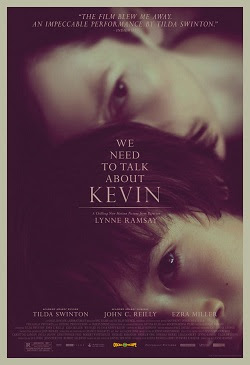 1. We Need to Talk About Kevin (directed by Lynne Ramsay). This film is impossibly twisted, unmistakably unsettling, and far beyond just "dark." Often picking my "favorite" films just comes down to the visceral feeling a film gives me. After all, a truly effective film is the kind of film that literally gives you chills, or overwhelming emotion that lingers hours, days, sometimes weeks upon seeing it. So it was a no-brainer for me to place We Need to Talk About Kevin firmly at the top after experiencing what can only be described as a "my skin is crawling" moment during the closing credits. This film is NOT for everyone. For example: children, people interested in seeing movies to escape / feel good, or people who would not like to be aware of the irreversibly fucked-up scenario of raising a child with serious psychological problems. So its audience is a little limited.
The deranged insanity of the demon-child in question "Kevin" is actually played by three actors at different stages of his life: toddler, adolescent, and teen. While the adolescent Kevin has the most screen time, it will undoubtedly be the teen Kevin (played by Ezra Miller) who will give you death-stares in your nightmares. In fact, it's not just his performance that stands out as exceptional, but Tilda Swinton's performance as his mother Eva. The complex emotions of Eva that drive the fractured narrative through its depraved story of the constant search for a normal life catapult this film into a territory of universal fear and the doubt of one's abilities as a human. It's a rough ride psychologically, but this film is dementedly visceral and not to be missed by anyone willing to stomach it.
Cross-published on Dominic Mercurio's personal blog.
 The Mill Valley Film Festival has celebrated the best in cinema from around the world for 34 years now, so it should come as no surprise that their lineups are carefully crafted creations. The big hitters often find themselves in a great position to join the ranks of Oscar® contenders early next year, and a consistent buzz on an indie darling can land it a limited theatrical run across the U.S. This year's selection of feature films have their fair share of buzz, but there's a lesser-known series of programming at MVFF: the 5@5 short film series.
5@5 gets its name from the template the series works off of—a collection of short films at 5:00PM for $5 per program with a total runtime of about one hour—so that each weekday of the festival you can catch one of these concise bouquets of short form cinema. If you're an Elton John fan, you'll probably also notice each package is named after a song in his discography, because … why not? After previewing this year's selection, it's safe to say that some of these films are strong contenders against the feature length heavyweights and should not be overlooked.
 5@5: Circle of Life—Comprised of five short documentaries, this collection contains three intriguing character profile pieces, each with their own quirks. Also on display here is a short about a group of swimmers explaining the importance of their early morning ritual (Swimming in a Dream, 2010) and a topical half-hour doc about Humboldt county's most famous export (Pot Country, 2011).
Doug Nichol's Chinese-U.S. coproduction Sunshine (2011) is a standout in this program. The film is an insightful look at TV ads through the eyes of an American ad producer in China working on several TV commercials and sharing a frank and honest look behind the curtain of the industry. The film is beautifully photographed and sharply edited which ensures things never feel slow.
Another standout is the aforementioned Pot Country. The film explores the crop and the small-time farmers who are caught between legality and livelihood. The film's perspective allows the audience to consider the human consequences of keeping marijuana illegal. The story leads through last year's Proposition 19, which was a failed attempt to legalize marijuana in California. By staying informative and personal, the film breezes by in its 27-minute runtime, feeling lean and concise.
 5@5: Don't Let the Sun Go Down On Me—Delivering a tough message can be a difficult task, and in each of these short films a character is faced with a daunting task of delivery. Ranging from a telegram being delivered during WWII (The Telegram Man, 2010), a hired writer takes on the task of writing someone else's suicide note (To Say Goodbye, 2011), a doctor who must put his skills to the test during his second job as a taxi driver (A Doctor's Job, 2010), and a cleaning lady whose employer would like her help to reconnect with her estranged brother (Confidante, 2011).
Cinematic and intense, Julio O. Ramos' Peruvian entry A Doctor's Job held my interest and played out rather nicely, though it didn't leave me particularly satisfied. On a similar note, Lisa Melodia's Confidante is full of entertainment value and some excellent characters; but, again, by film's end it felt like an episode rather then a completed story.
The true standout in this program is Jason Headley's To Say Goodbye. Fitted with a fantastic premise of a man who is hired to write other people's suicide notes so that loved ones will be left with a touch of poetry to ameliorate their suffering, this film clenches its darkly comedic tone and never lets go. The two central characters (the writer and his soon-to-be-dead employer) play perfectly off each other as they discuss everything from how they really must "consider their audience" when writing the letter to likely candidates that will find the body. This quirky vibe constantly breathes slight absurdity to an otherwise grounded story of life and death.
 5@5: Hard Times—All forms of animation and genre collide in this packed collection of 2-D, 3-D, stop-motion and live-action animation tackling comedy, drama, and far more abstract realms. Even for those who don't put animation at their top of their "to-watch" list, this collection does not disappoint.
Three phenomenal experimental pieces caught my attention: Pop (2011), The Death of an Insect (2010), and Seven Days in the Woods (2011). Conjuring up deep atmosphere and tone, these three shorts are sure to leave you with something to think about. Peter Larsson's Swedish entry Seven Days in the Woods offers up a twisted POV by way of a series of stop-motion vignettes. Each is like a moving painting, escalating with exaggerated sound design until the viewer's senses are overwhelmed by a cacophony of stimuli.
On a similarly twisted and stop-animated note, Mario Adamson's 2011 I Am Round (also from Sweden) is an enthralling short about two circularly shaped creatures who give birth to egg-shaped Mathilda, an immediate outcast from a society of squares. With evident parallels to real life discrimination, the story is heartfelt and well told, even while maintaining a bleak tone. As our spherical heroine grows up, she desperately tries to fit into a world dominated by squares hitting square buttons in even edged cubicles.
Perhaps the most visually striking and outlandishly entertaining entry in this program is the Argentine short Luminaris (2011). Utilizing an uncommon hybrid of live-action stop-motion to perfection, Luminaris is a wild and imaginative story of a man who works in a light bulb manufacturing company. He has an odd ability to chew on mystic glass marbles like bubblegum, and blow a light bulb bubble, at which point his assistant takes over and blasts the bulb with some sonic-vision wizardry that makes the bulb illuminate. Describing this film is one thing, but seeing these amazing acts take place on screen like a live-action Saturday morning cartoon complete with tons of on-screen visual tricks is nothing short of astounding.
 5@5: Just Like Strange Rain—Not everyone is meant to fit in, and the world is better for it. After all, strangeness is relative. The characters in these films, for one reason or another, aren't accepted by society. Some of them are better because of it.
Erik Rosenlund Swedish-Danish coproduction Out of Erasers (2011) is bound to immediately catch the attention of anyone who's a fan of zombie films. Though Out of Erasers contains no walking dead, its execution, style, and story elements mirror those of a great zombie film. After a major shortage of erasers, a strange pencil drawing (zombie-fans can replace "pencil drawing" with "virus") appears in a small town. Without any means to erase it, the "pencil drawing" begins to spread. Out of Erasers is heavy on atmosphere and maintains an eerie and consistent tone through its 15-minute length; an imaginative and dream-like story told with subtlety and visual flair.
Bethynia Cardenas Iñiguez's Mexican-U.S. coproduction Moonless Night (2010) is a classic "whodunit" set-up, but with enough elements working together in new ways that keeps it fresh. After a man is convicted of a crime he swears he didn't commit, he becomes torn over whether the truth would just make things more complicated. Played out with considerable suspense, the film does an excellent job of keeping up the pace and remaining entertaining through its tightly woven, satisfying story.
 5@5: The Last Song—Misunderstandings and fantastical stories fuel this collection of solid shorts. Covering a wide range, this collection has its fair share of laughs (Sexting, Good Luck, Mr. Gorski), but is also sure to make you ponder bigger questions (Boy, Saturn Rising), relive memories (My Big Red Purse), and maybe even feel like a child all over again (Pioneer).
Both comedies fall into the "outrageous" category, which they absolutely nail. Neil LaBute's Sexting (2010) boils down to a wickedly hilarious monologue from a young woman (played by Julia Stiles) after receiving a revealing text message. Given LaBute's playwrighting background, it only makes sense that Sexting's dialogue unfolds on the screen as easily as it would on a stage. Arron Shiver's Irish entry Good Luck, Mr. Gorski (2011) launches an alternative history where Neil Armstrong—taking his fateful step onto the moon—turns to the camera and cryptically comments, "Good luck, Mr. Gorski." An elderly couple watching this on television ponders just what it could mean? Especially since their last name is Gorski. The concept snowballs into absurdity and remains hilarious throughout, punctuated by great comedic performances by its two lead actors.
The standout in this program, however, is David Lowery's Pioneer (2011): a film that shows restraint yet manages to take you to surprising places. After a young boy wakes from a nightmare, he asks his father to tell him a bedtime story: the one of how he came to be. The father's ensuing tall tale takes up the vast majority of the film's runtime and—shockingly—doesn't use any cutaways or imagery beyond the bedroom. Much like the young boy intently listening, the audience uses its imagination to fill out details of the farfetched and earnest adventures of remembered childhood. It's a remarkable achievement and a testament to the performances of both the father and son. Hearing a bedtime story through the eyes and ears of a child has been masterfully recreated in Pioneer and is an experience readily available to anyone with an imagination.
 "The only real important filmmakers at the moment are the thousand and thousand YouTube providers."—Heddy Honigmann, in a Facebook entry dated Wednesday, March 12, 2011.
The Disposable Film Festival (DFF) and YouTube co-presented a special free screening of Oscar®-winning film director Kevin Macdonald's Life In A Day at the Sundance Kabuki Theater, San Francisco on Wednesday, July 20, 2011. Life In A Day (produced by Ridley Scott) is a user-generated feature-length documentary, shot on a single day—July 24, 2010—that enlisted the global community to capture a moment of their lives on camera. Culled from over 80,000 videos to YouTube, the 90-minute feature pulls together deeply personal, powerful films from contributors from Australia to Zambia, from the heart of bustling major cities to the furthest and most remote reaches of the earth. Life In A Day director Kevin McDonald and editor Joe Walker were available for a Q&A following the screening.
DFF Executive Director Carlton Evans said, "It's an absolute pleasure and an honor to be a part of this event. The DFF hopes that more projects like this will bring everyday artists' work to the silver screen." Added festival Associate Director Katie Gillum, "Life In A Day is a testament to the capability and power of disposable filmmaking. The film could not have been produced without widespread access to disposable media like cell phones or digital cameras and without the freedom and flexibility they afford."
The Evening Class thanks Dominic Mercurio for offering his perspective on the event.
* * *
Are you alive? Then see this film. Many films explore the human experience, but Kevin Macdonald's Life In A Day dives into the deep end of humanity's essence. This ambitious project asked the YouTube community to upload videos of their day on July 24, 2010. The experiment resulted in over 4,500 hours of footage submitted from 140 countries around the world. The staggering amount of footage was funneled down into a 95-minute visual time capsule of one day in our lives as humans, documented by ourselves. The concept is old, the execution is undeniably innovative, and the result is astounding.
What makes the film stand out is its brilliant use of our society's penchant for over-sharing. Social media has reached a crescendo and YouTube has been the one stop shop to find just about anything you could ever want to see, captured on video. Life In A Day masterfully pieces together a candid look at ourselves. Tapping into the direct line that YouTube creates from a single person to the rest of the world, Macdonald has removed one of the stigmatas of documentary filmmaking—the film crew—thereby underscoring the frequent argument that documentaries cannot objectively see the truth as long as there are people behind the camera imposing their editorial perspective on a subject situation. By empowering everyday subjects with cameras, documentary's thin pretense of objectivity capsizes and a subjectified portrait of real people from around the world emerges.
The film itself is essentially a feature-length YouTube video, complete with visuals ranging from camera phone to professional cinematography, and ranging from a few seconds to a few minutes. Moments are sequentially experienced as the channel flips from one country to the next through editing whose pace resembles the average internet users online experience, cribbed as it is by internet attention deficit disorder. Some say the average attention span of an internet user is a mere three minutes, so congratulations on getting this far in this article.
Trying to describe the film to someone who has not yet seen it is a difficult task. Singling out individual clips that struck me as powerful and poignant probably won't comport with the clips that resonate with others, but the variety of clips dropping you in the middle of hundreds of countries and situations ensures that there is something in this film for everyone. The film's celebratory vibe throughout its duration keeps it consistently fascinating and entertaining. While there is no real narrative arc to speak of, I would say it still tells a story. It's the story that we each live every day, though this one particular day is thoroughly documented.
Commencing at midnight (relative of course to where in the world you are), Life In A Day observes morning routines of people around the globe, carries on through the day, and eventually returns to midnight. With that bare bones cyclic structure in place, Life In A Day finds plenty of wiggle room to explore common themes: touching on love, death, happiness, wonder, growing up, possessions, technology, fear, and hope.
What becomes clear early on in the film is just how similar life can be around the world. It's easy to believe that an individual life is unlike anyone else's, but watching Life in a Day focuses less on difference and capitalizes on similarity. This isn't to demean our individual lives, but to bracket them within an omnipresent sense that "we are all one." The film solicits an identification with other people from other parts of the world.
The unique emotional punch of Life In A Day depends on what the viewer considers unique. By graciously providing a thrilling look at the world at a level only achievable through the tools of information in 2010, Life In A Day gives what the viewer, in turn, is willing to give. Allowing one's mind to wander through one's own experiences to explore how they relate to what the film provides can be a rewarding experience of connectivity. If films are meant to be hyper-reality, it could be argued that Life In A Day is simply reality, unprecedented for being unadorned and honest. It's hard to shake the feeling of communitas that the film inspires. Undoubtedly, when the lights come up in the theater, you'll hope to catch the eyes of fellow audience members to determine whether or not they feel the same.
Cross-published on Twitch.
 Lindsay MacKay developed a keen sense for the craft of filmmaking as both a writer and director while studying film production at Toronto's York University (where she graduated from their Film and Video Production program with producer S. Brent Martin). Her early work, Laces and We're On Our Way have won at the Moondance International Film Festival and screened at the Toronto International Film Festival Showcase. Lindsay's most recent work, Clear Blue (2010) premiered at Camerimage and was an Official Selection of SXSW and the Palm Springs International ShortFest; it is her Graduate thesis film at The American Film Institute (AFI). While at AFI, Lindsay was awarded the Bridge / Larson Foundation grant for her thesis and received the prestigious Mary Pickford Endowment for academic achievement and acknowledgement of her talent. In addition to her narrative work, Lindsay has co‐directed multiple video installations for Toronto's Nuit Blanche; they were voted number one attraction of the night by the Toronto Star. Lindsay is currently developing her first feature film entitled Wet Bum, which was recently named a top 10 finalist in the Zoetrope Screenwriting competition.
 S. Brent Martin is a graduate (MFA, Producing 2010) of the American Film Institute Conservatory (AFI), in Los Angeles, CA. While studying at AFI, Brent was the recipient of the prestigious Joseph and Olga Auerbach Scholarship. For his AFI thesis film, Clear Blue, Brent was awarded a College Television Award (aka Student Emmy) for his achievements in student filmmaking. Clear Blue was selected to screen in competition at Plus Camerimage, SXSW, the Atlanta Film Festival, and Palm Springs International ShortFest, amongst others. It was recently jury selected to screen at the annual AFI Thesis Showcase at the Directors Guild of America (DGA).
Originally from Calgary, Alberta, Brent graduated from York University. There he directed and produced the documentary My Grandfather's Voice (2006), which screened at film festivals across Canada, and won the Best Documentary Awards at both Cinesiege and the Winnipeg International Film Festival. While at York University, Brent also produced two award winning short films, Viva Jopo (2007) and Souvenirs From Asia (2007). Both films were screened in festivals across Canada, the US, and Hong Kong. In 2007, Brent worked as the assistant to producer William Vince, founder of Infinity Features. Currently based out of Toronto and Los Angeles, Brent is developing a number of television series, documentaries, and feature film projects.
 Clear Blue, their narrative entry into this year's Palm Springs International ShortFest, came highly recommended by my eyes and ears at the festival, Dominic Mercurio, who ranked it at the top of his 10 best from the fest. Dominic secured an MP4 of the film so that I might watch it and I agreed with his assessment, contacting producer S. Brent Martin who arranged for a telephone conference with the film's director Lindsay MacKay. I have to mention that sitting in my office in Boise, Idaho, with Brent in Toronto, and Lindsay in Los Angeles confirmed for me that relocating from San Francisco did not mean I would lose touch with film's cultural conduits. Quite the contrary. With less day-to-day distractions by insistent publicists and incessant press screenings, I can calmly focus on the films that interest me and which arrive before me in an organic fashion. These are the interview opportunities I've arranged for myself with no obligation to anyone other than myself and the films and filmmakers that attract me; something which has become increasingly important to me as a film journalist. [This conversation is not for the spoiler-wary!]
* * *
 Michael Guillén: Clear Blue is accomplished for being such a simple narrative with an elegant central concept. It bears a Pre-Raphaelite flourish and reminded me of the mermaid paintings of John William Waterhouse and Edward Burne-Jones. Can you speak to developing the concept for this script?
Lindsay MacKay: It came to me through a few images. I had an initial image of a naked elderly woman entering the ocean, which I found striking. Perhaps that image entered my mind because I now live in Los Angeles near the ocean? But the true root of Clear Blue is that I grew up around a nursing home and was constantly confronted as a young person by elderly people. And then, my brother and my sister were both lifeguards when I was growing up so water was a big part of my childhood. Every summer I spent a lot of time in the pool in our backyard. Clear Blue brings these two memories together.
Then because the image of the old woman entering the ocean was so rich for me, I started to research mermaid culture. I began thinking about my relationship to elderly people and how I approached them based upon how I felt, which was often that the look of them scared me and kept me away from them. They looked different than me. But once I got to know them, the shield came down and I realized they were nice people.
Guillén: [Chuckling.] As someone in his middle years—perhaps not quite elderly—I find myself repeatedly negotiating with young people in an effort to convince them that I'm not going to suck the life out of them.
MacKay: [Laughs.] Good! I think at a certain age a young person realizes their parents are people—"Oh, they have a life and their lives are complicated." That was a big realization for me, not only with my parents but with my grandparents, to realize they were complicated and dealing with things that were far more difficult than my teenage years.
 Guillén: Let's approach the look of the film. Even though I didn't have Dominic's opportunity to watch it projected in 35mm on a large screen and, admittedly, only got to see it on an MP4, I nonetheless found the look of the film quite beautiful and was struck by your opportunity as a student filmmaker to film a short on 35mm. How did you finance that? How did that come about?
S. Brent Martin: I can answer that. Clear Blue is our thesis film that we've worked on together as part of our curriculum at the AFI. It's the last and biggest project we make as we leave AFI and go out into the world. The American Film Institute has a long history of filmmaking. These days, if you're ever going to make a short on 35mm a great opportunity to do so is at a film school where you have that support and where a certain portion of your budget is freed up because you're using students for free labor and have a grant system within the school that supports you with equipment. Shooting on 35mm was something Lindsay and her wonderful Danish cinematographer Mattias Troelstrup wanted to do from the very beginning, right Lindsay?
MacKay: Yes!
Martin: Lindsay was uncompromising and I was pretty much on board. As far as raising the budget goes, the school gave us a chunk of it. We also secured a small grant. But the major portion of the budget was raised through an online Facebook campaign where friends and family—and strangers!—donated through our website. We advertised what we were doing on Facebook and—when someone would donate—we would make a point of saying, "Thanks to so-and-so for donating" and link their name to it. Others would see it and then it just snowballed. We raised close to $35,000 that way.
Guillén: Wow! Excellent!
Martin: Our experience is a testament to the modern age of technology and the internet that we were able to reach out to so many people without targeting anyone, except maybe our parents.
Guillén: [Laughs.]
Martin: We didn't really target them; they came to us. That was a cool thing. They came to us because they were genuinely interested in what we were doing and wanted to see us succeed. It was quite an interesting experience—and perhaps Lindsay can talk more about the creative choices of shooting on 35mm—but, it was a great experience to go through while we were at school. It made it much more possible.
 Guillén: Lindsay, it is astonishing in itself that you shot on 35mm for a short, but I am thoroughly impressed with all the underwater photography, which is equally astonishing. How did you effect that? Did you rent an underwater rig? Or did you build one?
MacKay: We worked with Hydroflex, one of the companies in L.A. They're probably international; I don't know....
Martin: They do all the underwater shoots that you see coming out of Hollywood like The Abyss and Titanic and all these big movies. They provide the technology and the expertise in doing these underwater shooting processes.
MacKay: We rented an underwater rig for the 35mm camera from them. Everything above water was handled by my cinematographer Mattias but then we hired a guy to do the underwater work so we could concentrate above water. We had a monitor above water, which attached to the camera below so we could see what the camera was seeing, and we had a speaker system so I could communicate with the actors and they could hear me underwater. Each actor had a safety diver underwater specifically for them and that safety diver had air so that, inbetween takes, the actors could swim to the safety diver to get air. We worked out a communication system. I now feel that—even though I hadn't done it before—I'm competent to direct underwater. It was surprisingly easy.
Martin: If I might interject real quick, the major challenge to shooting underwater was in training the actors and our uneasiness and uncertainty in working with actors underwater. Getting a believable and dramatic performance out of them while they were underwater was a major challenge. We did a lot of training with our actors with regard to their holding their breath and sinking to the bottom of the pool. There was a lot that went into leading up to the actual shoot. The safety divers that Lindsay mentioned were remarkable. Lindsay would shout "action" through the speaker system, the actors would let go of the air hose, perform their scene, and then Lindsay would yell "cut" and the safety divers would bring the air hoses back to the actors so they could breathe their oxygen before the next shot. The actors got so good at this that they would stay underwater up to 45 minutes at a time for take after take.
 Guillén: Let's talk about your actors. I was impressed with all the performances in your film—not only the two lead performances by Chris Sheffield as Simon and Nancy Linehan Charles as Flova—but your supporting characters as well, particularly Ron McCoy as Pat. Can you talk about how you went about casting?
 MacKay: We got a really fantastic Canadian casting director John Buchan to come down to Los Angeles to help us out. He was amazing for us. He brought in a lot of people. For the role of Pat, we saw quite a range of different types of people; but, when Ron came in, he blew us away. He was so natural. You could hear him coming a mile away on this huge motorcycle and he had this patch on his chin and, in gist, he turned out to be a completely different man than he appeared to be. He was actually so gentle and spot-on. He was amazing. We were all shocked that he did such a great audition.
As for the other actors, I have to say casting had a lot to do with luck and going with our gut. Chris Sheffield came to us and we weren't sure if we were going to go with him but then I did a callback with him and we played around for a little while, about a half hour or so, and he was just so natural. I threw a lot of strange things at him to see how he would react and what attracted me was that he was very much reacting, not acting.
 Martin: Knowing that we had the element of water to begin with, casting became an interesting challenge that none of us had ever dealt with before, particularly for both the elder and young Flova. The older Flova required the combination of an elderly woman and an excellent swimmer. We had actually cast the role weeks before our shoot with another actress and then got her in the water to make sure she could swim like she said she could and this lady almost drowned. We panicked and had to recast and find another elderly woman who could swim like a fish. We were so blessed to be graced by Nancy's presence. She was both a phenomenal actress and person and a great swimmer.
 Casting the role of the younger Flova was an added challenge because we didn't know how to cast the role of this actress who was underwater the whole time. We came to the conclusion that we needed to be looking at girls underwater or else we weren't going to be getting the information we needed to cast the role. We essentially sneaked into community pools and asked auditioning actresses to meet us there. We put them in the water and Mattias and Lindsay joined them in the water with the camera to film them doing exercises underwater to see if they appeared natural. Thia Schuessler, who we cast as the young Flova, was an exceptional swimmer and did a remarkable job with no lines 100% underwater. She brings quite a bit to the movie.
Guillén: Absolutely. All your actors provide a wonderful presence in the film. Let's talk a bit about Clear Blue's festival trajectory. Can you speak a bit to your experience of touring with a short film on the festival circuit? And what it's been like to interact with your audiences?
 MacKay: We premiered at Camerimage. I wanted to be in a festival whose prime focus was cinematography. I've been wanting to go to Camerimage for years and then Clear Blue was accepted but I wasn't able to go. It's an amazing festival and I hear it's primarily DPs who hang out and talk about their work.
After Camerimage we played South by Southwest, which was really an amazing experience for us. We were so lucky because we were programmed in the same program as Spike Jonze and the Safdie Brothers in the Medium Cool program, which consisted of medium-length shorts. Crowds of people came to see Spike Jonze's film Scenes From the Suburbs but—even though we were the underdog in that program—there was a lot of great response to Clear Blue. It was opportune to be screening in a program with a filmmaker of Spike Jonze's reputation and I felt we met the challenge. Since then, we've been playing a lot of regional festivals in the U.S. such as Akron, Atlanta, and now Palm Springs.
 Martin: One further highlight is that we won a "student Emmy" award a few months back. The official name is the College Television Award and the ceremony took place in L.A., sponsored by the Academy of Television Arts and Sciences, the same group that sponsors the Emmys. It's a nationwide competition for student films where three are awarded. We won second place in the drama category. That entailed a night in Hollywood at an award show with lots of television personalities and stars. It was quite an event. Quite cool.
Guillén: Congratulations! A taste of things to come, eh? Can you speak to your specific experience at Palm Springs? Did it differ in any way from your other festival experiences? Or can you speak to the experience as a whole?
MacKay: Palm Springs International ShortFest is a great festival. I've only been able to go to the South by Southwest screening and—though it was a wonderful festival and we were lucky to be in such a great program—the festival itself was so big and busy. What's been great about Palm Springs is that it feels like an intimate community. I was able to connect with other filmmakers and everyone seems really interested in the work. Not to say that they weren't at SXSW, but it's so much bigger there that it's harder to see everything and connect with everyone. There was a great crowd at Palm Springs. We would walk down the street after our screening and people who we didn't even know had attended our screening would come up to us to say how much they had enjoyed our film. For a filmmaker, that's a great experience. What about you, Brent?
Martin: Pretty much the same. Palm Springs is a personable festival and I have nothing else to say about it other than that the parties were great. We met a lot of people and I came away feeling that I'd gone to summer camp and made close friends. I stayed the whole length of the festival and it seemed there was one party after another to go to where everyone went to the same party. It was so much fun. I definitely want to go back.
 Guillén: What, then, are your future plans for Clear Blue? What's the next step for a short filmmaker once you've toured the film festival circuit?
MacKay: We're still hoping there's a bit of a life for Clear Blue. Right now it's playing at the Moscow International, which is really exciting and I wish I could be there. And we have our fingers crossed for a few other festivals. From that, I think I'll venture out into the feature world. I have a few ideas that I'm trying to get going. Hopefully, I'll just keep doing this. I'd like to make another short as well, but I think it's time that I tried to make a longer format film.
Guillén: Lindsay, can you speak to the value of a filmmaker starting out with short film format?
MacKay: I've made short films for probably seven years now. Before I started, I had no idea what film was. I liked the idea of telling stories, which is why I got into filmmaking. The value lies in just the vast knowledge of going out there and doing this. Most of my film education has been hands-on. The most important thing for a filmmaker is to pick up a camera and go out there and just try things. Shorts are a great format to do that. You can play around with characters and you can play around with the story. With every film that I've made, I've learned something new about myself and the kind of filmmaker I want to be. I'm just now getting to the point where I feel that—because of all my past experience—I'm ready to step into the feature world. And I'm sure that with every feature I make, I will have the same experience of continually learning as I've had making shorts, albeit in a longer format.
Guillén: Having had this fortunate experience of making films on 35mm through the assistance of AFI, how willing are you to curb costs and work on digital?
MacKay: I'm a bit of a film snob, which I'm trying to get over. I've shot only film in my undergrad work before I came to AFI. At AFI was the first time I ever shot on HD and I have to say that I am impressed with HD. There are cameras that can make a project look great. It's getting better all the time. At this juncture, I realize that the format I shoot in depends on what the project needs. If I can shoot on film, I will shoot on film, but I'm not going to sacrifice other aspects of the filmmaking just to shoot on film. We were fortunate with Clear Blue that Brent, myself, our cinematographer, our production designer Eun Kyung Nam and our editor Rachel Katz all agreed that we wanted the look of film for Clear Blue. That was important to all of us. But what's truly important is what works for the project. If we make a $200,000 feature and we can't afford film, I'll just suck it up and deal with it. [Laughs.] In the ideal world, I'm a bit of a film snob but I'll get over it.
Martin: We'll all help you, Lindsay.
MacKay: Thank you!
Guillén: To begin wrapping up then, let's turn to you, Brent. I'm intrigued by your leaning towards film production and by the fact that you and Lindsay started out together at York University and have both continued your schooling (and your collaboration) at AFI. Are you a filmmaker yourself?
Martin: I am. I have directed a little bit in my early days. As you say, I started with Lindsay at York University. I got into school there not really knowing anything about filmmaking but—just like Lindsay—I wanted to tell stories. Because I was so passionate about storytelling, I tried everything: editing, shooting, and directing. At York, I became enamored with the idea of making my own projects happen. There was no program on producing there so me and one other guy became the only two producers at York undergrad, surrounded by all these other directors and actors and camera operators wanting to tell their stories. I ended up having the fortunate opportunity of working with a lot of people. Ironically, Lindsay wasn't one of those people. We went to school together and we were friends but I never produced anything for Lindsay at York.
When it came time to attend AFI, we had our first year and we had the opportunity to work and collaborate with many other directors and Lindsay and I chose consciously not to work with each other that first year because we wanted the opportunity of meeting as many people as we could. We held off and resisted the temptation to work with one another. Then, by the end of first year, we realized we wanted to work together. I loved her script and the work she made in her first year and we decided it was time to work with each other. Even though we wanted to meet different people, we thought it was time to come together on this amazing project. I think it really paid off. I loved working with Lindsay.
I do want to continue to produce, as well as direct, in the future. I'm interested in producing documentaries, which I'm passionate about. Though I do direct, I'm interested in producing and making projects happen. I get to collaborate with great artists and filmmakers.
Guillén: As the producer of Clear Blue and hoping, as you said, that the film continues to have a life past the festival circuit, how (as the producer) do you hope to effect distribution? Will you pitch it to a streaming site?
Martin: We're always continuing to learn about what the best way might be to get this movie out there after the festival world. There are continuously more and more options in the digital realm and online. I've never dealt with distributing my own work before on this level. Once the festival circuit is over, the goal would be to either distribute it on DVD or broadcast on TV. Other formats like streaming on iTunes remains an option just to make it available. But the main excitement and point of this project is to have a great festival life, have as many people see it as possible, and use it as a calling card for everyone involved to go on and make their next projects. It's great to see how much we can squeeze out of this. Clear Blue's been treating us well so far and it's been fun.
Guillén: Well, it's a lovely and accomplished project and I want to thank both of you for taking the time to speak with me today.
Martin: Thank you. You've conducted a great interview and we appreciate it very much.
Cross-published on Twitch.
 10. Lotus Eaters (written & directed by Alexandra McGuinness). When I first saw the trailer for this film I thought to myself "looks sorta like that TV show Skins" (of which I mean the original British version ... don't even get me started on the American MTV bullshit remake) and I wasn't entirely off base. This film is sex, drugs, and rock and roll—plain and simple; but it does so with heart and searing visual flair. It all made sense in the Q&A after the screening when writer / director Alexandra McGuinness explained that she had a background as a stylist and a large interest in fashion, because the way this film is photographed is a bit reminiscent of classic fashion photography. Lotus Eaters follows a group of young upper class Brits living their life in that aimless cycle that we all at some point or another fell into in our teenage years. At the center is a blooming yet turbulent relationship between two of the main characters Alice and Charlie, the latter of which has a bit of a drug problem.
 9. The Tree of Life (written & directed by Terrence Malick). I would just as quickly warn people to never watch this film almost as much as I would plead others to do so. Its glacial pacing, stream-of-consciousness structure, over two-hour runtime, and minimalistic story will probably have unsuspecting filmgoers instinctually reaching into their pockets for a quick few rounds of Angry Birds as they pan it for being too artsy. I often wonder if films of this nature will slowly become extinct as our collective attention spans dwindle into the length of adorable-kitten videos on YouTube.
 8. The Girl With The Dragon Tattoo (directed by David Fincher). It's not often phenomenal filmmakers have turn around time between films as quickly as Fincher. After releasing The Social Network in October 2010, he's already back with his next project which slides snuggly in next to other Fincher classics like Se7en, Fight Club, Zodiac, and Curious Case of Benjamin Button. Yeah, this guy has certainly been busy making some of the greatest films of the last 10 years. It's well known that Dragon Tattoo is a remake of a 2009 Swedish film [Män som hatar kvinnor], leaving many to wonder just why the film is so necessary. While I more often than not join the rally of "leave great foreign films alone!" (as I did when they remade the brilliant Swedish film Let The Right One In), I can't help but make an exception if the film is helmed by a visionary director such as Fincher.
 7. Submarine (written & directed by Richard Ayoade). OK, I can't argue it. We've all seen a quirky coming-of-age love story before, however Submarine manages to rise above its own framework to offer a comedy with outstanding characters, emotional depth, and a so-British-it-hurts style humor for the 2011 generation. The film sinks its teeth deep into the visual medium it's presented in with a fresh and lively style. Consistent across the writing, cinematography, directing, and editing the film hits its tone so perfectly on all ends it becomes hard not to be swept away by its heightened reality. Fifteen-year-old Oliver Tate is wise beyond his years, and his hilarious introspective internal rants give us a great sense of the depth of his character. Character is something this film packs in by the tons. Each player in this tale has a perfect array of flaws, quirks, and oddities that make each scene a joy to watch as more layers are peeled back. A classic love story told in an unconventional way. Its odds and ends make this an addictive watch.
 6. Hesher (directed by Spencer Susser). It's hard to pinpoint exactly what about this depraved dark comedy I found so outrageously hilarious. In many ways, it's the sum of its parts, but truly the comedy orbits the hysterically straight-faced performance of Joseph Gordon-Levitt as the aimless stoner metal-head deadbeat Hesher. His unapologetically don't-give-a-flying-fuck attitude accidentally finds its way into a grieving family of three mourning the loss of mama-bear. Its dark tone is played for laughs on just about every turn of the story, and does so without shame. Despite its mostly bleak tone, Hesher keeps things energetic and entertaining with seriously fantastic performances, killer writing, and well-rounded characters. Hesher is filmmaking turned up to 11. In fear of over-complicating things, it's easiest to say: this film fucking rocks.
 5. Martha Marcy May Marlene (written & directed by Sean Durkin). Don't call it a cult film. OK, you can if you want, but—interestingly— director Sean Durkin prefers that the misguided and reclusive group that begins molding Martha's mind to do the "right" thing unconditionally not be so attached to the classical definition of a "cult." I think what he's really getting at is that Martha Marcy May Marlene is a "cult" film without the over-the-top cheesy elements involved. Don't expect any sacrificial lambs, speaking in tongues, and velvet robes in this one. This is a group that could very well exist in our modern world, and it's unnervingly easy to see how someone in a vulnerable state of mind (i.e., Martha) could find solace and a sense of community among her new-found brothers and sisters. This is crucial in understanding just what makes MMMM so powerful and truly chilling. Powerhouse performances from Elizabeth Olsen as Martha as well as John Hawkes as Patrick, the "cult" leader, make this a serious knockout of a feature-length directorial debut. The film is firmly grounded in reality, while Martha struggles to understand her own. Smoothly transitioning between her life since escaping the cult and the deep-rooted memories from when she was still a part of it makes you as the audience sometimes question what is a dream, a memory, or current reality. The audience is constantly trying to make sense of the events and what it will mean for Martha's transition to life in our normal society. You never really know more than Martha, down to this brilliant film's final frame.
 4. The Future (written & directed by Miranda July). Miranda July is odd. If you haven't seen her video blog, watched her interviews, listened to her audio-stories/spoken word albums, or seen her debut feature Me and You and Everyone We Know (in which, as with The Future, she wrote, directed, and starred) then it may be a bit hard to judge whether The Future is going to be your thing or not, but suffice it to say that it's another addition perfectly in line with her off-kilter humor mixed with child-like wonder. In other words it's brilliant. Describing the plot of the film actually doesn't do much good in enhancing your understanding of what this film is truly about. Sure, it involves love, modern-day dilemmas of technology, existential mid-life thoughts, and a talking cat—but really this film is more than about that. Absorbing the film into your mind offers you a rather insightful tale of ... well ... life. Despite its abstracted fun-house mirror presentation, this film at core is a grounded and relatable human story. Miranda July has often been discredited as being "weird for weird's sake" but what makes The Future so inciting is wondering how Miranda July is going to present the next scene. Her unique penchant for storytelling makes her work less about trying to figure out WHAT will happen next, but more so HOW it will happen. Call it weird, but I call it transcendent.
 3. Melancholia (written & directed by Lars Von Trier). "A beautiful film about the end of the world" is this film's tagline, and there truly isn't a better way to sum it up. When was the last time you saw a film about the end of the world that doesn't show people rushing into stores to stock up on supplies, frantic newscasters warning people to stay inside, the Golden Gate Bridge being destroyed, impossible scientific experiments like lasers that can destroy asteroids without any debris entering Earth's atmosphere, or Bruce Willis? In Lars Von Trier's (Antichrist, Dogville) latest film, he explores the real emotions of a handful of characters as they begin to come to terms with the fact that their lives, and the lives of all human beings on Earth might soon be coming to an end. The uncertainty of the situation and the wide personalities of the four main characters cast a relatable shadow in the audience's direction. Would you be the one to doubt it until the last minute? Accept it and enjoy your final moments? Panic and convince yourself there must be a way to stop it? Fantastic performances from Kirsten Dunst and Charlotte Gainsbourg blended with the unmistakable cinema-verite style of Lars Von Trier's eye as well as his latest obsession with super-slo-mo imagery make this film remarkably powerful and existential.
 2. Life in a Day (directed by Kevin MacDonald). It's always refreshing when films are able to take you beyond the simple presentation of a story, and Life in a Day does just that while still remaining captivating and interesting. Life in a Day essentially boils down to being a 95-minute video time capsule of what life was like for humans around the world on June 24, 2010. The result is both fascinating and deeply thought-provoking. Pieced together from thousands of clips that were submitted by people from around the world filming their day, this is a project unlike any other before it. By eliminating the arguably invasive film crew from this documentary, and handing the camera over to the subjects themselves (i.e., everyone on Earth) we get undeniably candid and personal moments that would otherwise be stifled by a bunch of film dudes making sure the shot looks good on the other side of the room. When I say this film is beautiful, I'm not talking about the camerawork, lighting, or visual effects—I'm talking about the deep undercurrent of human feeling sewn throughout the film's running time. In watching this film, you're sure to find connections to your own life and raise some questions about how you're living it. It's an experience that will happen for those willing to open themselves up to it. This film rewards audience members who allow this film to absorb into their minds. It turns out it's one of the most rewarding experiences that film has provided this year.
 1. We Need to Talk About Kevin (directed by Lynne Ramsay). This film is impossibly twisted, unmistakably unsettling, and far beyond just "dark." Often picking my "favorite" films just comes down to the visceral feeling a film gives me. After all, a truly effective film is the kind of film that literally gives you chills, or overwhelming emotion that lingers hours, days, sometimes weeks upon seeing it. So it was a no-brainer for me to place We Need to Talk About Kevin firmly at the top after experiencing what can only be described as a "my skin is crawling" moment during the closing credits. This film is NOT for everyone. For example: children, people interested in seeing movies to escape / feel good, or people who would not like to be aware of the irreversibly fucked-up scenario of raising a child with serious psychological problems. So its audience is a little limited.


