The 12th edition of the San Francisco Independent Film Festival—better known as SF IndieFest—takes over the Roxie Theater for two weeks starting this Thursday, February 4. Out of the fest's three dozen programs worth of features, docs and shorts, I had the chance to preview four on DVD screener. Happily, they're all winners.
 The film I'm most excited about is No One Knows About Persian Cats, Kurdish-Iranian director Bahman Ghobadi's controversial portrait of Tehran's underground indie-rock scene. It won an Un Certain Regard Special Jury Prize at Cannes last year at the exact same time the film's co-writer, Iranian-American journalist Roxana Saberi, received a suspended sentence on espionage charges and was released from Iranian prison. More controversy occurred last autumn when Iranian auteur Abbas Kiarostami publicly admonished Ghobadi for this decidedly unsavory look at life in Iran. Ghobadi responded with a bitter, anguished open letter to his one-time mentor. Brouhaha aside, Persian Cats is a remarkable film and an inspired departure for its director, best known for lyrical, but unsparing rural parables about war-ravaged children (Time for Drunken Horses, Turtles Can Fly). And though he's previously touched on the plight of musicians in Marooned in Iraq and Half Moon, this is his first time working in an urban milieu.
 Shot clandestinely in 17 days, Persian Cats follows two musicians as they pursue a vague-ish notion of performing in Tehran before embarking on an elusive foreign tour. After hooking-up with a sketchy, motor-mouthed music promoter, the trio buzz around Tehran perched on a single motorcycle, in search of band members, passports, visas, practice space and a venue. Harassment by the authorities is constant. During these excursions we're introduced to a variety of local musicians and musical styles—Persian-flavored rap, heavy metal, alt-rock, neo-soul—with song performances rapid-cut MTV-style to images of Tehran street life. The musicians appear to be playing versions of themselves, with sincere, somewhat stilted acting that works fine within the film's semi-documentary vibe. The exception is actor Hamed Behdad as the manic promoter Nader. The scene where he wheedles his way out of 75 lashes and a massive fine for possessing foreign DVDs and alcohol is the film's comic highlight. (Runner up: the heavy metal band playing for distraught cows on a dairy farm.)
With a mixture of resignation and outrage, No One Knows About Persian Cats proves that tenacious youth and rock 'n' roll will somehow find a way, even in an Islamic theocracy. The film is also beautifully shot, making it all the more fortunate that SF IndieFest will be screening it in 35mm (one of only four such films in the fest).
 In Belgian director Johan Grimoprez' wildly original mash-up/collage/essay film Double Take, we get an 80-minute riff on paranoid USA/USSR Cold War relations by way of Alfred Hitchcock's assertion that "if you meet your double, you should kill him. Or he should kill you." Clips of Hitchcock—mostly stuff from his droll film promos and TV show intros—are woven into a Hitch vs. Hitch narrative with the help of professional look-alike Ron Burrage and sound-alike Mark Perry. That's all cleverly edited with archival footage of the Nixon-Khrushchev debate, the Cuban Missile Crisis, worrisome Space Race updates (Sputnik! Pupnik!), Red Square military parades, flying saucer movie clips and a series of insidiously hilarious Folger's Instant Coffee commercials ("How can such a pretty housewife make such bad coffee?!"). Fascinating, spooky and poetic (with the occasional drift into ponderousness), this is the most original vision I expect to see at the movies all year.
 While Persian Cats and Double Take contain non-fiction elements, the other two films I previewed are straight-up documentaries. Don Argott's The Art of the Steal tells the story of the world's most valuable collection of post-impressionist and modern art, and how it became subjected to "the greatest act of cultural vandalism since WWII." Philadelphia pharmaceutical magnate Albert C. Barnes amassed the collection in the early 20th century, putting it on public display in 1923. The exhibition was reviled by Philly art critics, causing an outraged Barnes to move the whole thing to a building in the suburb of Lower Merion, PA. (The collection contains 181 Renoirs, 59 Matisses, 46 Picassos and is currently valued at around $25 billion.) In his will, Barnes specified that the collection should stay in Merion, and never be sold or go on tour. Director Argott meticulously details how Barnes' wishes got thwarted over the years by a tourist-hungry metropolis, ambitious politicians, clueless judges and duplicitous foundation board members. It's a thorny, engrossing tale well told. This is another film IndieFest will be screening in 35mm. The Art of the Steal is also scheduled to open at a San Francisco Landmark theater on March 12.
 I don't know if Palestinian-owned grocery stores are a phenomenon unique to San Francisco, but for 35 years I've never lived more than two blocks from one. Katherine Bruens' Corner Store, which is having its World Premiere at IndieFest, is the story of one such store and its soft-spoken proprietor. For 10 years, Yousef Elhaj worked at the Church St. Market from 7:30AM to midnight, 364 days a year, closing only for Easter (Elhaj is Christian). He slept in a back storeroom, saving money to support his wife and three children back in Bethlehem. His intention is to bring them to America, and—once all US bureaucratic hurdles have been cleared—the film follows him back to Bethlehem. Once there, however, Elhaj feels conflicted about returning to the US. On one hand, he loves being back amongst his people and culture. On the other hand, life under Israeli occupation, with its checkpoints and separation barriers, is extremely difficult. Friends, family and neighbors all weigh in with their opinions. I won't reveal what happens, but I promise this touching documentary will make you care one way or the other.
Cross-published on film-415 and Twitch.
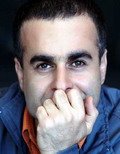 Bahman Ghobadi's eyes are filled with mirthful light. He is a small man but a few sentences into our interview made me realize I was in the presence of a large, generous soul. Pertinent to our eventual discussion, I am deeply grateful to the journalist who was interviewing him before me since she could speak Farsi and offered to help translate until Bahman's hired translator--who was late--could arrive. Tlassi Lahidji, who arrived about ten minutes into our interview, took over. Between these two women, I felt I was cared for by Farsi angels. Tucked aside from the frenetic hubbub of the Sutton Hotel lobby, Ghobadi and I talked about Niwenang / Half Moon, his entry into the Crowned Hope commemorative.
* * *
Michael Guillén: Bahman, all of your films are ravishingly beautiful. They're poetic and affect me emotionally. You strike me very much as a filmmaker who is creating poetry through a cinematic medium with far reaching political effect. By poetry I mean not only the lovingly rendered landscapes of Kurdistan but the humane portraits of the people who inhabit this landscape. Are you consciously using cinematic poetry to achieve a political end?
Bahman Ghobadi: I didn't want to make a political movie at all. All you see in the movie is the real life of the people. If you see a police man in Kurdish society, it's what it is, and I never once had an intention to make a political movie. For example, nowhere in Iran—except for the Kurdish people—could you see a police station. Secondly, when I was younger I used to write poetry. My sister is a poet and her poetry affected me, especially when I was younger. If you go to Kurdistan, you see this poetry in the everyday life of the people. They always smile even though they have a hard life. Their situation is difficult but, despite that, they are emotional people, kind to each other, always smiling. Poetry is an emotional thing among these people.
The reality of my movie is earthshaking, huge, sad. I didn't want to show all of that directly; I felt that would be bad for the audience and too much for them to bear. I wanted to present this hard reality more smoothly. I wanted to express these difficulties but in a smooth way.
MG: I understand. You are trying to protect us through beauty and humor.
BG: Exactly. I try to balance this harsh reality with a layer of light beauty.
MG: All of your films tend to be journeys across borders. In Half Moon it seemed the borders were also supernatural. Am I correct?
BG: It's true that my films have always treated this subject of the crossing of borders. But I've always considered borders to be ridiculous and something that have to be questioned. It's not only a Kurdish problem, of course. In this movie you can see that everyone has problems because of these subjective borders. I consider borders to be unnatural and something I fight against. That may not specifically answer your question?
MG: But I agree with you 100% and am satisfied with your response. It's my understanding that Half Moon is inspired by Mozart's Requiem and that Mamo moreorless embodies Mozart's spirit. Can you talk a little bit about that?
BG: It's very interesting that you noticed this because that's really what I meant. Even the name Mamo in itself ... in the beginning I meant to call the character Mamozart, which in Kurdish means "my Mozart", but this was really a kind of fantasy that I had, I wanted to do something really crazy with an analogy between Mamo and Mozart because there were many fantastic views on Mozart in this movie. My problem wasn't so much the Western audience but the Kurdish audience itself. I don't think they would have accepted the character if he was too much like the western Mozart. Because I didn't want to hurt their feelings, I had to respect their expectation of a Kurdish movie representing the Kurdish people. So I had to remain in something more acceptable to them. Otherwise I would have made something even more crazy and deeper with a western version of Mozart.
Now that I'm mentioning self-censorship, I had to do it for the Kurdish people but I also had to do it for the government. For example, I had a beautiful musical sequence where women sang but I had to self-censor it for myself because I knew it would be a problem for the government to accept it. So I cut it. The irony of it is that, even though I censored myself so badly, last week in Iran my film was banned for the very first time. The accusation was that the film was separatist, which is absolutely absurd. It's not a separatist movie at all. That's the reason why now I regret my self-censorship. I feel now that, if it had to be banned, I should have filmed it like I wanted to do in the first place.
MG: That's disturbing to hear about, not only the ban, but your regrets. There's an old saying that death is the middle of a long life, and your meditations on death in Half Moon were quite profound and far reaching and seemed to situate death in a broader context. Can you talk some about Mamo's awareness of death in the movie and how you played with that throughout the movie?
BG: The relationship that Mamo has to death in the film is the very relationship I have to death myself. I'm a person who is deeply afraid of death. This fear is present in my everyday life, when I'm walking in the streets, when I'm working, when I go to sleep at night, and when I think of what I'm going to be doing the day after, I always have this deep fear of death. Especially these days I have this very strong feeling and this very strong fear of death. For instance, when I go back to my home in Tehran I always have this premonition that something bad is going to happen, that there will be an earthquake, or maybe there will be an American attack or some bomb. I live every day with this fear. I even write it very often in my journal, in my diary, I'm writing almost every day that I'll die soon. That maybe I'll have 10 or 20 more years to live, that I will die soon.
MG: I am disheartened to hear that and I hope it is not the truth. I hope you continue to be a master for us for many years. Perhaps you can find some solace in our American poet Wallace Stevens who wrote that death is the mother of all beauty?
BG: I wish I could also think that. It might be true, but, at the same time, this is a very deep shake that I feel in me. Just the fact of—not even death really—but just thinking there is just one or two decades left for me to make films; that maybe after 20 years I won't have the strength left to make films is a real anguish to me and it prevents me from enjoying day to day life. I can't take advantage of the present moment and not feel the fear for the future.
MG: [The translator and I looked at each other with shared concern.] This makes me very sad to hear this, Bahman. I wish you could enjoy the present and not be so frightened of the future, which is uncertain for all of us.
I think one of the things that is most complicated for Westerners to understand is the lack of gender parity in Iran and Iraq, the exclusion of women from the spiritual life of the people. The hillside village of the 1,334 exiled women singers is unquestionably one of the most indelible and unforgettable images of Half Moon. I know the other day in your Q&A you specified that this was not a literal village, that it was a village conceived by your imagination, but could you help me understand why women are kept from singing? Why is it considered such a crime? I just can't comprehend it.
BG: That's exactly my objective through this movie. I really meant to portray how unfair it is to keep women from singing. There are many Iranian women who are artists and for whom singing is a part of their creative expression and for whom singing adds meaning to their lives. And they are not allowed to sing. They do not have the right to go out and sing to other people and to have other men listen to them. This is something that I find unacceptable. We have never approached this subject in film before. None of us Iranian filmmakers have filmed this before. So I mean to protest and to show that women's status is unacceptable in Iran. So I've done it for the first time and I've don't think I've done it enough in this movie. I need to make another movie to talk about women's status in Iran because it's unacceptable.
This village, it's true I said it was not a real village but it's not totally imaginary either. It's a symbolic village because we say all the time that the world has become a global village, and it's true. In fact, you could say that this village is quite symbolic of Iran. Iranian people as a whole have been taken hostage like the exiled women in the village, where they are imprisoned and they cannot sing because they cannot express themselves.
MG: Another image from Half Moon that amazed me was to hear the sound of Niwemang, the woman singer, landing on the top of the bus. There's no way that I cannot think, within our cultural context, that she's not an angel, a supernatural being who has come to help them achieve their dream. Am I correct in reading her character as being that of a supernatural being?
BG: That's true. I meant to show her as an angel but she's kind of a mixed angel. She's an angel who comes from Earth but is at the same time celestial. She's an angel who's related to life as she finally helps them to cross the border into Iraq but she's also an angel of death as she guides Mamo to his death. So she's an ambiguous angel. I meant to show this figure as an angel but Hesho, the first singer, she's also a kind of angel. I wanted to show that, when you see her hiding beneath the floorboards of the bus, it's exactly as if she is in a coffin and dying too. The message that she left to Mamo is in some ways an implication that she is Mamo's daughter. Her character is also a mysterious character who has also something to do with the angelic. That's because I consider both these women as angels because I consider that women in general are angels.
Further, these women who are artists I consider to be angels for two reasons. Because they're artists and because they're women. I meant to make this film as a tribute to women artists in Iran.
MG: To wrap up then, Bahman, I just want you to know that every day I will pray that you are safe from violence and that death will leave you alone so that you can create more of your beautiful films for us for many years to come.
[Bahman's smile is radiant and I feel bathed in the mirthful light of his eyes.]
Cross-posted at Twitch.
09/16/06 UPDATE: At Bahman Ghobadi's official website Mijfilm, there is a listing of interviews stemming from his previous features that are crucial not only for understanding his films in individual depth, but for appreciating the man more, as well as his beloved Kurdistan.
 The 12th edition of the San Francisco Independent Film Festival—better known as SF IndieFest—takes over the Roxie Theater for two weeks starting this Thursday, February 4. Out of the fest's three dozen programs worth of features, docs and shorts, I had the chance to preview four on DVD screener. Happily, they're all winners.
 The film I'm most excited about is No One Knows About Persian Cats, Kurdish-Iranian director Bahman Ghobadi's controversial portrait of Tehran's underground indie-rock scene. It won an Un Certain Regard Special Jury Prize at Cannes last year at the exact same time the film's co-writer, Iranian-American journalist Roxana Saberi, received a suspended sentence on espionage charges and was released from Iranian prison. More controversy occurred last autumn when Iranian auteur Abbas Kiarostami publicly admonished Ghobadi for this decidedly unsavory look at life in Iran. Ghobadi responded with a bitter, anguished open letter to his one-time mentor. Brouhaha aside, Persian Cats is a remarkable film and an inspired departure for its director, best known for lyrical, but unsparing rural parables about war-ravaged children (Time for Drunken Horses, Turtles Can Fly). And though he's previously touched on the plight of musicians in Marooned in Iraq and Half Moon, this is his first time working in an urban milieu.
 Shot clandestinely in 17 days, Persian Cats follows two musicians as they pursue a vague-ish notion of performing in Tehran before embarking on an elusive foreign tour. After hooking-up with a sketchy, motor-mouthed music promoter, the trio buzz around Tehran perched on a single motorcycle, in search of band members, passports, visas, practice space and a venue. Harassment by the authorities is constant. During these excursions we're introduced to a variety of local musicians and musical styles—Persian-flavored rap, heavy metal, alt-rock, neo-soul—with song performances rapid-cut MTV-style to images of Tehran street life. The musicians appear to be playing versions of themselves, with sincere, somewhat stilted acting that works fine within the film's semi-documentary vibe. The exception is actor Hamed Behdad as the manic promoter Nader. The scene where he wheedles his way out of 75 lashes and a massive fine for possessing foreign DVDs and alcohol is the film's comic highlight. (Runner up: the heavy metal band playing for distraught cows on a dairy farm.)
 In Belgian director Johan Grimoprez' wildly original mash-up/collage/essay film Double Take, we get an 80-minute riff on paranoid USA/USSR Cold War relations by way of Alfred Hitchcock's assertion that "if you meet your double, you should kill him. Or he should kill you." Clips of Hitchcock—mostly stuff from his droll film promos and TV show intros—are woven into a Hitch vs. Hitch narrative with the help of professional look-alike Ron Burrage and sound-alike Mark Perry. That's all cleverly edited with archival footage of the Nixon-Khrushchev debate, the Cuban Missile Crisis, worrisome Space Race updates (Sputnik! Pupnik!), Red Square military parades, flying saucer movie clips and a series of insidiously hilarious Folger's Instant Coffee commercials ("How can such a pretty housewife make such bad coffee?!"). Fascinating, spooky and poetic (with the occasional drift into ponderousness), this is the most original vision I expect to see at the movies all year.
 While Persian Cats and Double Take contain non-fiction elements, the other two films I previewed are straight-up documentaries. Don Argott's The Art of the Steal tells the story of the world's most valuable collection of post-impressionist and modern art, and how it became subjected to "the greatest act of cultural vandalism since WWII." Philadelphia pharmaceutical magnate Albert C. Barnes amassed the collection in the early 20th century, putting it on public display in 1923. The exhibition was reviled by Philly art critics, causing an outraged Barnes to move the whole thing to a building in the suburb of Lower Merion, PA. (The collection contains 181 Renoirs, 59 Matisses, 46 Picassos and is currently valued at around $25 billion.) In his will, Barnes specified that the collection should stay in Merion, and never be sold or go on tour. Director Argott meticulously details how Barnes' wishes got thwarted over the years by a tourist-hungry metropolis, ambitious politicians, clueless judges and duplicitous foundation board members. It's a thorny, engrossing tale well told. This is another film IndieFest will be screening in 35mm. The Art of the Steal is also scheduled to open at a San Francisco Landmark theater on March 12.
 I don't know if Palestinian-owned grocery stores are a phenomenon unique to San Francisco, but for 35 years I've never lived more than two blocks from one. Katherine Bruens' Corner Store, which is having its World Premiere at IndieFest, is the story of one such store and its soft-spoken proprietor. For 10 years, Yousef Elhaj worked at the Church St. Market from 7:30AM to midnight, 364 days a year, closing only for Easter (Elhaj is Christian). He slept in a back storeroom, saving money to support his wife and three children back in Bethlehem. His intention is to bring them to America, and—once all US bureaucratic hurdles have been cleared—the film follows him back to Bethlehem. Once there, however, Elhaj feels conflicted about returning to the US. On one hand, he loves being back amongst his people and culture. On the other hand, life under Israeli occupation, with its checkpoints and separation barriers, is extremely difficult. Friends, family and neighbors all weigh in with their opinions. I won't reveal what happens, but I promise this touching documentary will make you care one way or the other.