Sunday, June 16, 2013

YBCA: THE PARADISE TRILOGY: The Evening Class Interview With Ulrich Seidl

Fresh off the success of his New Filipino Cinema program, Joel Shepard and the Yerba Buena Center for the Arts (YBCA) score another programming coup with Ulrich Seidl's Paradise Trilogy, providing San Francisco / Bay audiences a rare opportunity to see all three films in sequence. It's an experience I envy, having only seen the first installment of the trilogy (Paradise: Love, 2012), in conjunction with Strand Releasing's U.S. theatrical rollout.

As profiled on the YBCA website: "Ulrich Seidl is one of the most controversial and provocative filmmakers working today. His portraits of the private lives of everyday people are disturbing to the core, and yet they are also often quite humorous. Obsessed with finding the beauty in ugliness, and a world-class smasher of all things taboo, Seidl vastly expands his reach with the epic Paradise trilogy."

As profiled at MUBI: "Ulrich Seidl was born in Vienna in 1952 and grew up in the town of Horn in Lower Austria. He studied journalism, art history and drama in Vienna, supporting himself with odd jobs, before entering the prestigious Vienna Film Academy at the age of 26. In 1980 he made his first documentary, Einsvierzig. Following the controversy surrounding his second film, Der Ball (1982)—a wickedly satirical portrait of the graduation ball in his home town—Seidl was asked to leave the Film Academy. In 1990 he returned to the scene with the feature-length documentary Good News. Within the decade Seidl was to make seven more documentaries for cinema and television, winning much acclaim and many prizes for his work.

"Hundstage—Dog Days, his first fiction film, was released in 2001 and won several important awards, beginning with the grand jury prize at the Venice Film Festival in 2001. The same year also saw the release of Zur Lage / State of the Nation, a critical survey of Austria under its far-right coalition government. Seidl initiated, oversaw and co-directed the project, which also contains episodes directed by Barbara Albert, Michael Glawogger and Michael Sturminger."

Seidl's most recent provocation, his Paradise Trilogy, launched with Paradise: Love (Paradies: Liebe, 2012), which premiered in competition at the 65th Cannes Film Festival, where Dave Hudson gathered up the critical response for Fandor's Keyframe Daily. Hudson continued monitoring the reception when the trilogy's second installment Paradise: Faith (Paradies: Glaube, 2012) appeared in competition at the Venice Film Festival. Paradise: Hope (Paradies: Hoffnung, 2013) appeared at the Berlin Film Festival, alongside the previous two installments.

My thanks to Marcus Hu and Strand Releasing for the invitation to interview Seidl during his L.A. press day, and to Robert Gray for helping with translation. The first installment Paradise: Love is currently in theaters via Strand Releasing. The Paradise Trilogy continues at YBCA through June 30, 2013.

* * *

Michael Guillén: I've read conflicting reports regarding the source of your story. Was it directly inspired by Ödön von Horváth's 1932 play, Faith, Hope and Charity?

Seidl: Well, as you know, originally the film was going to be a single film involving three separate protagonists. The title of the single film was going to be Paradise. When it turned out that the project was developed into three separate films, I had to come up with individual titles for those three separate films. Hope, Love and Faith seemed appropriate to me. So, my film was not so much a reference to the Horváth play, as it was to the three Christian virtues. I should also point out, however, that—while I had to come up with a title for each of the three separate films—the titles apply to all three episodes.

Guillén: You developed the script with your wife Veronika Franz. Can you speak to how the two of you collaborated to develop this script?

Seidl: I've been writing with my wife for many years now. Technically, our process is that I will write a scene and then she will read it and comment upon it. Sometimes she'll just make suggestions; other times she will re-write the scene. It's a kind of ping pong. With this project, where we were dealing with three female protagonists, it was especially useful to collaborate with a woman.

Guillén: I'm aware that your scripts develop once you start filming on location and begin interacting with your actors. Does Veronika join you on location when these changes are taking place?

Seidl: No, Veronika was only present on location on occasion, not for the entire period. The script forms the basis for beginning the work. It allows me to scout for locations and to start the process of casting. Veronika is in touch with all of these processes because it's important to have the input of her close collaboration. She's involved with the casting, which is a lengthy process, and I like having her on hand to discuss choices.

Guillén: With the Paradise Trilogy opening theatrically in the U.S. with its first installment, now is a good time to look back on its film festival trajectory, which has been admittedly unique. Each segment of the trilogy has premiered at a major international film festival—the first in competition at Cannes; the second winning awards at Venice; and the third shown with the other two at Berlin—yet all within a festival year. Were all three films ready to go at once?

Seidl: The first film I completed was the second part Paradise: Faith and I submitted it a year earlier to both film festivals; but, shortly thereafter, I finished the other two segments and had a better idea of how to show them at separate festivals. There just wasn't enough time to complete production on all three and that delayed their premiere as well. I also felt it was important that the films be seen in their correct order, which meant it was important to start with Paradise: Love. When it was invited into competition at Cannes, at the same time I decided to go with Venice for the second film, and shortly thereafter Berlin invited the third and final installment of the trilogy.

Guillén: As I'm interested in reception studies, I'm curious if—by unveiling the project at three separate film festivals—if you noticed a detectable difference in your audiences?

Seidl: Paradise: Love, which showed at Cannes, was the most popular. Cannes was the best place to show this film because it allowed the most exposure for the film. The Venice film festival was the best place to show Faith because of its components and, finally, I was very happy that Berlin wrapped up the trilogy and allowed me the opportunity to gain a retrospective view with the screening of all three films together. That was very useful to help publicize the trilogy to German audiences.

Guillén: I imagine you prefer that all three films be shown together? I'm sure that would reveal complexities within the narrative across the three films. So the Berlin experience must have been particularly rewarding. But now, as the films approach their theatrical distribution, once again they are being necessarily divided into individual releases. Does that feel at all like you are stepping backwards?

Seidl: First of all, the release of the film is subject to the dictates of distribution and it would be near to impossible to expect spectators to sit through all three installments. Many would be unwilling to do that. I left that decision to the distributor. But I would very much hope that audiences around the world might have an opportunity to see all three films together, perhaps as a special event? The response is quite different when you see all three films at once. You make associations, links, that make each film much more powerful in relationship with each other.

Guillén: Fortunately, in San Francisco audiences will have that opportunity as all three films are being shown by the Yerba Buena Center for the Arts.

Seidl: I'm very happy about that.

Guillén: You have described yourself as your "first spectator", but that you don't really consider audience reaction while making a film. But as you shepherd a film around the film festival circuit, does audience reaction factor into your ongoing relationship with your films?

Seidl: Of course, I am very grateful for the opportunity to talk to audiences and to hear their different responses. If those responses conflict with choices I have made, it doesn't make me look at my film differently but it does allow me to, perhaps, make my next film in a better way, based on what audiences (and critics) might think.

Guillén: And yet you are a filmmaker of integrity, often railed against as a provocateur, but true to your own vision, despite critical reaction?

Seidl: For a long time my films were criticized and attacked by a certain group of critics; but, I kept on making films in the way I believed was important. Interestingly, after many years several of those critics have reconsidered their positions and opinions. It's essential to remain true to your convictions. Work, like life, is a process that you are constantly re-evaluating.

Guillén: Your framing, your staging of reality, your observational aesthetics, have been emphasized as stylistic elements of your work for many years. If camera angles can be said to produce specific feelings, what is it about the planimetric approach that feels emotionally appropriate to your themes?

Seidl: My visual style was present from the very beginning with my first film. At the same time, my interest in film developed only after my initial interest in painting and photography. The environment is important to me and that's why it's so present in my films because the environment says a lot about the protagonists moving through it. Over the years I've been able to perfect my tableau images to create a more concise answer to the questions I have about the world. My films are a product of two different elements. The first is so-called documentary film, which remains for me the way you capture things as they happen, but which also allows a lot of room for chance. The other element is a more artificial and artistic element. Much like a painter composing a painting, I am able to make choices about the decoration and the lighting.


Guillén: I'm glad you mention your background in painting because it's your films' painterly effects that affect me emotionally. Painting essentially taught me the capacity of an image to contain several conflicting elements. For example, some of your most serious scenes likewise reveal comic undertones. Two separate feelings, two separate attitudes, are being shown at the same time. Images also exert a gravitational pull, a fascination, and your films equally fascinate.

Seidl: I'm attempting to capture various layers of meaning through my tableaus. I leave room for multiple interpretations, rather than imposing moral perspectives on the scene. This allows for a much more open-ended and richer experience. At the same time, I like presenting the absurd and comic aspects of serious events. In the face of something disturbing, there are always opportunities for laughter, even if it is laughter that gets stuck in the throat.

Guillén: I'm also glad that you mention your love for photography. I understand that Diane Arbus had a significant influence on your work? Can you speak to what it was about her work that influenced you? And, secondly, your films are often compared to the work of Martin Parr and I was wondering if you find any resemblance in your films to his work?

Martin Parr, "Common Sense"
Seidl: There are numerous photographers who have influenced me; too many to name. But among them, Diane Arbus and Nan Golden would be direct influences upon my work. Simpler, black-and-white photographers interest me. I discovered Martin Parr's work much later, so I can't say he was an influence, but I do think we share many interests and themes in common. [Note: A more thorough analysis of the similarities between Seidl's work and Parr's can be found in the essay "Critical Strands: On the Beach with Ulrich Seidl and Martin Parr", cross-published at retinalechoes and MUBI.]

Guillén: I would be remiss not to mention Margarete Tiesel's brave performance in Paradise: Love. Can you speak to your on-set strategies to create trust among your actors to deliver such revealing and intimate performances?

Seidl: I direct precisely. I describe everything to my actors in detail. But I never really write dialogue; that's something I develop with the actors. I also always work with an ensemble cast that combines both professional and non-professional actors. In Paradise: Love, all the roles of the white women were played by professional actors, whereas all the black men, the so-called "beach boys", were non-professional. To prepare them for their roles before we begin shooting on the set, I spend a lot of individual time with the various actors discussing their parts as well as who they are as actors. The role depicted in a film is the result of the encounter between the role as written and what the actor brings to the performance of that written role. I require actors to be able to improvise and to let go of the notion of trying to protect themselves when some subjects appear taboo. I help them work against self-censorship. Being able to improvise requires that an actor know the intention of the film and how to factor their performance into that intention.

Also, I'm always inspired by the locations where I'm shooting. Locations often give me ideas. That was exactly the case with Kenya where so many of my shots were determined by things I saw. But I present those shots in a specific manner that allow me to say a lot visually about this other world. You can feel the complexity of the world when you're faced with scenes like that.

Guillén: How do you achieve your admittedly disturbing nude scenes? Do you have a closed set with a skeleton crew?


Seidl: When you're doing a film like this, from the very beginning when you're talking to your actresses during casting you have to admit there are going to be these intimate scenes in which they will have to be naked in bed with black men. They have to be willing to display their bodies, however imperfect they may be on camera. Part of the preparation with my cast in the months before arriving on set and then when actually on location is to develop the trust, which is a context in which the actors feel that they can be free. This also requires shooting in a way in which the technical aspects of filmmaking play as little a role as possible and won't impede the atmosphere on set.

Guillén: I was impressed with Paradise: Love's post-colonial critique of sex tourism. There has been much discussion about the mutual exploitation of the characters within the story; however, I felt Margarete Tiesel's performance revealed an alarming sense of self-exploitation. Can you speak to how her character has colonized her own desires by conforming to social mores and standards?

Seidl: During the course of the film, Margarete Tiesel's character has to go through several experiences, not the least of which is recognizing that she is not seen as a woman in her own right by the beach boys, but as a white woman who has economic potential for the black men. By the end of the film she has decided to go along with this, but it departs from what she truly desires. Often love relationships are commercial arrangements that involve mutual exploitation.

Guillén: If the film's critique is that there are these economies of desire, that love—as you say—is more often than not a commercial arrangement that reflects inauthentic feeling, when can desire bring happiness?

Seidl: Desire and happiness are quite different. What interests me is showing people who are attempting to fulfill their desire to escape the trap of their isolation. I'm not so much interested in the individual fate or destiny of my characters, their happiness, as I am in presenting a mirror of our global society.

Wednesday, June 05, 2013

YBCA: NEW FILIPINO CINEMA—Kalayaan (Wildlife, 2012)

Reminiscent of the sensually dilated visions of Apichatpong Weerasethakul and João Pedro Rodrigues (Tropical Malady and O Fantasma, respectively), Adolfo Alix, Jr.'s Kalayaan (Wildlife, 2012) likewise exudes a nocturnal sheen as it slinks through a (somewhat) homoeroticized psyche, suggesting a gradual descent into madness. The opening scene tracks perfectly, with an unidentified nude male being blown by a mermaid among the shadowy mangrove roots, climaxing to the sound of a gun shot. A dream? A fantasy? Who's to say? Certainly not Julian, the taciturn soldier stationed on Kota, a remote military outpost on the disputed, isolated Spratly Islands.

Foxy Thai superstar Ananda Everingham delivers a wordless yet compelling performance as Julian, a soldier more than ready to complete his three-month service, even as news of a pending coup in Manila threatens to bring down the 1998-2001 presidency of Joseph Estrada, forcing Julian to stay on the island until further notice. The film's first half is a protracted depiction of near quotidian insanity as Julian battles boredom and loneliness by jogging along the beach, doing push-ups, watching a pet turtle emerge from his carapace, cleaning his rifle, and masturbating to porn. But at night, especially, Julian is silenced by ghosts and haunted by spectral presences enticing him from within the mangroves.

Winner of the Balanghai Trophy for Best Cinematography (Albert Banzon), Best Production Design (Adolfo Alix, Jr.) and Best Sound (Ditoy Aguila) when it premiered in the Directors Showcase at the 2012 Cinemalaya Independent Film Festival, Kalayaan recently received comparable accolades from The Young Critics Circle who—along with awards for cinematography, production design and sound—additionally singled out Teresa Barrozo's aural orchestration. Kalayaan is having its U.S. premiere as part of New Filipino Cinema at the Yerba Buena Center for the Arts.

In his review for Variety, Richard Kuipers likewise extols Kalayaan's high order technical feats achieved on a low budget, and he tunes in to Kalayaan's "internal logic" to appreciate its elliptical narrative, which he cautions might frustrate the impatient viewer. Albert Banzon's camera work mutes Kota's paradisal beauty and elicits an environmental menace that successfully visualizes Julian's beleaguered psyche, whose paranoia is further underscored by Ditoy Aguila's cacaphonous sound design mixing "low-bass industrial rumblings with the shrill tones of an insistently ringing bell." As stated by Gabriel Gatbonton, the island is given a "terrifying bipolar character—paradise by day, wilderness by night" and the island's beauty ironically compromised by monotony. A sense of the narrative's alterity is enforced throughout the first half of the film with startling images that are never explained (a body on fire submerged face down in beachside waves), Julian's silence, and an overall non-diegetic approach that edges the narrative's traction forward by viscerally immersing the viewer in Julian's unsettled perspective.

It isn't until about half way through the film that Julian's absolute isolation is interrupted by the arrival of Eric (Luis Alandy) and Lucio (Zanjoe Marudo), fellow soldiers sent to Kota by commanders concerned over Julian's lack of radio response. Swiftly caught into the round of Julian's routine, Eric and Lucio jog along the beach, do push-ups, shoot hoops, and struggle to draw Julian out of his shell, much like his pet turtle. They make him eventually laugh by staging a campy beauty peagant (that slyly critiques Philippine relations with Malaysia and China). Their narrative purpose, however, lies essentially in suggesting the back story that has challenged Julian's sanity. They discuss what Julian never reveals. By film's end it's a free-for-all as to what has actually happened; but, it's done so evocatively that it hardly matters. The descent has provided its own distinct pleasure.

Tuesday, June 04, 2013

YBCA: NEW FILIPINO CINEMA 2013—The Evening Class Interview With Joel Shepard


Last year about this time, Yerba Buena Center for the Arts (YBCA) launched New Filipino Cinema to introduce American audiences to the startlingly creative yet relatively unknown work coming out of the Philippines. Here at The Evening Class, we reviewed several films in the 2012 line-up—Niño, Kano: An American and His Harem, Remington and the Curse of the Zombadings, Amok, and Boundary—replicated Philbert Ortiz Dy's essay, and interviewed Raya Martin and Carlo Obispo.

New Filipino Cinema was so successful that YBCA programmer Joel Shepard has returned with a second edition, co-sponsored by FACINE (Filipino Arts & Cinema, International) and Filipino American Arts Exposition. "Even if the rest of the world is still catching on," YBCA's website boasts, "the Philippines remains one of the most creative and exciting countries for independent cinema. 5 days, 16 films, 7,107 islands!"

In his follow-up essay for this year's edition, Philippine critic and New Filipino Cinema co-programmer Philbert Ortiz Dy qualifies the difficulty of trying to pinpoint a unifying theme in this year's selection of films. "Once again," Dy writes, "we are faced with a uniquely diverse set of movies that defy classification. Like the country itself, which is made up of thousands of little islands, each with its own culture, dialect, and people, our cinema often refuses to homogenize." New Filipino Cinema's quest "to document the soul of a country" reveals a character of violence negotiated through art. "Many of our films ... seem to meditate on living within a culture of conflict, telling the stories of people who are forced to adapt to the violence that is so present in their lives."

During my recent stint in San Francisco, I made a point of inviting Joel Shepard out for coffee so that we could profile this year's edition of New Filipino Cinema, opening tonight at YBCA.

* * *

Michael Guillén: Joel, I was so pleased to receive notice that YBCA has followed through with a second edition of New Filipino Cinema. Before launching into that, let's recap a bit of what happened with last year's edition. Did it achieve the reach you imagined? From my perspective, the 2012 series was one of the best uses of diasporic channels to distribute a national product internationally that I'd witnessed in some time.

Joel Shepard: It's been quite a journey. I've made 7-8 trips to the Philippines now, researching Filipino Cinema, and pulling these programs together.

Guillén: What motivated your interest?

Shepard: I knew a little bit about Filipino Cinema, but mainly older films; I didn't know much about contemporary films. Then, six or seven years ago the Rotterdam Film Festival had a focus on the Philippines with a sidebar that had a particular view of contemporary Filipino Cinema. They focused on the avant-garde underground scene, very much based out of Manila, and a group of people who were all friends—Khavn De La Cruz, John Torres, Raya Martin—members of a younger, underground scene working with tiny budgets, who were making experimental and raw, immediate street filmmaking, and I had no idea all of this was going on. The Rotterdam sidebar was eye-opening. I decided I needed to know more and get deeper into Filipino Cinema, especially since the Bay Area has such a huge Filipino American community. It seemed a natural contribution for YBCA.

My first visit to the Philippines was to serve on a jury at a film festival called Cinemanila, which is actually the only international film festival in the Philippines. I learned there was way more going on with independent Filipino Cinema than the selection Rotterdam had shown—which were all great, important films—but, just one part of the whole scene. It was incredibly eye-opening to discover there was this independent film scene in the Philippines that is not hardly known at all outside of the Philippines. It's starting to get out there a little more but there's still a long ways to go.

The term "independent cinema" doesn't mean much anymore in America. It's been drained of meaning. "Indie film" has been largely co-opted by the studios. But it still means something in the Philippines where there are three major studios that put out all the commercial product and where everything else is independent.

Guillén: The financing is independent? None is government-subsidized?

Shepard: The Philippines have a unique system for how independent films get made. There are several film festivals in the Philippines who basically commission films through a grant-application process. The festivals fund a certain number of these films, which then end up being shown at the festival. Cinemaya and the Cinema One Originals Film Festival are both festivals composed of such commissioned films. We don't have anything quite like that in the States.

Guillén: Is that influence from Rotterdam, who I understand groom filmmakers to harvest premieres? Is the independent Filipino Cinema scene trying to make movies they think will interest festivals like Rotterdam?

Shepard: Their system pre-dates Rotterdam because it was basically the only way they could get movies made. The Cinema One Originals Film Festival is actually an offshoot of Cinema One, a television channel that's kind of like their HBO. They're producing these films because it provides content for their TV channel.

Guillén: It intrigues me that your research has discovered much more than what has been consensually understood as the national cinema of the Philippines. This confirms for me the slippery nature of using a term like "national cinema", which necessarily requires constant maintenance.

Shepard: I continue to be amazed at the quality of work being produced there and how little it is being seen outside of their own country. Again, a few films are spreading out into the international film festival circuit. I don't know if you noticed but at Cannes this year there are three Filipino films, one in main competition, and two in Un Certain Regard. That's the first time there's every been three Filipino films at Cannes at the same time. All three have come out of the indie world. So, though it's taken them a while, even Cannes is catching on.

Guillén: When you decided you wanted to create a program of New Filipino Cinema, what was involved in negotiating with YBCA? Did you seek a grant to finance your initial research trips? Did you have to have the whole program in place before you pitched it to them?

Shepard: Luckily, I'm pretty independent at YBCA in terms of where I place my focus. I'm allowed to be self-directed. I'm lucky that I can get obsessed about something and have the freedom to just go for it, as long as it fits into the institutional mission. I was able to adjust my budget to accommodate the additional travel required. I couldn't just have people send me DVDs to get a sense of the scene. I had to immerse myself in the culture and meet the filmmakers and go to the events. It would never have worked to just research on the internet and pull together a program that way.

Guillén: By comparison to your programming colleagues in the Bay Area, I consider yours to be one of the most curatorial sensibilities out there. Do you consider there to be a difference between programming and curating?

Shepard: That's a tricky question. I've always been a little bit uncomfortable with the term "curator", which seems to me to be a term that comes more from the visual arts of the museum and gallery worlds. I've never been sure exactly how it fits in to film. To be honest, it's always struck me as a little pretentious.

Guillén: I admire your modesty, but surely you're aware that your programs are singularly unique? Most notably, they have an edge to them. You often approach mature and erotic domains. You'd think in San Francisco that would be par for the course, but it actually seems to me that most programming in the Bay Area has become increasingly safe. There's not as much edgy content available.

Shepard: Less and less, yeah. It's changed over time. San Francisco's just not as edgy a place anymore, though that edginess is something I often revisit. As for the Filipino project, I should be clear that I co-programmed this series with Philbert Ortiz Dy. Right off the bat, I knew we needed to do this with somebody from the country. I'm not Filipino. I don't speak any of the Filipino languages. To make the series something deep, I felt it was important to partner with someone in the Philippines.

Guillén: Which lends credence. Philbert Ortiz Dy is one of Manila's main film critics as well?

Shepard: He is, yeah, and he's really sharp. He's somebody who can write about Iron Man all the way to some weird avant garde film with equal interest, intelligence, and passion. There aren't a lot of critics like that.

Guillén: He wrote the essay for last year's edition of New Filipino Cinema. Has he written a new one this year?

Shepard: Yeah, and it's very good. I wrote a short essay laying out the broad picture, then in his essay Philbert went deeper into the themes of this year's films.

Guillén: How did you two negotiate shaping the rhythm of the festival?

Shepard: We figured it out as we went along. We didn't draw up a contract or anything like that. We agreed on all the films. We both had to buy in to each film. I can't go to every major film festival that goes on there—not like I did in my first year when I made four visits to the Philippines—so I depend on him to preview films in advance for me and pass on what he thinks the most valuable.

Guillén: How is the Philippine film community reacting to the New Filipino Cinema series that you've introduced to the United States?

Shepard: They're supportive, happy and proud that it's happening. I was just there for a few days a couple of weeks ago on my way to a film festival in Korea and I was sitting at the breakfast buffet one morning reading The Enquirer—which is their daily newspaper—and opened it up to find an article covering the film series and the 16 Filipino films coming to San Francisco.

Guillén: Have you had any anecdotal response from the filmmakers featured in last year's edition to the extent of sensing any increased visibility for their participation?

Shepard: Having only had a year, I think it's going to take some time before the series is fully noticed. There certainly was an increased interest in the series nationally from other film programmers. I received a lot of inquiries: "Can we show these films here?" I imagine the next step for New Filipino Cinema is to organize some kind of national tour; but, it's complicated. Dealing with the Philippines presents unique problems and challenges that don't happen with other countries.

Guillén: [Laughs.] How ambassadorial!

Shepard: It's not simple.

Guillén: Is the entire series digital?

Shepard: Yes. It's pretty much all DCP. There's no film. But that's because no one is making film in the Philippines anymore. The only projects coming out on film are some of the broad, commercial films where prints are being struck because not all of the theaters have converted to digital yet; but, otherwise, in the independent world, no one is shooting on film.

Guillén: It's possible that—if the classification of a "national cinema" is to apply at all in the future—it won't be through commercial channels and might just have to be through digital independents.

Shepard: It's interesting. As much as I bemoan the loss of 35mm, I also have to acknowledge the democratization enabled by digital technology that allows people all over the world to make films that would have been impossible to make in years past. So there's good and bad.

Guillén: I imagine another advantage of a DCP series is the potential for organizing a national tour? In that respect, it's not such a bad thing?

Shepard: Yeah.

Guillén: I don't intend for you to cover the entire upcoming series for me, but I was wondering if you could give me three or four titles that you're especially excited about for one reason or another? Titles that you really want your San Franciscan audiences to see?

Shepard: The whole program, including shorts, is 16 films and—just so you'll have a sense of the series as a whole—we've really tried to make the program a comprehensive picture of the entire independent film scene. We cover the experimental, avant-garde world, as well as documentaries, more traditional dramatic narratives and shorts. I was very conscious of making sure we had a number of films directed by women, as well as films in different languages. Most people assume Tagalog is the language spoken in the Philippines, but that's just one of many languages. Tagalog is the language of the capitol region, but outside that region are dozens of other languages.

We also wanted the program to cover the whole geography of the islands. The Philippines are much more than just Manila. Of course, as the capitol, most film production takes place there; but, there are pockets of regional filmmaking going on as well, particularly in the South, which is historically known as a troubled region of the Philippines because of an ongoing Muslim war against the Philippine government. It's considered a dangerous area and Americans are warned not to travel there. That's mostly misleading information—it's safe to go there—and it was important for us to secure films from there. There's incredible independent work coming out of that region, which very few people are aware of.

We're starting the series with an older film Himala ("Miracle" in Tagalog) made in 1982. This was a choice we debated a lot because the program is called New Filipino Cinema. Himala is directed by Ishmael Bernal, who—though now deceased—remains one of the Philippines' greatest filmmakers. Himala is probably his greatest film; it's a masterpiece. It could be considered the Philippine equivalent to The Godfather or even Gone With the Wind, but it's completely unknown in the West. The rights to it are owned by ABS-CBN, a major television network in the Philippines, and they've restored the film. It was re-released at Christmas in the Philippines and it stars Nora Aunor, who's probably their biggest movie star. So we're opening the series with the U.S. premiere of this new digital restoration. This is exactly the kind of film that should be showing on the circuit at the Castro Theatre, along with Kubrick and Hitchcock and the standard repertory fare. So it's new not only in that it's a new digital restoration, but it's new in the fact that film restoration itself is a relatively new concept in the Philippines. In general, they haven't done a good job of taking good care of their film history; but, there are a lot of efforts now to change that.

Another highlight would be our closing film The Journey of Stars into the Dark Night (Ang Paglalakbay ng mga Bituin sa Gabing Madilim) by Arnel Mardoquio. He's one of the filmmakers from the South, Mindanao, that I was mentioning earlier. We showed his film Crossfire last year. His new film is also set during the uprising in the South but he takes a completely strange and unexpected point of view on this conflict. It's a truly surprising film and he's going to be at YBCA in person.

Guillén: Ah, I was going to ask if YBCA was hosting any talent.

Shepard: We have four people coming from Manila: three of the filmmakers, and an academic. So both the opening and closing films are pretty special to me. It's hard to choose because all of these films are like my babies. We've chosen them so carefully. We didn't have enough slots to show everything we wanted to show, there were that many good films, so everything's good in the series. You have to come and see everything!

Guillén: I'd still like you to single out at least one more.

Shepard: Okay. I'm a big fan of one of the documentaries we're showing, Tondo, Beloved: To What Are the Poor Born? (Tundong Magiliw: Pasaan isinisilang siyang mahirap?). Tondo is a neighborhood in Manila that has a bad reputation. It's one of metro Manila's poorest neighborhoods and is one of the most densely populated areas in the entire Earth, actually. This young woman Jewel Maranan made this documentary about the neighborhood. She lived with a family there for a number of years and has crafted an extremely intimate documentary about their daily existence. There isn't really a plot or anything like that. There's no editorializing. No directorial flourishes. I'm not sure if Jewel has ever seen this director's work, but her documentary reminds me a bit of Pedro Costa. It has a similar narcotic intimacy that fully immerses you in this place.

Guillén: Is there anyone in the United States who you would consider a Filipino cinema expert? Someone who's writing on the subject?

Shepard: There's very little. I had a meeting with Susan Oxtoby the other day and going over the program with her and she had never heard of any of these films and, as you know, she's one of the most knowledgable people in the world on film. Filipino Cinema is a blind spot for most people.

Guillén: Which your series clearly remedies; but, it makes me wonder why there's been such a blind spot? Are there historical contingencies between the Philippines and the U.S. that would have contributed to that?

Shepard: I'm not sure why this is; but, I feel like it's my duty to do something about it. Also, I think we owe the Philippines a little more than we're willing to acknowledge. They were our colony for 50 years and they're still very much dealing with the aftermath of that, and not always in an entirely positive way. Americans have a responsibility to understand more about the Philippines. That's my main reason for pulling together this film series.

Guillén: Let's return to the idea of distributing a national cinema through diasporic channels. How do you coordinate community outreach to your Filipino American constituency?

Shepard: There's a whole number of cultural leaders in the local community that I've gotten to know and who are giving their support. There's active Filipino American media in the Bay Area, including four newspapers, and a TV channel, a whole slew that—if you're not a member of the community—you wouldn't necessarily know about; but, it's big.

Guillén: Again, I know it's still too early to fully gauge reception for the series, but has there been any preliminary sense of how older Filipinos are relating to the new work you're showcasing in the Bay Area?

Shepard: It's complicated because there's a complicated relationship between Filipinos and Filipino Americans. They're not the same people. They're different communities. I don't necessarily think of Filipino Americans as being the main audience for New Filipino Cinema. They're an important audience, of course, and we want to do everything possible to reach them and get them interested but I want to reach beyond them too.

Sunday, June 02, 2013

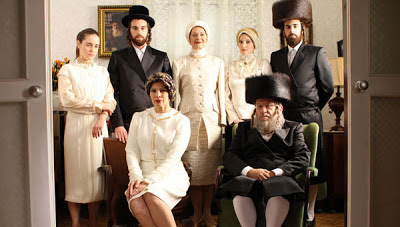
FILL THE VOID / LEMALE E HA'HALAL (2012)—The Evening Class Interview With Rama Burshstein and Hadas Yaron

Rama Burshstein was sitting at a wedding with a friend when a beautiful 17-year-old girl came to their table. She was wearing a lot of jewelry, which signified she'd recently been engaged. Burshtein's friend congratulated the girl, but in a weird almost mournful way, as if the young girl were going to a funeral and not her wedding. After the bride-to-be left their table, Burshtein's friend remarked, "You see her? She's about to marry her late sister's husband." That was "the end of it" for Burshstein, who became fascinated and pursued the young girl the entire evening, trying to understand why she had agreed to such an arrangement? Recently converted to the Hassidic faith, Burshstein had never heard of such a thing before; but, became intrigued enough to follow up with research. She met with 17 women, some girls, some already grandmothers, all married to their late sister's husband. By the end of her research, and with a more nuanced eye towards her culture, she came to accept that a young woman marrying her late sister's husband was a natural phenomenon, with hardly any of the drama she first imagined. Nonetheless, she drafted a treatment of the idea, even though she was not yet thinking about making a film.

Burshstein learned filmmaking at the Sam Spiegel School in Jerusalem. A few months after graduating, she became religious, and has been for 20 years. Though she didn't continue making feature films, she applied her skills to crafting films for her community, primarily films made by women for women (who ordinarily do not watch films). Paid for out of pocket, these films had to be generic enough—informational, educational, and with just the right balance of crying and laughter—to be something community women would come to see. Thus, they were hardly art films and had little to do with creative self-expression. They were, in fact, about making a living through providing entertainment. The experience taught Burshtein a lot about script writing, financing, camera work, directing and editing, all within a female-structured support system that met little resistance from the men.

But she felt mute. She felt women had no voice in Hassidic culture; a culture that was more than 3,000 years old, and which contained wisdom and beauty rarely shared from within. Any films made about the orthodox world were made by outsiders looking in, many were not researched thoroughly, and frequently were edited to misrepresent the community. She began to intuit meaning in the fact that she had learned a craft before becoming religious and became motivated to make a film that would reach past her community to the outside world, to give them an accurate view. Fond of saying her shoulders are too narrow to hold flags, Burshstein asserts her film was never meant to be political. She wanted to make a personal film, in the way the best stories told are personal. As a storyteller, she wanted to tell a story about her community set within her community. That's when she remembered the research she had done on the young girl marrying her deceased sister's husband.

With the blessing of her rabbi, and the support of her community, Burshstein began negotiations to make her first feature film Fill the Void (Lemale e ha'halal, 2012). It took a year to cast the film. Not because people weren't talented; but, because she didn't know what she wanted. It was important to her to cast the film from within her community, using non-actors, for fear that the performances would prove unbelievable otherwise; but, that ended up not being feasible because the characters proved too complicated for non-actors to perform. So she decided to audition actors, even though it was sometimes hard for her to believe they could accurately represent orthodox Jews. For example, the actor who played the male lead Yochay (Yiftach Klein) was already a recognized star in Israel, and had played such diverse roles as a pimp, a cop and a homosexual. Who would believe he was orthodox? The film's female lead Shira (Hadas Yaron) came to the project towards the end of Burshstein's year after auditioning everyone possible in Israel. Yaron walked into the room, "with love," and Burshstein knew immediately it was her. Yaron was Shira.

I met with both Rama Burshstein and Hadas Yaron in San Francisco's Fairmont Hotel during the 56th edition of the San Francisco International Film Festival (SFIFF) where Fill the Void was featured in the festival's New Directors sidebar. My thanks to Karen Larsen for arranging same. Fill the Void opens theatrically in the Bay Area come Friday, June 7.

* * *

Michael Guillén: First and foremost, congratulations on such an intimate, authentic film that has bravely crossed cultural barriers to achieve an international audience. A remarkable achievement.

Rama Burshtein: Thank you.

Guillén: At last night's Q&A after the SFIFF screening of Fill the Void, you were asked about your use of soft focus and its importance to the film's overall visual design. It was an interesting question to end your Q&A, but today I wanted to pick up from there because you mentioned that the soft and indirect focus was structured into your narrative script. By example, you brought up the brilliantly comic scene where the old woman interrupts Shira's conference with the rabbi to gain assistance with her oven. Can you speak to that comic timing—which I understood as a clear inflection of the humor within Jewish culture—and which you captured so well within that scene?

Burshstein: I can speak about the powerful thing that drew me into Judaism: the comic and the sorrowful working at once. Drama and comedy happen at the same time. Before I even joined the religion, a friend of mine who was religious had to marry off her son in the evening and her mother had died that morning. She buried her mother at 12:30 and at 7:00 she held the wedding and she was able to maneuver her conflicting feelings. I asked her, "How can you do that?" Ever since then I have asked the same question about Judaism. How can it be two things working at once?

The comic relief was about relief, yes, but it was more than that. You're drawn into a drama and interested in it, in what's going on and how it will end, and that's the time to break that focus because such is life. Life is never a movie that plays all the way out; there's always something interrupting. The rabbi, being responsible to his duties, knows that secret. He goes with whatever is floating. He doesn't say, "No, this is not important because this other thing is more important." Being a rabbi, a wise man, means asking, "Who says this is more important than the other? Who says?" So he leaves the conference with Shira to help the old women out with her oven. I didn't mean it to be so comic.

Guillén: But it was quite hilarious, perhaps because such "interruptions" are in and of themselves hilarious for being unexpected?

Burshstein: When the film screened in Los Angeles, someone came up to me and said that the only time she cried was during that scene because she felt the loneliness of the old lady. So everyone is watching this weird film differently. Yes, the scene was shot and edited to provide comic relief, but what I truly meant was that everything works together. For example, the wedding scene has everything in it: joy, excitement, and fear, and sorrow. It's all mixed up together. She's crying, so for a minute you think she doesn't want to get married. But then she's excited. Being honest is about allowing everything to happen, as it does in life. It wouldn't be true if she wasn't scared, excited, and sorrowful over the loss of a sister. For me this is the power of Fill the Void: everything happens together.

Guillén: Would you say that you're approaching this inclusivity of contrasting emotions from a cultural understanding? Or from a feminine viewpoint?


Burshstein: It's a cultural understanding. I had to learn this about my culture. I was brought up in a liberal family and taught to make clear distinctions—"I am a woman. Now I am happy. Now I am sad."—but, when I converted to orthodox Judaism, I had to learn that feminism within Judaism is about watching and observing and being able to hold what is witnessed without an immediate need to express it. Once I learned how to do that, new things happened. I'm still learning this. It's not my natural way of dealing with life.

Guillén: The comic strength in that scene, as well as the film's ambiguous ending, speaks to your directorial skill with timing. The ambiguity of the final scene has to do with, as you've said, the inclusion of so many different and contrasting emotions, but its strength lies in how you edited it and the moment when you chose to cut to black. Your timing is impeccable. The look on Shira's face begs interpretation and that scene's ambiguity becomes seductive. I didn't want you to stop the film there. I wanted to know more about what happened to these characters with whom I'd become so invested.

Burshstein: First of all because it's between me and God, I have to be honest and admit that the cut itself was made by Asaf Sudri, my cinematographer. I had cut the scene a little bit further and he came to me and said, "No, this is the place where we have to cut." So I have to give him the credit for the brilliance of that edit.

Guillén: Did he explain to you why he felt it would be better to cut right at that moment?

Burshstein: He was able to be more precise than I was. I looked for that moment, I looked for what he did, but I wasn't able to find it myself. He should receive all the credit for that choice. He suggested that the audience receive only a glimpse of what was about to happen, but they shouldn't be there when it happened. He made the cut and I saw how perfect it was and I asked myself, "Why didn't I see that?" Regarding that moment, some people feel it is erotic....

Guillén: It is! That's how I saw it.

Burshstein: But other people focus on how scared she is. They sense that Shira regrets the whole thing and wishes she could start over in the supermarket, having some say about the boy she wants to marry. Some people have focused on the difference in their ages, with Yochay being older than her, and it upsets them that he is going to be with her. Some people feel the romance. It's weird. Everyone reads it differently because all the emotions are there and they can choose whichever one they want to hold onto. It depends on who you are. From what you're saying, I can tell that you can see a lot of emotions at once; but, others can only go with one emotion at a time. They'll see the fear, or the regret, go only with the sorrow, or only with the romance. Everyone chooses their own lens to watch the film.

Guillén: I was startled last night by the question from the man who felt Fill the Void was all about duty and not about love. I wanted to turn around and ask him, "Did you just see this movie? Where were you?" You're clearly more patient with audience reception than I am, aware that the movie is being read in so many different ways. But perhaps that is what is widening your audience? The fact that the film is able to be read in so many diverse ways? You mentioned last night that before making this film you had made films within your community by women for women; but, you knew this film would reach past your community? You wanted that, right?

Burshstein: From the beginning I knew this film was not meant for the community. It never was.

Guillén: And yet from what I understand, it's been a blessed project from the very beginning. The community went with it and there were not a lot of issues about your making it. What has that been like for you? Did you anticipate such support from your community? Did you anticipate that the film would do as well as it's done and achieve the international reach it's achieved? Was it what you expected?

Burshstein: If you knew what I expected....

Guillén: What did you expect?

Burshstein: [Laughing] Nothing! My expectations were so low. I remember when the film was shown at Venice and I began to notice how the audience was reacting, I turned to Hadas and asked her, "Are you ready for this film to change your life? Maybe you're going to become a star?" First of all, I never expected to even make this film; but, then suddenly it was done. But as the director and the editor, it was really hard to achieve the precise energy of the film. I couldn't see if it was going to work or not. So I had low expectations of how it would be received by its audience.

Guillén: So the film's reception was a revelation for you?

Burshstein: It's not a question of revelation because it wasn't about my making a "successful" film. My reaction was more about, "I can't believe that people relate to this film." I was surprised. I couldn't believe that this simple tale, this love story where very little actually happens, where very little that is familiar happens, where the boy and girl don't touch, they don't kiss, and yet somehow this was so shocking to audiences.

Guillén: I consider Fill the Void to be one of the most eloquent expressions of the necessary restraint of desire. Because the Hassidic culture is completely foreign to me, as the film started I was concerned about whether or not I would be able to relate to it. But it didn't take very long before I began to sense that something was happening in this movie that was uniquely authentic, and fascinating for being so suggestive and erotic. And when I say "erotic", I don't mean sexual. I mean it in a classic sense, of eros being that which holds the world together. It's like atoms being attracted to each other to create molecules. What you have expressed about your culture through your film is the loving and erotic strength embedded in your faith. And I must commend you for communicating that so well to a secular audience.

Burshstein: I love you. I do. You've said it so beautifully that it makes me want to cry. Thank you, first of all. Really. I was always interested in the relationship between men and women. All I care about is people and their intimacy. For me, this is it, the secret and the enigma of all that, the chemistry. Judaism told me a great secret: passion is only for something you lack. You could never be passionate if you have it. The secret of passion is not having it. When you have it, you can be experiencing all sorts of wonderful things, even love, but it's not passion. As a secular person I didn't have an answer for why passion would go out of my life as swiftly as it came in.

I made this film going forward with the power of restraint that insures passion will be there all the time, and it's erotic as you say, but also sexual in a refined way. There are two sexual feelings and they are very different from each other. One happens here [she touches her heart] and then it goes down. But when it happens here [again, she touches her heart] and goes down, it is stronger when it goes down. That's what I was working with when I made this film. People feel it. Some people have told me they can't breathe watching the film; they're so into it.

Guillén: I like how Manohla Dargis described in her New York Times review that Fill the Void was sexy but chaste.

Burshstein: What do you mean by "chaste"?

Guillén: The sense of reservation, the sense of propriety, and the sense of not acting upon desire when it is not appropriate, and yet how sexy that all is. It's shown best in your film in the scene where Yochay comes perilously close to Shira and intimates what they could have had together. That scene is almost suffocating—the intensity of the desire sucks the air out of the room—and I found myself anticipating, "Are they going to touch? They can't touch."


Burshstein: [Laughing] You became the rabbi of the film!

Guillén: Hadas, was there something in particular about the story that made you want to play the role of Shira?

Hadas Yaron: It's a love story, which is always attractive to do. I guess it was because it takes place in such a certain community and a way of living a set of rules that added something much more intense to this love story; something you don't get to see a lot.

Guillén: Rama mentioned earlier that when the film screened at Venice she turned to you and asked you if you were ready to have it change your life? You then won the Best Actress award at Venice. The film has had a tremendous impact and you have achieved incredible visibility with this role. I saw an interview with Rama where she worried that everything was coming at you too fast and that you might become distracted from your studies. How do you see yourself positioned within your success?

Yaron: I don't know. Even though it's been a few months, I'm still letting it sink in. After I got that award, I did feel the need to go study. I had never studied in any kind of formal acting studio or drama school. I'd done maybe one workshop. While we were traveling with the film on the festival circuit, I just didn't know how to take it. It's weird when you do something for the first time, and you're not confident with what you do, and then someone tells you, "You're that good." You start questioning that. I'm still in that process with myself. I look in the mirror and it's like, "Really?" So I'm starting to do as many workshops as I can just to feel that I'm getting to know myself more as a person and as an actress. It's all been very strange, but I'm lucky to have the experience, and we'll see what happens.

Burshstein: Haddas is amazing as a person. She's not self-centered. She's humble and she's beautiful and she will succeed because of her nobility.

Guillén: How was your on-set interaction? How did you work with each other to create the character of Shira?

Yaron: Rama and I had a lot of conversations about how Judaism works so that I would understand. Because I didn't know anything about this world. You have to know how it works technically to understand what goes underneath. When I asked Rama for home work on how to work with this character, Rama just told me, "Read the script and see that you're getting it, that you're feeling it, and that you know what you feel in each and every scene."

Guillén: One of my favorite scenes is the accordion scene where we see Shira collapse into her uncertainty with music becoming the only way she can express her sorrow, however inappropriately in front of a group of children.

Yaron: I thought of my father working on that scene. My father always told me that—whenever the world became too noisy—he had a button that he could turn off to make it silent. I tried to do that with this scene. Shira doesn't have the vocabulary to tell herself what she's feeling.

Burshstein: She doesn't have it in words, but she's an artist. She's a true artist, because it's not about wanting to play to a packed audience at Carnegie Hall, it's about expressing herself through her music, which to me is higher than Carnegie Hall, in a bigger way, in bigger terms.

Guillén: This is the value of Fill the Void, and why I suspect audiences are relating to it so much, because it suggests a different way to approach desire and ambition. Here in the West we presume things have to be done in a certain way; but, your film suggests something else, another way. That there can be restraint. That there can be uncertainty. That final scene where Shira is preparing for her wedding is truly ambitious. As an actress, Hadas, you displayed a wide palette of emotions. How did the two of you work together to depict that conflict of emotions?

Yaron: All that I remember is that, first of all, it felt very real that day and I remember praying.

Burshstein: But you have to go back, especially when you went to go see a real Hassidic wedding. It was a strong experience for you.

Yaron: It was.

Burshstein: Mostly because the guy was crying all the time.

Yaron: Yeah, more than the woman.

Guillén: Is that what inspired Yochay's tearful approach to Shira during the wedding ceremony? How can anyone say there is no love in this film after seeing his eyes in this scene?

Yaron: That's true. When I saw the girl at the wedding, I was looking at her and thinking, "Okay, I'm going to be there." But when the boy—and he was a big boy—walked in, he was all red and crying. I was shocked.

Burshstein: It was important for me to express that a wedding for an Orthodox Jew is not just a ceremony; it's about a true moment where two souls unite. This is so strong for people in the Hassidic world. They've been educated in this moment. Usually when you go to a Hassidic wedding, it's so emotional that you can cry the whole time without even knowing the bride and groom personally. The connection is so strong. For me it was important that we show that strength and have the audience feel it.

To raise money, I made a four-minute documentary of a friend's wedding that focused on the bride waiting for the groom to come. She's crying and she's blessing. At one point she lifts her head after crying and her eyes are blackened with streaked mascara. In that moment she didn't care how she looked. She was into something so much deeper than that. Hadas and I talked about that footage a lot and it helped her prepare for that final wedding scene. Then there was this miracle where Hadas woke up that day, came to do the scene, and she was into it in a way that she said, "Tell me where to pray." She sat for three or four hours in that chair praying. I gave her the insights but she did the work.

After we shot the whole film, one nice thing that happened was that Yiftach Klein—who had been living with a girl for 15 years and had three children—finally married her with a rabbi. He went for it. He felt it. He felt the strength of it and he felt the need to do it.

Guillén: This touches upon what was asked of you last night regarding the tension between love and duty. Here in the West, love is something you try out. But you were clear that love for you meant commitment, a quality vital to your culture. Afterwards, I was arguing with someone about your response. They said, "I can't imagine not having had sex with the person I'm going to marry." And I said, "But this isn't just about sex. This is about an attunement." It strikes me that in your culture it is about being in tune with something larger? You don't need to try it out; you just need to be in tune with it. Is that a fair assessment?

Burshstein: It's fair enough. But I also understood what he was really saying; that it's scary to commit on that level. I'll speak freely, having sex with someone is about that specific time you're having sex with someone. But having sex is a lifetime thing. Sometimes it's nothing and it doesn't work. Sometimes it's beautiful. The way it works doesn't necessarily have to be beautiful and then it doesn't work. Sometimes it doesn't work in the beginning and it becomes beautiful. When you commit, it's not about now. That commitment is to the road, and that road has so many things that nobody's leaving. Nobody's going. Nobody's wondering, "Oh, will he call me tomorrow after we've had bad sex?" No. You have bad sex and then you work on it until you have good sex. Commitment revives love, but not in just a romantic way. Commitment doesn't let love go. You work at it. You understand it. You make it better.

Imagine you're stranded on an island until the day you die and no one is ever going to rescue you, and you're there with someone. It doesn't matter who that someone is. They will be lover and friend for your life, you and him, that's it. Even the genders don't really matter—you could be homosexual: a man with a man, a woman with a woman—or a man with a woman, but that's the person you have to work with. And it will work, right? Because that's the power of commitment. But I can understand the fear of commitment.


Guillén: As the closing credits roll, it's all in Hebrew except for the Sundance reference. Can you speak to your involvement with the Sundance Screenwriter Lab?

Burshstein: I didn't even know about the Sundance Screenwriter Lab and—if I'd known anything about it—I probably wouldn't have submitted my script, because only three out of every five thousand get chosen. But they came unofficially to Israel and the director of the film fund introduced seven new directors and they said they'd heard about my script and wanted to read it. I sent it to them, they read it, and then they invited me to the lab. Everyone was very excited about the opportunity but I didn't go because it was held on Saturday, which is a day when we don't work, and—even though they were into not letting me do much at that time—I felt that I had just finished the film and I was already playing around with my religion. I felt it was a test.

But the beautiful thing was that a month later they called me again and said, "You won't believe it but we're coming to Israel for the first time to bring the lab to you." They booked a four-day lab during the week so it didn't conflict with Saturday, and they invited two other Israeli female directors to attend. It was an amazing gesture of friendship. We've remained close friends, much how I imagine we would be close friends if you lived near me. It's so nice to meet people from your own tree.

Guillén: What a kind thing to say. Thank you. Can you speak a bit about who you were before you became religious and how it's changed your feeling of yourself as a woman?

Burshstein: Okay. That's a very good question. I was very naughty before I became religious and I stayed naughty. Nothing really changed. You stay the same. Being religious is not about not being you; it's about you on a way, on a path. So everything's the same. But femininity and womanhood is different. The difference is not who you are; it's the way you see femininity. I grew up in a very open house, home, family and I was educated. I was expressing myself and fulfilling myself and not holding myself. Being feminine in the orthodox way is to hold something inside, to be able—which I find very hard—not to express yourself all the time. When you force yourself to that which is really hard, then you start finding a new power that you didn't know you had within you. I love that power. So this is me, before and after.

Friday, May 24, 2013

BEFORE MIDNIGHT (2013)—SFIFF56 Closing Night Q&A With Richard Linklater & Julie Delpy

Photo courtesy of Pamela Gentile, San Francisco Film Society.
With Richard Linklater's Before Midnight (2013) opening theatrically this weekend, here at The Evening Class we offer a triple toast. First, Ryan Lattanzio's interview with Richard Linklater and Julie Delpy; second, a transcript of their on-stage conversation with Mike Jones at the 56th San Francisco International Film Festival (SFIFF); and following, a transcript of the Q&A after the SFIFF Closing Night screening of Before Midnight.  Naturally, all three entries are not for the spoiler-wary!!

* * *

Introducing Before Midnight—the third in a series of films preceded by Before Sunrise (1995) and Before Sunset (2009)—Richard Linklater expressed thanks to San Francisco Film Society Executive Director Ted Hope and programmer Rachel Rosen for choosing Before Midnight as the festival's closing night film, and added how special it was to take part in Ted Hope's first festival for the Film Society. "San Francisco, you're lucky to have him," Linklater declared, wishing Hope many more festivals. He apologized that Ethan Hawke couldn't make the screening (busy finishing up a film in Australia), but he was happy that Julie Delpy could join in the evening's festivities. Delpy thanked the crowd for their warm, enthusiastic reception and invited them to stick around for a Q&A session afterwards. She promised to answer almost every question.

After the film, Rosen started off the questioning by noting that nine years ago Linklater pulled off the incredible feat of making a sequel that lived up in every way to its predecessor and asked if Linklater could speak to the risk of making the third movie?

Linklater reiterated his remarks from the evening before at his on-stage conversation with Mike Jones, that making Before Sunset was much scarier and felt much more of a risk than making Before Midnight, which was a difficult film to make but less scary in a way; but, that being said, making Before Midnight happened in the same way as making Before Sunset. As with Before Sunset, there was a six-year period of no serious ideas and no serious consideration about making a third film, merely joking about it, and then somewhere along the way they realized that Celine and Jesse were still living characters who had something to say about their current situation in life. Jokingly, Linklater remarked, "We're currently on hiatus for six years."

Photo courtesy of Tommy Lau, San Francisco Film Society
Delpy offered that it was the writing that made Before Midnight more difficult than Before Sunrise in choosing to depict a more domestic side of Celine and Jesse's relationship and the very real issues arising between them, which were no longer "cute and flirty, as you might have noticed." Notwithstanding, Linklater asserted that they still wanted the narrative to be romantic. It's not that Before Midnight is anti-romantic. It just hedges the definition of "romantic" and shifts it around a bit. Celine and Jesse are still talking, still communicating and making each other laugh, and they're still sleeping together, which is pretty good for being over 40.

When they became serious about writing Before Midnight, Rosen asked if there were narrative elements that they instantly knew would carry over from the previous films? In particular, she was thinking of Celine's line in Before Sunset where she said, "Maybe we only get along because we walk around in cities in the same season." Did they know automatically that they wouldn't be setting the third film in a city with a warm climate? Or was the narrative up for grabs?

Delpy answered that early on, though not right away, they decided not to set the story in a city and instead to show them on holiday. Once they "found Greece", it took the story to a different level. Linklater added that they had outlined the story and were pretty far down the road in their conception of what the film would be, but the last little bit was finding the location, which ended up being Greece. The location helped define the film.

Rosen asked them to talk about the big dinner scene in Before Midnight, which she considered a significant departure from the first two films for being more populated with multiple conversational perspectives.

Photo courtesy of Tommy Lau, San Francisco Film Society
Linklater explained that they decided early on that they couldn't do the same thing with Before Midnight that they'd done with the previous films in the sense of structuring the story around a chance encounter. They knew the narrative had to be age-appropriate, as that quality of chance encounters happens less and less as one grows older. To see them in their lives meant placing them among all these other people. Delpy added that it was important to show Celine and Jesse at this stage in life compared to the younger couple at the dinner table to consider the possibilities of what it might have been like for them to meet each other today with all the new technologies available. Similarly, it was important to contrast their relationship against the older couple who had both lost their spouses. Linklater stated it was fun to show how your feelings about your own relationship in your social self is very different than your private self and how you can say things in a social setting that comment upon the private sphere through passive-aggressive jokes; jokes that aren't really jokes.

Admitting that acting is mysterious to her, Rosen enquired how difficult it was to achieve the natural, "non-acting" style adopted by Delpy and Hawke?

The goal of the films, Delpy answered, the bridge across the films, was to purposely give the acting in the films the feel of not acting, to elicit the sense of listening to two people actually talking. That was the acting style appropriate to the films. There are many different types of acting, from basically wearing old age make-up, to imitating historical characters, but the goal in the Before films was distinct. They achieved that first through the lengthy process of writing and coming up with words that they knew they would eventually have to say as actors, and then they rehearsed and rehearsed until the words sounded natural. Coming from a musical background, Delpy remembered and used her training as a child playing clarinet or bleeding from her fingers playing violin. Basically, she expressed, acting is like learning a musical instrument in that it requires repetition and tons of rehearsal so that you can finally just step up and do it without thinking. Nonetheless, the shoot was painful and both she and Hawke were filled with constant anxiety.

"She's still traumatized by it," Linklater apologized, but he knew their abilities and pushed them to do long, extended takes. Eventually, Delpy joked, Linklater would want them to do an entire movie in one take. But she was aware of the opportunity he had given them as actors to challenge themselves. He directed them in such a way that it allowed them to meet the challenge, giving them the freedom to go for it, but providing a safety net for them at the same time. In other words, as a director Linklater trusted his actors, which can't always be said about other directors, and the trust was there from the very first film, which was amazing and unusual.

Photo courtesy of Tommy Lau, San Francisco Film Society
All those degrees of difficulty—acting natural, long takes—reminded Rosen of The Five Obstructions (2003) and how placing constraints can help artists open up creatively. She asked if they were conscious of doing that?

Linklater admitted that it did seem like every film of his, not only the Before series, had some kind of insurmountable challenge to overcome. If a film doesn't naturally have a cross to bear, he creates it, because it makes everyone work really hard.

At that juncture, Rosen opened up the questioning to the audience. A fellow in the front row was struck by the hotel scene in Before Midnight, which—up to then in the series—was the most physically intimate Celine and Jesse had been and brought their relationship to a whole new level. He wanted to know how Linklater accomplished that?

"Are you talking about Julie's breasts?!" Linklater retorted. He joked they had been trying to get them in all of the films and that he told her it was now or never. In order to get to that new level, Delpy explained, the nudity served a certain realism they were striving to capture. Primarily it was to depict a moment that could have happened that doesn't happen. She exposes her breasts but then she hides them. The intensity of that moment wouldn't have been communicated had she been wearing a bra. "Could we have gotten a PG-13 rating if you'd been wearing a bra?" Linklater wondered. "We blew it," Delpy laughed. The hotel scene, Linklater finessed, was actually a lot of scenes. It was a love scene that lasted nearly 30 minutes and was its own mini-movie. It was a fun scene to face and they accepted the challenge of depicting how arguments actually build between people who love each other but harbor glossed-over resentments.

Photo courtesy of Tommy Lau, San Francisco Film Society
The Before series, Linklater added, offer great areas for declaration because this is the way people really speak. The dinner scene, especially, was a great place to share opinions, and to change subjects, and these films open themselves up to demonstrate that and contain a lot of different concerns at once that a more traditional film can't. Most films are tightly-structured short stories where everything advances the plot, such that the characters have no chance to drift away. But this is what they allowed themselves in these films and it opened up the opportunity to explore what was on their minds. Their working process is such that they're often approaching the film from where they're at in that moment in their real lives and trying to get things into the movie that reflect their own lives.

But all ideas are fully vetted between the three of them. If he has something he's trying to get into the movie but he gets two blank stares from Delpy and Hawke, then it's out. Which happens more often than not, Delpy confirmed. The film as a final creative product is the distilled version of the work process they have endeavored for years where they've discarded many ideas and pushed each other to make the narrative more interesting and deep. They give as much as they can and the movies are fun to return to as testaments of their process.

Aware that they had talked at length about their work process, I nonetheless wanted to know how they arrived at the narrative element of the twin girls, which was something I was not expecting out of the story; but, which delighted me.


Linklater answered that—with eight kids between he, Delpy and Hawke at this point—they talked a lot about what kind of children Celine and Jesse would have in their forties. They settled upon twins early in the process and that might have come from the fact that Linklater himself has identical twin girls (who were pissed at him for not casting them). They were lovely to watch running around. They were like miniature Julie Delpys. They also enhanced the paradisical fantasy of being on holiday in Greece. Celine and Jesse have gotten so much of what they probably wanted from the world. If they could have gone back nine years, they would have gladly signed on for this life, easily—this is a good scenario for them—and yet, they're still negotiating the world as humans always do. There's trouble in paradise.

A young woman asked how Linklater achieved emotional violence within words and if he could address the gendered conflict between Celine and Jesse? She felt that Jesse was not such a bad guy.

Linklater liked the idea of violence within words and jokingly compared it to his interaction with Delpy. What struck him was how, after an argument, you always think about what you could have said better. Delpy agreed that it was fun to write the argument because who hasn't had an argument with someone they live with? You go places in an argument that you sometimes later regret an hour later but you're speaking out of anger. No one can exasperate you and take you to that place more than a person you love.

But as for Jesse not being such a bad guy, Delpy defended her character Celine by saying how offended she was by Jesse's comment early in the film regarding his son. She knows what he's actually getting at. She's manipulative, yes, but so is he in his own way. They're two master manipulators going at each other.

Following up on that, another young woman asked about Celine's emotional resistance to Jesse? It seemed to her that Celine's reaction was out of proportion to what Jesse was trying to offer. It seemed he was really trying and she was resisting all his efforts. Why was she so angry at him?

Delpy again defended her character. Celine said it straightforward to Jesse: if she didn't fight back, she was going to end up being a subservient wife and mother living in a suburb of Chicago. Celine is an argumentative and strong person who won't let anyone else destroy—not only her life—but their lives together. She's aware that moving to Chicago would destroy their relationship. It's probably not the first time that she and Jesse have fought over this issue of Jesse's decision to stay with her in Paris. Delpy affirmed: "She didn't force him to. It was his decision." That got a noticeable rise out of her audience (and, for me, provided the evening's most telling moment of the audience's reaction to the storyline; they were clearly on Jesse's side).

Photo courtesy of Tommy Lau, San Francisco Film Society
The final question came from a man who admitted that—after watching all three films—he no longer considered My Dinner With Andre the talkiest film in the world. But he wondered if Linklater had any reservations about deciding to be so conversational? If he worried about his audience accepting it?

Linklater responded, "When you're making a construct, like a film, there is an audience in the back of your mind. That's a director's job to a large degree to see it from an audience's perspective. That's what we're doing." The audience that he has imagined for the film is abstracted through his hope that they will appreciate the film's heightened honesty. Delpy was bemused by the notion that it's a taboo area of representation to show couples who have been together more than 10 years working through their problems. Which was not only what they wanted to show, Linklater furthered, they also wanted to show the triumph of Celine and Jesse sticking it out, of trying to find each other in their current situation, not being satisfied with the past but trying to find ways to communicate into the future.