 In his introduction to the world premiere of Monster Brawl at the 2011 edition of Fantasia, director Jesse T. Cook recounted that his first break with the project came when he met with Anchor Bay Canada a couple of years back after he'd filmed a short sequence. They became interested and supportive of the film all the way through production. Having come from nothing—literally raising funds door to door while working as a bartender and a drywaller on the side—Cook's next blessing came in the personage of Art Hindle who helped secure financing for the film. With money in place, Cook and a crew of high school friends got together last summer to make their monster movie.
And it's truly a film filled with monsters taking it to the mat. As I wrote for Twitch in July: "Jesse T. Cook's Monster Brawl, which has just seen its world premiere at Fantasia, is—in my opinion—the undisputed smackdown hit of the festival, if not—indeed—this year's bumper crop of comedy horror. Its simple premise of melding iconic horror with Wrestlemania broadcasting is achieved through an abiding respect and love for both genres, and with a consummate ensemble of actors—including narration by Lance Henriksen, and hilarious turns by Dave Foley and Art Hindle as sportscasters—coupled with remarkable make-up effects by the Gore Brothers [Jason and Jeff Derushie], Monster Brawl will appeal to audiences of all ages and is a shining testament that we love our monsters—yes we do!—especially when they take each other on. This is a ringside ticket you will not want to miss!"
 Fortunately—for those who did miss that ringside ticket at Fantasia—Toronto After Dark (TAD) offers another opportunity when Monster Brawl opens their sixth edition later this week with an already sold-out gala event. An admitted effort to make "a really fun monster movie", Cook asked his Fantasia audience to think back to when they were watching Monster Squad or Wrestlemania on television; the clear inspirations for Monster Brawl.
My thanks to Susan Curran of Anchor Bay for facilitating an interview with Jesse T. Cook and Jason David Brown, which was conducted in the boisterous patio of the Irish Embassy Pub and Grill; not the most ideal conditions for a conversation—my recording with the Gore Brothers, in fact, was totally washed out by the noise—but, it was definitely a welcome opportunity to lift twobeer with Jesse and Jason and to congratulate them face to face for this audience favorite. Further thanks to Mitch Davis for his consummate moderation of the Q&A after Fantasia's world premiere, some of whose questions I've incorporated into this transcript.
* * *
 Michael Guillén: My focus at Fantasia this year has been a comparison of the international reach of national cinemas as opposed to the international reach of genre films. So kicking off with the notion of a national cinema, I'm curious if you identify yourselves as Canadian filmmakers and if you consider Monster Brawl a Canadian film?
Jesse T. Cook: Yes and no. Monster Brawl transcends countries. If you were a viewer in Antartica, you would know who Frankenstein is. We set it in the States but that was really for no reason in particular. We had the shout-out to Canada with Dave Foley—"Good evening monster fans in Newfoundland and Canada!"—but, in the sense of the spirit of the film and the struggle we all went through to get it made, I feel there's something very Canadian about that. But in terms of calling it a Canadian film? No. Not at all. We started our company to specifically make genre films because we think that's the doorway to making "big" movies, but that's also what we grew up on.
Guillén: I'm further intrigued by the notion that—when it comes to financing—a national cinema promoted as an art house film has a better chance of receiving government subsidy. Much more so than a genre film aimed at an international audience.
 Cook: Absolutely! The fact that we had to raise money and woo investors was a major responsibility for us at the end of the day. We didn't hand off the film to a sales agent or anything. Matt Wiele, one of our producers, is the sales guy and we did everything in-house. We made the film knowing what kind of numbers we might expect from various territories—we were very strategic in our process in terms of that—but, you're absolutely right. In terms of government funding, genre suffers, though I do feel they're starting to get on board with that now, if ever so slowly, kicking their heels. It's been kind of shitty for us. We applied for government funding years ago and essentially got laughed out of the room. But we had to use any negativity or doubt as rocket fuel, y'know? You can't just keep your head down.
 Guillén: Should Monster Brawl get out there on the international genre circuit and do well—which I predict it will—will you emphasize its Canadian production as a strategy to perhaps gain future funding from Canadian government?
Cook: No. We're set through our company to make 10 movies over the next 5 years. We're not really asking for government money at this point. We have the mentality that movies should be made through private capital and enter the market. We wouldn't have half the movies made in Canada if we all had to pay for it.
Guillén: When you say you're set to make 10 movies over 5 years, what do you mean? What have you set up?
Cook: Our investment structure was that we would raise the money to make two features. All the tax credit and sales money that pours in funds the next film. So we're feeling psyched. We have that workman's eye. We couldn't rely on anyone else. We tried the studio route and the grant route but ended up having to go door to door to do it.
Genre films go in all different directions and you have to outshock the last filmmaker, which is all cool and has its place; but, we wanted to do something more youthful and innocent, like from the days when we watched our first Wrestlemania episodes. That's why you're not going to hear any swear words in our film. We made a film a few years ago that was all swear words but this time we wanted to appeal to as many people as possible. The gore is selective. It's not fountains of blood everywhere. Even the CG blood that was put in, I'd always say, "Don't have it spray. Keep it subtle." No one would even notice it.
 Guillén: I have to admit that I'm glad you left your two bodacious babes alone. I was worried you were going to have them gutted and torn limb from limb.
Cook: [Laughs.] No reason to. They were just doing their job.
Guillén: Jason, you have worn multiple hats in this production. Not only are you the film's storyboard artist and production designer but you played the roles of Cyril Haggard, the Cyclops, and Swamp Gut. And as I was telling the Gore Brothers a little earlier, my favorite monster in the film was Swamp Gut. Not only because Jeff and Jason Derushie's makeup effects were remarkable, but because your performance was hilarious with hints of genuine pathos. I cared for this creature and for you, as the actor, within this get-up. The Gore Brothers told me you were sweating through the latex.
 Jason David Brown: Swamp Gut still haunts my dreams. I see his face when I go to bed at night some days. I still have vivid dreams about those days on set, stripping out of that fat suit covered in latex. What do you think? It took four-five hours to get it all on and within the first hour of shooting I was already overheating. It was a constant struggle. A fat suit on a summer day is already hot and then you're sealed in rubber inside a factory. It was the most uncomfortable thing I'd ever gone through.
Guillén: How did you keep from passing out while getting so overheated?
Brown: I just kept thinking about the movie. I kept getting dehydrated and overheated, but I didn't want to be a swamp monster in slowed-down shots.
Cook: We had talked about doing a Swamp Thing remake years ago. Now I'd like to do the Swamp Gut origin movie. But, yeah, that was the thing for us: we had to pretty much get guys who could do the jobs of 10 men and Jason was one of them. We did the concepts and story together and that was going to be it and then I said, "Hey man, can you draw up some storyboards?" And then it was like, "Can you build us two crypts?" He was the only one working on the movie for the first month before we hired the whole crew. And then I was like, "Do you mind playing Cyclops? And then Swamp Gut as well?" [Laughs.]
We didn't have an infrastructure. We didn't have production managers or assistant directors. Our grips were electric so these guys did the craft and picked up the actors from the airport. The whole movie was billed to two bank cards.
 Guillén: I'm fascinated that you've graphed out a production plan to make 10 movies in 5 years. I've spoken with many first-time or sophomore directors who feel lucky to have made what they've made and who never know if they're going to be able to make another movie.
Cook: That's how we felt after our first film. I had to go back to bartending and I thought, "We're done. We'll never make a film again." But we started up again raising money, only this time we did it a lot more smartly.
Guillén: Could you talk to me more about this investment structure?
Cook: Sure, though it's probably public knowledge. We wanted to raise $600,000. We wanted to make two films for $300,000 each. That was a strategic budget for us. Our whole mantra is that you can make a $1,000,000 movie and probably earn $1,000,000 back, or you can make a $300,000 movie that looks like it was made for $1,000,000 and you might get $1,000,000 back. That's the whole thing, right there, summed up. Our lawyer was great in terms of what we could get for a broadcast deal, and a U.S. deal, and our tax credit. The fact that we made two movies, dividing everything by two, meant that everyone had been paid back, we had the next movie funded, and everyone got a little change in their pocket as well.
The problem with that format is that we want to make bigger films. We don't want to be making these movies five years from now. So the plan might shift slightly, but—unless you're getting into that $5,000,000 or $10,000,000 budget?—anything less than that is going to be tough to get your budget back, unless you are one in a thousand.
Guillén: What type of film do you want to be making in five years?
Cook: Oh my God, the possibilities are endless.
Brown: We have so many ideas
Guillén: So what's going to be your distribution strategy with Monster Brawl? How will it roll out?
Cook: We already have deals in place in Canada, and we just did a German deal last week, we're gearing up for a sales marketing event in November, and the film is booked into other festivals. We also have a whole other film to launch as well.
 Guillén: That would be your Civil War zombie movie Exit Humanity? [Exit Humanity will also be screening at TAD later this week.]
Cook: That's right.
Guillén: Any plans to screen in the U.S.?
Cook: The strategy with the U.S. is that XYZ Films are going to handle distribution there. I think we're in good hands with them. Internationally, we're handling our own sales in-house.
Guillén: What are your hopes for Monster Brawl? You've been honest enough to admit that very few people got paid in this production, that it was a true labor of love. But in contrast to a multi-million dollar genre film that ends up being soulless, Monster Brawl has an engaging raw energy.
Cook: My dream scenario would obviously be that everyone who worked on Monster Brawl in whatever department will move on and work on big movies that advance their careers but that they'll still be willing to come back. We want to make Monster Brawl 2, not as a part of our low-budget slate that we have with our investors, but as a separate project that might be supported by a studio. It would be great to call all these folks back and say we're making Monster Brawl 2 but with a $5,000,000 budget this time where everyone would be paid tenfold what they made on the first film. That would be the dream for me. I feel our whole team is ready for it. We've made three films now for under a half million and now we want to make a film with a real budget.
 We don't want to be corrupted, though. As I was telling Jason on the way to Montreal, I see a few things in Monster Brawl that I might have changed if we'd had more money, but it's possible that more money might have corrupted this project.
Brown: Because we had to work so hard to make very single aspect of it work. We had one month to make Monster Brawl happen.
Cook: We had full control with Monster Brawl with every single expense down the line. We didn't have unnecessary handlers or anyone over or above us.
Guillén: Is that what you're hoping to maintain with the next 10 films?
Cook: Absolutely. We'll have to scale down in size for the next 10. We won't be bringing back 8 name actors next time or 38 characters, plus numerous locations.
Guillén: That was a huge enterprise.
Cook: It was suicidal. It was crazy. We had to debate whether or not we could afford pizza to feed the cast and crew because we wanted Dave Foley and Lance Henriksen. Granted, Lance did it as a favor to us.
 Brown: Honestly, I don't think we planned on Monster Brawl being as big as it was. Everything snowballed.
Cook: We had originally conceived it as a mockumentary with people talking into the camera while zombies strayed in behind them. We wanted to have that documentary feel but then we had to shift gears, which was to add the back stories. The film had to be either a full-on pay-for-view broadcast with a documentary look to it or it had to have all these kooky back stories. It's an odd movie. Frankenstein, who's the main character, doesn't even come in until after the hour mark. We had to get the formula down where a pair of fighters fought, we got them off, and introduced a new pair.
Guillén: Talk to me about how the two of you collaborated on the script.
Brown: We worked on the story together but the whole fucking idea was Jesse's. I'm not bragging but I remember everything so that—when we sat down to start talking about monsters—it was like a fountain, you know what I mean? We started collaborating and every day I looked forward to when Cook was going to come over. Everybody else would go to bed and we'd go down into the basement and talk monsters.
Guillén: So you guys have always liked monsters?
 Brown: Oh yeah! My attic is like a shrine to everything sci-fi that's related to monsters. When I was in public school, we used to act out scenes in the schoolyard. I'm not exaggerating.
Cook: He had an authentic Michael Myers mask and he would stand behind his neighbor's fence staring into their windows. It was dumb as shit.
Brown: But too much fun! We were seven years old on the school yard acting out scenes from The Neverending Story. The passion for film has always been there.
Cook: We were just small town guys. I played hockey with the producers of this film when I was five. I've known most of these guys since at least high school and have brought on new guys like the Gore Brothers. We keep adding to the group.
Guillén: Did you have a lot of versions of the script?
Cook: Absolutely. It took on many forms. Many different fight matchups were in it. The Grub (Chris Rutte) was originally the manager for Swamp Gut. Kevin Nash was originally one of the announcers, but then ended up as Colonel Crookshank. There were so many factors that altered the script. Scheduling was an issue about which monsters would fight who. It eventually all settled into this final version.
Guillén: Can you talk about your editing?
Cook: It was my first time editing. I was taught by Chad Archibald—who screened a film here last year called Neverlost—and John Geddes, one of the producers of Monster Brawl and the director of Exit Humanity. I edit by deduction. We had two or three cameras set up for each fight. I throw everything I ever film into the editing process and whittle and whittle and whittle it down. But I'm going to give this one to Phantom City Creative because they must have done about 400 friggin' shots on this thing and really made it look like a television broadcast, which was the format that we wanted.
Guillén: You mention that as kids you were acting out The Neverending Story, but most of the monsters in Monster Brawl hearken back to Universal Studios and their golden era of monster making. Why did you decide to pay homage to that period?
 Cook: We wanted to do Frankenstein all along, with Robert Maillet in the role obviously. I had to figure out if his character was going to be like Karloff's at Universal, which is actually from Mary Shelley's novel. Before the script was even written, we sent Robert Maillet drawings of him as Frankenstein and one thing led to the other so we were able to sign him on. It was a hellish time for him. It took six hours to get his make-up on and literally a barbecue brush to scrub it off. Other characters like Dracula were problematic because we didn't have the rights to use them, so we came up with Lady Vampire (Kelly Couture).
Guillén: So you could use Frankenstein because of its literary precedent and because it's out of the copyright domain but you couldn't use Dracula? Could you use the Werewolf?
 Cook: We couldn't use The Wolfman, though anyone can make a movie with a werewolf. You can even have a movie with The Mummy. But we couldn't use Swamp Thing or the Creature from the Black Lagoon; we had to create Swamp Gut. We wanted a fat monster like Andre the Giant.
Guillén: In terms of comic subtext, Monster Brawl had two brilliant moments. The first was the use of hieroglyphic subtitles for the Mummy and the second was Swamp Gut's ecological address.
Brown: [Chuckles.] We thought of that at the last minute.
Cook: We were sitting at Jason's house and we started thinking, "What if we make Swamp Gut sound like a scientist or something? Like he's really smart with words?"
Brown: That, again, is a Swamp Thing influence. Alec Holland—the guy who turns into Swamp Thing—was a brilliant physicist who was working out in the swamp on a secret cure when something goes wrong, a bunch of henchmen torch him, and he turns into the Swamp Thing.
Cook: I was delighted to see those scenes play because they were added in only a week ago. They were never in the script.
Guillén: Let's talk about reception a little bit. Clearly, at your world premiere, you had an audience who loved the film, with some folks favoring one monster over another, which fed the film's central thrust of competition. Were you expecting your audience to choose favorites like that?
Cook: Yes and no, in a way. People seemed to really like Witch Bitch (Holly Letkeman) online....
Brown: There were some people who said that Witch Bitch was going to win it all.
Cook: I couldn't believe the audience booed the Werewolf (RJ Skinner) inexplicably for no reason. At first, I thought they were howling along with him but then I realized they were actively booing him. In the movie he's a sympathetic actor whose pregnant wife gets murdered but the audience was cheering for Frankenstein!
Guillén: Was this movie as fun to make as it was to watch?
Cook: Absolutely. As I said, most of these guys were my high school friends who worked on our first film and so it was just a riot the whole time. We had a warehouse where Jason singlehandedly built the graveyard set himself. It was a 360° set about half the size of a football field. It was a blast. I think everyone had a good time.
Guillén: How much wrestling experience did your actors have?
 Cook: Robert Maillet, Rico Montana (who played Zombie Man) and RJ Skinner (who played the Werewolf and the Mummy) all had wrestling experience. Witch Bitch and Lady Vampire, Holly and Kelly, were part of a tremendous group of South Ontario wrestlers. We had to bring these guys on because we knew that we had to get the horror and monster elements right and we brought these guys on to get the wrestling elements right. They would read the script and say, "That's not even a move." They served as technical advisors. We also brought in Leif Havdale, Robert Pattinson's stunt double in Twilight, as our stunt coordinator and he was phenomenal. If we wouldn't have had him, I don't know how the fights would have looked the way they did.
Guillén: What went into deciding how to match up the monsters?
Cook: Initially, the script had seven fights. It was a tournament. Eight monsters with the winner moving on all the way through. But because of timing and scheduling, we could only do five fights. So we decided to do it more like a wrestling event where you have lower tiered bouts before the two heavyweight bouts. I would love to have had that middleweight bout between Cyclops and Lady Vampire. Every single combination you could think of was in the script but that was compromised by having to constantly figure out the schedules of actors and everything else. We settled for the middleweight tier and the heavyweight. There was originally even going to be an intermission with a royal rumble with trolls!
Guillén: And so finally, what's next for you?
Cook: Next up for us is Exit Humanity. Then in the Spring, probably around March, we go back into shooting two movies back to back again, but with a slightly bigger break inbetween. But they won't be on this scale. We could never pull this off again because people have to get paid. There's no way that we could pull all these resources together again. This is the last freebie.
 My thanks to Danny Kasman and MUBI for publishing my conversation with Argentine filmmaker Santiago Mitre on the occasion of his directorial debut El Estudiante (The Student, 2011), which premiered at BAFICI and travelled on to become an official selection at the Locarno, Toronto and New York film festivals.
Earlier at MUBI, Dan Sallitt dispatched from TIFF: "First-time Argentinian director Santiago Mitre, who has written several films for Pablo Trapero, has scored one of the hits of the fall festival circuit with The Student, which premiered at Locarno and travels from Toronto to the New York Film Festival. The dense script is set in the world of college politics, which Mitre posits as an all-consuming, warlike activity, requiring that its most dedicated practitioners give up going to classes altogether. I was reminded of Soderbergh, both in the realistic dynamism of the verbal pyrotechnics and in the somewhat conventional deep dramatic structure. Much of the large cast hovers on the edge of TV-like solemnity, but newcomer Esteban Lamothe carries off the lead role well, and there's a great supporting performance from Romina Paula as a girlfriend who is decidedly not restricted to the domestic sphere."
Subsequently, David Hudson rounded up the reviews from NYFF.
Photo courtesy of Alberto E. Rodriguez / Getty Images North America.
 This cinephilic eye gazes South whenever festival line-ups are announced and is pleased that the 34th edition of the Mill Valley Film Festival (MVFF) offers a satisfying sampling of films from Latin America. Contributing writer Dominic Mercurio has already commented on three cortometrajes entered into MVFF's 5@5 programs: the U.S. / Mexican co-production Moonless Night (2010), the Argentine animation Luminaris (2011) and the Peruvian short A Doctor's Job (2010).
 Wearing multiple hats, Julio O. Ramos serves as director, producer, screenwriter and editor for his award-winning 11-minute short A Doctor's Job (¡Una carrerita, Doctor!, 2010) wherein a young doctor (Miguel Iza) likewise wears multiple hats, moonlighting as a taxi driver on the streets of Lima to make ends meet. No matter where he finds himself working, however, his true "job" is to keep people alive: whether in the hospital emergency room, in the apartment where he houses his ailing mother, or in his cab when an unexpected emergency requires triage. Which job pays him the most is the narrative's implicit critique and moral quandary. Cinematographer Phil Klucsarits competently fills vehicular spaces with the kind of gripping intensity found in the films of South American compatriot Pablo Trapero. A Doctor's Job screens in 5@5: Don't Let the Sun Go Down On Me.
 From Argentina's Zaramella Animation Studios comes Juan Pablo Zaramella's incandescent and romantic fantasy Luminaris (2011), which suggests what it might be like if Jan Švankmajer took a shine to Buenos Aires. In a world controlled and timed by light, a common man (Gustavo Cornillón) dreams a plan to alter his destiny. As methodically as his window shutters open when the sun rises and close when it sets, our protagonist dutifully commutes to and from work each day; a slave to the diurnal. His work consists of chewing up clear marbles, blowing them out as light bulbs, and passing them over to his co-worker at work station 37, a young woman (María Alche). Like a true shakti, her skill is to envision the filaments glowing. Pilfering marbles and storing them in a large jar at home, our young man is discovered at work, given the boot, and drags himself back to his apartment, his dreams dashed. But his co-worker comes to his rescue with enough marbles to fill the jar, allowing the young man to create their dream vehicle of escape. But of course without her to bring light to his dream, neither can achieve mastery of the night sealed by a kiss. Lovely and imaginative, buoyantly scored to Osmar Maderna's vintage tune "Lluvia de Estrellas", Luminaris is an undisputed charmer, winner of the Annecy 2011 Audience and Fipresci Awards. Luminaris screens in 5@5: Hard Times. Trailer.
 Also addressing the nocturnal is Bethynia Cardenas Iñiguez's thesis film Moonless Night (Noche Sin Luna, 2010). Without the benefit of moonlight, however, it becomes difficult for witnesses to recount what they really saw on an evening in the late '70s when Julio Hernandez (Alejandro de la Madrid) plummeted to his death from a high story apartment balcony. Accused of his murder, Oscar Rodriguez (Alberto Estrella) is unable to admit his misfortune as homophobic law enforcement railroads him into confessing a crime he did not commit, unable to accept a love he dare not admit. At a time when love dare not speak its name, how can love voice its truth? Moonless Night approaches an era of intolerance with forensic insistence and respectful insight. Moonless Night screens in 5@5: Just Like Strange Rain.
 The Mill Valley Film Festival has celebrated the best in cinema from around the world for 34 years now, so it should come as no surprise that their lineups are carefully crafted creations. The big hitters often find themselves in a great position to join the ranks of Oscar® contenders early next year, and a consistent buzz on an indie darling can land it a limited theatrical run across the U.S. This year's selection of feature films have their fair share of buzz, but there's a lesser-known series of programming at MVFF: the 5@5 short film series.
5@5 gets its name from the template the series works off of—a collection of short films at 5:00PM for $5 per program with a total runtime of about one hour—so that each weekday of the festival you can catch one of these concise bouquets of short form cinema. If you're an Elton John fan, you'll probably also notice each package is named after a song in his discography, because … why not? After previewing this year's selection, it's safe to say that some of these films are strong contenders against the feature length heavyweights and should not be overlooked.
 5@5: Circle of Life—Comprised of five short documentaries, this collection contains three intriguing character profile pieces, each with their own quirks. Also on display here is a short about a group of swimmers explaining the importance of their early morning ritual (Swimming in a Dream, 2010) and a topical half-hour doc about Humboldt county's most famous export (Pot Country, 2011).
Doug Nichol's Chinese-U.S. coproduction Sunshine (2011) is a standout in this program. The film is an insightful look at TV ads through the eyes of an American ad producer in China working on several TV commercials and sharing a frank and honest look behind the curtain of the industry. The film is beautifully photographed and sharply edited which ensures things never feel slow.
Another standout is the aforementioned Pot Country. The film explores the crop and the small-time farmers who are caught between legality and livelihood. The film's perspective allows the audience to consider the human consequences of keeping marijuana illegal. The story leads through last year's Proposition 19, which was a failed attempt to legalize marijuana in California. By staying informative and personal, the film breezes by in its 27-minute runtime, feeling lean and concise.
 5@5: Don't Let the Sun Go Down On Me—Delivering a tough message can be a difficult task, and in each of these short films a character is faced with a daunting task of delivery. Ranging from a telegram being delivered during WWII (The Telegram Man, 2010), a hired writer takes on the task of writing someone else's suicide note (To Say Goodbye, 2011), a doctor who must put his skills to the test during his second job as a taxi driver (A Doctor's Job, 2010), and a cleaning lady whose employer would like her help to reconnect with her estranged brother (Confidante, 2011).
Cinematic and intense, Julio O. Ramos' Peruvian entry A Doctor's Job held my interest and played out rather nicely, though it didn't leave me particularly satisfied. On a similar note, Lisa Melodia's Confidante is full of entertainment value and some excellent characters; but, again, by film's end it felt like an episode rather then a completed story.
The true standout in this program is Jason Headley's To Say Goodbye. Fitted with a fantastic premise of a man who is hired to write other people's suicide notes so that loved ones will be left with a touch of poetry to ameliorate their suffering, this film clenches its darkly comedic tone and never lets go. The two central characters (the writer and his soon-to-be-dead employer) play perfectly off each other as they discuss everything from how they really must "consider their audience" when writing the letter to likely candidates that will find the body. This quirky vibe constantly breathes slight absurdity to an otherwise grounded story of life and death.
 5@5: Hard Times—All forms of animation and genre collide in this packed collection of 2-D, 3-D, stop-motion and live-action animation tackling comedy, drama, and far more abstract realms. Even for those who don't put animation at their top of their "to-watch" list, this collection does not disappoint.
Three phenomenal experimental pieces caught my attention: Pop (2011), The Death of an Insect (2010), and Seven Days in the Woods (2011). Conjuring up deep atmosphere and tone, these three shorts are sure to leave you with something to think about. Peter Larsson's Swedish entry Seven Days in the Woods offers up a twisted POV by way of a series of stop-motion vignettes. Each is like a moving painting, escalating with exaggerated sound design until the viewer's senses are overwhelmed by a cacophony of stimuli.
On a similarly twisted and stop-animated note, Mario Adamson's 2011 I Am Round (also from Sweden) is an enthralling short about two circularly shaped creatures who give birth to egg-shaped Mathilda, an immediate outcast from a society of squares. With evident parallels to real life discrimination, the story is heartfelt and well told, even while maintaining a bleak tone. As our spherical heroine grows up, she desperately tries to fit into a world dominated by squares hitting square buttons in even edged cubicles.
Perhaps the most visually striking and outlandishly entertaining entry in this program is the Argentine short Luminaris (2011). Utilizing an uncommon hybrid of live-action stop-motion to perfection, Luminaris is a wild and imaginative story of a man who works in a light bulb manufacturing company. He has an odd ability to chew on mystic glass marbles like bubblegum, and blow a light bulb bubble, at which point his assistant takes over and blasts the bulb with some sonic-vision wizardry that makes the bulb illuminate. Describing this film is one thing, but seeing these amazing acts take place on screen like a live-action Saturday morning cartoon complete with tons of on-screen visual tricks is nothing short of astounding.
 5@5: Just Like Strange Rain—Not everyone is meant to fit in, and the world is better for it. After all, strangeness is relative. The characters in these films, for one reason or another, aren't accepted by society. Some of them are better because of it.
Erik Rosenlund Swedish-Danish coproduction Out of Erasers (2011) is bound to immediately catch the attention of anyone who's a fan of zombie films. Though Out of Erasers contains no walking dead, its execution, style, and story elements mirror those of a great zombie film. After a major shortage of erasers, a strange pencil drawing (zombie-fans can replace "pencil drawing" with "virus") appears in a small town. Without any means to erase it, the "pencil drawing" begins to spread. Out of Erasers is heavy on atmosphere and maintains an eerie and consistent tone through its 15-minute length; an imaginative and dream-like story told with subtlety and visual flair.
Bethynia Cardenas Iñiguez's Mexican-U.S. coproduction Moonless Night (2010) is a classic "whodunit" set-up, but with enough elements working together in new ways that keeps it fresh. After a man is convicted of a crime he swears he didn't commit, he becomes torn over whether the truth would just make things more complicated. Played out with considerable suspense, the film does an excellent job of keeping up the pace and remaining entertaining through its tightly woven, satisfying story.
 5@5: The Last Song—Misunderstandings and fantastical stories fuel this collection of solid shorts. Covering a wide range, this collection has its fair share of laughs (Sexting, Good Luck, Mr. Gorski), but is also sure to make you ponder bigger questions (Boy, Saturn Rising), relive memories (My Big Red Purse), and maybe even feel like a child all over again (Pioneer).
Both comedies fall into the "outrageous" category, which they absolutely nail. Neil LaBute's Sexting (2010) boils down to a wickedly hilarious monologue from a young woman (played by Julia Stiles) after receiving a revealing text message. Given LaBute's playwrighting background, it only makes sense that Sexting's dialogue unfolds on the screen as easily as it would on a stage. Arron Shiver's Irish entry Good Luck, Mr. Gorski (2011) launches an alternative history where Neil Armstrong—taking his fateful step onto the moon—turns to the camera and cryptically comments, "Good luck, Mr. Gorski." An elderly couple watching this on television ponders just what it could mean? Especially since their last name is Gorski. The concept snowballs into absurdity and remains hilarious throughout, punctuated by great comedic performances by its two lead actors.
The standout in this program, however, is David Lowery's Pioneer (2011): a film that shows restraint yet manages to take you to surprising places. After a young boy wakes from a nightmare, he asks his father to tell him a bedtime story: the one of how he came to be. The father's ensuing tall tale takes up the vast majority of the film's runtime and—shockingly—doesn't use any cutaways or imagery beyond the bedroom. Much like the young boy intently listening, the audience uses its imagination to fill out details of the farfetched and earnest adventures of remembered childhood. It's a remarkable achievement and a testament to the performances of both the father and son. Hearing a bedtime story through the eyes and ears of a child has been masterfully recreated in Pioneer and is an experience readily available to anyone with an imagination.
 The 34th Mill Valley Film Festival (MVFF) gets underway this Thursday, October 6 with Glenn Close's gender-bending turn as a 19th century Irish butler in Albert Nobbs. Close will attend the screening with director Rodrigo Garcia, and then reappear the following night for her own festival tribute and reception.
Sharing opening night duties at a separate venue will be Jay and Mark Duplass' Jeff Who Lives at Home (see review below), starring Jason Segel and Susan Sarandon. The film is scheduled for a March 2012 release, making it an unusual choice for a MVFF opener. Both Duplass brothers are confirmed guests.
 Closing out the fest on Sunday, October 16 will be the film I'm most anticipating this autumn, Michel Hazanavicius' The Artist. This silent, B&W French homage to 1927 Hollywood won a Best Actor prize at Cannes for Jean Dujardin, best known in these parts for his lead performances in Hazanavicius' OSS117 spy spoofs. It's recently been confirmed that Dujardin, along with co-star Bérénice Bejo (who is also the director's wife), will be joining Hazanavicius for the evening's festivities. It kills me that I'll have to miss it.
In addition to Glenn Close, MFFF34 hosts a tribute to Burkina Faso's director Gaston Kaboré, one of the greats of African cinema. His debut film, 1982's Wend Kuuni (God's Gift) will screen at the tribute, and 1997's Buud Yam will be shown two days later.
 Three actors get the MVFF Spotlight treatment this year, most notably Hong Kong actress Michelle Yeoh. She'll be here along with French action director Luc Besson, both promoting The Lady, which examines the life of Burmese prodemocracy activist Aung San Suu Kyi. The remaining Spotlights are for young actors Ezra Miller (Lynne Ramsay's We Need to Talk About Kevin co-starring Tilda Swinton) and Elizabeth Olsen (Martha Marcy May Marlene).
MVFF34's Centerpiece Film will be Simon Curtis' My Week with Marilyn (starring Michelle Williams as Monroe) and for the fest's Special Premiere they'll be screening Stephan Elliott's (The Adventures of Priscilla, Queen of the Desert) latest, A Few Best Men. Both directors are confirmed to attend their respective screenings.
 Regrettably, I'll be out of town for most of this year's festival. Were I around, here are some films I'd be making an effort to see (none were available to preview on DVD screener). At the top is Gerardo Naranjo's Miss Bala, which eyes Mexico's drug wars from the perspective of a kidnapped beauty pageant contestant. The film was highly praised when it premiered in Cannes' Un Certain Regard sidebar and it's just been chosen as Mexico's 2011 Oscar® submission. Also from Cannes, but from the main competition, is The Conquest (La conquête), a thinly veiled look at the political machinations of French president Nicolas Sarkozy. Making its U.S. premiere at MVFF34 is actor Ralph Fiennes' directorial debut Coriolanus, which resets Shakespeare's play in war-torn Bosnia. Shame, director Steve McQueen's acclaimed follow-up to 2008's Hunger, once again stars Michael Fassbender, this time as a Manhattan sex addict. Albania-set The Forgiveness of Blood comes from Joshua Marston, the same American director as 2004's Maria, Full of Grace. This tale of a Balkan blood feud has, with some controversy, been submitted as Albania's 2011 Oscar® submission. Speaking of Oscar®, Germany has entered Pina into the race, Wim Wenders' 3-D look at legendary choreographer Pina Bausch. This is one of more than two dozen feature documentaries contained in MVFF34's Valley of the Docs sidebar.
Below are capsule reviews of 10 MVFF34 films I have had the chance to preview, all on DVD screener except where noted.
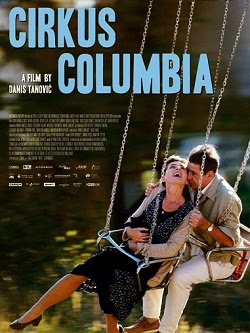 Circus Columbia (Cirkus Columbia) (Bosnia / Herzegovina, dir Danis Tanović)—Nearly 10 years after snatching the Golden Globe and Oscar® right out of Amélie's hands with No Man's Land, Danis Tanović returns with this near-perfect yarn about one town's drift toward civil war. After earning his fortune abroad, prodigal husband and father Divko returns to his Bosnian birthplace with new mistress in tow, promptly evicting his wife and teenage son from the family domicile. Divko's redemption drives this bittersweet, rollicking film. But in the background, hints of a dark future intensify, culminating in Tanović's unforgettable final shot which announces the start of war. Reviews from last year's Venice Film Festival were very mixed, but the director's impeccable pacing, balance of conflicting tones and direction of actors, all convinced me I was in the hands of a master filmmaker. Certain to be one of my Ten Favorite Films of 2011. As seen at the 2011 Palm Springs International Film Festival.
 Hello! How Are You? (Buna! Se faci?) (Romania, dir Alexandru Maftei)—We've had almost five years of admiring Romania's prodigious output of dour, bleakly funny human dramas. What we haven't seen is a Romanian rom-com, which is what we get with this genial comedy of errors. Gabi and Gabi are husband and wife in a loving, but lackluster marriage. One day they spring to life after simultaneously engaging in clandestine correspondence with an online admirer (and you can certainly guess who those admirers will turn out to be). While the film initially struggles to make this tired premise fresh, the director gradually steps up his game and scores some original moves. It doesn't hurt that the main subplot follows their hunky son as he auditions for porn and constantly updates an audio diary of his sexploits. The fun, tropicalia-flavored music score is a revelation. As seen at the 2011 Palm Springs International Film Festival.
 Silence of Love (Tous les soleils) (France, dir Philippe Claudel)—Director Claudel follows his 2008 psychological shocker I've Loved You So Long with something completely different—a gently humorous portrait of a single Italian-French father opening himself to the possibilities of love. Stefano Accorsi (Ferzan Ozpetek's Saturn in Opposition and His Secret Life) stars as a Strasbourg music professor who lives with a smart, rebellious teenage daughter he overprotects, and an agoraphobic, anarchist brother. While it gets a bit corny in places and the screaming, emotive Italian stereotypes can wear thin, the film is overall quite winning. Anouk Aimée shows up in a memorable supporting role and Strasbourg looks even lovelier than it did in José Luis Guerín's In the City of Sylvia. For what it's worth, I doubt the distributor could have come up with a lousier English title than Silence of Love.
 The Mosque (A Jamaâ) (Morocco, dir Daoud Aoulad-Syad)—In 2007's Waiting for Pasolini (which opened our 2008 Arab Film Festival), giddy chaos overtook a Moroccan village with the arrival of an Italian film crew. Now Pasolini's director has made a sequel of sorts, whereby a poor farmer is forbidden from dismantling the film's fake mosque, which sits on his land and has been appropriated as a real place of worship. Unable to support his family, he's told by the mosque's fake imam that his rewards lie in the next life. While initially a tad plodding and one-note, The Mosque improves as complex layers are added to the farmer's predicament. The result is a worthy allegory assailing religious hypocrisy, corruption and authoritarianism.
 Busong (Palawan Fate) (Palawan Destin) (Philippines, dir Auraeus Solito)—Director Solito, best known for his LGBT-themed films like The Blossoming of Maximo Oliveros and Boy, returns to his southern Philippines roots. In this dreamy meditation steeped in Palawan island culture, indigenous folklore and healing arts are revealed to us through a half dozen loosely connected storylines. In the costumes and art direction, Busong maintains a timelessness into which modernity only occasionally intrudes—the distant sound of a chainsaw, a wisp of poisonous smoke from a nickel mine, and a somewhat heavy-handed story of a fisherman's humiliating encounter with a white landowner. All of this—the pristine beaches, jungles, unending skies and underwater life—is sumptuously photographed. Solito's now familiar homoerotic gaze is also in full evidence.
 Beyond the Road (Por el camino) (Brazil / Uruguay, dir Charly Braun)—A youngish, Argentine ex-investment banker arrives in Montevideo, Uruguay and sets off to see some rural property left by his deceased parents. Along for the ride is a Belgian tourist, with whom he begins an uneasy fling. Considerably more interesting than their oscillating relationship are the stops they make en route; from a chic Punta del Este art gallery to a country horse fair, and from a rich uncle's estancia to a hippie commune in the boonies. First-time director Braun's talent lies in conveying a rich sense of place and populating his film with compellingly watchable "real" types. Even Naomi Campbell has a wistful cameo that's not out of place in this charmingly meandering, melancholy journey. Director Braun will attend both MVFF screenings.
 The Prize (El premio) (Mexico, dir Paula Markovitch)—At the height of Argentina's Dirty War, a mother and 7-year-old daughter hide from authorities in a remote, ramshackle beach hut. Their tenuously safe existence is threatened when the girl starts school and enters an essay contest meant to extol the virtues of the country's military. Markovich is best known as co-screenwriter of Fernando Eimbcke's Duck Season and Lake Tahoe, but her feature directorial debut contains none of the absurdist humor of those remarkable films. Her subject matter is certainly vital (and from what I've read, closely autobiographical), but the film is sabotaged by extremely slow pacing. Scenes of wind-whipped beach wandering alternate with long stretches of mother and daughter cooped up in their shack (where oddly enough, we never once observe them cooking or eating), to the point of grossly overstating the characters' anxiety, boredom and isolation. This dampens the potency of an otherwise absorbing work containing superb performances and distinctive mise-en-scène. Director Markovitch will attend the October 16 MVFF screening.
 Jeff Who Lives at Home (USA, dir Jay and Mark Duplass)—The Duplass brothers deliver their most mainstream film to date, which could put off fans of edgier works like Baghead and Cyrus. Jason Segel plays Jeff, a stoner whose begrudging errand for Mom (Susan Sarandon) sets off a day-long, follow-your-bliss-y search for signs of life in the universe. A cleverly crafted story rubs uncomfortably against too much strained poignancy. Still, highly recommended for those who think Segel is the most adorable schlub in the universe. As seen at a MVFF34 press screening.
 Pegasus (Pégase) (Morocco, dir Mohamed Mouftakir)—Somewhere in a vague dystopia, a crazy woman raves about "The Lord of the Horse" who's coming to get her. It's up to comely mental institution psychologist Zineb to get to the bottom of it all. I won't elaborate further on the plot, which rolls insanity, rape, transexualism, incest and creepy folklore into one big convoluted and culturally abstruse psycho-thriller. Still, the film is extremely well made, with arresting imagery and shifting color palettes matching the temperament of any given scene. Amazingly, Pegasus was the top prize winner at this year's FESPACO, Africa's most important film festival. Popular Moroccan actor Anas El Baz (Casanegra) will attend both MVFF screenings.
 Holidays by the Sea (Ni à vendre ni à louer) (France, dir Pascal Rabaté)—Graphic novelist turned film director Rabaté updates Jacques Tati with this homage to 1953's beloved comedy, Mr. Hulot's Holiday. Once again we're at a seaside resort, observing the droll antics of tourists and year-round denizens alike. But this isn't your grandfather's Tati, with subplots involving BDSM and a nudist camp. Rabaté conjures a few interesting visual ideas, but overall the film lacks cohesion and punch. And while comic mileage will always vary, this not painfully-unfunny frolic failed to elicit a single laugh out me. Points are given for top-notch production design, a cast of recognizable French character actors (including Jean-Pierre Jeunet regular Dominique Pinon) and an effectively whimsical, Theremin-heavy score (the film contains no dialogue to speak of).
Cross-published on film-415.
 In his introduction to the world premiere of Monster Brawl at the 2011 edition of Fantasia, director Jesse T. Cook recounted that his first break with the project came when he met with Anchor Bay Canada a couple of years back after he'd filmed a short sequence. They became interested and supportive of the film all the way through production. Having come from nothing—literally raising funds door to door while working as a bartender and a drywaller on the side—Cook's next blessing came in the personage of Art Hindle who helped secure financing for the film. With money in place, Cook and a crew of high school friends got together last summer to make their monster movie.
 Fortunately—for those who did miss that ringside ticket at Fantasia—Toronto After Dark (TAD) offers another opportunity when Monster Brawl opens their sixth edition later this week with an already sold-out gala event. An admitted effort to make "a really fun monster movie", Cook asked his Fantasia audience to think back to when they were watching Monster Squad or Wrestlemania on television; the clear inspirations for Monster Brawl.
 Michael Guillén: My focus at Fantasia this year has been a comparison of the international reach of national cinemas as opposed to the international reach of genre films. So kicking off with the notion of a national cinema, I'm curious if you identify yourselves as Canadian filmmakers and if you consider Monster Brawl a Canadian film?
 Cook: Absolutely! The fact that we had to raise money and woo investors was a major responsibility for us at the end of the day. We didn't hand off the film to a sales agent or anything. Matt Wiele, one of our producers, is the sales guy and we did everything in-house. We made the film knowing what kind of numbers we might expect from various territories—we were very strategic in our process in terms of that—but, you're absolutely right. In terms of government funding, genre suffers, though I do feel they're starting to get on board with that now, if ever so slowly, kicking their heels. It's been kind of shitty for us. We applied for government funding years ago and essentially got laughed out of the room. But we had to use any negativity or doubt as rocket fuel, y'know? You can't just keep your head down.
 Guillén: Should Monster Brawl get out there on the international genre circuit and do well—which I predict it will—will you emphasize its Canadian production as a strategy to perhaps gain future funding from Canadian government?
 Guillén: I have to admit that I'm glad you left your two bodacious babes alone. I was worried you were going to have them gutted and torn limb from limb.
 Jason David Brown: Swamp Gut still haunts my dreams. I see his face when I go to bed at night some days. I still have vivid dreams about those days on set, stripping out of that fat suit covered in latex. What do you think? It took four-five hours to get it all on and within the first hour of shooting I was already overheating. It was a constant struggle. A fat suit on a summer day is already hot and then you're sealed in rubber inside a factory. It was the most uncomfortable thing I'd ever gone through.
 Guillén: I'm fascinated that you've graphed out a production plan to make 10 movies in 5 years. I've spoken with many first-time or sophomore directors who feel lucky to have made what they've made and who never know if they're going to be able to make another movie.
 Guillén: That would be your Civil War zombie movie Exit Humanity? [Exit Humanity will also be screening at TAD later this week.]
 We don't want to be corrupted, though. As I was telling Jason on the way to Montreal, I see a few things in Monster Brawl that I might have changed if we'd had more money, but it's possible that more money might have corrupted this project.
 Brown: Honestly, I don't think we planned on Monster Brawl being as big as it was. Everything snowballed.
 Brown: Oh yeah! My attic is like a shrine to everything sci-fi that's related to monsters. When I was in public school, we used to act out scenes in the schoolyard. I'm not exaggerating.
 Cook: We wanted to do Frankenstein all along, with Robert Maillet in the role obviously. I had to figure out if his character was going to be like Karloff's at Universal, which is actually from Mary Shelley's novel. Before the script was even written, we sent Robert Maillet drawings of him as Frankenstein and one thing led to the other so we were able to sign him on. It was a hellish time for him. It took six hours to get his make-up on and literally a barbecue brush to scrub it off. Other characters like Dracula were problematic because we didn't have the rights to use them, so we came up with Lady Vampire (Kelly Couture).
 Cook: We couldn't use The Wolfman, though anyone can make a movie with a werewolf. You can even have a movie with The Mummy. But we couldn't use Swamp Thing or the Creature from the Black Lagoon; we had to create Swamp Gut. We wanted a fat monster like Andre the Giant.
 Cook: Robert Maillet, Rico Montana (who played Zombie Man) and RJ Skinner (who played the Werewolf and the Mummy) all had wrestling experience. Witch Bitch and Lady Vampire, Holly and Kelly, were part of a tremendous group of South Ontario wrestlers. We had to bring these guys on because we knew that we had to get the horror and monster elements right and we brought these guys on to get the wrestling elements right. They would read the script and say, "That's not even a move." They served as technical advisors. We also brought in Leif Havdale, Robert Pattinson's stunt double in Twilight, as our stunt coordinator and he was phenomenal. If we wouldn't have had him, I don't know how the fights would have looked the way they did.


