Tuesday, October 04, 2011

TIFF 2011: THE ARTISTThe Evening Class Interview With Michel Hazavanicius

Michel Hazavinicius and I first met when he accompanied OSS 117: Lost In Rio to the San Francisco Film Society's 2009 French Cinema Now series. It was Halloween and we dashed across the street to La Mediterranee so that he could catch a bit to eat before returning to the theater for his Q&A. He revealed that he was working on a new project with Jean Dujardin, his lead actor in the OSS 117 films. The new project didn't have a working title yet, but it was going to be a silent movie "with some music and eventual sound", less a comedy and more "a melodrama with some funny situations."

Fast forward to May 2011 and The Artist scored Dujardin the
Prix d'interprétation masculine award at the Cannes Film Festival (not to be undone by Uggy, his canine accomplice, who received the special Jury Prize, the Palm Dog Award). I was delighted when The Artist was programmed as a Special Presentation at the 2011 Toronto International Film Festival (TIFF) and noted that it was the only film I heard applauded by the international press during its festival P&I screening.

As Michèle Maheux wrote in her program notes for TIFF: "A love letter to 1920s Hollywood, Michel Hazanavicius'
The Artist resurrects silent cinema as a powerful and complex storytelling medium. Shot entirely in black and white, without dialogue and in a traditional 1.33 aspect ratio, the film remains faithful to the period it represents, avoiding the trap of pastiche through a sincere appreciation of the cinematic possibilities offered by classic silent film.

"Jean Dujardin plays George Valentin, whose matinee-idol good looks and arrogant but good-natured charm evoke Douglas Fairbanks at his best. George is at the height of his career in 1927 when
The Artist begins. While working the premiere of his new film, he accidentally bumps into a beautiful unknown, Peppy Miller (Bérénice Bejo), and the ensuing photo op sets her on the path to unexpected fame.

"George, however, quickly finds himself on the opposite track, as sound begins to dominate the screens. Refusing to accept this modern innovation, he finances his own silent feature in 1929 and loses it all. His wife leaves him and his fans forget him. Broken and alone, George fades into the shadows of old Hollywood.

"At the same time, new It-girl Peppy finds herself at the forefront of the sound phenomenon. As her star status rises, she never forgets the man who gave her the start she needed; she resolves to help George in any way she can.

"
The Artist tells a familiar story, reminiscent of classics like Sunset Boulevard and A Star is Born, but Hazanavicius and cinematographer Guillaume Schiffman breathe new life into an old tale. Their skilful handling of a style that could easily have turned into camp enables for a newfound appreciation not only for silent cinema, but also for melodrama and the intense emotional effects the genre can deliver. Above all, The Artist offers a joyous look back to a golden age, and will leave audiences nostalgic for a cinematic form that, as Hazanavicius proves, hasn't lost its resonance."

The Artist is scheduled to make appearances at the 49th edition of the New York Film Festival (currently in progress) and as the closing night feature at the upcoming 34th edition of the Mill Valley Film Festival, running October 6-16, 2011. My thanks to Andrea Grau of Touchwood PR for setting me up to speak with Michel Hazavanicius in the mezzanine of Toronto's Park Hyatt.

* * *

Michael Guillén: Michel, congratulations on The Artist. It's a beautiful, impeccably crafted film.

Michel Hazavanicius: Thank you very much.

Guillén: What I'd like to pursue in our conversation is an appreciation of cinematic citation. The Artist intrigued me for successfully circumventing the camp tendencies of pastiche and eliciting the depth of homage. But truthfully, it even goes past homage and is more accurately a silent film intact on its own terms.

Hazavanicius: That's right.

Guillén: Why were you attracted to making a silent film? It's quite a departure from the OSS 117 spoofs.

Hazavanicius: I wanted to do something completely different from the OSS 117 films. In a way, The Artist is very different from those films but it's also close to them, in the sense of taking a certain kind of cinema and making it modern. To take the spy movies, the James Bond movies, and make comedies that skewer racism was the thrust of the OSS 117 films. With The Artist, I wasn't trying to ape movies from the silent era. What intrigued me was that there was no more irony. I wasn't mocking the silent era. As you say, it wasn't that I wanted to do an homage per se; I just wanted to make a silent movie.

At the beginning, I wasn't sure if it would be a movie about a silent film actor or if the subject of the film would be about silent movies. I was primarily interested in the format. I ended up choosing this story of a silent movie actor because I thought it would be easier for the audience to accept watching a silent movie. That made sense. I felt audiences needed a justification to accept watching a movie in such an unusual format.

I had many deep motivations for wanting to make a silent film. As a member of the audience, I absolutely love the way stories are told to me in a silent movie. It's not a cerebral response. It's more a child-like response. Because there's no spoken language, the way the story engages your heart is special. It's hypnotic, sensual, not at all cerebral, and I love that sensation as an audience member. My motivations as a director were much more selfish. For me, it was a great experience. It's what cinema is about, in my opinion. I'm telling a story with images and music. With images, you have the actors, you have the sets, you have the costumes, the lights, everything, and that's how you're telling the story. You don't need words for that. It's the ultimate experience for a director to make a silent movie. I really wanted to try to do it.

The opportunity to do so I owe to the producer Thomas Langmann who gave me permission. It was a fantasy that he helped come true. Also, the two lead actors—Jean Dujardin and Bérénice Bejo—thoroughly inspired the characters. They were actors I felt could make a silent film because their faces and their styles of acting—since it's not just about their faces—aren't really modern and I felt they were suited to a silent film. All of the crew, my cinematographer Guillaume Schiffman, my composer Ludovic Bource, were involved early in the project. I invited them to come with me into the immersion process of trying to understand what kind of movie we could make.

So making
The Artist has been a very long process that started from a desire deep in my soul mingled with my selfishness and involving meeting the right people at the right time. Of course, the success of the OSS 117 films helped me a lot because—when I first talked about this story—nobody was interested in making a black and white silent movie. It was too much out of the market.

Guillén: You might know that in San Francisco we have one of the world's leading forums for silent cinema—the San Francisco Silent Film Festival—who have been wholly instrumental in educating my appreciation of the medium. I have to presume that you've had a lot of exposure yourself to silent cinema? You've utilized the conventions so masterfully that I presume you've attended Pordenone?

Hazavanicius: I watch a lot of silent movies, yes. My biggest challenge with this movie—aside from finding the financing, which was a big challenge—was the writing. It was during the writing process that I was convinced I could make a silent movie. I actually wrote a story with no dialogue that I felt I could shoot as a director and that I felt actors would be able to tell. So I've watched a lot of silent movies, yes, primarily to know the rules of the game. What you can do. What you cannot do. What the format frees you to do. There were several oneiric sequences where I could play, like poetry—I'm not saying I'm a poet—but, there were unrealistic sequences that a director can rarely use in a realistic film. Everyone would think it was ridiculous because usually in a realistic film you strive to be naturalistic. In a black and white silent movie you are already so far from reality, which in itself is a promise to venture into another space besides realism. Once you've set up that other space, audiences will enter. Does that make sense?

Guillén: Absolutely! And I think audiences are hungry to experience these alternate spectatorial spaces. I have to mention that even the press are. The Artist has been the only press screening I've seen applauded by the press here at TIFF. And that always amuses me because it's like we slough away our professional personas and suddenly become just an audience. We all just want a real movie. We all want to be entertained and taken away into—as you say—another space. The Artist succeeds in that.

Hazavancius: Perhaps because we made the film in a classical way? It's a pleasant film. It's like a classic film but it's also modern in the sense that the pace of the film is not like a silent era film. The story itself is not complicated, it's a simple story, but it's not quite as simple as some of the narratives of silent era cinema. If you watch, for example, Murnau's City Girl (1930) or Sunrise (1927), the scripts, their stories, are very very simple. For today's audiences, they might be too simple. So I made The Artist a bit more complex. But then again, I couldn't make the story too complicated because the format doesn't allow it. At a certain point you would need words to express complex relationships. I had to strike a balance: not too simple, not too complex, only as complex as I was able.

Guillén: It could be said, perhaps, that an aspect of that just-so complexity is rendered in the film's exquisite production design. Guillaume Schiffman's cinematography captures the spirit of George Hurrell's Hollywood glamour portraiture perfectly. Can you speak a bit to what was involved in the preproduction process to achieve the look of the film?

Hazavanicius: I'm very selective about locations. When we were scouting for locations, the cinematographer and the production designer [Laurence Bennett] started off liking me but by the end they were fed up with me because I was never quite satisfied with what they found. I know that a story cannot be told in a good way without the right locations. I was the same way with the OSS 117 films and I was even worse with this film. So preproduction took a little time. We filmed
The Artist in 35 days, which is short really, so the preparation wasn't as long as I would have liked but we committed ourselves to making sure that we could do the film justice on such a short schedule.

Guillén: How about post-production effects? Was a lot of time spent in post-production insuring the look of Hollywood in the '20s and '30s?

Hazavanicius: Not so much, really. The way I work is to try to do the less I can. I try to leave as much room as possible for the audience. I firmly believe that what the audience does is better than what I do because they do it in their own way. Every single viewer does the work in their own way. So my job as the filmmaker is to put as little as is necessary in each frame. So there was a little bit of post-production but mainly things that you aren't supposed to know about or notice.

For example, at that time the Hollywood sign actually read Hollywoodland. As a filmmaker I had a choice. Would I use Hollywoodland, even though most people didn't know that was the authentic sign? I chose to go with the authentic sign. But I couldn't reconstruct these huge letters on the hill so I had to effect this digitally in post-production.

Guillén: If I may single out one of my favorite images in the film? It's when Valentin, in a moment of self-loathing, pours out his whiskey on the reflective surface of the table. Stunning!

Hazavanicius: Oh,
thank you! That image was not included in the print shown at Cannes.

Guillén: It was not?!

Hazavanicius: No. This was the only shot I changed between Cannes and now. I don't know why I didn't include it at first. Perhaps because I worried that as a director it would appear that I was showing off?—"Look what I can do!"—and so I didn't feel comfortable and took it out. Then when the film screened at Cannes, I felt that the story got a bit confusing without that sequence so I reinserted it, provided a date, and that helped to structure that section of the film. They loved the movie anyway at Cannes but I feel it is better now.

Guillén: Along with eliciting these marvelous performances out of Jean Dujardin and Bérénice Bejo, how in the world did you find Uggy? And what went into developing a relationship between Jean and this upstaging Jack Russell?

Hazavanicius: I was lucky. But you know, I've been lucky from the very beginning of this movie right to the present moment. I hope my luck doesn't run out! The producer always said this movie was born under a lucky star. And really, that's the truth. I wrote the script with a Jack Russell doing all these tricks that you saw in the movie. I knew it was going to be a problem finding the dog. I knew that it would take a long time to train a dog to do all these tricks and we didn't have the money or the time. I told my producer that there were two things we needed to do very quickly. One was to find a dance instructor for the actors—because they had to do a tapdancing number—and we had to find the dog, because I thought we were going to have to train it.

So when we first arrived in Los Angeles, I had to push the producer to find the money to afford the dog. Then we started looking for him. We went to the largest animal training company in Hollywood who provides all the "talent" for animal movies. They're one of the best in the world. They have horses, birds, any kind of animal you can imagine, including dozens of dogs, and they showed me the dogs they had on file. I saw some genius dogs, as smart as Einstein, cute and able to do a lot of tricks, but none of them were a Jack Russell. So they told me, "If you really want a Jack Russell, it's going to take six months to train them because we're going to have to buy six to eight Jack Russells and train them to do specific things." They said I would need at least three Jack Russells for my movie. Which, of course, was very expensive and was going to take too long.

But then they offered another option. They knew of an independent dog trainer from a small family who lived in a small house in the suburbs who—when I first visited them—I thought were going to be useless. And then the trainer introduced me to Uggy. Uggy was exactly what you see in the movie. He already knew all of the tricks and the trainer told me, "Yes, I read the script and there's no problem." Then, bam, Uggy fell down dead like he does in the movie, and he did all the tricks, even more tricks than we showed in the movie: he
skates, he has a skateboard! He stands on his skateboard on two legs and curves, it's just amazing.

As for his relationship with Jean, there were two things. Uggy obeyed his trainer. This was useful while making a silent movie because the trainer could yell at him during the filming. But this proved very difficult for Jean. For example, towards the end of the movie when Valentin wants to commit suicide and Uggy is tugging at the hem of his trousers because he doesn't want Valentin to commit suicide, his trainer was yelling on the set to coax him to do this and Jean was having to play the scene very sad with all this noisy distraction. So, yes, Uggy performs marvelously in that scene, but it's Jean who is the consummate performer for maintaining the sadness necessary to the scene even as the dog trainer is shouting. There were other times when Uggy was not on set but Jean had to anticipate what Uggy might do. So these scenes do not succeed just because of how well-trained the dog is but because of how Jean worked with him. There's the famous caution to an actor never to work with children or animals and, in this instance, Jean had to work to make the scenes believable. If the scenes were not believable, no one would blame the dog. They would say the actor was no good.

Guillén: To wrap up here then, being a fan of silent cinema myself, I appreciated your observance of the transnational value of silent cinema, which I've been taught is one of the reasons that silent cinema was so beloved around the world. These films were easily accommodated through translated intertitles that allowed them to traffic globally. So I'm curious if you're replicating that strategy and have various prints that are traveling with translated intertitles?

Hazavanicius: Because it's an American movie, we felt American intertitles were more authentic so we've elected to use translated subtitles for the film's international screenings. But I did try to sell the idea of providing software to foreign distributors so that they could make their own intertitles in their own languages, but we ended up not doing that. Even at Cannes, the French watched the movie with American intertitles but French subtitles.

But what remains true for me is that silent cinema is more than language. It's a utopian medium that can travel anywhere and is understandable to everyone in the exact same way, irregardless of the intertitles. Silent cinema "speaks" in a language that anyone on the Earth can understand. There's something touching about that. When we were looking for the financing, that's what I told the potential investors. I wasn't sure if I was lying or actually telling the truth, but I told them that maybe the film wouldn't be a huge success in France because it was silent and it was in black and white. But I reminded them that we were making a prestige movie that—if we made it well—we could sell to every country in the world, because the film would harken back to an era when cinema was for everyone. Cannes proved the success of the idea.

Guillén: Not only in the conventions of silent cinema as a transnational medium, but in your choice to cast the film with an international ensemble that includes American, British and French actors. It's phenomenal what you've accomplished.

Hazavanicius: Thank you very much.

Guillén: I look forward to your next project.

Hazavanicius: Me too!

Monday, October 03, 2011

SAGEBRUSH: THE IDAHO BUCKAROO PROJECT—The Evening Class Interview With Andrea Scott

Film writing has so much to do with rhythm and timing and there's no question that the multiple disruptions in my life this year—relocating from San Francisco to Boise, Idaho (still in progress) and then attending to family emergencies once I arrived—have thrown me off schedule. I was thinking this morning that I'm feeling a bit "unstuck in time" (as Kurt Vonnegut would phrase it), having missed so many pertinent theatrical release dates and woefully behind on festival coverage, let alone on transcription of literally hundreds of recorded conversations that have (unfortunately) clustered on a back burner; but, I have to believe that it's the work that matters, however gradually it unfolds, and not so much how it serves the machinery. In fact, serving the machinery has become a low priority in my film coverage and finding ways to write about film that circumvent these marketing forces has become a daily meditation.

Perhaps the most immediate and apparent change in my film coverage is that I have gone more international even as I now strive to balance that coverage with regional coverage through a new sidebar here on
The Evening Class entitled "Sagebrush", which will cover the unique regionality of film culture in Idaho. I first experienced this regional filmmaking when I accepted filmbud Bruce Fletcher's invitation to attend the 2007 Idaho International Film Festival (IIFF), which he was programming at the time. It was an eye opener to experience firsthand an enthused film scene off the beaten path. No press junkets here! Just a refreshingly collaborative ethos between aspiring filmmakers crafting films on shoestring budgets and audiences supporting them. I wrote up IIFF 2007's opening night feature The Walker, incorporated earlier coverage on Rolf De Heer's Ten Canoes, and interviewed A.J. Eaton for his short The Mix-Up and Ernesto Livon-Grosman for his documentary Cartoneros, and drafted a festival overview, all of which will be incorporated into the Sagebrush sidebar, as will my interview with Seth Randal whose film The Fall of '55 crossed state lines to screen at San Francisco's Frameline31.

But my first true interview for the new Sagebrush sidebar at
The Evening Class was conducted earlier this Summer at a benefit screening of Cindy Meehl's Sundance winner Buck at Boise's art house cinema The Flicks. The benefit was for the Idaho Buckaroo Project spearheaded by photographer Andrea Scott and I felt that my conversation with her would be the perfect way to launch an ongoing series of entries on regional film production and cultural practice in Idaho. She was a genuine sweetheart in taking time from that sold-out event to sit down for a few minutes to talk to me. When I mentioned to her that I was a transplanted San Francisco journalist, she made me laugh by saying, "I've been waiting for someone sophisticated to interview me!" "Now don't get carried away," I countered.

Andrea Scott is an Idaho native who grew up on a large cattle ranch. The ranching tradition in her family dates back to the 1800s. She is currently creating a photography documentary of the West. She is known as the "Cowboy's Photographer" because she does not pose or recreate scenes, but captures them naturally as they appear. Andrea feels blessed by her friendships with the people who keep the western tradition alive and is honored to be able to capture this lifestyle in timeless images. Recently, Andrea won a photography award from Range Magazine and her other work, "Women with Scars", has been exhibited at DIA Art Foundation's Printed Matter in New York. Her photographs have also appeared in magazines and newspapers throughout the Northwest.

I'm timing the transcript of our conversation from earlier this Summer to coordinate with the unveiling of the Idaho Buckaroo Project Exhibit at the Stewart Gallery, 1100 W. Jefferson St., Boise, ID., this coming Thursday, October 6, 2011, 5:00PM to 9:00PM as part of Boise's First Thursday art walks.

* * *

Michael Guillén: Andrea, how did the Idaho Buckaroo Project develop?

Andrea Scott: About a year ago I took one photo that started this all. It got published in a magazine and the response was amazing. The response ranged from Florida to California. I come from a ranch background. I grew up for part of my life on a big cattle ranch in Montana and now have a small place outside of Boise; but, I'm urban as well. I have a Masters degree in writing and photography and have made my living as a photojournalist.

I started photographing Idaho's buckaroos and doors started opening. People from the city would look at these photographs and become excited and enthused. I received a small grant from the Humanities to continue the project. The Idaho Commission on the Arts also gave me a small grant to start studying some of the more traditional arts. As you know, a lot of money for the arts is drying up. It's very hard to travel the distances I have to travel and everything costs a lot of money. So veering away from what most writers or photographers would do, I started asking people to sponsor this project. A lot of people jumped on. They were enthused. I only heard "no" a couple of times. I remember a five-year-old boy give me 20¢ out of his pocket because his daddy was a cowboy and he wanted to be a cowboy too. The project has captured the public imagination.

I have a friend who likes to play devil's advocate with me who said, "Andrea, what folly in this time of economic depression that you're trying to generate this project." I said, "It is an uncertain time but what better time for our heroes?" Cowboys, cowgirls and buckaroos have long been the western heroes of our culture. So I started meeting buckaroo families and their generosity in letting me into their lives to document their daily work has been amazing.

When I got out into the buckaroo community, I saw a greater need. For one thing, medical services. A lot of these folks do not have medical insurance and if they're hurt on a horse—which is very apt to happen—they could be injured in serious ways and temporarily or permanently disabled. It could be the end of their careers. Then what kind of means do they have to generate income? I decided that one of my goals through the Idaho Buckaroo Project is to bring medical services to these smaller communities. We're talking Bruno, Grandview, Oreana, wherever Buckaroo families are.

I was familiar with the Idaho Commission on the Arts who do some limited apprenticeships with traditional artists. These are brilliant master artists who work in silvercraft, saddlemaking and leatherwork; arts which should not be lost. I want to create more slots through the Idaho Buckaroo Project to create opportunities for supplemental income. I pray that no one in these buckaroo families get hurt, but if they do, they will have something to fall back on if they're not able to get back on a horse again. I want to go into the schools and educate children about how important cowboys and cowgirls are to the very fabric of Idaho. We have a great resource here. We have a state horse. We have a state gem.

Guillén: So why not a state hero?

Scott: Right! I've been trying to promote that. I don't know if people are hearing that but they're going to keep hearing that. I think if you look at the range of items contributed to our silent auction tonight—everything ranging from a chichi spa gift to a discount on hay—you see the diversity of support. I want to create an understanding between rural and urban cultures. I'm fascinated by that.

Guillén: My understanding is that there are plans to publish your photographs of the Idaho buckaroos into a single volume?

Scott: We're working on that. I already have some distribution channels, which I understand is very important. A lot of the publishers are drying up. I haven't seriously launched on that part of the project because I've been so busy conducting interviews and taking photographs; but, I don't think I'm going to have any problems with publishing. There's already been so much interest.

Guillén: This specific event at The Flicks to promote The Idaho Buckaroo Project through a benefit screening of Buck, how did that come about?

Scott: I've known Carole Skinner forever from the day The Flicks opened their doors so I just said, "Hey, any chance of doing a benefit sometime down the road?" All of a sudden Carole goes, "Oh my gosh,
Buck's coming!" We could call it universal synchronicity, but hey perhaps a better term would be to simply say, "It was meant to happen." I could tell a bunch of stories about how stuff is just happening. I didn't end up here because I thought, "I'm going to do anything I see." I ended up here because people opened their hearts and these are people from all wakes of life.

The other day I said to some friends, "You know what we need for the Flicks benefit? We need a fiddle player. I want a young man or woman to play the fiddle." I had a booth for the day as a bellringer at the Saturday market and this young man shows up with a case. I thought, "Oh great, with my luck he'll be playing violin." Well, Kyle Pogue is an awesome fiddler! I talked to his mom and I said, "This is the perfect example of how this stuff works. Does your son come down to play at the Market all the time?" She said, "No. It's the weirdest thing. He came up to me the other day and he said, 'Hey Mom, I just want to go downtown and open up my case and see what happens.' " I want Kyle to always open events for the Idaho Buckaroo Project.

Guillén: I'm intrigued by your earlier comment that you're fascinated with making a connection between the rural and the urban. How does this event fulfill that?

Scott: The Flicks is an art theater. Outside of Boise, most people have never heard of The Flicks. People from the farms and the ranches look at The Flicks and they say, "Well, that's kind of a strange theater but they're bringing a film I care about" and by coming tonight to support the benefit screening, they're being exposed to a whole new world. It's magical.

One final thing I want to say is that a lot of people say, "Oh, this is a disappearing way of life." But I can tell you: it's not going to disappear as long as the Idaho Buckaroo Project is here. But it's going to take all of us working together. Even if you're not a buckaroo and not on a horse day in and day out like a lot of these families are, I think a lot of us have a little buckaroo in us. That's what I hope to bring out.

Photos courtesy of Andrea Scott and Pete Grady.

BLACKTHORN (2011)—The Evening Class Interview With Mateo Gil

"It's hard to be an outlaw when you're not wanted anymore."Danny O'Keefe

Danny O'Keefe's play on the word "wanted" signifies how important it is for an outlaw to be chased in a western. If an outlaw isn't chased, then what has he become? Or what has the western become? Mateo Gil's Blackthorn (2011) poses the question: what happens if the outlaw is caught, shot, and presumed dead? But isn't really dead?

In Gil's addition to the legacy, Butch Cassidy and the Sundance Kid escape their ambush in a Bolivian standoff but elect to forfeit their identities to Death in exchange for some new lives. Butch changes his name to James Blackthorn and lives an exiled life in Bolivia for 20 years. But flashbacks of his youth when he and Sundance were in top form and in love with the same woman revive old feelings in him. Blackthorn longs for moments lost and longs to ward off moments he is just about to lose. The need to meet a son he has never met inspires a series of melancholic letters in which he tentatively addresses the boy as "nephew". The time has come to return "home" and set things straight.

And who better to look off to the horizon with craggy determination than Sam Shepard in a role he was born to play. More force of nature than performance, Shepard enrichens his character with a deep sense of lived experience as he works through one obstacle after another. It's inspiring to witness. Supported by a competent international cast and outstanding Bolivian locations,
Blackthorn reconfigures a legend and a genre in one poignant and innovative stroke.

Mateo Gil is well known in Spain as a screenwriter. He co-wrote Alejandro Amenábar's
Thesis, Open Your Eyes (later remade as Vanilla Sky), The Sea Inside, and Agora, as well as The Method for Marcelo Piñeyro. His first movie as a director was Nobody Knows Anybody in 1999. He also directed the award-winning shorts Housebreaking and Say Me.

Blackthorn
premiered at La Palmas and was in the World Narrative competition at Tribeca 2011 in April. It premiered on Video on Demand on Friday, September 2, and opens in New York and Los Angeles on October 7 and in the San Francisco / Bay Area in the weeks that follow [release schedule]. My thanks to Brandon Nichols for facilitating the interview and for Mateo Gil for granting time to talk on the phone. Photos courtesy of Magnolia Pictures.

* * *

Michael Guillén: Mateo, it's my pleasure to speak with you today about your recent film Blackthorn (2011). You're the perfect person to talk to about one of my recent interests: how the international reach of genre contests the limitations of a national cinema. You started out as a screenwriter within the Spanish film infrastructure but quickly achieved an international profile through your collaborations with Alejandro Amenábar. How much do you think of yourself as a Spanish director or of Blackthorn as a Spanish film?

Mateo Gil: Yes, well, to be honest, originally I never imagined making films for an international audience. I simply had the good fortune to work on Alejandro's films, which is when I first encountered the opportunity to consider an international audience and to strive for those heights through his vision. Alejandro was the one who thought internationally.

With respect to Blackthorn, at a sincere level the film is almost entirely Spanish. Some of the financing came from France, and when we were on location in Bolivia we received some assistance from their government, but primary financing came from Spain. For a while, I thought we would find our audience in Spain but the western isn't that popular of a genre there. However, I think of the Spanish audience and the North American audience in the same sense. It isn't that I was trying to make a successful U.S. film. What I wanted was that a North American spectator would be able to watch my film and not think of it as strange or foreign (which is to say, European). But I understand that the spirit of the film is North American in the sense that the western is a genre particular to North America. But I wasn't trying to expand into North America by using the genre; I was just trying to make a film that contained the key elements of the genre. That was my primary purpose.

Guillén: In his interview for New York Mag's Vulture, Sam Shepard opined that these days the western seems best understood by foreigners. He singled out his experience working with you on Blackthorn, and another western he did with German director Uli Edel (Purgatory, 1999). Do you think that's true? What attracted you to film a western?

Gil: I've heard about this statement of Sam's and the truth is that I can't really answer your question because I don't know to what extent young directors in North America are involved with the genre. I do know that in Spain westerns are an almost forgotten genre. In Spain, or in other parts of Europe or the world, it might be true that they understand the western better; but, I don't know.

In my case at least, in my childhood I spent my time watching westerns on television. I watched a lot of westerns as a child because at that time there were a lot of westerns programmed on television, especially in the '70s and the '80s. My first time to a movie house was to see a western.

I chose to make a western because the genre—though considered to be a North American genre—is a genre that I feel is my own and part of my culture, having watched so many of them. Again, I don't know if the young directors in North America have watched as many westerns as I have or not; but, I do think that there's a general nostalgia for the western among audiences all over the world. I think they feel real pleasure when they watch a western in a movie house.

Guillén: How did you distinguish between the North American westerns that came out of Hollywood, let's say, and the spaghetti westerns that came out of Italy? How did each influence your vision of a western?

Gil: There are a lot of influences in Blackthorn. There are some of the spaghetti western influences because I watched a lot of the films of Sergio Leone. But the film has also been influenced by other types of westerns, especially from the '60s and '70s; the westerns of Sam Peckinpah, Arthur Penn, Sidney Pollack and Robert Altman. Even as I was working on the project and setting up the scenes on set, the films of John Ford were also present. It's as if the film itself did not want to exist without these influences. Thus my experience of Blackthorn is of a mixed experience, respectful of influences from the '50s, the '60s, the '70s, which were the westerns that I liked.

Guillén: Blackthorn's international cast is one of its strongest assets. You have Sam Shepard from the U.S., Stephen Rea from Ireland, Eduardo Noriega from Spain, Nikolaj Coster-Waldau from Denmark, and Magaly Solier from Peru. Was part of the rationale for casting an international cast a strategy for achieving an international audience?

Gil: No, no, no. The only thing I needed from the casting as a director and the only thing I was really strict about was that the accents needed to be accurate. So the only thing I needed out of the North American characters was that they spoke with a perfect North American accent. For the characters from Bolivia, I needed them to speak Spanish the way a Bolivian would speak Spanish. I knew that Magaly Solier would be able to speak a Bolivian Spanish, which she performed fantastically.

It was clear to me that the only person who could perfectly carry the North American accent was Sam Shepard, whereas the other characters could be cast from a European pool of talent. This was difficult because they still had to be able to carry off English, ride a horse, and—in the case of Nikolaj Coster-Waldau, who plays the young James Blackthorn—that he look like Sam. It was all very complicated but we had a marvelous casting director in whom I had complete confidence. Not only did we have good luck in securing Sam for the lead role but it turned out that Sam is a good friend of Stephen Rea and he was able to bring him into the project, which was a lucky break.

Guillén: So I imagine that being on set carried its own challenges in terms of all the different languages that were being spoken? It was a multilingual set with actors speaking English, Spanish, Aymara and Quechua. How did you negotiate direction on set?

Gil: It wasn't difficult at all. I simply had to be clear what to say in one language and what to say in another. But I didn't have trouble communicating with anyone. I would speak to them directly. I think for everyone who worked on this multilingual set, they walked away recognizing what a special and rich experience it was for them. It was a beautiful experience. And it was also historically accurate because multilingualism was present at the time of Blackthorn's exile in Bolivia.

I would say that Spanish predominated on set. Butch Cassidy was said to live in Bolivia for at least a couple of decades and, therefore, he would have had a good working Spanish. At the start, it was difficult to figure out who would be an American actor who could speak good Spanish. I don't know who else could have done it as well as Sam, because he can actually speak Spanish.

Guillén: Mateo, you have a notable reputation as a screenwriter and Sam is well-known for being a consummate playwright as well as an actor. Now that you've had the experience of directing, can you speak to how important is it for a director to be in touch with the craft of screenwriting?

Gil: I think it's very important. It was as important for me as a director as it has been for Sam. I understand the characters, as written, in a singular and clear way. For me, writing and directing have become the same thing. The writing helps me decide what is important when the time comes to direct and film, which is an essential facet.

Guillén: Blackthorn utilizes an epistolary structure by way of narrative voice over: a father writes home to a son he's never met and who—in his old age—he longs to meet. A melancholy permeates this film. It reminds me of what the Portuguese would call saudade, something which surely speaks to you as a Spaniard? When you decided to film a western, why did you decide to do such a nostalgic western, and not more of a shoot-'em-up actioner?

Gil: In the original version of the story written by Miguel Barros, that specific sentiment was already present. The nostalgia was already in place. This sentiment had a double reading for me. It wasn't only a sentiment of nostalgia for a certain type of values that have fallen into disuse in a way, become lost or forgotten. The sentiment also placed value in the struggle against greater powers, which is a struggle that Butch Cassidy incarnates in his personality. So the sentiment is not only one of nostalgia, but also one of a certain kind of passion against great odds that nowadays one rarely sees. It involves a charged vision of what is political or moral within the cinematic. I saw this sentiment in the original script and it served to energize me to pursue this film.

Guillén: Another strength evident in Blackthorn is what is often seen in all the classic westerns: the understanding that landscape is a character. Juan Ruiz Anchía's cinematography of the Bolivian landscape is stunning. In its visual relationship between the individual and the vast expanses through which he moves, I was reminded of John Ford's classic westerns; however, Bolivia's landscapes—unquestionably as majestic as Monument Valley—remain singularly distinct, though aesthetically similar.

Gil: It's curious. Various commentators have made the same observation that Blackthorn resembles the work of John Ford a bit. I take it as a compliment because, of course, John Ford is the master of the western genre. When I was preparing for the film, and traveled to Bolivia to scout for locations, I frequently thought about how films that are spectacular with incredible scenery are, in a way, the same throughout the world and that audiences have become immunized to the strength of these images of natural beauty from different countries. If you start seeing something too beautiful too often, you stop paying attention. All the more reason to use a genre like the western, which is known for its use of landscape, but to take it away from the landscape of North America to the landscape in Bolivia, so that the landscape can express itself to the spectator in a revived way.

Guillén: In your filmmaking, how did you negotiate with the presence of George Roy Hill's 1969 classic Butch Cassidy and the Sundance Kid? What Shelagh M. Rowan-Legg terms Blackthorn's "spiritual cousin"?

Gil: There's no way to escape the fact that Blackthorn has many points in common with George Roy Hill because they're the same characters, and in our film that's especially apparent during the flashbacks of Butch and Sundance as young men. Other than for that, I never saw Blackthorn as a direct reference to Hill's film. It's a marvelous film and I'm one of its fans but its tone is distinctly separate from Blackthorn. Butch Cassidy and the Sundance Kid was a western that was also a comedy. It celebrated all sorts of things. Blackthorn looks at the world with a melancholic eye. The flashbacks of youth are given all the more poignance for being seen through the senescent eye of old age.

Sunday, October 02, 2011

TIFF 2011: THE IDES OF MARCH (2011)

The opening film at the 68th Venice International Film Festival, George Clooney's The Ides of March (2011) [official website] screened as a gala presentation at the 2011 Toronto International Film Festival. It releases wide on October 7, 2011.

It's perhaps obvious to expect a dark lining to the overcoats worn by men running for political office. It's perhaps even more obvious that political corruption has long been a favored form of mainstream entertainment. Since our votes no longer seem to matter, slapping down ten bucks provides some assurance that no amount of spin will negate what we all fundamentally know about pants and their heedless zippers sheepishly strolling the corridors of power.

With an A-list cast that includes George Clooney (also directing), Ryan Gosling, Philip Seymour-Hoffman, Paul Giamatti, Marisa Tomei, Jeffrey Wright, and Evan Rachel Wood in efficient and top notch ensemble form,
The Ides of March campaigns forward by the sheer volition of its undisputed talent even if it is essentially a sermon for the converted and a somewhat melodramatic and predictable one at that.

Is it just me or are Philip and Paul playing the same roles over and over and over again? Marisa gleams with malice as a conniving journalist. I have to give a heartfelt shout out to Evan Rachel Wood who has matured into one of our loveliest and most gifted actresses. She's come a long way from being a child in the ill-fated TV series
American Gothic. Just you wait, she's going to do something in the future that will knock our socks off and earn her an Oscar®. This, however, is not that role but ranks her as ready and able.

Cross-published (in an earlier edit) on Twitch.

Friday, September 30, 2011

LECH MAJEWSKI ON THE MILL & THE CROSS

I've been recently fascinated with what would be considered "painterly" in cinema. It has, in fact, become one of my stock questions whenever I converse with a film historian or someone who has a deep embedded knowledge of film. Thomas Elsasesser distinguished between filmic projects where the director and art director collaborate to achieve either a historical drama (via the verisimilitude of historical paintings) and those films that express separate qualities about painting that are "more difficult to locate but [which] may actually have a deeper resonance."

"If we're talking about 'painterly', you really have to make a distinction," Elsaesser qualified. "Are you talking about 'painterly' in the 19th Century sense? Or are you talking about Modern art or painting? So I would make a big difference there. Both you can find in film."

When I posed the same question to Jonathan Rosenbaum for our published conversation in Film International (Vol. 9, No. 3), he responded: "It has an awful lot to do with the way certain people conceptualize and think about film. An obvious example of a painterly filmmaker is Chantal Akerman. She thinks in terms of painters. When I've talked to her before about her films, she'll talk about some of the Belgian Surrealists. Where I would say how much I liked Paul Delvaux, she would say, 'Yes, but his lighting is better than mine.' I remember she said that, which I thought was interesting. Of course, the painterly in film happens especially in experimental forms of cinema, such as the films of Michael Snow. In his own way, Snow is painterly though obviously he's also related to sculpture. Probably even more to sculpture than to painting."

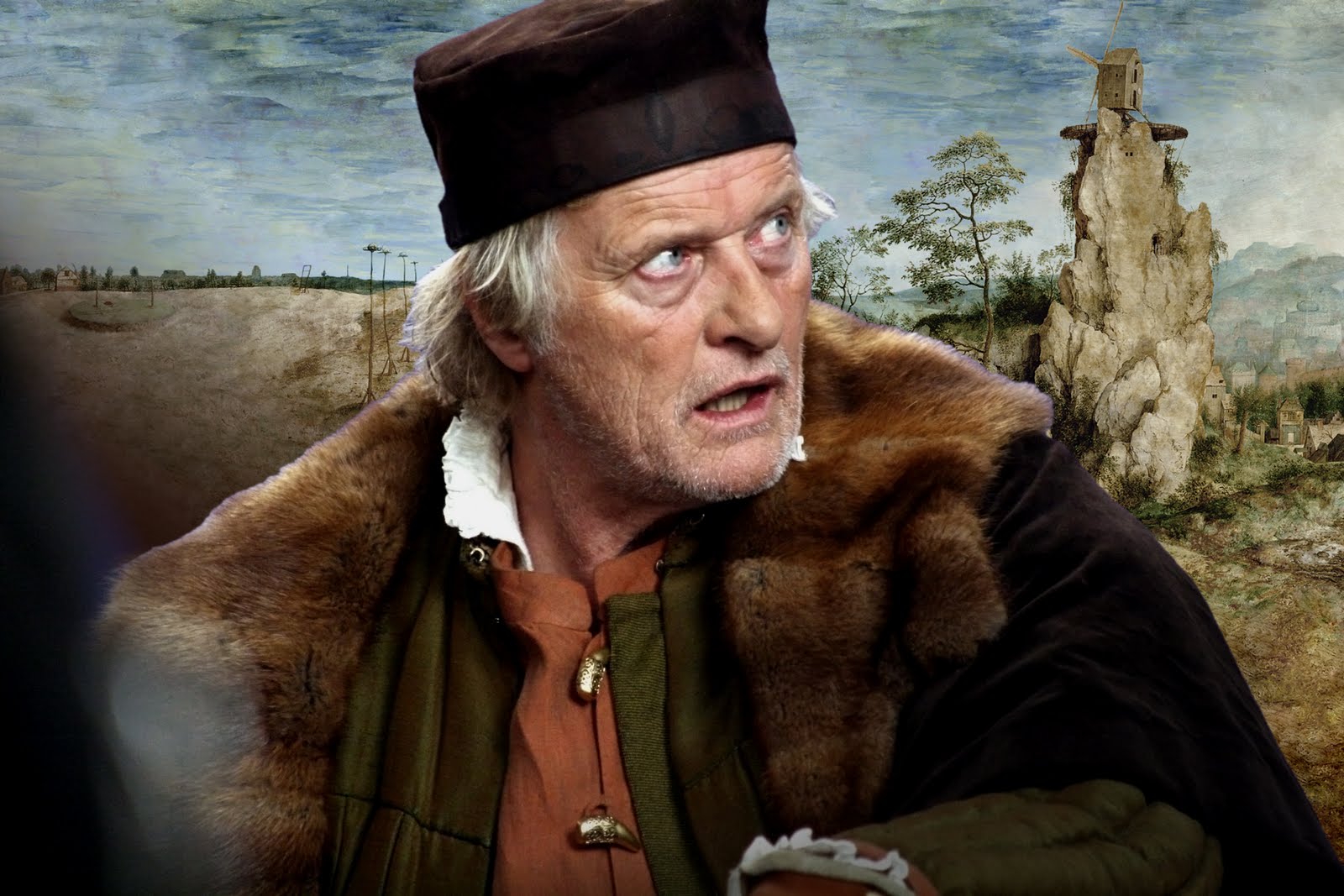
Lech Majewski's sumptuous The Mill and the Cross probably falls within the historical grouping outlined by Elsaesser as it springs directly from Pieter Bruegel the Elder's 1564 painting "The Way to Calvary"; yet, in its cinematic devices,
The Mill and the Cross achieves the quality of beauty delineated by Elsaesser that is effected by the dialogue a viewer establishes with a painting (or, in this case, a film). "The beauty is not something that your eye slides off after a couple of seconds because you think you recognize it," Elsaesser proposed, "but more the fact that the longer you look, the more the painting becomes something else. You know?" This quality of a painting "becoming something else" by way of cinema is undeniably evident in Majewski's The Mill and the Cross.

After a lauded tour on the festival circuit—including an appearance at the 54th edition of the San Francisco International Film Festival (SFIFF54) in their World Cinema Spotlight "Painting with Light" (which highlighted the cinematic contemplation of painting)—Majewski's
The Mill and the Cross opens theatrically this weekend.

As Graham Leggat wrote in his SFIFF54 program notes for the film: "A miracle of technology in the service of the artistic imagination, Lech Majewski's brilliant film transports its viewers into the living, breathing world of Pieter Bruegel's dense frieze of Christ's passion, 'The Way to Calvary'. And live and breathe it does. Though carefully organized along symbolic axes, Bruegel's 1564 painting sets the drama of the crucifixion within a rustic Flanders scene teeming with everyday life. ('About suffering they were never wrong, the Old Masters,' wrote W.H. Auden. 'How well they understood / Its human position; how it takes place / While someone else is eating or opening a window or just walking dully along.') Likewise Majewski—using computer-generated blue-screen compositing, new 3-D technology, just-so location shooting in Poland, Austria and New Zealand and a massive backdrop he painted by hand—tells the story of the painting largely through closely observed secular rituals of 16th-century Flemish daily life, in all its earth-toned grubbiness, with occasional scenes revealing Bruegel's artistic choices and the politics of the day. Windmilling, calf-hauling, bread-peddling, villagers dancing and children horsing around take up the better part of the narrative, while cameos by Rutger Hauer (as Bruegel), Michael York (as his patron and friend) and Charlotte Rampling (as a limpid Virgin Mary) give historical context and symbolic depth. But the narrative is not the point—the extraordinary imagery is. The painting literally comes to life in this spellbinding film, its wondrous scenes entering the viewer like a dream enters a sleeping body."

The Bay Area critical response during SFIFF54 was likewise affirming. At SF360, Max Goldberg noted that Majewski managed the problem of plotting a painting in time by organizing his scenes cyclically. Goldberg offered: "In regularly returning to the same actions—young children roughhousing, a man making heavy advances on a woman, a fool playing his flute—Majewski cleverly replicates the way our attention circulates looking at such a dense canvas. This enveloping aspect is further developed with the high-tech imagining systems that allow Majewski to situate his actors within Brueghel's own visual field. Meanwhile, the subversive aspects of the painting—the positioning of the mill grinder at a perch usually reserved for God; the placement of everyday bawdiness just next door to the Crucifixion, here imagined as taking place at the hands of Spanish inquisitors—come into focus through the narrative's slow build. By the time the camera tracks out from Brueghel's framed masterpiece, we're nearly surprised to find all that adventure emanating from a single canvas—only one of many in the gallery at the Kunsthistorisches Museum in Vienna."

At the
San Francisco Bay Guardian, Matt Sussman observed: "Majeswki both re-stages Bruegel's painting—which draws parallels between its depiction of Christ en route to his crucifixion and the persecution of Flemish citizens by the Spanish inquisition's militia—in stunning tableaux vivant that combine bluescreen technology and stage backdrops, and gives back stories to a dozen or so of its 500 figures. Periodically, Bruegel himself (Rutger Hauer) addresses the camera mid-sketch to dolefully explain the allegorical nature of his work, but these pedantic asides speak less forcefully than Majeswki's beautifully lighted vignettes of the small joys and many hardships that comprised everyday life in the 16th century. Beguiling yet wholly absorbing, this portrait of a portrait is like nothing else at the festival."

At
Vinyl Is Heavy, Ryland Walker Knight—though finding The Mill and The Cross "somewhat confounding, especially from the 2nd row"—nonetheless appreciated its wide and deep palette and noted that the film's "ideas, though rooted in the narrative structure of the painting, feel yet more modern in how arrayed (not inter-related) they are."

And at
Variety, San Francisco's own Dennis Harvey raved: "Neither conventional costume drama nor abstract objet d'art, this visually ravishing, surprisingly beguiling gamble won't fit any standard arthouse niche. Still it could prove the Polish helmer's belated international breakthrough, especially if marketed as a unique, immersive museum-meets-cinema experience a la Alexander Sokurov's Russian Ark."

At MUBI, Dave Hudson has gathered the critical commentary outside of the Bay Area.

Lech Majewski was born August 30, 1953 in Katowice, Poland, studied at the Academy of Fine Arts in Warsaw, and is a film and theater director, writer, poet, and painter. In the 1970s he studied at the National Film School in Łódź, notably as a student of Wojciech Has, who taught Majewski directing. In the early '80s, after completing
The Knight and as martial law was declared in Poland, Majewski emigrated to England and then to the United States, where he lived for most of the late Communist era. Today, Majewski is a dual U.S. / Polish citizen. He is a member of the American and European film academies and the Polish International PEN. In 2006, the Museum of Modern Art in New York City hosted a complete retrospective of Majewski's work. This was their first ever full retrospective of a Polish filmmaker, and one of their only ever mid-career retrospectives. For that program, Majewski created the film eventually called Glass Lips, though initially it was known as Blood of a Poet.

The following comments are taken from his public introduction and subsequent Q&A to the film's SFIFF54 screening. Photos courtesy of Kino-Lorber.

Introduction

A few words before the film. First of all, I would like to say that this is a work that took us three years to complete because we introduced some unbelievable and difficult tasks, technically speaking. I very much wanted to enter Pieter Bruegel's world. I respect him. I love his paintings. He was a great teacher for me in terms of his philosophy and the way he narrates his paintings.

Therefore, we did a lot of preparatory work. We started with costumes first of all. There are no textiles today like the textiles he painted in his paintings so basically we had to make these costumes, and then check the textures in front of the camera to determine which textiles would behave in a similar way as in the Bruegel painting. We had to hand-paint those costumes and hire seamstresses to hem them for us. The costumes alone took nine months of pre-production.

Then, obviously, when we started to look for the landscape that would be most appropriate to shoot the entire movie, we realized that there is no landscape like that; it doesn't exist at all. So we got a very good reproduction from the Kunsthistorisches Museum in Vienna that houses this painting "The Way to Calvary" by Pieter Bruegel. There are 500 figures in this painting. With the computer we started to analyze the perspective in the painting and found there were seven different perspectives in this singular painting. Obviously, Bruegel was foreseeing cubism 400 years before.

We were completely lost as to how we were going to shoot the nature because in his paintings he uses at the same time a point of view that is coming from the left, from the right, above and from below. We realized we couldn't have a landscape like that, but what we could do was to cut these multiple perspective into single ones and look around for similarities in the real landscape. Then in post-production we could piece it together.

There were also various things that were helping us. For example, an article was published in a Polish newspaper about a little village whose citizens were ancestors of Flemish immigrants from the 16th century. They speak a fossilized Flemish. This language that they speak doesn't exist anymore. Linguists have recorded them and the majority of them are 80+. So when you hear the sing-songs and the voices, keep in mind it is a non-existent language, a medieval French.

I went to New Zealand at one point during post-production and discovered that over the southern island there was a fantastic cloud formation. In fact, the Maori call this southern island the "Island of the Long Clouds". I quickly hired a DP and we shot these clouds because they were so reminiscent of Bruegel's clouds.

The film was assembled by weaving a digital tapestry. We had a lot of young people sitting in front of their computers spending their whole lives, like abbots in a monastery painting illuminated manuscripts.

The author of the original art essay that analyzes this film is the fantastic and brilliant writer Michael Francis Gibson, an American living in Paris and art historian who writes for the
Herald Tribune. He wrote the original analysis of the painting in a 300-page essay entitled "The Mill and the Cross, Peter Bruegels 'Way to Calvary' ", [in French, Noêsis, 1996 and in English, Acatos, Lausanne, 2001], hence the title of my film. Michael Gibson researched vanished customs (for example, you see the treatment of the bread, how the people touch the bread to their forehead or the young woman who puts a loaf of bread on her naked belly. It has some symbolic meaning. Pregnancy = the bread, which is the flesh.

On the Hidden Language of Symbols

Michael Francis Gibson gave me his book because he thought I had a "Bruegelian soul", as he wrote in his review of my other movie
Angelus (2000). The movie was showing in Paris and he saw it. He wrote a very good review and sent me his book.

I felt his book would make a great film because of his writing. The book was lucid and beautifully written. It's a brilliant guide through the labyrinth of allegories and symbols. The way he writes, it's a masterpiece. I'm a painter so the history of art is one of my favorite subjects. I read a lot of books about it. Also, I am a great lover of old masters, particularly the proto-Renaissance and the Renaissance. So I have read such subjects in other books and rarely have I encountered this kind of fantastic, beautiful and lucid analysis. It's very difficult to write about paintings. Michael Francis Gibson was born to do that.

When we met for lunch in Paris, it surprised him when I suggested making a feature film from his analysis. He thought I was mad. He thought a documentary would be the most we could get out of it. He imagined standing in front of the painting and pointing to various symbols, explaining them. But then he scratched his head and said, "Well, the impossible is the realm of gentlemen. Let's do it."

We selected a few characters from the painting and proceeded to discuss these people, as if they were alive. Where were they going? What were they doing? There were various interesting idiosyncrasies about the behavior of people in those times because it was quite different to our's. Symbols were very important to these people. Today I think we are losing a lot of this hidden language of symbols. We have become inundated with shallow images gliding by. Maybe it's because we're moving too fast? Maybe it's because the images we look at are moving fast in front of our eyes? We rarely focus on anything. In those times they didn't have television and cars.

I remind you that when you listen to music from the past, you will always discover the rhythm of a horse ride in the music. It's a rhythm given by the horse-drawn carriage. The screeching and banging of today's music is more like a train crashing or cars roaring by. It's natural that we digest the sounds and the images that are in our lives. In those times people spent a lot of time looking at paintings. They had the time and they could read the hidden language of symbols.

For example, if Titian is painting a woman dressed in blue and she leans against a tree and in front of her is a basket filled with grapes and an apple, for a contemporary viewer that's a sense that she's picnicking, reclining, and resting on a beautiful day; but, for the observer of those times, they realized that this image was the shortest metaphor for Christianity. The apple represents original sin and the grapes produce the wine—the blood of Christ—which washed away original sin. The tree she's leaning against becomes the tree of the knowledge of good and evil, as well as the tree upon which the fruit of her life will hang, crucified.

There is a painting in Washington D.C. by the Dutch painter Pieter de Hooch of a woman reading a letter. Her back is turned to the viewer who cannot see what is written on the letter. Only a corner of the letter is visible above her shoulder. There is a painting on the wall next to her. The painting is partially obscured because in those times people hung curtains over paintings so that they wouldn't become too familiar. When you become too familiar with something, you stop seeing it. So you would have to slide the curtain to take a look at the painting and, when done, you would close the curtain. In this painting the curtain is open a little bit and you can see a big storm, a huge wave. Thus, you imagine that the letter is very traumatic for the woman. You get the emotion from the image of the sea. There's a playing card on the ground and it's the ace of hearts.

If in a painting you see a chandelier and it has a candle in it, people from that time knew that the chandelier represented the Virgin Mary and the candle Jesus Christ. Whether the candle is lit or not determines which period we're talking about. If it's lit, it expresses the transmutation of matter into spirit; the wax into the fire.

There are various meanings to the symbols. If the dog is next to his master's legs, it means he's faithful. If a subject is holding something in his left hand, it means he's higher up in the social hierarchy. Basically everything is a symbol. If there is an uneaten fruit on the windowsill, it means that the woman in the painting is not pregnant yet, despite the fact that her dress is bulging as if she is pregnant.

In
The Mill and the Cross, for example, women of Flanders used to wash the threshold of the house. It was a common thing to do. Several times they washed the threshold and smeared it with different herbs for different seasons and for different times of the day. Oddly enough, those thresholds were worn out not by people stepping on them—that was forbidden—they were worn out from being washed.

On the Symbolism of the Mill

There are various symbols of the mill. Number one, Bruegel's placement of the mill on a rock is completely surrealistic and unlike anything you would imagine from a painter who realistically paints his observations. For starters, this is Flanders and Flanders is flat. It doesn't have any rock outcroppings, not even hills. But Bruegel, like any respected painter of the time, traveled to Italy and he crossed the Alps. When he saw the Alps, he knelt down and his sketchbook filled up with hundreds of sketches. When he came back to Flanders, the rocks began popping up in his paintings. Apart from everything, the rocks and the nature at that time had an anthropomorphic character, which meant that nature served as a metaphor for the human body. So the rock on which the mill rests is the body, usually the body of Jesus Christ. The cracks in the rock represent the wounds of the crucified Christ. So if you have Leonardo's painting of the Madonna among the rocks, that's what it means. Putting the rock in the painting was Biblical. It's in the gospels. You have St. Peter, Pétros, "the rock", who builds the church upon the rock. Basically, that's what Bruegel is showing.

The shape of the mill and the fact that it has the cross in its blades or sails, the wings of the mill, obviously represents the Church. Therefore, the miller and his mill is completely surreal; it makes no financial sense. It's nonsense. How will he get the grain in there? How will he sell his flour? Perched on that rock, he will obviously get good wind; but, that's about it. Thus, the miller is not meant to be real; the miller is the Creator.

On Going Inside the World of the Painting,
Into the Mill


The painting invites you into the terrain of the imagination. Once we received the fantastic reproduction from the Kunsthistorisches Museum—which was very accurate—we could show it on a big screen and zoom into the details. One of the things that I noticed were the two windows carved in the face of the rock. I instantly saw shafts of light penetrating these windows and illuminating this enormous kind of cathedral inside this mountain. For that reason, we needed machinery that was pre-modern. This miller is the Creator, right? He cranks up the mechanism that allows the sky to move.

Obviously, we wanted to relay the size of the mill's interior; but, most of it was done through sound. Visually, there's a little bit of trickery. We managed to shoot several interiors of existing mills—one in the Czech Republic, the other in Poland, and one in Austria—as well as the big machinery in the salt mines in Poland close to Krakow. The salt mines are from the mid 1400s. Salt used to be more expensive than gold. Whoever had salt had money and power, unbelievably so. Now we can buy a kilo of salt for one buck and you cannot buy the same amount of gold for one buck. So the interior of the mill is a combination. Most of it exists in the reality of the salt mines and the rest of it—like the extension of the staircases—was engineered patiently in 3-D by the minute work of many young people. Throughout the film, 99% of what you see is a combination or reality, pieces of Bruegel and nature, and the construction through 3-D.

All of the images you see were built up by layers upon layers upon layers. People were shot separately against the blue screen. The landscape was shot separately. For example, when Rutger Hauer touches the spider web, it was a situation where at first we shot Rutger with a stick and he asked, "Where do I look?" I told him, "Well, look at the end of the stick." He said, "Then I'll be cross-eyed." I told him, "We'll fix it in post. Don't worry."

Then we had three young gentlemen working on the spider web. One was working on the construction of the spider web. The computer had produced a perfect spider web and we looked at it and thought, "This is not a spider web. This is some German construction. Spiders don't behave like that." We Googled images of hundreds of spider webs and tried to get into the mind of the spider; but, we got nowhere because those spiders are high on drugs or something. They start to do a perfect web and soon thereafter they destroy it by going into various zigzagging ways as if they were thinking about something else, as if they were thinking, "I'm not going to do this spider web. I'm going to do its opposite." We had to figure out what would be the spider's algorithm of mistake; but, we couldn't find it. So we had to destroy the spider web by hand.

Then the other guy was doing the dew drops on the spider web, which was easy because the dew drops behaved politely with gravity. Gravity determined the size of the drop. Then we had the problem of the spider itself. The third young man was creating the spider. He asked me, "With which leg should the spider take its first step?" I couldn't figure that out. So he and I caught several spiders, filmed them, and in slow motion it turned out that spiders of the same species move differently. On one hand we had this top technology and on the other hand it felt like we were in the Middle Ages weirdly rediscovering the world and how it would translate into this 3-D creation. In order to create a tree moving, we had to go out and watch a tree and figure out how it moves. During this process, these young people grew to respect the Creator. That's a perfect animation, really.

On the Tension Between Stillness and Movement

Contrary to the popular idea about cinema, and life, I believe that the most important action is not that which moves but that which stands still. I think that people who are caught in the most important moments of their lives, in dramatic moments or moments of bliss, don't move. They stand still. Initially, I thought that throughout the entire movie I would have the people standing still for one hour and a half and just have the camera move around them. That was the initial idea. But then, you know, as with all good ideas, I had to give in and add movement. Sorry for that.

On the Business Side of the Production

Our Swedish co-producer hired an English production manager who measured what it would cost to make this film in England. It came to £33,000,000. But we did it in Poland for a fraction of that amount.

Initially, I thought that the movie would only be shown in five museums. The Louvre subscribed to this movie, the National Gallery in Washington, D.C., MoMA in New York (because I had a big retrospective there three years ago), the Prado in Madrid, Spain, and the Kunsthistorisches Museum in Vienna (because they house the painting); but, the film premiered at the Sundance Film Festival in January and there it was sold to 32 countries for theatrical distribution. I was totally surprised that people would want to see this film in theaters. Kino-Lorber is distributing the film in the United States and Canada.