Tuesday, April 25, 2006

2006 SFIFF—The Evening Class Interview With Andrucha Waddington


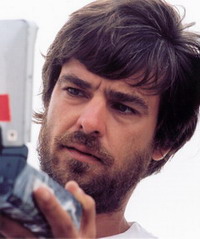
Casa de Areia / The House of Sand is Andrucha Waddington's first feature-length fiction film since his 2000 award-winning Eu Tu Elles / Me You Them (Official Selection Cannes Film Festival / Un Certain Regard and Toronto International Film Festival; and Winner, Best Film, Karlovy Vary Film Festival). It features Fernanda Montenegro (Academy Award nominee for Central Station) and her real-life daughter Fernanda Torres (Best Actress for Parle-moi d'amour at Cannes), two of the most renowned actresses of Brazil, brought together for the first time in a film's leading roles. I met up with Andrucha Waddington early Monday morning at the Hotel Adagio for coffee and conversation. I'm keeping Andrucha's broken English intact because I found it charming and uniquely communicative.

* * *

Michael Guillén: First of all, I wanted to congratulate you on winning the Alfred P. Sloan award at this year's Sundance Film Festival.

Andrucha Waddington: Thank you very much.

Guillén: Sundance has been very good to you! They initially gave you $10,000 for the development of the film, did they not?

Waddington: They gave more! They gave $150,000. It was $10,000 for development and $140,000 for a pre-buy NHK deal, that when we had the film ready, NHK bought the film for t.v. in Japan. So then it was a guaranteed pre-buy so you could count on that money for production.

Guillén: And then at this year's Sundance you won the $20,000 Sloan award?

Waddington: Yes, it was amazing! I couldn't believe that! And actually, for me it was very touching because the jury was made by scientists, and actually Antonio Demasio which is an amazing neurologist and he's a guy who studied about human behavior and I read many of his books and when I saw him in the jury, . . . I was really moved and I said, "I can't believe, Antonio, that you are on the jury; it was my dream to meet you!" And then I went to L.A. after Sundance and I went out with him and we became friends. So besides the honor to get the award, the money, I got a friend!

Guillén: That's absolutely the best perk! The Sloan Award is presented to an outstanding feature film focusing on science or technology as a theme, or depicting a scientist, engineer or mathematician as a major character. The expedition that features in House of Sand was a true historical scientific expedition, was it not?

Waddington: Exactly. This expedition was sent to Brazil by Albert Einstein to prove the general theory of relativity. He sent two expeditions: one to Africa and one to Brazil. The Brazilian one was leaded by Cromley, which was an Irish—if I'm not wrong—an Irish scientist and they made this picture of the solar eclipses, the total solar eclipses, that took place in May, 1919. Actually, the sky was cloudy in Africa so the theory was proved in Brazil by this picture. This picture was taken 200 miles from where it was shot so we did this small political … no …

Guillén: Artistic license?
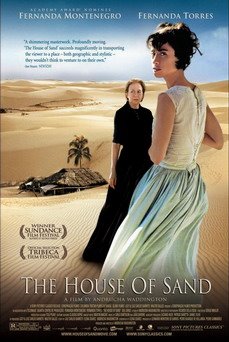

Waddington: Artistic license! And we brought this expedition to the camp of dunes and we actually saw many pictures in the research about how was this expedition, how they had equipments, because they had photographed documents about their day by day during this expedition. So we tried to recreate as it was and actually there is something that was a challenge for us because I didn't want to put dates in the screen, just in the beginning to set the audience really quick where we are, but, from this moment on I didn't want to have like, okay, 1919, 1942 written in the script, so we had to find a way to have a locator on time. We noticed that being out of society, being away of everywhere, the only connection would be from the sky.

So we used the 1910, the Haley's comet, with the appearance was really really astonishing and it's very subtle in the film, but, it's there. [The night when Aurea first arrives to her new "home", she scans the sky and Haley's comet can be seen off towards the horizon.] The solar eclipses of 1919. The war planes that used to fly during WWII used to fly from U.S. escaping from the German U-boats that was patrolling the North Atlantic. They used to fly through the north shore of Brazil and we are almost in the shore. So when I went to make a research in that place I was talking to some people that was alive in that time and living and there was no radio, no communication, no nothing, and suddenly started to fly like hundreds of planes went over their heads every day. And they said that they were really scared in the beginning and then they started to get used. But in the beginning everybody used to run and didn't know what's going on, so we took that as a locator as well. And, finally, the man on the moon in 1969. So we choose like four events that would locate in time and would connect them to the rest of the world by the sky.

Guillén: The element of time is fascinating in House of Sand. Not only did you have this direct reference to Einstein trying to prove his theory of relativity but you actually folded the theory into the film. It's a very challenging film to an audience. You're asking the audience to accept certain conventions. And one of them was this leapfrogging of the actresses over the generations. When it first happened, it was a very interesting feeling in my body because I didn't know what was going on mentally, but, I knew what was going on visually. House of Sand has a unique visual signature—quintessentially cinematic in that way—and exquisitely rendered by your stunningly beautiful desert location. Why did you choose the Lençóis Maranhenses National Park? Was it from the photograph?

Waddington: Yes, from the photograph. First I want to go back to what you said about the intelligence of the audience and to don't underestimate the audience. Yesterday in the Q&A here a guy asked me, listen, I like a lot the film, but I didn't understand why you choose this kind of time lapse. I took a couple of seconds or minutes to understand and I said to him, I did it because I don't like to be underestimated when I am an audience, so I believe that the audience likes to think and realize things and understand—not in the cut—but take a couple of seconds to understand and to read it and to think about. And I think this is something that we don't see too much in the films in these days. It's something I think the cinema was counting more the intelligence of the audience in the old times, in the old films, and here as we were exploring like—actually, it's an original story that it's almost a tale, but we tried to make it as real as it could be, but this idea to believe that the audience is capable to read, to understand, without being explained and to take their conclusions is something that I appreciate a lot when I am watching a movie. When I answered that, the whole audience was like [hurrah!], they liked it! Because it's a kind of a gift to the audience. To don't underestimate them.


Back to the photograph, how this film started, it's really odd how it started: Luiz Carlos Barreto, he's a great producer in Brazil, he was coming from a trip from Ceará, which is another environment with dunes in the North of Brazil. They have a couple of dunes around. He was in a bar and on the wall of bar was a picture of a house half-covered by sand. He asked it to the owner of the bar who was living in that house? And the guy said there was a woman who was fighting against the sand for almost her whole life and when she died the sand took over her house. He arrived in Rio and there was a party, I was coming in, he was going out, we met at the door. He grabbed my arm and said, "Andrucha, I was going to call you, because I arrived from Ceará today, I saw this picture and I was thinking on you in the last 24 hours and you need to make this film." And I didn't took too serious, I went home, and I had seen Woman in the Dunes from Hiroshi Teshihagara two weeks before and I went home and I had a dream and I mixed in the dream the image that Luiz Carlos Barreto described in color with the images from the Teshihagara's movie. So I woke up in the morning, totally in shock, then I called him, I said, "Barreto, you told me this story, I didn't took it too serious, but, it's in me and let's make the movie." So I went to his house, we spent like six-seven hours talking about how the movie could be. After this first session we called Elena Soárez, the screenwriter, to develop the original story with us, Fernanda Torres and Fernanda Montenegro, and said, "We have this idea. We will write this script for you. As soon as we have this script we will send it to you." So this script was totally written for them. Actually, when I saw Teshihagara's movie and mixed everything, the other film that made me be really strong about this story could be a great story, was The Exterminating Angel from Luis Buñuel, which talks a little bit with this idea, being in this place that you cannot leave you cannot leave you cannot leave you cannot leave. Those are films that you don't see very often in the contemporary cinema.

I was talking to Walter Salles, which is one of the co-producers, and he said to me, listen, you are really going against the current because here in Brazil now everybody is making films that's very contemporary about political statements or the day by day life, but, you are making a film that is totally against the actual current of the Brazilian cinema. I said, this is a compliment! So let's do it and I was really happy because, in the beginning, was a film difficult to … I think all the time there was a doubt how successful the film would be. The film in Brazil was very successful with critics. It was released as an art house movie with 35 prints. And it did really well for the amount of prints we released. So in the end of the day I was really happy. Now we have distribution here in the U.S., we have distribution in France, in England, in many countries of Europe, in Asia. So it's something that you never know when you make a film if it will achieve the audience and if you will be able to distribute a film and to bring them to the audience. So now I am really happy because I am here, like the film is being played in a very nice way, and the best thing is the fact that the film is against the current makes the film different.

Guillén: It is different!! Someone was asking me yesterday—because they're going to see it today; I'm also going to see it again today—they asked, "Is it a costume drama?" I said, No. I mean, It has that. For me it was almost like a very subtle piece of science fiction.

Waddington: I love it!! I love what you said. My wife, Fernanda Torres, she always say it's 2001 with no money, with no space, 2001 in terms of it's a science fiction. And she describes the film as a science fiction every time we talk about the movie. [Chuckling.]

Guillén: That's how I saw it. I saw the time lapse scene as very similar to Tarkovsky, to Solaris.

Waddington: Yes!! Which is a film that I loved. Tarkovsky is a master!

Guillén: Another movie that's at the festival this year is one out of Mexico, Ricardo Benet's News From Afar. It has a similar introduction in the sense that it has a woman who is taken to a place she does not want to go with a husband who forces her to go there and is trying to eke out a living in a place where it's impossible. Both husbands die, in News From Afar and in The House of Sand, and the women are left to discover their destinies. Were you trying to talk about patriarchy at all in Aurea's husband Vasco?

Waddington: The idea it's very simple. We talked a little bit about the foundation of Brazil. Brazil was founded—Brazil as it is these days—was founded by immigrants so we have a tripod in this film, which is, like, the runaway slaves, which was very important for the population of Brazil and there is a huge black community in Brazil that came from all the ships that brought the slaves and when the slavery was abolished they had to set their lives in a new way and, like, there was no help to establish them. They were, like, thrown to the sharks, you see? Okay, slavery is abolished, so now you have to find a way to survive. So that's why there was like the quilombos that were made by runaway slaves. They were hidden far away and a couple of quilombos lost a lot of time to understand that the slavery was abolished. So this was one element.

The other element is Vasco, which is the Portuguese, first generation, that arrives in Brazil and wants to settle a new life, to settle and starts to create a new life, and he bought that land but he was cheated, there was only sand over there. And he actually paid the debts of his wife and, by paying the debts, he had her as his wife and she had the compromise to come with him. So the women at that time used to be a kind of slaves as well. She had no way out. She could not complain. She had a deal with him. So when he dies and this is like the male kind of imposition on the women of that time, so there was like this dual slavery—slavery of the woman, slavery of the slaves—and they were two released, these two segments, the women and the runaway slaves they were, they found each other in the middle of nowhere and I think the union of Aurea and Massu tells a little bit about the next step in the Brazilian society. This was something that I didn't planned, but this is something that I can read as—because for a woman at the time to accept to be with a black man was impossible. That's why I think Aurea, it took for her ten years to understand that she was in love with Massu.

Guillén: But it shocked her daughter Maria.


Waddington: Maria was shocked by—in my opinion—by two things. First, to see her mother having sex, it could be with anyone, when you are nine years old you see that. But I think the main reason she was shocked was because her mother was promising her that she would leave that place since she was born and when she saw Aurea having sex with Massu, she understood that she would not leave any more. And, before that scene, she says to Maria, "Let's go home." And then she cut the hair. It's the first time she says "home." She says, "Let's go home, Maria." When she sees that the expedition has gone and then she walks back to the hut and she says, "Let's go home, daughter." They arrive in the hut, it's night, Aurea cut the hair, and it's like a cut to the previous life and she starts a new life from that moment on.

Guillén: People are always looking for ideal relationships. I was taught, however, that you don't need to look for relationships because you are already in relationships; you just need to recognize the ones you're in. What I saw in this movie was a landscape that was in relationship to these women. They were in relationship to the landscape. They just didn't understand that relationship.

Waddington: The mother understands first.

Guillén: First. But it took her about ten years to understand that and eventually her daughter comes to the same understanding. What were you trying to effect with that landscape? How were you hoping it would define the characters of these women or, more appropriately, isn't the landscape itself a major character?

Waddington: It's a character that brings isolation, that brings them out of the society and allows them to create a new way of living, her statement, their statements, they create a tiny little small society with their rules, with their new way of facing the world.

Guillén: But with memories too! The thing I thought was so beautiful….

Waddington: The music?!

Guillén: Well, yes, the music. But not just the music. The film is very subtle and multilayered, interconnected. True, it was beautiful that when Aurea heard the music in the expedition camp, it reawakened memories, reawakened her sexuality, reminded her of someone else she had been, could be. This was equivalent to a natural fact about the desert. Those sand dunes in Lençóis Maranhenses become lagoons when the rains come and the lagoons, amazingly, fill up with fish! Where do the fish come from? They come from the sand.

Waddington: That's right!

Guillén: Because there are eggs dormant in the sand just waiting for rain. It's like there's something there already. And in the final scene, where Maria returns to her mother with the gift of music, she plays Chopin's Prelude Opus 28, #15, "The Raindrop." I thought that was a brilliant touch! Music for Aurea was like rain for the desert; it brought so much back to life! How did the choice of the Chopin piece come about? You obviously have a very keen sense of music, I know you've worked with many Brazilian musicians . . . .

Waddington: Yes, but, I will tell you there, I will be frank here. Because there was no music in the film and then there is this gift that comes in the end. I selected like tons of cds to try to experiment. The first music we put in the film was that raindrop prelude. And when we saw it, myself and the editor, we looked at each other and said, "It will be very hard to replace. We will not find anything better." And we kept trying for months. Every day at the end of the sessions of editing we spent one hour listening, trying to find the right music to be there. In the end of the month we said, okay, it's done. And so then it was like a gift that came from casuality but I think it matched. It's a piece of a puzzle that came first that didn't allow any other piece to replace it.

Guillén: There's an organic feel to the movie that way. It does feel like it was created in process. That comes across in the film. As I was reading the press notes, I came to the understanding that the actors contributed to the film.


Waddington: A lot! A lot. Actually, in all my films, I really like, I really appreciate like I think—to have a . . . I don't believe that the director can have a vision by himself only. I think to build a film and to build up a clime of working and to put everybody in the same mood and to understand the film you are making, I think these table reading discussions are the most precious things that you can have. So always like four months before I start shooting, I start to make these sessions with the actors, and without having any problem to be confronted, to be argued, so I really open the script, okay, let's read, everybody have the right to say anything so we should, like, criticize and understand which is the doubts and everything, so session by session this makes the script more powerful because you work in the lines, you argue about the scene that is there, but why this scene is here? And when you let the actors speak—because they will live their roles—they start to really think from the inside so when you start shooting everybody knows who they are. Like the actors they are in the roles already. We understand, I think I as a director, I absorb a lot from these sessions. I think cinema is a group work. Of course, the director is the one who chooses, okay, this I like, this I don't like, this I want, this I don't want, but a film is made by many eyes. So to not use these eyes I think it's a mistake because you are losing something that could improve a lot the movie. So I really believe that in the process if you have like these readings with the actors, and with the head of the departments involved, we create something that you became like a real group that will make something all together. You create a soul that belongs to this group that is working.

Guillén: Group soul. Kind of an ensemble vision?

Waddington: Yeah, exactly.

Guillén: When you have a film like this one and your previous one which did so well in the festival circuit, as you're traveling around from festival to festival are the audiences different? Do you find a commonality among the audiences?

Waddington: Actually, the film is different! The other film was a dramatic comedy, which in a sense relates a little bit to this one, but really tiny line because I think it's a different subject. There it's a woman … the only thing that is really connected to this film is that, in isolation, you create your rules and your statements. This is something that you have in both films, but, it's two totally different films and, saying that, the reception The House of Sand is having around the world it's almost the same of Me You Them. It's so warm as Me You Them was, even not being a comedy. In like the last five minutes of the film there is three spots where the audience is totally taken and laugh and when I made the editing I never thought that people would laugh over there. And it was because everyone was relieved. It's a kind of relief that the audience feel because they understand that the circle will close. Because I think the film has something that … the film drives the audience to somewhere that you don't know where you're going to get. So the conclusion comes really in the end. And I think this makes the audience really relieved.

Guillén: It's a relief because it's an acceptance. You see the characters accept. And accept not in a bad way….

Waddington: It's a reconciliation at the same time.
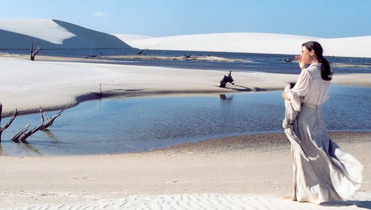

Guillén: It's a reconciliation, yes. I can live this life. I can stay with this man. I can stay in this place. And it is my life. It's a good feeling that you get from that. They're not prisoners, which I really liked.

Waddington: Yeah.

Guillén: In terms of music, the guy that you had playing Massu when he's older, Luiz Melodia, is an actual musician?

Waddington: Yes. Seu Jorge as well.

Guillén: Oh? I know you've done a documentary on several Brazilian musicians, who I love. I adore Gilberto Gil.

Waddington: I've done a documentary on Gilberto Gil. I've produced a documentary on Caetano Veloso. I'm doing a documentary now about Maria Bethania. I like to do documentaries and I don't know what I started to make these documentaries about this artists and actually music, it's something that's very interesting, and I love very much Brazilian music, so it was something that appear in my life, and it happened, it was not too planned. It was something that I just grab it and then I let it go.

Guillén: So what's coming up next? You're doing this documentary….

Waddington: Yes, I'm doing this documentary that I'm finishing right now. I have one day of shooting when I arrive in Brazil on the 10th of May, then I finish it. It will be released over there by September. And I'm starting to prepare a film called Conquistador, which is a story of the conquest of Mexico. It's the story of Hernan Cortes. This is a Hollywood gang production, which is based in L.A., and it will be an American, Mexican and Spanish co-production.

Guillén: Excellent!

Waddington: It will be a Spanish language movie.

Guillén: Well, thank you so much for your time. I'm looking forward to seeing the film again today.

Waddington: Thank you very much. I will be there waiting for you!

Cross-published on Twitch. Photographs courtesy of Outnow.

12/23/06 UPDATE: Kendall's Quest has an evocative response to House of Sand. Despite watching the film with friends who were less than enthusiastic, Kendall appreciated the film on its own merits and offered a great and pertinent paraphrase by Oscar Wilde that "women turn into their mothers: that’s their tragedy."

Kendall's final paragraph is lovely: "Would I be as moved by the film as I am, if I had not had my own adventures in the rust-red dunes of Namibia? Blinded, dazzled, and nearly overcome by heat stroke among those snaking mountains of sand, I doubted I would ever see anything that dramatic again in my life. I haven’t, till I saw this film. But the Khoisan people who live in the dunes of Namibia have the most difficult lives imaginable, foraging for desert melons and sucking precious moisture from them, pumping hours for drips of brackish water from nearly-dry bore holes, and erecting tin or plank shacks to screen out the sand, the wind, and the killing sun. Every man and woman born in that landscape ultimately makes some kind of life. That is the miracle–as Faulkner said, not that we survive but that we prevail. House of Sand raises all the attendant questions about the ways we prevail; the film pays its respects to all the people, especially the women, who prevail in the most inhospitable places of the earth. I will play it again and again in my mind’s eye."

Monday, April 24, 2006

Imagining the Real—Paul Rusesabagina: An Ordinary Man, A Clean Well-Lighted Place For Books Reading

Last Friday, April 21, 2006, Paul Rusesabagina was in San Francisco for the day, delivering a luncheon lecture at the Marines Memorial Theater for the World Affairs Council and then later that evening promoting his recently-published book, An Ordinary Man, to a capacity crowd at A Clean Well-Lighted Place For Books. I frequently attend readings at this bookstore but have never seen such a crowd! People were stacked on top of each other and lingering in crowds outside the doors. Anticipating same, I had arrived an hour and a half early and had a front row seat. Prefaced by an embarrassingly hagiographic introduction, Rusesabagina humbly took stage. Here is my transcription of his talk:

* * *

After such a speech, many times I am myself speechless. But tonight of course I cannot tell you all it is about. An Ordinary Man will explain everything in details and maybe in a better way than what I can do tonight. But I would like to share with you a few questions that many people many times do ask me.

Many times people do look at me and tell me, ask me that, "Paul, have you ever been scared in your life?" Yes. And very much. That was on April the 9th, 1994, when after the government that has been beheaded on April the 6th, a new government was put up and they sent me some soldiers to come and evacuate me from my house and take me to the hotel because they had taken over the hotel where I was the general manager and all the hotel keys for the many rooms which were not occupied the previous night when I left on the 6th I had kept them in my office. …So when they took over the hotel they had no other alternative than sending soldiers to come pick me up and bring me to the hotel.

Everything went very well until the time when we took off from my house and a mile away—not on the hotel compound as you have seen on the screen in Hotel Rwanda—just a mile away I saw those guys 20 soldiers in two jeeps, pulling to the side of the road, and all of them they had been very kind with me all over, and that time I saw everyone jumping out of the jeeps and everyone pointing his gun on my head. I knew that those guys were not joking because all along the street there were so many dead bodies. Some of them, their heads cut off. Others, bellies opened, mutilated, and yet all of those people were very well known to us. We had been staying in that neighborhood for seven years. We knew each and every one and each and every one knew us.

The very same captain who was the leader of that team just came to me and told me, "Listen you, traitor, we are not killing you today but have this gun and kill all of your cockroaches in these cars."

I looked at him and just like a few minutes ago I stayed speechless for five minutes. After five minutes of looking at him, watching him, I told him that, "Listen my friend, myself I do not know how to use guns, but, even if I knew, I do not see any reason why I could kill this old man." There was an old man, Michel, who was my neighbor. From day one of the genocide I already had 26 neighbors who came to stay in my house and when I was evacuated that day I was with them. So I pointed out that old man and told him that, "Listen my friend, I don't see any good reason I can kill this old man. Are you sure that this old man is the right person we are fighting today?" There was another young lady, also a neighbor, holding her baby, her second daughter who was three months old. I pointed out that baby again and told that young captain that, "Listen my friend, I do not think that the enemy we are fighting today is this baby who does not know anything about what is going on."

Sometimes you have to trick people accordingly, call their ego, catch that sensitive point of life. I told them that, "Listen you guys, I do understand you. You guys are hungry, thirsty, tired, stressed by this war, but such problems, we can solve them otherwise, we can find other solutions." Then we started finding other solutions and after two long hours they drove us up to that diplomat hotel and I went to my office, I went to the safe, just took some money, and paid what I promised. That day I was scared and very much.

Many times people look at me and tell me that, "Listen, you have made so many decisions. What toughest decision have you ever made in your life?" On May 2, 1994, in the afternoon the United Nation executives who had remained behind because all the UN soldiers had been evacuated and they all left town with the 2060 soldiers during the genocide. They pulled out and took more than 2000 soldiers, left us with 200. So a few executives, who were working with those soldiers, the rebels army and the regular army, the Rwandan army, had been sitting together, trying to find a way to exchange refugees, the Milles Colline refugees, with the refugees who were in the National City Stadium. The National City Stadium being controlled by the rebels and the Milles Colline by the army.

That day, that May 2, lists came out in the afternoon and all my family members' names came almost first on the list. Then that day—when my names, my family members, all of them came on that list, including myself—most of the Milles Colline refugees came to me and told me that, "Listen, please, tell us, are you really going to leave this place tomorrow?" I said, "No." "If you are going to leave this place, tell us so that we can go to the roof of the hotel and jump." Our problem was no more to die, but how to die. Were we going to afford to be tortured? Killers were coming and cutting a hand, going and coming after many hours, cutting the other one. Cutting again after some other hours, cutting a leg, torturing their victims. So they told me, "If you are leaving, there is no way we can afford to be tortured like that. Please tell us so that we can go to the roof of the hotel and jump." I told them that, "Listen, my friends, I am not leaving." No one could believe me. No one.

That night I went to sleep at a very late hour but I was a very disturbed person because I had made a decision I won't wish to make any more in my life. I had decided to send [away] my wife, my children. Where? With what hope to survive? None. Remain behind. Doing what? Nothing. Without any hopes to see them anymore. I went to sleep at 1:00 a.m. the following morning. When I went to sleep at 1:00 it was due to . . . phoning the international community, sending faxes all over the world, disturbing each and every one because in any case I had nothing to lose.

So when I arrived in the room my wife and my children were playing, not sleeping at all, but they noticed that I had changed. That change they saw it in my face. Each and every one was just looking at me but they couldn't understand. I said, "It's okay, I'm tired." Then I tried to find courage to tell my wife and children that I am not being evacuated with them. But I couldn't. Until a time when I decided to pretend that my children were not there and I told my wife that, "Listen, tomorrow you are going to be evacuated." When I said that word that you are going to be evacuated, each and every one looked at me. And in a drained voice almost they told me that, "Listen, you are saying us. How about you? Aren't you coming with us?" I said, "No. Today my advisor, my own conscience, has told me not to leave these people because if I happen to leave today and these people are killed, I will never be a free man. I would be a prisoner of my own conscience. Please, do accept. Leave and go to a separate place without any hope of meeting anymore."

The following day in the afternoon around five, I escorted my wife and my children. I just helped them to climb into the UN trucks. I saw them off. That experience itself was heartbreaking. I have never never suffered that much in my life. To see them off. I watched them leaving, the first truck, the second one, the third, the fourth. As the last truck was just crossing the hotel main gate the radio, the media, the radio was reading the names of all the people fleeing and being evacuated from the Milles Colline hotel, urging militia men to set up roadblocks, stop all those Milles Colline cockroaches and kill them. Because, the radio was saying, if you don't kill them, if you don't forgive them, they will never forgive you.

Well, those people couldn't make it for more than two miles. They were stopped, beaten to death, until a time when they started killing them and the first bullet from a militia man killed a soldier. Then soldiers and the militia men started fighting each other. Soldiers saying that, "Militia men are killing us!" That was the moment when the few UN soldiers who were driving them, who had surrendered actually and were hands up for many hours, they brought down their hands, started pulling the victims from the tarmack, throwing them in the backs of the trucks.

When they came back, my wife was not as you have seen on the screen, shouting, "Give me back my wedding ring!" She was lying flat in the back of a truck, unable even to talk and even to turn herself. I took her up to the room where she stayed for many weeks even unable to move.

Many are the times when people have asked me, "Paul, have you ever been sad in your life?" Yes. On July the 12th, 1994, just almost a week after the 100 days, the three months of the genocide, my wife, a friend, and myself decided to drive south and go to where we belonged to, our homeland. That was our first real trip outside Kigali, the capital, to see how the country looked like. All along the way, the whole country was nearing death. All along the way, there was no human being alive. All along the way, we could see only all over a lot of flies. There was no animal alive. We could hear dogs barking from the background, very far. We drove up to my homeland. When we arrived I was lucky enough—even now I call it to be lucky—because my older brother was there. I went to his house. I started asking him, "Where are our neighbors? Where is so and so?" He started telling me that, "Listen, so and so have been killed by militia men. Others have been killed by the army. Others are being killed by the rebels who had already taken over the country. Others are being burned in those houses you see burning there."

At that time my eldest sister, my younger brother, had just been killed by the rebels. My brother at a given time looked at me and told me that, "Paul, please do me a favor. Leave this place. Because if you don't, even these walls you can see have eyes and ears, they do listen to what you are saying, they are looking at you. Please, leave this place." I recall his message.

We drove down south to see my mother-in-law. When we arrived, before we arrived even, her two houses had just been destroyed. She had been killed with her daughter-in-law, six grandchildren, all of them thrown in a pit where we used to mature bananas in order to make banana juices and banana beer. That day we sat down in the wind and like young babies, we cried. We cried and we drove after a few hours we drove back to Kigali where we stayed until a time when I was almost assassinated, almost killed in September, 1996, and fled the country, went to Belgium, where I live until today. That day I was very sad.

Have we learned a lesson? To you: have we learned a lesson? All of that was taking place in Rwanda. Last year I went to Darfur myself to see what was going on in Darfur. Exactly what I was seeing in Rwanda between 1990 and 1994 is what is going on in the Sudan. Rwanda, by 1994, the day before the genocide, we had more than a million people surrounding Kigali who had fled the rebels because the rebels were inviting men for meetings, killing them; inviting their sons to join their army, killing them. So the people had been fleeing the zones they occupied. And by 1994, early before the genocide, we had more than a million surrounding Kigali, without shelter, without food, without water, without education for the future generations, for four years those people had been frustrated just like that, and when the genocide broke out they were the first ones to take machetes, go down to the streets and chop each and every one into pieces.

Today in Darfur we have more than two million people in that same situation. In Darfur there are government helicopters just destroying villages completely and a few individuals who have been just to flee the burning villages are being killed by the Jajaweed militia men on horses, again armed by a government, just like the Rwandan militia, who were just hunting us, killing many people by 1993. And the whole world is standing by, watching, and doesn't do anything. When their children saw us when we there, they just gathered and demonstrated. When they were demonstrating, they had a blackboard on which they had written, "Welcome to our guests but we need education." Is that not a shame to mankind? Have we learned a lesson?

I'll end up, wind up my speech tonight and An Ordinary Man will take over, will start far ahead of me and go farther than I. . . . Thank you.

Saturday, April 22, 2006

2006 SFIFF—"Who Killed the Electric Car?": The Evening Class Interview

The opening night gala at the Regency with its Perhaps Love circus atmosphere was truly fun! I couldn't resist my Skyy vodka martinis and you know what they say: one is too many and two is not enough! So I arrived at my interview at the W the following morning a little worse for wear but eager nonetheless to have a chat with Chris Paine, the director of Who Killed the Electric Car?, interviewee Chelsea Sexton, gas conservation expert Wally Rippel and executive producer Dean Devlin. Chelsea was overdue, having missed her flight from L.A., but was expected during my interview timeslot so we elected to start without her.
* * *
Evening Class: I wanted to preface this interview with a necessary caveat: I'm 52 years old, and I've never had a car. I've never had a driver's license. I'm not a motorist. But I was so enthused by Who Killed the Electric Car? that—if I were a motorist—I would have wanted the EV-1! Please pardon me if I sound ignorant about cars because I know very little about them but you really don't need to be a motorist to appreciate this documentary. I've been interviewing various documentary filmmakers lately and what seems to be a common theme through the work is the systematic erasure of history by various powers-that-be. The erasure of the history of General Motors' EV-1 comes across excellently in Who Killed the Electric Car?

So my first question is: An audience sees this movie, what are we supposed to do with it? What are we supposed to do with this information that you've given us? The culpability has been narrowed down and spread out among the usual suspects but what does a person do with this information?


Chris: That's a good question! Well, I would hope that people finish this film thinking, "My god, there are alternatives to my gasoline car I've been driving. There are alternatives in the way I think about what transportation is. About what kind of car I want to demand that be available to me. What do I want to do with the car that I currently own?" You don't use a car, which is fantastic, because you're obviously not going to be using …

Wally: You don't create emissions! [Laughter.]

Chris: That's terrific! I even hear about people talking on the radio this morning about $4 a gallon for gasoline and the solution is, "Well, why don't I just drive less?" That's terrific. The auto companies—and you would hope the government would [provide the incentive for] this—should really make it easier for us to use electricity to make cars go because we create that here in the U.S. Our film talks about how effectively that can work if we all put our minds to do it. It did work, in the 90s we had it, and it can come back now. The technology is not gone.

EC: CARB (the California Air Resources Board) initially implemented the Zero Emissions Mandate (ZEV) to ward off California's pollution crisis but then ended up revoking it due to compromises struck with auto industry personnel. Can the ZEV mandate be brought back somehow?

Wally: That's a very interesting question. It is coming back in different ways. We have right now the Prius, for example, and there's a lot of them out there. In many ways that's the same technology as in the EV-1 in some ways. It's updated.

EC: Is this the hybrid?

Wally: Yes, the hybrid made by Toyota. There's a lot of stuff happening. And I think it's being driven in many cases because of high fuel prices. We saw this coming. Remember when the EV-1 was done, fuel prices were much lower than they are now; but, we saw this coming. I think that things are going to happen whether or not government is involved. My concern is this: my concern is not are we going to do the right thing to save the planet, but is America going to be left behind? Are we going to watch as the Japanese do good stuff? As the Chinese move in and start doing stuff? As India does stuff? As Europe does stuff? Are we going to be the odd man out? I'm sensitive to that as an engineer. I want to be in the leadership role. I want to be a participant. I do not want to be an observer. It's like going to a baseball game if you're an athlete and watching the game and seeing people do stuff and feeling, "Hey! I could do better!" You want to be in the game.

EC: My concern—and I think it's a growing concern among people as we're becoming more aware of the current administration and certainly past administrations—is the addiction for oil justifying aggression. The other day I was listening to a news report about the oil resources in Venezuela and how suddenly we have war ships off the coast of Venezuela and just as suddenly we're finding reasons to be angry with them. The transparency of the situation irks me. Who Killed the Electric Car? premiered at Sundance? Is that correct? It was the world premiere?

Chris: It was a first screening, early cut.

EC: I understand it's still not completed? And what I saw was not a finished version of the film? You're working on sound now?

Dean: There's a couple of sound tweaks. But it's basically finished. But, yeah, there's a couple graphic cards when you saw it that are being changed and some sound pieces but by tonight's showing, we'll have the final version.

EC: So I need to see it again?

Dean: You absolutely have to see it again. And again and again. [Laughs.]

EC: As I was reading various print and online press about the film, it appears the audience reaction at Sundance was strong and affirmative. I was talking to your co-producer last night, Richard Titus, and he was saying he was very surprised by the Sundance response. Were you expecting that?

Dean: No!

Chris: No!

Dean: It was stunning. On our first screening there was a standing ovation at the end of the film and Chris and I looked at each other in complete shock. [They laugh.] It was such a fulfilling moment. I've been making films, different kinds of films obviously, for 12 years. Nothing was more fulfilling in my career than that moment. Because not only had we made something that was very entertaining, not only had we moved people but we told a story that we knew that the world didn't know that we wanted to get out. And it was literally one of the highlights of my professional career.

EC: It seems that it has fallen to documentary filmmakers to correct the adage that history belongs to the winners. Certain documentaries, like yours, cause us to re-evaluate what "win" means. At first we trust the decisions of our leaders, they seem to be for the best, but then we take a second look and realize their decisions are wrong and their histories self-serving. A.O. Scott called Who Killed the Electric Car? a "prosecutorial examination" and Grist Magazine's Dan Bree called it a whodunit in the form of a love story....

[Chelsea walks in. After initial introductions and salutations, she settles into the interview.]

EC: Chelsea, I was talking about how Who Killed the Electric Car? has been posed as a whodunit mystery but that it's really a love story. And you walked in just at that moment!

Dean: The love interest!

Chelsea: Hardly….

EC: What are you doing now, Chelsea? How have you continued on with your advocacy of the electric car?

Chelsea: I still do quite a bit of work with Plug In America which was the organization that you saw towards the end of the film. We went through this evolution from saving cars to trying to get more cars built. And so we still continue to do that. We work with policy makers and car companies and the whole point is to get these cars back on the road, to take the lessons that we learned and that are portrayed in the film and kind of keep it from happening again and also figure out how to move in a forward positive direction.

EC: Audiences have definitely been moved by this film. How do you think the American consumer is going to react to this information? Do you think they will rally to the call?

Chelsea: I think they will. And our experience has proven that they want to. They come out of each screening saying, "What do I do? Where do I go? Who do I call? What do I buy?" The whole point is to give them more of those options, it's about creating more choices about different kinds of cars for people to buy. And make them available again.

EC: Why do you think General Motors was so drastic in destroying the EV-1s? That was the emotional part of this documentary. Even though I don't drive a car, I think they're admirable, y'know? I can go to these concourses down in Pebble Beach and look at these beautiful cars of the past; I can admire them. They saved those cars! Right? Why was there such a systematic erasure and destruction of the electric car?

Chris: As we say in the film, I don't think the vested interests wanted to see electric cars running around on the roads to remind people that they're possible and they're now. They just want to take them off the road. So what do you think, Chelsea? How do you answer that?

Chelsea: I think the short answer is that the cars were their own best advertisement. The more they were on the road, the more people wanted them and if that's not the business you want to be in, having them out there and having that advertisement becomes a liability in itself.

Chris: The official reason they claimed was that there were no spare parts and that cars couldn't be kept on the road and that there was a potential long term liability because they didn't manufacture tens of thousands of these cars. But their arguments seem very circular, I mean we could talk for a long time about it. We really came to the conclusion they just didn't want electric cars out there on the roads. What do you think, Wally?

Wally: I think a lot of it deals with what the vision is. Let's suppose you were a typewriter company and it's 1975 or something, and you started a little venture with computers and a little bit of stuff with word processing and, of course, these things are more expensive than typewriters. And you really didn't believe in it but you thought we'll do this anyway, and people liked your product, and you're getting pushed in directions that just don't fit in with your typewriter plans. If you didn't have vision for computers, you probably wouldn't do those things that would move you into the present day world. And this is the big picture that I see. I see that General Motors is doing things that are hurtful, not just to the rest of us but to themselves! Look at their bottom line right now. They're losing a million dollars an hour twenty-four hours a day. Eventually it's going to end up to be some real money. So, it's lack of vision. The thing is also when you tell lies, you sometimes believe your own lies. I'll give you an example of one. In the days when the EV-1 was available, I thought I'd do a little experiment so I called up as an interested party—which I was—and I say, I'd like to lease one of these. Great. Now I have a question for you. These use electricity—I'm pretending to be dumb, of course—these use electricity and electricity is made by power plants and power plants put out emissions. So isn't it possible that the emissions by way of power plants are just as great or maybe even greater than from a gasoline car? There's silence and I said, "Do you have any information that deals with this?" No. I knew the answers! I had studied all that stuff and the answer is it's wonderful!! The benefit of an electric vehicle over a gasoline vehicle—even when you include the power plant emissions—is about 30 times better. It would take about 30 electric cars to create as much emissions as one gasoline car, and I knew that and I had all the numbers. I didn't share it with this person. But this was an interesting thing because here is somebody trying to sell a product, supposedly, and they're not using information that is in their interest. I found out what I wanted to know at that point and that is there's a hidden agenda here. They really didn't want to do this. They were pushed into it. They were trying to make some statement. But what they did in the whole process of trying to get out of this, is they never did get the vision, they didn't see what was happening in the world. And it's like the typewriter company missing what's happening. Computers are coming! We're seeing this happening overseas as I mentioned before and the American companies, I want them to succeed. I'm on the side—you might find this hard to believe—I'm on the side of General Motors! I want them to succeed! I want them to do what's right and what's right will be right for our environment and it'll be right for their bottom line.

Dean: It's interesting talking about General Motors, on 60 Minutes a couple of weeks ago they did a big piece about how General Motors may be near bankruptcy and they blamed 100% of this on their workers! They blamed it on how much they have to pay in the retirement funds and the health benefits and I thought, "How disgusting! Blame the people who built your company and not even mention that you abandoned the technology that you had before anyone else in the entire world, that could have put you on the map, that could have changed the face of your company, just ignore that and blame the workers. So I absolutely agree with what Wally is saying about the vision thing.

EC: The thing I keep getting from your documentary and it's a question I initially asked them, Chelsea, is I've been seeing a lot of documentaries where they point the finger and you see the wrong that's been done but I keep wanting to bring it back to the American people: what are we supposed to do? You named some actual advocacy groups and you think that's the way to go with this? I was interested whether or not the old zero emission standards could be brought back? If your documentary would in any way lobby for a re-evaluation of that decision?

Chelsea: Right. The advocacy is one avenue, it's one thing. It's something we came to after a lot of other things didn't work. The ZEV Mandate is actually going to be revisited this summer. There are some new hearings to try to figure out what to do with it and whether to include newer things that have come into the fray since they sort of watered it down in '03 to include things like hybrids and all kinds of other avenues. So we absolutely not only hope, but expect this film to have an impact on those hearings and on those long term decisions. And the bottom line is the consumers have got to start asking for what they want. The traditional model of the auto industry that we're going to build something and then convince you that you want it; it needs to be reversed. And the car companies have got to start building what people actually want to buy but people also have to ask for it.

EC: I was also struck in your documentary when you were talking about the advertising and you showed those commercials and they were soooooo creepy!

Dean: They were terrifying!

EC: They were terrifying! And I thought, "Why would I want to own that? I'd be afraid to be in the garage with it!" [Laughter.] Another disturbing element of the documentary is that you do place culpability on the consumer—their lack of awareness—and yet at the same time I'm curious whether it's entirely their fault for not being aware? Your documentary serves a purpose by bringing awareness to the forefront but the average consumer at that time was being bombarded with advertisements for "preferable" products that the auto industry wanted to sell. Can the consumer really be blamed?

Wally: This is such a fascinating question for us. We went back and forth because consumers really didn't have a chance to buy this in 99% of the country, you never ever heard about this, so how can we blame them? It's a close call, but, we decided that those consumers that knew about it amongst our friends, friends of ours who are still very close friends, who may even have hybrids, they made the call that said, "You know what? I need to wait and see." They made the call to say, "I'm going to go with what I see advertised on television." And I think sometimes of Ralph Nader who says, yes, we're all consumers, we should be chasing the best deal for our dollar, we should be maybe getting what the Joneses have up the street, but we're also citizens and we can also say, "Advertising is just advertising. What product really corresponds with my values? What do I want for my vision of the future?" And that requires that we step outside of advertising. I don't mean to soapbox here, but, we decided in the end that consumers are part of the solution. So since the electric car was killed, we're all in this together. And we all need to work together to get out of the situation we're in now.

Dean: There's also the … what was going on at the time. It's a very different world today. Chris and I were talking about this just this morning. If these same things were coming up today as opposed to ten years ago we think the results would have been very different. The consequences of not embracing this kind of technology is much more apparent today than it was at the time for the average consumer.

Wally: Hurricane Katrina….

Dean: When you have hurricanes, and the threat of global warning is palpable now when before it was theoretical, the war in the Middle East where people are dying all the time and it's directly related to our addiction to oil and, frankly, just gas prices! If nothing else, if we had gas at $4 a gallon back then I think the consumers would have reacted in a way that they didn't then. They didn't need to as much. And if you watch how the sales of the Toyota Prius have skyrocketed, it says that consumers can make a big difference. So while it was very painful for us to make the decision to include consumers as part of the guilty party, the fact is to see how much they've done to help the hybrid car, shows what they can do in bringing back the electric car.

EC: Another documentary that's screening at the festival this year is out of Argentina—The Dignity of the Nobodies—I don't know if any of you have seen that? It was another one that really impressed me because here you had the collapse of an infrastructure and basically people voted with their feet, they walked away from the ways they had been taught to complain about something. What I liked about your documentary—along with its exposé of the systematic destruction of the EV-1—was its positive tone. That's why I keep repeating the question: what do we do? You're showing us this, you're giving us hope that we can do something, y'know? I love that you interviewed Phyllis Diller!! How did you get Phyllis Diller; I gotta ask this! [Everyone laughs.]

Chris: We were mixing our sound for the movie and we're in a little room in the back, the documentaries get a special closet at the back of a real sound stage, and we heard the laugh—Phyllis Diller's laugh—in the other room. I thought, that can't be the real Phyllis Diller in this building, I'm going to go over there and find out. So there she was and she was doing a voiceover for an animation series. And she said, "Now what are you doing, young man?" I'm 45, but, I'll take that. We're doing a documentary about electric cars. And she says [doing his best Diller]: "Electric cars?! I drove in one as a little girl!" So I think that's when I called Dean up and said, "Do you have any money for us to go out and film Phyllis at her house?" And Dean goes, "What?!!!"

EC: Hilarious! Which also makes me ask you, Dean, my understanding is that you created the first web site for a movie?

Dean: The first official movie website. In other words, this was back in 1994, and for most people the Internet was still a pretty new thing. There had been fan sites that had come up to support movies but no studio had ever embraced the Internet and done an official website for their film. So when we did the film Stargate, I was having a lot of frustrations with the marketing people at the time, because they wouldn't do the things I was hoping they would do. So I said, "Can I have the Internet? They said, "The what? Sure, it's yours!" And so we put a team together and we created the first movie website.

EC: That's really cool. Wally, you addressed an issue I was going to ask about emissions from the power plants. Another complaint I've heard about the electric car is replacing the batteries, that it would be very expensive: is that true?

Wally: Well, of course that bridge has already been crossed. People are driving Priuses. The battery technology that's developed in the Prius, the nickel metal hydride battery is in California being warrantied for 150,000 miles. The Prius is a little bit more expensive to buy than a conventional vehicle, you're talking about a 10-15% cost difference and the fuel of course you're saving. So when you go through all the numbers at a $1 a gallon for gas, you're right, the Prius does cost more. But gas doesn't cost $1 a gallon, it costs $3 a gallon right now and the arrows are all pointing upward. The bottom line is that there's been a lot of progress on one hand. We're going to see two years from now the Priuses being powered by lithium batteries rather than the nickel metal hydride and we have some spy people telling us that the Priuses are going to have—at least some of them—will have the option of being plug-in vehicles so that instead of getting just 50 miles per gallon, you'll be able to get well over 100 miles per gallon by mixing the electricity in with the gasoline.

EC: Well, I'm going to wrap it up because I know someone else is coming in. Thank you so much for your time. It's a wonderful project. I think you're on Oscar track. I'm serious! Thank you very much.

Chris: Thank you for spending time with us!

Wally: And don't buy a car!!

Cross-published on Twitch.

Tuesday, April 18, 2006

Phillip Lopate—Mikio Naruse and "Wife! Be Like A Rose"

Earlier this year the Pacific Film Archives ran the touring Mikio Naruse retrospective organized by James Quandt of Cinematheque Ontario. I caught two—Flowing and Floating Clouds. I very much enjoyed the drunken geisha dance in Flowing—it made me laugh outloud in delight—but despite my best intentions, during Floating Clouds I felt like an animal caught in a trap willing to gnaw off his foot just to get away!! I didn't return to see any of the further entries in the Naruse restrospective and I felt guilty about it. What kind of film commentarian had I become that I couldn't learn to appreciate Mikio Naruse?!

So when as part of its Readings on Cinema series PFA recently invited Phillip Lopate to speak about his new book American Movie Critics: An Anthology From the Silents Until Now and offered, further, a screening of Mikio Naruse's Wife! Be Like A Rose with Lopate's introductory remarks, I thought, "Okay, we will try again."

After discussing his anthology and entertaining questions on it for a bit, Lopate turned to the screening at hand, offering just a little bit about "Micky" (as he affectionately calls Naruse) and a few things about Wife! Be Like A Rose. "Having gone through two entire series of Naruse films, first in the 80s and then more recently," Lopate commented, "I'm struck by how—this is the worst word you can use about a filmmaker, but I'm going to use it—how literary Naruse is. How his films feel like novels. He himself had wanted to be a novelist, to study literature, but because of family problems, money problems, he had to drop out [of school] and become a prop man in a Japanese studio." Naruse's interest in writing persisted, and in Wife! Be Like A Rose, for instance, one of the characters is a haiku poetess.

Another Naruse film, Anzukko, is also about a writer, a poet, and Lopate discussed the wonderful "collaboration" Naruse had with Fumiko Hayashi, a great Japanese woman novelist and short story writer. Actually, Lopate qualified, they hadn't really collaborated, she had written all these books, and Naruse just adapted one book after the other; Hayashi had already died before the first film was released. But Naruse was always very interested in the woman's point of view as well as literature. Lopate praised Naruse's beautiful adaptation of Yasunari Kawabata's Sound of the Mountain. As the PFA notes for the touring series highlighted: "The novelist Fumiko Hayashi was his favorite source for plots epitomizing his own vision that modern women are offered only illusory freedom. Audie Bock, who championed this relatively unheralded director years ago in her book Japanese Film Directors and in a monograph, writes of the 'condition of trapped awareness' in Naruse's women. It is this awareness that gave actresses like Hideko Takamine, Kinuyo Tanaka, and Setsuko Hara a chance to show their depth."

"One of the things I love about his movies," Lopate offered, "is that they edge away from redemption, they refuse transcendence. In that, there is also something kind of novelistic. Sometimes the endings have something inconclusive about them, not always. Audie Bock has said that there are no happy endings in Naruse but there are some incredibly enlightening defeats."

But, Lopate quickly added, Naruse also had a comic streak, one might say a wise streak. Lopate explained that sometimes people write about Naruse and they use words like "bleak" and "pessimistic", but when he watches Naruse's films, he's "always enlivened" and doesn't experience Naruse "as a downer." Partly because Lopate does think there is this odd sense of humor in Naruse wherein he shows how people want something. Naruse himself said "people move a little and then they hit a wall." They want something, Lopate amplified, Naruse "shows them wanting it, he shows them deluded that they can get it, then he pulls the rug out from under them. There's something kind of comic in their sense of denial but also in their stoicism and in their resilience. In many ways Naruse characters have a great deal of dignity because they don't expect happiness, but they keep plugging along." Wife! Be Like A Rose is probably lighter and more intentionally comic than most of Naruse's films, something of an anomaly. "And you should know that he married a young ingénue after the film," Lopate told us, "and had a miserable marriage. It really fed his art, y'know."

After the film—which I rather enjoyed!—Lopate returned to the podium and quipped, "Did I say that was a light film? Questions? Comments?"

He was asked if he knew if Criterion was going to be putting out any of the Naruse movies on dvd? Lopate responded that he had been urging them to. "I've done a lot of work for Criterion over the last few years. And I know that it's in negotiation. I would love to see a box set of Naruse." He announced that he would be doing the commentary for Sound of the Mountain, but through another company. Criterion is very aware of Naruse, however, and negotiating for the box set.

Lopate added: "This movie, by the way, was made in 1935. Part of the charm of it, for me, is that it's right on the cusp between silent and sound. You have that strange whirring noise of the microphone starting up."

Lopate was asked to say something about Naruse's directorial style, how he gets such sensitive performances from his actors, and to also say something about Naruse's involvement with the set direction?

"As I said in my essay about him," Lopate answered, "he doesn't have a signature visual style that's very easy to pinpoint in the sense that Mizoguchi has the flowing tracking shots, or Ozu has the tatami mat shot [sorry Acquarello, just reporting!] or Kurosawa has this kind of vigorous energy. His films are very often interior but, as you can see, he opens them up, there's usually a sense of the city life in his films. He wants you to feel that people, as he said, will hit a wall quickly so there's always this feeling of the narrowness of the interiors, the narrowness of the alleys. As far as his directing of acting is concerned, I think he really was interested mostly in the psychology of character, it's his dominant interest. Hideko Takamine—who is the great Japanese actress who worked with him so often—said that he didn't give very much instruction at all. She asked him, 'How do I play this role?' and he would say, 'It'll be over before you know it.' " Lopate's audience laughed. "Which reminds me a little bit about that story of Ingrid Bergman talking to Alfred Hitchcock, asking, 'What do I do? How do I find my motivation?' And Hitchcock said, 'Ingrid, it's only a movie.' " More laughter.

Returning to the question at hand, Lopate continued: "Naruse was silent and glum. He wasn't like Lubitsch who imitated the way that every line was to be done. He didn't give direction. He chose actors who he trusted. That's why he had to have a crew of people that he could depend upon, a troupe you might say—like Hideko Takamine . . . and those people—and once he chose you, you kind of floundered around until you found the part. My sense is that by withholding instruction he forced the actors into a sense of their own solitude and into their desperation that was so important to the Naruse vision of life. I think he gave off a force field that was very Narusean and if you came into contact with it, you understood." Lopate suggested that the solitary poet at the end of Wife! Be Like A Rose was, in a way, a stand-in for Naruse.

Lopate further pointed out: "But there's also that beautiful daughter looking at her mother, which is very similar to the ending of Mother, of Okasan. The child trying to understand the parent. Filled with sympathy and knowing that there's always going to be this divide between parent and child."

Lopate concluded: "What I love about this movie is this sense—and in Naruse in general—that people can only do what they can do. They're not superheroes. They try but, y'know, life breaks them in certain ways. They're not evil. They can only do what they're going to do."

One fellow in the audience stated that he had heard Naruse was something of a cad toward women, which was surprising given Naruse's sensitive treatment of them in his films. Lopate was asked if he had any information on that.

"I don't think he was a cad to women but I wasn't under the bed, so I'm not sure," Lopate answered. "There's a story which I put in my essay about him. He would go out to eat in restaurants, usually working class restaurants. Even though he was a director, he didn't make that much money. Most of his social conversation was reserved for the waitresses who brought him the food and there was one waitress who was in love with him and he did not reciprocate her infatuation and she committed suicide. I don't know if that's being a cad. He was just being typically silent and withdrawn. Which will drive some people—not just women—crazy."

Another fellow likened the thumbing the taxi scene in Wife! Be Like A Rose with Capra's It Happened One Night. He wanted to know how a Japanese audience would have understood that reference?

"The Japanese directors of that period of the 30s," Lopate responded, "were very interested in Hollywood movies. All of them were watching Capra and Ford and early sound films. Sound came in later in Japan than it did in most countries. But there definitely is a Capra-esque feeling here. If he didn't see It Happened One Night, he surely saw somebody thumbing a ride. But I think it was It Happened One Night."

"What is and was Naruse's reputation in Japan when he was making the films and now?" one woman wanted to know. Lopate stated: "Wife! Be like A Rose was pretty much the first Japanese film that was released in America that showed in New York. It was a popular film." At first Naruse was making a lot of movies for the same studio that produced Ozu and they said, "We don't need two Ozus here." Even though his films are very different from Ozu, he was considered "the poor man's Ozu."

"One thing he was able to do," Lopate described, "was to bring in a film on time and under budget. So he basically continued to make films even in bad times. Of course, World War II was a terrible period. But, once he hit his greatest period, which was the 1950s, then I think there was much more of an appreciation." During the early 60s when a package of Japanese films toured America, When A Woman Ascends the Stairs was included, so even then he was considered an important Japanese director. "I think now he's still considered one of the big four: Ozu, Mizoguchi, Kurosawa, Naruse. I don't think he was ever hugely popular but he was respected."

Lopate was asked to speak about the influences and inspirations on Naruse's editing process? He offered: "Kurosawa thought that Naruse was the master editor. Kurosawa compared it to a strong river current that's taking everything. He'll do some movements with the camera, he'll do very short shots sometimes during long dialogue scenes. But he keeps you off balance I feel like, y'know? He keeps you questioning, y'know? Instead of resolving things, his editing is often forcing you to think about something. That's also where I feel he's like a novelist who's commenting on something, with the way he edits a scene. Puzzles. You feel this question mark. In this particular film, for instance, it's all about shifting sympathies. Who's going to get the major sympathy? And in the end, of course, everybody is fairly sympathetic. And he can only do that by this kind of destabilizing editing system."

08/21/07 UPDATE: At Rouge, Kiyoaki Okubo conducts a fascinating reception study of Wife! Be Like A Rose when it was shown in New York’s Filmarte Theater under the title of Kimiko. It was the first Japanese sound film to be shown commercially outside of Japan and didn't fare too well.

Saturday, April 15, 2006

SFIFF49 2006—The Dignity of the Nobodies (2005)

The U.S. premiere of Fernando Solanas' The Dignity of the Nobodies (La dignidad de de los nadies, 2005) is being presented at the 49th edition of the San Francisco International Film Festival in association with the United Nations Association Film Festival and Global Exchange. The second in a projected series of four documentaries dealing with the plight of Argentina, The Dignity of the Nobodies is—as Miguel Pendás pens for the program catalog—"activist cinema at its best: passionate, informative and uncompromising." Pendás concludes: "The film's power and immediacy make it feel like a hopeful forecast of things to come."

Imagine! A documentary that testifies to hope!! The Dignity of the Nobodies has arrived on these bleak shores none too soon.

"It was hard to imagine," Solanas writes regarding the genesis of the documentary, "that the small women farmers, ignorant of banking or political affairs, would be able to organize a vigorous and original resistance movement confronting banks and stopping over a thousand auction sales. The neighborhood or community soup kitchens, community clinics, bakeries and other social initiatives created by the neighbors to give an answer to poverty and hunger. The dozens of silence marches staged by relatives of the victims of police mafias which managed to unmask the murderers and send them to trial. The factories revived by their former workers showing that under self-management and without the hierarchical structures of managers and foremen, they could produce with efficiency and quality."

All these "stories" are passionately recorded in The Dignity of the Nobodies and any American—fearful of where our so-called leaders are taking this country—should become cognizant of these grass root strategies and project their own future involvement into them.

Where a feature film like
Obaba creates a narrative fiction out of the documentary process, Solanas inverts the assertion: "The Dignity of the Nobodies is not only testimonial cinema, it is not fiction either. It starts from reality but uses procedures from other genres, and on telling characters' facts and stories it approaches fiction. In The Dignity of the Nobodies I tried to fuse genres, to approach real facts to narrative stories, to use procedures of the documentary together with those of fiction or of essay cinema. Its narrative structure resembles that of an open book with tales, chronicles and stories, looking for the testimonial to blend with the poetic, the essay with the testimonies, and the characters with life. The idea of the genres has been reversed and the limits between fiction and the documentary cinema are difficult to specify."

Whereas I was entertained by the stately whimsy of Obaba, and its play on who is seeing who, it remains a philosophical reverie on structures of memory, an artistic construct I can look at, enjoy, write about, and ultimately dismiss. With The Dignity of the Nobodies, however, memory and the documentary process forge a progressive alliance, engaging me at a deep level. "The tragedy," Solanas explains, "pushed me to preserve memory against oblivion." These stories are not philosophical musings; they are practical stratagems for survival! Here, voting is accomplished with the feet, with action, and not by passive cooperation with structured party politics. Here, Basta! Becomes a rallying cry. Enough! Enough.

But it is precisely by his bringing the resistance down to personal testimonials that Solanas has achieved universality and solidarity. Each character—Martin, the writer delivery-rider, Toba the teacher, Antonia and Chipi who run the poor soup kitchen, Margarita and Colinche who provide for their children through scavenging and gleaning, Silvia and Carola in the public hospital, Lucy who organized farmer wives against the banks' auctions of their farms, Dario martyred by the police mafia and Claudia his fiance, Gustavo, the young priest turned social reactionary—are introduced via
coplas, which have their origin in the 19th century payada. The payador was the chronicler gaucho who traveled through the pampa passing on the news in verse to the music of his guitar.

I was entertained by Obaba; but, I was profoundly moved by The Dignity of the Nobodies. A must-see at this year's festival!

2006 SFIFF—Obaba

As Julio Cortazar is one of my favorite South American writers, Antonio Machado remains my favorite Spanish poet. One of my favorite poems of his reads:

The eye you see is not
An eye because you see it.
It is eye because it sees you.

In gist, this is the lesson any documentarian must learn when they turn their camera onto the world, the selfsame lesson that Lourdes (Bárbara Lennie) has to learn, arriving in the small Basque hill town of Obaba equipped with a videocamera, intending to satisfy a school video assignment by recording the history of this small community. And Lourdes learns her lesson: you can't catch fish without getting wet.

Willis Barnstone, reflecting on the above Machado poem in his book of translations Antonio Machado—Border of a Dream: Selected Poems, writes: "[Machado] tells us that the eye of the other already is, and not because by perceiving it you render it living, but because it is there waiting to come into more apparent being by seeing you. In waking you to its being, it gives you life. And you are companions. Like the world, the eye is on its own. And the world and the eye will go on being, when you are darkness." (2004:xix)

This is the marvelous symbiosis achieved by Montxo Armendáriz in Obaba. Self and other, the documentarian and the documented, create the double helix of identity. It is in equal measures mysterious and revelatory, much like a mask serves to conceal and reveal. The past and the present, childhood and adulthood, walk down the cobbled street hand in hand, counting steps (and time) as they go.

As I mentioned in my write-up of Alica Scherson's Play, the worlds created by magical realism are more alternate than other. If narrative shift can induce a new world, then surely memory can do the same, being perhaps the original narrative shift? As Jonathan Holland writes in his report to Variety from the Toronto Film Festival, Obaba "unlocks the past to study its effect on the present, with results that hauntingly jog things out of familiar perspectives." For it is the story we tell ourselves about our own lives that ultimately creates the fictional construct we call identity, and if the story is continually adjusted, accommodated, all the more to prove that identity is fluid, a continual process more than a static state of being. Lourdes repeatedly prefaces her self-inquiries and her examinations of others with the phrase "quiero decir que" ("what I mean is"), which underscores the thirst for meaning inherent in every story. Exact words become substituted by alternate meanings and we understand ourselves (and others) more by approximation, than definition.

Obaba is structured as a series of flashbacks—three to be exact—which account for the presences and absences of key characters in Obaba. Holland synopsizes them well in his Variety review. Why have some remained in this small provincial town whereas others have traveled away? "You can live anywhere," the film attests, "if you're happy on the inside." Interiority becomes a key piece to the puzzle. Where does insanity come from, Lourdes asks the hostel keeper Ismael (Hector Colome), who promptly responds that it comes from the same place as hate, as reason, from within. Ismael is a subtle character in the film. He is the first Lourdes meets on her way to Obaba, encountered at night on a bending road with a lizard firmly in his grasp. He runs the Lizard Hostel, behind which he raises in a shed what might be considered hostile lizards, reputedly able to crawl in through the human ear to feast on their favorite delicacy—the human brain. Allegedly he has made his best friend Tomas (Txema Blasco) a deaf simpleton by putting one of these lizards in his ear. Or at least that is the accusation of Tomas' sister Begona (Inake Irastorza). Or is it simply that she is bitter over spurned advances from when they were children? In one of the final scenes of Obaba it becomes clear that the wounds of childhood fester into adult consequences. What is inside will find its way out. As Miguel Pendás writes for the festival program: "The people of Obaba are trapped in the past, telling stories from their childhood that involve one another in a complicated web of feelings and relationships."

One other thing he writes seems spot on: "Perhaps we were meant to realize that our technological gadgets are incapable of seeing the essence of reality, and that the only way to really know the world is to surrender to its beauty and mystery." The lens of the video camera by which we enter this accomplished film—and which might be thought of as Machado's eye seeing the subject eye—has (as Machado implies) its inherent limitations. This is poignantly examined when Lourdes reviews her tapes to determine if a lizard has entered her ear. Just when she thinks she is going to discover the answer, the camera fails her.

But for the documentarian it is not only the lens of the camera that has limitations, but the process of editing itself; the eye of the editor. Lourdes' inquiries, predicated on a class assignment and committed to videotape, are brought back into the class room where her instructor advises that now is the time to take the compiled footage and edit the images, to give them whatever meaning she deems appropriate. Reality, he teaches her, is not unique and transparent, but rather multiple and complex. Quoting Balzac, he says that life does not make perfect stories but a novelist can.

Lourdes seems to reach an awareness, however, that what is imperfect in humans is exactly what is essential about them and she begins—not to shape stories—but to allow them to tell themselves. She suggests that what is irresolute about human nature might be that which makes a person happy inside. And once you're happy inside, as we now know, you can live anywhere, even in a quirky provincial little town like Obaba.

Friday, April 14, 2006

2006 SFIFF—Play

As I mentioned in my write-up on En la Cama (In Bed), Jorge Morales' FIPRESCI report from the 2005 Havana Film Festival includes a deconstruction of the so-called Nuevo Cine Chileno, and culls out that what's actually being discussed are three distinct Chilean features making the festival rounds at the same time: Matías Bize (In Bed / En la cama), Alicia Scherson (Play), and Sebastián Campos (The Sacred Family / La sagrada familia).

Acknowledging that Scherson won the Debuts section of the Havana festival (Scherson also won Best New Narrative Filmmaker at Tribeca), and admitting that Play "is probably one of the best crafted of all recent Chilean productions" with cinematography "remarkably executed in a High Definition digital format" and "outstanding" sound and shot composition, Morales then asserts that all this excellence does nothing more than "support a naïf babbling, a sort of urban magic realism in which Scherson seems to be more concerned about making the most superfluous details seem exotic than of telling a story with a minimum support. The calculated idea of accentuating the color palette—with no further sense than embellishing the image—the fact of acutely working the sound but without giving it an expressive value, give away the questionable wish to surprise, of shyly impressing instead of moving, of making rhymes but no poetry."

Naturally, poetry is an extremely personal matter. Some prefer their Robert Frost. Others their Juan Ramon Jimenez. Some prefer their poetry dramatic and compelling. And others look up from the page shyly impressed, their forehead on flight.

When Doug Cummings "discovered" Play earlier this year at the Palm Springs Film Festival, he was "dazzled" by "its formal ingenuity, infectious spirit, and profound humanism." Sensing more poetry than rhymes, Doug evoked: "While the movie exhibits an indulgent playfulness, unlike most contemporary films, its stylistic witticisms increase our emotional connections rather than decrease them. More tantalizing than ridiculing, more Jacques Rivette than Jean-Pierre Jeunet, the film celebrates the way personal curiosity and anonymous compassion can inform and enliven modern, urban lives."

Doug's enthusiastic guidance convinced me to give Play a second chance. I had seen it on screener tape and hadn't been drawn in—as often happens when I'm larger than the screen—but Doug suggested I watch Play projected big at the press screening and, as Susan Sontag has defined, I was "kidnapped."

My enthusiasm was shared by Chris Knipp, who attended the same screening, and who found it "extraordinarily accomplished" and "delightful" as well as "rich" and "delicate". "If Play seems to be about 'nothing,' " Chris opines, "look again. Antonioni's L'Avventura and Fellini's La dolce vita were about 'nothing' too. Scherson has modulated Antonioni's boredom into bemused loneliness and Fellini's wealthy idleness into a twenty-first century urban anomie of easy meetings and easy separations."

Since, along with Cathleen Rountree, Doug and Chris have both skillfully synopsized Play's storyline, I'm free to meditate on what impressed me most about the film: its comment on how class is always greener on the other side, its sound design and its gentle inflection of magical realism. As a great lover of Latin American literature and film, what I have come to appreciate over the years is that the worlds created by magical realism are not other worlds distinct from our own, but alternate worlds that share many qualities with our own, often indistinguishable, until something happens—a moth flies out of a rejected man's mouth, for example, and circles around a young woman observing him from across the street; a young woman who understands his loneliness.

For it is precisely in observation that the alternate worlds of magical realism can best express themselves. These expressions can be made so fantastic and over-the-top as in Like Water For Chocolate, or rendered as storybook illustrations like in the starry skies of Viva Cuba, or rendered as simple and nonsensical as dreams that appear to have no importance in waking life. Dreams play a big part in Play. But that's not to say they add much to the plot. Butter melts in the timelapsed sun. A black chick pecks breadcrumbs in the dreamer's shoes, along with his yellow brethren. A mother dreams her daughter gives birth to a chicken. The dreams of night don't seem to matter as much as the dream of fitting in among others in a new place or the dream of configuring a new identity and letting go of an old one.

Alicia Scherson allows the urbanity of Santiago to contain the crisscrossing dreams that don't make any sense, stitching together alternate perceptions of a shared reality, or rather, layering them. The cinematic texture of Play is one of many polyvalent layers. Its weave is nearly hypnotic. Watching Play a second time (which it definitely warrants), I caught so many connections and transitions lost in my initial, confused anticipation.

I love how Scherson uses sound to indicate alterity. Martial art moves practiced in front of a mirror resound with chopsocky swish. She'll show a boat on the shore and you hear seagulls and waves. She'll show a photograph of a nearly-extinct Amazonian tribe in a National Geographic magazine, and you hear their chanting, their drumming. You are, in effect, in two worlds. One of representation. One of evocation. We perceive things not only by how we see them, but how we hear them. And so she plays with the separate universes that individuals live in, determined simply by the shift of one Ipod to the other. I loved the scene where Cristina (Viviana Herrera) and Manuel (J. Pablo Quezada) kiss for the first time, each listening to their own music.

Curiously enough, when I first watched Play at home on screener tape, I watched it along with Underground Game, a cinematic riff on a Julio Cortazar story. I adore Cortazar, of course, I consider him a master of modern fiction because he repeatedly demonstrates that narrative shifts in and of themselves alter perception of reality and, thereby, create alternate worlds. And both films—Play and Underground Game—involved a somewhat necessary stalking or pursuit of one individual by another. One of the fun thrills of any kind of festival or retrospective is the chance cluster of themes that seem to gather movies together within certain circles of perspective. In Dignity of the Nobodies, as an example of a simple man standing up to the police state, another short story of Cortazar's is mentioned, "The Pursuer", wherein a man—who believes he is being pursued—eventually comes to the understanding that he is the one in pursuit. There's something of that resiliency in Play.

As if knowing that she needs to become a nurse for someone new, Christina finds herself someone lonely to care for. And the final shot of her observing Santiago from the hospital rooftop confirms her eye for detail, especially when it involves her future. Variety's Ronnie Scheib writes: "Final scene finds [Christina] high atop the city whistling in the wind as the camera pans over Santiago to end on her face, a very 21st century, feminine version of Balzac's intrepid Rastignac surveying the Paris he vows to conquer." Scheib further attributes the same eye for detail to director Scherson, stating: "Director Scherson tells her story in jigsaw-puzzle fragments—her camera focuses with equal interest on a section of tie or a character feeding rose petals to a rabbit. The devil, they say, is in the details and Scherson has a sharp eye for the telling minutiae and everyday surrealism of Santiago's streets. Moments and objects carry a charge that has little to do with plot, or perhaps are the plot."

My final agreement with Scheib is that Play "has less to do with romance than with class and how the other half lives" but Play's "all-pervasive class consciousness manages to be both gently empathetic and wickedly ironic."