If you're a director searching for a low-cost solution to filmmaking, what could be better than limiting your film to one actor and one location? Of course, eschewing the bells and whistles of modern cinema means you better have a pretty fantastic script to back it up: it has to be entertaining simply through its storytelling. Director Rodrigo Cortés has hit the jackpot with Buried, a film with a story so stark it could almost be a play.
Paul Conroy (Ryan Reynolds) wakes up in darkness. He flicks on his Zippo lighter and finds that he is inside a coffin, under the ground. An American truck driver delivering supplies in Iraq, the last thing Paul remembers is his truck being attacked by a group of Iraqis with automatic rifles, and now he's here. His phone rings—except it's not his phone, it has Arabic text and terrible reception—but he does what anyone in the situation would do: he starts making calls. But between the bad reception, being put on hold and getting answering machines—the things that tick you and me off in everyday life—have become the difference between life and death for Paul.
 I hesitate to reveal any further twists, but be assured that the suspense moves quickly and organically. Cortés builds layers of ticking bombs—the phone's battery life, the oxygen level in the coffin, etc.—and by the end the tension has ratcheted to near-unbearable levels. The inherent claustrophobic nature of the coffin itself is enhanced by the seemingly infinite threat of darkness that wraps around Reynolds' body, licking menacingly at him with shadows created by the Zippo.
Reynolds himself was something of a revelation to me; I suppose I haven't been paying enough attention to his transformation into a thoroughly fine actor. I've seen a number of his films, but here he plays Paul as a believable everyman who finds himself caught up in the bureaucracy of war, and that comedic timing he's known for is a godsend in easing just enough of the tension to allow it to continue to build. But it's in the moments where Paul's frustrations reach their limit that I found Reynolds most relatable. He's asked to single-handedly carry the film and it's a pleasure to see that his charmingly one-note performance from Van Wilder will not define him forever.
 It remains to be seen whether Buried can break out of the "indie" box in which it finds itself (pun noted, but not intended). Although releasing through horror giant Lionsgate, the single-location novelty is a double-edged sword for a broader public, who may find the phone calls repetitive and action-less, and be disappointed not to see more of Reynolds' comedy or a big action scene. The film is comparatively small when stacked next to something like a Saw sequel, but it is definitely not an experimental work and its aspirations lie squarely in the realm of entertainment.
Buried is the epitome of a good idea well-actualized. Variations on the story have been done but here the focus is solely the man and the coffin, and never straying from that core focus is a bold move. "Hitchcockian" is a term bandied about far too freely these days, but I do think it's the sort of film that the master of unyielding suspense would love. Buried certainly would have made a damn fine episode of Alfred Hitchcock Presents.
Cross-published on Ornery-Crosby and Twitch.
 Distribution possibilities don’t allow me to give an outright review, but I thoroughly enjoyed this successful overview of the American horror film. Visually, Andrew Monument's Nightmares in Red, White and Blue (2009) [official site] resembles one of those TV docs that pop up around Halloween time, counting down the scariest moments of what-have-you, but while those programs want only to be top ten lists of memorable movies, Nightmares takes it a step further by contextualizing those successful scares. More than any other film genre, horror is an industry that has grown along with its viewers, adapting to what makes its audiences afraid—World Wars, genocide, government paranoia, etc. Even trashy film can be a wonderful chronicler of the human experience, directly or indirectly, because it will always be a product of the times in which it was made. With talking heads from horror bigshots like John Carpenter, Wes Craven, and George Romero and narrated by Lance Henriksen, I have to say: I took a class on the horror film in college and Nightmares is very much a condensed but equally insightful version of that information, for thousands of dollars less in tuition.
Cross-published on Ornery-Crosby and Twitch.
 Future X-Cops (Mei loi ging chaat, 2010) is a paint-by-numbers, sci-fi action flick that's doing gangbusters in China but is unlikely to make it past the bargain bin here in the US. The reason for its success abroad is simple: Andy Lau is one of the world’s biggest superstars. They used to call him the "Chinese Tom Cruise," but I think Lau's publicists would prefer to steer clear of that comparison these days. Still, it's hard not to compare the relative slump the two stars find themselves experiencing in 2010, with Cruise's Knight and Day pulling in the smallest opening weekend in 15 years for the one-time sure thing, and Lau slumming it in Future X-Cops. A possible thread regarding Lau's intentions here leads to his relationship with director Jing Wong, who coincidentally directed a film called Future Cops with Lau back in 1993. That film was a Street Fighter parody with no relation to Future X-Cops, but the possibility remains that this is a case of old friends scratching backs. It better be because, contrary to what X-Cops would indicate, Lau is not usually this bad an actor.
Here are the numbers Lau and Wong paint in Future X-Cops: In the year 2080 the world has been saved from an energy crisis by a scientist who has invented a giant shield that envelopes the earth and soaks up solar rays. The loss is so devastating for the energy companies that they create a team of cyborgs to assassinate the scientist by going back in time to 2020 and stopping him from ever inventing the solar shield. Super-cop Kidd Zhao (Lau) travels back as well, to protect the young scientist and to seek revenge for the loss of his own wife.
 It's a simple set-up and, although it bars the film from bringing anything terribly original to the plate, it could still be a good time. After all, I cannot count on ten hands the number of horror films that tread familiar ground and still emerge as pieces of relevant cinema. But X-Cops unfolds as you would expect, with some broad humor and a misty-eyed love story, hoping to cover all the bases. As a sci-fi fan, the film's worst insult is that it relies on visual effects and I've seen better CGI in pictures 10-years-old, including a few Asylum pictures(!). I considered enjoying X-Cops on the level of camp but found myself incapable of submitting to an experience that never decides whether it wants to be funny, thrilling or romantic. A somewhat novel scene at an amusement park did cause a smile, and bad guy Kalon is played seriously by Siu-Wong Fan of Ip Man (2008) and Riki-Oh (1993) but he's not really on screen enough to chew any of the cheap-looking scenery.
If you're a Lau or STV Chinese-action-flicks fan, you're likely steeled for a film like Future X-Cops already. Anyone else is looking for action in all the wrong places.
Cross-published on Ornery-Crosby and Twitch.
 I wonder how often filmmakers work backwards from a good title, as director Júlíus Kemp has admitted to doing with Reykjavik Whale Watching Massacre (2009). The film itself seems to work its way backwards as well, opening threateningly with real whale-hunting footage and a gritty look, but perhaps sensing its slim chances of living up to the similarly titled Texas Chainsaw Massacre (1974), Reykjavik drops the grit about a half hour in to focus on black comedy. It's a smart move, and the film is often darkly funny, I only wish the filmmakers had gone back and reworked the whole thing because I can see a lot of viewers shutting it off before they get to the good stuff.
 After the whaling footage we are introduced to an international cast of harpoon fodder—a rich Japanese couple, a drunk Frenchman and a few other forgettables—and everyone speaks in their native language or terribly stilted English. The realities of working with such a diverse cast make the "getting to know you" phase of Reykjavik feel like everyone is playing charades. It's hard to spot those often clearly-defined heroes or villains—well maybe you can pick out the villains. Initially, it's hard not to compare Reykjavik to Texas Chainsaw, no matter how dissimilar they wind up being. The villainous family are whale fishermen down on their luck, similiar to Texas' family of slaughterhouse workers, and they come to the faux rescue of the whale watchers after a violent accident. Then there's the casting of Gunnar Hansen as captain of the troubled boat. Having played the chainsaw-wielding Leatherface in the original 1974 Massacre, Hansen is a well-known name to horror fans and a big reason Reykjavik is getting so much play at horror-themed festivals like Holehead.
 Once you get to the actual massacre, Reykjavik drops the pretenses of plot and becomes kind of fun. It still feels like it was written in one sitting, but now those numerous narrative inconsistencies bring big dumb applause. It can be hard to tell how much is meant to be taken as comedy, but at some point I decided I was going to have a good time with it and that was not hard to do. The harpoon I mentioned earlier is particularly enjoyable, the violence fairly brutal and the character reversals completely off-the-wall. It never makes any real sense, but in its own way Reykjavik Whale Watching Massacre is better than most STV horror. Still, I imagine its best days will be on the festival circuit. Watching with a crowd of like-minded fans, all of them playing spot the reference, is the kind of mindless experience that we go to these festivals for.
Look at that, I went the whole review without a single Eyjafjallajökull joke.
Cross-published on Ornery-Crosby and Twitch.
 I always assumed that kappa meant cucumber in Japanese, leaping to the conclusion as a result of an immodest consumption of kappa sushi rolls over the course of my life. I now know that kappa are green goblins that live in Japanese ponds, and who specialize in swimming and sumo wrestling; it is because the kappa's favorite food is cucumbers that the sushi received its name. These gaijin-centric facts are revealed early on in Death Kappa (2010) by a self-identified Professor Tanaka who speaks directly to the camera, and including them for viewers indicates the producers' awareness of the appeal of low-budget Japanese filmmaking in the West. Thanks to the unexpected success of splatter hits Tokyo Gore Police (2008) and Machine Girl (2008), producers Yōko Hayama and Yoshinori Chiba are familiar with the tastes of Western audiences and the first half of Death Kappa, with its similar barrel-scraping budget and gleeful stupidity, is familiar ground.
The story goes that a young girl promises to protect the kind kappa who lives near her grandmother's house. The kappa is pretty gross looking, with a turtle shell on his back and hair in all the wrong places, but that's part of its charm. This particular kappa also loves terrible J-pop and dances around in the backyard before being suddenly ensconced by a team of renegade Japanese soldiers accompanied by a woman dressed like Female Convict: Scorpion who wheels her dead grandfather around in a wheelchair and who wants to use the kappa to create an army of "amphibious weaponized fishmen." To be honest, I don't understand half of what I'm talking about anymore, but I figure if you pay too much attention to the details of Death Kappa you're missing the point. I've made films and I can recognize a group of people just having a great time making movies.
 Around the halfway point, the film jarringly switches directions and becomes the kaiju film touted by the trailer. As fun as all the goofy evil-scientist stuff is, the kaiju portion is way more entertaining, with large sets full of miniatures and projections and attack planes with clearly-seen strings attached. The kappa, now huge-ified, must battle a monster whose name I didn't note but I'm pretty sure rhymes with Legolas, as the Japanese army attempts to stop them both. It's immensely silly to watch little remote-controlled tanks and death rays shoot pop-pops at a man in a rubber suit. You'll never catch me declaring Death Kappa a good film, but it never pretends to be. It's good for a laugh. Two laughs? Well, mileage will vary.
At 75 minutes, Death Kappa will be either just the right amount of fun or a real struggle, depending on how funny you find watching the big rubber suits crush plastic models. Boys will be boys, after all.
Cross-published on Ornery-Crosby and Twitch.
 SF IndieFest's Another Hole in the Head (Holehead) always prefers that you have a good time over a good film. This year's line-up continues the gore and guffaws, and some of the films manage to be wholly original through sheer gumption and insanity. Titles like Mil Mascaras vs The Aztec Mummy and Ticked-Off Trannies With Knives seem to only encourage audiences to come to the showings drunk, and the programmers' obsessions with Miike and The Machine Girl bring the latest iterations of each, but for my money Holehead's best films might be the older ones on the bill: The Exterminator (1980), Lady Terminator (1988) and Metropolis 1984 Redux.
 The Exterminator—A classic of crap genre film, The Exterminator is a NY anomaly of gleeful macho-isms and vigilante justice in the wake of Death Wish (1974). Opening with a bang in the jungles of Vietnam before taking to the streets of The Big Apple, The Exterminator has some great scenes of slo-mo action and gore but struggles with a scattered narrative and pretty piss poor action hero—but those are both pros and cons for a film of this ilk. Robert Ginty as John "The Exterminator" Eastland has a droopy face and very little motive to do in a lot of the street punks he murders, but luckily there is only a single city cop on the case and he'll never catch Eastland because he keeps taking time off to go on dates. Made in 1980, The Exterminator still has that gritty '70s grindhouse look and feel, and it even takes a stab at an ending that reflects post-Vietnam paranoia. Doesn't work though.
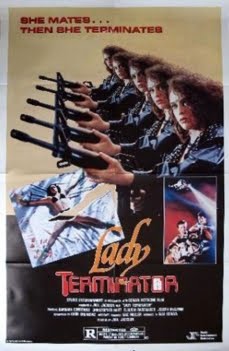
 Lady Terminator—Killing two male fantasies with one stone, this Indonesian production beat its inspirators by 15 years in bringing a female Terminator to the screen. Mixing island fantasy with sci-fi, the female Terminator of the title is actually the reincarnation of The South Sea Queen, a demon who seduces men and then cuts off their you-know-whats. The differences barely matter though, and Lady Terminator does more than pay homage to the 1984 classic, fully recreating the eye gouge at the sink and the "Come with me if you want to live." With die-hard pacing, '80s fashion and Indonesian pop music, Lady is easily one of the better cheapo action flicks of the '80s, Indonesia or otherwise, and sports some great-terrible dubbing.
 Metropolis 1984 Redux—Yep, that Metropolis. Having really enjoyed the 1927 silent classic, disco-star Giorgio Moroder pulled some strings and re-cut his own version, tailor-made for 1984 audiences. The man behind Midnight Express' "Chase" theme and the mastermind of Donna Summer's best hits re-scored the film and added a bunch of crazy colors, but the core remains. In addition, Moroder re-imagined a lot of lost scenes from the original cut, but managed a product 40 minutes shorter by making most of the inter-titles subtitles. Is it blasphemy? Well, for the haughtier of film fans there can be no doubt, but Moroder's release did gain the film a new audience who would not have otherwise seen the film and his redux version has its own charms stemming from a time-capsule candy coating and terrible Freddie Mercury theme song. Sure, there were probably a bunch of kids who treated Metropolis 1984 Redux like a planetarium laser show, but let's not pretend we're above something as fun as a laser show.
Cross-published on Ornery Crosby and Twitch.
 From Paris With Love concerns the forced pairing of a straight-laced ambassador's aide (Jonathan Rhys Meyers) with a wildcard secret agent (John Travolta) as they strong-arm their way through the Paris underworld. There's something about a terrorist attack and a cocaine deal and a conference of diplomats, but I couldn't quite nail it all down. Of course, coherence of plot is not the reason people go to movies like this anyway—they go for the action and hope for a few jokes. And, more or less, that's what you'll get here. The fight scenes are choreographed to the point of nonsense, but Travolta and Meyers seem honestly amused as they attempt to crack each other up for an hour and a half, and more than a couple of things explode.
No doubt, opinions about such a film are going to be divided. From a critical standpoint, the movie is hollow, cliché and nonsensical—but the sense of fun is there nonetheless. There's the impression that no one was taking this thing seriously, a levity which can be contagious, though I'm not sure the screenwriter was in on the joke. Hoping to steer the viewer from pondering such things, the rapid-fire editing careens us from shootout to shootout at a pace that allows no time for analytical thought.
 Say what you will about the ups and downs of his career, John Travolta has an undeniable presence, and his presence is even more appreciable when he's the sole funny guy in a film full of "straight men". Sporting a bald head and goatee, his pairing with the lip-stachioed Meyers seems to strive for the classic buddy-movie mismatch, but it falls short of the chemistry that made Rush Hour (2002) the first in a trilogy. As I compare the two films, I can hear picture writer/producer Luc Besson salivating at the idea of a From Paris With Love franchise.
Besson once was the king of movies like From Paris With Love. In the early '00s he was the preeminent money man behind a slew of action movies that were just a little better than straight-to-DVD: The Transporter (2002) and Kiss of the Dragon (2001) come to mind. As vehicles for a variety of action stars, such films serve their purpose and assuredly make their investors' money back quickly, but I sometimes wish Besson had more interest in returning to the gritty tableau that began his career. The Professional (1994) and La Femme Nikita (1990) were consummate examples of '90s action cinema, where characters had real stakes and action was rough and painful looking.
 I mentioned earlier that people don't go to action movies expecting a decent story anymore, and it's a sad truth. Perhaps there's just not enough money these days in putting decent screenwriting before slam-bang action. We seem to have forgotten that we can have our cake and eat it too. Though an embarrassingly entertaining diversion, From Paris With Love also reflects much of what is lacking in contemporary action films.
Cross-published on Ornery-Cosby and Twitch.
 By and large, animation gets a bum rap. The average filmgoer long ago decided that the medium catered either to kids or art house snobs, and Hollywood has spent the last few decades marketing accordingly. Luckily, it's a medium that also has some of the most fervent fans—ones who endlessly support the films and keep the animated flame burning—such as the San Francisco Film Society, which will host the San Francisco International Animation Festival (SFIAF) November 11-15, 2009 at the Landmark Embarcadero Center Cinema. SFIAF's fourth edition boasts four narrative features, a selection of shorts, and live events; a great way to become better acquainted with the overlooked genre if you're unfamiliar, and—if you're already on the hook—an opportune chance to see some of the best animated films of the year on a big screen.
 The biggest draws will likely be SFIAF's features: First up, The Fantastic Mr Fox. Based on the eponymous novel by Roald Dahl, Wes Anderson's latest journeys away from live-action but retains all of the director's trademark eccentricities thanks to voice-acting from many of the actors who frequent his hit films. Shot entirely in stop-motion, Fox is the story of the titular Mr. Fox, a retired crook who risks his happy home life for one last hit on the three meanest farmers in town. Oceans 11 with George Clooney as a fox?! I can't confirm such a fantastic allegation, but I'll be attending this screening myself and my fingers are crossed. The film may open wide just a week or so later, but why not see it early and think up a swell question to ask Anderson (who is expected to attend)?
 Next on the schedule is the irreverent Belgian import Panique au Village / A Town Called Panic. Twitch teammate Todd Brown writes: " 'Juvenile' and 'absurd' are perfectly good descriptors when talking about Panique, though only if they are accompanied by 'brilliant' and 'hysterical'." I've been anticipating Panique for quite some time since quickly discovering the English dub on Atom Films. Each episode follows the adventures of three toy figures—Cowboy, Indian and Horse—who share a house. Its simple setup has a big part in creating the sort of universal comedy that has crossed culture lines, the series having swiftly gained support in the UK from Aardman Animation (the studios behind Wallace and Gromit). Will the five-minute episodes translate well to feature length? Early word leans towards the positive.
 A new Mamoru Oshii is always big news for animation fans, though you might be surprised to hear his latest is a samurai biopic. Stepping back from the usual action and sci-fi fare of previous efforts such as Storm Riders and Ghost in the Shell, Musashi: The Dream of the Last Samurai is more a detailed examination of the political climates that conspired to create the man who became the legendary samurai Musashi, rather than a straightforward story about his life. Using an anachronistic narrator to steer the film from sounding too much like an animated essay, Oshii's script explores both the myths and the facts but ultimately comes no closer to understanding the true identity of the mysterious samurai. Even when the film glorifies more than enlightens, Oshii's fascination with his subject shines, making Musashi an engrossing exercise in style and structure. At Twitch, Todd Brown stages his complaints while Simon Laperriere considers "ideal" the film's description as "an animated encyclopedia … since the film uses a structure similar to a book covering a wide variety of subjects all linked more or less with the same theme."
 Closing the fest is Tarik Saleh's Metropia, a near-future mystery flick starring Vincent Gallo as a dissatisfied call-center employee who begins hearing voices after using a new brand of shampoo. As a slow-burn sci fi noir, Metropia is often cryptic and scattershot; but, anyone familiar with the genre knows better than to expect events to unfold in any other way. Saleh delivers enough intrigue and double-crosses, and such an interesting style of animation—big-eyed photorealistic characters that move almost like marionettes—that the plot's contrivances are negligible. At Twitch, Todd Brown writes: "Metropia fits beautifully into the canon of dystopic literature, a grim but thoroughly plausible vision of the future, a future in which progress leads to squalor rather than prosperity" whereas—though Simon Laperriere admires Metropia's "astounding" animation—he concludes the effort "disappoints."
 If shorts are more your thing, Saturday brings a few compilations. The most eye-catching is The Best of Annecy (marking selections from The Annecy International Animated Film Festival), and Walt Disney's Alice Comedies, a selection gleaned from the 56 classic shorts made between 1923 and 1927 that helped launch the Disney Studios.
Of related interest: indieWIRE has published the 20 films submitted for consideration for Best Animated Feature at the Academy Awards®, including The Fantastic Mr. Fox and Panique au Village / A Town Called Panic.
Cross-published on Ornery-Crosby and Twitch.
 Another week, another "found footage" horror film.
The Fourth Kind claims only half of its run-time is found footage, the rest is introduced by actress Mila Jovovich as elaborate dramatizations of real events that occurred in Nome, Alaska. I am always a bit wary when a film's tagline is "Based on a true story", but setting aside questions of legitimacy, I recognize that it was a risky endeavor to construct a movie from equal parts VHS tape and America's Most Wanted re-enactment.
In the secluded town of Nome, Jovovich does indeed play a real person, Abigail Taylor, a small-time therapist who recently lost her husband in an unsolved murder. Her husband, who had also been a therapist, was investigating a pattern in his patients suffering from insomnia and bad dreams, and Abigail is convinced that—by finishing his work—she can somehow understand his death. She begins by videotaping the sessions with her patients as they are put under hypnosis, and discovers that they all remember the same thing—waking up in the middle of the night with a big white owl sitting outside their window.
What it all means I won't divulge here, but I think the trailers are keen on making it clear that this is a film about alien abduction.
While Abigail unravels the mystery of the owl, director Olatunde Osunsanmi constantly switches back and forth between dramatization and purportedly real recorded footage, each time including captions to delineate the real people from the actors. It's obviously a device that has greatly enamored the filmmaker, but what begins as a novelty quickly becomes a distraction—at times up to four different points-of-view crowd the screen at once. Towards the end, Osunsanmi manages to confine the moments of videotape to key "scare" moments, relying on the shoddiness of the footage to lend an eerie authenticity to otherwise familiar moments, but disassociating the audience with fuzzy VCR-roll isn't the same as actually developing suspense.
Even as I decry it as a distracting gimmick, the juxtaposition of fact and fabrication remains the most interesting aspect of the film. It's wildly apparent that the filmmakers have put all their faith in the movie's dual footage premise at the expense of a story, and The Fourth Kind delivers an alien abduction experience that is about as rip-roaring as a late era X-Files episode—you get the feeling everyone is just going through the motions.
Is it real, is it fake? I suppose I could add the absence of a satisfying conclusion to the film's narrative offenses, but you've probably already figured out that a supposedly true film about alien abduction isn't going to contain proof of extraterrestrial life or you'd have heard about it by now.
Cross-published on Ornery-Cosby and Twitch.
 I was afraid that I had forgotten what it was like to be a child, my own memories having faded and mixed with the archetypes of youth that pop-culture has drilled into me, but the opening scenes of Where the Wild Things Are feel more authentic than any muddled memory I can muster. Before ever visiting the land of wild things, the young boy named Max spends an afternoon building an extravagant igloo, only to have his sister's friends—in a moment of recklessness—cave it in. His anger and rejection are wordlessly apparent as he destroys his sister’s room in a fit of rage. Later that night, as Max relaxes beneath a table while his mother is on the telephone, he studies her face. Her conversation sounds like white noise but her expressions reveal emotions without drawing attention to them.
Moments like these bubble to the surface and endear themselves throughout Where the Wild Things Are, but when given the chance to let his imagination truly run free, why does Max, by proxy director Spike Jonze, invent such dreary friends for himself?
 You might already know the story of Maurice Sendak’s 1963 children’s book, but as a recap—Max gets in an argument with his mother and retreats to an imagined world of strange creatures, where he rules as king. Sendak’s story is not the most substantial piece of writing, totaling a mere nine sentences in all, and Spike Jonze has approached writer Dave Eggars to fashion a new story for the film that draws upon the themes and emotions from the acclaimed book. Eggars' take on the story trades the visual-reliant style for a lot more talkiness, giving human voices and personalities to his wild things, but it's a mystery why he chose to have the otherworldly characters spend most of their screen-time sulking and discussing the futility of life.
 Here's an example: upon arriving in the magical forest of the wild things, Max announces himself as their leader and their first question is whether he will take away all the sadness. Such oppressive melancholy colors much of the second half of the film, and Eggars' attempts to riff on Max's loneliness and fears by having them physically invade his dream world never reach any narrative finality, making the thinness of the original conceit all the more apparent.
 Yet, there’s no denying the impressive look and feel of the film. Jonze's decision to use a hand-held camera affords a lot of maneuverability, allowing us to experience the world from the viewpoint of a child. Likewise, his determination to forgo the popular CGI route for the wild things, instead adorning the actors in rubber suits and digitally manipulating their expressions, is in keeping with the organic DIY feel of the film. Both Max Records as Max and Catherine Keener as his mother are perfectly cast, and even the actors playing the wild things turn in wonderfully-nuanced performances despite the cheerless subject matter.
 As a children's story, I can't see many kids latching onto the heady themes of Jonze's film—their attention is more likely to focus on the impressive visuals and wonderful look of the wild things themselves—but, even eye-popping visuals can only compensate for so much gloom. Putting aside the question of its appeal to youngsters, I think adults too will tire of the exhaustive in-fighting and passive-aggressive nature of the creatures which mirror real-life people a bit too closely. The lack of a narrative that properly reflects the source material's simple exhilaration ultimately hurts a film with a lot of visual richness, leaving Where the Wild Things Are a terribly bittersweet experience.
Cross-published on Ornery-Cosby and Twitch.
 The Wild and Wonderful Whites of West Virginia chronicles a year in the life of a family of self-proclaimed hillbillies. One member of the White family, Jesco, has already achieved cult status, after being featured in a 1991 PBS special called Dancing Outlaw, which spawned a sequel in 1994 and a narrative feature earlier this year. Jesco is an Appalacian "mountain dancer" whose many run-ins with the law have delayed his dream of being hailed as a worthy successor to his late father, the famous mountain dancer D. Ray White. Director Julien Nitzberg now offers us a chance to meet the rest of the White family, which is extensive, but even with so many lives to explore he fails to discover anyone with the same level of natural charisma as Jesco White.
Scrutinizing the White family tree is enough to give one a headache. We are introduced to enough aunts, uncles, mothers and grandchildren that the filmmakers are forced to caption each family member's name even after featuring them on-screen several times. At the top of the tree is the matriarch of the family, Bertie Mae, who with her daughter Mamie attempts to establish some sort of order within the group while their children become involved in increasingly-dangerous circumstances. From prescription pills to attempted murder, the exploits of the Whites are often lessons in fatalism, a fact of which the family is disturbingly proud.
Amidst the head counting, a few stories do rise and take focus, such as a trip to pick up Mousie White from jail and Kirk White’s battle with Child Protective Services to see her newborn daughter, but by and large the film is representative of the Dickhouse production logo—a company run by a crew from MTV’s Jackass. Like its TV ancestor, the footage is more focused on chronicling day-to-day drug use and exploiting violent antics for shock value than exploring anything below the surface. The most interesting moments are probably accidental, when the Whites stop mugging for the camera and let their guard down—Jesco’s reflections on fame and fan expectations are particularly memorable—but then it’s off to another night at the bar to watch the Whites get drunk. Occasionally, local police and government officials are interviewed in an effort to situate the family’s poor behavior within the community, but for the most part Nitzberg seems hell-bent on remaining impartial towards his subjects. Perhaps I would be too, after getting an earful of the multiple stabbings and shootings of which the Whites freely boast.
The Wild and Wonderful Whites is a film about an unattractive and offensive group of people. It’s not my place to make judgment on their character, but it is my duty to tell you if the film about them is any good, and frankly it’s not. Forgoing the fact that the film says nothing insightful about its characters, its meandering structure forces even the exploitative elements to grow tiresome well before its 85 minutes are up. Worse still, it’s a film that encourages its subjects to continue their damaging lifestyle in the pursuit of some sort of fame, never realizing they’re being laughed at, not with.
Cross-published on Ornery-Cosby and Twitch.
 When DreamWorks picked up Israeli émigré Oren Peli's effectively creepy lo-fi supernatural thriller Paranormal Activity at Slamdance 2008, it withdrew the film from its scheduled festival appearances in the Bay Area. As reported at the time on The Evening Class, SF IndieFEST resisted DreamWorks’ position and went ahead with its scheduled screening. Since then—as Dennis Harvey has detailed at Variety—"Paranormal's path to commercial release has been a laborious one: Initially, DreamWorks intended to simply use it as a DVD extra for a bigger-budgeted remake it signed Peli to create. When that fell through, the pic shifted to Paramount's shelf."
Nearly two years later, as Harvey enumerates, Paramount has taken an unusual approach in its distribution of the film, scheduling it at midnight screenings in various metropolitan and college markets, and encouraging viewers to urge wider bookings via online service Demand. The strategy appears to have paid off. The midnight screenings have been nationwide sellouts, demand for the film has increased, and sightings of Paranormal Activity can now be expected in a more conventional theatrical rollout. Our thanks to Peter Galvin for his review.
* * *
Micah and Katie have got it all worked out. He's a day trader and his job pays well enough to support them both while Katie goes to school. Early on in Paranormal Activity Micha explains that they're "engaged to be engaged" and they've finally decided to move in together. The only thing gumming up the works is that Katie is being plagued by nightmares and strange voices while she sleeps. Concerned, Micah hatches a plan to film these mysterious phenomena with a camera set up in the corner of their bedroom in order to better understand the unwanted presence plaguing his and Katie's lives.
 Shot entirely through a diegetic camera and posited as "found footage", Paranormal Activity probably shouldn't work. The weathered movie-goer in me immediately figured the set-up for a cash-in on an increasingly tired gimmick: "Those aren't scary noises, that's the director behind the scenes jiggling the lights and stomping his feet. No way will I be amused for an entire 90 minutes of light-jiggling." But let me tell you, when I walked out of that theatre, I was white-knuckled and grinning. Not only does this gimmick still have some legs, but this may be one of the best examples of it I've seen.
 Largely, the film's success is due to the performances. Set entirely in one location, where the two main actors are on-screen for every frame, the film lives or dies on how willing the audience is to care about its characters. Katie (Featherston) is so steadfast in her belief that the anomalies that torment her are ghostly that dialogue which could have elicited laughs comes across instead as serious and sinister. Micah (Sloat) matches Katie's earnestness with a thick sense of humor, but his main function is ultimately as aggressor. His preoccupation with filming the house's curious displays and his stubborn unwillingness to stop and listen to what his girlfriend actually needs drive the film toward an uncertain conclusion. Neither give particularly showy portrayals, but the pair have a natural chemistry and authenticity, without which my belief would certainly have crumbled.
 Another asset is writer/director Oren Peli's knack for subtlety containing the film from being an overblown shockfest. Sure, some of his willingness to downplay the scares can be chalked up to a meager budget, but Peli has an unwavering dedication to the illusion he has formed and understands when less is more. Many of the scarier sequences are spent merely watching the couple sleep, but our perspective from the tripod facing their bed—a spinning timecode on the screen counting down the hours 'til morning—creates an undeniable apprehension for what might happen before they wake. As the film continues, and the attacks become increasingly brazen, the static point-of-view also helps to transform the otherwise modest effects into impressive displays of movie magic.
Completed in 2007, Paranormal Activity has been withheld for three years while Peli figured out how to approach a proposed big budget remake. Whatever forces conspired to help that project dissolve, I'm glad, as the low-budget no-name feel of the film is one of its strongest distinctions. We've had more than enough verité horror in recent years, but if the execution continues to prove as effective as Paranormal Activity, I don't see that trend dying out anytime soon.
Cross-published at Ornery-Cosby and Twitch.
 While most of the Twitch team caught Karyn Kusama's Jennifer's Body at Toronto's Midnight Madness, Evening Class contributing writer Peter Galvin caught the film's press screening in San Francisco. Though Twitch editor Todd Brown cautioned viewers to "adjust expectations accordingly", he credited Jennifer's Body for being "a much sharper than normal stab at PG-13 horror comedy" and predicted that it "will, no doubt, play strong to its intended audience." According to indieWIRE's Anne Thompson, however, the film "opened soft" this weekend with some confusion as to who its "intended audience" truly is. She characterized the film as "a classic tweener: neither a horror thriller for men, nor a coming-of-age horror-comedy for women." At The Auteurs Daily, David Hudson has scooped up the decidedly mixed-to-negative reviews, with only a few cheering the film on as an acceptable genre piece that will gain a cult following. My thanks to Peter Galvin for sharing his thoughts with both The Evening Class and Twitch readerships.
* * *
 There's a great untapped market for Jennifer's Body. Men like blood and hot chicks, sure. Check. But instead of the tired slew of female victims being stalked and dismembered, writer Diablo Cody flips the script, making men the targets. It’s a feminist's dream. Hell, it's a college essayist's dream. Written, directed by, and starring strong, tough women, will the male-oriented horror audience flock to theatres to watch their male facsimiles be dismembered? So long as they're not expecting to actually see much of the dismemberments, they just might.
Jennifer and Needy (short for Anita; I catch the pun) are best friends. They've been BFFs since they were kids and swore to always be true to each other. Or at least Needy swore; Jennifer has always been more of an egotistical, hyper-sexual, selfish brat. Definitely not a virgin. So when a fire at the local "nightclub" results in a struggling indie-band sacrificing Jennifer to Satan, she comes back as a flesh-eating demon. And she's got a whole high-school of hormonal boys just dying for a date with her.
 Right off the bat, this is very much Diablo Cody's film. All that love-it-or-hate-it dialogue you remember from Juno is back in full-force. However, I think horror might be a more appropriate avenue for Cody's limitless pop-culture references. Perhaps I'm less sympathetic to made-up catch-phrases in a coming-of-age film than I am in a teen-horror film, but here I was able to take it in stride as part of the charm. I don't even know if high-school kids talk anything like this, but I'll be damned if Cody hasn't got me convinced that they do. So, for what it's worth, I decided to strap in for a good time.
 It's hard not to when the actors are having such a good time themselves. No doubt Megan Fox is a little zany—and the recent character she has created in the tabloids makes it a bit hard to separate fact from fiction—but she absolutely works in this role, delightfully making the audience squirm. Perpetually the second fiddle, Amanda Seyfried really comes into her own here. I've always found her a convincing actress, but the extra breathing room she has as the "final girl" hopefully gets her more starring roles in the future. Filling out the supporting cast, both Adam Brody and J.K. Simmons appear to be having the time of their lives, stealing every scene they're in as the lead singer of the indie band and a high-school teacher, respectively.
 Overall, Jennifer's Body lays more squarely on the comedy side of this horror-comedy. Cody has seen enough B-movies to parody many of the more well-worn tropes—at times reminiscent of Slither—and it is often laugh-out-loud funny, even if Cody employs a "kitchen sink" comedic strategy. On the other hand, the horror doesn't fare nearly as well. In addition to skimping on the gore, the scares are flat and tedious, and I couldn't help but see squandered potential, most notably during the underwhelming climax.
But like I said, there's a market for this. Forgetting the subtext and satire for a minute, this is a movie written by a big kid for little-er kids. On that level, it should succeed with its intended market, and it shows a lot of potential for more films like this. If you can handle another round of Juno-logue, aren't looking to be scared, and aren't expecting Megan Fox's nipples, it's an enjoyable tongue-in-cheek effort.
Cross-published on Twitch.
 If you're a director searching for a low-cost solution to filmmaking, what could be better than limiting your film to one actor and one location? Of course, eschewing the bells and whistles of modern cinema means you better have a pretty fantastic script to back it up: it has to be entertaining simply through its storytelling. Director Rodrigo Cortés has hit the jackpot with Buried, a film with a story so stark it could almost be a play.
 I hesitate to reveal any further twists, but be assured that the suspense moves quickly and organically. Cortés builds layers of ticking bombs—the phone's battery life, the oxygen level in the coffin, etc.—and by the end the tension has ratcheted to near-unbearable levels. The inherent claustrophobic nature of the coffin itself is enhanced by the seemingly infinite threat of darkness that wraps around Reynolds' body, licking menacingly at him with shadows created by the Zippo.
 It remains to be seen whether Buried can break out of the "indie" box in which it finds itself (pun noted, but not intended). Although releasing through horror giant Lionsgate, the single-location novelty is a double-edged sword for a broader public, who may find the phone calls repetitive and action-less, and be disappointed not to see more of Reynolds' comedy or a big action scene. The film is comparatively small when stacked next to something like a Saw sequel, but it is definitely not an experimental work and its aspirations lie squarely in the realm of entertainment.