As is often the case, one need look no further than MUBI to achieve an overview of Lars Von Trier's Melancholia (2011). After offering the trailer, David Hudson rounded up the reviews from the film's premiere at Cannes (where Danny Kasman also weighed in), reported on the controversy surrounding Von Trier's press snafu that earned him the status of persona non grata, and then expanded his critical round-up from the New York Film Festival. Most recently, Hudson has reported on Melancholia's multiple nominations at the European Film Awards.
I caught Melancholia at the Toronto International Film Festival (TIFF) and was stunned by its somber beauty and its unflinching infatuation with the apocalyptic. The film opens theatrically this week and—though I don't really have much to add to what's already been written—I do have a few tangential impressions I wanted to share. When I watched the film, I was struck by its depressive weight, its gravitas if you will, where gravity is determined by the pull of celestial bodies upon each other. If ever the "inner reaches of outer space" could be palpably felt, Melancholia achieved that microcosmic / macrocosmic correspondence in shaded spades. For me the film was a grim and dark fantasy about inauthentic weddings and the clay feet of the paterfamilias.
 It was Charlotte Rampling's stony performance as Gaby that most unnerved me. Gaby possesses what Jungian analyst Sylvia Brinton-Perera has brilliantly described as the "death eye" in her groundbreaking study Descent to the Goddess: A Way of Initiation for Women (Inner City Books, 1981), which explores the deeper meaning of the wedding ritual by way of the Innana / Persephone mythologem. In essential ways the death eye is grounded in the authentic experience of marriage, even as it mercilessly exposes the false marriage (one might say the marriage of convenience) through lancing insight. Brinton-Perera provocatively suggests that what feels at first like a curse might actually be a key to feminine strength and freedom. Gaby's psychological attitude triggers Justine's descent and Justine (in an award-winning performance by Kirsten Dunst) does, indeed, go down under the weight of her mother's negativity. But it could be argued that Justine needs to find her own strength because she cannot rely on any of the men around her. Her philandering father Dexter (John Hurt) is of no help, weakened by a penchant for saturnalia; her spouse-to-be Michael (Alexander Skarsgård) can't live up to his namesake and conquer the devil of her depression; and her brother-in-law John (Kiefer Sutherland) favors science and reason to ill effect, trying to ward off an impending loss of control, only to succumb to the ultimate act of cowardice and abandonment. The archetypal underpinnings of Von Trier's narrative are so pronounced that they are nearly hidden in plain sight.
 This visually ravishing descent narrative cogently captures the oppressive influence of a suffocating familial environment and—as I watched the film—I kept thinking of an early memory of Carl Gustav Jung's, poignantly recalled in his autobiography Memories, Dreams and Reflections: "I had anxiety dreams of things that were now small, now large. For instance, I saw a tiny ball at a great distance; gradually it approached, growing steadily into a monstrous and suffocating object. ...I see in this a psychogenic factor: the atmosphere of the house was beginning to be unbreathable."
Melancholia takes my breath away on multiple levels, both oppressive and liberating. It is, indisputably, one of the year's best films and will be a front runner in the oncoming awards season (which sometimes feels like an impending planetary collision in its own right). When the cast of Melancholia appeared on-stage at TIFF, Kirsten Dunst saw the film's opening sequence—frequently interpreted as oneiric—as less Justine's dream than the very real possibility that Justine was actually from the planet of Melancholia, which was how she worked with the role. Kiefer Sutherland added that Von Trier shot much more specific footage for the opening sequence that he decided not to use. By doing so, he allowed the sequence to be sparse enough so that it could be interpreted variously by each audience member, which Sutherland believed was "a strong move."
 Regarding the strength that Justine develops to face the apocalypse, a strength that is nowhere evident earlier in the film, Dunst stated, "Lars and I talked about that a lot. When people are depressed, they're less afraid or not afraid of what's about to happen. In having no fear, you can be the strongest one in such a situation." For me, this is a clear confirmation of the value of Brinton-Perera's notion of the "death eye."
 Sutherland: "One of the things that Lars did that was truly unique from any other experience I've ever had in film, we didn't block scenes out and we didn't do a lot of rehearsal. We were actually forced to find moments as they were happening. There was some panic and fear about that. At first, I thought it was his way of trying to control the thing, but there was actually a reason for him to do it like that. It had a profound impact upon me as an actor and Lars and I talked about that a lot. I think that was one aspect that allowed us to focus on the moments instead of the whole scope of the film." Udo Kier added that—after having worked with Von Trier for years—he's learned that Von Trier hates actors who act. He wants them to be in the moment, reacting honestly.
 One hilarious moment in the TIFF Q&A was when an audience member asked Udo Kier how he maintained his youthful, sexy appearance? "You've made my evening," Kier beamed, and admitted that—since he has had no plastic surgery—he must be sexy by nature. Another respite arrived when the cast was asked what working on the film had taught them about the anxieties and depressions of people in their own lives. Skarsgård was quick to refute: "I'm from Sweden and we're all very happy in Sweden." When asked if he thought things would have "turned out differently" if Jack Bauer had been on the scene, Sutherland fessed up that Lars Von Trier would have kicked the shit out of Jack Bauer.
 Mom used to say that all good things come to those who wait; but, Mom didn't see All Good Things (2010), the long-anticipated feature debut of Oscar®-nominated documentary filmmaker Andrew Jarecki (Capturing the Friedmans) whose film—waiting aside—had me fervently hoping by its midway point that All Good Things would simply come to an end.
All Good Things is one of those odd creatures whose source material is, admittedly, stranger than fiction and—in Jarecki's filmic experiment wherein he blends documentary and speculative impulses—it's markedly diminimized by fiction. As Folner paraphrases The Bible in William Goyen's House of Breath: "Because you are lukewarm—neither hot nor cold—I will spit you out." That's the feeling I had watching All Good Things. It was neither hot nor cold, neither true nor false, almost there but not quite there in believability.
 Whereas, the real-life story of Robert Durst is, as they say, one hot property. As Doris Toumarkine phrases it in her review for Film Journal International: "Tabloid journalism got a great gift—and one that kept on giving—with the real-life, sprawling saga and devolution of Scarsdale-born New York real estate scion Robert Durst." His marriage to Kathleen McCormack and her mysterious disappearance without a trace a few years later remains considerably more interesting and, ironically, more believable—precisely for all its evidential gaps—than those Jarecki seeks to fill.
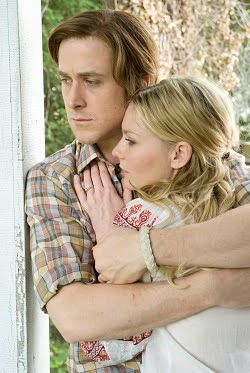
 To fill in the gaps, to turn a perfect love into a perfect crime (as the film's tagline asserts), Jarecki has—in effect—made two separate films distinct in tone that don't fit together. At Movieweb, Harvey Karten observes: "The first half is lively, adventurous, varied and upbeat; the second half is slow, fitful, melodramatic, and melancholy." Jarecki's concerted effort to make these two sequences fit feels like he's forcing puzzle pieces into place. As much as I was caught up with the film's build-up where Robert Durst aka David Marks (Ryan Gosling) and Kathleen McCormack aka Katie McCarthy (Kirsten Dunst) meet cute and fall in love, All Good Things destabilizes into an unholy mess when David unhinges and becomes a brooding, possessive menace. Of course, one could argue that it actually did turn into an unholy mess in real life, involving transvestism, a missing and presumably murdered wife, the murder of a potential witness, and the murder and dismemberment of an elderly neighbor. As much as I admire Ryan Gosling as an actor, his transition from a nice attractive guy to a psychologically-damaged-beyond-repair sociopath who wears dresses was engineered as subtly as the smile-to-frown countenance of the Mayor of Halloween Town in Tim Burton's Nightmare Before Christmas. I just didn't buy it and, as a consequence, the bridge from the first to the second act didn't reach.
 The obstacles Andrew Jarecki has had to surmount to bring his fictionalization of the Durst scandal to the screen have been only a little less interesting than the scandal itself. At the L.A. Times, John Horn has detailed the legal dispute over the film. As would be expected, the Durst Organization (run by Robert's brother Douglas) has threatened to sue Jarecki and the film's distributor, Magnolia Pictures, over the company's depiction in All Good Things despite Jarecki's thinly-veiled tactic to change the names of the film's characters. Jarecki asserts he didn't change names "to make the Dursts happy" but rather to free the actors from the constraints of having to impersonate real people and to give them the license to invent their own characters. As suggested by Kurt Brokaw in his fascinating piece for The Independent: "Jarecki, who grayed similar lines in Capturing the Friedmans, is typical of documentarians who migrate onto a playing field that promises more artistic freedom." Brokaw calls this "speculative journalism" and traces the origin of "domestic crime docudramas" like All Good Things to the true-crime magazines of the '30s and '40s (nicknamed "slicks"). What differentiated "slicks" from "pulps" (i.e., pulp novels) were their "scores of crime scene photographs, lineups and mug shots" and their "re-creations of actual murders" by true crime reporters who "planted the seeds of scenes that might or might not have actually taken place."
 According to Charles V. Bagli and Kevin Flynn at the New York Times—Bagli and Flynn were the reporters who initially covered the Durst scandal for the paper—it wasn't so much the depiction of Robert Durst's implied involvement with his wife's suspected murder that upset the Durst Organization—he's been estranged from the family for years—but rather the depiction of the Organization as complicit with prostitution and drug dealing in Times Square and the negative characterization of Seymour Durst (the patriarch portrayed by Frank Langella). Despite their initial saber rattling, the Durst Organization appears to be backing off from their threats to sue because—as Douglas Durst stated to the Times—"Fortunately, this movie will be seen by so few people that litigation would be superfluous." Once the reviews start coming in, he might just be right about that.
Yet again, truth is stranger than fiction and endlessly more interesting. According to the New York Times article, it now appears that the film's main supporter is no one less than Robert Durst himself, who has shown a keen interest in the film, even so far as quietly observing filming at outdoor locations in New York. After seeing the film at a private screening arranged by Magnolia Pictures, Durst admitted that parts of the film made him cry. "The movie," he told the Times "is as reasonably accurate as anything out there; a whole lot more accurate than those endless TV documentaries. And this doesn't pretend to be a documentary."
 For his narrative voiceover, Jarecki lifts verbatim the transcript of Durst's testimony from his trial for the death of 75-year-old neighbor Mr. Black. Durst's testimony was disputed on many points and Jarecki found it compelling to have such a rare "unreliable narrator" tell the story. Quite pointedly, Kurt Brokaw questions Jarecki's creative strategy: "Is this responsible filmmaking? Are we back in Catfish country, where we're not only dealing with untrustworthy narrators, but possibly untrustworthy artisans as well? It's a pretty slippery slope here, and worth your consideration."
 According to his testimony, Durst killed his elderly neighbor Mr. Black in self-defense and then proceeded to dismember and dispose of the body. Mr. Black, named Malvern Bump in the film—as in "bumped off" (I couldn't resist!)—is portrayed by Philip Baker Hall. Amazingly, Durst wasn't charged with Mr. Black's murder but was charged with the illegal disposal of a body and fleeing the scene of a crime (only to be caught when he was spotted in a Pennsylvania supermarket shoplifting a Band-Aid and a chicken salad sandwich). Why couldn't Jarecki fit that into his movie?! Gosling might have redeemed his performance with such a scene.
Durst didn't seem to object to the implication in All Good Things that he manipulated Mr. Black to murder suspected accomplice Susan Berman (Deborah Lehrman in the film, played by Lily Rabe) to keep her from confessing to the police; but, he did take offense with an earlier article in the New York Times that described him as "swimming in blood" after carving up the old man's body. Durst protested: "I didn't carve up the guy. I dismembered a corpse."
Disclaimer: Reviewed from screener. Cross-published on Twitch.
 As is often the case, one need look no further than MUBI to achieve an overview of Lars Von Trier's Melancholia (2011). After offering the trailer, David Hudson rounded up the reviews from the film's premiere at Cannes (where Danny Kasman also weighed in), reported on the controversy surrounding Von Trier's press snafu that earned him the status of persona non grata, and then expanded his critical round-up from the New York Film Festival. Most recently, Hudson has reported on Melancholia's multiple nominations at the European Film Awards.
 It was Charlotte Rampling's stony performance as Gaby that most unnerved me. Gaby possesses what Jungian analyst Sylvia Brinton-Perera has brilliantly described as the "death eye" in her groundbreaking study Descent to the Goddess: A Way of Initiation for Women (Inner City Books, 1981), which explores the deeper meaning of the wedding ritual by way of the Innana / Persephone mythologem. In essential ways the death eye is grounded in the authentic experience of marriage, even as it mercilessly exposes the false marriage (one might say the marriage of convenience) through lancing insight. Brinton-Perera provocatively suggests that what feels at first like a curse might actually be a key to feminine strength and freedom. Gaby's psychological attitude triggers Justine's descent and Justine (in an award-winning performance by Kirsten Dunst) does, indeed, go down under the weight of her mother's negativity. But it could be argued that Justine needs to find her own strength because she cannot rely on any of the men around her. Her philandering father Dexter (John Hurt) is of no help, weakened by a penchant for saturnalia; her spouse-to-be Michael (Alexander Skarsgård) can't live up to his namesake and conquer the devil of her depression; and her brother-in-law John (Kiefer Sutherland) favors science and reason to ill effect, trying to ward off an impending loss of control, only to succumb to the ultimate act of cowardice and abandonment. The archetypal underpinnings of Von Trier's narrative are so pronounced that they are nearly hidden in plain sight.
 This visually ravishing descent narrative cogently captures the oppressive influence of a suffocating familial environment and—as I watched the film—I kept thinking of an early memory of Carl Gustav Jung's, poignantly recalled in his autobiography Memories, Dreams and Reflections: "I had anxiety dreams of things that were now small, now large. For instance, I saw a tiny ball at a great distance; gradually it approached, growing steadily into a monstrous and suffocating object. ...I see in this a psychogenic factor: the atmosphere of the house was beginning to be unbreathable."
 Regarding the strength that Justine develops to face the apocalypse, a strength that is nowhere evident earlier in the film, Dunst stated, "Lars and I talked about that a lot. When people are depressed, they're less afraid or not afraid of what's about to happen. In having no fear, you can be the strongest one in such a situation." For me, this is a clear confirmation of the value of Brinton-Perera's notion of the "death eye."
 Sutherland: "One of the things that Lars did that was truly unique from any other experience I've ever had in film, we didn't block scenes out and we didn't do a lot of rehearsal. We were actually forced to find moments as they were happening. There was some panic and fear about that. At first, I thought it was his way of trying to control the thing, but there was actually a reason for him to do it like that. It had a profound impact upon me as an actor and Lars and I talked about that a lot. I think that was one aspect that allowed us to focus on the moments instead of the whole scope of the film." Udo Kier added that—after having worked with Von Trier for years—he's learned that Von Trier hates actors who act. He wants them to be in the moment, reacting honestly.
 One hilarious moment in the TIFF Q&A was when an audience member asked Udo Kier how he maintained his youthful, sexy appearance? "You've made my evening," Kier beamed, and admitted that—since he has had no plastic surgery—he must be sexy by nature. Another respite arrived when the cast was asked what working on the film had taught them about the anxieties and depressions of people in their own lives. Skarsgård was quick to refute: "I'm from Sweden and we're all very happy in Sweden." When asked if he thought things would have "turned out differently" if Jack Bauer had been on the scene, Sutherland fessed up that Lars Von Trier would have kicked the shit out of Jack Bauer.