Tuesday, March 22, 2022

REVIEW: DEER HOOF ON RIVER COBBLES (2022)

Dendrochronology is the word that comes to mind in assessing poet Walker Abel’s body of work in anticipation of the April 22, 2022 release of his fourth volume of poetry Deer Hoof on River Cobbles, to be published by Homebound Publications. The science or technique of dating events, environmental change, and archaeological artifacts by using the characteristic patterns of annual growth rings in timber and tree trunks—the history of wood, if you will—is, for me, an apt characterization of the unfolding growth of Abel’s vision and the maturation of his craft.

You could say that Walker and I met each other as saplings in mid-December 1986, when he attended Gary Snyder’s seminar “The Girl Who Went Off With A Bear”, sponsored by the C.G. Jung Institute of San Francisco (where I was a full scholar at the time). The seminar’s venue was the historic Firehouse at Fort Mason in San Francisco. At that particular event, I was helping out the Institute’s public programs by passing out box lunches to the participants. When I realized that Walker had not pre-purchased a box lunch and was going to go without, I offered him one for free. He was grateful, we exchanged contact information, and thus began what has been without question one of the main epistolary friendships of my life.

In what Walker later characterized as “a daring overture”, I wrote Walker after the seminar, stating: “My responsibilities to the seminar kept me from having much time to converse with you, but—in the brief time that I did—I felt that words were nothing more than small berries on a twig of juniper for you, and that twig hidden in a forest of junipers.” He confirmed in his response: “You are right … about my relation to words. I don’t say much. And I do emulate the wordless ways of nature, be it creek or juniper berry.”

During the ensuing years, Walker shared his freshly drafted poems with me as he maneuvered through his education. I even read—and learned a lot—from his Masters Thesis “The Poet and Nature: Emerson, Whitman, And An American Spiritual Path From the Perspective Of Transpersonal Psychology.” His eventual employment with the Sierra Institute allowed him to put his wilderness psychology into practice. Each year’s worth of poems, each achieved goal, registered as a tree-ring indicating his growth as a writer. It was intriguing to watch the typewritten manuscript of Runes In Present Mountains, which he offered me to read, transform (albeit amended) into his first published volume of poetry, The Uncallused Hand (2014), which won the 2014 Poetry Prize from Homebound Publications, went on to become a Finalist in the Foreword Reviews 2014 Book of the Year and to win Gold in the 2015 Nautilus Awards. The Uncallused Hand was followed by Stories Dreamed from Dust and Distant Light (2017) and Five Hearts of Aloneness (2019). How pleased I was to see Walker achieve his audience. He was no longer small berries on a twig of juniper hidden in a forest of junipers.

Which brings me to the tree ring closest to the bark. At a time when so much of the world has lost its previous meaning and I struggle to retain my footing in our contemporary moment—let alone set out towards an uncertain future—troubled by pandemic waves, political-corporate corruption, and heart-wearying environmental degradation, Walker’s most recent collection of poems—Deer Hoof on River Cobbles—offers redemptive hope to my apocalyptic mind by suggesting that I remain in the power of the present moment, to not wrestle with meaning, neither meaning forlorn and lost, nor meaning feared and anticipated.  

Deer Hoof sagely begins with versed contemplations on how Walker recommends his poems be read. Etymologically, contemplation is an act of being “together with”, “near”, “by”, “beside” a piece of ground that has been consecrated, and that is meant to be used to build an edifice, a “temple”, to honor and worship the spirit of that place. The demarcation of a space that becomes sacred enough upon which to build a temple, however, sprang from much simpler origins. A space that was marked out for observation—let’s say a hilltop—leant ancient augurs opportunity to portend or prognosticate towards bad or towards good. From that hilltop they could have a commanding view of birds in flight and craft their predictions. Should their crafted predictions become reliable, that marked-off piece of land, that hilltop, gained sacred credence, earning it the stature of a temenos, a precinct set apart from the ordinary, and an eligible site for an altar, and eventual temple, to worship the spirit of place. But before becoming too enmired or wedded to that religiosity, I would suggest that the temenos was deemed sacred simply because that was where one could go to be one’s true self. It’s in that inflection that I approach the act of contemplation, which I understand as being in the temple of one’s own being, especially as reflected by nature, or rather as being understood through the evidence of nature. I’ve long thought of Walker as an augur poet able to read nature. His unique gift, however, is that he can mark off and have a dialogue with the sacred from any point of observation, implying that the sacred is not within any one person or any parcel of land, but rather in the interaction between person and land, and most assuredly between a poet and land, which is to say nature. Among his proposed contemplations, he offers: 

1.  

Like listening to instrumental music 

or gazing at abstract or impressionistic art 

can I notice what effects come to me 

rather than pushing 

to figure out what the poem means? 

2.  

If each poem is its own being 

like a plant or animal 

can I let the presence and the gestures of that being 

have their place in the world— 

something arisen out of Mystery 

representative not of a life 

but of Life? 

Rather than have his poems allude to something other than what they are through ascribed and parlayed meaning, Walker suggests that poems exist intact within their own structure, their own being, and that—if fortunate, if attentive, if disciplined—the reader can breathe with the poems, match the rhythm of the poem’s breath, to earn the relaxed company of the poem. He asks us to be with his poems and to take part in what he describes as their “expansive moment”. In mastering the description of nature, or his impressions of nature, Walker’s poems simulate somatic certainties about nature. Although people might have varying cultural (i.e., mental and ideological) attitudes about nature, the effect of nature on the human body translates universally. Across the board, witnessing a supreme sunset can calm and soothe the body, or hazarding an extreme storm can instill fear and awe in the body. He quotes Mary Oliver: “You only have to let the soft animal of your body love what it loves.” By striving to capture a clear description of nature—rather than trying to interpret nature—Walker is, in effect, making the images of his poems somatically accessible, thereby minimizing the distance between the poem and the reader. He is playing with the ancient Hindu adage tat tvam asi, thou art that. To become one with the poem, Walker assures us, is to witness the Absolute, by way of nature. This is his temenos, the ground of his poetry. He intimates as such in his poem “Not One, Not Two”: 

just a voice clear as the river 

and paired with it, a listening 

made of the same water. 

And again in “Everything Happens Of Itself”:  

So perfect, the pale green of sagebrush 

summoned out of light and leaf 

as though there could be severance 

between the seer and the seen. 

Through his poems Walker situates his reader, acknowledging the dynamic tension between the “complementarities”, as he terms them, of thought and language, handing the reader the punctuational diagonal slant as if saying, “Here is your oar, Raftsman, navigate your two shores.” This energizing principle of thought and language and how it is structured is what I envision not only as the raftman’s ruddering oar, but a holy hinge, something that connects and utilizes complementarities, allowing movement in two directions, like a hinged door swinging both ways, or the bellows Lao Tzu describes in the quote Walker provides. Further, I like to think of that door as swinging both ways at once. 

In his observations of nature, Walker is sometimes oneiric. Nature becomes so specific, so exact, written in sensuous detail that it borders on the dream-like for escaping the quotidian. But nature itself is an everyday phenomenon so the quotidian speaks more to a failure in language. Just as dreams are often just what they are without our being able to interpret or understand them, nature in its being is the same. You might also notice that Walker avoids speaking about nature in the past tense, but most often keeps it in the present, preferring aspect to tense, often speaking in gerunds. In this way a sacred moment of observation lasts forever because it is continually happening, which one can interpret as a shamanic point of view. If memories are indulged, it is to resuscitate them into the present moment. An invocation of an observation from the past necessarily occurs as a present observation. This allows the inherited wealth of a lifetime worth of observations to thrum through each new observation, but Walker tempers the weight of the cumulative by reducing description to its quintessential truth, as he relays in “Too Die For”:  

By stripping time this spare 

the naked moment 

hatches out of thinnest air.  

The poem from which the collection borrows its title has this visionary stanza:  

Behind every tree, she said 

an unseen column of space. 

That after sticks are gathered 

beauty burns with fugitive heat. 

That “unseen column of space” imagined “behind every tree” is as much an understanding of how the visible world of phenomena—nature, if you will—relies upon and is informed by something invisible, something which it is not, that again through complementarities advises the poet who cares to pay attention that—if something is corporeal, something must be incorporeal; if something is conceivable, imaginable, thinkable, communicable, definable, expressible, speakable, it remains forever ineffable. No one ever said the poet’s dance with words would be easy. Perhaps the greatest danger is when a poet becomes inflated with his own words. To his credit, Walker is humble in his lucid descriptions. He knows that he doesn’t invent these things; he simply has the heart and the visual acuity to describe them clearly to the best of his craft. He knows that the “unseen column of space” is what makes beauty burn with fugitive heat. Everything we cannot know, we cannot see, cannot express, is what makes what we can know, what we can see, what we can express all the more beautiful for being fleeting, fugacious, fugitive. “Forever you want me to say,” he states in “Lifting Anchor”, “but never is just as true.” Poetry is the human experience expressed at its best. 

There is significant generosity in Deer Hoof. Segmented into 10 sections, including a preface and an addendum, Walker introduces each section with a pair of selected quotes that he has gleaned from years of reading. The quotes give thematic shape and structure to the individual sections, as well as pay deference to respected influences. Walker has a compelling need to share gem-like snippets of writing from the likes of Lao Tzu, Mary Oliver, Jim Harrison, Ralph Waldo Emerson, Walt Whitman, Freya Mathews, Galway Kinnell, Pablo Neruda, W.S. Merwin, Wallace Stevens, among others. Apparently, clarity loves company and seeks to share its light. With tender wryness Walker summarizes in “Ars Poetica”:  

If it were critiqued 

that all my poetry 

amounted to variations of 

I was here 

acquiescence 

would be immediate 

if allowed to add 

You were too. 

 Deer Hoof concludes with an addendum—“Poetry, Qigong, and Expansive States of Being”—which, along with the volume’s introductory contemplations, are welcome pieces from the poet offering glimpses into his own craft. “But the appeal of poetry through the ages,” Walker defines in his addendum “is exactly because, even in its use of words, it can nevertheless be a portal for the reader (or listener) into a moment not limited by language. And an expansive moment, however achieved, has proven itself deeply appealing to humans.” It is his description of this “expansive moment” that I recognize as his temenos, as his sacred ground of being, which he observes faithfully so he can share it with others. 

Earlier, when I was opining that the ineffable delimits all human expression, Walker appears to concur. He understands that “the poet is someone who is able to leave the verbal mind, and enter a space that is in itself wordless and yet out of which words cohere.” In hopes that his poems allow readers to share in their expansive moments, Walker goes one step further and offers qigong techniques that he uses to put himself in a ready state of acceptance. Qigong might not be the technique that works for you, but the poetry of Deer Hoof on River Cobbles will certainly aim you in a direction that will.

Monday, March 21, 2022

EDITORIAL: A NOTE TO THE READERSHIP OF THE EVENING CLASS


What a difference a decade makes. Or for that matter, try short of two.  

The Evening Class project began in 2006 as an enthusiastic exploration of the self-publishing possibilities of the blogging medium, which was then in its ramp-up stages. The promising ideal of a “citizen press corp” (a term, I believe, coined by Susie Gerhard when she was serving as editor for SF360, the journalistic arm of the San Francisco Film Society) idealistically offset what was being recognized as the gradual weakening of what the fourth estate could offer to cinephilia. As ad revenues dried up for newspapers, so did columnar space for film reviews and commentary and—as the cogs often work in these geared transitions—blogs proposed an alternate form of publicity. It was a particularly exciting time for being the onset of the “blogosphere” when bloggers throughout the country and into other countries introduced themselves, shook each others’ hands, began meeting up at film festivals, and began linking into each others’ work to demonstrate and enjoy the variety of approaches to film coverage that editorial policies at newspapers could rarely afford. 

Some of the blogs were erudite and incisive, such as Girish Shambu’s eponymous site, nuancing films with academic tools to better understand their structure and cultural import; others were like fanzines focusing on favored genres—horror, westerns, police procedurals, sword and sandal sagas; some were alert to all film-related events in their regional calendar, such as Brian Darr’s ever-informative Hell On Frisco Bay; some served an aggregate function like David Hudson’s itinerant Daily, strengthening the network of the blogosphere by profiling individual efforts swept up in the collective stream. There’s no doubt in my mind that without the interactions formed in the blogosphere—without Girish’s skill in gathering writers together to discuss film cogently, or Brian’s notifications of rare but important screenings, or David’s promotion of the best of our work—The Evening Class would never have found what it needed to grow and thrive: camaraderie. 

It was a proud frenetic season of work and contribution. Being one of the very first bloggers in the Bay Area to request and be granted press credentials remains in my mind to this day a singular achievement. I helped lead a charge against the gatekeepers of film publicity, established working relationships with publicists based on new strategies of coverage, and watched over the years how the passion and practice of so many individuals fed into the strengthening of local film cultures and the capacity of film commentary to educate, enthuse, inform. I never identified as a film critic, always as an enthusiast, and tried to remain true to that spirit within.

Though I may have been one of the first to seize opportunity, however, it wasn’t long before storming the gates seemed like a high-flown scene in a Cecil B. Demille Biblical epic, a race to get the word out on a film before twenty-five others did, before fifty others did. As press passes began flying out like cards in a hand of poker; as publicists began hunkering down on what they required, if not demanded; as eventually each film festival developed their own social media departments with full-time committed employees, the obsolescence of the blogging format revealed itself. No longer needed to pick up the slack of the fourth estate, what was the role then to be played? How many blogs could a person keep up with? How many broken links before a broken spirit?

The decimating effect of the COVID pandemic on brick-and-mortar film festivals bifurcated access, producing virtual festivals and hybrid festivals (combining virtual screenings with in-theater screenings) that attempted to simulate the festival-goers’ experience. These were effective in varying degree; but—without question—the old days of audiences communally watching movies together in the dark shifted into the realm of the nostalgic. After two years of canceled film festivals, several have initiated re-entry into live screenings and it is yet to be determined how much of an impact the safety-in-place directives have influenced viewing habits. Who will return to watch movies in brick-and-mortar moviehouses? Who will fear to do so?

Not quite knowing where The Evening Class was to go next, I’ve elected to branch out from exclusive film coverage to incorporate literary and musical domains, using the same strategy of producing direct source material by way of interviews and Q&A transcriptions. During the COVID Interruption, I discovered the Academia website, joined, and was delighted to discover that conversations from The Evening Class were being incorporated into academic papers all over the world. This has given me the incentive to imagine this blog into the future. What follows will be the results of that incentive. I apologize to my readership for the long lapses in coverage, but hope you will join me in months to come.

Friday, October 29, 2021

TREEFORT MUSIC FEST 9 (2021)—The Evening Class Interview With Smokey Brights

Any day that releases two new singles by Seattle band Smokey Brights [Facebook / Twitter / Instagram] is cause for celebration. “Honey Eye” and “Unity”, produced by Andy Park (Death Cab for Cutie, Deftones, Princess Nokia) and engineered by Sam Rosson (Great Grandpa, Sydney Sprague), and released on Freakout Records, are described as “anthems for finding light and protecting joy in the strangest of times.” 

“Unity”, featured as the “Daily Discovery” at American Songwriter, is described by singer and keys player Kim West as “a rally cry against division; an anthem against apathy. We have all seen how much easier it is to divide than unite these days. People are scared, people are angry, people are tired. And why wouldn’t they be? It’s a nightmare out there. But there is still so much love and light left in this world. And it is worth fighting for. Living in the Pacific NW, we have seen smokier and smokier summers. It is easy to look up in the blood red sky in the middle of an August day and just think, whelp that’s it. We’re too far gone for fixing. And it’s true—no single person is going to save us. But if we can find the common ground to work together, we can fix more than we even know.”


“Honey Eye”, a Big Takeover exclusive, is described as “a sincere and desperate love letter from one worried lover to the other. As the world seems to crash down around them, their resolve is to live and love as deeply as possible, while they still can.” 

Cobbling from the press release for Smokey Brights: “Fronted by husband and wife duo Ryan Devlin (guitar and vocals) and Kim West (keys and vocals) , Smokey Brights was born during a cash-strapped Christmas when the two approached their first holiday season as a newly-formed couple. They looked at their woefully underfunded bank accounts and their long list of family and friends, and knew that gift cards and baked goods weren’t going to cut it that year. It was right then and there that they decided to combine their mutual love of music and record a few of their favorite songs to create CDs to distribute among friends and family. This lofi collection of covers contained the seeds of what would become the band we know today as Smokey Brights. 


“Now married, their bond continues to permeate their pop songcraft. Pulling from their mutual love of 70s rock, vintage synthesizers, thrift shop treasures, and early MTV, the pair co-writes about the deeply personal aspects of their life together. The early days of their origin story is on full display in songs that speak to their transitions: As young friends to life partners in their beloved city of Seattle. Touring in a van during the Northwest’s notoriously grey winters. Being in love in a deeply uncertain period. And everything in between. 

“West, a barred attorney, and Devlin, who has a background in booking, publishing and punk bands, create songs that are perpetually deep and eminently danceable. Nick Krivchenia (drums), is an Ohio native from a family of musicians, and brings a soulful, classic groove to Smokey Brights’ sound. Luke Logan (bass) grew up singing folk songs with his family in Kodiak, Alaska, and provides melodic bass lines and a crucial third harmony to the band’s vocals. Together, Smokey Brights create a stoney blend of Northwest rock & roll and razor-sharp disco grooves. 

“Musical inspiration is commonly sketched into notebooks in the curiously small, window-less dining room at the center of their home, crowded with a 50s jukebox, a Wurlitzer 200A electric piano, guitar holsters, and the upright piano West grew up learning on, complete with a well worn sticker marking middle C. Only after songs are fleshed out on guitar, piano, and voice, they make their way downstairs to the band’s wood-paneled practice room and take on new shapes and grooves at the hand of the full lineup. 

“Despite the pandemic, Smokey Brights continue to record and release music in and around a constant bustle of songwriting, demo recording, BBQs, bar-tending, co-working, band practice and 18 months no one will soon forget. The band remains best known for their explosive live shows that immerse the listener in warm, harmony rich, and arena rock anthems, and instantly found a hard core fanbase in the US, UK, and Europe, and earned slots at SXSW, Off Beat Festival, and Treefort Music Fest. 

“After more than a decade they have a rabid base of fans to show for it. Gaining momentum with every show, they are a self-made, self-sustaining rock ‘n roll machine that generates maximum joy through musical communion.” 

Thanks have to go out to Dana Robinson Slote, tour manager for Smokey Brights, who first invited me to come listen to the band at Treefort, and then arranged a Zoom interview the week after. 

* * *  

Guillén: I want to congratulate you on your presence at Treefort. I caught your “hot” show at The Hideout, where you were literally dripping with sweat. It looked like you were melting on stage. I’d like to start off with the name of the band—Smokey Brights—because I haven’t read anything anywhere regarding what that name signifies. How did you go about choosing Smokey Brights as the name for your band? 

Ryan Devlin: Originally, before we were Smokey Brights, we were called Colossal Brights. We had a little recording project going—Nick, myself, our original bassist Jim, and Mikey our original lead guitarist. We were making some demos and were thinking, “How are we going to get a name for this?” 

I had the radio down real low when I was driving home one night listening to KEXP and this song where I thought I heard someone say in this song “colossal brights”. I thought that was such a cool phrase. I came back to the band and told them, “I’ve got the band name: Colossal Brights!” Jim looked at me and he goes, “Spell Colossal.” And I couldn’t. So I said to him, “Well, it’s back to the drawing board, I guess.” 

A day later, Jim was like, “Y’know, ‘Brights’ is a cool name. I’ve never heard that attached to a band. It’s kind of cool.” We’ve always straddled some darker, moodier, gloomier elements—being Northwest folks suffering through the cold—but we also love pop, and are trying to find the light of things. So, it felt like ‘Smokey’ Brights embodied the dichotomy that sounded like what we were already doing.  

Guillén: I understand you’ve been to a few of the Treefort festivals, but I’m curious what your experience of this particular edition of Treefort was like? For our community this edition was painfully meaningful. It took such a struggle and effort on the part of the Treefort team to get the festival going that, for myself, it felt triumphant that Treefort actually got back out there for the community. There had been worried concerns that they might have to cancel again when the Delta Variant began spreading in Idaho, which I honestly believed might have spelled the death of this festival. So it was great that the festival got to go, albeit masked and vaxxed and waxed (whatever people had to do). [The band laughs.] 

So I want to know if each of you can give me a feeling you had about what your experience of the festival was? I know you got to play three different stages—the Record Exchange, the El Korah Shrine, and the Hideout—which is lucky. I don’t know many musicians that have had that luck. So, perhaps, in describing your experience, can you comment as well on the variance of the stages? Perhaps on the sound systems? If you felt your music was being presented differently on the different stages? 

Kim West: I’ll go first. You described it perfectly. The experience was triumphant. It was triumphant and surreal to get to play our favorite festival. We played Treefort a couple of times before and the first time we played we came in 20 minutes before our set and had to leave at 7:00AM the next day because we were on tour. All of our friends were like, “What are you doing? You have to be here the whole time!” We were walking around the streets of Boise, freaking out, saying, “What are we doing? We’re messing up! We have to be here the whole time!” Ever since then, we come Wednesday through Sunday and just try to experience so much of it because it’s more music than we get to see in four days.  

Guillén: Who can? It’s a discovery festival. You’ve been here three or four times, as you’ve said, and yet this is the first time I’ve seen you, or even heard of you, because there’s always over 300 bands and it’s tough trying to graph out who to listen to. A person can only do so much. I feel lucky that I got to see you guys this time. A lot of that is due to Dana, who has been doing a remarkable job for you. She reached out and invited me to come hear you. 

I feel your band is on the cusp of something—I sense it, I feel it—and I’m excited for you guys. I’ve been listening to as much of your music as I could get my hands on and have been bopping around the house. I really love the music. But back to the festival, other band and stage experiences? 

Ryan Devlin: I’ll try to be brief but I can speak to that feeling that it might not have happened was really palpable. There was a lot of conflict even within our own immediate community of other musicians and friends, people who come to every Smokey Brights show in Boise, who weren’t so convinced that Treefort should be happening. I was following along. I read Eric Gilbert’s interview in the Idaho NPR affiliate where he said, “We need to prove that this can work. That if we get vaccination cards in hand, and we mask up, we can go ahead and have a really good time together.” 

One of the most surreal moments to me was when I had a hangout with a friend, a resident of Boise, usually vocal on Twitter about how Treefort shouldn’t happen because Idaho’s health care systems were overloaded, and it was too irresponsible. We went to our first set, we hung out, we had a really long conversation, and then that night he drove home and he passed what he described as a country bar. He looked at it and a lightbulb went off in his head. He thought, “I’ve driven by this bar every night during this pandemic and it’s been packed. These people aren’t wearing masks. And these people aren’t being vaccinated (some might be, who knows?). Treefort’s not the problem.” 

Kim West: Of course not. 

Ryan Devlin: Treefort has been working collectively to create a safe experience. If they don’t do that, as a music community, as promoters, as bands, people are going to find something else to do but it might not be as safe. So that feeling of being right on the edge, everyone was feeling that, but it wasn’t until we got there that we thought, “This has to happen.” 

Kim West: It has to happen, yeah. And I couldn’t have thought of a cooler way to start our experience than to play the Record Exchange for their first in-store appearance in 18 months. The sound was amazing. I wasn’t expecting a stage. I wasn’t expecting a full PA. It was like the whole nine yards. The sound guy was probably one of the more experienced sound guys in Boise. He had worked for everybody and knew that whole system backwards and forwards. We could hear everything. It was a really nice way to ease back into this festival experience.  

Guillén: I was just watching the videos from your performance at the Record Exchange today. They’ve just gone up. 

Kim West: Oh, cool….  

Guillén: And they do sound good. 

Kim West: We’ve played in stores before and it doesn’t usually sound like that.


Guillén: How about the El Korah Shrine? 

Nick Krivchenia: I think my audio is gone again. Oh, here I am!!  

Guillén: [Laughs.] Okay, that’s enough feedback out of you. [Band laughs.] 

Luke Logan: The El Korah was massive. We felt really humbled to play it and thankful that we were able to get that slot and that Eric trusted us with that. One of the things that we didn’t have during the pandemic was audiences. They’re a pretty important half of what we do; the people who come to give it back in our faces. We played some shows throughout the summer. We had a couple of ones where it felt like we were getting some energy and pulsing but they were smaller scale. Our El Korah experience was big scale. Talking to what Ryan was saying, knowing that everyone had gone through so much to get to that point too, that it was a very intentional crowd, even moreso than it usually is, made it even more meaningful as they were moving along with the rhythms that Nick was putting out. It made it one of the more special performing experiences I’ve ever had.  

Guillén: Which leads me to the question of what it was like for you guys to be onstage looking out at a masked audience? Normally, you’d be registering smiles, you’d be registering facial reactions to your music; but, suddenly, you’re watching a sea of masked faces. Did that affect you? Other musicians who have answered that question for me have said that it didn’t make a difference, that they still felt the energy of the crowd. But did you miss the facial connection? 

Ryan Devlin: I can speak to that. We had a few practice runs of playing to masked audiences and I have to say that, at first, it was a little disorienting because we are so much depending on the energy put forth from our audience and, yeah, that is usually displayed in cheering, in smiling, in singing along, all those things that we don’t really get to have with a masked audience. But by the time we got to the El Korah Shrine, we had several different performing experiences and I was pretty used to the masked audience. Feeling the energy of those people in that room far transcended any sort of loss of seeing the smiles or anything like that. One thing that the mask does not cover are tears. When we played “I Love You, but Damn”, I looked out and saw at least three friends, dude friends, just crying.  

Guillén: Dudes aren’t the same anymore, are they? [Laughs]. Nick, reaction to the Hideout. How did you like the Hideout? 

Nick Krivchenia: Loved it.  

Guillén: It wasn’t too hot for you? 

 Nick Krivchenia: It was super hot. The sound was great. We got everything we needed. Great crowd.  

Guillén: You guys might not have noticed this, but across the street from the Hideout was a big parking lot, which was where I was parked whenever I came down to the festival, and in the parking lot your music got amplified. It was a huge sound. I couldn’t believe it! There were people actually sitting on the higher levels of the parking lot to watch your set from there. 

Kim West: That would have been a good spot to watch!  

Guillén: I came in to cover Treefort this edition primarily because of my interest in the COVID Interruption—those 18 months of artistic interruption—which almost devasted film and film festival culture because film culture is based so much on production and exhibition, both of which couldn’t be done. Whereas, music differs in that—though you couldn’t have exhibition and concerts—musicians could still make music. Can you speak to how your band kept its musicality together? I’m actually proposing that the COVID Interruption helped many artists focus and get more creative. What happened with you folks? 

Kim West: For us, it was three phases of COVID. We had a record on deck, “I Love You, but Damn”, that was going to come out. We had four tours, national and international, booked. We had a whole year ready to go. We were like, “Here we go!” We were getting ready and then COVID hit. We actually personally weren’t very creative the first couple of months. We were sad. All of a sudden we were free-floating and trying to figure it out. I consider us very lucky in that we were all able to prioritize our time in getting together and practicing and making that something that was important to us. Ryan and I saw these two men [Nick and Luke] and our two other friends and that was it. Those were the only people we saw during the whole pandemic in person without the masks. We made it work. We got through the sadness. We wrote a record that we kind of liked. Then we kind of scrapped that. Then we wrote another record that we really liked and we went and recorded it about a month and a half ago. In two days all the amazing tracks were done. In a week everything was recorded. Then we came into being able to play live shows again. There wasn’t a moment of, “Oh no. Do we know how to do this still?” It was: “Oh yeah, we can!!”  

Guillén: One thing that has always fascinated me about music is the cover song. There were two songs that caught me in your work immediately: “I Love You, but Damn”, of course, but then you had a cover of Gerry Rafferty’s “Right Down the Line”, which was just a beautiful cover. And then when Dana sent me the press notes, I discovered there was this wonderful love story behind all of this with the covers and the poor Christmas and the CD that went out with the covers on it as Christmas gifts. I’m interested in knowing what some of those covers were on that CD, because it’s not available is it? 

Kim West: I actually have a picture of it on my phone from a friend’s aunt who just found a copy of that. 

Ryan Devlin: It was just a burnt CD.  

Guillén: That’s what I figured, but I thought it was interesting because I have been arguing with musicians I’ve met in the Boise scene about the importance of covers. I’m an older guy so I’m familiar with music from the ‘60s and the ‘70s, and going even further back. I had a complaint with the Boise music scene when I first arrived because it was so thoroughly saturated with neo-psychedelia. It was like every band I heard was neo-psychedelia and they were copying each other. I could only take so much of that, y’know? I would say, “Can’t you guys learn a traditional? Like even just one traditional? Can’t you go back and sing a song written by a songwriter from the 1970s? Would that be so wrong?” 

For me, the value of a song is that it can be interpreted. If you write a good song, it can be sung in different tempos, different languages, you can do so much with the structure of the song. So you started out with a burnt CD of covers and I’d like to know what some of the titles were on that burnt CD. As I was going through your body of work noting which covers you’d done, there was “Right Down the Line”, there was Fleetwood Mac’s “Dreams”, and Sinead O’Connor’s “Nothing Compares to You.” Are there any others that you’ve actually recorded?


Ryan Devlin: That first EP was wintery, holiday-feeling songs for us, but they were not traditional holiday songs. We had Joni Mitchell’s “River”, Kim sang it, and it was really beautiful. 

Guillén: I would love to hear that. You know, of course, that Joni Mitchell’s “River” has since become an official holiday song? 

Ryan Devlin: We did a cover from one of my most formative bands, Idaho’s own Built to Spill. We did “Twin Falls, Idaho.” We did “St. Augustine” by Bob Dylan, again feeling vaguely religious, vaguely holiday. It’s one of my favorite Dylan tunes.


Guillén: How autobiographical are your songs? My roommate was listening to “I Love You, but Damn” and he was taken with the lyrics from where you talked about “being taken home to dinner to meet the parents and how are you going to explain me”. Was that about you two? 

Kim West: “You’re back home getting your degree / explain me to your family.”  

Guillén: With the COVID Interruption having tripped up the release of “I Love You, But Damn”, don’t you think it should somehow be re-released? 

Ryan Devlin: We would need to get a bigger label. 

Kim West: We have two singles coming out soon. And we’re going to release a deluxe version of “I Love You, but Damn” on CD with those two. We’ve gotten quite a number of requests for CDs, generally from people not in the U.S., usually people in Asia; but, CD technology is still alive and well in certain parts of the world and in people’s cars.  

Guillén: Tell me the story of “I Love You, but Damn.” 

Ryan: In the briefest sense possible, not all of Smokey Brights’ songs are autobiographical, but the speaker in that song is probably Ryan Devlin, me. When Kim and I first started dating about twelve years ago, I was playing in a couple of punk bands and touring a lot. For the first six months of us dating I was gone easily three months of it. We had an up and down cycle, y’know? We’d get together, we’d break up, we’d get together, we’d break up. That song is literally about love and distance, trying to grow up and figure it out, while being very far away from this person that might be falling in love. If we might be falling in love, we might have to change ourselves, I might have to change how I think about myself.  

Guillén: I’m sure you recognize that in the corpus of your work, it is an important song. As I was reviewing your work, it was the first song that, POW, I was grabbed. “What is this song?!!” And I’ve noticed you’ve chosen to use it to close your sets, so obviously you are aware of its power? So I’m glad it’s getting a CD re-release with your two new singles. 

I’m going to let you go, because you got to go, you have other people to talk to, but thank you so much for your time and I really hope you guys enjoy your ascent. I really think you’re on a cresting wave. 

Smokey Brights: Thank you, Michael.

Thursday, October 14, 2021

THROWBACK THURSDAY—The Evening Class Interview With Cassandra Peterson (All About Evil, 2010)

Eleven years ago, dragstar impresario Joshua Grannell (better known to his fans as Peaches Christ) embarked on his first feature film All About Evil (2010), which featured actress Cassandra Peterson (better known to her legions of fans as horror hostess Elvira: Mistress of the Dark) setting aside her revealing goth lingerie to play it straight as a concerned mother of a troubled teen. The shift in persona revealed Peterson as an actress to be reckoned with. 

Little did I know at the time that the true horrors in Cassandra’s life were not being evoked in Grannell’s film. According to Wikipedia, it wasn’t until the recent publication of Yours Cruelly, Elvira: Memoirs of the Mistress of the Dark (2021) that she admitted being sexually assaulted by Wilt Chamberlain during a party at his Bel Air mansion in the 1970s. Chamberlain allegedly offered to show Peterson his custom-built closet for his NBA jerseys, before he forced her to give him oral sex. Peterson had stated that she had blamed herself and was almost "convinced that I was a very bad person for letting that happen", until the Me Too movement made her rethink the experience. Peterson felt that the assault was "creepier" because Chamberlain had been a personal friend. 

As her publishers Hatchette Books synopsize: “On Good Friday in 1953, at only 18 months old, 25 miles from the nearest hospital in Manhattan, Kansas, Cassandra Peterson reached for a pot on the stove and doused herself in boiling water. Third-degree burns covered 35% of her body, and the prognosis wasn't good. But she survived. Burned and scarred, the impact stayed with her and became an obstacle she was determined to overcome. Feeling like a misfit led to her love of horror. While her sisters played with Barbie dolls, Cassandra built model kits of Frankenstein and Dracula, and idolized Vincent Price.

“Due to a complicated relationship with her mother, Cassandra left home at 14, and by age 17 she was performing at the famed Dunes Hotel in Las Vegas. Run-ins with the likes of Frank Sinatra, Sammy Davis Jr., and Tom Jones helped her grow up fast. Then a chance encounter with her idol Elvis Presley, changed the course of her life forever, and led her to Europe where she worked in film and traveled Italy as lead singer of an Italian pop band. She eventually made her way to Los Angeles, where she joined the famed comedy improv group, The Groundlings, and worked alongside Phil Hartman and Paul "Pee-wee" Reubens, honing her comedic skills. 

“Nearing age 30, a struggling actress considered past her prime, she auditioned at local LA channel KHJ as hostess for the late night vintage horror movies. Cassandra improvised, made the role her own, and got the job on the spot. Yours Cruelly, Elvira is an unforgettably wild memoir. Cassandra doesn't shy away from revealing exactly who she is and how she overcame seemingly insurmountable odds. Always original and sometimes outrageous, her story is loaded with twists, travails, revelry, and downright shocking experiences. It is the candid, often funny, and sometimes heart-breaking tale of a Midwest farm girl's long strange trip to become the world's sexiest, sassiest Halloween icon.” 

What neither Wikipedia nor Hachette mention, however, is what it took Emily Kirkpatrick writing for Vanity Fair magazine to celebrate: love. In Yours Cruelly, Elvira, Peterson “comes out of the coffin” and reveals she’s been in a relationship with Teresa “T” Wierson for the past 19 years, following the end of a 25-year marriage to Mark Pierson. “For the first time in my life,” Peterson writes, “I’m with someone who makes me feel safe, blessed, and truly loved.” And I think that’s the best memoir anyone can have! But am I the only one who thinks it’s odd that Wierson rhymes with Pierson? Had I known anything about any of this when Cassandra and I sat down to talk during one of Evil's exhausting night shoots, I might have had opportunity to ask her directly. Instead, appropriate to time and place, we talked about her participation in the film; a conversation, incidentally, that ranks as my most popular entry on The Evening Class to date. Not Bela Tarr. Not Hao Hsiao-hsien. Not Andrey Zvyagintsev. And what silly arthouse aficionado claims that genre doesn’t traffic? 

In tribute to finding love and scoring blog megahits, I tip my hat to yesteryear and republish my conversation with Cassandra Peterson, Elvira, Mistress of the Dark. 

* * *  

Michael Guillén: Cassandra, I consider you—not only iconic—but probably one of the most intelligent and talented artists of my generation. You've had such a profound effect. As I was surveying your career, I was shocked how many places you pop up. A classic example is you as a strip tease performer on the cover of Tom Waits' album Small Change. 

Cassandra Peterson: People are talking about that so much lately and the very bizarre thing about that is that I don't know if that's me! I don't know. People say it is, it looks like me, but I don't have any recollection of ever doing that. But it was the '70s, so I don't have a recollection of a whole lot that I did then.  

Guillén: I'm very pleased to talk with you as Cassandra Peterson. Not to disrespect Elvira or anything; but, her accomplishments are well-documented, so I wanted to focus instead on the fact that—within All About Evil—you actually get to play a role, to act. How does that differ from playing an icon like Elvira? 

Peterson: Well, it's a lot different because I don't know what I'm doing as an actor in All About Evil. I feel pretty comfortable as Elvira. As myself, I act so rarely that my biggest challenge is not to act like Elvira, y'know? People go, "What are you thinking of while you're acting?" and what I'm thinking is, "Don't roll your eyes and mug."  

Guillén: I respect your humility but I wouldn't deminimize your chops as an actor. The other night I was watching you do multiple takes on a scene, over and over and over, and I was genuinely impressed with your concentration. I knew you were exhausted, it was something like 3:00 in the morning, it was stop and go with the scene, but you kept going back to the same space, in character, focused. 

Peterson: Thank you. I guess I've been around for so damned long that I've finally picked up on it, whether I'm trying or not.  

Guillén: You've had a longstanding friendship with Joshua Grannell and his alter-ego Peaches Christ for at least the last few years, how did you get pulled into this project? 

Peterson: It was obviously through Peaches. She told me she was doing this movie and wanted me to be part of it. I really didn't know if I could act in a role. She had seen this other short film I did called Tomoko's Kitchen (2006) that was apparently screened at the Sundance Film Festival. I had a small role in it (and I don't know how I got dragged into that one either). I never watched it because I didn't want to see what I looked like in it; but, Joshua had seen it and he said, "I thought your acting was really great." I was like, "You're kidding?" Then I actually watched it and I wasn't as bad as I thought. So I thought, "Hmmmm, okay, maybe I can act in All About Evil, I don't know." It had been so long.  

Guillén: Have you grown as an actor as a consequence of committing yourself to performing in Evil? 

Peterson: I guess I have. The hard part about being an actor is not being self-conscious. From being Elvira for so many years I have absolutely no shame or self-consciousness—that's all gone—so I feel very relaxed.  

Guillén: That must feel fabulous to be so confident and centered? 

Peterson: It does feel a little bit like, "Oh well, I can do whatever now."  

Guillén: What has it felt to be directed by Joshua, or I guess I should say "Peachua"—Joshua, half in drag? 

Peterson: Peachua's a great name! It's been great because Joshua is just so damn sweet and nice and any suggestions you make, he thinks they're great. He's such an easygoing guy. I love being around him. He's funny and we work great together. I love doing stuff with him.  

Guillén: This moviemaking environment and this experience of late night shoots, multiple takes, how does that differ from your TV experience where you have set skits? 

Peterson: The hardest part for me is not having a teleprompter. Oh no! I'm a teleprompter queen. To actually have to remember lines is stressful because—with TV—I never have to remember any lines ever. So that's the hardest part for me, plus staying up all night. I know I'm "Mistress of the Dark"; but, y'know….  

Guillén: And I imagine that—even after working all night—it's hard to decompress and get to sleep? I did three nights of extras work while recovering from an appendectomy and was doing pretty good until the third night, when I finally had to beg off and go home to sleep and recuperate. I was so exhausted, I thought for sure I was just going to go home and die. But, instead, I couldn't go to sleep. I was so wound up. It took nearly three hours to calm down enough to sleep. 

Peterson: That happens to me too. I go home after filming on set; but, I'm so beyond exhausted that I'm still wired, y'know?  

Guillén: Do you want to do more acting gigs beyond your Elvira persona? 

Peterson: Maybe. But I don't want to start the whole thing of getting an agent and going back out on the calls; I'm too lazy. I've been doing this too long. The thought of going out on interviews is more than I can stand.  

Guillén: All About Evil is more a labor of love, then? 

Peterson: It is. When friends call me and ask me to do something, then I love to be there. But the practical thing of looking for work? That's just too hard.  

Guillén: Tell me about your character Linda. What was it about the role that you felt you could move into? 

Peterson: Well, she's a mom with a teenager and I am a mom with a teenager. Every line that is written in this script for the character of Linda is something I have repeatedly said before to my own kid.  

Guillén: I was observing with interest the manner in which you handle your co-star Thomas Dekker, who plays your son Steven. Dekker is something of a live wire on the set. 

Peterson: Yeah! "Get over here! Where's your coat? Stop smoking!" Face it, being cast in the role of Linda was typecasting.  

Guillén: And you haven't had to do any of the gore effects in the film? 

Peterson: Not really, no. Just what I have on now: a little blood. I get to kill a bad person. That was fun. I never get to kill anyone. I did get to threaten Pee Wee Herman once in Pee Wee's Big Adventure (1985); that was good. That was a dream job for any gal: getting to threaten Pee Wee.  

Guillén: You'd worked with Paul Reubens earlier, however? 

Peterson: We'd been in The Groundlings together and we were in a Cheech and Chong movie together [Cheech and Chong's Next Movie, 1980]; but, mostly working at The Groundlings.  

Guillén: I haven't heard much about Paul Reubens lately. 

Peterson: He's around. He's been doing quite a bit of acting and working on a whole bunch of TV projects that he's trying to get out there; but, he does quite a bit of acting as himself.  

Guillén: When I first interviewed Joshua a few years back, you hadn't yet made it up to Peaches Christ's Midnight Mass; but, you were scheduled to make your first appearance and I remember Joshua being all excited about it. How difficult is it to have such a strong alter-ego; Joshua has Peaches and you have Elvira? You mentioned a little earlier that you had trouble getting rid of Elvira acting the role of Linda. 

Peterson: Well, when I see a camera in front of me, like I said I just start mugging, rolling my eyes and stuff, automatically. I play it pretty straight here in All About Evil, I'm Mom, I'm not making jokes or anything and the hardest part for me is, "Don't be Elvira, don't be Elvira." That's all I'm thinking. "Be normal for once for God's sake, woman!"  

Guillén: And how would you describe working with the ensemble on the All About Evil set? 

Peterson: It's great! I love all these actors. Everybody here is just so great. Oh my God, Jack Donner—who plays Mr. Twigs—I think he's stealing the show, damnit! He's such a pro.  

Guillén: You say that with complete love? 

Peterson: I do! I love it! He's such a great actor and such a nice guy; but, everyone in the cast—I feel like they're all little kids; they're all adorable—we've been getting along great. I've been swapping music with them and they've been showing me how to do things on the computer because I'm so computer illiterate. We've been having a lot of fun. Even on our day off we all got together and had dinner. That was nice. 

 Guillén: Your involvement in this project is something of a gift to San Francisco. It certainly has been to the extras involved in the film. They bemoaned the fact that they missed Mink Stole—she shot her scenes before the extras came on board—but, they've been excited to interact with you and delighted to watch you in action. 

Peterson: That's cool! The extras have told me they're very excited and I've been out sitting in the audience with them, talking with them. They seem like real fans. They're great.  

Guillén: Have you always loved genre films? 

Peterson: I have. Ever since I was a kid, I've loved that kind of thing. I've always been into it. For me, All About Evil is a cross between Herschel Gordon Lewis and John Waters. They've melded together. It's a dream job for me.  

Guillén: I was recently watching the YouTube clip of you and Peaches on stage at Midnight Mass. Peaches acknowledged that she was influenced by you and you credited the creation of Elvira to a drag queen… 


Peterson: Oh yeah, definitely! Lots of drag queens.  

Guillén: I'm intrigued by that sense of continuity. 

Peterson: Isn't it weird? I really do feel that I learned everything—how to walk, talk, dress—from drag queens and now I'm influencing drag queens. It's come full circle. Isn't that weird? I can't tell you how many drag queens have come up to me and said, "Oh, you were my idol growing up." And I'm like, "Well great, I see I've rubbed off on you."  

Guillén: I'm aware that you're holding auditions to find a second Elvira to make appearances that—as I think you've said it—don't pay you enough? 

Peterson: [Laughs.] That's exactly right. Gimme that money! No, actually it was a low budget attempt at doing what I would eventually like to do, which is to franchise the character of Elvira. Not quit Elvira right now—as someday I'm going to have to—but, sort of doing what Bozo the Clown did. I love basing my entire career on a clown. Bozo—for anyone old enough to remember him—was wearing tons of make-up too so that he could go out and get a lot of other actors to play Bozo to make various appearances and do TV shows across the country. I started thinking, "Hmmmmm. Bozo. That sounds like a good gig. Maybe I could do that too."  

Photo by Aaron Rapoport/Getty Images 
Guillén: This is why earlier I was praising your intelligence. You market better than almost anyone I know. Elvira has been a successful "product" for you. 

Peterson: Thanks. Well, I have a lot of help. I get good people and I'm still working on that, believe me. I'd like to say it's much bigger than it is; but, it's been going along pretty well for 28 years.  

Guillén: So your hope is to continue the Elvira franchise but to be behind the scenes? 

Peterson: Exactly! Yes. So I don't have to be schlepping around in this outfit when I'm 85.  

Guillén: As I mentioned earlier, It's been a true pleasure to watch you perform as an actor in a non-Elvira role. 

Peterson: Thank you. It's been fun for me. A nice break.  

Guillén: And I trust that—even though you may not want to go out and actively solicit roles—that when people see your performance in All About Evil it will open a window on a whole new facet of your personality and earn you invitations to act in other films. 

Peterson: It would be nice to be given an opportunity to do something without having to work too hard to get it. [Laughs.] 

Originally published April 10, 2010.

Friday, April 09, 2021

MICHAEL HAWLEY PREVIEWS SFFILM 64

It's been a year since SFFILM's 63rd edition was Covid-cancelled, a hapless victim of its position on the festival calendar year. Unlike Sundance, Berlin and Palm Springs, the fest was unable to squeak through before the world shut down. Unlike festivals soon to follow, SFFILM couldn't just instantly transition to the streaming and drive-in model that soon became our pandemic norm. We learned what a stellar event they had planned after SFFILM, rightfully proud, posted the entire line-up on its website. The whole thing was made doubly sad as SFFILM63 was to be the last assembled by treasured and respected Director of Programming Rachel Rosen. 

Well, that was then and this is now. SFFILM's 64th iteration will most assuredly take place from April 9 to 18, with a promising roster of live events and online screenings. The festival is roughly half its normal size, at least in terms of feature films (43), with an impressive 57 percent of all films being directed by women filmmakers and an identical percentage by BIPOC. With few exceptions, SFFILM64 will be available to stream from anywhere in the USA and at any time during its 10-day run. I've previewed 13 selections, and will touch on others I hope to catch during the festival proper.

Where else to begin but with Big Nights? This year's Opening Night boasts the world premiere of Chase Palmer's Naked Singularity, a heist thriller starring John Boyega (Star Wars, Small Axe). The Closing Night attraction will be Marilyn Agrelo's Street Gang: How We Got to Sesame Street, an origin-story documentary about public television's long-running, esteemed children's show. For Centerpiece Film the fest has selected Bo McGuire's Socks on Fire, an autobiographical docu-drama about an inheritance battle between the Southern director's homophobic aunt and cross-dressing uncle. The film won the Best Documentary prize at last year's Tribeca Film Festival. Naked Singularity and Street Gang will have live showings at Fort Mason drive-in and be available for all to stream. Socks on Fire can only be streamed by festival passholders and its drive-in option will be supersized with a live drag show. A late addition to Big Nights is a drive-in only appearance by Bay Area Grammy-winning musician Fantastic Negrito, who'll perform a live score to the collage film Lost Landscapes of Oakland.

Kentucker Audley and Albert Birney's retro-dystopian fantasy Strawberry Mansion emerged the clear favorite of the films I previewed. Audley, a longtime fixture of sub-indie U.S. cinema, directs himself in the role of a humorless tax auditor who monetizes individual elements of people's dreams (as in, if you dream about a buffalo, you'll get taxed 50 cents.) His ordered world is capsized upon entering the secluded home of aging eccentric Arabella, whose nightscape he traverses by watching her dreams on VHS while wearing some kind of electric welding helmet. What follows is an astonishingly inventive psycho-adventure fraught with danger, romance and plain weirdness. The directors also wrote the screenplay, wherein they've miraculously juggled Maddin, Lynch, Sendak, Gondry, Gilliam and Pee Wee's Playhouse, not to mention their own waggish sensibility, all without resorting to pastiche.

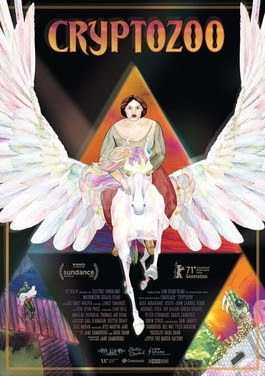
I was also taken by two upcoming releases from distributor Magnolia Pictures. Cryptozoo is the latest boundary-pushing animated escapade from director Dash Shaw, who expands on the promise shown in his 2016 debut, the underseen My Entire High School, Sinking into the Sea. Employing an eye-popping mix of crude and sophisticated animation styles, Shaw and animation director Jane Samborski weave a wild tale about the world's endangered cryptids (think unicorn, Kracken, Gorgon, et al.) and one woman's efforts to protect them from nefarious U.S. military schemes. Voicework is provided by an eclectic mix of actors ranging from Michael Cera to Twin Peaks' Grace Zabriski. Dash Shaw will be the recipient of the festival's 2021 Persistence of Vision Award, given each year to a director whose "main body of work falls outside the realm of traditional narrative filmmaking." He'll also participate in a live Cryptozoo "Making Of" talk on Friday, April 16.

Magnolia is also distributing the superb UK genre flick Censor. Director Prano Bailey-Bond's debut feature is set in a Thatcher-era England where gruesome exploitation movies are being blamed for real-life crimes. That becomes a problem for mousy censor board member Enid, who's recently approved a movie where a man eats his wife's face. Her subsequent dive into the depths of a shady director's filmography reveals a possible connection between an actress and Enid's long lost sister, who disappeared as a child while under Enid's care. The resulting denouement will have viewers either howling in delight or disgust. I was among the former. Although intensely unnerving at times, Censor also has just the right amount of sardonic shadings to take some of the edge off. I was reminded somewhat of fellow UK director Peter Strickland's work (Berberian Sound System, In Fabric). Appropriately, Censor and Cryptozoo will have drive-in screenings in addition to online presentations. 

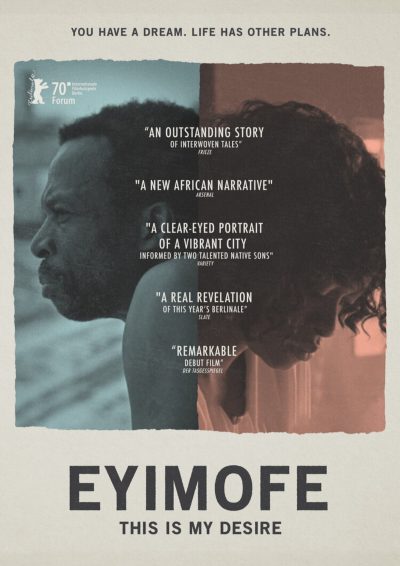
Three favorites from the Narratives: International section depict lives of not-so-quiet desperation as experienced from disparate points on the planet. In her follow-up to 2012's Oscar-nominated Wadjda, Saudi filmmaker Haifaa Al-Mansour's The Perfect Candidate concerns a female doctor's frustrations with getting a paved road to her clinic. She finds herself running for municipal council almost by accident, which the film uses to unveil the small and large humiliations experienced by Saudi women. Nigerian directors Arie and Chuko Esiri's masterful This is My Desire uses a bifurcated structure to render the lives of two Lagos residents dreaming of emigration: a solemn middle-aged printing plant engineer fed up with crumbling infrastructure and his needy family, and a bright female bartender whose life is weighted down by mercantile relationships with men. This is My Desire represents intimate, social issue filmmaking at its best, and stands in sharp contrast to the Nigeria portrayed in noisy Nollywood melodramas. Colombian director Nicolás Rincón Gille employs an episodic approach in Valley of Souls, tracing the aquatic odyssey of a fisherman as he searches a river for two sons murdered by paramilitaries. Elegiac, heartbreaking and enhanced by gorgeous widescreen cinematography, Valley of Soul's languorous 137 minutes are never less than captivating. Side note: it helps to know that Colombian cyclist Egon Bernal won the Tour de France in July, 2019. 

Fans of Latin American cinema should be pleased by SFFILM64's Cine Mexicano spotlight. From among its six offerings I previewed Alexis Gambis's Son of Monarchs, winner of Sundance's Alfred P. Sloan Prize for depiction of science or technology in a narrative feature. The film's main character Mendel (Tenoch Huerta, Gueros, Sin Nombre) is a Mexican biologist whose youth was spent amongst the monarch butterflies in Michoacán's forests. Son of Monarchs alternates between scenes of childhood and Mendel's adulthood in NYC, where he works mapping out butterfly DNA structure while navigating personal existential crises. Not least of the movie's appeal is the refreshing experience of watching a Mexican immigration narrative that doesn't concern the undocumented. Son of Monarchs features a nice supporting role for Gabino Rodríguez, the smoky-eyed, pointy-jawed actor who's the most recognizable face in Mexican independent cinema. Rodríguez also turns up in SFFILM64's Fauna, the actor's tenth collaboration with Mexican indie filmmaker Nicolás Pereda. Fauna nears the top of my list of films to catch during the festival, along with Dance of the 41, a historical LGBT period piece about an early 20th century scandal in Mexican high society. I also hope to see The Spokeswoman, a documentary about the first indigenous woman to run for Mexico's presidency. 

I previewed two additional works from the Narratives: US section. Home is a tough and touching redemption story about an ex-con returning home after a 17-year prison stint for murder. For the most part, the movie effectively conveys a certain type of American underclass without resorting to reductive white-trash miserablism (although some of the sets are art-directed to distraction). Jake McLaughlin delivers an edgy, sympathetic lead performance. He's joined by Kathy Bates as his ornery cancer-afflicted mother, as well as Lil Red Howry (the best friend in Get Out) as Bates' wise homecare giver. Home isn't the type of film I'd ordinarily seek out, but I was fascinated that it's both written and directed by German actress Franka Potente (Run Lola Run, a pair of Bourne movies). I'd love to know what drew her to this project, apart from its providing a juicy supporting role for her husband, actor Derek Richardson, as the protagonist's junkie best friend.

Supercool is another kind of American movie I wouldn't ordinarily watch, but I was curious why SFFILM might program a "teens gone wild comedy." The first thing that struck me was the Finnish subtitles on the festival-provided screener. It turns out that filmmaker Teppo Airaksinen's main body of work lies in Finnish TV (180-plus episodes worth), so how he came to this project is no doubt a story worth hearing. At age 67, I'm clearly not the intended audience for a film like this. I'll therefore reserve judgment except to say it seemed very well made, left me exhausted, didn't make me laugh, had an almost creepy surfeit of queer content and an incongruous retro soundtrack (Huey Lewis & the News!?). Oh, and Damon Wayans Jr. is in it. Supercool is having its world premiere at SFFILM64.

Documentaries traditionally make up a large chunk of SFFILM's line-up and this year is no exception. The one I'm most anticipating is Peter Nicks' Homeroom, which hones in on the triumphs and travails of Oakland High School's 2020 graduating class. The film marks the final installment of Nicks' "Oakland Trilogy," which began with 2012's sublime The Waiting Room about Oakland's Highland Hospital, and continued with his 2017 study of the city's police department, The Force. SFFILM is also honoring Nicks with the festival's George Gund III Craft of Cinema Award, given for "distinguished service to cinema as an art form." Another much-awaited Bay Area-related doc is Mariem Pérez Riera's Rita Moreno: Just a Girl Who Decided to Go For It, which honors the soon-to-be 90-year-old Berkeley resident and EGOT (Emmy, Grammy, Oscar, Tony) winner. The film drew raves at Sundance and following its spring festival rounds, will open theatrically in June. It's worth noting this is one of the few SFFILM64 selections with a limited viewing window (April 9 to 12), and one of only two that are geo-blocked for California residents only (the other being Street Gang). 

A majority of the festival's 18 documentaries are biographical or autobiographical in nature, including four I previewed. In keeping with a Bay Area groove, there's David Alvarado and Jason Sussberg's We Are As Gods, which surveys the visionary life of Stewart Brand. Tagged as the "Intellectual Johnny Appleseed of the Counter Culture" and then later the "Da Vinci of Cyber Culture," Brand is most recognized as creator of "The Whole Earth Catalog." The documentary switches between a chronological retelling of his exploits and accomplishments, and a critical examination of his current interest in "de-extinction." Brand is a leading proponent of this highly controversial science, which seeks to genetically reintroduce extinct species such as the American chestnut tree, the North American passenger pigeon and more ominously, the woolly mammoth. We spend a lot of time with Brand at Siberia's Pleistocene Park, where an entire ecosystem is being prepped for the mammoth's return. One curious omission from We Are As Gods is Brand's creation of The WELL, regarded as the world's first significant virtual community. Brian Eno composed the film's fitting music score. 

Two women directors have made docs focused on their problematic mothers. Co-directed by Paul Sng, Celeste Bell's Poly Styrene: I Am a Cliché honors one of punk music's pioneers. With her anti-fashion sense and mouthful of braces, the "half-caste" Styrene (née Marion Elliott) blasted on the scene with her band X-Ray Spex at age 19, an anomaly in a music genre dominated by white males. Musicians Thurston Moore, Kathleen Hanna and Neneh Cherry are among the talking heads who discuss her influence. She'd dissolve the band three years later at their height of popularity, which was followed by a decades long struggle with mental health issues. Director Bell was born in 1981 and spent much of her childhood living on a Hare Krishna commune, until social services stepped in and she was put in her grandmother's care. Bell narrates her mother's story and often appears on camera, visiting places of significance in Styrene's life. This is sometimes effective (bringing her Mom's ashes to be scattered in an Indian river) and sometimes not (Bell aimlessly wandering around a nocturnal Times Square). 

In contrast, Iranian director Firouzeh Khosrovani narrates but never appears (except in photos) in a documentary about her mother. Radiograph of a Family employs generic archival footage, family photos and movies, love letters, and imagined dialogue to uniquely depict the grossly mismatched marriage between her secular doctor father, and a mother who'd transform from docile bride to a machinegun-wielding religious fanatic during Iran's revolution. It's an eerie and melancholy tale. The final doc I previewed was Oskar Alegria's Zumiriki. The title means "island in the middle of a river" in Basque, and anyone who saw Alegria's The Search for Emak Bakia at the festival in 2013 knows to expect something singularly enigmatic. The river in question is the Arga in northeastern Spain, along whose banks stood Alegria's family home. Zumiriki consists entirely of Alegria building a camouflaged cabin perched on the Arga's banks, and then once built, spending months submerged in the lore and natural surroundings of his childhood stomping grounds. It's charmingly indulgent and a delightful way to spend two hours. 

Now to wrap up with a few odds and ends. On Saturday, April 17 SFFILM will host a virtual tribute to white-hot actress Vanessa Kirby, wherein she'll be presented with the festival's Impact Award. Kirby has been seen nearly everywhere in recent years, from The Crown to three Mission Impossible movies to 2019's $730M blockbuster Fast and Furious Present Hobbs and Shaw, and now of course her gritty, Oscar-nominated performance in Pieces of a Woman. 

For the first time ever, the festival presents a separate section of Mid-Length Films. Defined as ranging between 30 to 50 minutes in length, each of the five programs will present one such film paired with one or two shorts. I'm particularly intrigued by Tales of the Accidental City, which finds a group of Nairobi residents gathered over Zoom for a court-ordered anger management class. Speaking of shorts, SFFILM64 of course has an entire section devoted to them, 56 to be exact, spread out over seven programs. 

Finally, in addition to aforementioned Socks on Fire and Dance of the 41, there are a half dozen more films of LGBTQ interest scattered throughout the program. I'm most intent on catching Romania's Poppy Field, whose protagonist is a closeted policeman called to quell unrest at a Bucharest cinema showing a film with queer content. I'd also love to see the sneak preview of Language Lessons, but unfortunately (for me) it's only showing at the drive-in. The film recently earned raves at Berlin and SXSW and is about a friendship that develops over Zoom between an Oakland gay widower (Mark Duplass) and the Costa Rican woman (Natalie Morales, who also directs) from whom he takes Spanish lessons. I've also heard excellent things about Tove, a biopic about bisexual Finnish children's book author Tove Jansson. The documentary Seyran Ates: Sex, Revolution and Islam profiles a reformist Muslim lawyer who, among other things, is a champion for LGBTQ Muslim youth. Ma Belle, My Beauty and Nudo Mixteco round out SFFILM64's queer offerings. 

 Cross-published at Film-415.