Jim Mickle's Stake Land (2010), co-written by its leading star Nick Damici, has been a consensual favorite for the Twitch team even before its world premiere at the 2010 Toronto International Film Festival (TIFF), where Midnight Madness programmer Colin Geddes described it as "a road movie with fangs" and praised producer Larry Fessenden's "choice to take bigger chances and make bolder choices in spite of budget limitations." TIFF's audience wholeheartedly agreed and Stake Land won the Midnight Madness Award.
Twitch teammate Todd Brown proclaimed Stake Land: "The American horror film of the year. Plain and simple"; a pullquote picked up by the film's marketing team. Sean Smithson, Kurt Halfyard, and Swarez likewise placed Stake Land on their year-end top lists. "Mickle is just happy and unashamed to be making a genre picture with no pretensions to Deep Meaning," Grady Hendrix suggested; Stake Land "alternates between scrappy and stately" commented Kurt Halfyard; and Andrew Mack praised the film's "beautiful musical score that helps evoke that feeling of frontier spirit of the film."
With a a couple of Late Show screenings at SFIFF54 and a "decongestive" three-day stint at the Roxie (April 29-May 1, 2011) as part of Mike Keegan's "Spring Slaughter on 16th Street"—"a respite from the fluff clogging your cinematic sinuses this time of year" (a wry snipe if ever I've read one)—Stake Land bombs the hell out of San Francisco with its devastatingly feral undead.
Although Todd Brown already interviewed Mickle for his "New American Horror" series, and followed through with a handful of supplemental inquiries at TIFF, I couldn't resist my own round with Mickle to promote Stake Land's Bay Area premiere. My thanks to Todd for getting Mickle and I in touch.
[This conversation is not for the spoiler-wary!!]
* * *
Michael Guillén: Jim, your opportunity to interact with audiences and engage their feedback has been primarily through the festival circuit at this point?
Jim Mickle: Yeah. So far, only the festival circuit. I went over to see it at Cinefest this last weekend and that was the first time I'd seen it with an audience in a while.
Guillén: How are audiences taking the film?
Mickle: Great! Since our first screening at Toronto, it's all been great. Mulberry Street (2007) had a weird response. We premiered at South by Southwest and there was a weird response there. I don't think people really knew what to think of it. It floundered a little bit and then it played at the European fantasy festivals where it started to get its legs. People started to appreciate it and realized it wasn't what they thought it was going to be but they liked it for what it was. By the time it hit Tribeca a couple of months later, it had achieved momentum and had a much stronger reception. It really seemed to connect with people.
But Stake Land right off the bat in the middle of September when we hit Toronto really connected with people and seemed to trip the response I like to hear and that I hear kind of often—"I don't really like horror movies but I like this movie"—which I feel is good. People who do like horror movies are increment when they bring their friends or dates or family and those people wind up enjoying it too.
Guillén: You won the audience award at TIFF's Midnight Madness, which isn't a bad start to a festival run.
Mickle: Yeah, that was good validation from them at the start.
Guillén: Did that audience validation come as a surprise? Or did you already have a sense that your reversion of the vampire mythos was strong and sure?
Mickle: It's tough to be able to look at it that objectively, especially that early on, and I remember moments of being on set and thinking, "Wow, this is low budget. This is very DIY. This is like going in the backyard and making a movie." On the one hand, that's great; but on the other hand, that often doesn't translate into a big audience. I remember considering these things at some point and having to black that all out just to keep moving forward, making the movie and trusting the script, characters and actors.
So that was the first thing I remembered when we did win. I didn't expect to win because there were a lot of great movies in Midnight Madness. A lot of movies that played earlier than we did seemed to have a giant reception so I was pretty shocked and excited when we won because I had spent a lot of years in Toronto in high school. It felt like a family field trip to remember all the crazy midnight movies I used to see there and it had always been a goal to have a movie of mine play there at some point.
Guillén: You went to school in New York, is that correct?
Mickle: Yes, I went to film school in New York. I grew up outside Philadelphia.
Guillén: And you've been friends with Nick Damici, the film's screenwriter and lead actor, for going on 10 years now?
Mickle: Yeah, 10 years this week actually. I just found a journal I used to keep in college when I was working on films and jotted down contact info. I looked through it and found "4/19: Met Nick Damici, actor." So, yeah, it's pretty cool to think that Stake Land will be coming out to the day almost 10 years after.
Guillén: I know it's difficult to pinpoint such things and narrow them down, but, what was it in Nick Damici when you met him that gave you a sense that you could collaborate with him in the future?
Mickle: That's a good question. I met him during a student film and he really stuck out. Usually you don't see actors in a student film where you think, "Wow, this guy's great." But he really stood out in that little student film and—especially in film school—you do a lot of work on family melodramas and coming-of-age stories where everybody's finding their voice but they're all 19-22 years old. That was at a time when I was starting to lean towards enjoying genre again. I had gone through a snobby patch of only liking foreign films and forgetting that I had grown up loving horror movies. I sort of fell back in love with them and realized that genre films were the most fun thing to be working on. So I met Nick at that time and he was one of the only people that I talked to on these sets that sort of felt the same way. But also, I have an odd sensibility and have been influenced by a mishmash of a lot of genres and it was sort of the same for him. Then in a weird way we kind of completed each other because he was 20 years older than I am and he grew up with a whole different set of influences whereas I grew up with the films that came a whole generation after so—through our friendship—we were able to pool from a wide range of movies that pertained to what we were into. At the same time, they completely overlapped. We're both turned on by the same material, the same ideas, so I think it was all about that.
Also, we had the same kind of desperation. I was getting out of school and I was in a panic because when you graduate from school you have no idea where you're going to go or what the next step is going to be. It's terrifying. At the same time, Nick was doing In the Cut (2003), the Jane Campion film, he had a role in that, and there was all this uncertainty about whether the film was going to do well and what that might mean for his career. Both of us hit a patch for a couple of years where we were both frustrated and feeling like we weren't getting anywhere. He really wanted to act and write and I really wanted to direct and so it seemed like a perfect pairing.
Guillén: Is it fair to say that it was precisely your mutual love for genre that motivated your decision to collaborate?
Mickle: Yeah, I think so, definitely. When we were working together on that student film it was a crazy shoot where we were staying in cabins out in the middle of the woods for about two weeks and at one point the guy who owned the cabins invited us into his cabin at about 2:00 in the morning after a long shoot to sing karaoke with his family. It was an incredibly weird and surreal experience with all of us film students invading this guy's home and his daughters sitting there in their night gowns with the lights off and karaoke on the TV screen. At one point there was a Barbie doll on the floor and Nick looked at me and said, "I feel like I'm in a David Lynch movie." When he said little things like that was when I realized that he was into the same stuff I was into, I saw the same absurdity too, and right after that experience someone told me, "Hey, that guy Nick just wrote a horror film." That was right at the time I was back into horror films but I couldn't find a lot of other people who were so Nick and I bonded over genre and also bonded over wanting to do something more with the genre, to stretch it. Neither of us were interested in typical horror standards. We were thinking about how we could mix horror with the western genre and come up with a weird mixture.
Guillén: Well, it's true when you mash up genres you get some weird mixtures, but also some exact articulations of contemporary feeling. I've long thought that the juiciness of genre lies in the emotions they trigger. Specific genres trigger specific feelings and I imagine that's why audiences relate to them. When you go mixing up genres, however, you generate some complicated feelings. That's what drew me into Stake Land. Yes, it was a monster movie and I run to every monster movie I can see, but I came away with an appreciation of its complicated emotionality. Colin Geddes has used that term "elevated genre" to describe films like yours and I have to agree it's absolutely appropriate to Stake Land where you've elevated the horror narrative by plumbing its emotional depths.
Mickle: Good! Thank you. I like the horror genre because it gives a filmmaker an avenue to heighten emotions and the complexities of relationships. You can transpose other genres into that and all of a sudden you discover deeper ways of telling the story. Also, a lot of the things we deal with in Stake Land, if it weren't a horror film I think the audience might come away feeling unsatisfied because we never really come to a conclusion. We point out a lot of things about the world around us but we don't try to make Stake Land a strict message movie. We leave a lot of those threads open for discussion. If the film had been an artsy drama with a social critique and didn't have these other fun elements to it, it might have ended up being unsatisfying overall.
Guillén: I consider Stake Land a narrative of blood and salt, in the sense that it's a recapitulative narrative and—as we all know—looking back can be hazardous; you can turn into a pillar of bitter salt. But the positive aim of recapitulation is precisely to consciously place things behind you in order to move on. You accomplished this in Stake Land through Martin's voiceover reflecting on evocations of the Depression era and the frontier West and his own journey into manhood. Connor Paolo, incidentally, inhabits Martin's character arc with tremendous tenderness and dexterity. Can you speak about your choice to use narrative voiceover?
Mickle: I always really liked voiceover and so I'd write it into my scripts in film school and my professors would say, "Oh this is really bad. Never use voiceover." At some point I got trained out of it. At another point, Nick and I were discussing something else—we were adapting a book that was in first person narrative—and both made the decision: "No narration." But I always thought there was something there, a context that was a way of looking into the story that we were missing without it.
When he started sending me the first couple of pages of Stake Land and once the narrative voiceover popped in I was totally like, "Ah, yes! Finally." I really like narrative voiceover and I like how you can use it as a rhythm and use it as almost another thread of the music. It's not just about story but it's also about the tones a lot of times. I was so excited when he first gave those pages to me. It also started to give Stake Land a feel of Terrence Malick, a Badlands feel, a Days of Heaven feel, and those were both movies that I appreciated but never actually thought that I would get to take a stab in the realm, especially by making a horror film. I think the narrative voiceover opened the film up to not having to be just a genre story.
The film is sort of like a backwards time machine that starts in a post-industrial world that is falling apart, then works back through the Civil Rights era almost, back through the Depression, and at one point we're bordering on the Civil War and pioneering, back to hunting and gathering.
Guillén: That's an interesting take. Stake Land is also being likened unto a road movie and within that domain of reference I appreciated that there were journeys within other journeys or journeys that were relayed into further journeys. The journeys overlap and become layered, in other words. So when you talk about the narrative being irresolute—and though that might be considered a criticism by some—that's exactly what I liked. The open-ended quality of the journey has a poetic feel.
Mickle: Absolutely. And I've read critiques of Stake Land that point that out and call it a flaw, like it wasn't a choice, like it was something we forgot. It was kind of the same thing with Mulberry Street, which was raw and we didn't quite have the tone yet. By seeing Mulberry Street several times with audiences, I got a sense of how much we can get away with and how much we can't, and the ways we could have pushed things even further, and so it was fun to come back and take a second stab with Stake Land. I could rely more on my instincts and I could rely on how I knew it would play in the theater with people who are either into it or not into it.
Guillén: I can't believe anyone wouldn't be into Stake Land but different strokes for different folks, I guess.
Mickle: It happens. There are people out there. But I'd rather have people who either love it or hate it. I'm glad it's not a middle-of-the-road movie.
Guillén: Agreed. There's nothing worse than lukewarm genre. I know you've talked to several different people about the design of your vampires. There's been a lot of witty repartee about how different your vampires are from Twilight's glittering vampires. I think one reviewer wrote that your vampires would eat up one of the Twilight vampires and spit out the glitter. How I'd like to angle in on them, however—having just watched the film again the other day—is the peculiar way in which your vampires are a metaphor for America's current economic crisis. These are creatures who maybe at one time were decent law-abiding citizens that have been drained of life—i.e., transformed—by economic forces. You could say these people have had the life sucked out of them by predatorial banks and lending institutions. Do you think that's a valid read?
Mickle: Yes, absolutely. That's part of the film's open-endedness also. We don't try to fit things too tightly into a box or to be too set in our ways. We tried not to play our narrative in any specific time in history. We were vague and unspecific about names and politics—who was the President?—and yeah, the final draft that got greenlit was in September or October 2008 before the election and it was right when people were feeling the vibe between Blue and Red states and the us vs. them politics. Also, there was all that uncertainty about which direction the country would be heading? And what these overall attitudes were going to do to the country? But the time that we were in a lot of ways more interested in was this idea of terrorists and terrorism being used as a way to control people through fear. A lot of that plays into the Brotherhood and their relationship to the vampires. That's what's sort of nice about the zombie and vampire genres—some people say our creatures are zombies/vampires—they are in a sense humans, they are characters, and not just guys in zombie suits.
Guillén: Well, that's another thing I was going to say about your creatures. They're relevant as a potential metaphor not only of how the financial crisis has drained Americans of their livelihood and created, in effect, a class of the undead; but, politically, your vampires—for as feral and ferocious as they are—achieve a certain pathos for essentially being victimized by Christian extremists. They are, in a disturbing way, misguided terrorists being used to rule others by fear. This is all the more relevant in the face of such recent headlines as Terry Jones, the Florida pastor who incited such horrific violence by burning the Koran. Christian extremism is a seriously violent issue in our country today.
Mickle: And I don't think it will cease to go that way. At one point we may have thought, "Oh we've peaked out and Stake Land might have relevance now but it won't keep being relevant."
Guillén: Christian extremism isn't going away. It's only getting worse.
Mickle: During Mulberry Street there was the moment right before we came out where there was the scandal about finding rats all over the Taco Bells in New York. It was like, "Oh my God. What are the odds that would happen right when we were making a movie about rats in New York City?" So we had that little bit of a bump or wave but I remember thinking, "That was our bump or peak and we just missed it." But then we realized, no, these things continue even though we've tried to stay away from being specific about dates and places.
When Obama got elected, there was a week or two where we were saying, "Shit, what is this going to do to the country? What is this going to do to our story? What if he fixes everything? What if he solves the economy? And all the issues in our film are no longer issues? We'll be making a movie that brings people down because it will remind them of the old days."
Guillén: [Laughing.] That's funny. The face of new American horror will be when everything's in order and we live in a state of anxiety that everything will be taken away from us. Right.
Returning to your narrative where order has capsized and the Brotherhood seeks to re-create order through extremist means, I have to say that the sequence where they come in with helicopters and bomb the refuge of settlers with vampires is one of the most brilliant moments of horror ever. What a concept! Every time I watch that scene my heart comes up my throat like I'm going to vomit. It's terrifying.
Mickle: Oh good! [Chuckles.]
Guillén: Lately I've been interacting with several young people engaged with the disposable film movement that seeks to put affordable and available tools into the hands of aspiring media makers. Naturally, there's some discussion about the necessity of going to film school. Can you talk about whether you think it's still important to go through film school and why?
Mickle: Good question. I remember that being the big question in my mind when I decided to go to film school: does it make sense to do this? Or should I just spend my money and time and go off and make my own films? What's great about film school is it provides a structure that allows you to go out and experiment. If people are interested in making film and art, sometimes it's hard for them to focus and get down to it. The one thing you always hear from people is, "I'm going to make a movie. I'm going to make a movie." Three years later you still hear them saying, "I'm going to make a movie." So what was good for me about film school and what was the best class by far was where I made five films in a semester. You're directing a film one week, you're editing it the next, you're working on your friend's movie the next week, then the next week after that you're making another short film and so it keeps you in a mode of constantly being forced to come up with an idea that fits existing criteria and try to find your own way to make it different.
That being said, any form of community-based interest in film is good if it has that sort of film school mentality. For example, the 24-hour film, 48-hour film competitions, are great because they force people to go out and do it because that is the biggest obstacle: going out and doing it. Anything that supports that, I think is good. Especially now with the RED camera, and so many of the DSLRs, there's so many amazing cameras with Final Pro Cut being available, that you can very easily make a film on your own that can hold up to much higher standards than ever before. So the big obstacle now is getting out there and doing it.
Guillén: So if I'm hearing you right, what you're saying is that the value of film school is that it teaches you discipline about production?
Mickle: Yeah, discipline. And networking also. When I look back now and think about the people who I was friends with when I was in film school, there weren't tons of them but I was in that bubble surrounded by others who were dealing with the same sorts of issues, and learning from them, sometimes from seeing what they did wrong. That kind of experience is invaluable and you can't get it from books. There are groups like Blue Tongue films....
Guillén: Ah yes, I deeply admire their collaborative ethos!
Mickle: Well, I look at them and I think, "That's what I would be doing now if I weren't going to film school." I would surround myself in a bubble with people who are making films and who are able to support each other. Larry Fessenden does something like that with Glass Eye Pix. He's got all different scales of movies happening over there in all different stages of production. He's in this awesome world where he gets to bounce around and make his own films but also be able to comment on people's scripts and look at cuts.
Another thing about film school that's good is the competition. You go into a class and you have to watch 30 films that day. I didn't get a sense that NYU was cutthroat but you did want the things you were working on to stand out. Your films are held up to this harsh reality where people critique them. You might not like what they say but that's also something important to learn, rather than loading something up onto YouTube and ignoring the reception. There is value in learning how to handle criticism.
Guillén: Do you know if it's essential to have had film school training in order to break into the industry of studio filmmaking? Does one lead to the other?
Mickle: I think it's absolutely just the opposite. It's weird, you know. I'm in New York and I'm in the independent world here but I just spent two weeks in L.A. working on a film and doing a lot of meetings and started to get a little bit of a sense of that studio system; by no means any real sense of it but for the first time I stuck my toe in those waters. I was blown away by how much it seemed—and I know this sounds cliché—to be a corporate culture. I don't know if there really was or is a presence of film school background, maybe there is but they take things for granted and don't talk about it? But then, the other night I was back in New York and went to a party for IFC Films and wound up in a conversation with a bunch of guys from L.A. and I was blown away by the topics in our conversation. One of the guys I talked to had worked on a T.V. show in L.A. doing lighting but we wound up having a conversation about Terrence Malick. So I guess there's two very different worlds going on there.
One of the best things I did as a young filmmaker was working on a lot of different types of movies, pre-production, production, and post-production, and having that as a background. It helped me navigate but I've started to realize that all that stuff was not essential at all.
Guillén: When you were talking to Todd Brown you said, "I could retire if I got to do a western." That intrigued me, partially because there is such a strong western feel to Stake Land, but also because the western seems to be making something of a comeback not in and of itself but through its galvinization with other genres, particularly horror and sci-fi. Case in point would be this summer's upcoming blockbuster Cowboys & Aliens. Yet I would love and encourage you to do a pure western.
Mickle: Yeah, me too! It's fun to see some of these western mash-ups, but it would be great if all that meant there would be a resurgence of the pure genre. I'm in a minority but I wasn't really impressed with the remake of True Grit. It just felt like it was the best we had for a western and that's okay but I would like to think that the fact that it did well would make it much easier to do it better. Unfortunately, there's a mentality—especially with remakes being so prevalent—where studios don't want to spend a lot of money and westerns with desert sands and period costumes mean money; therefore, no.
Guillén: Well, if anyone could do it, I think it's you. The value of a western lies in its characters and—as someone recently said—there's no small parts in a western. All the characters are important. You've shown us in Stake Land, a horror film, that it's the characters that vitalize the genre.
Shifting into the noir genre, I understand you're adapting Joe Lansdale's Cold in July, which you've describe as a western noir hybrid. Is that still in the works?
Mickle: Yes, it is. It's been an up and down back and forth sort of in the works but just in the last week or two it's gotten a big boost behind it. Half the task is finding the cast and financing but now it looks like the financing is there and a good chunk of the cast is there so I'm hoping by the end of the month that all those nuts and bolts will be put on and it will be ready to go. We're looking to do an August or September shoot.
Guillén: Can you provide a synopsis of that project and why you're being drawn to it?
Mickle: Yeah, sure. It's a story with a lot of twists and turns so it's been a tough pitch, which I sort of like. I don't like the this-meets-that sort of pitch. Cold in July is about a guy, a father, who wakes up one night to find a burglar in his living room. He shoots the guy and kills him and winds up facing off against the father of the dead burglar and they end up having an odd relationship, which is I guess the best way to put it. I like it because in a lot of ways it's two or three different stories in one. By the time you get to the end of it, you can't believe you started where you did. I really like those kinds of stories. I find that so many times when I come to see movies or I read scripts that I know exactly how they're going to end and who's going to be there and where the location is and so this is one of those narratives where some place in the middle you give in to the story and explore it to see where it goes. But it is a morality tale. It's a character-based thriller. What made it tough to get done for a while was that it wasn't a straightforward thriller and I think people wanted something that was going to be easily defined: a thriller that could be put in the thriller section. It finally will go forward without having to lose any of its character stuff.
Someone has pointed out the family stuff in Mulberry Street and Stake Land and Cold In July is going to fit into that, again without really trying, but it's a strong ode to fathers, good dads and bad dads. Nick and I both have great dads and so I think in a lot of ways this is a love letter to them. But also, I'm a huge fan of Joe Lansdale and he's best known for Bubba Ho-Tep and some of the crazier over-the-top stories, but he also has these quiet, simmering, contained stories with twists and turns that are not over the top or big genre mash-ups. He writes both of those equally well but he's not really known for his quiet stories. As a fan of his work, I'm proud to be able to bring that quiet side of his universe onto the screen.
Guillén: Sounds great. Good luck with that. Since you've brought up the suggested father-son dynamic between Mister and Martin, I can reference its sad and lovely poignance in Stake Land's final scenes where you've brought up the necessity of the father having to let go in order for the boy to become a man. Any sense of what happened to Mister?
Mickle: No. Actually no. I had ideas and Larry had ideas and Nick had ideas but the one idea that really came to the forefront was that we shouldn't really know and, to a certain extent, don't really even need to know or want to know. Anytime we pushed in that direction it felt wrong. It's the simplicity that makes it more interesting.
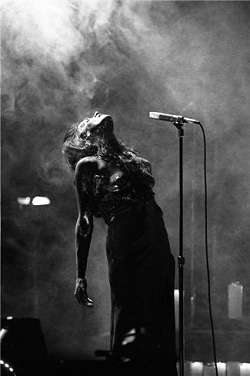
Hailed as one of the most important singers of our time, Diamanda Galás has earned international acclaim for her highly original and politically charged performance works, as well as her memorable rendition of jazz and blues. A resident of New York City since 1989, she was born to Anatolian and Greek parents, who always encouraged her gift for piano. From early on she studied both classical and jazz, accompanying her father's gospel choir before joining his New Orleans-style band, and performing as a piano soloist with the San Diego Symphony at 14.
In the '70s, Galás played piano in the improvisational scene around San Diego and Los Angeles with musicians such as Bobby Bradford, Mark Dresser, Roberto Miranda, Butch Morris, and David Murray. She made her performance debut at the Festival d'Avignon in 1979, where she sang the lead role in Vinko Globokar's opera, Un jour comme un autre, based upon the Amnesty International documentation of the arrest and torture of a Turkish woman for alleged treason. While in France, she also performed Iannis Xenakis's work with l'Ensemble Intercontemporain and Musique Vivante.
Galás first rose to international prominence with her quadrophonic performances of Wild Women with Steak Knives (1980) and the album The Litanies of Satan (1982). Later she created the controversial Plague Mass, a requiem for those dead and dying of AIDS, which she performed at Saint John the Divine cathedral in New York City and released as a double CD in 1991. In 1994, Led Zeppelin bassist John Paul Jones and Diamanda Galás sought each other out for a collaboration that resulted in the visionary rock album, The Sporting Life.
Over the past two decades, Galás's wide range of musical and theatrical works have included The Singer (1992), a compilation of blues and gospel standards; Vena Cana (1993), exploring AIDS dementia and clinical depression; Schrei 27 (1996), a radical solo piece for voice and ring modulators about torture in isolation; Malediction and Prayer (1998), a setting of jazz and blues as well as love and death poems by Charles Baudelaire, Pier Paolo Pasolini and Salvadoran guerrilla fighter and poet Miguel Huezo Mixco, occasionally fused with the virtuosic singing of the Amanes (improvised lamentation from Asia Minor); La Serpenta Canta (2004), a greatest-hits collection from Hank Williams to Ornette Coleman; and Defixiones, Will and Testament (2004), an 80-minute memorial tribute to the Armenian, Greek and Assyrian victims of the Turkish genocides from 1914-1923.
Galás has contributed her voice and music to Francis Ford Coppola's film, Dracula, Oliver Stones' Natural Born Killers, Spanish / Nicaraguan filmmaker Mercedes Moncada Rodriguez's El Immortal (The Immortal), as well as films by Wes Craven, Clive Barker, Derek Jarman, Hideo Nakata, and many others. In 2005, Galas was awarded Italy's first Demetrio Stratos International Career Award. Her much-anticipated CD, Guilty Guilty Guilty, a compilation of tragic and homicidal love songs, was released by Caroline in the U.S. and MUTE UK worldwide on April 1, 2008.
In 2005, Diamanda Galás asked Italian filmmaker Davide Pepe to create the visual analogue to Schrei 27 (2010) based upon her eponymous 1994 radio piece, a co-commission of New American Radio and the Walker Art Center (Minneapolis). This is her first collaboration with a filmmaker on a major project and the world premiere of the filmic version of Schrei 27 is scheduled at London's Barbican Theatre as part of the SPILL Festival of Performance on April 22-23, 2011. The work furthers a 1996 live performance staged in complete darkness under the title of Schrei X, which was subsequently presented by Divadlo Archa Theater (Prague), Wexner Center for the Arts (Columbus, OH), P.S. 122 (New York City), Portland Institute for Contemporary Arts (PICA), and On the Boards (Seattle).
In 1994, New American Radio in Staten Island commissioned Diamanda Galás to compose a work dealing with asylum institutionalization—the warehousing of an individual whether for political or personal reasons. The work was created with co-commissioning funds from the Walker Arts Center, where the radio version was recorded. 27 refers to the amount of minutes available for the radio broadcast, although Galás insisted upon silence between each of the many sections of the work on the radio. This proved controversial because nothing is more forbidden on radio than "silence".
The work consists of several short performances over the space of 27 minutes alternating extreme high-energy vocal work with absolute silence. The performances are chapters of a confession which might have been induced through a chemical or mechanical manipulation of the brain. They reflect the state of a patient subjected to torture in a confined space with periodically or randomly triggered bright light, heat, beatings or rapes. There is a high density of speech-sound over time which is often machine-like in its velocity. The work employs the atypical speech and vocal signal processing that Galás has been researching since 1979.
As synopsized in the chapter extract "Schrei ecstatic performance" from David F. Kuhns' German Expressionist Theatre: The Actor and the Stage (1997): "The term 'Schrei' has a rather narrow semantic range including: 'cry, shout, yell, howl, wail, scream, shriek.' As applied to Expressionist performance specifically, the significance of the Schrei varied according to the type of script and production it served, but all types appear to have found a use for it. ...More than any other performance feature, consequently, the Schrei became the hallmark of that breadth of vocal and physical performance capability—and endurance—which was the first standard of excellence in Expressionist acting. However, it seems to have assumed its most comprehensive meaning in certain of the earliest Expressionist dramas, where emotional expression itself was both the subject, and the chief agency, of dramatic action. ...[T]he phrase 'Schrei Expressionism' is meant to signify early stage Expressionism, the development of which occurs first not in Berlin or Vienna but in various progressive provincial theatres, chiefly located in the south-German cities of the Rhein–Main area, as well as Dresden, and Munich."
It was with great pleasure that I anticipated the premiere of Schrei 27 by way of a telephone conversation with Diamanda Galás. My sincere thanks to Janette Scott for facilitating same.
* * *
Michael Guillén: Diamanda, what does Schrei mean?
Diamanda Galás: Schrei means "shriek" but it can mean a shriek that's the sound of objection, or the sound of funereal mourning, it can be used many different ways. The tradition of Schrei theater comes from small German villages, not Berlin, not Munich, and it was a virtuosic tradition where movement was oral and the sound was corporeal. The idea was that the spoken word and gesture were one. When I started referencing Schrei theater years ago, I was thinking of it in its particular form as related to German Expressionism. It was a rigorous actors theater. A Schrei theater performer was expected to be virtuosic because the words were springboards for extreme mental states. In some cases, there were few words but the actor was expected to do a hell of a lot with those few words. Many times they would perform in cafés or small theaters. They were usually shut down because the subject matter was forbidden. It was a theater style that was considered decadent.
This was all before Hitler; but, it's a tradition whose documentation was destroyed during Hitler's era so there's not much to go on and little has been written about it. In any case, what I wanted to do in this collaboration with Davide Pepe was to develop a piece that had first been commissioned for the radio by New American Radio and the Walker Art Center in Minneapolis. I worked on that and then went to the studio to perform the piece for the radio. The problem was that you couldn't have silence on the radio, even though the silence was part and parcel of the work. But it was forbidden on the radio. We couldn't get paid for silence.
So I did that piece of it and then I did live performances of it but I had created a work that was almost impossible to perform. The performances are all extremely intense. In order to do it right, I had to work very hard, to work with just voice, ring modulators, delay units, distortion units, a lot of different types of processing. My collaborator was Blaise Dupuy and he was incredible; but, we performed it only a few times and it was not a popular piece. As a matter of fact there was usually a lot of screaming in the middle of it and audience complaints because I performed it in darkness and it was unrelenting for 27 minutes. People were angry about the piece—that's just the way it was—but the idea was that it was a piece about isolation. The visual world, you know, is much easier to access than the sonic world. Chances are that when you get into the avant-garde sonic world, you don't even get paid.
Guillén: Why is that?
Galás: Why? First of all, if you look at a painting, you see it all at once. You can stand there and look at it as long as you want, from up and down to left and right; but, you have that one moment when you do see it. With an audio work that takes 27 minutes, you have to actually pay attention for 27 minutes. Most people can't even go to a concert anymore. They can't read a book anymore. They can't do that and sit in their seat. That means that—if you do an avant-garde work that is avant-garde by nature of the fact that you haven't heard it before and you'll never hear it anywhere else and true to its militaristic connotation it's on the front line—the audience can think, "Do I really want to go through this?" Whereas when you've seen a painting, you've already gone through it, unless you've decided not to. Film also allows the option of staying or leaving. While watching a film you might have expectations that things might change and become more entertaining; but, with audio it's not about being entertaining.
Guillén: I imagine sound also affects and interacts with the body differently than visual stimulation?
Galás: When it comes to audio, a person has to want to stand it, to sit through it, and I don't give them a chance. In 2007, Schrei 27 was curated as a quadrophonic installation in complete blackness by the notorious Basque transvestite curator Xabier Arakistain in the Canary Islands and in Victoria, Spain. Whereas everyone else was doing video performances, I said, "This is my video performance." I walked in, the room went completely black, and I performed in quadrophonic sound so that they could close their eyes and the video would be what they would see when they closed their eyes. Naturally, they were horrified by this! But I wasn't going to give them a damn video. I told them, "This is my video, okay? Take it or leave it." So that was the first "film" version of Schrei 27.
Then I saw the wonderful work of Davide Pepe who had been documenting my concerts for years. I didn't want to watch myself on video because I thought it was going to be awful to watch myself. But Davide said, "You must. Sit down. At least watch this film I did." He showed me his film Little Boy and it was incredible! Many of the things that I have been doing with audio were like these flickering gestures he is doing with film. His sense of time is scary. And his audio sensibility is astonishing because he uses the sound of the camera itself. When I saw how he used this in Little Boy, I thought, "Jesus Christ! This is my collaborator." The propulsion of his images, the flickering decontextualization of a situation, matched the kind of vocal work I was doing.
The truth is that you should also talk to him because we are both the filmmakers, both sound and visual. I'm only half the team. One could say, "Yeah, but you're the actor in the film" but that's not true either. His friend Salvatore Bevilacqua is one of the actors in the film too. I want to make that clear. I don't like the idea of not giving credit where credit is due. Davide is in Bologna right now working on all the final touches on the film.
We continued from the idea of Schrei theater that the corporeal and aural merge and come out of each other; equal components of the mise-en-scène. It isn't that one accompanies the other; it's that they're both the same. You'll have a very loud sound coming out of the speakers while you're in a group of people watching this film and—in this regard—it's a similar thing to what was being done with Schrei theater. A lot of them would dress up wearing black costumes with only the bones of the face so that they looked like skulls. Or they would paint the nerves of the body so all you would see was red nerves on blue fabric. The idea was to get to an interior place and an extreme heightened emotional state.
When I saw Davide's film Little Boy, I thought, "Okay, this is the person I can do Schrei 27 with." But he had to understand that this was a relationship. I didn't want him to just film my performance, no, no, no. I wanted to work with him together. It's been such a great experience because I have many paintings and drawings—many of them are of the face or the body in different contortions—but they're scenes of military execution. The subject of the film is a person who has been isolated from society by being put into a mental hospital or a prison where they have been experimented upon in an attempt to confess what they know or to forget what they know. Sometimes it's just an attempt, as we all know, to research torture to see how it goes; to see what new techniques do this and what new techniques do that.
This is something that is commonly known among Greek prisoners who were sent to the Devil's Island many years back and tortured. They were hidden in mental institutions and by the time they got out of there, you never knew what to expect. A lot of them couldn't walk anymore. Not only were they beaten on their feet, but their entire legs were broken. A lot of these people you never hear from. You hear from people who were around the scene but the actual people who were tortured never want to talk to anyone again, ever. It's similar to Vietnam vets. If you go to a Vietnam vet and ask, "Tell me all about your experience", they'll say, "Forget about it."
In a sense this is all, again, connected to the idea of the schrei. The schrei is a scream of terror. It's a scream of the nightmare made flesh, which is something I also used to say to describe Plague Mass. I have worked with voice for many many years and I've trained with many teachers because I believe you must have extreme training to be able to move between—not only the speaking and the singing and all the vocal techniques and all the languages—but between dynamics, to move fluidly and with great dexterity, not having to stop because you can't make a sound you hear. But my desire was not just about wanting to become a virtuoso, it was to realize something emotional. What we have now in this film or this installation, whatever you want to call it, is a unique relationship between the audio and the visual. I don't know, perhaps you know more about this than I do, but I don't know of many films that are made like that.
Guillén: It intrigues me that even now you are ambivalent about whether Schrei 27 is a film or an installation. You don't consider this your first true film?
Galás: I think so, yes. You know my background with film. I've done videos with Peter "Sleazy" Christopherson for songs of mine like "Double-Barrel Prayer", but if you don't count those things, the only other film I've been involved with is David Wojnarowicz's Fire In the Belly, which is rarely seen because the "original" version is in dispute [see Pia Catton's Wall Street Journal article on this controversy].
Part of Schrei 27 also comes from my research on the Ewen Cameron mind-control experiments done for the CIA where he would subject people drugged on phenobarbital to a tape loop that would say, "I always wanted to fuck my father", then he would shoot them full of insulin, and leave them in isolation for 24 days. By the end of that period they had forgotten everything they'd ever known except that they had always wanted to fuck their father. Cameron was looking for alternate ways to eliminate information from someone's brain without killing them—very Manchurian Candidate kind of stuff—but he was paid a lot by the CIA. There were also places like Willowbrook where they conducted hepatitis experiments on children, injecting them with the hepatitis virus to see what would happen. They found out! Then the experiments were revealed. There have been so many people who have been experimented upon in mental hospitals, old folks homes, prisons.
Guillén: And I've no doubt such covert practices continue to this day.
Galás: Oh yes, big time! Actually, I did a lot of the drawings that are in this film when I was in an artists colony in Italy. I got kicked out of it for causing problems—what they called "insubordination"—and they had their security take me to another city where they dumped me off. I was suspicious of the colony because of the way we were treated. I felt they were covering themselves up as an artists colony but that, in fact, the colony was being used for some other purpose. We were put in rooms without heat, treated badly, given bad food, demoralized and humiliated; it was quite the experience. We were punished for speaking any language besides English. It was all the more shocking because it was run by distinguished people from the university. Here I was supposed to be working on a piece about institutionalized torture and found myself in this situation. A lot of the drawings in the film came out of my experience of being there.
The film also includes medical photographs of my vocal chords that were taken with a camera inserted into my throat. It's an awful process but a doctor friend of mine wanted to see what my vocal chords would look like when I was doing unorthodox sounds. Because he was my buddy, I said, "Okay, just this once." We did it, so we have the footage, and when you see my vocal chords, it's almost shocking. I also had to have some surgery on my hand and had those x-rays, and we collected other x-rays from doctors and different kinds of medical footage. We had engineers remix sections from Schrei 27 so—though parts of the film are like the original Schrei 27—the film includes additions to the work that make it different and more current than anything from before.
Guillén: I'm sure the film is going to rock your audiences when it premieres at the SPILL Festival of Performance at London's Barbican. You've attended the festival before?
Galás: No. But I've performed at the Barbican many times.
Guillén: And though Schrei 27 is perhaps truly your first collaborative film project, you have worked on other peoples' films, largely as a sound artist. I didn't realize until I was researching your career that you are the voice that has horrified me in several movies. You were the voice of the dead in Wes Craven's The Serpent and the Rainbow (1988). Your cover of the Schwartz-Dietz song "Dancing in the Dark" appeared in Clive Barker's film Lord Of Illusions (1995) during the closing credits. Your song "Exeloume" appeared on the soundtrack to Derek Jarman's The Last of England (1987).
Galás: That's so nice, with Tilda Swinton!
Guillén: "Exeloume" is a beautiful song. You were also the voice for the female vampires in Francis Ford Coppola's Dracula (1992), the voice of the witch in John Milius's Conan the Barbarian (1982), and several of your songs—"I Put a Spell On You", "Vena Cava", "The Lord is My Shepherd", and "Judgment Day"—were featured on the soundtrack for Oliver Stone's Natural Born Killers (1994).
Galás: There was also a beautiful film called El Immortal about the war in Nicaragua by Mercedes Moncada Rodriguez. She used a lot of my music in that film too. You're right that I've worked on a lot of those films but I've never done a full soundtrack. I'm not convinced I would be a natural person to do that because ... well, let's put it this way: Bernard Herrmann was such an incredibly great composer, as you know, but I think it's odd that when people talk about Alfred Hitchcock, they rarely know who Bernard Herrmann is. I'm not saying that people in the film industry don't know; but, the average moviegoer doesn't know. But his work was so essential and terrifying. Have you heard Herrmann's soundtrack to Brian DePalma's Sisters (1973)? My God!! The combination of moog synthesizers and the orchestra was his incredible innovation. And the sounds of the birds in The Birds (1963) he got from an organ from a guy in Germany, an electronic music composer. He never used one real bird sound. He was constantly working on these effects and did a good job but was at the mercy of the studios. The way he ended up at the end of his life must mean it's only worse now.
Guillén: I'd like to think that there's more opportunity to—as you suggest—reveal how important those collaborations were. I was actually watching a video interview with you where you were talking about how little recognition has been received by the great ballad composers. I'm sure much of that neglect is based upon an over-reliance on auteurist notions of creativity as some kind of singular activity, when in truth these projects are co-auteurial and collaborative. I'm sure Schrei 27 has been a collaborative project?
Galás: Oh yes! For example, I did Litanies of Satan with Dave Hunt who produced the music. That guy has a monstrous knowledge of electronic music but has no interest in self-promotion. He could have if he had wanted to. I bring his name up because he's a complete genius. I brought him material from Schrei 27 and asked, "What do you think about this section here? Or what do you think about making this do that?" He did the remix and added sounds to that section, which is towards the end of the film. I won't tell you what happens there but it's just beautiful what he's done with ring modulation, delay and distortion. Obviously I'm making decisions about what I like or what I don't like and making technical decisions and requests and offering suggestions about what kind of ring modulations I want, but we're all working together. That's what I love! When you're working with Dave Hunt and Blaise Dupuy and engineers like them, you end up with something layered and complex. I'm adding something visual and they're contributing brilliant audio elements. I can't say, "Oh, I'm the composer and, therefore, you can't add anything." What a bunch of shit that would be. For what reason? He has great ears. Such collaboration is my dream with this film.
That was my basic idea in the first place. Film started with silents, then went to talkies, then added soundtracks, but by the time it got to Bernard Herrmann, he took it to an altogether different level that was beyond melodramatic compositions or the poor use of symphonic pieces from Rachmaninoff. He didn't just want people to weep their heads off. He worked at combining electronics with his lush symphonic scores, coming up with a hybrid that was truly terrifying. That's what I'm interested in. When you think of Herrmann's chord changes being dramatic elements and then you think of the electronics as being dramatic elements and then you think of all these modulations interfacing and interweaving, everything potentiates everything else. To say that he was just adding a "soundtrack" to a visual is simply absurd.
Guillén: Last night to prepare for today's interview, I spent about three hours watching every YouTube video of yours I could find.
Galás: Oh my God!
Guillén: I was surprised to discover how many standards you've sung.
Galás: For years I was in my father's band with my brother Philip-Dimitri—I started out with my father first and Philip joined us later—but I had to play four hours of standards a night. We did New Years Eve gigs and played all those songs.
Guillén: Well, what I was going to say was that—the way you perform these standards?—it's not accurate to say you're doing covers. That would be a ridiculous statement because covers imply a surface treatment of a song. You interpret these songs and they come from the inside out. For example, your interpretation of Holland-Dozier-Holland's "My World Is Empty Without You" downright blows me away.
Galás: Thank you. You would never say that John Coltrane was doing "covers." You might say Miles Davis, because his approach was different, but you'd never say John Coltrane or Ornette Coleman were doing covers. Hello! Coltrane knows the chord changes. He knows the melodies. He knows those are two different things. And then he also knows what the songs are about, which is usually indicated by the chord changes anyway, and then he goes! Any musician starts with knowing those things but then they take it into their own world—if they have one!—and, if they don't, then.... Or maybe you might want to do a song straight just because you want to play it straight. I'm like that too. The simple, stark, straight-up interpretations appeal to me because—if you use the same approach and play every song the same way—that's stupid and boring. When people say, "Oh, you're doing covers", I just look at them and think, "You're really fucking stupid. For God's sake!"
When people say Rubinstein performed Chopin the same way every night, I don't think so. If that were the case, he would not have been able to perform Chopin the same way every night; he would have been too bored. There's a level after which you can't call it a "cover" and it's a level of knowledge and musicality. To call it a cover is just stupid.
Guillén: You have a palette you use and much of it leans into the horrific and the terrifying. Can you speak to the aesthetic that drives you in that direction and why it appeals to you?
Galás: I have to say it's autobiographical. God, when I say it that way it sounds like My Name is Barbra, doesn't it? But I know a lot about isolation and I know a lot about wanting to be alone; but, I also know what it does to you after a while. I know about the levels of extreme depression and mania. I know that whole route. I know a lot about the black and I know a lot about the white but I don't know much about the grey at all. That's something you try to learn so that you can stay in the game, you know? But the grey is not a natural thing for me. It wasn't natural for my father or for my brother Philip. We all share a certain temperament.
It has sometimes erroneously been said that Philip's work is comic and I think, "Are you fucking out of your mind? What he writes is tragic." And then they'll say, "But his work doesn't look at itself in that regard." And then I want to say, "You know what? Why don't you shut up? Do you not know that what is not part and parcel of the other is going to be inferior? Do you understand that?" Let's talk about the "comic" Lenny Bruce. Oh yeah, he was a real upbeat guy. C'mon!
I feel that Philip and I in a sense were doing the same kind of work; but, one sprung out of the word and the other out of the melody or however one might conceive of melody. Still, I would never be inane enough to say, "Oh yes, the theater of words. There's certain things you cannot express with words." I would say, "Well, yeah, if you're a bad poet there are certain things you cannot express with words." And then by the same token, "There are certain things you cannot express with music." Again, by the same token, if you're a bad musician, there are indeed some things that you cannot express with music. And it doesn't mean that you can't do one or the other, it means you have the ambition to combine things; but, that's not because you have a weakness.
Guillén: As a final question, then: the color black is so important to you and, of course, it's been mistakenly and tritely associated with goth; but, what does the color black mean for you?
Galás: It means cover. It means being unseen. It means being covered by blackness. My first experimental works were performed in the dark. I didn't want anyone to see my face. It's perhaps the same impulse as in Greek theater where they came onto the stage with huge masks. They didn't want people to see the nuances of their face while they performed. They wanted to be free. There's something that has to be free in order for you to express yourself fully and I like to work under cover of darkness—a lot of my lighting emphasizes darkness on stage—because ideally I wouldn't have lights on stage at all. It's hard for me to explain. I just like to be alone when I'm performing. I don't like people to see what I'm doing when I'm performing. But then eventually, one does use light for specific reasons, and then you start combining lights in interesting ways, but I still would say that as a performer black means I don't want to be looked at; I want people to listen.
Guillén: Which reminds me of a comment you made regarding Édith Piaf and how when she sang she disappeared into the song, into her music.
Galás: When I look at her filmed performances, I see that her gestures and her sound, the change of timber and the change of dynamic, are all the same. She was a classic actress in that regard. She was profound in her work. Her sense of timing, oh my God! The minimalism of her gestures. She didn't do big gestures. When she was asked, "How do you know what to do next?" she would say, "The music tells me." On a certain level you work with theatrical people to give you ideas—I haven't done that; perhaps I should—but the main instructor is always the music. Piaf understood these things and she was impeccable and, yes, there was a little black dress and that was it! It's not about you, really. It is you but it's you as the carrier and the conductor of something that your mastery has facilitated. Otherwise, why do it?
Guillén: It's interesting you mention Piaf's little black dress because I actually saw that little black dress in Paris at a major exhibition of her work at the Hôtel de Ville.
Galás: Did you?!
Guillén: I remember just standing there staring at it. I was caught in its orbit as if I were caught in the orbit of a painting by Gauguin or Van Gogh. It was a remarkable remnant of performance.
Galás: I love that.
Guillén: Another aspect of your performing under cover and not wanting to be seen is your habit of rapidly leaving the stage after you perform. I've noticed that in some of your videos.
Galás: I can't stand it! I don't want to be standing there after performing. My first instinct is: "Oh my God, here come the vegetables!" I don't want to hear anybody say anything to me. I don't want to know anything. I know how good the show was and if people disagree with me, that's their business. I don't like standing there not doing anything and standing there is being the recipient of the audience's reactions without any ability to do anything but stand there. I find that insane. It's like going into the ring without your boxing gloves.
The advantage of making young friends is that they turn you on to their favorite music. My thanks to Dominic Mercurio for drawing my attention to Animal Collective.
I already mentioned in my preview of As If! Like, a performance, Duh (As If!), that—if you haven't already bought a ticket for the sold-out six+-performance run of As If!—you might as well plaster a big ol' glittery "L" on your forehead. Talk about a failing grade. And now that I've seen the show, I can emphasize in bold that "L" is for LOSER! Check it out! You better pray or pay big bucks to get squeezed into the remaining performances of this enthused, imaginative and downright fun send-up of Amy Heckerling's 1995 American comedy Clueless.
I'm the first to admit that I am way too old to have experienced the "val-parties" of the 1990s; but—thanks to the prescient vision of Energy Club Unlimited (namely, Em Gift, Leslie Kulesh and Liz Franczak)—intermission to As If! provided an opportunity to interactively experience the film's theme party by drinking my whiskey neat, smoking a little boo, and dancing a sweat to infectious music from the '90s, while cast members of the ensemble interacted with their audience and furthered narrative traction by renacting key scenes from that infamous party.
Em Gift deserves a major shout-out for her creative staging of Liz Franczak's adaptation of the original screenplay, using Engine Works' limited space to maximum effect (her stashing and staging of props was completely ingenious), and Franczak has done a sharp job of condensing the screenplay to its most comic elements, assisted by Nick Demarco's video interstitials (the "loader" sequence with a pothead sucking on a bong was priceless). The re-creation of a 1990 Beverly Hills high school was achieved through Leslie Kulesh's evocative installation set-pieces and Leah Martin's vibrant quick-change costume design splashed color all over the stage.
Performance-wise, the women owned that colorful stage: Hannah Hunt inhabited the role of Cher Horowitz to sexy perfection and her frustrated whine guaranteed a laugh every time. Carla Baker as Cher's best friend Dionne (the two were named after famous acts reduced to infomercials and were best friends because they each understood what it meant to have others be jealous of them) brought to hilarious life the freeway driving sequence: perhaps one of the most difficult scenes to re-enact from the entire film. Katie Miller as Tai was sexy as a stoner gal shifting into valleyhood and—of all the male actors in the ensemble—Andy Schosser shone as skater boy Travis, inflecting his characterization with charismatic street cred. Perhaps the performance that most deviated from the original (and popped because of that) was Anna Seregina as the lesbian P.E. coach Ms. Stoeger. But let me emphasize, the ensemble as a whole deserve ovation.
I wanted to stick around for the second late night performance but it was sold out. On the horizon for Energy Club Unlimited? A staging of Party Girl or The Craft. I want witches! What about you?
 Jim Mickle's Stake Land (2010), co-written by its leading star Nick Damici, has been a consensual favorite for the Twitch team even before its world premiere at the 2010 Toronto International Film Festival (TIFF), where Midnight Madness programmer Colin Geddes described it as "a road movie with fangs" and praised producer Larry Fessenden's "choice to take bigger chances and make bolder choices in spite of budget limitations." TIFF's audience wholeheartedly agreed and Stake Land won the Midnight Madness Award.
 With a a couple of Late Show screenings at SFIFF54 and a "decongestive" three-day stint at the Roxie (April 29-May 1, 2011) as part of Mike Keegan's "Spring Slaughter on 16th Street"—"a respite from the fluff clogging your cinematic sinuses this time of year" (a wry snipe if ever I've read one)—Stake Land bombs the hell out of San Francisco with its devastatingly feral undead.
 Michael Guillén: Jim, your opportunity to interact with audiences and engage their feedback has been primarily through the festival circuit at this point?
 Mickle: It's tough to be able to look at it that objectively, especially that early on, and I remember moments of being on set and thinking, "Wow, this is low budget. This is very DIY. This is like going in the backyard and making a movie." On the one hand, that's great; but on the other hand, that often doesn't translate into a big audience. I remember considering these things at some point and having to black that all out just to keep moving forward, making the movie and trusting the script, characters and actors.
 Guillén: And you've been friends with Nick Damici, the film's screenwriter and lead actor, for going on 10 years now?
 Also, we had the same kind of desperation. I was getting out of school and I was in a panic because when you graduate from school you have no idea where you're going to go or what the next step is going to be. It's terrifying. At the same time, Nick was doing In the Cut (2003), the Jane Campion film, he had a role in that, and there was all this uncertainty about whether the film was going to do well and what that might mean for his career. Both of us hit a patch for a couple of years where we were both frustrated and feeling like we weren't getting anywhere. He really wanted to act and write and I really wanted to direct and so it seemed like a perfect pairing.
 Mickle: Yeah, I think so, definitely. When we were working together on that student film it was a crazy shoot where we were staying in cabins out in the middle of the woods for about two weeks and at one point the guy who owned the cabins invited us into his cabin at about 2:00 in the morning after a long shoot to sing karaoke with his family. It was an incredibly weird and surreal experience with all of us film students invading this guy's home and his daughters sitting there in their night gowns with the lights off and karaoke on the TV screen. At one point there was a Barbie doll on the floor and Nick looked at me and said, "I feel like I'm in a David Lynch movie." When he said little things like that was when I realized that he was into the same stuff I was into, I saw the same absurdity too, and right after that experience someone told me, "Hey, that guy Nick just wrote a horror film." That was right at the time I was back into horror films but I couldn't find a lot of other people who were so Nick and I bonded over genre and also bonded over wanting to do something more with the genre, to stretch it. Neither of us were interested in typical horror standards. We were thinking about how we could mix horror with the western genre and come up with a weird mixture.
 Guillén: I consider Stake Land a narrative of blood and salt, in the sense that it's a recapitulative narrative and—as we all know—looking back can be hazardous; you can turn into a pillar of bitter salt. But the positive aim of recapitulation is precisely to consciously place things behind you in order to move on. You accomplished this in Stake Land through Martin's voiceover reflecting on evocations of the Depression era and the frontier West and his own journey into manhood. Connor Paolo, incidentally, inhabits Martin's character arc with tremendous tenderness and dexterity. Can you speak about your choice to use narrative voiceover?
 Guillén: That's an interesting take. Stake Land is also being likened unto a road movie and within that domain of reference I appreciated that there were journeys within other journeys or journeys that were relayed into further journeys. The journeys overlap and become layered, in other words. So when you talk about the narrative being irresolute—and though that might be considered a criticism by some—that's exactly what I liked. The open-ended quality of the journey has a poetic feel.
 Guillén: Agreed. There's nothing worse than lukewarm genre. I know you've talked to several different people about the design of your vampires. There's been a lot of witty repartee about how different your vampires are from Twilight's glittering vampires. I think one reviewer wrote that your vampires would eat up one of the Twilight vampires and spit out the glitter. How I'd like to angle in on them, however—having just watched the film again the other day—is the peculiar way in which your vampires are a metaphor for America's current economic crisis. These are creatures who maybe at one time were decent law-abiding citizens that have been drained of life—i.e., transformed—by economic forces. You could say these people have had the life sucked out of them by predatorial banks and lending institutions. Do you think that's a valid read?
 Guillén: Well, that's another thing I was going to say about your creatures. They're relevant as a potential metaphor not only of how the financial crisis has drained Americans of their livelihood and created, in effect, a class of the undead; but, politically, your vampires—for as feral and ferocious as they are—achieve a certain pathos for essentially being victimized by Christian extremists. They are, in a disturbing way, misguided terrorists being used to rule others by fear. This is all the more relevant in the face of such recent headlines as Terry Jones, the Florida pastor who incited such horrific violence by burning the Koran. Christian extremism is a seriously violent issue in our country today.
 When Obama got elected, there was a week or two where we were saying, "Shit, what is this going to do to the country? What is this going to do to our story? What if he fixes everything? What if he solves the economy? And all the issues in our film are no longer issues? We'll be making a movie that brings people down because it will remind them of the old days."
 Guillén: Lately I've been interacting with several young people engaged with the disposable film movement that seeks to put affordable and available tools into the hands of aspiring media makers. Naturally, there's some discussion about the necessity of going to film school. Can you talk about whether you think it's still important to go through film school and why?
 That being said, any form of community-based interest in film is good if it has that sort of film school mentality. For example, the 24-hour film, 48-hour film competitions, are great because they force people to go out and do it because that is the biggest obstacle: going out and doing it. Anything that supports that, I think is good. Especially now with the RED camera, and so many of the DSLRs, there's so many amazing cameras with Final Pro Cut being available, that you can very easily make a film on your own that can hold up to much higher standards than ever before. So the big obstacle now is getting out there and doing it.
 Mickle: Well, I look at them and I think, "That's what I would be doing now if I weren't going to film school." I would surround myself in a bubble with people who are making films and who are able to support each other. Larry Fessenden does something like that with Glass Eye Pix. He's got all different scales of movies happening over there in all different stages of production. He's in this awesome world where he gets to bounce around and make his own films but also be able to comment on people's scripts and look at cuts.
 Mickle: I think it's absolutely just the opposite. It's weird, you know. I'm in New York and I'm in the independent world here but I just spent two weeks in L.A. working on a film and doing a lot of meetings and started to get a little bit of a sense of that studio system; by no means any real sense of it but for the first time I stuck my toe in those waters. I was blown away by how much it seemed—and I know this sounds cliché—to be a corporate culture. I don't know if there really was or is a presence of film school background, maybe there is but they take things for granted and don't talk about it? But then, the other night I was back in New York and went to a party for IFC Films and wound up in a conversation with a bunch of guys from L.A. and I was blown away by the topics in our conversation. One of the guys I talked to had worked on a T.V. show in L.A. doing lighting but we wound up having a conversation about Terrence Malick. So I guess there's two very different worlds going on there.
 Guillén: When you were talking to Todd Brown you said, "I could retire if I got to do a western." That intrigued me, partially because there is such a strong western feel to Stake Land, but also because the western seems to be making something of a comeback not in and of itself but through its galvinization with other genres, particularly horror and sci-fi. Case in point would be this summer's upcoming blockbuster Cowboys & Aliens. Yet I would love and encourage you to do a pure western.
 Shifting into the noir genre, I understand you're adapting Joe Lansdale's Cold in July, which you've describe as a western noir hybrid. Is that still in the works?
 Someone has pointed out the family stuff in Mulberry Street and Stake Land and Cold In July is going to fit into that, again without really trying, but it's a strong ode to fathers, good dads and bad dads. Nick and I both have great dads and so I think in a lot of ways this is a love letter to them. But also, I'm a huge fan of Joe Lansdale and he's best known for Bubba Ho-Tep and some of the crazier over-the-top stories, but he also has these quiet, simmering, contained stories with twists and turns that are not over the top or big genre mash-ups. He writes both of those equally well but he's not really known for his quiet stories. As a fan of his work, I'm proud to be able to bring that quiet side of his universe onto the screen.