 With each edition, SFIAAFF uncovers, rediscovers and celebrates films that have "blazed the trail of independent cinema" through a fourfold Special Presentations program, which includes a film retrospective, an out-of-the-vaults screening, a filmmaker spotlight, and an on-stage conversation with a filmmaker. All but the latter receive special support from the Academy of Motion Picture Arts and Sciences. This year's retrospective "After Death: Horror Cinema From South East Asia" was a welcome tip of the hat to this populist genre, and a shout-out to its fans. The festival catalog qualifies: "While each film deals with horrifying stories about ghosts, spirits or more worldly entities, the stylistic expressions and atmospheres are as diverse as the countries of origin. The strength of these films is how they beautifully weave local folklore and superstitions into the stories."
From the Philippines comes Affliction (Yanggaw, 2008), which Twitch teammate Andrew Mack cautioned might disappoint horror fans unfamiliar with its cultural context. That's precisely what Francis "Oggs" Cruz provides in his review at Lessons From the School of Inattention. Not only does Oggs provide interesting production detail on the film's funding by CinemaOne, but he appreciates its deft genre-blending of mythic horror with the Philippine family melodrama. With his kind permission, I replicate his write-up for Affliction's SFIAAFF audience.
* * *
 Among the three horror shorts that comprise Shake, Rattle and Roll 2k5, the seventh installment in the horror franchise that started way back in the early 80's, is Richard Somes' Ang Lihim ng San Joaquin (The Secret of San Joaquin), about a man (Mark Anthony Fernandez) and his pregnant wife (Tanya Garcia) relocating to a rural town that is populated by aswangs (which—according to Filipino folklore—are monsters that partake the form of ordinary human beings during the daytime but transform into hungry monstrosities at night that feed on the blood and internal organs of humans, preferably the very young). Somes transforms what essentially is a straightforward story of survival (in fact, the short is ridden with logical loopholes and unanswered questions, the biggest of which is why any sane couple who are expecting their firstborn would relocate to an impoverished barrio with dubious residents) into a thrilling portfolio of his directorial mettle, although influences (F. W. Murnau, Tod Browning, George Romero, and Peque Gallaga: not really a bad lot to borrow from) are evident. Given the scarcity of good genre directors in the country—there's Rico Maria Ilarde (Sa Ilalim ng Cogon / Beneath the Cogon, 2005) and Altar (2007)—I was excited as to what Somes would offer next.
 Three years later after Lihim ng San Joaquin, Somes releases Yanggaw (Affliction, 2008), whose screenplay has been gestating for a number of years before it was given the green light by CinemaOne, a local cable network that gives grants to several screenplays in their annual film festival (successful CinemaOne-funded films include Dennis Marasigan's Sa North Diversion Road (On the North Diversion Road, 2005), Sherad Anthony Sanchez's Huling Balyan ng Buhi (Woven Stories of the Other, 2006), Jerrold Tarog and Ruel Antipuesto's Confessional (2007) and Adolfo Alix's Tambolista (Drumbeat, 2007). The term yanggaw is an Ilonggo term that refers to infection, more specifically, of an affliction that turns normal human beings into aswangs. Somes' film centers [on] Junior (Ronnie Lazaro)—a former barrio official who retires from service because of disillusionment and eventually manages to feed his family through meager means—who suddenly confronts the situation of having Amor (Aleera Montalla)—his beloved daughter who suddenly returns from another barrio with a curious illness—degenerate into a rabid and murderous aswang at night.
 Yanggaw is in concept, a horror film. However, Amor's horrific predicament is treated with the least sensationalism possible (especially if compared to other aswang films like Topel Lee's Yaya (Nanny, 2006), where much of the short centers on the nanny who turns out to be an aswang out to kill her wards, or Somes' Lihim ng San Joaquin, where the meticulously conceived aswangs (complete with computer-generated tongues) dominate the picture). She stays in the background (in fact, there is not much fuss as to her appearance; she is mostly hidden in the night with only the stark crimson of her victims' blood on her face to serve as her definitive feature.
Actually, Somes does wonders with his limited budget (CinemaOne gives its grantees one million pesos, or around $20,000 to complete the film). Utilizing simple make-up (there are no hideous prosthetic make-up, a staple in aswang movies), lighting (Somes shows remarkable adeptness, probably borrowed from Murnau, in utilizing shadows as implement for creating atmosphere; there's an impressive sequence wherein Amor appears from her room, complaining of her illness, with her body is partially illuminated while her face is completely unseen. It's a simply set sequence, but Somes effectively creates an awkward and eerie feeling throughout), sound (the ambient noise and the long stretched of deadening silence) and editing effects, Somes creates an effective set-up for the ensuing events.
 The horror element (the aswang aspect of the feature) of the film is not there for cheap chills and thrills, but is there as basis for the lingering familial dilemma, very much like drug addiction or infidelity in normal family dramas. In fact, much of the picture observes the simplicities and the intricacies of the relationships (like Junior's observable disappointment with his son, who returns the favor to his father with striking indifference) among the family members. However, it is the family's struggle with Amor's affliction that becomes the heart of the film, converting Yanggaw from mere genre picture into an engrossing examination into the Filipino family's psyche, especially if confronted with such a divisive situation.
 As Amor's illness worsens and her hunger for human meat escalates, Somes' audiences become witnesses to the family's encounters with moral quandaries (also escalation in gravity, from simple ones as having to choose between spending the money they don't have to bring Amor to a doctor in a faraway barrio to more delicate decisions as allowing Amor to hunt at night for her survival in exchange for the lives of the residents of their community), and eventually, to the family unit's complete deterioration. Thus, by film's end, it doesn't become surprising that the intensity of the drama heightens into near-operatic levels (the ending seems to belong more to a melodrama, with its swelling music and unneeded montage of crying faces), a slight aberration in the film's near-perfect control of mood and atmosphere. Having said that, Somes' Yanggaw, while riddled with pacing problems (there is reportedly a longer cut, which could fix the film's rushed feel) and an ending that could have been more subtly executed, is an achievement, mixing traditional elements of horror and family melodrama, creating a picture that is so bizarre, it will be stuck to your mind months after seeing it.
Cross-published on Lessons From the School of Inattention and Twitch.
 In complete concurrence with my colleagues Frako Loden and Michael Hawley, the importance of Yunah Hong's documentary Anna May Wong: In Her Own Words (2010) lies in its focus on the star's personal life and career through—as the title imparts—her letters and interviews. Partnered with stunning photographs and clips, Hong's portrait is an effective and welcome addition to recent tributes. Less effective is Hong's decision to shuffle in reenactments with actress Doan Ly posing as Anna May Wong. Pose is the key word here as Ly's "performance" is nothing but. Against the real deal her competitive efforts are anemic, ill-placed and—as Frako Loden pegs it—bothersome. What was Hong thinking? If Marlene Deitrich could barely hold her own against Anna May Wong, what chance in the world did Doan Ly have? In a separate piece this idea might have worked well; but, by comparison, not at all.
Already familiar with much of Anna May Wong's life and career, I was nonetheless surprised to learn that lyricist Eric Maschwitz wrote the classic ballad "These Foolish Things (Remind Me of You)" for Anna May, when they parted ways and he returned to England, leaving her in Hollywood. This ballad has been covered by numerous vocalists and several versions can be found on YouTube, including Benny Goodman (with Helen Ward), Billie Holiday, Ella Fitzgerald, Etta James, Nat King Cole, Frank Sinatra, Della Reese, and The Duprees. Likewise available are instrumental jazz versions by Chet Baker, Lester Young, Stephane Grappelli and Michel Petrucciani, Dave Brubeck, and Thelonius Monk.
Two YouTube clips feature contemporary covers of the tune with photomontages of Anna May Wong; Bryan Ferry (whose version was patterned after Dorothy Dickson) and Rod Stewart.
 The 29th edition of the San Francisco International Asian American Film Festival (SFIAAFF) begins this evening Thursday, March 10 and runs through March 20 at various Bay Area venues. In a previous post I gave an overview of this year's extensive line-up. The following are capsule reviews of six narrative features and four documentaries I've had the opportunity to preview on DVD screener.
Anna May Wong: In Her Own Words (USA / South Korea, dir. Yunah Hong)—Those who attended SFIAAFF's 2004 Anna May Wong retrospective won't want to miss this seamlessly constructed documentary that covers all aspects of the star's career and personal life. Deftly blending quotes from letters and interviews, along with choice photos, clips and interviews with those who knew her (including renowned cinematographer Jack Cardiff), director Hong renders a clear sense of just who this legendary Chinese-American actress was—beyond the exotic stereotype she seldom escaped on-screen. Among its many revelations is that lyricist Eric Maschwitz wrote "These Foolish Things (Remind Me of You)" especially for his lover, Anna May. What doesn't quite work are the film's reenactments with actress Doan Ly, especially the attempted recreation of Wong's cabaret act.
 Bi, Don't Be Afraid! (Viet Nam / France / Germany, dir. Phan Dang Di)—In this sumptuously photographed family drama, a boy maneuvers his way around a world of troubled adult relatives. Five-year-old Bi's grandfather has returned to Hanoi to die, while his absent alcoholic father cavorts with a masseuse. Putting up with it all is his empathetic mother. Bi's young schoolteacher aunt is pursued by a hunky construction worker, but she's developed the hots for one of her students. The film is leisurely paced to a fault, with peculiar editing choices that fail to unite disparate plot threads. There's also an overheated eroticism that verges on creepy. And I never thought I'd ever say this about any film, but the ample male nudity here is fairly gratuitous. Still, Bi is worth a look for its urban mise-en-scène (particularly that of an ice factory where Bi spends much of his time), uniformly fine performances and the stunning, aforementioned Red One cinematography.
 Dance Town (South Korea, dir. Jeon Kyu-hwan)—A female escapee from North Korea adjusts to life in the South in director Jeon's third and final installment of his "urban loneliness" trilogy. The film is strongest in its first half, as Jung-rim tentatively stakes out a new existence, prodded by a well-meaning caseworker and some overbearing churchgoers. It all gets a bit overreaching and Crash-y, however, with storylines focused on characters in equally desperate straits. By the end, Dance Town seems to enjoy wallowing in its own miserablism, almost to the point—I hate to say it—of being laughable.
 Dog Sweat (Iran / USA, dir. Hossein Keshavarz)—Most of Iran's population is under 30-years-old and living amidst an authoritative, fundamentalist society. How they reconcile youthful desire for personal freedom in the face of such strictures is the theme of this modest, clandestinely-shot indie. The film juggles a number of potentially interesting, inter-connected storylines, but tends to lurch gracelessly between them. There's also a lack of depth in the characterizations, which holds particularly true in the depiction of a gay man and aspiring female pop singer who are joined in an arranged marriage. First we see their initial meeting amongst family members, followed by a scene of their wedding, and then a shot of them at home watching TV—all without a single word of dialogue in which they discuss their mutual predicament. Still, Dog Sweat has value in that it depicts a side of Iran we rarely see. Just don't go in expecting the level of artistry seen in youth-oriented films like Bahman Ghobadi's No One Knows About Persian Cats, Jafar Panahi's Offside or even last year's SFIAAFF shot-on-a-cellphone documentary, Sepideh Farsi's Tehran Without Permission.
 The Imperialists Are Still Alive! (USA, dir. Zeina Durra)—In this impressive directorial debut, we witness post-9/11 New York City through the eyes of its young "émigré intelligentsia." Theirs is an enviable life of limos, swag bags, galleries and underground clubs—but if you're young and Arab, it's also a life of disquiet and paranoia. French actress Élodie Bouchez (Wild Reeds, The Dreamlife of Angels) portrays a politically provocative artist of Bosnian-Lebanese-Jordanian descent, who in the opening scene is being photographed with nothing but keffiyeh wrapped around her head. One eventful night she learns that a friend has probably been abducted by the C.I.A., and she meets a handsome Mexican PhD student. The film follows the course of their burgeoning relationship amidst this life of privilege. Director Durra obviously knows this life well and her film is full of delicious rib-poking that avoids full-on lampooning of her bourgeois characters. These are real people with valid concerns—Bouchez's character spends much of the film fretting about a brother who's trying to escape the Israeli bombing of Beirut. Durra's screenplay has also devised interesting ways for her characters to interact with NYC's immigrant economic substrata of manicurists, maids and taxi drivers. Poignant, charming, politically aware—and shot in gorgeous 16mm depicting a wintry Manhattan—this is one of my favorite films of the year thus far.
 Living in Seduced Circumstances (USA, dir. Ian Gamazon)—The co-director of 2005's urgent Philippines kidnapping drama Cavite returns with this curious two-hander tale of revenge and torture. At a remote forest cabin, a demented pregnant woman torments an older man she's duct-taped to a wheelchair. Fancying herself "Princess of the Jungle," she shoots him with arrows, smacks him with a shovel and sticks his feet in a wood-burning stove. A motive for all this aggression is given early on, but another one arises that relates to the two characters being Vietnamese. Color camera filters and animation give the film a dreamlike quality, and Quynn Ton tears into her role with a terrifying, childlike malevolence. Overlong at 76 minutes, this would have made for one awesome short.
 Passion (Mongolia, dir. Byamba Sakhya)—In its communist era heyday, Mongolia produced seven features and 40 documentary films per year, but today the Mongolian Studio complex lies in near ruin. Jigjid Dejid was considered the country's greatest director, and today his son Binder struggles to carry on the tradition. When he discovers that his latest film can't be screened in Ulan Bator's only cinema because of format and aspect ratio issues, he takes it on the road. Unfortunately, Human Traffic, his cautionary tale about a rich city woman who sells her rural sister's kidney, inspires few ticket sales, even in the provinces. Joining this dispiriting 2,000 km journey is Binder's longtime cinematographer, Passion's director / narrator / DP Byamba Sakhya. Their close friendship renders this an extremely personal film, perhaps a bit too much so. But those with an interest in national cinemas, or for that matter, an overall concern for the future of film exhibition everywhere, will find much to appreciate. Highlights include Sakhya's staggeringly beautiful photography of Mongolia's towns and villages, along with a trove of fascinating clips from the country's cinematic legacy.
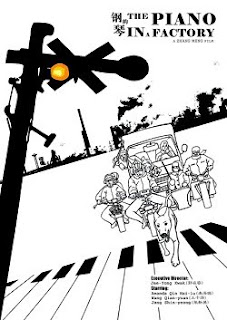 Piano in a Factory (China, dir. Zhang Meng)—Chen Guilen plays accordion in a band and is in a fluctuating relationship with its comely lead singer. He's also in a custody battle with his soon-to-be nouveau riche ex-wife. To win the affections of his daughter, he launches a monumental scheme to build her a piano with help from his scrappy friends and bandmates. This is the framework upon which writer/director Zhang hangs this delightfully loopy film, which in quite unlike any Chinese movie I've ever seen. Zhang has a sublime visual sense, utilizing interior and exterior spaces for utmost effect in his compositions and camera movements. This is also a musical of sorts, with several production numbers and a soundtrack that encompasses everything from Russian pop songs to the theme from Super Mario Bros. One could complain that Piano in a Factory is a bit precious and overworked, but that criticism is easily overshadowed by the film's enormous ambitions and sense of fun.
 Summer Pasture (USA / Tibet, dir. Lynn True, Nelson Walker)—Yama and Locho are married Tibetan yak-herders whose way of life is fading as fellow nomads choose life in the city. This extraordinary documentary observes them through the course of one summer, giving us a rich portrait of both their quotidian lives and individual personalities. Wife Yama suffers from heart disease, yet rises at 4 a.m. to gather yak dung for fuel, with the rest of her day spent making butter and caring for their baby daughter. Husband Locho, a ladies man in his younger days and still rather vain, grazes the family herd. He has an illegitimate child by another woman, which counts against the three-child maximum he's allowed by the Chinese government (and the woman in question had to be paid off in caterpillar fungus, which is the region's new cash crop). One revealing sequence cuts back and forth as Yama and Locho, filmed separately, recount the incident. This is yet another SFIAAFF 2011 documentary with eye-catching cinematography, with yak silhouettes against a dawn sky and the arrival of a hailstorm among the high points. In the end credits I noticed that Philip Maysles—son of acclaimed documentarian Albert Maysles—was one of the cameramen, and the Maysles Institute itself is listed as one of the funders.
 Tales of the Waria (Indonesia, dir. Kathy Huang)—This fine documentary brings us four touching, humanist portraits of transgenders living in Makassar on the southern tip of Indonesia's Sulawesi island. Waria is a combination of the words wanita
 (woman) and
pria (man), and their existence in this Muslim society is tolerated because in pre-Muslim times they were trusted caretakers of the king. None desire sex-change operations, believing that they were created as men and must ultimately return to God as men. (This is in contrast to Iran, where the government pays for the operation, believing that transexualism is okay because nothing in the Quran forbids it). The most compelling story is that of Mama Ria, a waria in her fifties who has been a policeman's second wife for 18 years. One memorable scene shows her strolling arm in arm with the first wife during a family outing at a water park. Over the course of the film, however, we sadly watch her marriage come to an end, despite recent plastic surgery to improve her looks. The other warias are Suharni, a hairdresser who leaves her boyfriend to earn money in Bali; Agus, a husband and father who struggles with the desire to return to the waria way of life; and Tiara, an exuberant showgirl and beauty pageant trainer.
Cross-published on film-415 and Twitch.
 Over the course of attending press screenings and viewing over a dozen screener DVDs, I kept changing my mind about the overall quality of the offerings in the San Francisco International Asian American Film Festival (SFIAAFF), beginning its 30th year of existence this Thursday, March 10. Maybe it's because last year's event was particularly outstanding, at least in the category of documentaries. Or maybe it's my anxiety over regime change after Chi-hui Yang's assured stewardship of more than a decade. At any rate, I'm happy to report that there's plenty to like about this year's bounty, and depending on your choices you will have the film festival experience you hoped for.
 First of all, I want to wish a hearty "Welcome home!" to new Festival and Exhibitions Director Masashi Niwano. It's reassuring to know that, despite his youthful looks (he's 29 like the festival), Masashi actually spent years toiling in different departments of this festival before submitting his own film for screening (Falling Stars, 2006), then moving on to preside over the Austin Asian American Film Festival. He's now returned to the Bay Area where he was born (Campbell) and matriculated (SF State).
Almost Perfect—A moderately entertaining romantic comedy focused on a beleaguered heroine (Kelly Hu) whose troubled family members keep getting in the way of her pursuit of love. Her love object, handsome can't-put-a-foot-wrong Dwayne (Ivan Shaw), is more than patient especially with her resentful little brother (Edison Chen) and recently-retired father (Roger Rees), both of whom crash at her loft. I should have been more absorbed in the family conflicts, but instead I kept wondering how much it cost to heat such a living space in the Manhattan winter, especially with siblings who leave the refrigerator door ajar. (Press Screening)
 Surrogate Valentine—A listless comedy about a semi-successful musician (played by local artist Goh Nakamura) who reluctantly takes on the job of teaching a narcissistic TV star how to play guitar in one week. I kept getting reminded of Steven Okazaki's 1987 Living on Tokyo Time, with its introverted Japanese-American guitarist's pathetic attempts at communication and Bay Area locations. Being a big fan of Dave Boyle's more obviously comic stories of outsize eccentric personalities, Big Dreams Little Tokyo and White on Rice, I was disappointed by this more reserved comedy. (Press Screening)
Clash—A handsome but derivative action film from Vietnam. All it showed me was that Vietnamese filmmaker Le Thanh Son can also do a conventional mixed-martial-arts action film, albeit with Saigon as backdrop. It has its strengths: The constantly pissed-off assassin played by Veronica Ngo is entertaining to watch as she pummels her posse of thugs into submission and gets them to cooperate on the job she needs to complete in order to be reunited with a daughter taken from her years ago. And true to its 1980s Hong Kong roots, we can enjoy the action without the crutch of CGI. (Press Screening)
 Raavanan—Veteran director Mani Ratman's Tamil version of his modern retelling of the Hindu epic the Ramayana is a study in extremes, set in breathtaking natural locations yet heavily daubed with CGI and wire work. Vikram plays a vicious, possibly mentally disturbed, bandit leader who avenges his sister's death by kidnapping the wife (Aishwarya Rai Bachchan) of a police inspector (Prithviraj). As the modern equivalent of the Demon King Ravana, with the demons mostly in his own head, he holds her hostage waiting for virtuous King Rama to come rescue his chaste Queen Sita. While in captivity, she comes to know her captor better and reluctantly falls in love with him. There are a few interesting references to the disenfranchisement of darker-skinned peoples at the hands of the lighter-skinned security forces, but clearly the pleasure lies in watching Aishwarya Rai tied up soaking wet as Vikram flexes his tattooed muscles and makes threatening animal noises while Prithviraj's forces approach his bandit camp for the showdown. (Press Screening)
For me, still thrilled by the final film (Naan Kadavul) in Lalitha Gopalan and Anuj Vaidya's recent series Cruel Cinema on 21st-century independent Tamil film at Pacific Film Archive, Raavanan was an opportunity to see Tamil cinema's higher-budget and more commercial counterpart. I'll take the lower-budget, more politically audacious and iconoclastic Tamil works any day.
 Histeria—This Malaysian thriller about a group of schoolgirls punished by being locked into a school building over the weekend, inadvertently conjuring a spirit they had only been joking about, is an uninspired rehash of countless teen slasher films both Asian and American. (Screener) For a more satisfying horror experience, see the 1999 Thai Nang Nak, based on a traditional ghost story about a pregnant wife who insists on coming back from the dead. I remember seeing it on its initial release and being astonished, and creeped out, at how different Thai ghosts are from other Asian ghosts.
M/F Remix—We seem to be witnessing a spring awakening of Jean-Luc Godard. First the Academy gives him an award (OK, back in November), then two films giving him the intertextual nod show up in this festival: The Imperialists Are Still Alive! and M/F Remix, a playful Asian American riff on Godard's 1966 Masculin Féminin. "We know Coca-Cola, but who the hell is Marx?" (Screener)
 Bi, Don't Be Afraid!—An impressionistic Vietnamese film about an inquisitive and footloose little boy coming upon the secrets of his elders. I don't want to say too much about this film since I wrote the catalogue note. But if you've ever spent time in Hanoi and sat in front of a fan feeling the sweat flying from your brow, it will all come back to you watching this. (Screener)
Bend It Like Beckham—Another encore presentation, this one part of a tribute to director Gurinder Chadha (whose husband Paul Mayeda Berges is a former director of the festival), still holds up from 2002 as a lively cross-cultural comedy about a London girl who idolizes footballer David Beckham and pursues the sport despite opposition by her traditional Sikh parents.
I still think of last year's remarkable program of documentaries and can't help comparing it to this year's less brilliant selection. There are high points though, and even some of the low points are strangely compelling.
One Voice is this year's crowd-pleasing inspirational doc, following high school students competing for the coveted Kamehameha Schools Song Contest in traditional Hawai'ian (better not forget the apostrophe) language. The quieter Amin also celebrates traditional song, but the players are older and not enjoying a resurgence. Widely admired young musician and musicologist Amin Aghaie must search through modern Iran for old practitioners of Qashqai music, recording them before they fade away. (Screener)
 Anna May Wong: In Her Own Words is valuable for using the legendary actress's own letters and articles as its narration for a much-needed career overview. But the use of re-enactment for such a visually spectacular subject, whose film clips we also get to see, is just a bother. (Screener)
Two documentaries about Asian subcultures compel conflicted compassion. Resident Aliens profiles Cambodian "returnees," or young Cambodian-Americans, never made citizens of the United States, who—as a result of being convicted of a crime—have been deported to a country they don't really know. The viewer is torn between pity for these Americans who have had to leave their families behind, and impatience at their poor judgment and self-sabotage in their new and alien home. Tales of the Waria evokes indignation at the treatment of a community of Indonesian men who live openly as women and choose to abide by Islamic doctrine by not undergoing sex reassignment. The idea of anyone sacrificing everything for love is moving, but these people get an especially raw deal in their personal lives. You can imagine which other San Francisco film festival will screen this film a few months hence. (Screener)
 Two of the more sensational documentaries try to understand the motivations behind unspeakable crimes. Open Season explores the 2004 mass murder by a Hmong-American man of six white hunters in Wisconsin, asking if shooter Chai Vang's rampage was an act of self-defense (as he claimed) or of rage against anti-Hmong sentiment, especially in the deer-hunting community. The House of Suh, another film investigating the shooting death of a white man at the hands of an Asian-American man in the Midwest, tries to pry open the deeply locked secrets of a Korean-American immigrant family. The revelations grow more horrifying as the film uncovers the passionate ambitions of parents and children who feel cheated out of their portion of the American dream. (Screener)
Another pair of documentaries take us to Central Asian regions. The melancholy and spectacular Passion is a road movie that traces the history of Mongolian cinema through the works of its most notable filmmakers, including one on tour screening his latest melodrama to a frankly indifferent viewership. (Screener) Far from film culture or any media for that matter, Summer Pasture is a charming and increasingly anachronistic account of a nomadic married couple who herd yaks and make butter in the eastern Tibetan grasslands. He's immature and vain, applying acne ointment to his face. She never stops working and is aware of his infidelity. When they break into giggles, you realize how young they are. Meanwhile, an easier life in the city for their infant daughter is a constant temptation. (Seen at Palm Springs Film Festival, January 2011)
Finally, my choice for best film at the fest so far is the Iranian Gold and Copper. This is the film that singlehandedly changed my evaluation of this year's prescreened offerings. Don't miss this one! It starts out as a mundane story of a sober young theology student who brings his rug weaver wife and two small children to Tehran. Seyyed can't concentrate on his studies when he's constantly disturbed by a neighbor girl who plays music on the radio. Other stresses of city life distract him from noticing his wife's months-long complaints of numbness in her fingers and legs. It isn't until she collapses and has to be hospitalized that they learn she has the symptoms of multiple sclerosis. Her inability to weave, cook or care for the kids forces him to take over these tasks at the expense of his mullah training. What sounds like an Iranian Mr. Mom is much more profound and even transcendent, as the young family faces crippling disease and loss of income while it grows stronger in love and courage. (Screener)
Cross-published on Twitch.
 Last weekend's international symposium on silent cinema—Cinema Across Media: The 1920s—was clearly not oriented towards the average cinephile, nor was it—I think—ever intended to be, though some form of inclusivity in future editions would be welcome. Nevertheless, it provided a keen challenge to keep up with its diverse presentations, which had as much to do with styles of delivery as with complex thematic content. Even amidst the numbing opacity of language tortured beyond necessity, every now and then a term would rise from the podium like Gandalf's wand of light held aloft against the obfuscating legions. One such word was the conference's leitmotif of intermediality. Reams have been written on the subject but for me it arrived as a fresh perspective; such is the wonder of language that certain words reach certain people exactly when appropriate. Intended to suggest that the intermediality of silent cinema in the 1920s comports with contemporary trends in intermedial practice, I regretted that—at least in the presentations I heard—this theme failed to flesh out demonstratively.
Another word—wholly appropriate to any study of silent cinema in the 1920s—first reared its luminescent head in Tom Gunning's introductory lecture "From the Cinema of Attractions to the Montage of Attractions: The Art of Running Film History Backwards": that word being photogénie. It surfaced again and again in subsequent papers until I finally felt compelled to approach Gunning during one of the conference's stimulating coffee breaks to ask if he could please define the term for a layperson such as myself? He graciously complied.
* * *
Tom Gunning: The point of photogénie is entirely visual. It can't be reduced to words. In other words, what you can do is point at it, point it out, but you can't define it. However, to define it by circling around it, the quickest thing is to say that—when something's photographed—one view would be that you just copy it. It's exactly as it looks in real life. The other view would be: no, that's not true; it's transformed. And it's transformed in a way that is both creative and revelatory in the sense that it's not just distorting something but revealing elements to it, you know? That's the idea. It's the way that a photograph or a film transforms what it films or photographs, and transforms it in a way that reveals aspects of it—not just viewpoints of it—but a sense of texture, a sense of form, and so on, which you might not notice if you look at it in real life.
Michael Guillén: So you're saying the term photogénie was a photographic term in existence long before the advent of cinema?
Gunning: Well, it did literally but it didn't necessarily mean what it means for cinema. It basically meant "an image made with light." So it was in reference to photography and some work in printing. But before cinema, it didn't mean what I've just described.
Guillén: I've heard it referenced in several of the presentations I've heard so far. Is it a tapword in current academic research?
Gunning: No. It's a term from the 1920s. From the 19-teens, actually.
Guillén: I'm surprised I've never heard this word before.
Gunning: Well, you have. You've heard its reduced form, the adjective: photogenic. And what does that mean when someone says, "She's photogenic"? She looks good in a photograph. She actually looks better in a photograph than she does in real life. It's not so much the idea of "That's a lie" but it's more, "Oh, the photograph brings out her beauty." Photogenic is the common everyday term; but, it's very much the idea that then gets elaborated to: "Okay, let's not just think of that as 'Oh gee, she looks good in the photograph' but how it adds quality to photography and—if we're going to expand film—how we're going to think of it as an art form.
* * *
Next, having brunch with Thomas Elsaesser, I posed the same query and mentioned how marvelous it was to have a concept like photogénie hiding all these years in its commonplace usage of "photogenic."
Thomas Elsaesser: Photogénie has a special meaning because—like "realism" in the post-war years—it was the term in the 1920s that everybody, at least in France, related to.
Michael Guillén: Can you define it? Can it be defined?
Elsaesser: No. No. [And with considerable mirth in his eye] Go to Google. [Laughter.]
* * *
So accepting Elsaesser's mirthful recommendation that I Google the term, I've reinforced what I've long opined: that to Google is to remember. My research uncovered Paul Coughlin's helpful Senses of Cinema purview entitled "Sublime moments", wherein he examines the distinctive properties of the theories aligned with photogénie.
At her website, photographer Joanne Lee—who has entitled one of her pieces "Photogénie"—traces the term's usage to film-maker Jean Epstein who, in turn, borrowed some of its meaning from Louis Delluc in the 1920s. "He used this word to describe the almost magically transformative power of film/photography," she summarizes. "His photogenic wasn't pretty blonde girls or chocolate box cottages, but a kind of ephemeral intensity, which, once noticed, could only be sustained for a matter of seconds before it subsided. Epstein asserts, however, that this fleeting but concentrated moment can be captured by photography: 'A lens zeroes in on it […] distilling photogénie between its focal planes'."
At this juncture I might mention Sarah Keller's fascinatingly accessible symposium presentation—"Jean Epstein and Intermedial Revelations in the 1920s"—wherein she provided a striking example of what might be considered photogénie in a film clip from Epstein's Finis Terrae (1929); a sequence that captured the hypnotic pulsing of the sun behind drifting smoke.
Wikipedia likewise offers its take on the term's protean meaning within the context of how the narrative avant-garde of the 1920s explored the perception of reality through two main destabilizing concepts: subjectivity and photogénie. Of the latter, they write: "Photogénie occurs at the meeting of the profilmic (what is in front of the camera) and the mechanical and the filmmaker. It is above all a defamiliarization of the spectator with what appears on screen. It is a property that cannot be found in 'reality' itself, a camera that is simply switched on does not record it, and a filmmaker cannot simply point it out. As [Ian] Aitken summarizes, '…fully realized photogénie could only be manifested when its latent power was employed to express the vision of the film-maker, so that the inherent poetry of the cinema could be harnessed, and developed in a revelatory manner by the auteur.' However, the narrative avant-garde lacked a theoretical and philosophical base upon which these notions rest and thus the concept of photogénie is always on the edge of an inexplicable mysticism that many critics cannot accept."
Finally, I recommend Sigrid Merx's application of the filmic concept of photogénie to the theatre [in PDF format].
Cross-published on Twitch.
 This time of year is always tantalizing as the San Francisco Film Society (SFFS) begins to release its press announcements regarding their upcoming "jewel of the crown": the San Francisco International Film Festival (SFIFF), assured and stately in its 54th edition. Their first announcement honors the creative collaboration between renowned French filmmaker Claire Denis and composer Stuart Staples—best known as the primary singer and songwriter for the groundbreaking British chamber rock band Tindersticks—and is an exciting reason to circle May 2, 8:30PM at the Castro Theatre with a big red circle. I know I am. What are you waiting for?
In what will be an unforgettable live performance, Tindersticks will accompany "a meticulously prepared montage of scenes from six Denis films scored by Staples and his band mates. Technicians have scoured archives to collect the original elements and assemble strikingly sensual and alternately meditative and shocking clips from Nénette et Boni, Trouble Every Day, Friday Night, The Intruder, 35 Shots of Rum and White Material."
 "Working with Claire makes us shift our vision," Staples has said. "We come out the other end of it and we always feel kind of changed."
And how much more will this spectacular SFIFF event be appreciated for having earlier indulged the opportunity to watch the Pacific Film Archive (PFA) retrospective "Under the Skin: The Films of Claire Denis", currently running through April 16?
As Juliet Clark has noted for the PFA website: "The work of Claire Denis begins with what she calls 'tactile intuition'. Her films feel their way through charged situations and complex relationships—cultural, familial, sexual—by attending to the textures and rhythms of the physical world and to the ways that people move through it. This is a corporeal cinema: Denis once asserted, 'capturing bodies on film is the only thing that interests me.'
 "Born in Paris in 1948, Denis spent her childhood in various African nations where her father was a French colonial functionary. Several of her most acclaimed films, from her debut feature Chocolat to Beau travail and the recent White Material, are set in Africa, and a concern with colonialism and its aftereffects runs through much of her work. But her approach to this and other subjects is less political or even psychological than emotional and experiential; exposition is pared away, leaving impressions whose full meaning emerges only with the passage of time.
"Denis served a long apprenticeship before directing her own films, beginning as an assistant on Dušan Makavejev's Sweet Movie (1974) and later working as an assistant director to Jim Jarmusch and Wim Wenders. This retrospective includes her films with those two directors, as well as the fruits of her long collaborations with cinematographer Agnès Godard, writer Jean-Pol Fargeau, and actor Alex Descas (whom she has described as her 'muse'). Here is a chance to experience a body of work that both exerts and rewards alert observation."
For ease of reference, I replicate PFA's schedule.
 Friday, March 4
7:00 White Material
Claire Denis (France, 2009)
9:00 Chocolat
Claire Denis (France/W. Germany, 1988)
Saturday, March 5
7:15 Paris, Texas
Wim Wenders (Claire Denis, assistant director) (W. Germany/France, 1984)
Sunday, March 6
3:00 I Can't Sleep (J'ai pas sommeil)
Claire Denis (France/Switzerland, 1994)
Sunday, March 20
3:00 No Fear, No Die (S'en fout la mort)
Claire Denis (France, 1990)
 Friday, March 25
7:00 Nénette and Boni (Nénette et Boni)
Claire Denis (France, 1996)
9:00 Good Work (Beau travail)
Claire Denis (France, 1999)
Beau travail is repeated on Friday, April 1.
Saturday, March 26
8:30 Down by Law
Jim Jarmusch (Claire Denis, assistant director, U.S., 1986)
Friday, April 1
7:00 Good Work (Beau travail)
Claire Denis (France, 1999)
8:50 Trouble Every Day
Claire Denis (France, 2001)
Saturday, April 2
8:30 Wings of Desire (Der Himmel über Berlin)
Wim Wenders (Claire Denis, assistant director, W. Germany, 1988)
Wings of Desire is repeated on April 20 as part of the Film 50: History of Cinema series.
 Friday, April 8
6:30 The Intruder (L'intrus)
Claire Denis (France/S. Korea, 2004)
The Intruder is repeated on Saturday, April 9.
9:00 U.S. Go Home
Claire Denis/Cédric Kahn (France, 1994)
Followed by:
Claire Denis: The Wanderer (Claire Denis: La vagabonde)
Sébastien Lifshitz (France, 1996)
Saturday, April 9
8:30 The Intruder (L'intrus)
Claire Denis (France/S. Korea, 2004)
 Friday, April 15
7:00 Friday Night (Vendredi soir)
Claire Denis (France, 2002)
8:50 Vers Mathilde
Claire Denis (France, 2005)
Preceded by short:
Pour Ushari Ahmed Mahmoud (Claire Denis, France, 1991).
Saturday, April 16
8:40 35 Shots of Rum (35 rhums)
Claire Denis (France, 2008)
Pacific Film Archive
2575 Bancroft Way, Berkeley
For information please call 510-642-1412
Cross-published on Twitch.
 With each edition, SFIAAFF uncovers, rediscovers and celebrates films that have "blazed the trail of independent cinema" through a fourfold Special Presentations program, which includes a film retrospective, an out-of-the-vaults screening, a filmmaker spotlight, and an on-stage conversation with a filmmaker. All but the latter receive special support from the Academy of Motion Picture Arts and Sciences. This year's retrospective "After Death: Horror Cinema From South East Asia" was a welcome tip of the hat to this populist genre, and a shout-out to its fans. The festival catalog qualifies: "While each film deals with horrifying stories about ghosts, spirits or more worldly entities, the stylistic expressions and atmospheres are as diverse as the countries of origin. The strength of these films is how they beautifully weave local folklore and superstitions into the stories."
 Among the three horror shorts that comprise Shake, Rattle and Roll 2k5, the seventh installment in the horror franchise that started way back in the early 80's, is Richard Somes' Ang Lihim ng San Joaquin (The Secret of San Joaquin), about a man (Mark Anthony Fernandez) and his pregnant wife (Tanya Garcia) relocating to a rural town that is populated by aswangs (which—according to Filipino folklore—are monsters that partake the form of ordinary human beings during the daytime but transform into hungry monstrosities at night that feed on the blood and internal organs of humans, preferably the very young). Somes transforms what essentially is a straightforward story of survival (in fact, the short is ridden with logical loopholes and unanswered questions, the biggest of which is why any sane couple who are expecting their firstborn would relocate to an impoverished barrio with dubious residents) into a thrilling portfolio of his directorial mettle, although influences (F. W. Murnau, Tod Browning, George Romero, and Peque Gallaga: not really a bad lot to borrow from) are evident. Given the scarcity of good genre directors in the country—there's Rico Maria Ilarde (Sa Ilalim ng Cogon / Beneath the Cogon, 2005) and Altar (2007)—I was excited as to what Somes would offer next.
 Three years later after Lihim ng San Joaquin, Somes releases Yanggaw (Affliction, 2008), whose screenplay has been gestating for a number of years before it was given the green light by CinemaOne, a local cable network that gives grants to several screenplays in their annual film festival (successful CinemaOne-funded films include Dennis Marasigan's Sa North Diversion Road (On the North Diversion Road, 2005), Sherad Anthony Sanchez's Huling Balyan ng Buhi (Woven Stories of the Other, 2006), Jerrold Tarog and Ruel Antipuesto's Confessional (2007) and Adolfo Alix's Tambolista (Drumbeat, 2007). The term yanggaw is an Ilonggo term that refers to infection, more specifically, of an affliction that turns normal human beings into aswangs. Somes' film centers [on] Junior (Ronnie Lazaro)—a former barrio official who retires from service because of disillusionment and eventually manages to feed his family through meager means—who suddenly confronts the situation of having Amor (Aleera Montalla)—his beloved daughter who suddenly returns from another barrio with a curious illness—degenerate into a rabid and murderous aswang at night.
 Yanggaw is in concept, a horror film. However, Amor's horrific predicament is treated with the least sensationalism possible (especially if compared to other aswang films like Topel Lee's Yaya (Nanny, 2006), where much of the short centers on the nanny who turns out to be an aswang out to kill her wards, or Somes' Lihim ng San Joaquin, where the meticulously conceived aswangs (complete with computer-generated tongues) dominate the picture). She stays in the background (in fact, there is not much fuss as to her appearance; she is mostly hidden in the night with only the stark crimson of her victims' blood on her face to serve as her definitive feature.
 The horror element (the aswang aspect of the feature) of the film is not there for cheap chills and thrills, but is there as basis for the lingering familial dilemma, very much like drug addiction or infidelity in normal family dramas. In fact, much of the picture observes the simplicities and the intricacies of the relationships (like Junior's observable disappointment with his son, who returns the favor to his father with striking indifference) among the family members. However, it is the family's struggle with Amor's affliction that becomes the heart of the film, converting Yanggaw from mere genre picture into an engrossing examination into the Filipino family's psyche, especially if confronted with such a divisive situation.
 As Amor's illness worsens and her hunger for human meat escalates, Somes' audiences become witnesses to the family's encounters with moral quandaries (also escalation in gravity, from simple ones as having to choose between spending the money they don't have to bring Amor to a doctor in a faraway barrio to more delicate decisions as allowing Amor to hunt at night for her survival in exchange for the lives of the residents of their community), and eventually, to the family unit's complete deterioration. Thus, by film's end, it doesn't become surprising that the intensity of the drama heightens into near-operatic levels (the ending seems to belong more to a melodrama, with its swelling music and unneeded montage of crying faces), a slight aberration in the film's near-perfect control of mood and atmosphere. Having said that, Somes' Yanggaw, while riddled with pacing problems (there is reportedly a longer cut, which could fix the film's rushed feel) and an ending that could have been more subtly executed, is an achievement, mixing traditional elements of horror and family melodrama, creating a picture that is so bizarre, it will be stuck to your mind months after seeing it.


