 Adam Wingard's A Horrible Way to Die (2010) had its world premiere in the Vanguard sidebar at the 2010 Toronto International Film Festival (TIFF) where—in his official description—Colin Geddes noted: "While the title might imply a degree of exploitation and nastiness, director Adam Wingard triumphs in placing the dramatic narrative ahead of genre conventions." Geddes likewise praised Wingard for having "developed a keen cinematic eye, melding striking imagery with intricately layered soundscapes to create emotionally honest characters and an intimate atmosphere. A Horrible Way to Die marks the arrival of a fresh, dedicated vision in independent American cinema."
 San Franciscans can judge for themselves when A Horrible Way to Die screens twice at SF's IndieFest: first on Saturday, February 5 at 11:30PM and next on Monday, February 7 at 9:15PM. I consider A Horrible Way to Die to be a significant maturation of Wingard's work, creatively angling away from the drug-fueled paranoia of his previous feature Pop Skull (2007) to evoke a cooly unfolding thriller that explores the dark variations of addiction. Having had the pleasure of interviewing Peter and E.L. Katz, the producers of Pop Skull, when that film was programmed at SF IndieFest a few years back, I welcomed the opportunity to finally meet Adam Wingard in Toronto. I had no idea when I arrived for our interview, however, that I would be sitting at a table with the entire creative team behind the film. I've reconstructed the flow of the conversation to focus first on the collaboration between director Adam Wingard and writer Simon Barrett, and then to focus next on the performances of the actors.
[This conversation is not for the spoiler-wary!!]
* * *
 Michael Guillén: Adam, as you know, I've been monitoring your work and am intrigued by your being that rare hybrid of director/editor, which you don't always find in combination. It's your editing style that has caught my attention over the past few years, not only in your short films but in Pop Skull. Every time I think about the time you've taken to achieve your stroboscopic editing effects, I'm simply in awe.
With A Horrible Way to Die you have anchored your already considerable editing skills to a sharp and startling script. Can you speak a bit about your evolution as an editor and how that has informed you as a filmmaker?
 Adam Wingard: With Pop Skull, I was still trying to find what worked for me as a director and that came through just shooting tons and tons and tons of footage. Even though Pop Skull was a small film, I spent a good while on it and I ended up with upwards to 90 hours worth of footage, which is a lot of footage for an 80-minute film. Through that I discovered editing because—when I was shooting—I was shooting anything that came to my head. At the end of it, Pop Skull turned into—not so much a rescue effort—but a discovery of the movie through editing. Through the editing I figured out what I liked and didn't like.
Since then, I've been working at trying to find the decor of the scene in fewer takes, switching it up. I got sick and tired of having to piece together scenes, especially improvisational material. I did that with Pop Skull but it was always hard to split things up. On A Horrible Way to Die, I tried to find the core of it from one perspective and tried to do long takes, with interspersed jump cuts to break it up.
Guillén: Let's address your key visual elements. Several segues from scene to scene were like washes and almost like experimental cinema for me. If it wouldn't have been for the strong narrative, your camera work could easily be categorized as avant-garde cinema. Along with the washes, you used a lot of shallow focus....
Wingard: The visual style was created by the fact that this was the first time I filmed using 35mm lenses. I come from a background of shooting with the DVX and HVX cameras with regular lenses. With those cameras the depth of field is not very shallow at all and if you want to shallow down the field, you have to really zoom it in. So I got used to shooting that way for a while and—when it came to doing A Horrible Way to Die—I loved how 35mm lenses had that shallow depth of field and I wanted to continue those long shots, where in this case the depth of field was now mere centimeters. The shallow depth of field became even more increased. All the fades to blurriness were initially created because I really liked the way that 35mm lenses actually gave me an almost new dimension to play with. I could create what you saw (and didn't see) even more through separating actors from the background and so forth.
 Even other things, like the ending of the film where Amy's hanging upside down for a good portion of it—the last 15 minutes of the film plays upside down in camera—that idea came from the fact that putting a lens adaptor on a camera automatically flips the image upside down. When you go to edit it, you have to flip it rightside up. We got to the point where we were always watching our dailies with our heads turned upside down. But then I started thinking. Watching the dailies upside down, I got used to watching them upside down. I started realizing that was a cool thing. It gives a claustrophobic feel. It interests me how technical elements such as that ended up influencing creative decisions down the line.
Guillén: One of the signature strengths of your work, I would say, is your capacity to use visuals to create anxious, uneasy and uncomfortable states of mind.
 Wingard: I think I live in an anxious state of mind! My girlfriend would probably tell you that. For a long time I was not a social person. Through high school, I never went out to parties and when I did I was always aware, "Is anybody going to notice that I'm not talking to anybody and not drinking?" I guess that plays into my work a little bit. But also, I like movies with large, textural atmospheres to them anyways. A lot of Japanese films have that. Kiyoshi Kurosawa and Shinya Tsukamoto were the two guys who struck me in that phase just before I started film school where I was just starting to think about filmmaking in general. Since then, that kind of work has become more ingrained into what I do.
Guillén: Kiyoshi is my god and texture is the perfect word to describe what you're accomplishing visually. One other visual element that I admired was during the erotic scenes when you fuzzed out what I presume were strings of Christmas lights to create glowing globes of color.
Wingard: Yeah, they were Christmas lights.
Guillén: That fuzzed out effect to create those orbs of color was quite beautiful and contributed to the erotic atmosphere of those scenes.
Wingard: I just really like Christmas lights. [Laughs.] I was going through this period where I was purely obsessed with Christmas lights. I have another movie that will be coming out next year that I shot just before this one—it's very low budget—and it has a similar vibe. Now I'm kind of over it and am trying to move on from the Christmas lights. But the Christmas lights were kind of a trick—hanging them in front of the camera and putting them all over the background—that creates an emotional environment. It's almost as if you're in the characters' brains or something. The colors influence the feeling of the scene. Plus, when you don't have a huge production design budget, you need something to keep it creative. Maybe I overdid it a little bit with the Christmas lights here and there but it was definitely an easy way for me to make the scene look a bit more interesting. "We haven't used the blue Christmas lights? Okay, bring in the blue Christmas lights!"
 Guillén: Simon, you wrote A Horrible Way to Die?
Simon Barrett: Yeah.
Guillén: Where did this story come from?
Barrett: Adam and I had been looking for a project to collaborate on for a while and had been discussing various ideas that I would write and he would direct. He could probably answer this better than me, but he was going through a period where he was researching a lot of serial killers because he was interested in them. He brought the idea to me of developing a serial killer script, which didn't initially excite me but then—when we talked a little more and I approached it from the angle of a young woman who had been in a relationship with a serial killer and had been unaware of it at the time—then I got really excited and went off and wrote it. It was an easy and clever process. I wrote the script and Adam said, "Yeah. I don't know if we'll be able to do that scene but there's no point in cutting it out at this stage." That pretty much became our shooting script.
Guillén: The audience I was in was visibly pleased with the twist in this tale.
Barrett: Oh good! I'm glad.
Guillén: I don't want to go into much detail about it so as not to reveal too much; but, just wanted to express how impressively it worked.
 Barrett: Adam didn't know about that twist when I was writing it. I wanted to surprise him as well. I just handed him the script without explanation and—when he read it—he was pleased too. That twist works much better in the film than it did in the script, mostly because of Joe Swanberg's performance and the way Adam staged those scenes.
Guillén: There was a lot of purposeful misdirection in several of the performances, which—along with the visual texture we discussed earlier—created an intriguing pace to the script.
Wingard: For me the script always had a kind of floaty feeling to it anyways. It jumps around here and there and—from a conventional standpoint—it's almost random; but, as the movie goes along it reveals more of the emotional arc by jumping back and forth and it's not necessarily about revealing events that happened as much as it is creating an emotion you feel—not from watching things in order—but from watching pivotal points to the narrative at just the right time. That was something that Simon and I thought about from the get-go; but, to give Simon credit, it was an idea he initially came up with. At first I wasn't totally sure that I wanted to do something so unconventional. Coming off of Pop Skull, I wanted to do something less experimental; but, then I realized that A Horrible Way to Die was more conventional than Pop Skull because it wasn't as experimental of a story line. Ultimately, it flows so naturally that I don't think it draws any attention to itself, which was a very big concern of mine.
Guillén: Do you act?
Wingard: Me?
Guillén: Yeah.
Wingard: I have recently in one of Joe Swanberg's films. [Laughs.]
Guillén: Do you like shifting between directing and acting registers?
Wingard: I love it. I really like acting. I started acting in my own stuff out of necessity because it was cheaper and easier to schedule myself as one of the characters than to deal with another actor. After two films, I discovered that I really liked acting and friends started casting me in little one-scenes in their movies and I had a good time doing that. I enjoy playing characters close to myself. I don't think I would enjoy burying myself into a character who was different than me and having to do research and that kind of stuff. I don't think that I'm that kind of actor and I don't think I would have a good experience doing that. But if I can sort of play myself, it's one of the things I find most pleasurable in filmmaking, probably more than directing.
 Guillén: Now here's the dreaded question. I wasn't sure if I was going to ask it, but I've decided to ask it anyway: is A Horrible Way to Die "mumblecore horror"? [A baited pause.] Any reaction to that? Do you hate that term "mumblecore"? Do you want to not be associated with it?
Wingard: Early on, when Simon and I were still conceiving the script, we were inspired by "mumblecore" movies in general and it was interesting because—even at that phase—I didn't really know Joe Swanberg and it was just one of those weird things where everything aligned: the money came together, I had just worked with Joe on a film, and—though initially I didn't think of Joe as the character of Kevin—after working with him I realized that Joe has an underlying dark side that you don't usually see and I thought he could play the role of Kevin perfectly. Plus, I just enjoyed putting him in weird sexual situations. His movies are always so wholesome sexually. [Laughs]
Guillén: Well, let me ask you, Joe, about the purposeful misdirection of your performance as Kevin. Actually, you were the only one I truly suspected. I will say that.
 Joe Swanberg: My wife watched the film and my brothers watched it and all of them said that—from the very first scene after the Alcoholics Anonymous meeting where I ask Sarah (Amy Seimetz) in the parking lot to go on a date with me—all of them were like, "Eeeuw, he's creepy. I bet something's wrong with him." And then they said that about 40 minutes later they "un-suspected" me again.
Guillén: That's absolutely right. Plus our hearts went out to you during the sex scene. All the guys in the audience were like, "Oh no!" [Laughter.]
 Swanberg: Exactly. Even my wife said that she thought that I was bad initially and then—after that sex scene—she felt really bad for me and the morning after when I'm trying to make coffee or whatever, she thought, "Aw, this poor guy. He's going to get hurt." Or whatever. Myself, I played the performance the same way the whole time. We had the benefit of being able to shoot most of the scenes chronologically so Amy and I were able to work on that relationship as it was happening and sort of build it. I didn't want to overthink it and try and play like subtlely creepy or anything like that. I mostly let Adam's camerawork and the lighting and things like that make me seem moreorless creepy dependent upon the situation and I sort of just tried to play it the same the whole way; but, I really loved that it went to that place where I could start out really intimidating, have the audience suspect me, and then have the audience come to consider me as a real loser by the middle of the film, not suspecting me of anything other than potentially ruining the relationship with Sarah. Then I was off the hook for the next 30 minutes and actually the good guy for a while who was maybe going to help her. That was kind of fun. But the thing is it was all in the editing. I don't think it was performance choices I was making. Truth is, I'm so limited as an actor. This is the "dark" movie. I only get to do each kind of thing once. I've done dark, I've done this, so that's off the table now.
 Guillén: A.J., let's talk about your performance as the serial killer Garrick, again a misdirection but a different kind of misdirection. When I thought about the movie after seeing it, I decided yours was an extremely tough role. I didn't understand your reactions during the movie until the end of the movie.
A.J. Bowen: I was a little reluctant to play someone that was so gnarly. I had done it before but nothing anywhere remotely close to this territory. We talked a little bit about it and tried to find an approach. It would have been really easy to play Garrick as camp or a caricature of a human being. When people do extreme things in a story, it's really easy to play for the most base, to play the action instead of the pathos, and for us it was really important—we were all on the same page on the book—it was really important to try to humanize these terrible events and this terrible behavior. Otherwise Garrick would have been vilified and then his behavior would mean nothing; it would have no weight and no impact.
We discussed the concept of addiction a lot. You asked if this was "mumblecore horror", if this was a horror film, and I've made a lot of horror films and I never thought that A Horrible Way to Die was a horror film. I still don't think so.
Guillén: I agree. It's really not a standard horror film.
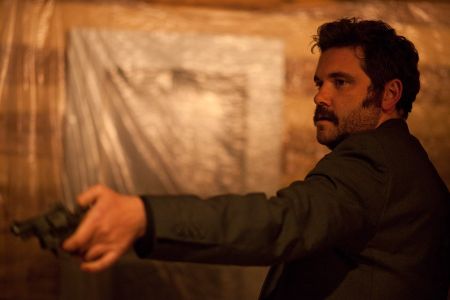 Bowen: We've talked a lot about it being a love story and a story about addiction in various shapes and forms. We did a lot of reading about different behavioral addiction, chemical addiction, because we thought an interesting angle would be to take a person who does terrible things and who is self-aware that what he does is terrible and who hates that about himself. He thinks that every time it happens, it's going to be the last time that it happens and that he's going to transcend his problem. And every time he doesn't, it's like Sisyphus: you think you're getting out of it, but then you're back down at the bottom. We played around a lot with the idea of this person seemingly getting away with this, but it's still destroying him because he has a conscience. He doesn't want to be doing this. He doesn't want to be a serial killer.
Guillén: What's interesting, however, is that that's not how your character is being read throughout the movie. That's how he's read after the movie is over. The image that lingered in my mind after I walked out of the movie was your facial reaction to seeing the dead woman in the tub. Later, when I realized what had actually happened in that scene, that was the image that immediately came back to my mind for re-evaluation, reassessment. It was like I rewatched and reworked the movie instantly.
 Bowen: Every time there was an act of violence—with the exception of one very specific act of violence and, of course, the climax of the film—for every act of violence we had the moment before where Garrick actually had no idea what he was about to do. He wasn't trying to trick these people into feeling safe. He was more, "What am I going to do? What am I going to do? I'm not going to hurt this person because I'm done with that part of my life. I just got to get out of here." Then we usually shot—not the actual act of violence—but the moment after. We had the moment of thrill kill but then we had the comedown and we played a lot in the world of the comedown. The time after the euphoric moment of the addiction has passed and now you're dealing with the consequence of coming back down to reality and crashing. In that scene specifically, we knew that was what we were going to do.
Guillén: Addiction is the true American horror story. For this film to have approached addiction and presented it so honestly is exactly why it is so terrifying and disturbing. So to wrap up here, I'll turn to you, Amy. I should have been a gentleman and asked you this question first; but, you've been so maltreated by all these guys anyways that what the heck? [Laughter] As the female lead in this film, as a woman, was it difficult for you to be tortured in this movie? What was your process in creating the character of Sarah?
 Amy Seimetz: Initially agreeing to do it was a bit hard. The position I took with her specifically was that I made one decision: she has really bad gut instincts. That means she doesn't get jokes. She doesn't read people well. She's not an idiot. She's not stupid; she's smart. But it might have been that something so horrific happened to her in the past that it's a short fuse in her brain. She doesn't know who to trust but she knows she has to trust people again. So she's not reading signs of when someone's acting strange. She just assumes it's herself. She thinks she's the one being paranoid. Even though someone else is acting strange, she's thinking, "No, it's probably me." Because she has to trust again or she's going to give up on life.
Guillén: Which could be thought of as a victim's strategy.
Seimetz: A victim's strategy, yeah. And she is a little bit of a victim, but she's also trying really hard. She's grappling with alcoholism but I don't necessarily think that's the problem. Her's is a concrete problem that makes sense for her to deal with. The addiction for her is more in the sense of relationship to Garrick. She is addicted to the feeling of being in an intense relationship with someone, which she's unable to replace with anything else. Alcoholism is something she can deal with on the surface. I do think she has a problem with alcohol, but I think she has a deeper addiction problem that alcoholism disguises.
Guillén: As the only survivor of the film's climax—the final image is of Sarah stumbling out of this horrific event—can you project in any way what will happen to Sarah?
Seimetz: Hmmmm. That's a really hard one. We talked about the ending a lot. We shot three different endings; but, we decided it was very important in the end that Sarah leaves. That she says no. The ending is very important for her. It's the moment when she's had enough. Another thing we talked about with regard to AA meetings is how you do them, you talk, and part of it is the repetition of going to the meetings. You don't really believe the words. You don't really believe in the ideas behind AA. Whatever form of rehabilitation you're doing, you just do it and then there comes a moment when suddenly you just get it and you understand what the ideas behind AA mean.
Guillén: By film's end Sarah has been forced into courage and she knows the difference.
Seimetz: I don't like the idea that she's just a victim or, for that matter, that anyone's a victim. You make yourself a victim. Sarah realizes by film's end that it's a choice. She has an active role in this whole thing.
Cross-published on Twitch.


