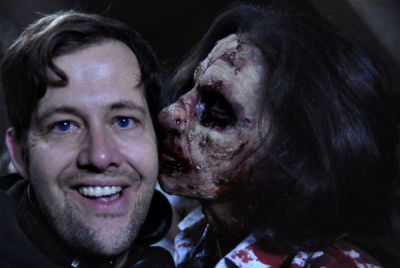
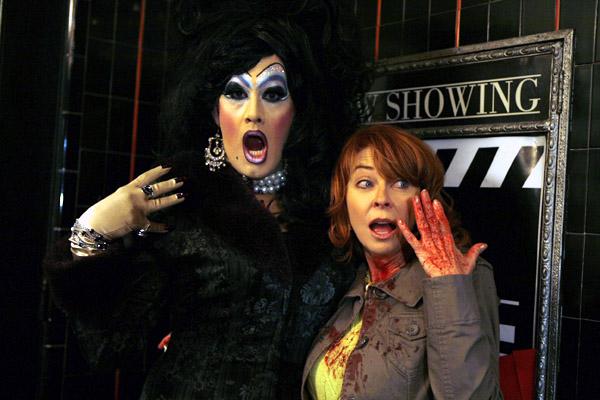
Known to her legions of fans as horror hostess Elvira: Mistress of the Dark, actress Cassandra Peterson has set aside her revealing goth lingerie to "play it straight" in Joshua Grannell's All About Evil. The shift in persona is revelatory. During one of Evil's exhausting night shoots, Cassandra and I sat down between takes to talk about her participation in the film.
* * *
Michael Guillén: Cassandra, I consider you—not only iconic—but probably one of the most intelligent and talented artists of my generation. You've had such a profound effect. As I was surveying your career, I was shocked how many places you pop up. A classic example is you as a strip tease performer on the cover of Tom Waits' album Small Change.
Cassandra Peterson: People are talking about that so much lately and the very bizarre thing about that is that I don't know if that's me! I don't know. People say it is, it looks like me, but I don't have any recollection of ever doing that. But it was the '70s, so I don't have a recollection of a whole lot that I did then.
Guillén: I'm very pleased to talk with you as Cassandra Peterson. Not to disrespect Elvira or anything; but, her accomplishments are well-documented, so I wanted to focus instead on the fact that—within All About Evil—you actually get to play a role, to act. How does that differ from playing an icon like Elvira?
Peterson: Well, it's a lot different because I don't know what I'm doing as an actor in All About Evil. I feel pretty comfortable as Elvira. As myself, I act so rarely that my biggest challenge is not to act like Elvira, y'know? People go, "What are you thinking of while you're acting?" and what I'm thinking is, "Don't roll your eyes and mug."
Guillén: I respect your humility but I wouldn't deminimize your chops as an actor. The other night I was watching you do multiple takes on a scene, over and over and over, and I was genuinely impressed with your concentration. I knew you were exhausted, it was something like 3:00 in the morning, it was stop and go with the scene, but you kept going back to the same space, in character, focused.
Peterson: Thank you. I guess I've been around for so damned long that I've finally picked up on it, whether I'm trying or not.
Guillén: You've had a longstanding friendship with Joshua Grannell and his alter-ego Peaches Christ for at least the last few years, how did you get pulled into this project?
Peterson: It was obviously through Peaches. She told me she was doing this movie and wanted me to be part of it. I really didn't know if I could act in a role. She had seen this other short film I did called Tomoko's Kitchen (2006) that was apparently screened at the Sundance Film Festival. I had a small role in it (and I don't know how I got dragged into that one either). I never watched it because I didn't want to see what I looked like in it; but, Joshua had seen it and he said, "I thought your acting was really great." I was like, "You're kidding?" Then I actually watched it and I wasn't as bad as I thought. So I thought, "Hmmmm, okay, maybe I can act in All About Evil, I don't know." It had been so long.
Guillén: Have you grown as an actor as a consequence of committing yourself to performing in Evil?
Peterson: I guess I have. The hard part about being an actor is not being self-conscious. From being Elvira for so many years I have absolutely no shame or self-consciousness—that's all gone—so I feel very relaxed.
Guillén: That must feel fabulous to be so confident and centered?
Peterson: It does feel a little bit like, "Oh well, I can do whatever now."
Guillén: What has it felt to be directed by Joshua, or I guess I should say "Peachua"—Joshua, half in drag?
Peterson: Peachua's a great name! It's been great because Joshua is just so damn sweet and nice and any suggestions you make, he thinks they're great. He's such an easygoing guy. I love being around him. He's funny and we work great together. I love doing stuff with him.
Guillén: This moviemaking environment and this experience of late night shoots, multiple takes, how does that differ from your TV experience where you have set skits?
Peterson: The hardest part for me is not having a teleprompter. Oh no! I'm a teleprompter queen. To actually have to remember lines is stressful because—with TV—I never have to remember any lines ever. So that's the hardest part for me, plus staying up all night. I know I'm "Mistress of the Dark"; but, y'know….
Guillén: And I imagine that—even after working all night—it's hard to decompress and get to sleep? I did three nights of extras work while recovering from an appendectomy and was doing pretty good until the third night, when I finally had to beg off and go home to sleep and recuperate. I was so exhausted, I thought for sure I was just going to go home and die. But, instead, I couldn't go to sleep. I was so wound up. It took nearly three hours to calm down enough to sleep.
Peterson: That happens to me too. I go home after filming on set; but, I'm so beyond exhausted that I'm still wired, y'know?
Guillén: Do you want to do more acting gigs beyond your Elvira persona?
Peterson: Maybe. But I don't want to start the whole thing of getting an agent and going back out on the calls; I'm too lazy. I've been doing this too long. The thought of going out on interviews is more than I can stand.
Guillén: All About Evil is more a labor of love, then?
Peterson: It is. When friends call me and ask me to do something, then I love to be there. But the practical thing of looking for work? That's just too hard.
Guillén: Tell me about your character Linda. What was it about the role that you felt you could move into?
Peterson: Well, she's a mom with a teenager and I am a mom with a teenager. Every line that is written in this script for the character of Linda is something I have repeatedly said before to my own kid.
Guillén: I was observing with interest the manner in which you handle your co-star Thomas Dekker, who plays your son Steven. Dekker is something of a live wire on the set.
Peterson: Yeah! "Get over here! Where's your coat? Stop smoking!" Face it, being cast in the role of Linda was typecasting.
Guillén: And you haven't had to do any of the gore effects in the film?
Peterson: Not really, no. Just what I have on now: a little blood. I get to kill a bad person. That was fun. I never get to kill anyone. I did get to threaten Pee Wee Herman once in Pee Wee's Big Adventure; that was good. That was a dream job for any gal: getting to threaten Pee Wee.
Guillén: You'd worked with Paul Reubens earlier, however?
Guillén: I haven't heard much about Paul Reubens lately.
Peterson: He's around. He's been doing quite a bit of acting and working on a whole bunch of TV projects that he's trying to get out there; but, he does quite a bit of acting as himself.
Guillén: When I first interviewed Joshua a few years back, you hadn't yet made it up to Peaches Christ's Midnight Mass; but, you were scheduled to make your first appearance and I remember Joshua being all excited about it. How difficult is it to have such a strong alter-ego; Joshua has Peaches and you have Elvira? You mentioned a little earlier that you had trouble getting rid of Elvira acting the role of Linda.
Peterson: Well, when I see a camera in front of me, like I said I just start mugging, rolling my eyes and stuff, automatically. I play it pretty straight here in All About Evil, I'm Mom, I'm not making jokes or anything and the hardest part for me is, "Don't be Elvira, don't be Elvira." That's all I'm thinking. "Be normal for once for God's sake, woman!"
Guillén: And how would you describe working with the ensemble on the All About Evil set?
Peterson: It's great! I love all these actors. Everybody here is just so great. Oh my God, Jack Donner—who plays Mr. Twigs—I think he's stealing the show, dammit! He's such a pro.
Guillén: You say that with complete love?
Peterson: I do! I love it! He's such a great actor and such a nice guy; but, everyone in the cast—I feel like they're all little kids; they're all adorable—we've been getting along great. I've been swapping music with them and they've been showing me how to do things on the computer because I'm so computer illiterate. We've been having a lot of fun. Even on our day off we all got together and had dinner. That was nice.
Guillén: Your involvement in this project is something of a gift to San Francisco. It certainly has been to the extras involved in the film. They bemoaned the fact that they missed Mink Stole—she shot her scenes before the extras came on board—but, they've been excited to interact with you and delighted to watch you in action.
Peterson: That's cool! The extras have told me they're very excited and I've been out sitting in the audience with them, talking with them. They seem like real fans. They're great.
Guillén: Have you always loved genre films?
Peterson: I have. Ever since I was a kid, I've loved that kind of thing. I've always been into it. For me, All About Evil is a cross between Herschel Gordon Lewis and John Waters. They've melded together. It's a dream job for me.
Guillén: I was recently watching the YouTube clip of you and Peaches on stage at Midnight Mass. Peaches acknowledged that she was influenced by you and you credited the creation of Elvira to a drag queen…
Peterson: Oh yeah, definitely! Lots of drag queens.
Guillén: I'm intrigued by that sense of continuity.
Peterson: Isn't it weird? I really do feel that I learned everything—how to walk, talk, dress—from drag queens and now I'm influencing drag queens. It's come full circle. Isn't that weird? I can't tell you how many drag queens have come up to me and said, "Oh, you were my idol growing up." And I'm like, "Well great, I see I've rubbed off on you."
Guillén: I'm aware that you're holding auditions to find a second Elvira to make appearances that—as I think you've said it—don't pay you enough?
Peterson: [Laughs.] That's exactly right. Gimme that money! No, actually it was a low budget attempt at doing what I would eventually like to do, which is to franchise the character of Elvira. Not quit Elvira right now—as someday I'm going to have to—but, sort of doing what Bozo the Clown did. I love basing my entire career on a clown. Bozo—for anyone old enough to remember him—was wearing tons of make-up too so that he could go out and get a lot of other actors to play Bozo to make various appearances and do TV shows across the country. I started thinking, "Hmmmmm. Bozo. That sounds like a good gig. Maybe I could do that too."
Guillén: This is why earlier I was praising your intelligence. You market better than almost anyone I know. Elvira has been a successful "product" for you.
Peterson: Thanks. Well, I have a lot of help. I get good people and I'm still working on that, believe me. I'd like to say it's much bigger than it is; but, it's been going along pretty well for 28 years.
Guillén: So your hope is to continue the Elvira franchise but to be behind the scenes?
Peterson: Exactly! Yes. So I don't have to be schlepping around in this outfit when I'm 85.
Guillén: As I mentioned earlier, It's been a true pleasure to watch you perform as an actor in a non-Elvira role.
Peterson: Thank you. It's been fun for me. A nice break.
Guillén: And I trust that—even though you may not want to go out and actively solicit roles—that when people see your performance in All About Evil it will open a window on a whole new facet of your personality and earn you invitations to act in other films.
Peterson: It would be nice to be given an opportunity to do something without having to work too hard to get it. [Laughs.]
I had a few conversations with Noah Segan during the shoot of All About Evil, wherein he plays the demented Adrian. At the time, Noah had produced and starred in Someone's Knocking At the Door and shared a screener. We talked about his performance in that film, along with one of my favorites—Deadgirl. Here are some thoughts Noah shared regarding his experience with All About Evil. [Not for the spoiler-wary!!]
* * *
Michael Guillén: How did you get pulled into All About Evil? Did you know Peaches beforehand?
Noah Segan: I'm very good friends with Darren Stein, who is All About Evil's producer. He's also the director of Jawbreaker. As Darren and I were becoming pals—we met through mutual friends—we realized quickly that we'd like to work together. We'd been talking, running through various projects, and when this came on his radar and Peaches/Joshua started the casting process, it was an opportunity for Darren and I to work together and for Darren to help Peaches find his appropriate Adrian. The three of us got together and later I introduced Peaches to Tom Richmond, the cinematographer, who's an old friend of my family. Natasha Lyonne, of course, accepted the lead and the family just kept growing. It was originally through Darren but now at this point it just feels like one big family.
Guillén: How does it feel to be directed by someone who's in half-drag part of the time and full drag the rest of the time?
Segan: It feels great. It feels at home. This is a wild flick. This is an out there movie. My character Adrian particularly is an out there guy. Actually at the end of the film I end up in drag. There's a little bit of Mark David Chapman in my character. I want to kill to become. That's how I end up in drag because my character Adrian is so enamored with Deborah, Natasha's character, that I eventually want to be her. There's a lot of that even in my regular get-up. I have these fucked-up teeth and I'm this disgusting deviant guy. The same with Jack Donner who plays Mr. Twigs. The Twins. Everybody's wild and has their own style. So it's nice to have a director who has an aesthetic style. Know what I mean? Obviously, Joshua's only in drag when he's Peaches. He doesn't do it just for fun on set. But it is fun. It feels like it's an aesthetic collaboration. You're not just talking to somebody. You're thinking, "Well, that person's on the same team as me!" We're all a bunch of wild weirdos.
Guillén: I saw you dressed up in your drag and, pardon me, but you walked around like a drag queen looking for his horse. [Laughs.]
Segan: It's just my love of the western shining through, man. I'm a big fan of the western. But I have a newfound respect for women in high heels, I'll tell you what. It's been a challenge. I've done a lot of physical stuff in films ranging from getting my butt kicked to getting killed, being dismembered, but walking in high heels was a physical challenge! I've also gained a lot of respect for what women have to wear. I believe now that women are mostly cold all the time. I was freezing when I was wearing that dress! That's why I had the robe around me. It wasn't that I was bashful; I was freezing my ass off.
Guillén: I know you've been on the set of many genre films. By comparison to the many sets you've worked on, what is the set of All About Evil like?
Segan: The set? You mean the environment?
Guillén: Yes.
Segan: This is very much on the level of beyond the professionalism, competency and logistics of anything I've worked on. These people have it together. The mood on the set reflects the mood in the film. It's sardonic, absurd, and there's a lot of sarcasm, humor and irony floating around the set, even within the crew. Our production assistants, grips and electricians are all people who want to be here. We all understand that—though we're making a film that slots into the horror genre—it's a little deeper than your average horror movie, as well as silly and out there.
No one wields a butcher knife like Peaches Christ. She makes it seem like a necessary fashion accessory and—well, let's face it—isn't it these days? "Gore Couture" is sure to be on the rise this Summer as Joshua Grannell's debut feature All About Evil launches its national event-tour with a star-studded "spooktacular" before its world premiere at the historic Castro Theater, as part of the 53rd edition of the San Francisco International Film Festival (SFIFF53). Next stop: the Alamo Drafthouse in Austin, Texas.
Before retiring after decades of service as the chief editor of Fangoria magazine, Tony Timpone contacted me and asked if I wouldn't cover the production of All About Evil? Knowing that it has been a lifelong dream of Joshua Grannell's to be featured in Fangoria, how could I resist? Why would I want to? The past year has been rich with set visits and a volley of research interviews for the Fangoria assignment (which will be featured in their June issue). Until then—and in celebration of the film's world premiere at SFIFF53—I hope you will enjoy the original conversations as much as I have. First up: Joshua Grannell. This transcript is cobbled together from many conversations with Joshua, his introductory address to the Cast & Crew screening of All About Evil, and his recent San Francisco Film Society Film Forum panel on making horror films in San Francisco, moderated by SFFS programmer Rod Armstrong. [This conversation is not for the spoiler-wary!!]
* * *
Michael Guillén: Joshua, we've spoken before about how Peaches Christ is a collaborative performance project with many other people beside yourself or—as you told Sean Abley in the first installment of your interview with him—"In some cases, it takes a village to raise a drag queen." What was it like for you to take that collaborative spirit one step further to work as a producer-director with a professional crew?
Joshua Grannell: Though, yes, Midnight Mass has always been collaborative, I've always been the leader. It's been my vision for a pre-show or a marketing campaign or a performance so—to some degree—I was more comfortable than I even knew I would be working with actors on the set of All About Evil. I got a lot of great feedback from them, saying it didn't feel to them that I was a first-time director and I suspect that had a lot to do with years of training with Trannyshack and Midnight Mass, making the short films, and basically being the person who was responsible for communicating a vision and nurturing people along to make sure it's what we wanted; but, also letting them be their own artists and encouraging their own creative input. So on one hand it was comfortable. There was something I enjoyed about it. It felt natural. On the other hand, I was working with an entirely new group of people, many of who had come from experienced film backgrounds. It was intimidating to reach outside of my group. But I have to say that we—and by "we" I mean the folks involved with Midnight Mass—stayed true to all the work habits we've always embodied: this should be fun, this should be creative, and this should be a community where we're all working together to get this done. The crew and the actors of All About Evil embraced those work habits. It felt like we were working on a huge version of something Midnight Mass had done before.
Guillén: Can you speak to the distinction between working on short films as opposed to a full feature? And what it's been like to combine the core group of collaborators who worked on your short films with the much larger crew required for a feature? Expanding your family, so to speak. How did that expansion influence your core group of collaborators?
Grannell: It was such a mutual joining. These film professionals were joining our group—our cult of bohemian misfits and DIY underground artists—and we were joining their world too. They were so patient and wonderful about teaching us and sharing information. I will forever be grateful to the crew of All About Evil. I feel blessed. You saw these butch, straight guys running around sweating their balls off every day for hours and hours and hours and they were never anything but respectful, gracious, and impressed with what we brought to the table. Every part of the crew—the art department, the costume designer, the lighting and camera department—took the time to teach the folks we had who showed up with no experience, the extra sets of hands, the film students, the fans, the artists. That was established across the board. That's not to say it wasn't challenging or hard or that we weren't trying to do a ridiculous amount of work in a short amount of time; but, somehow the marriage of the two worlds worked out really well. A lot of the film crew from All About Evil actually came and played with us at last Summer's final season of Midnight Mass.
Guillén: Admittedly you were wearing many hats (wigs?) for All About Evil, not the least of which was performing as Peaches Christ. You've mentioned to me in the past the necessity for conserving energy in order to be up for your Midnight Mass performances, so what was it like on the set of All About Evil where you had to prolong your performance of Peaches' persona on top of taking care of everything else? Did you get tired of Peaches?
Grannell: Yes!! I'd be lying if I said I didn't. I did have a lot of warning about it, however. There was this terror amongst the filmmaking world about this first-time director who was also a producer of the movie, who wrote the movie, and was going to be performing in drag in the movie. You could feel the fear amongst the establishment. [Laughs.] It was palpable. John Cameron Mitchell actually gave me some advice before we began shooting. Ironically, two weeks before the shoot began, I hosted a screening of Hedwig and the Angry Inch at the Victoria. I met with John backstage and I told him I would be appearing in drag in the movie and he said, "It will be harder than you can ever imagine. Making Hedwig was the hardest thing I've ever done." I said, "Well, you were in it every day. You were the star of the movie. Peaches is only in 8 of 28 days." But now in retrospect I can't imagine or even fathom how John did it because—by the end of the shoot—I was really sick of Peaches.
Guillén: How long does it take for you to put on your make-up to become Peaches?
Grannell: That was one of the problems I had to figure out as the director. I had to show up on the set before everyone else. I hit the ground running, answering questions to the entire crew, leading and directing the whole time I was there. So, unlike the other actors who could show up on set and do a rehearsal and then go and get into hair and make-up for a few hours, I couldn't do that. I had to be available. We had to devise a plan where I would get up at my apartment three hours early, shave and do my face, which takes about two to three hours to do the whole thing. The reason it took a little bit longer was because sometimes I was so sleep-deprived and it was so early in the morning.
Guillén: I bet it was a nightmare to match up your eyebrows!
Grannell: Oh my God, it was a mess! My hands were shaking, both out of nerves and exhaustion. I would have to show up on the set ready to go and then Tria, my costume designer who was working in the costume department, would always be prepared. They had a special area for me where I could run away to do a quick change where they'd throw me into drag in 10 minutes, whereas any other actor in the set getting into costume would get more time. The bottom line was that Peaches could not affect the schedule. The schedule was built around me, Joshua, the director, needing to direct first. It was up to me to make sure that Peaches never made anyone wait.
Guillén: In the little bit of time that I worked as an extra on the film, I was amazed with how I would be exhausted after being 12 hours on the set, get home, and not be able to sleep for yet a few more hours because I was so pumped up on adrenalin. How did you handle that for a 5½-week shoot?!
Grannell: I have to say that it actually felt like it was longer because pre-production for me was so intense that—by the time we started shooting—I felt relief by just the fact that pre-production was over. [Laughs.] It was so stressful! All the planning and securing locations and casting the actors and basically just having to sell the thing over and over and over again, explaining every little vision, special effect, and stunt. By the time we started shooting, I felt this relief like, "Finally, the cameras are rolling. Now we can make this movie." It's all adrenalin that gets you through. I'm amazed we didn't all get sick. I'm amazed that I could live on that little sleep and—the way you described your experience—is exactly what I experienced: it was just a total rush every day that got you through.
Guillén: What's more astounding is that you want to do it again!
Grannell: I knoooow! Isn't that sick?! It's so sick. Sometimes I wonder if I'm out of my mind. It's difficult to describe: it was the hardest thing I've ever done and also one of the most incredible, satisfying, fun experiences. Some filmmakers describe it like going to war; but, I didn't feel that way. I felt we were bonding and creating this sick and twisted family. I get the metaphor of war, but I would say it was more like building a city. It didn't feel negative to me. War is such a horrible thing to compare to filmmaking; it's too dramatic and pretentious. I thought making a film was wonderful. It was super-dooper hard, yes, but there was a lot of levity on the set. Even when the shit was hitting the fan and stressful stuff was going on behind the scenes, there was a lot of laughter. Even when it was a nightmare, we'd still try to find a way to make a joke out of whatever was going on.
Guillén: Now that you've had the experience of directing your first feature film, and can look back at the experience, is there anything you would have done differently? Clearly you were learning as you went along?
Grannell: Definitely! There's no better film school, really, than making that first feature and it was obvious I was a first-time director. I'm not sure I've even had enough hindsight to answer your question; but, I guess I wish I would have had the luxury of more rehearsal time with the actors. They were incredible; but, due to the size of the budget, we would squeeze in rehearsals anywhere we could. I have to say, though, that Natasha Lyonne especially made herself available, every hour of every day. We never had a day off. We were always working. So that's one thing: I wish I could go back and figure out a way to put more rehearsal into the schedule. I've learned so much that the next time I do this, I'll just be better at it. I'll have more confidence. I was lucky for my first time to be surrounded by a cast and a crew who trusted me; but, I wish I wouldn't have doubted myself as much as I did. I made it harder on myself than I needed to and came up to the same conclusions anyways.
Guillén: I remember the night the director's chair broke when you sat down in it.
Grannell: Yes! I was horrified. [Laughs.] That's one of those moments where you have to laugh, right? But this is what's really funny about that: everyone had told me, "You are going to lose weight making a movie because of the stress and anxiety." And I thought, "Great! That's fabulous. So I don't even need to worry about this diet I'm on." But, I gained so much weight making the movie! I'll eat out of boredom and I'll eat out of stress. Those are my triggers as far as food goes. Peaches has an open and honest struggle with the ups and downs of weight over the years so ripping through that director's chair on the set was both horrifying—more horrifying than any of the murders we were committing for the screen—and unbelievable.
Guillén: I don't mean to laugh but it was a genuinely funny moment watching those hunky guys get you out of the chair. The other laughable moment on set was when Thomas Dekker—who was a bit of a live wire on set—was harassing you and Heklina and you got so fed up with him and in a voice as cold as ice said, "Christian Bale is going to make such a good John Connor." What was it like working with your lead actress Natasha Lyonne?
Grannell: I have to say, Natasha had a sense of humor that fit in well with every queen on set. She did the movie because she loved doing the movie. That was clear from the get-go. That role, for any actress, is so risky. Not only are you carrying the weight of the movie but the movie depends upon your performance in order to—not only sell the movie—but make it entertaining, special, and eccentric, all those things that we wanted it to be. Natasha connected with the screenplay and—though we talked about it over the phone—it wasn't until she got to San Francisco and we spent time together creating the blueprint for the role that she truly fell in love with making the movie. I think it was hard for her when it was over. She didn't want to leave San Francisco. When we needed to add days, she was fine with that.
She openly has issues and struggles with acting in general, whether or not she even enjoys being an actress. I find that to be absolutely fascinating. She actually shared that with us on set the last day. She said, "I've been an actress basically my whole life." She was a child actor and she said, "I really go back and forth with whether or not I hate this crap or love it, and if I'm doing it for the right reasons, and this movie made me fall in love with acting again." She was amazing. Of course, we were all squish squish and crying; but, she was speaking from the heart. For anyone in her position to do this performance of an ego run wild, total insanity, going the full arc from A to Z, and to not make it 100% camp, to give the performance real depth and weight while also injecting a sense of humor, well, I can't imagine anyone else now having done it.
Guillén: It was revelatory to be an extra in the climax scene sitting in the front row at the Victoria Theatre watching her deliver her monologue on stage over and over and over again. She would bring slight nuances to her delivery every time, and they were always authentic. It was a fascinating experience for me to watch her and it made me wonder about how she could keep her concentration. Being on the set helped me realize how a movie is filmed so piecemeal. You're a stage performer, how was it to adhere your performance skills to such a piecemeal process?
Grannell: As the director, I felt comfortable with it because I was sitting in front of this fabulous monitor that was created to give me the scene or piece of the movie that I needed to see. As a performer, I found it to be incredibly difficult. As the director I was able to watch their performances and—because I had written and lived with the script so long—I knew when they were on or when they were off. I could watch them on the monitor and then tell them, "More of this. Less of that." I had a confidence around that. I knew when we "got" it. I wasn't second guessing that. The material was mine and I was comfortable with that directorial perspective. Even when we were jumping around sequentially, it didn't affect me. When I got stuck in front of the camera and there was no audience to laugh or cheer or react to Peaches, I hated it.
[At about this point three little girls began yelling at the top of their lungs and sustained the pitch until Joshua and I were forced out of our cafe conversation to consider their mayhem.]
That's unreal!
Guillén: They should be beheaded.
Grannell: I think that's going to be my next movie. I don't know if it will be controversial, something about gentrification and a child killer who wants to take them all out so the city can gentrify.
Guillén: A horror film about a comfort animal killer is long overdue.
Grannell: [Laughs.] Maybe we could combine them? A murderer who hates children and their comfort animals? Both of which have totally taken over this city, by the way.
Guillén: Back to All About Evil, where I really noticed the brilliance of that piecemeal process was the evening Cassandra Peterson did multiple takes of one of her scenes in the auditorium of the theater. She had to do it isolated and out of context and over and over and she was so fabulous and centered and kept pulling the performance right out of herself, even if at times she got past no more than a sentence. I was impressed with her professionalism, which made it all the more surprising when I spoke to her that she had serious reservations about calling herself an actress.
Grannell: Cassandra can call herself an actress. Her performance in All About Evil is going to be a revelation for people. She has so much talent; but, most people only know her as this one fabulous spectacle; Elvira is a character beyond one person.
Guillén: When I read Michael Fox's piece on All About Evil for SF360, I was intrigued by all that had been accomplished since shooting wrapped. You've done some focus group test screenings? What did you feel when you saw these focus audiences watching your first feature? When you saw the finished film for the first time, did it match what you had seen in your head?
Grannell: Yes. It felt like an out-of-body experience; a bit of torture and heaven at the same time. Part of it, too—and I think I talked to Michael about this—being the stage performer that I am, there's this anxiety about, "I can't change this experience. It's going to be what it is." That being said, having an audience respond—screaming where they're supposed to scream; being grossed out where they're supposed to be grossed out; snickering where they're supposed to snicker; cheering where they're supposed to cheer—to sit with those people and to experience the film that way was a high I don't know if I'll ever be able to recapture. I'm sure every screening will have its special moments; but, it was so cool to see it actually working with this test audience. In some ways even better than I expected.
The other interesting thing about seeing All About Evil with an audience for the first time was that you really see the movie you made, when at first it was just the movie that you set out to make. When I wrote the screenplay, I knew it was true to our Midnight Mass world, which meant that it was hard to quantify. It was hard to describe what it was. Was it a horror movie like the way we're used to watching horror movies today? No. Was it a straight-up black comedy? No, not really. After I watched the finished film for the first time, I was the one who said, "It's a black comedy set in the world of a horror movie." It's like a drive-in movie that I loved as a kid, but smart and sassy, and wickedly funny. I was able to finally understand my own movie for possibly the first time because there it was and this was what the audience did with it. It was wonderful that our gags worked.
Those things that you budget money and time for—of which we really had neither—were so terrifying on set. If you were making a Hollywood movie and dropping a body from the ceiling on someone in the way we did in one of the final scenes, not only would you have a whole crew just for that one scene but you'd have a whole week to shoot it, with CGI to help you. We did it all with practical effects. This was old-fashioned moviemaking and I'm thrilled to say that all of that stuff worked and is in the movie.
Guillén: Speaking of the challenge and triumph of practical effects, Aurora Bergere was a fascinating and truly creative collaborator on this project.
Grannell: Very much so. And what's important to recognize is that she did it for nothing. Like I said earlier, every penny was stretched for this movie. All these effects you see in the movie—the gag with Mink Stole; the gag with Kat Turner—were one-take deals because we just didn't have time to re-set them. That's a real credit to Aurora's genius. She did test after test after test at home with a little digital camera and she'd bring the footage in to show me what the tests looked like of Mink's mouth being sewn shut.
Guillén: And Aurora looks like such a nice girl. You wouldn't think she was at her most creative mastering such grisly effects.
Grannell: She's sick! I would say to her, "When Mink rips through the stitches, I want it to look fleshy and I want you to see the strings and the pain" and she would say in her beautiful French accent, "Oh Joshua, it will be beautiful." And she meant it! For Aurora, gore is beauty, which it is when that's your work and that's what you're designing. She was a little French wonder. She designed these effects in such a way that we were able to get them in one take. When the audience sees the movie and they see that Mink gag, they should remember that was one take, two cameras. That's all we had time and money for.
Guillén: Beyond desire, what inspired you to make All About Evil? What were the advantages and disadvantages of filming in San Francisco?
Grannell: For me there was never any question that we had to make All About Evil in San Francisco, especially after being "responsible" for the whole Midnight Mass thing with the crazy cast of drag queens and performers, and nurturing a whole community of creative people—whether graphic designers or costume makers—who we've worked with over 12 years. When it was time to finally step up and do a feature, after making short films for $10, it was like, "Well, we have to shoot it in San Francisco!" It was written to take place in San Francisco. It was inspired and nurtured here. Even though we were bringing in people like Natasha Lyonne from New York to be in the movie and the fabulous D.P. Tom Richmond from Los Angeles, the shoot was a great marriage between the bohemian underground drag weird world that I come from with more of an indie film world. Natasha's an indie icon in many ways and Tom had actually shot Natasha in The Slums of Beverly Hills. Darren Stein—who wrote and directed Jawbreaker—was one of the producers and then we married that with local producer Brian Benson.
Guillén: Originally, All About Evil was to be filmed at the Bridge Theater, but, at the last minute, the shoot was shifted to the Victoria Theatre. Can you speak about that?
Grannell: That was a real challenge. A week before cameras were to roll, we were all set to shoot the movie at the Bridge Theater—the home for Midnight Mass—the Bridge had shut down, the art department had already started painting the lobby, Natasha Lyonne and Thomas Dekker were arriving in San Francisco, and the biggest wrench you could imagine was thrown at us. The Bridge told us, "We're not able to do this." I can't go into the details as to why—I may still be a little bit angry about that whole evening where I laid in bed all night going, "My movie is being flushed down the toilet tonight and there's 100+ people ready to work on it." It was terrible. It was awful. But our location manager Matthew Riutta stayed completely upbeat and positive and he went out and got us the Victoria Theater. As much as I love and will always love the Bridge—which was the perfect home for Midnight Mass—and as much as I've had a relationship with the Bridge, the Victoria ended up suiting the movie better. Matthew experienced this: when the owner of the Victoria heard that it was us and that we were looking for a new location, they responded. In some ways, being Peaches Christ isn't the worst thing in the world, as I imagined it would be when asking for favors. It was at one time. We didn't want landlords to know and certain employers for sure, but, in this case I had done a show at the Victoria with John Cameron Mitchell and that helped us get our foot in the door.
Guillén: So what do you think? Now that you have this first feature under your belt, could San Francisco be more hospitable to independent filmmakers?
Grannell: I've been in San Francisco almost 14 years and—when I began preparing to shoot All About Evil—I began running into other local filmmakers who told me how hard it was for them to make a movie in San Francisco. Once the challenges were pointed out about permits, parking, and a lot of the frustrations that are unique to this city in contrast to how other cities do it and the incentives and encouragements other cities offer, then it began to sink in more. How much a cop costs per hour in San Francisco versus another city were things I never knew before; but, now I do from looking at a budget with producers and trying to figure it out. So there is a part of me that feels, "We should start a proposition that says local filmmakers should get special rights because we pay taxes and we live here and we're artists from San Francisco." You would sign that proposition, right?
For Hollywood, San Francisco is a great location and they have a lot of money and can shoot here without having to worry about it; but, if you're a local filmmaker who lives here and you want to make a movie in your own city, it's incredibly challenging (if you want to do it legally).
Guillén: This is undoubtedly an obvious question, but why did you choose to make a film in the horror genre?
Grannell: It's what I love. I grew up the kid who subscribed to Fangoria magazine reading about Freddy Kreuger. In fact, I modeled Peaches Christ after Freddy Kreuger and Joan Crawford as if they were, like, married. I was inspired by Divine and John Waters growing up in Maryland. I wanted to make the kind of movie I would have enjoyed seeing when I was a kid and—particularly with All About Evil—it's not really a horror movie first of all; it's really a black comedy set in the world of an old horror movie. But to call All About Evil a horror movie is, first of all, not true. It would have to be scarier. It's more a send-up of my love for Doris Wishman, Herschel Gordon-Lewis, and Ted Mikels. It's really about to what lengths DIY filmmakers will go to save our single-screen movie theaters. That's where the idea for this movie was born. And it was while I was managing the Bridge Theater for 12 years while also doing Midnight Mass. So this screenplay about single-screen theaters being an endangered species in San Francisco was a genuine fear I had and still have. The movie was born out of that but also had to be silly and funny.
Guillén: With a limited budget to make All About Evil, where did you spend your money?
Grannell: A lot of times we spent our money on overtime. Our shoot was extremely ambitious and the schedule was really tough. Just to get everything we needed to get, we had to go into overtime. I wouldn't say that the bulk of the budget went into any one place. The money was spread out as thinly and as wide as it possibly could have been. Every single department took the little amount of money that they had for the script and stretched it to the limit, whether it was costuming or the gore make-up effects, all of them were looking at us like, "Are you kidding? We're not miracle workers." And I was like, "Yes, you are. You can do it!"
Even though it was more money than I've ever dealt with, or made a movie with, it was in the same spirit as when we produced Midnight Mass where people showed up for the sake of the movie—art for art's sake—there was this local spirit about it. We had hundreds of extras. None of them were paid. Hundreds who came day after day after day. We would have never gotten that in L.A. But we could do it here because of who we were and what we were trying to do and there was this great support. I remember while shooting I'd be so exhausted and stressed out and then I'd look up in the balcony at the Victoria Theatre where the extras spent long hours sitting and waiting in the balcony and I'd get choked up because it was so cool to see the film supported by all those guys.
Guillén: Mark Twain quipped that the coldest winter he ever spent was summer in San Francisco. The city's unreliable weather is infamous. Did that cause any problems on the shoot?
Grannell: We were really lucky. I know exactly what you're asking because we talked a lot and thought a lot about that in pre-production. We shot just about a year ago at this time and after this major rainstorm we had this past weekend I was thinking, "Oh my God, I'm so glad we didn't have this during a day when we were shooting an exterior." Because we just didn't have rain like what we had over this past weekend. We had enough exteriors that weather like that would have screwed us.
The most memorable was a night shoot from 6:00PM to 6:00AM. If you've never done it, it's the weirdest thing: you show up at 6:00PM and everyone says "good morning" to you and they're eating breakfast; it's totally weird and wrong. I didn't really like the night shoots and you'd think I would being this big ol' drag queen. I preferred the day shoots. But one night we were shooting at about 4:00 in the morning on the roof of the Victoria Theatre and the wind was so insane that we almost had to shut down. The wind was burning the faces of the actors. Other than for that one night, we were really lucky. I don't know how you would prepare for that otherwise.
Guillén: How did the budget affect your ability to maintain script continuity?
Grannell: Some continuity problems I purposely left in the movie so that audiences can look for them and write about them on IMDb trivia and bloops. There are times where you think, "We either use it or we re-shoot. But we have no money because we've gone over budget." So you watch it and you think to yourself, "How much would anyone notice that?" There are a few places in the film where I'm waiting for someone to say something and they haven't so far. As the director, you can only look at that one wrong thing but often nobody else sees it.
Guillén: It's great that you're going to premiere the film at this year's San Francisco International. Congratulations. That's a great door to walk through; but, past that, what are your hopes for eventual distribution past the festival circuit?
Grannell: We don't yet know the answer to that entirely. I do have a plan, an idea, which is to premiere at the San Francisco International, then play some festivals—we've decided to be a little more calculated about what festivals we play and how many we do and where we do them—and then it's been my dream to launch and create an All About Evil stage show that will actually accompany the movie. It's how we're going to premiere the movie at the San Francisco International. Peaches Christ will present a "spooktacular" that night. Joshua will be there at the Q&A after the movie. So I don't think either of us will be watching the movie. In the case of the International, we're pulling out all the stops, we're going to film it for a documentary, and members of the cast will be performing. We're lucky that we have a cast of people such as Mink Stole and Thomas Dekker who are comfortable performing on stage with Peaches. It will be a drag extravaganza celebrating the movie. Then a version of that will go out to different cities, city by city. Two weeks after San Francisco, we'll be at the Alamo Drafthouse in Austin, Texas where we'll do a stage show where Mink Stole and Cassandra Peterson will be joining Peaches. I love William Castle. I love all his gimmicks. These are the movies that we're sending up and celebrating in All About Evil so I figure that as much as possible our theatrical should emulate that. Luckily, I have a 13+-year relationship with Landmark Theatres, who have enjoyed the movie very much and are being supportive and helpful as far as this event tour goes.
Then I hope we can get a VOD deal and a DVD deal where every kid who reads about it in the pages of Fangoria magazine will be able to see it at home if they can't make it to one of the cities where the staged events are. I hope we can make it accessible to them.
Anyone who lives in San Francisco knows that—if you are in their favor—the 7x7 guardian spirits bless you with chance encounters, broadside accidents and other romances. They love to mix it up. They'll stir serendipity into your Blue Bottle cappuccino. You'll be waiting to conduct an interview at the Larsen Associates offices on Ritch Alley, basking in one of the first warm days of Spring with—humility aside—the best-tasting coffee in town, and you'll find yourself shamelessly eavesdropping on a stranger's telecon, and all because he mentioned fried chicken and the best places in town to find it. Did you hear the sound of screeching brakes? Me and fried chicken go way back. I can do without a comfort animal but don't deny me my comfort food.
So Andrew ("Please call me Andy") Samwick and I struck up a conversation and he found out I was a film journalist and I found out he was a food blogger—inspired by the film Julie & Julia, no less—and, well, that's when the 7x7 guardians started grinning ear to ear because in no time flat Andy had become a plus one at my press screenings and he began turning me on to eateries and breweries around town. His blog You Want a Knuckle Samwick! is not only a fount of hand-to-mouth recommendations; but, a sensual diary of a young man embracing his discovery of himself in San Francisco. And that's really one of my favorite stories: the youthful faces change but the old story never ends.
For those who sport with phone apps, Andy has mastered Foursquare and currently reigns as Mayor in several fine establishments around the Bay Area. So who else to turn to when curious about where to eat by which particular movie theater? In a first of guest columns, Andy takes us to Berkeley to point out where to eat and drink near the Pacific Film Archive while catching their current film program Joseph Losey: Pictures of Provocation.
* * *
There is definitely plenty of provocative food to eat while visiting Berkeley for PFA's Joseph Losey: Pictures of Provocation. I am partial to a good sausage. And if you don't have a lot of time or money, Top Dog is quite satisfying. With three locations in Berkeley and one in Oakland, there are plenty of options. I have had every dog on the menu since I moved to California in 1996.
Another place I love, probably more so for the beer, is Jupiter located at 2181 Shattuck Avenue (at Center Street). I was there in February to celebrate Strong Beer Month on a rainy evening. I got some snacks while I drank through the beer menu. Their BBQ Rib Tips are smoked pork rib tips wood-fired with the choice of mild or spice BBQ sauce and are served with their house slaw. And you can't go wrong with their pizza selections.
If you are looking for some healthy food options, there is a Café Gratitude at 1730 Shattuck. I love the "I Am Luscious" Smoothie. It's a raw chocolate smoothie that has hazelnut milk, figs, dates, raw cacao and vanilla. It is mighty good. The "I Am Cool Milkshake" certainly makes anyone feel confident. Otherwise known as the "Minty Chocolate Chip Shake", it has hazelnut milk, vanilla bean, raw cacao nibs and mint. When it comes to food, I always get their macrobiotic bowl called "I Am Whole." Basically, it is shredded kale, sea vegetables, quinoa, house-made kim chee and sprouts with garlic-tahini sauce and teriyaki almonds.
Now, if price is not an option, and you are looking for a legendary California cuisine experience, then run—don't walk—to Chez Panisse, 1517 Shattuck Avenue. Alice Waters opened her doors in 1971 and it is still one of the strongest restaurants we have going in the Bay Area. I have eaten in both the Café and the Restaurant. Most recently, last year, I had the experience of eating in the Restaurant with two of my girlfriends. The staff were so kind and inviting. They allowed us to tour the kitchen and see what goes on behind-the-scenes. The Café is also a great option and doesn't require reservations weeks in advance. I would suggest anything that highlights their access to local produce. Bob's beets, grapefruit and oranges and their current pizzetta are stunning. I should know, I spoil myself every time I go there.
The Pictures of Provocation series runs through April 16th. So, there is plenty of time to take advantage of some rare film gems and make it a great night with some suggested fare in the neighborhood.
 Known to her legions of fans as horror hostess Elvira: Mistress of the Dark, actress Cassandra Peterson has set aside her revealing goth lingerie to "play it straight" in Joshua Grannell's All About Evil. The shift in persona is revelatory. During one of Evil's exhausting night shoots, Cassandra and I sat down between takes to talk about her participation in the film.
 Michael Guillén: Cassandra, I consider you—not only iconic—but probably one of the most intelligent and talented artists of my generation. You've had such a profound effect. As I was surveying your career, I was shocked how many places you pop up. A classic example is you as a strip tease performer on the cover of Tom Waits' album Small Change.
 Guillén: I'm very pleased to talk with you as Cassandra Peterson. Not to disrespect Elvira or anything; but, her accomplishments are well-documented, so I wanted to focus instead on the fact that—within All About Evil—you actually get to play a role, to act. How does that differ from playing an icon like Elvira?
 Guillén: You've had a longstanding friendship with Joshua Grannell and his alter-ego Peaches Christ for at least the last few years, how did you get pulled into this project?
 Peterson: It was obviously through Peaches. She told me she was doing this movie and wanted me to be part of it. I really didn't know if I could act in a role. She had seen this other short film I did called Tomoko's Kitchen (2006) that was apparently screened at the Sundance Film Festival. I had a small role in it (and I don't know how I got dragged into that one either). I never watched it because I didn't want to see what I looked like in it; but, Joshua had seen it and he said, "I thought your acting was really great." I was like, "You're kidding?" Then I actually watched it and I wasn't as bad as I thought. So I thought, "Hmmmm, okay, maybe I can act in All About Evil, I don't know." It had been so long.
 Guillén: What has it felt to be directed by Joshua, or I guess I should say "Peachua"—Joshua, half in drag?
 Peterson: That happens to me too. I go home after filming on set; but, I'm so beyond exhausted that I'm still wired, y'know?
 Guillén: I was observing with interest the manner in which you handle your co-star Thomas Dekker, who plays your son Steven. Dekker is something of a live wire on the set.
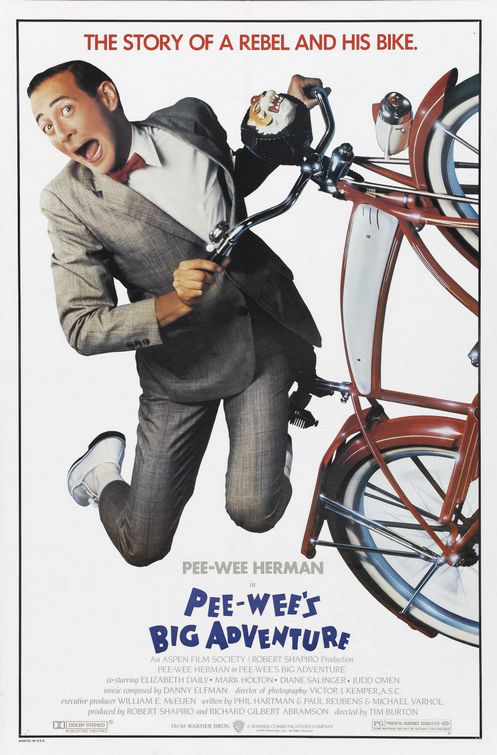 Peterson: Not really, no. Just what I have on now: a little blood. I get to kill a bad person. That was fun. I never get to kill anyone. I did get to threaten Pee Wee Herman once in Pee Wee's Big Adventure; that was good. That was a dream job for any gal: getting to threaten Pee Wee.
 Guillén: I haven't heard much about Paul Reubens lately.
 Peterson: Well, when I see a camera in front of me, like I said I just start mugging, rolling my eyes and stuff, automatically. I play it pretty straight here in All About Evil, I'm Mom, I'm not making jokes or anything and the hardest part for me is, "Don't be Elvira, don't be Elvira." That's all I'm thinking. "Be normal for once for God's sake, woman!"
 Guillén: Your involvement in this project is something of a gift to San Francisco. It certainly has been to the extras involved in the film. They bemoaned the fact that they missed Mink Stole—she shot her scenes before the extras came on board—but, they've been excited to interact with you and delighted to watch you in action.
 Guillén: I'm aware that you're holding auditions to find a second Elvira to make appearances that—as I think you've said it—don't pay you enough?
 Guillén: So your hope is to continue the Elvira franchise but to be behind the scenes?