The poster for the reboot of the Nightmare On Elm Street franchise welcomes us to a new nightmare, and the cast of that new nightmare—Jackie Earle Haley (in his highly-anticipated incarnation of Freddy Krueger), Katie Cassidy, Kyle Gallner, Rooney Mara, and Thomas Dekker—were welcomed by Geoff Boucher of the L.A. Times to their WonderCon 2010 panel.
Of course, the obvious question hovering in the air was what it's been like for Haley to become Freddy, a recognized cinema icon lovingly created by Robert Englund over 20 years ago? "It's a scary process," Haley admitted. "It's tough to take on a character that one guy has played. Robert Englund has done an incredible job. Wes Craven created this character and Englund is the only actor who has played him over the decades. So, yes, it's a bit scary and daunting; but, these guys were going to re-envision the film and start over so they were looking for a new Freddy. I can't tell you how exciting it was to be offered the role. The first thing I heard was that you guys were suggesting me for the part"—Haley gestured to his audience—"I guess some of you must think I'm a little creepy or something? I don't know what's up with that; but, it was a trip and an honor to play such an iconic character, especially after playing such an iconic character as Rorschach in Watchmen."
 Englund's original interpretation of Freddy Kreuger was a mixture of menace and wicked black humor and Haley was asked if his interpretation would retain that sense of humor? "We're a little darker and a little bit more serious," Haley responded. "There's a bit of humor but not as much." Boucher noted that as the various chapters of the Nightmare franchise evolved, more and more comic elements came into Englund's performance of Freddy as time went along and opined that it would be difficult to reboot a franchise starting off with such a comic take.
 As for what elements of the original he incorporated into his performance, Haley said, "I actually saw the original in the theater in the early '80s. I remember seeing the trailers and the film at the time. I rewatched it, but I made a point of not watching them all because I knew that the first one—from my recollection—was a bit different than the others, it was more serious. I watched the original to take a look at the tone and what went on there, what Robert had done, and it wasn't so much like, 'Let me see how I can incorporate that into what I'm doing' as it was to re-see and re-apprise myself of what the film was. I felt it was important for me to play this character where there was still something familiar about him—because he has so many fans of, obviously, the hat, the glove, the sweater—but, to do it in such a way that I could still be able to own it, to make it my own." Aware of just how much the Nightmare franchise is a part of American pop culture—"a sick part of our culture but a fun part nonetheless"—Haley likens it unto the campfire story that's been in circulation 100+ years. "Nightmare on Elm Street is a special one of that ilk, and Freddy Kreuger is a special character, and I for one am really excited to introduce him to existing fans but also to a whole new generation."
 Having now played an admittedly creepy sex offender in Little Children, and the morally ambiguous Rorschach in Watchmen, and now a slasher villain in Nightmare, Haley discerns that—though a commonality of creepiness can be ascribed to his characters—for him, they require diverse approaches. "I like them all in different ways. Ronnie [from Little Children] is the most real of the group. They're all satisfying in different kinds of ways. Watchmen was such an incredible comic book. For me it was fascinating because I had never been a comics fan and that book was what introduced me to that world. It was cool just to become a fan of it. Getting to play that character was tough in a whole different kind of way because I was isolated a bunch and would run everything through a filter in my head and I came out of that experience a little bit cynical. But it was such a different energy.
 "Working on Nightmare, I started down this road when Sam [Bayer, the film's director] sent me the script and—not with anything specific in mind—we were looking together for a way for me to access the part. He sent me this big book on serial killers and so I started to go through that and get into the minds of these guys. I focused on Ed Kemper. By the way, this actor's work on studying the mind of a serial killer is not fun work. The mind of a serial killer is a messed-up mind. But while I was doing this I noticed there was a movie on Ed Kemper so I thought, 'Let's go check this out' so I brought it up on YouTube and it was a slasher movie. It pissed me off; but, it was at that moment that I realized I was playing a bogeyman and that I really needed to embrace playing this mythical bogeyman, this character from a campfire story. I still wanted to embrace his human side and define what made him tick and go after him in that way; but, it was neat to discover early on that this wasn't an exercise about getting into the mind of a serial killer. It was an exercise in embracing this monster, this bogeyman."
The make-up was particularly challenging for Haley. "Once all the artistic decisions were made for the day's shoot, then the process of putting on make-up was a mere 3½ hours and an hour to get out of it, and that was even before stepping onto the set."
 Curious if Haley had to put in a lot of practice to master his glove, he described that it took only a little bit of time to put it on. First it snapped on and then the screws were secured with a screwdriver and, basically, he kept it on for long periods of time and had plenty of opportunity to work with it. "Luckily, I never stabbed anybody and never cut my face or anything." Kyle Gallner—who plays Quentin—interrupted Haley to remind him that during one of their sequences Haley actually sliced him on his stomach a bit. "Oh yeah, I forgot about that," Haley grinned, "Sorry."
Rooney Mara—who has taken over the role of Nancy Thompson (originally portrayed by Heather Langenkamp)—revealed: "Our Nancy's slighter darker than the original Nancy. She's a tortured, lonely soul trying to figure out what's happening to her."
 Thomas Dekker said the role of Jesse was offered to him no less than a day or two after he finished shooting All About Evil here in San Francisco when he returned home to Los Angeles. Familiar with the original, he didn't even bother reading the script. He saw the title and knew he wanted to do it. As for what he felt about the hazards of doing a remake of such a classic film, he countered, "Remakes and reboots are very tricky subjects and they're very hard to do because you don't want to piss off the people who loved the original and yet you want to give birth to something that new people are going to love, and they're always going to be in opposition. However, when the script is written well and you have great actors—all these folks are incredible—I feel confident and do believe that all of you who are here because you love this franchise will not be disappointed. I'm adverse to remakes and yet this one is great. We have a great product and I think that all we cared about was keeping the faith of all of you."
 Kyle Gallner concurred: "It's a franchise that's been loved by so many people for so long that—when you take it on your shoulders—you don't want to screw things up. You want to pay homage to the original but you also want to have the balls to make it your own and not do a frame-for-frame remake. We want to show you something you haven't seen, technology's different, visual effects are different."
Cross-published on Twitch.
 WonderCon—San Francisco's sibling response to San Diego's ComicCon—roused thousands of fans to the George Moscone Convention Center this Easter weekend on the hunt for more than chocolate eggs. My favorite is always Movies Saturday where thousands pour into the Esplanade Ballroom to get their first glimpse of upcoming blockbusters while listening to creative talent pitch their films panel after panel. I park myself in my front row seat at about 10:30 in the morning and don't leave until the early evening because—once you leave the Ballroom—good luck getting back in!
WonderCon's Kick-Ass panel included comic book creator John Romita, Jr., screenwriter Jane Goldman, and cast members Nicolas Cage, Aaron Johnson, Chloë Moretz, Christopher Mintz-Plasse, and Clark Duke, moderated by HitFix.
 The HitFix moderator noted that—in contrast to Dave Gibbon's reaction to having his graphic novel The Watchmen transposed to cinema after the fact—John Romita, Jr. and Mark Millar had a nearly opposite experience; their comic book wasn't even completed before they began working with Matthew Vaughn, effecting a cross-pollination between the book and the movie. He wondered how Vaughn got his hands on the story and what it was like for Romita and Millar to go through the experience with Vaughn simultaneously?
 Romita quipped that—being Sicilian—"bribery and threats" worked well for him. Vaughn was in need of a project and Millar—who ran into him at a party—mentioned to Vaughn that he and Romita had successfully worked together remounting Wolverine and were working on another interesting project. Up for the gamble, Romita joined Millar in publishing their comic Kick-Ass under Marvel's Icon imprint, even as they began developing Vaughn's film. Romita praised Vaughn for having "good taste in comics" and for recognizing a quality story when he read it. By directing an animated flashback sequence in the film, Romita earned his directorial debut alongside his scribal credits.
 In a world where most people get bullied upon and get their asses kicked, Romita was asked how he felt about delivering a fantasy that turns that situation on its head? "I can tell you what Mark Millar initially said," Romita answered, "that's exactly what he did when he was a kid: exercised, took martial arts classes, and planned to get a costume because he wanted to fight crime. He claims that's what he wanted to do. I think everybody in this room probably fantasized about that." When Millar first approached Romita with the project, he admitted it was a risk but offered a 12-year-old bottle of scotch if Romita could finish the script on time. Romita didn't, so he didn't get the scotch, but from the moment Millar sent him the first synopsis—and, at that time, the character of Kick-Ass wasn't even involved; it was just Big Daddy and Hit Girl—Romita enjoyed it. "Mark is out of his mind and that's the fun of it. It morphed into what it is. So it's working with Mark and working with that story that was just amazing."
 When screenwriter Jane Goldman and Vaughn decided to go with Romita and Millar's unfinished comic book, it was a huge act of faith on their part because they had no way of knowing how the comic book—thereby, their movie—would end. Irregardless, Goldman was attracted to the idea of superheroes without superpowers, which—much to her surprise—hadn't been fully explored. The fact that the movie industry has been plundering the comic book characters that have been around for quite a long time encouraged her and Matthew to work from the angle of a completely fresh character.
 Of course, the character of Hit Girl—the child assassin who has elicited some controversy for her colorful language—was a special challenge for Goldman, who is no stranger to controversy. The mother of two daughters, Goldman felt the character of Mindy McReady (aka Hit Girl) was a strong female role, precisely because she was pre-teen and a nonsexualized female character. That combination is almost unheard of in contemporary cinema where a sexy woman with a gun is considered to be a strong female role, which Goldman doesn't believe it is at all. It was that combination of youth and vigilante activism that struck her first, rather than the idea that people might be outraged. Further, audiences are used to seeing women and children as the victims of violence. Surely it's less offensive to see them kick off violence? As much as people might complain about linking a pre-teen girl with so much violence, anyone who sees the film and situates the character in its context, in its humor, never seems to complain.
As for whether or not she felt there was any place that went "too far" in the writing, something she felt she needed to pull back from, or whether she felt inclined to push all the tropes of the superhero as far as she could, Goldman offered that she always knew the film was intended for an adult audience; but, that being said, she never wanted to push further than the spirit of the comic, she wanted to be true to it, and tell the story as it had been told.
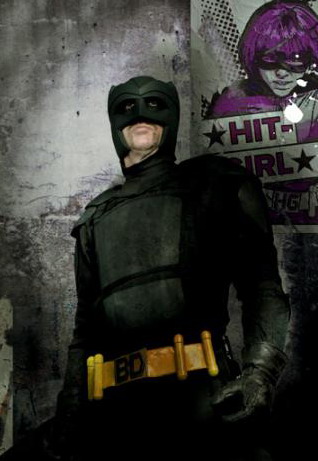
 The readily identifiable and "delicious touchstones" Nicolas Cage has built into his portrayal of Damon Macready (aka Big Daddy), are character-driven, including Big Daddy's mask, and especially his belt. Cage remembered that when Matthew Vaughn first showed him his character's yellow belt, he instantly sourced it to the 1960s Batman TV series as the belt Adam West wore. Vaughn confirmed that's exactly what it was and asked Cage if he thought they could pull it off? Not only did Cage think they could pull it off, he felt the belt was one of the coolest things about Big Daddy's character. Not only did he decide he was going to wear it, but he decided Big Daddy should talk like Adam West in the TV series. West delivered his lines in staccato rhythm in odd inflections that didn't quite go together.
 Cage added that everyone loves comic books because they're like the myths of our times; they give people power. There are people that go out and wear Batman t-shirts underneath their cop uniforms or Superman t-shirts underneath their paramedic uniforms because that's what gives them the guts to go in and get the job done. Cage figured that it was somewhat the same for Big Daddy: mimicing Adam West's portrayal of Batman gave him the guts to fight crime. Cage also remembered dating a girl many years ago whose father was a cop and he always wore these sunglasses and had that moustache that a lot of cops wear and he always called his daughter "child", which Cage thought was strange. He thought of Damon Macready as being like that guy.
 Cage recalled that he learned to read at the age of four-six with comic books. "I would read Stan Lee's stories and the words were so interesting. I learned words like 'opaque' and 'inexorable' when I was six. So I've always had a soft spot in my heart for comic books. I don't want to mislead you. I don't want you to think that's all I read or that I'm on a steady diet of comics as I speak here today, but I think my interest in comic book characters is when they fall within the realm of the supernatural. I like characters that are supernatural like City of Angels [1998, based on Wim Wenders' Wings of Desire (1987)] or Ghost Rider [2007], because when you play a supernatural character, the possibilities are limitless. We're talking about infinity, imagination, you can do anything almost, you're not stuck in a context of reality, whatever that is. So comic books lend themselves to that. That's what it is. They have a big impact. People respond to myths. Comic books give us that power." Asked which superhero he would like to be, Cage responded, "I'd be the Silver Surfer so I could fly through the universe and beat up Superman" to which Mintz-Plasse quipped: "I'd be Galactus, so the Silver Surfer could feed me planets."
 Asked what made him go for the role of Big Daddy, Cage responded that as an actor he feels he has the mind of a student, he's always learning. "I can't always sing the songs that I love because it's too easy," he said. "Sometimes I have to sing songs that make me uncomfortable, that take me out of my comfort zone, so I can learn something, right? I wanted to do Macready because I didn't know how I was going to get around shooting a 12-year-old girl in the chest. It made me a little uncomfortable so I figured I'd better do it." As challenging as he found the role, it ended up being a joy for him because he got to work with Aaron Johnson and Chloë Moretz "and these guys are as good as it gets," he praised. Since he's been around for over 30 years now, Cage tries to learn when he works with different generations of actors. Working with the current generation of actors keeps him relevant. The minute he met Chloë and began working with her, he knew she was destined to become a star because of her charisma and confidence. Immediately they began riffing off each other and there was no question in his mind that the chemistry would work.
 As for his favorite scene in the film? Cage didn't miss a beat: "My favorite scene in the movie, hands down, is when Aaron takes on the three hoodlums and he says something like 'I'm the guy who will take on three guys who are picking on one guy.' He said it with such conviction that I realized at that moment that was his superpower, it was as simple as that. When you see the movie, you're going to ask yourself, 'Would you do it? Would you have that level of guts?' I think a lot of us have been in that situation and wondered whether to jump in or not. That moment inspired me."
 When asked about how he'd trained for his role of Dave Lizewski (aka Kick-Ass), British newcomer Aaron Johnson admitted he mainly just ran around in circles waving his arms. Both he and Christopher Mintz-Plasse (as Red Mist) basically sat back and watched Chloë Moretz do all the action. Both of them got their asses kicked more than kicking any ass. Mintz-Plasse added that—when he first read the script—it was bloody and violent and funny, "and that's everything that I want to see in a movie." He auditioned and read for the role of Kick-Ass, and Matthew Vaughn hated him right off, but offered him the role of Red Mist on the spot. As for Red Mist's look: "They were going for David Bowie. I thought it was more Rihanna, really. I got Christopher Lambert once but I refused to agree with that!"
 Because she dropped the "F-bomb" in the film, let alone talked about giant cocks in the sky, Chloë Moretz was asked how her parents reacted to her performance in this role? Her mother read the script before Chloë and thought the role was awesome and unique and synched to how young kids play. She handed the script to Chloë, fully aware: "Who wouldn't want to play Hit Girl?" Chloë's favorite scene in the film is the one time you see Hit Girl become an 11-year-old girl. You enjoy seeing her kick ass and kill and root for her to do so; but, when she sees her dad in trouble, she realizes it's not a game they're playing anymore, it's real-life, and you see her become a little girl worried about her dad.
Clark Duke—who plays Dave's best friend Marty in the film—helped Aaron a bit with his American accent; but joked: "I'm Aaron's life coach, actually, I focus on health and nutrition." Duke, incidentally, has been receiving great reviews for his comic role as Jacob in Hot Tub Time Machine and his comic talent was readily apparent onstage as he shamelessly pitched for a costume of his own in the Kick-Ass sequel, which—rumor has it—Mark Millar has confirmed.
 I'll be the first to admit that Nicolas Cage is not one of my favorite actors. Along with some admirable work, he's done a lot of big budget dreck. But I never wish him ill will, and am glad that Kick-Ass and The Sorcerer's Apprentice have helped him back into the limelight. He's genuinely funny as Big Daddy in Kick-Ass. He came off quite gracious on both the Kick-Ass and Sorcerer's Apprentice WonderCon panels, despite sounding like Howlin' Wolf (he had laryngitis from an allergic reaction to location shooting in Louisiana). Clearly the big draw of this weekend's WonderCon, I respected how Cage deferred to the performances of his co-workers in both films, in contrast to the grandstanding of some of the younger actors who one might criticize haven't learned to share the stage yet. Case in point would be Aaron Johnson who seemed visibly petulant that he didn't have a name card, and grumbled that his presence didn't "fucking matter." He grabbed Nicolas Cage's name card and said he would be Nicolas Cage. Cage opened his mouth to say something, thought better of it, and stayed silent, which amused his audience. It takes a touch of class, and years of experience, to know that each young actor has to learn how to carry themselves in public. Johnson's next project will be the upcoming thriller Chatroom, directed by Japanese filmmaker Hideo Nakata (Ringu, Dark Water).
Cross-published on Twitch.
 My first conscious exposure to the films of Joseph Losey was with regard to the Film Noir Foundation's successful efforts to strike a restored print of Losey's 1951 eerie noir The Prowler. I say "conscious" because—though I had seen The Boy With Green Hair (1948), M (1951), The Servant (1963), and Boom! (1968)—I didn't connect the author to his work. And isn't that an oddity? That a director's auteurial legibility evades ready identification? That grievous oversight is currently being corrected by Joseph Losey: Pictures of Provocation, co-curated by Steve Seid and Peter Conheim, screening at the Pacific Film Archive through April 16 (when the series ends with The Prowler). As different as Losey's films are from each other, this series has intelligently culled out their connective tissue and common concerns.
 Reinvigorated commentary on The Prowler has surfaced in association, no doubt, with its recent Film Forum revival. At The L Magazine, Matt Zoller Seitz offers a video essay on The Prowler (transcript here) and Justin Stewart reviews same. At The Auteurs, Daniel Kasman identifies The Prowler's ill-fated lovers—Susan Gilvray (Evelyn Keyes) and Webb Gardner (Van Heflin)—as "ciphers" ("you can't call them characters"). While at The Village Voice, J. Hoberman credits Losey's "sordid nocturne" as "the creepiest of film noirs."
Also of note is Brecht Andersch's analysis for SFMOMA's Open Space of Losey's Eve (1962) and Accident (1967), which proved instrumental in my catching both films at their PFA screenings, if only to honor the goddess Venus in and out of furs. Pre-empted by covering the San Francisco International Asian American Film Festival, I'm only now joining the Losey retrospective in process, with hopes of catching the bulk of the program's second half in the next couple of weeks.
 The PFA screening for Eve was introduced by co-curator Peter Conheim who—along with Steve Seid—organized the 15 films plus for the Losey retrospective, as well as writing the program capsules for The Big Night (1951), The Sleeping Tiger (1954), Time Without Pity (1957), Blind Date (1959), King and Country (1966) and The Prowler (1951). Long-time friends Seid and Conheim collaborated earlier on Value-Added Cinema—their scathing indictment of product placement in film—a sampling of which can be found here. Conheim is also a member of the experimental music group Negativland. He is also the co-founder of the band Mono Pause and has played in other groups such as Wet Gate and Neung Phak, as well as in his solo project under the alias The Jet Black Hair People.
Peter was kind enough to respond to a few email questions.
* * *
 Michael Guillén: To start with, let's get some background. Could you tell me a little bit about yourself and your education and how you came to collaborate on PFA's Losey retrospective? How did you and Steve work together to shape this program? Did you divvy up films and, thereby, the research? Was this program affiliated in any way with the recent Film Forum Losey retrospective? In other words, is this a traveling program you and Steve expanded upon? Or did the two of you work from scratch?
Peter Conheim: I'm pretty much a life-long film buff who used to write capsule reviews—complete with one-to-four-star ratings, a system I now despise—when I was about eight years old. My film education has come mainly from mentors at the shops and institutions I worked at in my youth, mostly independent video stores, now deceased.
From 2004-2009 I co-owned and operated a small cinema in Albuquerque, New Mexico, the Guild Cinema. My former business partner has continued to run it. And when I left the theater, I began looking in earnest for ways to apply the various arcane knowledge I've been storing up, and those ways have generally been as an independent curator and film collector, and ersatz preservationist. I'm currently working mostly in the latter arena and hope to produce some restoration projects over the next few years.
 I've worked on and off at PFA since 1997 on a clerical level, though not on a formal curatorial level by any means, and my friendship with Steve Seid goes back to my early video store days in the early 1990s. He's brought me on board several times to work on screenings; we co-curated several outdoor shows in the PFA sculpture garden, and he's consulted with me now and again on his regular shows.
I had been hoping to at least co-curate a Joseph Losey retrospective for several years, and was heartened by the 2008 series at Harvard Film Archive, which was actually 100% complete. Once I knew they had had success with it, and had located some of the trickier prints, I decided to push harder for such a series at PFA. I dropped enough hints that eventually the idea was put forward, though I can't really be credited with instigating it—they probably would have gotten around to it ... Losey has been sort of "in the air" of late.
 We began by drawing up a complete filmography, and once Steve presented me with the various restrictions we had to work with, I pretty much did the first go-round of red-lining titles, passing over certain things in order to be able to show something else (i.e., being able to import Mr. Klein, which is costly, and so only showing one of the two Elizabeth Taylor collaborations—Boom! instead of Secret Ceremony, or choosing Time Without Pity over The Criminal, etc.). We simply weren't able to do it all for many entirely expected reasons. The major omission which was not our doing is The Go-Between, which we were unable to secure a print of. There is only one apparently un-faded color print in existence in the U.S., and it was not available to us for some frustrating reasons best not to go into. So, rather than show a basically worthless print which had faded entirely to red, we chose to omit it. We hope that down the road, Sony—which is the U.S. rights holder—will see fit to do a preservation on this wonderful film, which isn't even available on DVD in the U.S.
 Steve did the majority of the research of the prints, and several are from my own collection: Blind Date and King and Country. In those cases, the distributors no longer had any prints and, indeed, Blind Date is arguably the rarest film in the series in terms of availability. I am aware of two extant prints, both 16mm—and that is literally it.
I've begun making inquiries to see if some other venues around the country might want to pick up on the series. The issue for venues is, and will continue to be, the importation of prints from Europe, Assassination of Trotsky, La Truite, Roads to the South, Stranger on the Prowl and nearly all the British films among them. We've not located prints in the U.S. of any of those titles. And Losey's final film, Steaming, apparently does not exist in print form at all—only Betacam video. Which seems crazy, given that it was only made in 1985, but there you are.
 Guillén: In your introduction to the Losey doublebill of Eve and Time Without Pity, you made a point of emphasizing how different these films were from each other. And they were. And these two, in turn, differ very much from other films of Losey's I've seen. Can Losey be read, then, for his auteurial legibility? Do you consider him an "auteur" and—if so—can you describe what you perceive to be his creative signature?
 Conheim: I would argue that Time Without Pity fits very well alongside his other noir-ish titles, such as The Big Night in particular, as well as The Prowler and Blind Date. I would also argue that Eve fits nicely alongside The Servant and Accident, to a certain degree, but I think it can also be viewed as an anomaly because he was consciously in the grip of Antonioni, Resnais, et al., admittedly so, and I think it's safe to say he was positing himself as making a "serious art film" with Eve. If you read interviews with him, he admits to a certain amount of self-consciousness and excess with the film, and indeed, it's almost hard to believe something as economical as King and Country was made by the same person.
 I find the whole auteur concept to be slippery. When you are a filmmaker working with the "system", the products which emerge were and are inevitably born of collaboration (and compromise), so I think there are genuinely few true auteurs in the real sense of the word; I think of Russ Meyer when I think of the word, not Losey. I think of someone completely on the fringes, in total control of their product, who every once in a while pulled the wool down over the eyes of studio execs and accomplished something truly auteurial, such as Beyond the Valley of the Dolls. Whereas Losey took the jobs that were offered to him for the majority of his life. Some of his best pictures he came onto after they had already been originated, sometimes with other directors in mind—Godard was initially slated to direct Eve, for instance.
 But Steve did, I think, nail the recurrent themes which run through Losey's work which, I suppose, could be considered the marks of an auteur: characters up against an unfair system, or deeply flawed, being forced to reckon with their flaws. Certainly he filtered his 1950s work through his experiences as an exile—it's pretty hard to separate the work from his life during that period.
There are certainly different ways to approach an overview of a director with as varied a resumé as Losey; from the standpoint of an easily digestible evening at the cinema, we could have put The Big Night and Time Without Pity together, or The Servant and Accident together, but I think Steve was wise in mixing them up, effectively discarding an easy definition of "auteur" for Losey.
Because I am a sick and cruel person, I would have put Boy With Green Hair and King and Country together, myself. On Easter!
* * *
 As stated earlier, Joseph Losey: Pictures of Provocation continues through April 16 at Berkeley's Pacific Film Archive, with screenings on Friday, April 2, of Blind Date (1959) and Modesty Blaise (1966); on Sunday, April 4, of King and Country (1966), with an encore screening on Thursday, April 8; Boom! (1968) on Friday, April 9; Mr. Klein (1976) on Saturday, April 10; wrapping up on Friday, April 16, with the restored archival print of The Prowler (1951), preceded by Losey's short A Gun In His Hand (1945).
Cross-published on Twitch.
 Take a walk around midnight in the city / Young blood is hiding there somewhere / And if you're lookin' for somethin' to do / There's always somethin' happening there.—Ricki Lee Jones
Scott Boswell's first feature The Stranger In Us faces the street with considerable compassion, observing the youthful exploration of urban night life with generous honesty and tact.
Scott Boswell is production coordinator at San Francisco State University; a hybrid position where he teaches half-time, while lending production support for all the media needs of the film students the rest of the time. Having graduated with an MFA from San Francisco State in 2004, the shorts he produced while he was a graduate student were the first shorts he distributed, with some success. His film came to me in an interim cut by way of Frako Loden who felt I would appreciate its subtleties. She handed me her screener, which I watched, and which intrigued me enough to contact Boswell to see if he would be willing to discuss the project. We met up for coffee at Bean There in the Lower Haight.
* * *
Michael Guillén: You're in post-production for The Stranger In Us; working on color correction?
Scott Boswell: We are right now, yeah. In the Fall we decided to do some focus test screenings of the film with small groups of people who didn't know anything about the project and mostly didn't know me. The result pinpointed where people were finding the plot confusing. We decided there were maybe five or six issues we needed to address and so we've done that.
Guillén: Thus, the screener I've watched is not as the film stands today?
Boswell: What you've seen is before we did a re-cut, yeah.
Guillén: I was intrigued by your film's narrative structure, which—admittedly—I "got" more upon second viewing than the first. It took me a bit to understand that your main character Anthony was remembering earlier events while on a bus to find his friend Gavin. So I'm wondering now if that's been shifted in your recent edit?
 Boswell: No, that basic structure remains intact. But we actually added chapter cards to give the film seasonal stamps to help distinguish that these are two different tracks in Anthony's life. There's actually three. There's the track of him on the bus, where he's having memories of these two people who have come into his life and who he's lost. There were lots of questions around that in the focus screenings. People typically by the end of the film pretty much understood the structure; but, the questions always landed in the first act.
Guillén: To be honest, I didn't fully catch the structure until Anthony showed up with a black eye….
Boswell: Which is easily an hour into the film.
Guillén: …and then I thought, "Oh. That's why I'm not following certain things here. The sequence is being shuffled." I liked that, however, because that's truer to how people actually remember things. People don't remember things in a linear fashion.
Boswell: That was the idea behind it. The trick with editing this project was finding the balance between people enjoying the puzzle while figuring out the structure and being annoyed by it.
Guillén: I was never "annoyed."
Boswell: I'm glad to know that.
Guillén: I've watched enough films to know there are many different ways to structure a narrative and none of them are essentially wrong; it's whatever the filmmaker wants to do. Let's back up a bit to the title: The Stranger In Us. Why that title?
 Boswell: By and large the film is about self-discovery and the character—this actually comes up in his poetry—is exploring the relationship between himself and strangers, but also the discovery of what he doesn't know about himself. For example, most people who find themselves in a situation where their partner is not treating them well and is being abusive surprises them. We don't go out into the world on a daily basis thinking that that's going to happen to us, normally, right? This particular character comes from a sheltered world and enters this urban area to discover that he's doing things that he may never have thought that he would do, on the streets with Gavin, the homeless character, experimenting with drugs and those kinds of things.
Guillén: While I was watching this again this morning in preparation for our talk, I found myself considering that an alternate title to this film could have been Face the Street. Where your film spoke to me was in my own experience of growing up on the streets of San Francisco. I arrived here in 1975 at the age of 21 during that incredible Castro Florescence where it seemed we had all been summoned by some kind of homing beacon. Anthony's experience in your film was my experience and—I might venture—will be every young gay man's experience coming to a metropolitan center like San Francisco. In some ways your film was difficult for me to watch—i.e., remember—because, of course, I'm so much more mature now. [Laughs.] I'm more centered, more grounded, and it was difficult to relive that awkward and necessary pain that a young man has to experience in order to familiarize himself with the stranger within. I appreciated how this was expressed not only through Anthony's struggles to become a poet but in the poetic vision of the film itself. Are you a poet?
Boswell: No, not in the traditional sense.
Guillén: So this isn't a situation of a closet poet coming out as a filmmaker?
 Boswell: No, but I'm drawn to it. I appreciate slam poetry, which the current generation of young people have embraced and—in many ways—they're expert at it. Before I worked at SF State, I ran a digital filmmaking program for teenagers in Oakland and, of course, I started to meet all the different worlds I ran in and all the different arts that they create. Slam poetry was one step away from what we were doing.
Slam poetry has become so popular and has received so much attention that now they feature slam poets on HBO and they're hosting national competitions. But myself, no, I'm not a poet. What you said earlier about coming to the city and sharing Anthony's experience I find particularly interesting because—since I've been working on this project—I've found a number of gay men who have told me that. There's a lot of mythology around San Francisco, especially for gay men. Hence, when we arrive here we don't quite know what to expect but we're driven by some sort of optimism.
Quite a few people have told me that they relate to Anthony's experience of feeling alien in the city at first and having trouble making connections with people while discovering this more urban, gritty street life. I love that. For me, I didn't quite know what to expect from the Castro but somehow it was disappointing.
Guillén: When did you arrive in San Francisco?
Boswell: I arrived here in 1997.
Guillén: Ah, so what you entered was the commodified Castro?
Boswell: I did! I experienced a commodified, more gentrified Castro and—at least on the surface—what I was seeing were more materialistic values and things that weren't interesting to me. I came looking for an alternative and, instead, felt alien in this enormous gay world. But I also came to discover that there were lots of us like that.
Guillén: Definitely. I have often said that the meanest men I have ever met were gay men in the Castro. Which was quite a shock to me when I arrived in San Francisco from the conservative Mormon belt of southern Idaho. I came expecting brotherhood and found brutal hierarchies of sexism and—much to my alarm—racism.
 Which leads me to one of the distressing topics in Strangers In Us: that of partner abuse, a subject that's not usually addressed in gay narratives. The self-loathing that capsizes relationships among gay men was skillfully handled in your film. Likewise, inversely, the genuine relationship Anthony had with Gavin the street kid pulled me right in for feeling so resoundingly honest. Truthfully, I learned to know myself as a young man by hanging on the streets. Anthony's desultory late night wanderings and how he learns to navigate the city—down to the broken glass and shit on the sidewalk—struck me as an urban poetic aesthetic of a young man's coming into being. I have to ask then: where did this story come from?
Boswell: The story is autobiographical and very much reflective of my experience coming to this city. Of course, whenever you work on a piece of fiction it becomes more and more fictionalized; but, the lead characters are based on people that I knew and experienced. I was largely trying to capture that experience, which is unique to people like yourself and I who have come from smaller, more conservative regions….
Guillén: Where are you from?
Boswell: I'm from central Illinois, a town called Normal. I literally grew up tasseling corn in the summertime. Normal was very much in the Midwestern Bible Belt. I moved here sight unseen. I just decided to pick up and go West. I don't regret it for a minute; but, I will say that you find yourself in this entirely new world and it's exciting and scary and makes you question everything about yourself. Ultimately, you either find your place in it or you don't.
In terms of domestic violence between gay men, you're right, I haven't seen that portrayed much in "gay" movies, or between same-sex couples at least. But it's always been of interest to me on a political level as well as a personal level and that's one of the reasons that I wanted to explore it. I mean, I've seen violence portrayed between gay men such as in Brokeback Mountain where I felt they were effectively trying to beat out the homophobia, that they were both frightened for being attracted to another male, but that violence was coming from somewhere else. I was more interested in the kinds of violence integral to a relationship, whether it's between two men, two women, or a man and a woman. I feel this is a big issue in the society at large; but, I haven't seen it dealt with a lot in the gay world.
Guillén: In some ways, it's not cool timing as it seems most gay films these days are concentrating on positive images. That's okay in and of itself, although I believe it delimits the potential of queer cinema, which—unfortunately—appears to have collapsed into rom-com fantasies that I don't feel particularly further queer sensibility, other than to offer comfort through fantasies of commodification. Partner abuse isn't a comfortable subject to look at, but, it's a real one, and I commend your film for tackling the theme, and the performances of your actors for rendering it real. Can you speak to me about your three main actors who play Anthony, Gavin and Steven? Are they San Franciscan actors?
Boswell: They were when we shot the film. Let me start by saying that my initial approach to this project was completely different. I was wanting to do something a little more experimental. And if I may back up just a little? I've always been fascinated with the Polk Street neighborhood as an older, grittier, alternative to the Castro, especially the Polk Street that I knew in the late '90s. Now Polk Street's become more gentrified itself; but I was fascinated with the kinds of bars you'd find there and the diversity of people, the rent boys on the street, the tranny hookers and all of that had some sort of appeal to me. I was thinking of doing something more like a documentary set in the Polk Street area but it would be a hybrid narrative where I would bring in actors into the scenario and film it like a documentary to see what we could make. Then as I worked on it, the script became more fleshed out and traditional, and I posted earlier than usual for actors before I'd actually finished the script, because I was still thinking of a more experimental approach. I wanted there to be a lot of improv and stuff that had to be worked out before the camera rather than in pre-production.
 One of the first people to respond was Raphael Barker, who appeared as Rob in Shortbus (2006). This threw me because I wasn't expecting to hear from someone who had some props. I thought, "Okay, well, let's meet." So we had coffee, hit it off immediately, and in some ways he inspired me to move forward with the project as it is.
Guillén: Let me be clear about this, when Raphael contacted you there was no finished script? How did he know what he was auditioning for? Had you posted a general story outline?
Boswell: Yeah. On the call for actors, I tried to pitch it in the way that I felt passionate about it. That's what drew him. He actually said something about how he doesn't normally respond to these but this sounded like an interesting project and he wanted to find out more about it. When I saw Shortbus in the theater, Raphael genuinely impressed me in that movie. He was one of my favorite actors in that film. Out of all the actors in that film, he's the one I would have wanted to contact me. So I was very excited that he was interested. When we met, I tried to explain to him what I was trying to do with the project and he got it. He was on board for it. There was another good eight months before we actually went into production. I did audition Raphael because I needed to know he could do it. He genuinely gave the best audition, which is apparent in his performance in the film.
 Adam Perez, who plays Gavin, was one of maybe forty auditions for that role. We just kept looking at actor after actor. Ultimately, he proved to be bringing to the role what we wanted. We made him audition three times because we wanted to see that he could handle it. Raphael was kind enough to come in and do a chemistry test with him. They worked together very well, which I was excited about.
 Scott Cox, who plays Steven, is a local stage actor who, incidentally, is the sweetest guy on the planet. If you've gone to plays locally, you've probably caught him at some point. I knew him because of a short I had worked on several years ago. We had been trying to find someone who could handle the difficult role of Steven. Fully qualified actors were having trouble bringing something to the role that we were looking for and I just suddenly remembered Scott and having worked with him a number of years earlier, so I contacted him and asked him, "Would you like to audition?" He was excited about it. And then it all worked out.
So that's how we came to working with those three and all three of them were such a pleasure to work with—and thank God!—because you hear nightmare stories sometimes.
Guillén: How much did they lend to the development of the script? Did you do a lot of improvisation with them to shape dialogue?
Boswell: We did. A fair amount. The script is 100 pages; but, the way it reads, there are paragraphs that say: "Now we're going to improv", with descriptions of what should happen for the set-up and I let them go where they wanted with it. I wanted to capture a naturalistic feel to the film and retain some sense of the original documentary impulse. Personally, it's also the kind of acting I enjoy. The truth is that 85% of the script was written but the actors were given liberty to adlib and then there were moments when we risked improvisation. We did spend quite a bit of time in auditions as well with improv to see if people could handle it. I have to say that sometimes the actors provided gold and sometimes they didn't; but, ultimately, I got what I needed. All of them brought moments to the script that I didn't compose myself. All of them also brought moments that were absolutely off base—which is what happens in improv—and that's when as a director you need to step in and bring it back to where it needs to be.
Guillén: Who are you imagining to be the audience for this film?
Boswell: That's an excellent question. I decided when I made this film that, first of all, I was just going to do it. That's not because I don't care about audience. But I wanted to make a feature for a long time and I woke up a couple of years ago and realized, "You can! Maybe you go a little bit into debt. But do you choose to buy a car or choose to make a low-budget feature film?" Once I had that thought, nothing was going to stop me. I'm a big believer in quality work and I believe that—if work is done well—it will find an audience. I don't think The Stranger In Us will appeal to all gay men. I do hope it plays in LGBT festivals. I hope it plays in international festivals too. We haven't aggressively started the distribution process yet. I suspect the audience will be somewhat diverse. We have shown it to maybe 100 people now and we've received some positive reactions from a diverse group of people and so The Stranger In Us needs to appeal to a certain aesthetic taste, to people who can appreciate the kind of film that we've shot and made. Perhaps those are film festival goers? Maybe there's an LGBT market for it? In general, audiences who can appreciate dramatic character-driven work. It's definitely in the indie vein so I imagine it would have to be something of a film festival audience.
 Guillén: Though the film allows access in several different ways. For example, I've approached it by way of memory because, of course, the film reminds me of my own youth and my transformation from rural to urban. In fact, because it faces the street so honestly, I was wondering how its urbanity will speak to audiences outside an urban area? I have to reiterate that the depiction of Gavin is one of the most thrillingly authentic portraits of queer street youth I've ever seen. It was the character of Gavin, and Adam Perez's pitch-perfect performance, that enthused me about wanting to talk to you about this project. Basically I just wanted to tell you exactly that. Gavin, as a character, is such a grounded, real person. Also the bartender who Anthony solicits for help in determining Gavin's whereabouts is someone I feel I already know. And, of course, I'm very intrigued by the transgender character Sonja who serves a wise and poetic function in the film, almost like a member of a Greek chorus. What were you trying to say through her character?
 Boswell: It's funny you mention Sonja. She comes up a lot in conversation, which I enjoy. My initial idea—and the way it's written in the script—is that she is another one of those lovely characters that you meet in the Tenderloin. What I love about the Tenderloin is all the crazy—and I mean that lovingly—people that you encounter. I don't think Sonja's crazy at all. I never wanted her to be a joke or a caricature or anything like that. I wanted her to be lovely. Joshua Grannell actually helped me find her. Her name is Veronica Klaus. She's a well-established local cabaret singer. I approached her and she agreed to do it and the song she sings in the film is her song. There's a studio version of her song that we'll probably incorporate into the credits in the final cut.
 Sonja is a character who's a bit mystical in that she observes what's going on around her and she sees that Anthony's in pain. She offers whatever comfort she can, even by just crossing paths with him on the street. In retrospect, I might have included her more, largely because I love Veronica's performance. Of course, going into it you don't always know what you're going to get; but, in this post phase, I have often thought that I would have put her in more often.
Guillén: That's actually a question I was going to raise. Being that this is your first feature, a project that you have strived for quite a long time, and now that it's moreorless done, would you have done anything differently? What is the main thing you've learned from your first feature?
Boswell: I've learned a lot. I've learned that you must always be extremely focused and mindful of your vision for the project. If you lose sight of that, scenes aren't going to work. Only you, as the director, carries that. Meaning that it's not necessarily the responsibility of the actor. They're not the director. You might find that they tripped, especially when you're allowing improv. For instance, Raphael loves to be funny.
Guillén: He does have some cute bits he delights in.
Boswell: And thank God because it brings layers to the character.
Guillén: His humor reveals his vulnerability.
Boswell: Exactly. But if it were to drift too far in that direction, the tone of the film would be lost. So there were times that I had to pull him back. The only thing I would do differently is that I imagined this to be a piece where all of the puzzle would fall into place more clearly than it seems to. That's one of the reasons we've done some additions and re-cutting to set up more clues to guide the audience into what they're seeing. I don't like films that hit you over the head with structure and its meaning and things like that, but I failed to realize as the writer of this piece just how obtuse it is for many viewers. I will be more mindful of that in the future.
Guillén: "Obtuse" only in the sense that, I suspect, people don't really want to know themselves very well and are, thus, reluctant to do their share of the work. As you said earlier, a lot of young gay people come to the city with preconceived notions of what life is going to be like for them once they arrive here. They anticipate a fullness of experience that real life often delivers fractured. You can become hardened because of that, jaded, which was always something I was most fearful of as a young man: I didn't want to become a jaded queen.
Boswell: [Laughs.] Which, fortunately, you didn't.
Guillén: [Knocking on the table.] Fortunately, I didn't. But, even if you don't become a jaded queen, you still hazard becoming a macho mannerist hiding behind enacted virilities. Rather than concerning yourself with the imagined failure of your narrative, I would focus on how it successfully depicts a young man who doesn't even really know what he can have or become yet—though he might have a sense of what he wants—yet, by film's end, even though it's left open-ended and is not neatly tied up, you sense that Anthony is ready for the challenge of living an authentic life. It's a subtle optimism: every young person can answer the call to lead an authentic life. For gay people, especially, it's problematic because there are all that many more barriers in the way of leading an authentic life, not the least being their own preconceptions and fantasies.
Boswell: I agree. That has been some of my own frustration with San Francisco. I don't mean to bash the Castro; but….
Guillén: [Laughs.] Oh go ahead.
Boswell: The Castro symbolizes….
Guillén: All that went wrong!
Boswell: When I first moved here, the apartment that I found to live in—and you know how competitive and difficult it is to find housing—was in the Castro, which shocked me. I never expected that to happen as someone coming from the Midwest, and everyone knowing what the Castro is, and so on and so forth. To me the Castro symbolizes the inauthenticity that you're describing. I've always resisted it. Of course, I love the Castro Theatre and I love the sense that there's this mythological community that's always festive and safe—even though it's not always—but, my attitude has largely been to resist falling into that and, as cliché as it sounds, to not become that, to remain true to myself. That's one of the reasons I moved out of the Castro. And you may notice in the film that Anthony never goes to the Castro. He's in San Francisco but he never goes there.
Guillén: I did notice that. I noticed that the film focuses on the Civic Center, the Tenderloin and Polk Street.
Boswell: That's why. Because of what the Castro symbolizes for me. I completely agree with you. I think it's reflective of what I do want to say about this city.
Guillén: As a film journalist who watches lots of movies and monitors the fantasies that basically inform movies, I often consider which fantasies (i.e., movies) can actually help people lead an authentic life and which will throw them off the track. One of my main critiques of queer cinema is that I often feel that the stories that are being told/sold are inauthentic narratives.
Boswell: I agree.
Guillén: These are not stories that are going to help anybody achieve anything, except perhaps a momentary illusion of normalcy, which itself is fraught with error. Returning to your choice of locations, and your decision to monitor Anthony's nocturnal wanderings, are you familiar with the work of João Pedro Rodrigues?
Boswell: No.
Guillén: His debut feature was O Fantasma, and he followed that up with Odete, and most recently with To Die Like A Man. One of the aspects I most enjoy about João's work—and I've talked to him about this—is that he uses the night as his mise-èn-scene. Night becomes the realm or the domain within which his characters discover themselves. Night is their mirror. Can you speak to what night means for you in The Stranger In Us?
Boswell: First of all, I can't deny that it's based largely on real experiences. In that sense, it's purely just trying to capture something I experienced myself. There was … is a Gavin and he was someone that I used to only see at night and run into in the neighborhood, and he was someone with whom I developed a friendship when I didn't feel that I had a lot of other close relationships here, and had gone through and just come out of a difficult relationship. But I love the visual symbol of being in the dark. I also love the beauty of Polk Street at night because it's so colorful and florescent and for me it sets up what is simultaneously appealing and scary about it. Because there are all these things going on around, it's possible that you could get hurt; it's possible that you could get lost; but, it's also erotic and beautiful and there are other people out there just as lost and lonely as you are. In terms of just a place on the planet where different people meet, I found the Polk Street region a fascinating place to explore and it seems to me that happens most at night.
Guillén: I've frequently considered that what was so different in the '70s was the proportion between private and public space. So much of what was public space has become privatized since then, such that it's only at night these areas are reclaimed as public. I especially took note of this in the scene in The Stranger In Us where Anthony meets Sonja. This was filmed outside the public library?
Boswell: It's actually the Asian Art Museum, but the Civic Center area.
Guillén: I was fascinated by this because the Civic Center is truly a private sector of art and cultural institutions, a government sector with city and state institutions, and yet at night it's being reclaimed as a terrain of self-discovery for an alternative culture.
Boswell: The shot where Anthony sees Gavin for the first time is in front of City Hall.
Guillén: How did you decide where you wanted to set your film? You've talked a little bit about Polk Street already. Did you have any issues filming in these locations?
Boswell: No. For the most part we had permits.
Guillén: So you weren't shooting guerilla?
Boswell: We didn't do it all guerilla, though we did do a bit when we shot a few hours past what we were permitted for. But no one asked. It's funny, we shot for days and for hours and hours on Polk Street, in the alleys around Polk Street, and the police never once asked. Which, of course, if we hadn't secured the permits, they would have asked every time we went out there. I don't know if they had bigger fish to fry; but, we chose the locations largely for aesthetic reasons and lighting reasons. We didn't set up any outside lights. We scouted very carefully beforehand and spent a lot of time walking around and driving around that area, looking for places where light always falls at night, either from street lamps or any other artificial lights set up in the area. Then we set all of our scenes beneath those lights because it's very easy to walk just a few feet away and fall into darkness in a way that wouldn't work for the visuals. We based our locations largely on the light that we could find. Some of the scenes turned out beautiful in ways that look almost lit. If you look carefully, there's light on the shoulder, on the head, on the face.
 Guillén: Which lends to its naturalistic look. It is real, without being murky as can often be the case. You've billed your film as cinema vérité, though your camera is more controlled and composed than what I would associate with cinema vérité. To wrap up here, though you're still in post-production, what is your strategy for getting the film out there once the film is finished?
Boswell: The obvious first step would be to submit to film festivals. I always find this to be a tricky step in my work because I don't just want to be a gay filmmaker; but, I get that I'm dealing primarily with gay characters and themes. I always hope that my films will screen in international film festivals as well as the LGBT festivals, and my shorts have, so hopefully this one will as well.
Guillén: Do you strategize that way? Do you aim for a general audience first and then fall back on the sure LGBT audience?
Boswell: Typically, I've done them both simultaneously and just see what happens. But there are a couple of other possible trajectories. I, ultimately, would love some DVD distribution. I obviously want it to be shown as much as it can and my hope is to interest some of the distributors who would distribute a movie like this. My producer Cheryl Valenzuela has been largely looking into these possibilities. Also, independent filmmakers are dealing with the fact that there's a lot more media being produced because it's cheaper to produce now—which is why I could make this film—but, when you hear the number of submissions that festivals are getting now, it's staggering. So how does your film get attention? There's a movement of DIY filmmakers creating distribution strategies that work for them and we're just starting to look into that to try to create our own buzz around the project. This is all new territory for me so it's simultaneously mysterious and exciting and worthy of exploration in the coming months. We're in the grey zone of thinking, "Who's going to show this? And when?" That whole international vs. LGBT issue is tricky, because you don't want to turn anyone down but you also don't want to undersell.
Cross-published on Twitch.
 The poster for the reboot of the Nightmare On Elm Street franchise welcomes us to a new nightmare, and the cast of that new nightmare—Jackie Earle Haley (in his highly-anticipated incarnation of Freddy Krueger), Katie Cassidy, Kyle Gallner, Rooney Mara, and Thomas Dekker—were welcomed by Geoff Boucher of the L.A. Times to their WonderCon 2010 panel.
 Englund's original interpretation of Freddy Kreuger was a mixture of menace and wicked black humor and Haley was asked if his interpretation would retain that sense of humor? "We're a little darker and a little bit more serious," Haley responded. "There's a bit of humor but not as much." Boucher noted that as the various chapters of the Nightmare franchise evolved, more and more comic elements came into Englund's performance of Freddy as time went along and opined that it would be difficult to reboot a franchise starting off with such a comic take.
 As for what elements of the original he incorporated into his performance, Haley said, "I actually saw the original in the theater in the early '80s. I remember seeing the trailers and the film at the time. I rewatched it, but I made a point of not watching them all because I knew that the first one—from my recollection—was a bit different than the others, it was more serious. I watched the original to take a look at the tone and what went on there, what Robert had done, and it wasn't so much like, 'Let me see how I can incorporate that into what I'm doing' as it was to re-see and re-apprise myself of what the film was. I felt it was important for me to play this character where there was still something familiar about him—because he has so many fans of, obviously, the hat, the glove, the sweater—but, to do it in such a way that I could still be able to own it, to make it my own." Aware of just how much the Nightmare franchise is a part of American pop culture—"a sick part of our culture but a fun part nonetheless"—Haley likens it unto the campfire story that's been in circulation 100+ years. "Nightmare on Elm Street is a special one of that ilk, and Freddy Kreuger is a special character, and I for one am really excited to introduce him to existing fans but also to a whole new generation."
 Having now played an admittedly creepy sex offender in Little Children, and the morally ambiguous Rorschach in Watchmen, and now a slasher villain in Nightmare, Haley discerns that—though a commonality of creepiness can be ascribed to his characters—for him, they require diverse approaches. "I like them all in different ways. Ronnie [from Little Children] is the most real of the group. They're all satisfying in different kinds of ways. Watchmen was such an incredible comic book. For me it was fascinating because I had never been a comics fan and that book was what introduced me to that world. It was cool just to become a fan of it. Getting to play that character was tough in a whole different kind of way because I was isolated a bunch and would run everything through a filter in my head and I came out of that experience a little bit cynical. But it was such a different energy.
 "Working on Nightmare, I started down this road when Sam [Bayer, the film's director] sent me the script and—not with anything specific in mind—we were looking together for a way for me to access the part. He sent me this big book on serial killers and so I started to go through that and get into the minds of these guys. I focused on Ed Kemper. By the way, this actor's work on studying the mind of a serial killer is not fun work. The mind of a serial killer is a messed-up mind. But while I was doing this I noticed there was a movie on Ed Kemper so I thought, 'Let's go check this out' so I brought it up on YouTube and it was a slasher movie. It pissed me off; but, it was at that moment that I realized I was playing a bogeyman and that I really needed to embrace playing this mythical bogeyman, this character from a campfire story. I still wanted to embrace his human side and define what made him tick and go after him in that way; but, it was neat to discover early on that this wasn't an exercise about getting into the mind of a serial killer. It was an exercise in embracing this monster, this bogeyman."
 Curious if Haley had to put in a lot of practice to master his glove, he described that it took only a little bit of time to put it on. First it snapped on and then the screws were secured with a screwdriver and, basically, he kept it on for long periods of time and had plenty of opportunity to work with it. "Luckily, I never stabbed anybody and never cut my face or anything." Kyle Gallner—who plays Quentin—interrupted Haley to remind him that during one of their sequences Haley actually sliced him on his stomach a bit. "Oh yeah, I forgot about that," Haley grinned, "Sorry."
 Thomas Dekker said the role of Jesse was offered to him no less than a day or two after he finished shooting All About Evil here in San Francisco when he returned home to Los Angeles. Familiar with the original, he didn't even bother reading the script. He saw the title and knew he wanted to do it. As for what he felt about the hazards of doing a remake of such a classic film, he countered, "Remakes and reboots are very tricky subjects and they're very hard to do because you don't want to piss off the people who loved the original and yet you want to give birth to something that new people are going to love, and they're always going to be in opposition. However, when the script is written well and you have great actors—all these folks are incredible—I feel confident and do believe that all of you who are here because you love this franchise will not be disappointed. I'm adverse to remakes and yet this one is great. We have a great product and I think that all we cared about was keeping the faith of all of you."
 Kyle Gallner concurred: "It's a franchise that's been loved by so many people for so long that—when you take it on your shoulders—you don't want to screw things up. You want to pay homage to the original but you also want to have the balls to make it your own and not do a frame-for-frame remake. We want to show you something you haven't seen, technology's different, visual effects are different."