Showing posts with label
TCM Classic Film Festival 2010.
Show all posts
Showing posts with label
TCM Classic Film Festival 2010.
Show all posts
 With this entry, I wrap up my coverage of the first-ever TCM Classic Film Festival with many thanks to TCM's publicist Sarah Schmitz and Caitlin McGee at L.A.'s mPRm Public Relations. I've already written some on TCM's Road to Hollywood tour, which built up to the TCM Classic Film Festival with a set of five local events. Attended by enthusiastic fans, the pre-festival Road to Hollywood celebrations featured free screenings in New York, Chicago, Boston, San Francisco and Washington, D.C., with appearances by TCM host Robert Osborne, weekend daytime host Ben Mankiewicz, Oscar®-winning actress Eva Marie Saint, filmmaker Peter Bogdanovich, Broadway legend Elaine Stritch and others. Not only was this a conciliatory gesture to offset the hefty price tag for passes at the festival proper (the Road to Hollywood screenings were free to the public); but, each film was chosen as reflective of the city wherein it was screened. What better choice could there be for San Francisco than Orson Welles' 1948 film noir The Lady From Shanghai? And who better to introduce this memorable thriller than filmmaker Peter Bogdanovich (The Last Picture Show), an expert on the films of Orson Welles and a close friend of the director, joined by San Francisco's KRON reporter Jan Wahl?
 Asked how Orson Welles might react if he knew that The Lady From Shanghai was being screened at San Francisco's historic Castro Theatre, Bogdanovich asserted Welles would have been thrilled. When Bogdanovich asked Orson Welles how people reacted when The Lady From Shanghai first opened, Welles told him people avoided the subject. If the film was mentioned, people would quickly change the subject. The first American who said anything nice about the film was Truman Capote when Welles met him in Sicily two years after The Lady From Shanghai came out. Capote even quoted lines from the movie. But other than for that, the film was not terribly well received.
Bogdanovich met Welles in 1961 when he was asked to curate the first U.S. Orson Welles retrospective at New York's Museum of Modern Art. He'd been invited to curate the retrospective because he had written a nice program note about Othello (1952), which Bogdanovich hailed as "the best Shakespeare film ever made." Once he agreed to curate the show, Bogdanovich wrote a monograph, which was sent off to Welles in Europe where he was making The Trial (1962). Bogdanovich didn't hear anything at all from Welles for seven years.
 He finally received a phone call where Welles announced himself and said, "I can't tell you how long I've been wanting to meet you. I'm staying at the Beverly Hills Hotel. What are you doing at 3:00 tomorrow?" Bogdanovich said, "Nothing. I'll meet you there." Though he was nervous as hell, Bogdanovich met Welles the following day. Welles was dressed in a loose caftan. They spent three hours talking and by the end of that conversation Bogdanovich felt like he'd known Orson Welles all his life. Bogdanovich had brought Welles a copy of the book he had written on John Ford, who he was aware was Orson Welles' favorite director. Leafing through the book Welles insinuated that it was too bad Bogdanovich hadn't written a book on him. Bogdanovich said he would welcome the opportunity to write a book of interviews with him and so their first interview was held on the set of Catch-22 (1970), which urban legend says is where Bogdanovich first met Welles, though that's not entirely accurate; they had met before.
 With regard to The Lady From Shanghai, apparently Harry Cohn—who was running Columbia Pictures—was angry at Welles because of his influence on Rita Hayworth, even though their marriage was faltering and they were estranged during the filming of The Lady From Shanghai. Cohn was upset that Welles convinced Hayworth to give up her red tresses, and dye her hair blonde and cut it short. After the shoot was over, Cohn swore he would never make another picture where the director and producer was also the star. "I had nobody to fire," he complained, "I might as well be the janitor."
Though some shooting took place at locations in San Francisco—such as Portsmouth Plaza, the Steinhart Aquarium in Golden Gate Park, and Whitney's Playland Amusement Park on the beach—other scenes were shot on sound stages, in Mexico and on Errol Flynn's yacht Zaca. Evidently, Flynn is even in a couple of scenes, though not so he can be recognized. Under contract to Warners, he wasn't about to give Cohn that pleasure.
 The Lady From Shanghai was not fully the picture that Orson Welles wanted; but, then again, he rarely achieved the pictures he envisioned. One major dissatisfaction for him was Heinz Roemheld's score, which he hated and had nothing to do with. For example, the mirror sequence at the end was not supposed to have any score at all and Bogdanovich imagined Welles gnashing his teeth every time he heard it.
At one point, Orson Welles moved in with Bogdanovich and—though he was fun to live with—he moreorless took over his house. "It was a big house too!" Bogdanovich emphasized. Welles had a room, and an anteroom and a bathroom, but pretty soon he was using the dining room table as his writing desk. One of Bogdanovich's happiest memories of that stay was when Orson Welles moved briskly through his office, saying, "Dick Van Dyke is on!" Welles loved watching reruns of The Dick Van Dyke Show.
 Another time, Cybill Shepherd—who was also living with Bogdanovich—walked by the part of the house where Orson Welles was staying and she smelled something burning. She knocked on the door and said, "Orson, I smell something burning." He shouted back, "Yes, well I'd like a little privacy, please, that's all. Everything's fine." "But I smell something burning," she insisted. "Privacy is what's requested," he repeated. She didn't mention anything to Bogdanovich and later when both she and Orson were out of the house, Bogdanovich's housekeeper called out to him and said, "Mr. B., I think Mr. Welles had an accident." She had found his white terrycloth robe with a big burn mark in it. It turned out that he had put his lit cigar in the pocket of the robe and it had caught fire. So he had taken it off and thrown it into the bathtub but a part of it had fallen over the edge of the tub and had ignited the carpet. Welles said he would take care of it but he never did. A couple of days later a beautifully-wrapped book arrived for Cybill and when she opened it she found a beautifully-illustrated book about opera—she loved opera—and inside Orson had drawn a picture of a burning house with a ladybug in the foreground looking terrified. Underneath the drawing, Welles had written: "Ladybug, ladybug, fly away home. Your house is on fire and so is your houseguest. Love, Orson."
 Orson Welles was also the individual responsible for the rule that there should never be "dead air" on the radio or television because of the way he scared half the country with his Halloween 1938 radio adaptation of War of the Worlds. Staged as a series of simulated news broadcasts—now unlawful— interrupting the normal musical programming, Welles had an eyewitness newscaster describing the alien craft that had allegedly landed in Princeton. The moment that specifically terrified America was when the announcer—who had gone to Princeton—was describing the green monster emerging from the space craft and suddenly let out a scream followed by silence, dead air. People who were in the studio where Welles was directing recount that he wouldn't let them break the silence. He kept gesturing to them to keep the pause going for a long time. The silence is what scared the shit out of everybody.
Welles was also the one who advised Bogdanovich to film The Last Picture Show in black and white. When Bogdanovich asked him why, Welles explained, "Because your script is an actors story. Its an actors picture. And you know what I say about black and white?" "What, Orson?" "It's the actor's friend." "Why do you say that?" "Because every performance is better in black and white."
 Along with recognizing Orson Welles' brilliance, Bogdanovich described him as being very funny. Bogdanovich had the honor of working with Welles on The Other Side of the Wind, an unfinished film directed by Welles starring Bogdanovich, John Huston, Dennis Hopper and Oja Kodar. Though Welles was kind to his actors, he could be a bit rough on his crew who were largely composed of volunteers or people who were not getting paid much. One day they had been there since 7:00 in the morning and it was already 3:00 in the afternoon and they hadn't broken for lunch. The assistant director nervously mentioned to Welles, "Uh Orson, the crew hasn't eaten. They've been here since 7:00 and it's already 3:00." "All right," Welles voiced irritably, "if they have to eat, let them go to lunch. I'm not hungry." Bogdanovich was sitting there and he said, "I'm not hungry either, Orson, I'll stay with you." "Fine!" Welles pronounced, "Peter and I will stay here while the crew goes to lunch." So the crew left for lunch and when Bogdanovich and Welles were finally alone, Welles turned and asked, "Are you hungry, Peter?" They went into the kitchen and on top of the refrigerator was an industrial-sized bag of Fritos. Welles picked it up, tore off the top, and poured the bag's contents onto the kitchen table. Welles sat down, took a big fist full of Fritos and shoved them in his mouth and—while crunching on them—said to Peter: "Y'know, you don't gain weight if nobody sees you eating."
 Recalling that Bogdanovich had filmed What's Up, Doc? (1972) in San Francisco with Barbra Streisand, Wahl quipped that not too many people who have worked with Streisand have lived to talk about it and asked if Bogdanovich could share a bit of his experience working with her? "I loved working with her," Bogdanovich answered, "she was a lot of fun." She didn't like the script, though she had given up script approval; but, she did like Bogdanovich and he liked her. She would read the script and go, "You think this is funny? This is funny to you?" He would say, "I think it's really funny, Barbra." Then he'd suggest, "Why don't you read that line like this?" She would stop, stare at him, and say, "You're giving me a line reading?" He told her he was merely giving her an indication of how the line could be said. Her agent called him up and said, "You're giving Barbra Streisand line readings?!" Again, he explained he was just offering a suggestion on how the line could be read. Two weeks later she finally said, "Okay, how would you say it?" Then he would tell her and she would do it. Finally, when she was singing "As Time Goes By" for the film, Bogdanovich asked her, "You know that line where you say 'and on that you can rely'?" She said, "Yeah." He said, "Can you hit 'can'?" She retorted, "Now you're giving me line readings on the fucking song?!" But she did it.
Bogdanovich mentioned that—if you listen to the DVD commentary for What's Up, Doc?—Streisand is very funny because she acts like she's never seen the movie. You hear her saying, "Oh, this is funny!" She said, "I don't know what to say about this, all I did was show up and did what he told me." Bogdanovich called her up and said, "I like what you said on the DVD." She said, "It's true, isn't it? I showed up and I did what you told me." But that wasn't exactly true because—when she first began working on the film with Bogdanovich—she told him flat out, "You know, I've never been directed." "Really?" he said, so while the picture was happening he would direct her along and she would protest, "What are you doing?" He said, "I'm directing." She said, "I'd like to take a moment here." He said, "No moment. There'll be no moments for the entire picture." She swore, "Jesus Christ!"
 Towards the end of the film Streisand had a scene where she says the in-joke, "Love means never having to say you're sorry." When the time came to rehearse the scene, Bogdanovich told her to say "love means never having to say you're sorry" in one straight phrase and then blink her eyes. "Why?" she wanted to know. He explained he felt it took the heat off the line and made it funny. "Yeah?" she answered, "huh." So from then on in the two weeks left before they shot the scene she went to each and every person on the set and asked, "What's funnier? Love means never having to say you're sorry ... or ... love means never having to say you're sorry?" She went to her co-star Ryan O'Neal, "Ryan, which do you think is funnier?" Ryan said, "I don't know, Barbra. Peter's the director." Finally, the day they were supposed to shoot the scene, she said, "Okay, let's shoot it two ways." She wanted to shoot it with her saying the line the way she wanted to say it and then the way Bogdanovich wanted her to say it. Bogdanovich told her he wasn't going to do that; they were only going to shoot the scene once. "Why?" she wanted to know. "Because if we shoot it both ways," he told her, "from now until forever you'll be saying, 'Use this one. No use this one. No use this one.' " She retorted, "Jesus Christ!" Bogdanovich asserted, "This is called directing, Barbra." With total deadpan, Bogdanovich said, "I loved working with her."
 As for working with Cher on Mask (1985), Bogdanovich was quick to opine that he did not love working with her. Directing Cher was like pulling teeth. He had to resort to a lot of close-ups because she couldn't sustain a scene for more than a few moments. She would start a scene one way and end up way over somewhere else and he would have to say, "Cher...." He admitted she was great in close-ups because she had all the suffering of the world in her eyes, "until you found out it was self-pity." The audience howled. He charged on, "The only good thing she had to say about Sonny was when he died. I love Cher."
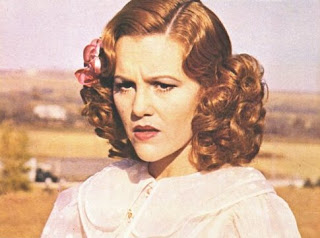 Wahl related that one of her favorite scenes in all of movies is in Paper Moon (1973) when Madeline Kahn is trying to convince Tatum O'Neal to come down off the hill. There's something so touching about that scene for her. Bogdanovich related that in that scene Kahn as Trixie Delight pleads with Tatum's character Addie to not screw things up for her with Moses Pray (Ryan O'Neal). She cajoles Addie into sitting in the back seat and letting Moses sit up front with her big tits. The first time they read the scene, Kahn said, "I'm not saying that." He said, "You're not going to say that?" "No," she answered. "Well, what do you want to say?" Bogdanovich asked. "Big breasts or big boobies or something," Kahn offered, "but I'm not going to say tits." "Okay," Bogdanovich said, letting it go. And, indeed, Kahn never said it until the day came to shoot the scene and just before they started rolling, he went up to her and whispered in her ear, "Say tits just once" and walked away, not sure if she would do it. She did it. When you see it in the picture, Bogdanovich pointed out, it was her one and only take and then afterwards there was this great moment because she had never said it and she had this kind of embarrassed smile, "which was heaven."
 Bogdanovich wrapped up by seizing the opportunity to tells stories that allowed him to do his infamous (and hilarious!) vocal impersonations of Cary Grant and James Stewart and then concluded with a complaint: "Nobody ever says, 'Have you seen that old play by Shakespeare?' Or, "Have you heard that old symphony by Mozart?' Or, 'Have you read that old novel by Hemingway?' No one ever says that. But they always say, 'Have you seen that old movie?' I don't like that because a movie—if you haven't seen it—it's not an old movie; it's a new movie."
Cross-published on Twitch.
 Each morning at the TCM Classic Film Festival a 70mm film was screened at The Egyptian Theater. I wish I could say I caught them all but the only one that truly worked for my schedule was the Friday morning screening of Stanley Kubrick's 2001: A Space Odyssey (1968), which—believe it or not—I'd never seen in 70mm.
As the TCM notes synopsize: "With the success of 2001: A Space Odyssey in 1968, science fiction moved into the Hollywood mainstream, paving the way for such later blockbusters as Star Wars (1976) and Avatar (2009). Director Stanley Kubrick and legendary novelist Arthur C. Clarke created a visionary work about the human race's coming of age, highlighted by a richly detailed view of space travel. The film not only featured space ships so realistic they seemed about to take off, it filled them with product placements for everything from IBM computers to Howard Johnson hotels. And the Oscar®-winning special effects team, led by Douglas Trumbull, pioneered in the use of front projection and split-scan photography to create the most dazzling visions of space travel to that time. Kubrick deliberately kept the film's action ambiguous, a choice that left most critics dumbfounded and even hostile. But it also opened Hollywood's eyes to a new audience. Word soon came back that box office returns were being generated largely by students and hippies who attended multiple times, often in drug altered states, to experience what they considered 'the ultimate trip.' The film's success helped create the cult movie phenomenon of the '70s and established the market for other visionary filmmakers like David Lynch. In Kubrick's words, he proved the viability of film as 'a non-verbal experience—the truth is in the feel of it, not the think of it.' "
 I was baffled by 2001 when I first saw it as a 14-year-old at the Idaho Theatre in Twin Falls, Idaho; but, just as the TCM notes characterize, my young psyche was already galvanized by the cultural foment taking place all around me. I hadn't even tried pot yet; but, 2001: A Space Odyssey insinuated that inevitability and—until that first puff—was, as Spike Lee coined it, my first joint. Like The Treasure of the Sierra Madre, I have watched this movie countless times, but am grateful to the TCM Classic Film Festival for providing the opportunity to see it in a pristine 70mm print provided by the Academy of Motion Picture Arts & Sciences. It was a spectacular experience, nearly as thrilling as when I first saw it over 40 years ago. This go-round, I was struck by the startling contrast between the immaculate interiors of the Discovery One—all that white plastic and metal—and Gary Lockwood's virile physique; yet another inflection of the tension between technology/machinery and flesh/the human. Lockwood's performance of astronaut Dr. Frank Poole has entered the domain of the iconic and, without question, he never looked better (except, perhaps, wearing a tight black t-shirt in Jacques Demy's Model Shop).
 After the screening, TCM daytime host Ben Mankiewicz welcomed special effects wizard Douglas Trumbull to the stage of the Egyptian to discuss his participation in the film.
Mankiewicz asked Trumbull if he was still moved watching the film? "Yeah, I am," Trumbull responded. "It's really great to see it on a big screen and to see it in 70mm." Guessing the Egyptian had a 65-foot screen, Trumbull reminded his audience that 2001 was designed for a 90-foot curved Cinerama screen. "There are very few people alive today," he conjectured, "who have seen it in that format."
 Mankiewicz enquired how Trumbull came about to work on the film? How Kubrick found him and hired him? Recounting that one of the first films he worked on was To the Moon and Beyond for the 1964-1965 New York World's Fair, the film was produced by Cinerama Inc. using a camera with a single fisheye lens and projected onto a dome screen in a process called Cinerama 360. To the Moon and Beyond was shown in a 96-foot high "Moon Dome" that was part of the Transportation and Travel building (Pavilion No. 123) in the Transportation section of the Fair. Both Stanley Kubrick and Arthur C. Clarke had seen the film at the Expo and hired Con Pederson from Graphic Films—where Trumbull was working at the time—to do some preliminary designs because they were specializing in space simulations. Trumbull then cold-called Kubrick after obtaining the director's home phone number from Pederson and left Graphic Films to work on 2001.
Asked of his impressions of Stanley Kubrick as a person and as a professional, Trumbull answered, "Stanley Kubrick is a lovely man. Stanley is—or was—extremely intelligent. Way over people's heads. People around him were intimidated by him. But he also was a very private man. He liked to be left alone. He liked to be left to his own creative processes. He didn't like the interference of Hollywood studios and of people second guessing him. That's why he left the country and went to shoot in England for most of his films. He didn't like being critiqued and he didn't like talking to the press about what it was he was trying to do. It pissed everybody off, frankly, because the press doesn't like being denied access. For a lot of reasons like that, he got a bad reputation of being eccentric, difficult, whatever. Stanley was definitely eccentric—there's no doubt about it—but, I don't say that in a derogatory way.
 "My experience of him was that he loved me and I just happened to be in the right place at the right time. He was extremely supportive. We were struggling with the Star Gate. Nobody knew what a Star Gate was; but, I came up with some ideas that I didn't even know at the time were based on some things I was learning as a young guy about street photography and weird photographic techniques where the camera is a different kind of a camera; the shutter is not in the camera, the shutter is out in the world. Street photography was a technique that was used for photo-finish cameras at the race track. Stanley was a photographer. He knew a lot about photography. He knew all about lenses. He had a lot of Nikkons all around. A lot of people don't even know that 2001 was shot largely with Nikkon lenses—Panavision doesn't like to admit that—but, he was very involved with photography and when I came up with ideas and said, 'I think there's this street photography application that will solve the Star Gate thing', he would say, 'Hey. That's great. I love it. I believe it. I understand it. What do you need to do it?' and I would have complete carte blanche, which was wild as a young guy; I was 23-24 when I started the movie, and was 25 by the time I was doing the Star Gate. He would say, 'What do you need?' and I'd say, 'Well, I need to go into town and buy some weird bearings and some stuff' and he would send me off to town in his Bentley, with a driver, into London. It was great!"
 Despite Kubrick not wanting to have to explain himself to the press, he was nonetheless sensitive to reviews and was very hurt by Pauline Kael's negative response to 2001. "He was completely dumbfounded that people didn't get the movie when it first came out. He was totally there and he'd been in it for years, obviously he'd made this movie and understood it completely. He incorrectly estimated how much slow, endless shots that people could tolerate, so—as you probably know, 17 minutes was cut out right after the first premiere to get the pace up a little bit; but, yeah, he was very hurt by these reviews and it really wasn't until a whole different audience than the studio expected started showing up for what they rebranded 2001 as 'the ultimate trip' and it became an experience where you would sit in the front row, smoke a little pot, and trip out. It completely rebirthed the movie. The movie was a day or two away from being pulled when the theater owners started calling the distribution company saying, 'Why don't you wait a couple more days before you pull this movie because the audience is starting to build back up' and it was all about the young people in the front row. People, finally, after a lot of agony for Stanley, started understanding what he was trying to do."
 Referencing the impressive special effects and Bruce Dern's performance as an "eco-astronaut" in Trumbull's 1972 film Silent Running, Mankiewicz queried about the film's effect on a young filmmaker named George Lucas who was making his own film at the time. "George came to me after I had made Silent Running—I had a little office out in the San Fernando Valley—and asked me if I would do the special effects for Star Wars and I said no. That would have diverted my life or changed the course of my life in some drastic way if I had. I had just directed a movie and I told him, 'I'm very honored to be asked and I'll give you all the help I can'—because he said he was going to need robots (which became R2D2)—and I said, 'I'll help you out by giving you the names of all the people we used, the bilateral amputees who were performing' and he said, 'No, no, no, thank you, but that creeps me out.' He was going to use midgets and I said, 'Well, whatever you want.'
 "I said no to George because I was on my own career path starting out as a young director in this town. I was getting into development deals with almost all the major studios and I had a number of sci-fi films that I was going to direct after Silent Running. I went into what is called development hell. You don't get paid much money when you're developing a screenplay or a production design or whatever. I kept going through these incredibly amazing experiences as a young filmmaker. I was like the hot young filmmaker. Everyone was amazed that I could make Silent Running for such a low amount of money—just a little over a million dollars; a fraction of what 2001 had cost—but, I had a project at MGM and we got way down the pipe: we had a screenplay; we had locations scouted; we were starting to cast the movie when Kirk Kerkorian decided to close the studio and build a Las Vegas casino. That stopped that one dead.
"And then I had a project called Journey of the Oceanauts, a big underwater action adventure sci-fi spectacle with Arthur Jacobs who had done The Planet of the Apes. We got way down the pipe on that, started shooting tests, had a screenplay in production, and Bob McCall did a lot of production design for me—he did the poster for 2001—and we were getting that all geared up when Arthur Jacobs suddenly died and the whole project got tied up in his estate. I could go on and on and on but development hell is exactly that.
 "I was really hitting the wall and going broke and—though I've never had an agent—I went to my attorney and said, 'I'm desperate. I've got to find something to do and I do have a lot of ideas about how movies can or should be made. We could dramatically improve the quality of film technology by doing some experiments.' So we actually got some money from Gulf & Western and Paramount Pictures to start a company called Future General Corporation, which was a research and development company down in Marina del Rey where we started experimenting with film. We started exploring tests with every film format known to man, every kind of camera, every kind of lens, every kind of projector and that's when I realized that one thing no one had ever tried was to really dramatically change frame rates. We shot films at 24, 36, 48, 66 and 72 frames per second and showed them in a special theater. We were blown away. We knew it was great; but, in order to get a patent, we had to prove that it was stimulating to audiences. We set up a lab out in Pomona at a university and hooked individuals up in a screening room to galvanic skin response ... four different sensors—breathing, heart rate—like a lie detector test and mapped them out relative to frame rate. That was in 1975-1976 and we found out that getting up to around 60 frames per second created a dramatic increase in human stimulation; a sense of immersion. That became the Showscan film process, which I patented. We did quite a few films for expos and world fairs and other special projects. We invented simulator rides, 3D-interactive video games, virtual sets, electronic cinematography, all kinds of stuff came out of this little company. Then the management of Paramount changed and I was back in development hell."
 With the current popularity of 3D, Trumbull was asked if he would have done 2001: A Space Odyssey in 3D were it being made today? "I would," he said, "but not like this." Conceding he was "a complete media fanatic" as a result of working on 2001, he learned a lot about film formats and giant screens and film technology even as they began making the movie. They hit a lot of obstacles. For starters, they discovered that 24 frames per second limited the speed at which anything could move across the screen before it would start blurring and strobing. They had trouble holding the resolution of stars against a black field. But since then, Trumbull has been looking at every conceivable way to make movies, including the Showscan process he developed several years ago that used 60 frames per second, which got rid of all the resolution problems they had making 2001. Jim Cameron, who has "broken the mold" with Avatar, has often talked about Showscan and high frame rates. They both opine that 24 frames per second is inadequate for 3D and Trumbull is convinced that Cameron will continue to push the envelope. "There has been talk about going to 30 frames per second, there's more talk about 48, there's serious talk about 60, and now there's talk about going to frame rates even above that. As a result of Avatar, and 3D, a whole lot of other dynamics in the way that movies can be made are in play."
Understanding that Trumbull was impressed with Avatar from a technological point of view, Mankiewicz queried whether Trumbull was as impressed with its storyboard? "I have complicated feelings about it," Trumbull offered. "Impressed? Yes. If you look at 2001, Kubrick was trying to explore what he thought was a new cinematic form. He was very tired of normal cinematic conventions: master shots, two shots, over the shoulder singles, close-ups, inserts. There's a language of film that's very well-known that every good filmmaker knows how to do. He was trying to break the mold here. 2001 was a first-person experience. It was about you being in space. He wanted you to be able to interpret any way you wanted and just kind of be there rather than him hitting every nail on the head where—by the end of the movie—you knew everything and there was total closure. He wanted you to drift off into all kinds of your own speculations about what the meaning of life is, what the meaning of God is, what encountering a civilization a billion years in advance of us would entail, and how would we handle it? It's an extremely intelligent movie in that respect.
 "What I'm getting at is that Jim Cameron made Avatar in this completely amazing new technology, which is only enabled by digital computer graphics; but, it does adhere to normal cinema conventions. All the stuff in there is fairly straight drama ... but he lands in this new territory, which is really beautiful and is one of the attributes that people are enjoying about the movie. We don't discuss it very much and critics don't seem to talk very much about it; but, it's a technology-enabled out-of-body experience. ...He shot his actors in advance, he built all the virtual location sets and props in advance, worked out all his lighting, worked out all his blocking, and then went back in with this virtual camera and looks at the scene in its digital form but with total camera fluidity inside the computer-generated world. He has controls on it so that he can be one-to-one, which means that—if he moves a foot—the camera's going to move a foot. But if he wants a hundred-to-one, they dial it up and just doing this [Trumbull gestures a dive with his hand] is a thousand-foot dive off the edge of a cliff. He becomes, still, the director of these virtual shots that are completely amazing arobatic maneuvers.
 "Jim is an informed filmmaker because he understands flying dynamics, he understands underwater dynamics, he understands what bioluminescent creatures look like underwater when there's no light, all kinds of things that you see in Avatar that have been informed by a lot of his diving experience before and after Titanic. You see a lot of things in there that are enhancing 3D. They're not necessarily story elements, but—when there's a lot of little sprites and things or motes of dust in the air—it's all about enhancing your perception of depth and scale."
Cross-published at Twitch.
 I first learned of Luise Rainer—as with so many other of the creative individuals of her generation—through the diaries of Anaïs Nin. If I recall correctly, they befriended each other about the time that Rainer was separating from her first husband playwright Clifford Odets and what sticks in my memory is Nin's descriptions of Rainer's suffering at the time, especially one episode where she sat on the steps of her home painfully enunciating the word "masochism", which lends credence to the ascription by film historian Emanuel Lefy that Luise Rainer was the "most extreme case of an Oscar® victim in Hollywood mythology" (All About Oscar: The History and Politics of the Academy Awards, Continuum International Publ. 2003, p. 314). It wasn't until years later that I caught Rainer's Oscar®-winning performance as the Chinese peasant woman O-lan in The Good Earth (1937), which came offered to participants at the first-ever TCM Classic Film Festival in a brand new print from Warner Bros., with Rainer—at 100!—present to converse with TCM host Robert Osborne.
 The TCM notes for The Good Earth state: "Luise Rainer became the first actor to win two Oscars and the first to score back-to-back wins with a role that gave her fewer lines than the average supporting performance. Playing the devoted, long suffering farmer's wife in Pearl Buck's epic tale of life in a remote Chinese province, she didn't need words. She relied on her expressive eyes and exquisite body language to bring O-Lan to life. The performance was showcased in one of MGM's most impressive productions. The studio had devoted six years to developing this tale of a Chinese family struggling to survive war, famine and a spectacular plague of locusts. The original director, George Hill, shot location footage in China while studio researchers sent hundreds of home furnishings and props back to Hollywood. After Hill's suicide, the project lay dormant for two years until Sidney Franklin took it over. Although MGM production head and "boy wonder" Irving G. Thalberg had originally planned to shoot The Good Earth entirely in China, he eventually had technicians transform 500 acres of Chatworth, CA, into terraced Chinese farmland. This was the last project Thalberg brought to fruition and he fought tirelessly to realize Buck's vision to the fullest. When he died shortly after principal photography ended, Mayer gave Thalberg what he would never take himself—on-screen credit for his work."
 Led to the stage of The Egyptian Theatre on the offered arms of two young strong men, Rainer beamed as the audience took to their feet in a cheering standing ovation. The event, however, proved a near disaster. Though Rainer had managed to make it to Hollywood from Vienna inbetween spewing plumes of ash from Iceland's erupting volcanoes, she accidentally broke her hearing aid earlier in the morning and could not hear a word of what Osborne was asking her. With cameras rolling—the conversation was being filmed for future broadcast on TCM—the otherwise poised Robert Osborne seemed momentarily nonplussed until someone from the audience shouted out the suggestion that he write down his questions and rushed to the stage with a notebook pad and pen so he could do so. Ever gracious, Osborne expressed his gratitude to his audience's ingenuity.
Rainer apologized for the fact that she had to limp into the theater assisted by others. Her comment underscored the commonly-held belief of yesteryear's "stars" that they owed glamour to their fans.
 Asked how she developed her characterization of O-lan, Rainer said that she first of all fought against the excessive make-up the studios wanted to apply to "turn" her Chinese. "Are you mad?" she told them. She refused to wear such a mask. As an actress who worked "from the inside out", she believed that—if she couldn't become O-lan—no amount of make-up was going to do the trick. She claimed her interpretation was largely gestural, based upon the small gestures she had observed in Chinese women. It's difficult not to address the faint trace of racism in such a comment, let alone that many today believe the role should have rightfully gone to Anna May Wong, who—by MGM's refusal to consider her for the role—faced the most severe disappointment of her career. Despite consideration of what Wong might have brought to the role of O-lan, wide berth must be given to Luise Rainer who had her own issues with the Hollywood system.
On the set during one of the crowd scenes Rainer dropped her pocketbook and as she bent down to look for it she knocked heads with one of the Chinese extras who was helping her search. The extra recoiled, shocked, but then smiled and let out a garbled laugh, and in that moment Rainer knew that this Chinese woman was O-lan and that she would base her character on this woman, who she found demure and loveable.
 Asked about working with co-actor Paul Muni, who played her husband Wang Lung, Rainer recalled that he was a "naughty" man who was quite different from her not only in his acting style but how he approached the project. They were never on a first-name basis. She called him "Mr. Muni." Muni's wife would sit at the monitors to make sure her husband looked better than anyone else. "I was not so much in love with him," Rainer admitted.
 As for what it was like to work with Louis B. Mayer, Rainer recalled that—in Mayer's eyes—she was "a little crumb". He couldn't make her out because she wasn't interested in becoming a "star." He called her a Frankenstein and said that—if they weren't careful—she would end up ruining MGM. She refused to sit on his knee like the other young actresses and not only was she disinterested in being one of his stars, she didn't even want to be one of the tools in his dream factory. She wanted to create beautiful films and create characters whose feelings she could share with others. It was the process of creating her characters that mattered to her. She didn't believe in "acting"; she believed in being. For her the human personality possessed as many layers as an onion, of which an actor was required to be aware, so that as they peeled back each layer—ranging from murder to love—they could eventually arrive at deep feeling, deep beauty.
It is the warmth of human beings that enhances her own existence, Rainer attested. She recalled that Greta Garbo adored her and her beauty, her face, down to her perfect feet. When Osborne asked her, "What about Luise Rainer today?" she promptly answered, "Here!"
 She touched upon her love for her first husband Clifford Odets and how their marriage failed in divorce. Her second husband, publisher Robert Knittel, remained by her side for 47 years before his death. She adored him because he saw her as the center of the universe. "As do we," Osborne concluded the session, despite Rainer's protestations that she wanted to have more time with the audience, to answer their questions. Such was not to be.
Cross-published on Twitch. The photograph of Luise Rainer being led into the Egyptian Theatre courtesy of Movie Morlocks.
 Conversing with several festival participants while waiting in line, it rapidly became clear to me that TCM fans are both knowledgeable and opinionated. "How TCM could hold a classic film festival without including even one Bette Davis film is beyond me," complained one fan and there were commensurate complaints that the only Joan Crawford film—the "essential" though, arguably, obscure A Woman's Face (1941)—was being screened in the festival's smallest venue: Mann's Chinese Theatre House 3. I set reservations aside to enjoy this freshly-struck print from the Warner Bros. vaults, introduced by Melvyn Douglas's granddaughter Illeana Douglas and Joan Crawford's grandson Casey LaLonde (who likewise shared his grandmother's home movies with participants in a Club TCM presentation; the tail end of which I likewise enjoyed).
 As the TCM notes synopsize: "Often forgotten among the many lesser vehicles that Louis B. Mayer had her cast in during her last years at MGM, this 1941 romantic thriller contains one of Joan Crawford's personal favorite performances. Those sentiments are echoed by her grandson, Casey LaLonde, who not only chose this film for the Festival, but will be in attendance to present this screening. After seeing Ingrid Bergman in the 1938 Swedish version, Crawford persuaded Mayer to pick up the property for her, even though he thought the choice would end her career. He feared audiences would be disgusted by the role of a scarred female criminal whose character changes when plastic surgery turns her into a beauty. Crawford put her full trust in director George Cukor, who eradicated any hint of the MGM glamour queen from her performance. To get her to drop all artifice while telling how she got her scar, he made her recite multiplication tables before the take. Then he complemented her work with a vivid visual style bordering on Expressionism. The result was a triumph she hoped to follow by playing the mute servant in The Spiral Staircase, but Mayer was firm—'No more cripples or maimed women!' (Dorothy McGuire would star in The Spiral Staircase in 1946, but for another studio). Crawford always harbored a soft spot in her heart for A Woman's Face and later credited it with helping her win the Oscar® for Mildred Pierce (1945) by reminding Hollywood she was a very talented actress."
 It's hard not to consider Joan Crawford's tutelage under Lon Chaney, Sr. in the silent classic The Unknown (1927) as a possible inspiration for her fierce lobbying for the role of Anna Holm in A Woman's Face. Undoubtedly it's true that the "Man With A Thousand Faces" shaped Crawford's belief that acting should not always be confined to glamorous roles and that now and again she should play a face that only a plastic surgeon could love. Crawford has been quoted as saying that she learned more about acting from watching Chaney work than from anything else in her career. "It was then", she said, "I became aware for the first time of the difference between standing in front of a camera, and acting."
As Crawford wrote in her autobiography A Portrait of Joan (Doubleday & Company, Inc. Garden City, New York. 1962:126-127): "Poor Mr. Mayer. He had borne with me as the bitch in The Women, the bleak-looking woman in Strange Cargo, the mother of a subdeb in Susan, now he balked at my playing a scarred woman who hated the world. Luckily George Cukor took up the cudgels for me, and A Woman's Face scored my high point at MGM. I was extolled as the first lady Lon Chaney, for as Anna Holm, I wore from eye to mouth on the right side of my face a hideous mass of seared tissue created by Jack Dawn. The studio released no publicity art. They were concerned that my mutilated face would keep people away from the theater. The scar didn't deter me, there are too many beautiful women in pictures anyway.
 "What worried George Cukor was my emotionalism. He anticipated that wearing a scar would affect me as wearing a cape has been known to affect some actors. To offset the possibility, he rehearsed the very life out of me. Hours of drilling, with camera and lights lined up for the opening sequence in the courtroom, then Mr. Cukor had me recite the multiplication table by twos until all emotion was drained and I was totally exhausted, my voice dwindled to a tired monotone.
" 'Now,' Mr. Cukor said, 'Now, Anna ... tell us the story of your life.'
"I say a prayer for Mr. Cukor every time I think of what A Woman's Face did for my career. It fortified me with a measure of self-confidence I'd never had ... the greatest rave notices I'd ever had ... the succès d'estime I'd longed for ... what critics called 'the best picture to emerge from Hollywood in a long long time' ... and what others called the best picture, without question, of the year."
Variety, at the time, observed: "Miss Crawford takes a radical step as a screen glamour girl to allow the makeup necessary for facial disfiguration in the first half ... [Crawford] has a strongly dramatic and sympathetic role ... which she handles in top-notch fashion."
 A Woman's Face joins Crawford's catalogue of entertaining—if not slightly coerced—melodramas. Her character Anna Holm is on trial for murder. The film is structured as a series of sequential flashbacks that impel the plot forward one character at a time, providing clues and perspectives to winnow out the conflicting motivations of this romantic thriller. The technique bears interest for prefiguring by a little under a decade Rashomon's soon-to-be-infamous relativity of perspective. A Woman's Face cries out for a screen capture assessment, especially because as each character tells their tale his or her face is held superimposed upon the beginning shot of their narrative. When it comes Crawford's turn to recount her involvement, her face is superimposed stunningly against a wintry landscape. This is a screen capture that could be aptly entitled "The Ice Queen." With Melvyn Douglas as love interest Dr. Gustasf Segert, Conrad Veidt as the oily foil Torsten Barring, Marjorie Main as the prudish Emma Kristiansdotter, and a cloyingly impish performance by child actor Richard Nichols as Lars-Erik, Crawford's turn from depravity to redemption clings fiercely to its narrative arc and succeeds by sheer force of will alone. Of incidental interest is Conrad Veidt's participation in this project, reminiscent of his own turn as the disfigured Gwynplaine in the 1928 classic The Man Who Laughs.
Two contemporary and particularly commendable commentaries can be found at Self-Styled Siren (Farran Smith Nehme) and Cinepassion (Fernando Croce). Nehme writes: "What we have here is two-thirds of a good movie. A Woman's Face starts out wonderfully, continues well through the midpoint and just when you are thinking, 'Hooray! I love this!' Joan Crawford shows up at a dance in some kind of Swedish peasant dirndl-drag and it's all over." The film's final third Nehme categories as "hamfisted." Croce culls out some intriguing resemblances to the work of Hitchcock and Rossellini.
 Several of Illeana Douglas's performances have captured my attention over the years, notably when Robert DeNiro bites her cheek off in Martin Scorsese's Cape Fear (1991), her triumphant figure eights over the frozen corpse of Nicole Kidman in To Die For (1995), and her channeling the spirit of singer-songwriter Carole King in Grace of My Heart (1996). Douglas was 15 or 16 at the time her grandfather Melvyn Douglas passed away so she has clear memories of him. "First of all," she began, "I just want to say thank you to TCM for showing this film. It's really a great film and I'm thrilled to be part of the TCM family. I've done some introductions for films of my grandfather. He was born in Macon, Georgia—a lot of people don't know that—and he was discovered by Gloria Swanson while he was doing a play called Tonight Or Never. The fun thing about that was that his understudy was Joseph Cotten so that—when he went to Hollywood with Gloria Swanson—Joseph Cotten took over for him and that's what started his career. He was at MGM for many years under contract and then in 1949 my grandmother ran against Richard Nixon for senate, she was defeated, and it caused a lot of problems." Illeana's grandmother Helen Gahagan Douglas, in fact, was the first to call Richard Nixon "Tricky Dick." Her grandparents lived in a lovely home in Hollywood, neighbors to Paul Douglas and Ronald Reagan; but, 1949 proved a difficult year in many ways for many people in the film industry. That's when Melvyn Douglas's career shifted from leading man to character actor.
 "What's great about this movie for me," Douglas emphasized, "is that it's at the height of my grandfather's leading man career. He's the only actor, I believe, to have worked with Bette Davis, Joan Crawford, Katherine Hepburn, Garbo, Marlene Deitrich, Norma Shearer, and Irene Dunn. A Woman's Face is at the height of his career during the golden days of MGM."
Douglas then recounted that Melvyn Douglas was a wonderful grandfather. She was allowed to be on his movie sets a couple of times (namely, Being There and A Ghost Story), which proved to be "a crazy experience" for her as a young girl. As he became a character actor later on, Douglas added, her grandfather bristled against the delimited view of character actors and insisted there was no such thing as "character acting". If you're a good actor, he said, it's all character acting.
Joan Crawford and Melvyn Douglas did three films together: The Gorgeous Hussy (1936), A Woman's Face, and They All Kissed the Bride (1942). Crawford spoke highly of him. As Illeana was growing up, she was obsessed with Crawford, and wanted to look like her because she was so beautiful, even in A Woman's Face, and—in her estimation—an actress whose performances in such films as Autumn Leaves (1956) have been highly underrated.
 Casey LaMonde, Joan Crawford's grandson by way of Cathy LaMonde—one of Crawford's adopted fraternal twins born in 1947—contacted TCM as soon as he heard about the film festival and offered the heretofore unseen home movies. Accepting his offer, TCM then granted him the right to pick a Joan Crawford movie to show at the festival and his choice was A Woman's Face, first because he had never seen it on a big screen and second because it linked in temporally with the home movies. Recalling his grandmother, he admitted he was five when she passed away. "I would give just about anything to have had more time with her. She was in failing health when I knew her. We would visit her in New York City at least once or twice a month. She hadn't been out in public in quite a long time because she was not looking like Joan Crawford anymore. As a term of endearment—no 'grandma' for her, no 'granny', because she was Joan Crawford—she came up with a nickname. We called her Jojo. My mom referred to her as Jojo as well. So I have wonderful memories of going to the city, seeing her, days and weekends with her in her amazing apartment on the Upper East Side. We'd go eat lunch with her, run around her parquet floors, and just hang out with Jojo. To my mother and my Aunt Cindy who passed away about two years ago she was a loving supportive mom. None of the Christina stuff was ever discussed because it never happened to them at all. She was loving to her children and her grandchildren as well."
05/11/10 UPDATE: At TCM's Movie Morlocks, Moira Finnie considers A Woman's Face.
Cross-published on Twitch.
 One of the many fascinating sidebars at the first-ever TCM Classic Film Festival was their tribute to The Hustons: A Hollywood Dynasty. Walter and John Huston were acknowledged with a screening of The Treasure of the Sierra Madre (1948); Anjelica Huston with her turn in Crimes and Misdemeanors (1989); and her half-brother Danny Huston with his recent performance in The Proposition (2005).
The TCM notes synopsize Treasure of the Sierra Madre: "With this 1948 Western, John and Walter Huston went into the record books as the first father and son to win Oscars and, eventually, two thirds of the first family to produce three generations of Oscar winners (including Anjelica Huston). Rarely have the awards been so well-deserved. Sadly, the film and star Humphrey Bogart didn't do as well. In fact, though most critics now hail Bogie's Fred C. Dobbs as his best performance, he wasn't even nominated. Perhaps his decidedly unsympathetic portrayal of paranoia was too far ahead of its time. Indeed, The Treasure of the Sierra Madre set new standards for Hollywood. Filmed mostly in Mexico, it was one of the first U.S. films shot almost entirely on location. Its cynical tale of three prospectors divided by greed after they strike it rich pointed to the more adult Westerns of later decades (i.e. Sam Peckinpah's films). B. Traven's novel reminded John Huston of his days with the Mexican Cavalry when he first read it in 1936, and he dreamed of directing his father as Fred C. Dobbs. By the time he got to make the film in 1947, the elder Huston had outgrown the lead, so his son re-shaped the role of the elderly prospector for him. Not only did he have to convince the matinee idol to accept a character role, but on the first day of shooting he had to wrestle his father's false teeth from him to make sure he played it right. Once he heard himself deliver the lines, Walter Huston knew it was the right choice. In fact, he was so good, his son started getting memos from studio management warning him not to let him steal the film from the star. That was hardly a danger; Bogart matched him scene for scene. But when award season rolled around, it was the Hustons who came out on top, with honors from the Academy, the Golden Globes, the New York Film Critics and the National Board of Review."
 The Treasure of the Sierra Madre is not only my favorite Humphrey Bogart film but, quite possibly, one of my top 10 favorite films. I have seen it countless times on television, and a few times in movie theaters, but never in such a pristine print as shown at the TCM Classic Film Festival. I love it for many reasons, from Bogart's ability to play the greed-addled Fred C. Dobbs to Alfonso Bedoya needing "no stinkin' badges"; every performance in this film is outstanding and exquisitely embodied. Walter Huston's jig at finding gold matches my enthusiasm for this timeless B. Traven story. I attended TCM's morning screening of The Treasure of the Sierra Madre in Grauman's Chinese Theater with Anjelica and Danny Huston present to introduce the film by way of an on-stage conversation with TCM host Robert Osborne.
* * *
 Robert Osborne: I have to ask, is it tough being a Huston?
Anjelica Huston: Not this morning.
Osborne: But aren't there expectations that come with being part of the Huston clan?
Anjelica Huston: I think yes; but, we had quite an exacting father. He liked when we put our best foot forward and we tried to do that, right Danny?
 Danny Huston. Yes. I mean, he's such a giant of a filmmaker that to measure oneself up against him is quite difficult and one seems to be having to crane one's neck to look up high; but, in a sense, he was very supportive of us as filmmakers and I found this little place beneath this giant that protected me from the harsh rays of the sun. It was a gentle feeling and one of encouragement.
Osborne: Did you talk to your father about his films very often? Or was that something that wasn't talked about much in your family?
Danny Huston: Something that brings me to The Treasure of the Sierra Madre was an experience I had at the Cannes Film Festival where he was showing Under the Volcano. The producer, Michael Fitzgerald, and I stayed up all night waiting for the reviews and the following morning Michael Fitzgerald was translating the reviews from French to English. But my father didn't appear to be listening. He had this faraway stare. Michael said, "John? Are you listening?" And he said, "This reminds me of when I stayed up all night to read reviews for a play that my father put on, which he'd wanted to do his entire career: Othello." Walter Huston reached a point in his career where he could put this play on in New York. Othello was applauded at the end but my father had a nagging feeling that maybe it hadn't gone as well as he'd imagined. My father stayed up all night and the following morning read the reviews and they were terrible, absolutely awful, and he thought, "Oh dear. What am I going to do?"
 He went to my grandfather's place and rang the doorbell. He could hear laughter and he thought, "Jesus, this is going to be even more difficult than I expected." The door opened. The reviews were all on the floor and my grandfather had tears streaming down his cheeks, but laughing, and laughing with a certain amount of glee. That's the laughter that they called upon for the end of The Treasure of the Sierra Madre when the gold is blown back into the hills....
Anjelica Huston: [Admonishing.] Sssssshhhhh!!
Danny Huston: I suppose you've all seen it?
Osborne: How do you both feel about this film in your father's catalogue? Is it a particular favorite of yours? Have you seen it recently?
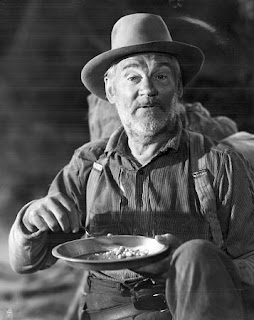 Anjelica Huston: I haven't seen this film recently. I think maybe 15 years ago I saw it on television; but, it was the first film actually of my father's in memory; this film and The African Queen. Growing up on the West Coast of Ireland without television and just the movie projector; all the films that I saw were my father's films. The first time that I saw a film that wasn't my father's was something like Gidget Goes Hawaiian. The Treasure of the Sierra Madre was a staple at our household and there was always this endless routine of looping the projector—because no one really knew how to loop the projector—so there was always an incredible anticipation of whether, in fact, we could even get the movie projected. Eventually, I guess I've seen this movie maybe ... well, certainly over 50-70 times in my childhood. So I know it pretty well but I can't wait to see it on a big screen again. I know it will bring back a lot of memories. I used to have a little black poodle growing up called Mindy and—every time the donkeys ran—Mindy would run after the donkeys. I always enjoyed that moment. I hope you will too.
Danny Huston: It was a deliciously noisy little projector, wasn't it? And usually it was a very scratchy print. But it was a way for us to say hello to our grandfather and in a way it was a rather glamorous family album. It's so wonderful to be able to share it with you all today. Thank you, Robert, for being such a champion of these films.
Anjelica Huston: I was recently up in Vancouver working on a film and—in my spare time—I just laid in my bed in my hotel room and watched TCM with the great Robert Osborne conducting. I have to say, it's such a pleasure to see these beautiful old movies so carefully and lovingly presented without commercials.
 Osborne: I have to tell you a little story. I don't want to take this up from talking to you guys; but, at the Telluride Film Festival a couple of years ago they asked me and Sam Goldwyn, Jr. to present Dodsworth at the festival. Sam's father had produced it and he had come to talk about the making of the film. This was the year that Babel and King of Scotland and all of those films were out—these were the hot new movies—and they don't show old films at the Telluride Film Festival; but, they decided to show Dodsworth. It turned out—it was so incredible—it was the hit of the festival. It went so well, they had such a crowd, that they asked, "Would you and Sam do another [screening]?" We did. They had a third showing and that had never happened before. It was that film of your grandfather's and it's so magnificent—particularly for anybody who really knows Walter Huston from The Treasure of the Sierra Madre—to see him as a dapper, elegant leading man in Dodsworth. To have that legacy in the family is pretty terrific too.
 Anjelica Huston: Yes, I actually met my grandfather through film. If it hadn't been for Treasure and Dodsworth, I wouldn't have known anything about him; but, as it is, I have a very clear picture of him as an extraordinary actor because these two parts—as you were saying—are so diverse. It's a treasure for me to have Treasure.
Osborne: Is there a personal favorite of your father's films beyond The Treasure of the Sierra Madre?
Danny Huston: This is definitely my favorite for many reasons, including sentimental reasons; but, the lesser-known films such as Fat City, Wise Blood, The Misfits of course—Eli Wallach was here the other night; what a thrill it was to meet him—there are so many. But if I had to choose, this would be the one.
 Another little story, if I may, and hopefully I won't ruin the end. It was a beautiful Spring morning and my father and his father (Walter) decided to go on a picnic. The hillsides were covered with wild flowers. My grandfather and his wife at the time, Nan, got out of the car and they laid out this cloth and my grandfather pounded this flower and hit it again and absolutely destroyed it. Then he turned around and hit another and hit another—the hillside was covered in these beautiful blossoming flowers—and then he stood up and, like the god Pan, pounded another and then pounded another again and Nan said, "Walter! Stop it! What are you doing?" There was this sort of panic in the air. He said, "I'm stopping Springtime." That was apparently the genesis of the wonderful jig dance that he does in Treasure of the Sierra Madre, combined with this ironic laughter in the face of disaster.
 Osborne: Now was it true from your family history that your father had a difficult time talking your grandfather into doing this movie?
Danny Huston: I believe he had to take his teeth out and my grandfather was not that happy about it.
Osborne: Because he had been seen in Dodsworth as a very elegant man so Treasure was a big stretch for him?
Danny Huston: I guess. As I say, he was not too keen on taking his teeth out. But it did win him an Oscar®.
Anjelica Huston: Dad asked Jack Nicholson to wear a toupee for Prizzi's Honor. He kind of liked to do that sort of thing.
Osborne: What would you say is maybe the one thing you miss most about your father?
 Anjelica Huston: That's a big question. I'd say just the voice. That voice that resonates through my being, every nuance in it, that's what I miss most about my dad.
Danny Huston: Yes, I would agree with that. Sometimes it was like speaking to God.
Anjelica Huston: He played God in The Bible.
Danny Huston: And Noah. And directed it.
Osborne: So what are you doing now? You mentioned, Anjelica, that you were in Vancouver making a movie?
 Anjelica Huston: I was making a movie—it's untitled; I wish I could give you a title—with Seth Rogen and a wonderful young director Jonathan Lavine, also with Joe Gordon-Levitt, Bryce Dallas Howard. I think it's going to be a very beautiful film. I play the mother of a boy who gets cancer. It's moving and it's funny and I'm proud to be part of it.
Osborne: And Dan?
Danny Huston: Well, forgive me for being crass; but, You Don't Know Jack airs tonight at 8:00 on HBO. It's about Dr. Kevorkian, with Al Pacino.
Osborne: But since we're here tonight, we'll get another chance to see it because HBO won't show it just this once, right?
 Danny Huston: That's correct. I'm competing with myself unfortunately because there's a screening of The Proposition tonight—of which I'm very proud—at the same time.
Osborne: Thank you both so much for participating and adding so much glamour and clout to our festival and for sharing the memories of your father and this movie. We can't thank you enough.
Anjelica Huston: Our honor.
Cross-published on Twitch.
 With this entry, I wrap up my coverage of the first-ever TCM Classic Film Festival with many thanks to TCM's publicist Sarah Schmitz and Caitlin McGee at L.A.'s mPRm Public Relations. I've already written some on TCM's Road to Hollywood tour, which built up to the TCM Classic Film Festival with a set of five local events. Attended by enthusiastic fans, the pre-festival Road to Hollywood celebrations featured free screenings in New York, Chicago, Boston, San Francisco and Washington, D.C., with appearances by TCM host Robert Osborne, weekend daytime host Ben Mankiewicz, Oscar®-winning actress Eva Marie Saint, filmmaker Peter Bogdanovich, Broadway legend Elaine Stritch and others. Not only was this a conciliatory gesture to offset the hefty price tag for passes at the festival proper (the Road to Hollywood screenings were free to the public); but, each film was chosen as reflective of the city wherein it was screened. What better choice could there be for San Francisco than Orson Welles' 1948 film noir The Lady From Shanghai? And who better to introduce this memorable thriller than filmmaker Peter Bogdanovich (The Last Picture Show), an expert on the films of Orson Welles and a close friend of the director, joined by San Francisco's KRON reporter Jan Wahl?
 Asked how Orson Welles might react if he knew that The Lady From Shanghai was being screened at San Francisco's historic Castro Theatre, Bogdanovich asserted Welles would have been thrilled. When Bogdanovich asked Orson Welles how people reacted when The Lady From Shanghai first opened, Welles told him people avoided the subject. If the film was mentioned, people would quickly change the subject. The first American who said anything nice about the film was Truman Capote when Welles met him in Sicily two years after The Lady From Shanghai came out. Capote even quoted lines from the movie. But other than for that, the film was not terribly well received.
 He finally received a phone call where Welles announced himself and said, "I can't tell you how long I've been wanting to meet you. I'm staying at the Beverly Hills Hotel. What are you doing at 3:00 tomorrow?" Bogdanovich said, "Nothing. I'll meet you there." Though he was nervous as hell, Bogdanovich met Welles the following day. Welles was dressed in a loose caftan. They spent three hours talking and by the end of that conversation Bogdanovich felt like he'd known Orson Welles all his life. Bogdanovich had brought Welles a copy of the book he had written on John Ford, who he was aware was Orson Welles' favorite director. Leafing through the book Welles insinuated that it was too bad Bogdanovich hadn't written a book on him. Bogdanovich said he would welcome the opportunity to write a book of interviews with him and so their first interview was held on the set of Catch-22 (1970), which urban legend says is where Bogdanovich first met Welles, though that's not entirely accurate; they had met before.
 With regard to The Lady From Shanghai, apparently Harry Cohn—who was running Columbia Pictures—was angry at Welles because of his influence on Rita Hayworth, even though their marriage was faltering and they were estranged during the filming of The Lady From Shanghai. Cohn was upset that Welles convinced Hayworth to give up her red tresses, and dye her hair blonde and cut it short. After the shoot was over, Cohn swore he would never make another picture where the director and producer was also the star. "I had nobody to fire," he complained, "I might as well be the janitor."
 The Lady From Shanghai was not fully the picture that Orson Welles wanted; but, then again, he rarely achieved the pictures he envisioned. One major dissatisfaction for him was Heinz Roemheld's score, which he hated and had nothing to do with. For example, the mirror sequence at the end was not supposed to have any score at all and Bogdanovich imagined Welles gnashing his teeth every time he heard it.
 Another time, Cybill Shepherd—who was also living with Bogdanovich—walked by the part of the house where Orson Welles was staying and she smelled something burning. She knocked on the door and said, "Orson, I smell something burning." He shouted back, "Yes, well I'd like a little privacy, please, that's all. Everything's fine." "But I smell something burning," she insisted. "Privacy is what's requested," he repeated. She didn't mention anything to Bogdanovich and later when both she and Orson were out of the house, Bogdanovich's housekeeper called out to him and said, "Mr. B., I think Mr. Welles had an accident." She had found his white terrycloth robe with a big burn mark in it. It turned out that he had put his lit cigar in the pocket of the robe and it had caught fire. So he had taken it off and thrown it into the bathtub but a part of it had fallen over the edge of the tub and had ignited the carpet. Welles said he would take care of it but he never did. A couple of days later a beautifully-wrapped book arrived for Cybill and when she opened it she found a beautifully-illustrated book about opera—she loved opera—and inside Orson had drawn a picture of a burning house with a ladybug in the foreground looking terrified. Underneath the drawing, Welles had written: "Ladybug, ladybug, fly away home. Your house is on fire and so is your houseguest. Love, Orson."
 Orson Welles was also the individual responsible for the rule that there should never be "dead air" on the radio or television because of the way he scared half the country with his Halloween 1938 radio adaptation of War of the Worlds. Staged as a series of simulated news broadcasts—now unlawful— interrupting the normal musical programming, Welles had an eyewitness newscaster describing the alien craft that had allegedly landed in Princeton. The moment that specifically terrified America was when the announcer—who had gone to Princeton—was describing the green monster emerging from the space craft and suddenly let out a scream followed by silence, dead air. People who were in the studio where Welles was directing recount that he wouldn't let them break the silence. He kept gesturing to them to keep the pause going for a long time. The silence is what scared the shit out of everybody.
 Along with recognizing Orson Welles' brilliance, Bogdanovich described him as being very funny. Bogdanovich had the honor of working with Welles on The Other Side of the Wind, an unfinished film directed by Welles starring Bogdanovich, John Huston, Dennis Hopper and Oja Kodar. Though Welles was kind to his actors, he could be a bit rough on his crew who were largely composed of volunteers or people who were not getting paid much. One day they had been there since 7:00 in the morning and it was already 3:00 in the afternoon and they hadn't broken for lunch. The assistant director nervously mentioned to Welles, "Uh Orson, the crew hasn't eaten. They've been here since 7:00 and it's already 3:00." "All right," Welles voiced irritably, "if they have to eat, let them go to lunch. I'm not hungry." Bogdanovich was sitting there and he said, "I'm not hungry either, Orson, I'll stay with you." "Fine!" Welles pronounced, "Peter and I will stay here while the crew goes to lunch." So the crew left for lunch and when Bogdanovich and Welles were finally alone, Welles turned and asked, "Are you hungry, Peter?" They went into the kitchen and on top of the refrigerator was an industrial-sized bag of Fritos. Welles picked it up, tore off the top, and poured the bag's contents onto the kitchen table. Welles sat down, took a big fist full of Fritos and shoved them in his mouth and—while crunching on them—said to Peter: "Y'know, you don't gain weight if nobody sees you eating."
 Recalling that Bogdanovich had filmed What's Up, Doc? (1972) in San Francisco with Barbra Streisand, Wahl quipped that not too many people who have worked with Streisand have lived to talk about it and asked if Bogdanovich could share a bit of his experience working with her? "I loved working with her," Bogdanovich answered, "she was a lot of fun." She didn't like the script, though she had given up script approval; but, she did like Bogdanovich and he liked her. She would read the script and go, "You think this is funny? This is funny to you?" He would say, "I think it's really funny, Barbra." Then he'd suggest, "Why don't you read that line like this?" She would stop, stare at him, and say, "You're giving me a line reading?" He told her he was merely giving her an indication of how the line could be said. Her agent called him up and said, "You're giving Barbra Streisand line readings?!" Again, he explained he was just offering a suggestion on how the line could be read. Two weeks later she finally said, "Okay, how would you say it?" Then he would tell her and she would do it. Finally, when she was singing "As Time Goes By" for the film, Bogdanovich asked her, "You know that line where you say 'and on that you can rely'?" She said, "Yeah." He said, "Can you hit 'can'?" She retorted, "Now you're giving me line readings on the fucking song?!" But she did it.
 Towards the end of the film Streisand had a scene where she says the in-joke, "Love means never having to say you're sorry." When the time came to rehearse the scene, Bogdanovich told her to say "love means never having to say you're sorry" in one straight phrase and then blink her eyes. "Why?" she wanted to know. He explained he felt it took the heat off the line and made it funny. "Yeah?" she answered, "huh." So from then on in the two weeks left before they shot the scene she went to each and every person on the set and asked, "What's funnier? Love means never having to say you're sorry ... or ... love means never having to say you're sorry?" She went to her co-star Ryan O'Neal, "Ryan, which do you think is funnier?" Ryan said, "I don't know, Barbra. Peter's the director." Finally, the day they were supposed to shoot the scene, she said, "Okay, let's shoot it two ways." She wanted to shoot it with her saying the line the way she wanted to say it and then the way Bogdanovich wanted her to say it. Bogdanovich told her he wasn't going to do that; they were only going to shoot the scene once. "Why?" she wanted to know. "Because if we shoot it both ways," he told her, "from now until forever you'll be saying, 'Use this one. No use this one. No use this one.' " She retorted, "Jesus Christ!" Bogdanovich asserted, "This is called directing, Barbra." With total deadpan, Bogdanovich said, "I loved working with her."
 As for working with Cher on Mask (1985), Bogdanovich was quick to opine that he did not love working with her. Directing Cher was like pulling teeth. He had to resort to a lot of close-ups because she couldn't sustain a scene for more than a few moments. She would start a scene one way and end up way over somewhere else and he would have to say, "Cher...." He admitted she was great in close-ups because she had all the suffering of the world in her eyes, "until you found out it was self-pity." The audience howled. He charged on, "The only good thing she had to say about Sonny was when he died. I love Cher."
 Wahl related that one of her favorite scenes in all of movies is in Paper Moon (1973) when Madeline Kahn is trying to convince Tatum O'Neal to come down off the hill. There's something so touching about that scene for her. Bogdanovich related that in that scene Kahn as Trixie Delight pleads with Tatum's character Addie to not screw things up for her with Moses Pray (Ryan O'Neal). She cajoles Addie into sitting in the back seat and letting Moses sit up front with her big tits. The first time they read the scene, Kahn said, "I'm not saying that." He said, "You're not going to say that?" "No," she answered. "Well, what do you want to say?" Bogdanovich asked. "Big breasts or big boobies or something," Kahn offered, "but I'm not going to say tits." "Okay," Bogdanovich said, letting it go. And, indeed, Kahn never said it until the day came to shoot the scene and just before they started rolling, he went up to her and whispered in her ear, "Say tits just once" and walked away, not sure if she would do it. She did it. When you see it in the picture, Bogdanovich pointed out, it was her one and only take and then afterwards there was this great moment because she had never said it and she had this kind of embarrassed smile, "which was heaven."
 Bogdanovich wrapped up by seizing the opportunity to tells stories that allowed him to do his infamous (and hilarious!) vocal impersonations of Cary Grant and James Stewart and then concluded with a complaint: "Nobody ever says, 'Have you seen that old play by Shakespeare?' Or, "Have you heard that old symphony by Mozart?' Or, 'Have you read that old novel by Hemingway?' No one ever says that. But they always say, 'Have you seen that old movie?' I don't like that because a movie—if you haven't seen it—it's not an old movie; it's a new movie."


