 It's clearly time to start brushing up on Angie Dickinson's career in anticipation of her on-stage appearance with the "Czar of Noir" Eddie Muller at the upcoming 10th edition of Noir City where 35mm prints of two of Dickinson's finest—The Killers (1964) and Point Blank (1967)—will be screened at the world's most popular film noir festival. Where best to start than with David Thomson's entry in The New Biographical Dictionary of Film, wherein he pointedly quips that one thousand words of analysis won't carry more weight than a well-chosen still. Good advice from an ardent admirer.
 Thomson likewise wrote a piece on Angie for GQ magazine back in October 2005 profiling Dickinson's career, confirming once and for all that it isn't just Nicole Kidman he has a "thing" for. "It wasn't that I necessarily thought she was a great actress," Thomson writes in his GQ piece, "just my favorite. You see, I had this notion that, as the years went by and you saw most of the movies that came along, you could enjoy the difference between someone who was plainly a Great Actress and someone you were simply glad to see, a woman you thought of as a pal—always effective, a reliable doll." His overview ends up being, admittedly, "not an essay on celebrity, so much as a reflection on fondness and how it can last." Thomson concludes: "No, she wasn't the greatest actress ever, just my favorite—which means that for a certain kind of movie dream, in the role of a woman as brave as she is gorgeous, as smart as she is funny, I never saw anyone better." (GQ, October 2005, pp. 126-134.)
 Of the two films screening at Noir City X, Thomson situates them within "a trio of terrific performances from the mid-Sixties", which includes The Chase (1966). Angie plays "the treacherous romantic lead in The Killers, a film where she is torn between John Cassavetes and Ronald Reagan, and in which Reagan slaps her in the face very hard." In the "extraordinary" Point Blank, Angie "is the ambivalent woman who elects to help Lee Marvin in his implacable attempt to recover $93,000 from the Mob. There are scenes in that film where she offers herself as bait to the villainous John Vernon that are hauntingly sexy. There's also a scene where she beats on the impassive Marvin and collapses in frustration as he hardly notices her."
 Then, of course, there is—perhaps—the "definitive" overview: Sam Kashner's piece for Vanity Fair ("A Legend With Legs"). If that isn't enough for you, revisit Dennis Cozzalio's April 2006 Angie Dickinson blogathon at Sergio Leone and the Infield Fly Rule.
But enough words. Time to follow Thomson's advice.
 The flush of desire inspired by the blush of youth has rarely been as lyrically expressed as in Tom Ford's A Single Man, elegantly adapted from the novel by Christopher Isherwood. But it isn't just the innocence of youth that momentarily reminds George Falconer (Colin Firth) that life is worth living and that fleetingly pulses color into his otherwise pallid grief: the little girl who lives next door (who precociously notes that her father considers George "light in his loafers"), the underlit petals of a carmine rose, and the hair of a dog that "smells like buttered toast" likewise throw death off Falconer's scent, even as the film observes that death remains an amorous and persistent suitor.
 A life leached of color is just one way that Ford visibly represents the loss felt by Falconer over the vehicular death of his partner of 16 years. Rogue waves of grief are equally felt (and depicted) as dreams of drowning. Falconer's suicidal ideation is as neatly arranged as his practical affairs; a revolver cozies up in his briefcase to a novel by Aldous Huxley. Each ticking of the clock mimics the sound of footsteps leading to an inevitable destiny. Without the love of his life, the center cannot hold and as Yeats' poem insinuates: "the falcon cannot hear the falconer." There's also morbid comedy in Falconer's amor fati: he can't quite seem to get comfortable enough to commit suicide and is easily distracted by his social obligations.
 Set in Los Angeles in 1962, A Single Man follows Falconer through the course of a single day, where a series of encounters brings into question whether he has reason to live after the loss of his longtime companion Jim (Matthew Goode). Though consoled by his closest friend, Charley (Julianne Moore), a 48-year-old beauty left behind by husband and son, and flatteringly stalked by one of his concerned (and androgynously seductive) students, Kenny (Nicholas Hoult), Firth delivers an admirably restrained and dignified performance as a man quietly drowning in grief who lacks confidence that it isn't foolish to want to be saved. His melancholy smile is a heartbreaker.
 Among the film's many accomplishments, A Single Man situates the depth of grief against the superficial society in which Falconer lives. Here, Ford's fashion background accurately represents the surface calm true to the period that belies turbulent currents underneath, achieving this perhaps more poetically than Mad Men's comparable televised effort (though Ford offers a wink and a nod to that effort by casting Jon Hamm as the uncredited voice of Hank Ackerly, who delivers the sad news to Falconer that Jim has died).
 The conflict between style and substance is nothing new, but what distinguishes the substance in this narrative is the "inappropriate" nature of grief itself, especially in a world of stylish surfaces. Poet Robert Bly once quoted Ortega y Gasset as saying: "The only real ideas are the ideas of the shipwrecked." Bly noted, "You have an utterly sincere glance when you look around after you are shipwrecked. You weep a long time on an island when you realize what's happened to you. …Sociological prose can tell you everything, but it can't point out the grief." By "shipwrecked", of course, he means that "the ordinary structures that hold you up are gone."
 I first caught A Single Man at its North American Premiere at the Toronto International Film Festival where it arrived fresh with a Best Actor win for Firth from the Venice International and—after recently catching it again at a press screening preparing for its theatrical distribution—I can vouch that A Single Man deserves more than a single viewing, and not only for Firth's Oscar®-worthy performance. There's so much to catch, whether a cameo of Don Bachardy in the teacher's lounge, or one of Bachardy's drawings in Falconer's bathroom, the psychological weight of a yellow pencil sharpener (yellow the color of decay), or that visually arresting scene in the parking lot where Falconer's life is rendered small against a large advertisement of Alfred Hitchcock's Psycho. An aggrandized Janet Leigh stares out at A Single Man's audience in a terror that seems at odds with the quiet, desperate terror Falconer is experiencing. There's a slight incongruency (in that Psycho actually came out in 1960); but—as David Thomson has pointed out in his recent volume on the film—the true terror of Hitchock's Psycho is not only that it taught Americans how to love fear, but, more importantly, that it showed how loneliness can drive a man mad.
 Mention must be made of the sensuous, evocative music of Abel Korzeniowski that keeps the audience afloat but drowning in emotion, and the angelic guidance performed by Hoult, Goode and Moore; a heavenly threesome easy on the eyes. And speaking of angelic beauties, let's not forget the American debut of the ravishing Spanish model Jon Kortajarena. Dave Hudson has gathered the key reviews at The Auteurs Daily.
Cross-published on Twitch.
 Currently screening at the Pacific Film Archive through December 20, 2009 is a 14-film tribute "Otto Preminger: Anatomy of a Movie", curated by Steve Seid. The first three entries in the series—Laura (1944), Fallen Angel (1945) and Daisy Kenyon (1947)—constitute the heft of Otto Preminger's collaboration with actor Dana Andrews, with the exception of Where the Sidewalk Ends (1950), which has not been included in the series (though—incidentally enough—it reunited the Laura duo: Andrews and Gene Tierney).
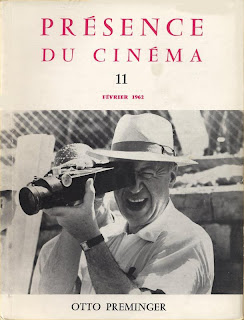 So much has been written about Otto Preminger that it seems foolish to reiterate what's already been stated many times over. Within immediate parameters, however, Steve Seid has synopsized: "As legend would have it, Otto Preminger was a bald-headed baddy scolding helpless actors about flaws in their performance—the tyrant on the set. But Preminger's films, some thirty-seven in all, bear no sign of this heated temperament, instead sharing a muted detachment that ironically excites our own engagement with his complex characters. …Preminger promoted a cool take on human nature that simultaneously savored cinema's expansive visual spaces; over time his eloquent way with the camera grew complex and sensuous. The willful director's insistence on artistic autonomy compelled him to become one of the first champions of independent film."
There are, of course, the career overviews offered by James Quandt, Thomas Gale, Jonathan Rosenbaum, Tag Gallagher and Chris Fujiwara. James Quandt cleverly finesses the alphabet to review Preminger's career from autocrat to Zanuck at the Cinémathèque Ontario website; Thomas Gale's entry on Preminger for The Encyclopedia of World Biography can be accessed at Highbeam Research Library; Jonathan Rosenbaum's essay "The Preminger Enigma" is at The Chicago Reader website; Tag Gallagher's Film International essay on Preminger's "heroic" films can also be accessed at Highbeam Research Library; and Chris Fujiwara's nuanced profile for the Great Directors database can be found at Senses of Cinema.
 Fujiwara, in fact, has provided the most recent biography on Preminger: The World and Its Double (Faber & Faber, 2008), published close on the heels of Foster Hirsch's own notable study Otto Preminger: The Man Who Would Be King (Knopf/Random House, 2007). Earlier, in his Film International DVD review "4 x Otto Preminger" (May 2004, Vol. 2, Issue 3), Fujiwara convincingly contested the oft-stated ascription of "film noir" to the suite of Preminger films that include Laura, Fallen Angel, Where The Sidewalk Ends, Whirlpool (1950), The Thirteenth Letter (1951), and Angel Face (1952). Fujiwara argued against this received wisdom: "It is pertinent to remember that Preminger repudiated this term, as far as his own work was concerned. Seeing these films as 'films noirs' is no more illuminating and no less destructive of any understanding of what the films are doing than seeing River of No Return (1954) as a Western; Carmen Jones (1954) as a musical; or In Harms Way (1965) as a war film. Preminger's films are absolutely heedless of genre, and Preminger never makes the slightest effort to adapt his style to generic norms."
Fujiwara further pointed out that films like Laura, Fallen Angel, and Whirlpool "depart radically from the 'film noir' pattern … characterized by scheming femmes fatales, trapped and desperate male protagonists, and unhappy endings."
Laura (1944)
 Dana Andrews—a popular leading man in the 1940s—has never been one of my favorite actors, though his brooding performance as the smitten detective Mark McPherson is unquestionably one of his best. In her profile of Andrews at Bright Lights Film Journal, Imogen Sarah Smith has written: "Dana Andrews, with his naturally tamped-down style and his gift for ambivalence, was an ideal leading man for Preminger. Apart from The Best Years of Our Lives, Andrews' four films with Preminger … were the peak of his career, and they gave him his most complex and compelling roles."
 In "Acting Like Children", his 1958 interview with the Columbia University Oral History Research Office, Andrews admitted: "People very often say to me that Laura was my first picture. Well, it's the first one they saw, which is why they think that." His recollections of the behind-the-scenes intrigues that shaped Laura—specifically his characterization of Detective McPherson—details how then-producer Preminger deviously wrested directorial control away from Rouben Mamoulian (the film's original director) by strategically aligning himself with studio head Darryl F. Zanuck. Andrews opines: "I think Mr. Preminger wanted to be a producer-director." Andrews also recounts how he and Preminger disagreed on a point of direction and stared each other down in stony silence for hours, "acting like children."
 Allegedly, Zanuck's dissatisfaction with Rouben Mamoulian's interpretation of Detective McPherson as an Ivy-league criminologist clashed with Zanuck's preference for a tough "right-down-the-alley type of detective" more familiar to audiences. Preminger's willingness to cater to Zanuck's vision on such a major issue distracted the studio head from his noted objection to the casting of Clifton Webb in the role of Waldo Lydecker. Andrews recollected that Laura was Webb's first motion picture. "He'd been under contract to MGM for 18 months and never done a foot of film—never had seen himself on the screen." According to David Boxwell at Bright Lights Film Journal, the homophobic Zanuck was initially displeased with Webb's portrayal of Lydecker as an effete and waspish socialite; however, Preminger convinced Zanuck that such effeminacy suited the character and provided comic contrast to the traditionally masculine Andrews.
 Originally, as Eddie Muller intimated in his Noir City introduction of Hangover Square (1945), Mamoulian had wanted Laird Cregar for the role of Lydecker; but, Preminger worried that Cregar—who had gained notoriety playing the sinister role of Jack the Ripper in The Lodger (1944)—would lead the audience to become suspicious of Lydecker earlier than necessary. When Cregar died of a heart attack after a drastic attempt to lose weight for the role, Preminger brought in Clifton Webb. It's now nearly inconceivable that anyone else could deliver Lydecker's vicious bon mots more stingingly, which to this day delight audiences with their unfettered bitchiness. "The voice alone would have carried the performance: the tone of a courtly buzz saw, the razor diction dining on consonants as if they were truffled squab," Richard Barrios has written in Screened Out: Playing Gay In Hollywood From Edison to Stonewall (Routledge, 2003:202).
Despite Lydecker's homosexuality having been removed from the script early on (though, as Barrios continues, "the rewritten character's bouts of hetero-jealousy [sit] oddly upon Webb's epicene deportment"), Clifton Webb's performance of Waldo Lydecker has gone down in cinema history as one of the great gay characters on film; the epitome of the "mannered, high-gloss style" that David Thomson pointedly identifies in his recent book The Moment of Psycho (Perseus Books 2009, p. 43) as a "code for homosexuality" in American films of the '30s, '40s and '50s.
 In retrospect, Preminger's direction of both Andrews and Webb—and the characterizations they finally settled upon—served to manifest a tension essential to Laura's suspense. As Imogen Sarah Smith has correctly perceived in her Bright Lights Film Journal profile: "Preminger was right about McPherson. Not playing him as hard-boiled not only destroys the comedy in his interactions with Laura's friends, it eliminates the tension within Mark's character as he begins to feel and behave in ways no one would expect of a standard-issue tough cop. Laura introduces the essential Dana Andrews character: the Average Joe with unexpected complications. It also demonstrates the Preminger Paradox: the director was a notorious tyrant, prone to tantrums and sadism often directed at the most vulnerable of his actors, yet the keynote of his films was tolerance for ambiguity. Ensembles in shades of gray, full of subtle, tamped-down performances, his films never turn on a simple axis of good and evil but listen to many voices and allow each some degree of persuasiveness."
 Smith evokes the "long, wordless sequence, followed by Preminger's fluidly tracking camera" wherein "McPherson prowls around Laura's apartment, ostensibly looking for clues but really indulging his insatiable desire for communion with the dead woman. Reading her letters and her private journal isn't enough; he opens her closets, fingers her silky handkerchiefs (obvious Hays Code stand-ins for her unmentionables), and sniffs her perfume. He doesn't linger over things sensually; he fidgets brusquely, irritated by his own romantic yearning. He heads for the liquor cabinet and gulps Scotch while gazing at Laura's portrait. He snarls at Waldo Lydecker, who hits the nail on the head when he sneers, 'I wonder you don't come here like a suitor with flowers and a box of candy.' Mark couldn't, or wouldn't, openly admit his own feelings: cops just don't find themselves in the grip of morbid, perfumed obsession with dames who have been bumped off. But he knows that Waldo is right, hence his seething, brooding restlessness. Alone again, he plants himself in front of the portrait and nurses a drink until he falls into a stupor."
 This pivotal scene—underscored by David Raskin's haunting theme (with belated lyrics by Johnny Mercer)—is seductive in its gravitational allure. It's one of my favorite scenes in Laura and one of my favorite scenes in film altogether. Rarely has desire for what is absent been so sensuously embodied in an imagined presence, save perhaps Portrait of Jennie (1948). It reminds me of what poet Mark Doty once wrote in his equally haunting study Still Life With Oysters and Lemon (Beacon Press 2001:3-4): "I have fallen in love with a painting. Though that phrase doesn't seem to suffice, not really—[rather, it's] that I have been drawn into the orbit of a painting, having allowed myself to be pulled into its sphere by casual attraction deepening to something more compelling. I have felt the energy and the life of the painting's will; I have been held there, instructed. And the overall effect, the result of looking and looking into its brimming surface as long as I could look, is love, by which I mean a sense of tenderness towards experience, of being held within an intimacy with the things of the world."
Cross-published on Twitch.
 It's clearly time to start brushing up on Angie Dickinson's career in anticipation of her on-stage appearance with the "Czar of Noir" Eddie Muller at the upcoming 10th edition of Noir City where 35mm prints of two of Dickinson's finest—The Killers (1964) and Point Blank (1967)—will be screened at the world's most popular film noir festival. Where best to start than with David Thomson's entry in The New Biographical Dictionary of Film, wherein he pointedly quips that one thousand words of analysis won't carry more weight than a well-chosen still. Good advice from an ardent admirer.
 Thomson likewise wrote a piece on Angie for GQ magazine back in October 2005 profiling Dickinson's career, confirming once and for all that it isn't just Nicole Kidman he has a "thing" for. "It wasn't that I necessarily thought she was a great actress," Thomson writes in his GQ piece, "just my favorite. You see, I had this notion that, as the years went by and you saw most of the movies that came along, you could enjoy the difference between someone who was plainly a Great Actress and someone you were simply glad to see, a woman you thought of as a pal—always effective, a reliable doll." His overview ends up being, admittedly, "not an essay on celebrity, so much as a reflection on fondness and how it can last." Thomson concludes: "No, she wasn't the greatest actress ever, just my favorite—which means that for a certain kind of movie dream, in the role of a woman as brave as she is gorgeous, as smart as she is funny, I never saw anyone better." (GQ, October 2005, pp. 126-134.)
 Of the two films screening at Noir City X, Thomson situates them within "a trio of terrific performances from the mid-Sixties", which includes The Chase (1966). Angie plays "the treacherous romantic lead in The Killers, a film where she is torn between John Cassavetes and Ronald Reagan, and in which Reagan slaps her in the face very hard." In the "extraordinary" Point Blank, Angie "is the ambivalent woman who elects to help Lee Marvin in his implacable attempt to recover $93,000 from the Mob. There are scenes in that film where she offers herself as bait to the villainous John Vernon that are hauntingly sexy. There's also a scene where she beats on the impassive Marvin and collapses in frustration as he hardly notices her."
 Then, of course, there is—perhaps—the "definitive" overview: Sam Kashner's piece for Vanity Fair ("A Legend With Legs"). If that isn't enough for you, revisit Dennis Cozzalio's April 2006 Angie Dickinson blogathon at Sergio Leone and the Infield Fly Rule.


